INTRODUCTION
Hydrobia ulvae (Pennant, 1777) is an intertidal snail that is very abundant in estuaries and coastal lagoons of the North Atlantic (Fretter & Graham, Reference Fretter and Graham1994). It is thought to feed preferably on microalgae present in the first few millimetres of the sediment (Fenchel et al., Reference Fenchel, Kofoed and Lappalainen1975; Levinton, Reference Levinton1979; Blanchard et al., Reference Blanchard, Guarini, Provot, Richard and Sauriau2000). Since feeding, resource allocation, predator avoidance and survival of extreme abiotic conditions in the temporally complex intertidal environment are keyed to locomotion and general dispersal mechanisms of individuals, behavioural reactions of the species have concentrated considerable interest.
Hydrobia ulvae displays a complex suite of behaviours. During low tide these snails can be seen crawling over the surface of damp sediment, or standing still on boulders, on the shoots of marsh plants and on any structure protruding above the sediment. This climbing behaviour has been shown to be related to feeding on the microalgae adhering to these surfaces (Barnes, Reference Barnes1981a, Reference Barnesb). Field observations also showed that H. ulvae is more active during the night than during daylight hours, and during high water than when exposed by the low tide (Barnes, Reference Barnes1986). When out of water over dry surfaces, however, H. ulvae does not move, withdrawing into the shell and sealing the aperture with mucus. A diel rhythm of feeding in natural conditions has been identified in a population continuously submerged during spring tides (Barnes, Reference Barnes2003). Feeding peaked around noon, which is opposite to the usual pattern of crawling activity, and was suggested to be related to the increase in the biomass and production of benthic microalgae during diurnal low tide. This in turn is related to the vertical migration of the microalgae along the first few millimetres of sediment exposing them to appropriate light conditions for photosynthesis (Serôdio & Catarino, Reference Serôdio and Catarino2000).
A recent study on the crawling activity of H. ulvae (Vieira et al., Reference Vieira, Coelho, Nolasco, Serôdio, Barnes and Queiroga2010) concluded that crawling is subjected to the control of an endogenous clock, because individual snails display an overt rhythm with a circatidal period when placed in the laboratory in constant conditions of darkness and immersion. The phase response curve to delays or advances in the start of immersion relative to the expected tide cycle suggested that immersion is a relative weak zeitgeber of the rhythm, because many snails were irresponsive to lags between start of immersion and expected time of high water. However, continuous immersion is not the usual situation in the natural intertidal environment of H. ulvae, where it is subjected to repeated cycles of immersion and emersion recurring at tidal frequencies. It is therefore likely that the synchronization, amplitude and overall level of the crawling behaviour are affected by the temporal pattern of inundation.
In this study we address the effect of a tidal cycle of alternating immersion and emersion on the entrainment of the crawling behaviour of H. ulvae in laboratory microcosms, relative to snails kept in continuous conditions of immersion and of emersion. Moreover, we compared the levels of activity in the microcosms with measurements of crawling velocity on the sediment surface, in an attempt to investigate the effect of the natural sediment and the food it contains on levels of crawling.
MATERIALS AND METHODS
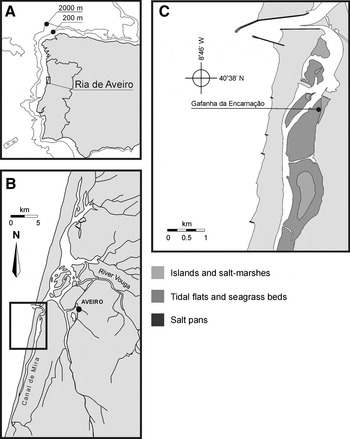
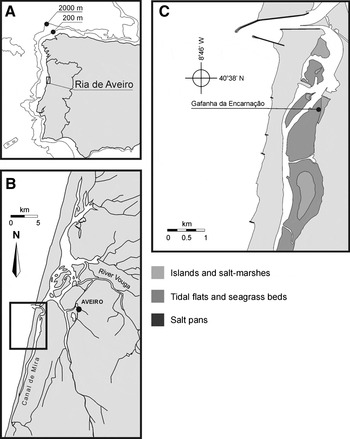
Hydrobia ulvae were collected on an intertidal mudflat in the Canal de Mira, Ria de Aveiro, at Gafanha da Encarnação (Figure 1). The Ria de Aveiro is a bar-built estuarine system located on the north-west coast of Portugal. It is formed by a complex dendritic pattern of channels characterized by the existence of important intertidal zones composed of mud flats, seagrass meadows and salt marshes. The tide in Ria de Aveiro is semidiurnal, with a mean tidal range of about 2 m (Dias, Reference Dias2001).
Map of the Ria de Aveiro, Portugal, with location of the sampling station.
Activity patterns in different immersion conditions
Samples of H. ulvae were collected during low tides. In the laboratory the snails were sieved from the sediment and the shell height was measured using a stereoscopic microscope. All experiments were conducted from June to September of 2007. We used a digital video system located in a constant-temperature laboratory (18°C) to record the movements of the snails. The system had six cameras (Allied Vision Technologies GMBH AVT-D2 FireWire) connected to a computer and controlled by dedicated software. Snails were recorded in dark constant conditions using infrared light provided by two Derwent Miniflood 100 led projectors equipped with low-pass 850 nm filters.
To subject the snails to different conditions of immersion we enclosed the animals individually in six microcosms formed by cylindrical acrylic chambers (internal diameter and height of 93 and 30 mm). Each chamber had a removable lid, inflow and outflow diametrically opposed holes in the bottom (3 mm in diameter), and a lateral overflow hole (1 mm in diameter) levelled to the top of the chamber and placed above the bottom outflow hole. All chambers were interlinked with silicone tubing and connected in parallel to two software-controlled peristaltic pumps (Cole-Parmer Instrument Company model no. 7550-030 equipped with MasterFlex® heads) through Tygon® tubes. One of the pumps was used to flood the chambers (through the bottom inflow hole) and the other to ebb them (through the outflow hole), with a period identical to that of the tidal cycle. One-way flow valves were appropriately placed in the in- and outflow tubes so that two of the chambers never filled with water (although a streamlet of water flowed from the in- to the outflow holes), two were always completely filled with water (excess water provided by the inflow pump discharging through the overflow at the top), and two simulated a tidal cycle of 6.2 hours of immersion and 6.2 hours of emersion. In order to facilitate water circulation between the in- and outflow holes in the chambers that never filled with water, all chambers were slightly tilted so that the bottom sloped downward to the outflow hole. By connecting all the chambers simultaneously to the pumps we ensured that a very slight vibration caused by the pumps affected all individuals equally, and that water renewal rate was identical in all immersion conditions.
Because our main goal was to investigate the influence of different immersion conditions on the timing, amplitude and level of the crawling activity we tried to keep any other source of perturbation as low as possible. To this end we started the experiments 1–2 hours after collection and we timed the period of the immersion/emersion cycle to that of the expected tidal cycle. Typically, we recorded batches of six snails from the same size-class (shell height >2 mm) for periods of 3 consecutive days, two snails randomly allocated to each of the three immersion conditions described above. The frequency of image acquisition was set to 1 per minute. The set of images obtained for each snail was analysed with Image-Pro® Plus 5.1 software, using the automatic tracking option of the Sequence module, after differencing consecutive frames. The tracks generated by the automated analysis were always reviewed in order to eliminate spurious tracks caused by shadows projected by the snails. The time-series of the distance travelled by the snails were prepared by averaging the data over 6 minute bins and by removing the trend. We recorded five batches of six snails but we had to discard two recordings because of camera malfunctioning. In total we obtained 3 days of records for nine snails subjected to continuous emersion, nine subjected to continuous immersion, and 10 subjected to a cycle of immersion/emersion. These groups of snails will hereafter be referred to as Emersed, Immersed and Tidal snails.
We used spectral analysis and autocorrelations (Chatfield, Reference Chatfield1996) in order to determine the presence of periodic patterns in crawling activity. Given that most snails that were not continuously emersed displayed an overt circatidal rhythm, the phase relationships between the expected tidal cycle and the crawling activity displayed by Immersed and Tidal snails were determined by estimating the average angle between the peaks in the time-series of individual activity and high water at the sampling site (Quinn & Keough, Reference Quinn and Keough2002). This was accomplished by converting time along the expected tidal cycle to an angle, with high water at 0o and low water at 180o. Since Emersed snails displayed very limited activity and usually stopped after a few hours we only calculated the mean angles for Immersed and Tidal snails, and compared them using a Mann–Whitney test (Quinn & Keough, Reference Quinn and Keough2002). Details on the time-series techniques for the identification of the cyclic components and their relationship to the expected tidal cycle can be found in Vieira et al. (Reference Vieira, Coelho, Nolasco, Serôdio, Barnes and Queiroga2010). Additionally, we computed the mean-hourly form-estimate for the different immersion conditions (Palmer, Reference Palmer1995).
The effects of different immersion conditions on the overall level of movement were analysed using one-way analyses of variance (ANOVAs), followed by Tukey's honestly significant difference post-hoc multiple-comparison tests, after checking the assumption of homogeneity of variances with a Cochran test (Quinn & Keough, Reference Quinn and Keough2002). Because the different observations made on the same individual are not independent, this analysis was made on the overall level of activity displayed by each individual, as calculated by taking the grand average of the 6-minute bins average. Moreover, given that the snails were not fed a decrease of levels of activity with time was expected, and the analysis was separately applied to data obtained during the first day and during the entire length of each run. Because of the lack of independence of the observations described above we did not attempt to compare statistically these two measures of activity level.
Distance moved by snails on the sediment surface
Attempts to measure the activity of the snails inside the microcosms in the presence of sediment and food from the natural environment failed because the water flow suspended the finer sediment particles, which adhered to the chambers' lids and prevented successful recording. In order to obtain a measure of activity of the snails on the sediment surface, cores of sediment (64 mm in diameter) were collected from the sampling site shortly before low water. In the laboratory they were covered with 2 cm of seawater and allowed to rest for 1 hour under ambient conditions. All dates coincided with neap tides and experiments were conducted on 26 July and on 3, 4 and 5 September 2007. Subjective tide conditions were 3 hours after low tide in July and around low tide in September. The surface of each core was observed under a binocular microscope and snail movement on the surface of the sediment was estimated in each core for a 5 minute period, by measuring the straight-line distance from the starting point of each snail to its finishing point 5 minutes later. After the measurements the total number of snails in each core was counted (snails on the sides of the corer above the sediment being discarded), by sieving the sediment with a 500 µm sieve.
A least squares linear regression of average velocity of the snails in each core against snail density in the core was adjusted to the data. Moreover, in order to compare velocity of the snails on the sediment to velocity displayed in the microcosms an equal number of observations on individual velocity was randomly selected from the experiments made during neap tides with Immersed snails, distributed along the subjective tidal cycle in a similar way as the observations made on the sediment surface. The two series of observations were compared with a Mann–Whitney test (Quinn & Keough, Reference Quinn and Keough2002).
RESULTS
Effect of immersion conditions on activity patterns
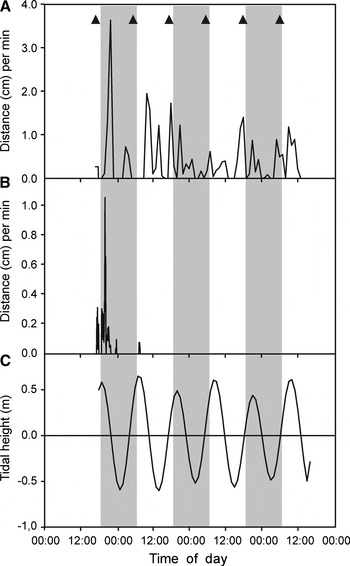
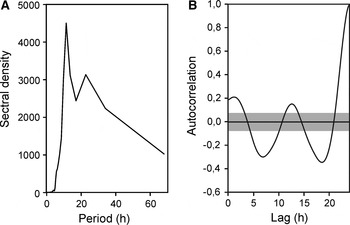
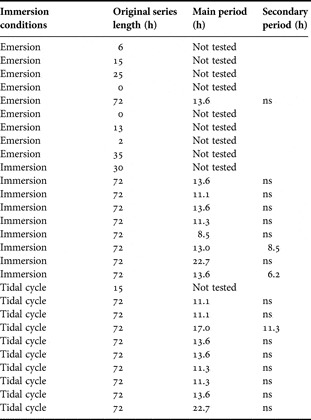
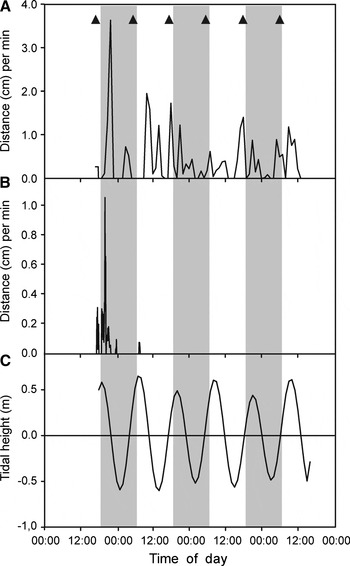
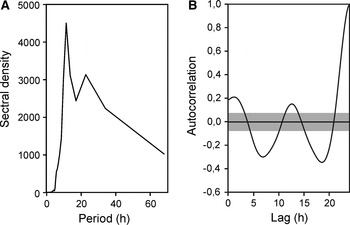
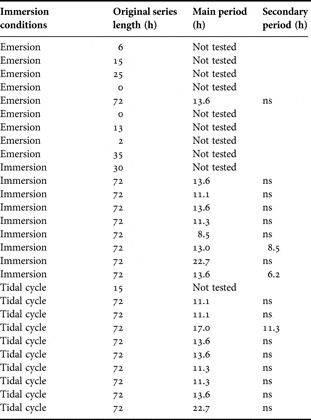
Of the 28 H. ulvae recorded two did not move at all and eight became inactive somewhere within the first 2 days of the experiments. All the others were active from the beginning to the end of the recordings (Table 1). Most snails that showed reduced levels of activity were Emersed snails. Immersed and Tidal snails displayed a crawling behaviour record with one clear periodic component, although a few also showed secondary periodic components. The main periods in the different immersion conditions simulated ranged from 8.5 to 22.7 hours, but most were concentrated from 11.3 to 13.6 hours and were related to the period of the tidal cycle (Table 1). Therefore, most snails exhibited an overt circatidal rhythm of crawling activity. Figure 2 shows examples of the time-series of the activity of one Tidal and one Emersed snail, as well as the tidal height at the sampling site. Figure 3 shows the periodogram and the autocorrelogram of the time-series in Figure 2A.
Hydrobia ulvae. Crawling activity of individual snails in dark conditions subjected to a cycle of immersion and emersion (A) and to continuous emersion (B) and tidal height at the collecting site (C). Black triangles at top represent expected high water time; grey bars represent night period.
Hydrobia ulvae. Periodogram (A) and autocorrelation (B) of the time-series in Figure 2 (A).
Hydrobia ulvae. Immersion conditions and period of the crawling rhythm of individual snails in dark constant conditions; h, hours; ns, significant period was not detected.
Activity levels decreased during the course of the experiments from 0.08, 0.41 and 0.36 cm min−1 recorded during the first day, to 0.05, 0.31 and 0.29 cm min−1 recorded during the 3 days of the recordings, in Emersed, Immersed and Tidal snails respectively. The ANOVA of the influence of immersion conditions on quantity of movement showed highly significant differences among immersion regimes after the first (Fs2,29 = 25.223, P ≪ 0.001) and the third (Fs2,29 = 19.515, P ≪ 0.001) days of the experiments. Post-hoc tests showed that overall levels of activity did not differ between Immersed and Tidal snails at the 5% significance level, neither after the first nor after the third day of experiment. As expected, levels of activity of Emersed snails were significantly different.
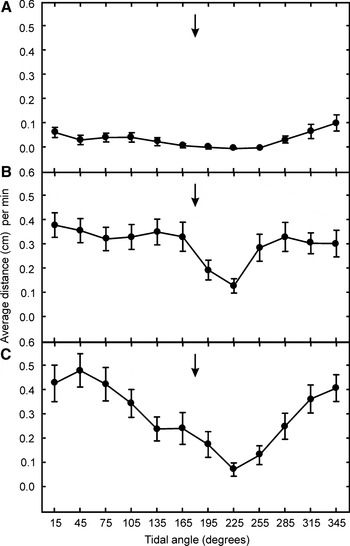
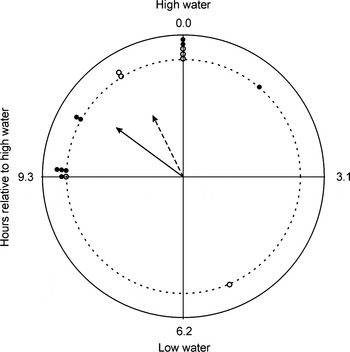
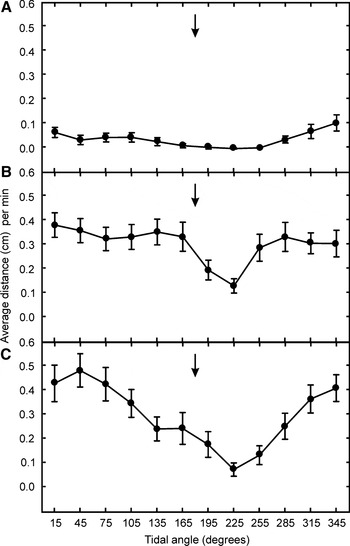
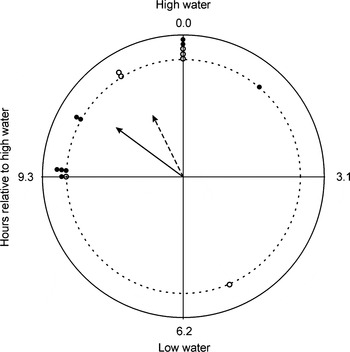
The form-estimate curves indicated higher levels of crawling activity around expected high water for all immersion conditions (Figure 4). Peak activity levels were centred around 11.6 hours (mean angle ā = 336°) and 10.6 hours (mean angle ā = 307° ) after expected high water in the case of Immersed and Tidal snails respectively (Figure 5), but this difference was not significant (Mann–Whitney U s 7, 9 = 22.500, P > 0.25). Although overall levels of activity and phase synchrony of the rhythm were identical in Immersed and Tidal snails, the shape of the form-estimates differed. Mean-hourly activity had higher amplitude in Tidal snails, reaching maximum levels ~1 hour after high water and minimum values ~2 hours after low water, while the form-estimate curve for Immersed snails was flatter and had a protracted period of high levels of activity around high water. This resulted in higher mean-hourly values of activity around high water in Tidal snails than in Immersed snails, but lower values around low water, with a significant negative cross-correlation of the difference of the two form-estimate curves at lag of 6 hours (r =–0.447, P < 0.05, N = 7). Therefore, exposing the snails to a cycle of immersion and emersion with a tidal period resulted in greater amplitude and higher synchronism of the tidally-timed crawling behaviour.
Hydrobia ulvae. Form-estimates of crawling activity of (A) Emersed, (B) Immersed and (C) Tidal snails recorded in microcosms. Expected high water in the field was set at 0o and expected low water (arrow) at 180o. Each 30-degrees interval represents 1.033 hours.
Hydrobia ulvae. Phase relationship between peak activity in dark conditions and the expected tidal cycle for Immersed (broken arrow, open dots) and Tidal (solid arrow, closed dots) snails. Each point represents the time lag between maximum crawling activity and expected high water, as determined by cross-correlation analyses. The dotted circle represents a correlation, r, of 1; the vectors are aligned to the mean angles ā = 24° and ā = 53°and have lengths (= correlations) of 0.59 and 0.71, for Immersed and Tidal snails respectively.
Distance moved by snails on the sediment surface
There was a significant linear effect of density (ind m−2) of H. ulvae on velocity (cm min−1) of individual snails within density values ranging from 8437 to 1875 ind m−2 (Velocity = 0.6331 – 0.00023 × Density, Fs1,2 = 41.736, P < 0.05, R2 = 0.95). The average distance travelled by the snails on the sediment surface, all densities comprised, was 0.50 cm (±0.031) per minute. This velocity was significantly higher (Mann–Whitney U s49,49 = 621, P < 0.001) than that estimated from an equal number of randomly selected observations (but following an identical distribution along the tidal cycle) made in the microcosms on Immersed snails, which was 0.30 cm (± 0.060) per minute.
DISCUSSION
Effect of immersion conditions on activity patterns
Individual H. ulvae subjected to continuous conditions of emersion displayed very low levels of crawling activity, contrasting markedly with those subjected to continuous immersion or to alternating periods of immersion and emersion. This effect of emersion is a typical feature in the behaviour of the species (Barnes, Reference Barnes1981a). Most snails that were continuously immersed or that were subjected to a cycle of immersion and emersion displayed an overt rhythm of crawling activity with a circatidal period. It is interesting to note that the only continuously emersed snail that remained active after 3 days also displayed a rhythmic behaviour. The activity levels of Immersed and Tidal snails, as well as their phase relationship to the subjective tidal cycle, were similar. However, the form-estimates of the rhythm differed, with higher amplitude and synchronism in the Tidal snails. Therefore, cycles of immersion alternating with emersion at tidal frequencies should contribute to a well-defined cyclic pattern of crawling activity in the natural environment.
Distance moved by snails on the sediment surface
The levels of activity displayed by individual H. ulvae over the sediment surface, measured as average velocity displayed by the snails, decreased linearly with snail density. We suggest that this density-dependent effect can be explained on the basis of inter-individual interference, similarly to findings made on Hydrobia ventrosa (Levinton, Reference Levinton1979). Moreover, a study of feeding of H. ulvae in laboratory microcosms provided with a layer of microalgae, demonstrated a decrease in ingestion rates with increasing density, which was explained by an increase in encounter rates (Blanchard et al., Reference Blanchard, Guarini, Provot, Richard and Sauriau2000).
The average levels of crawling activity measured in the sediment cores (0.50 cm min−1) were significantly different from those recorded in the microcosms for snails subjected to continuous immersion in the absence of food and interference (0.30 cm min−1). At minimum density, the level of activity in the cores was 0.61 cm min−1, while maximum levels recorded in the microcosms shortly after high water in Immersed snails were around 0.38 cm min−1. In order to eliminate any bias caused by the influence of the tidal phase on absolute activity levels, the observations compared were similarly distributed along the tidal cycle during low and mid-flood tides. In spite of this care the values cannot be directly compared because of two reasons. The first is that there should be a maximum limit for the crawling velocity of the snails beyond which any monotonic increase with decreasing density should breakdown, and it is not known whether the values measured at the lowest density are close to that limit. The second is that there is a decrease in activity levels with time in the starved snails kept in the microcosms, which likely has affected the average estimate. Nevertheless, the range of results obtained suggests that the measurements of activity levels made in the microcosm experiments are about half those displayed on the sediment surface. Behavioural patterns in H. ulvae are plastic and can be modified by external factors. For instance, artificial light/dark cycles can entrain a diel rhythm in activity (Barnes, Reference Barnes1986) and exposure to dry conditions inhibits crawling (Barnes, Reference Barnes1981a). Additionally, the highest intensities of feeding around noon in the natural environment detected in a Norfolk population (Barnes, Reference Barnes2003) may be linked to the local conditions. This population remains continuously submerged for several days during spring tides because of damming caused by a shingle bank and, in these circumstances, it would be advantageous to time feeding for the period when benthic microalgae are more abundant at the surface. Therefore, it is possible that the absence of sediment and of the food it contains in the experiments reported in the present study might reduce crawling activity relative to the natural environment.
Based on the present results we conclude that cycles of immersion and emersion are a powerful synchronizer factor of the crawling rhythm of H. ulvae, and we predict that in the natural intertidal environment the species should display a clear cyclic pattern of crawling with higher levels of activity around high water.
ACKNOWLEDGEMENTS
S.V. (BenthicLink Research Assistant grant) and H.C. (PhD grant SFRH/BD/23720/2005) were supported by Fundação para a Ciência e Tecnologia (FCT). This study is part of ‘BenthicLink—Trophic links regulated by tidal and daily rhythms: benthic microflora and fauna in estuaries’ research project, funded by FCT (POCI/BIA-BDE/61977/2004). Financial support was allocated by FCT under the Support Community Framework III, Operational Programme Science, Technology and Innovation.