Holocaust survivors (HS) and their offspring (HSO) represent a unique population for investigating the long-term effects of trauma. They are generally stable, well-educated people with medium to high socioeconomic status (SES), and therefore risk factors are likely to be largely confined to the variables associated with parental exposure to the trauma or parental symptoms following exposure (Yehuda, Halligan, & Grossman, 2001). Whereas extensive research has been conducted with second-generation HSO, only sparse literature exists regarding the third generation. This study examined the long-term effects of extreme war-related trauma, looking at the second and the third generation of HS. Specifically, this study investigated whether HSO mothers, namely, the second generation, differed from a comparison group in their psychological distress, and parenting representations. In addition, the study examined whether grandchildren of HS (the third generation) differed from a comparison group in their psychosocial functioning during their senior high school year and in their coping and adjustment to the leaving-home experience. Incorporating models of developmental psychopathology, the study also explored the associations between the extent of Holocaust experience in the family (one parent was HSO or both parents were HSO) and the psychosocial functioning of the second and the third generations. Finally, the role of parenting variables as a mechanism underlying the association across generations within different family contexts of risk was explored.
HSO
Being an extreme and extended traumatic experience, the Holocaust carved vivid marks of maladjustment into the lives of HS. These survivors proved to be a risk group for emotional disorders and adjustment problems, including chronic anxiety and depression (Niederland, 1968), posttraumatic stress disorder (Kellerman, 2001b), psychosomatic disorders (Gampel, 1988), low self-esteem (Kestenberg, 1982), as well as difficulties in creating and maintaining close or intimate relationships (Gampel, 1988) and in feeling genuine pleasure. However, highlighting human resilience, other scholars documented that many HS adapted successfully to their environment, ran creative lives, and successfully accomplished a variety of psychosocial tasks (Krell, 1993; Leon, Butcher, Kleinman, Goldberg, & Almagor, 1981).
Trauma may also affect people who are in close contact with trauma survivors, and this indirect psychological impact has been termed secondary traumatization (Figley, 1993; Solomon, 1995). Two explanations were offered for its occurrence. First, close and continued contact with a person who experienced severe trauma may operate as a chronic stressor that leads over time to somatic and mental detriment. Second, identification with a traumatized person might lead to internalization of the stressor imagery, and eventually to acting and feeling in a like manner (Solomon, Waysman, Levy, & Fried, 1992; Waysman, Mikulincer, Solomon, & Weisenberg, 1993).
With regard to the Holocaust experience, specific mechanisms have been suggested as propagating the transmission of the effects of trauma from the first generation of HS to the second. The extreme traumatization that HS experienced might have impaired their capacity for parenting (Felsen, 1998). According to attachment theory, parents who are overwhelmed by traumatic memories associated with past abuse or with the death of significant others may display an anxiety that could, in turn, be frightening and incomprehensible to the child, given its internal source in the parent's past experiences (Main & Hesse, 1990). Lyons-Ruth and Block (1996) suggested that parents' attempts to defend themselves against reexperiencing painful fear, helplessness, and rage related to earlier traumas result in parental emotional and physical withdrawal from, or a hostile stance toward the child. The parents' frightened or frightening behavior, and the failure to maintain an adequate level of responsiveness toward the child, may leave him or her feeling unprotected and frightened.
In line with this suggestion, a recent study with a US sample demonstrated that adult offspring of HS reported higher levels of childhood trauma, particularly emotional abuse and neglect, than comparison participants (Yehuda et al., 2001). It was suggested that this emotional abuse resulted from parents' minimization of their children's experiences by placing their difficulties in the perspective of their own trauma. Nevertheless, this behavior was perceived as invalidating, and induced guilt in the children for bothering a suffering parent with inconsequential concerns. Ancharoff, Munroe, and Fisher (1998) suggested other possible mechanisms. Silence of family members in an attempt to avoid issues that might trigger distress (Bar-On, 1995), and conversely overdisclosure, might terrify children, especially when communicated in a flat or nonmodulate associate affect. Identifying with their parents, offspring may learn to manifest similar hypervigilance, believing there are dangers in the world, and therefore they should constantly be on guard. Reenactments of trauma-related affective experiences transmit trauma by engaging offspring in scenarios that are thematically reminiscent of their parents' trauma. Family theorists have described these processes as the presence of the past, not just the influence of the past (Bowen, 1972; Friedman, 1991), or the existence of a “legacy” which impinges on the offspring (Boszormenyi-Nagy & Spark, 1973).
In line with these suggestions in an extensive review of research conducted in North America, Felsen (1998) referred to cumulative evidence of differences in the psychological makeup of HSO and controls, albeit within the normative range of psychological functioning. Compared with controls, groups of HSO showed a tendency to experience depressive symptoms, mistrustfulness, heightened anxiety, and difficulties in expressing emotions accompanied by difficulties in the regulation of aggression, stronger feelings of guilt and self-criticism, and higher prevalence of psychosomatic complaints. Reviewing research with HSO in Israel, Solomon (1998) presented a more positive picture, and concluded that the second generation in Israel were no more prone to psychopathology than comparable control individuals (Keinan, Mikulincer, & Rybnicki, 1988), although they suffered from discrete intrapsychic difficulties such as greater self-criticism (Felsen & Erlich, 1990), higher levels of guilt feelings, and difficulties in expression of aggression (Nadler, Kav Venaki, & Gleitman, 1985). Others highlighted the resilience point of view (Yuchtmann-Yaar & Menachem, 1992) indicated that HSO had achieved greater socioeconomic success than a comparison group, and demonstrated high levels of daily functioning and ability to deal with stressful life events. Further, in a recent meta-analysis, no evidence for secondary traumatization was found, except in studies with clinical participants who experience other stresses (van IJzendoorn, Bakermans-Kranenburg, & Sagi-Schwartz, 2003). Thus, a varied picture regarding the functioning of HSO was observed: general positive functioning of HSO compared to controls on the one hand and some vulnerabilities, which were nevertheless within the normal range of functioning on the other hand. In line with this mixed profile it was argued that although HSO function well, they might be at increased risk especially following stressful events that could expose their latent vulnerability (Dasberg, 1987; Yehuda, Schmeidler, Wainberg, Binder-Brynes, & Duvdevani, 1998).
In light of their own experiences with their parents, the parenting of HSO themselves was also assumed to be a complex task (Felsen, 1998; Haas, 1990; Solomon, 1998). For example, although the maternal self-image of 34 daughters of HS did not differ from that of a comparison group (N = 31), they showed higher levels of anxiety, more suffering, less satisfaction, and less flexibility in responsiveness toward their own children, the third generation (Marcus, 1986). HSO were described as committed and dedicated to the new families they created, but this commitment was often accompanied by high levels of tension and difficulties (Shafat, 1994). These formulations were not confirmed in a recent study (Sagi-Schwartz et al., 2003). HSO women (N = 48) did not differ from the comparison group (N = 50) in their state of mind with regard to attachment or in their maternal behavior with their infants. The researchers did not find intergenerational transmission of disorganized attachment or traumatic stress symptoms, and they concluded that the impact of the Holocaust was restricted to the generation of survivors.
In sum, various theories and conceptualizations suggest that HS trauma might exert enduring effects of secondary traumatization on their offspring. Sometimes this leaves HSO with higher levels of psychological distress and with difficulties in parenting their own children. Still, not all empirical studies have confirmed these claims.
Third Generation
The literature on the third generation of HS is sparse. These few studies, which mainly examined indicators of psychopathology among the third generation, mostly with young children, presented an equivocal picture with regard to the long-term effects of the trauma. As for vulnerability, grandchildren of survivors were found to be overrepresented by 300% in a child psychiatry clinic population (Sigal, DiNicola, & Buonvino, 1988). Rubinstein, Cutter, and Templer (1990) recruited 40 families of HSO (acknowledging the high refusal rate among those contacted) and 11 controls (contacted through referral of the target participants). They found that parents and teachers identified higher levels of fear, neurotic behavior, aggression, social withdrawal, and inhibition in the third generation of survivors (ages = 4–13 years) than in controls. Felsen (1998) cited a 1996 study by Jurkowitz who examined 91 survivors, their children, and grandchildren, and found evidence of transmission of depression, guilt, and shame down three generations.
Other studies yielded different findings. In a community study, 70 young children of HSO were reported by their parents as higher in self-esteem and coping, and lower in behaviors indicative of severe psychopathology than were the 48 children of the comparison group (Sigal & Weinfeld, 1989). The researchers suggested that the superior psychological functioning was probably the outcome of their parents' and grandparents' investment in them because they represented hope for rebirth. Another study (Bachar, Cale, Eisenberg, & Dasberg, 1994) employed a projective test to assess aggression in reaction to frustrating events among 54 grandchildren of HS (mean age = 10 years). The researchers found that the third generation did not differ from a comparison group (N = 43) in their expression of aggression, although boys showed a tendency to be more aggressive than controls. The authors suggested that these results might indicate that the transmission of trauma had ceased by the third generation.
The Present Study
The different studies outlined above regarding HSO and their offspring have yielded discrepant findings. It has been suggested that one of the reasons might be that the assumption of pathology affected the selection and the definition of research questions and the choice of measures, and colored the interpretation of the findings (Solomon, 1998). Many studies of Holocaust effects were based on nonrandom, partial, or self-referred samples (Felsen, 1998; but see, e.g., Sagi-Schwartz et al., 2003). The present study, which is not “typical” trauma-related research, might offset some of these shortcomings.
The main focus of the original research project (Mayseless & Scharf, 2001a; Mayseless, Scharf, & Solt, 2003; Scharf & Mayseless, 2001; Scharf, Mayseless, & Kivenson-Baron, 2004) was to examine parent–adolescent son relationships in a middle-class sample in Israel, in particular, the normative developmental transition of leaving home in Israel. In this country the great majority of the 18-year-old cohort of Jewish men (85%) leave their parents' home for a period of 3 years' mandatory service in the Israel Defense Forces (IDF). We focused on the developmental trajectories of male adolescents, which might be different from those of females (Josselson, 1987). Because of logistic considerations we were constrained in the number of families we could include. To meet statistical power considerations, we decided to focus on males only rather than split the sample into two smaller groups of males and females.
As part of the demographic questionnaire, information provided by parents included their Holocaust background. This enabled us to examine differences between groups of participants based on this aspect, without presenting the Holocaust as a central theme of the research. Thus, participants' inclination to take part in the study was not related to their Holocaust background, and this subject was never specifically mentioned. It probably did not color, at least not directly, their answers, by their trying to convey a positive picture through stressing the lack of impact of the Holocaust, or by their trying to demonstrate its adverse influences. In addition, our study benefited from the special nature of the sample (well-educated, stable middle class), which made it possible to examine risk factors that were largely confined to the Holocaust trauma. Finally, the utilization of the original data facilitated the exploration of the long-term effects of the Holocaust trauma, on the second and the third generation not only in pathology-related outcomes.
Vulnerability and protective processes are assumed to operate at “turning points” in people's lives rather than to reflect long-standing attributes (Rutter, 1987). Previous studies of the third generation focused mainly on children and infants. This study looked at the psychosocial adjustment of the third generation during adolescence, a developmental period that presents several challenges such as coping with separation and individuation (Holmbeck & Leake, 1999; Steinberg, 1990). In this respect late adolescence might be a key turning point because of the challenges embedded in the leaving-home transition, which in many Western countries is considered a major developmental task and part of the individuation process (Garber & Dubas, 1996). In this study the leaving-home transition involved starting mandatory military service, in which the adolescents had to adjust to the harsh demands of basic training and to cope with these challenges away from home and without the availability of previous supportive relationships. This transition might therefore provide an opportunity to observe the operation of both vulnerability and protective processes.
The effects of risk factors on the individual's development may not be straightforward. Models of developmental psychopathology (Cicchetti & Toth, 1995; Cummings, Davies, & Campbell, 2000) emphasize that exposure to a manageable degree of stress and handling it successfully may actually strengthen individuals' coping with future misfortune (by “steeling” them to it) (Cummings et al., 2000; Rutter, 1987). Similarly, protective factors might promote positive outcomes in the face of adversity. Availability of close and supportive relationships, successful task accomplishments, authoritative parenting, and parents' postsecondary education are among the various protective factors that have been identified (Masten & Reed, 2003; Rutter, 1987). Yet, although the negative effects of one risk factor may be offset by protective factors, the co-occurrence of two or more risk factors (synergistic, or multiplicative, models) might induce a more harmful impact than the sum of the factors taken in isolation (Rutter, 1983; Cummings et al., 2000). Thus, a range of models of risk and resiliency may operate within various familial and environmental contexts.
The inconsistency found in earlier studies with second and third generation HS might also be attributable to their failure to capture one aspect of such variability in the family context, namely, the degree of Holocaust presence in the family. The marriage of two HSO could incur cumulative stress in both partners, which subsequently might impact on their children (reflecting the operation of the cumulative risk model; Masten & Reed, 2003). By contrast, marrying a non-HSO might serve as a protective factor for the HSO spouse. Applying developmental psychopathology models, we could explore the effects of variability in Holocaust presence in the family on psychosocial functioning. Is psychosocial functioning in families where one parent is HSO poorer than in families with no Holocaust background (general risk model)? Do families where both parents are HSO function even worse because of additive risk? Or is the functioning of families with both-parents HSO worse than the summed diminished functioning perhaps evident in families where one parent is HSO (synergic/multiplicative models)? Finally, we might also observe protective or steeling factors, where families with one-parent HSO actually function better than non-HSO families. Each of these possibilities was explored in the present study. In addition, in line with previous suggestions that trauma affects the next generation through its interference with the quality of parenting (Felsen, 1998) the possibility that quality of parenting experienced by the third generation mediates the association across generations was also explored.
Method
Sample
The study reported here is part of a longitudinal project examining parent–adolescent son relationships in Israel during late adolescence and young adulthood (Mayseless & Scharf, 2001a; Mayseless et al., 2003; Scharf & Mayseless, 2001; Scharf et al., 2004). Participants in the study were identified and recruited from published lists of high-school seniors in metropolitan middle-class neighborhoods in the northern part of Israel. All the families with an adolescent son on these lists, which covered all the high schools in these neighborhoods, were contacted by mail and then by phone. They were informed about the research, and after screening out of families that did not meet the research requirements (i.e., nonintact families; recent immigration to Israel; son's conscription was deferred) the remainder were asked for their cooperation. The choice of participants was limited to intact families that had not immigrated recently to Israel (i.e., families for whom life had been fairly stable) so as to avoid diverse sources of variation. This constraint did not result in a highly skewed sample because divorce rates in Israel are much lower than in the United States (8.5% according to the Statistical Abstract of Israel, Central Bureau of Statistics, 1996), and because in these neighborhoods new immigrants comprise only 5% of the population (Central Bureau of Statistics, 1996). Deferment of military service occurred because IDF authorities distribute the conscription dates throughout the year according to the adolescents' age. Because of time constraints on the research project we included only families in which the son's conscription was due within a year following the first assessment.
The active consent of all three family members concerned (father, mother, and son) was required for a family to be included in the study. Participants did not receive any payment, only small gifts for their participation. As the current study required an investment of several hours by each family member, most families who declined to participate did so because of pressure of time. The final sample included 88 families, which reflected consent by 41% of eligible families. In Israel, parental level of education, density of living quarters, and neighborhoods are considered better indices of SES than income (Dar & Resh, 1990). In addition families of Western origin (Europe or North America) are more prevalent in high SES levels. In line with the prevailing characteristics of the middle-class neighborhoods from which they were sampled, the families in our sample were primarily well educated (80% of the fathers and 74% of the mothers had at least a college education), 70% of the families were of Western origin, and their living quarters were of moderately low density.
At the time of the first assessment adolescents' ages ranged from 17 to 18 years. The number of children in these families varied between 2 and 5, with a mean of 2.93 (SD = 0.74). About one-third of the adolescents (37%) were first-born children. About 70% of the families described themselves as secular, the remainder as upholding the Jewish religious tradition but not in an orthodox manner.
From their demographic background we identified mothers with Holocaust background for whom at least one parent was a Holocaust survivor, and fathers with a Holocaust background. Accordingly, four groups with different Holocaust background were constructed: both parents were HSO (n = 17; two fathers in this group were first-generation HS, and were therefore excluded from the analyses), mother alone was second-generation HSO (n = 17), father alone was second-generation HSO (n = 13), and parents had no Holocaust experience in their families (n = 32). Seven families did not submit information on the Holocaust experience and were not included in the analyses. The groups did not differ in any of the background variables.
Procedure
The parents and their adolescent sons were interviewed and filled out the questionnaires during the sons' senior year at high school, approximately a year prior to their conscription. Halfway through the basic training period (approximately 5 weeks after conscription) during a weekend vacation, 84 of the adolescents filled out questionnaires regarding their coping with this transition. They were also asked to provide the names of two peers (friends from their basic training unit who knew them well), who were contacted by the research team and who rated the respondents' coping and adjustment by means of a phone interview. Logistical problems prevented us from gathering peers' data for more than a subsample of the adolescents (n = 64). This subsample did not differ from the rest, for whom peers' reports were not available, on any of the background variables or the measures employed in this study.
Measures
Second-generation measures
Mothers' psychological distress
The Brief Symptom Inventory (BSI: Derogatis & Spencer, 1982) is a 53-item self-report used extensively to assess global psychological distress. The measure includes nine specific subscales: somatization, obsessive–compulsive, interpersonal sensitivity, depression, anxiety, hostility, phobic anxiety, paranoid ideation, and psychoticism. Mothers indicated the severity of psychological symptoms during the foregoing month on a 5-point scale. A general BSI score was computed by averaging across all the items (Cronbach α = .95).
Parenting representations
Parenting representations were assessed by the Parenting Representations Interview—Adolescence (Scharf & Mayseless, 1997/2000). This is a semistructured interview designed to arouse memories and emotions regarding parenting experiences with adolescent children. In this version (1997) parents were requested to give a general description of their relationships with their children and to support this description with specific incidents from childhood and adolescence. The interview included questions regarding experiences of closeness, pain, guilt, anger, worry, discipline, children's increasing autonomy, and the way parents deal with these situations. In addition, the parents were requested to describe how they saw their child in the future and to describe their imagined future relationship with him. Interviews were audiotaped and then transcribed verbatim.
Based on the transcripts several scales were coded using a 5-point Likert scale, relating to three basic aspects: (a) Representations of the parent, consisting of two scales (r = .60): parental competence, meaning the extent to which the parent has realistic confidence with regard to his/her capacity to handle effectively various parenting situations including general difficulties and daily demands and activities; and self-understanding, meaning the extent to which attributions of the causes of the self actions, thoughts, and feelings are logical, accurate, complex, and reflective. (b) Representations of the child, consisting of three scales (r = .45–.57): trust/confidence in child's capacities, meaning the extent to which the parent has realistic confidence with regard to the child's coping capabilities in different contexts; child's understanding, which measures the extent to which attributions of the causes of the child's actions, thoughts, and feelings are logical, accurate, complex, and reflective; and perception of the child in the future, which assesses the richness of the description of the child in the future as reflecting the parent's thoroughly knowing his/her child. (c) Representations of the relationships, including four scales (r = .52–.72): warmth and affect, being the extent to which the parent describes his/her relationship with the child positively in terms of feelings of acceptance, joy, pleasure, pride, warmth, and affection; mutuality, which assesses mutuality and reciprocity in the relationship, as well as flexibility and openness, readiness for negotiation, adequate partnership in responsibility and decisions, and open communication between the child and the parent; monitoring, being the extent to which the parent exerts behavioral control over his/her child, knows where the child spends his/her free time and his/her friends, and is aware of his/her functioning in school and other settings; nature of future relationships with the child is the extent to which the parent shows positive perception of the future relationship based appropriately on current descriptions.
Twenty interviews were coded by two coders. Interjudge reliability of the scales (intraclass correlations) was high, from .78 to .96. The scales were significantly correlated with concurrent measures of the mother–son relationships, and with the current socioemotional functioning of the adolescent. Mother's representations predicted her son's adaptation to the first phase of military service (Mayseless & Scharf, 2001b, 2002). For data reduction purposes and because of the moderate intercorrelations among the scales one global scale for mothers' representations was constructed (Cronbach α = .92).
Third-generation measures
Relationships with parents
The Mother–Father–Peer (MFP) Scale (Epstein, 1983) was applied to assess adolescents' perceptions of their childhood relationships with each parent. Because of time constraints a slightly shorter version of two scales of the original inventory was employed: parental acceptance/rejection (8 of the original 10 items, e.g., “My father/mother could always be depended upon when I really needed his/her help and trust”) and parental independence encouragement versus overprotection (9 of the original 13 items, e.g., “My father/mother encouraged me to make my own decisions”). The inventory has shown good reliability and was validated against several other measures of parenting (Crowell, Treboux, & Waters, 1999; Ricks, 1985). Internal reliabilities for mother and father were α = .82 and .80 for acceptance and α = .71 and .71 for independence encouragement, respectively. For data reduction purposes one scale for both parents was constructed averaging across the acceptance and the independence encouragement scales. Correlations among the scales were moderately high (r = .45–.58).
The Attachment Style Questionnaire was used to assess adolescents' attachment style. It is based on Hazan and Shaver's (1987) descriptions of how people typically feel in close relationships in general, and these relationships may include romantic partners as well as friends. Attachment styles are only modestly associated with attachment relationships with parents, and they seem to assess a somewhat different construct (Crowell et al., 1999). Participants were asked to rate the extent to which each of the 15 statements (Mikulincer & Nachshon, 1991) applied to them on a 7-point scale ranging from 1 = not at all to 7 = very much. Three scales were constructed: secure style (“I find it relatively easy to get close to others”); avoidant style (“I am somewhat uncomfortable being close to others”), and ambivalent style (“I find that others are reluctant to get as close as I would like”). Internal reliabilities were .61, .66, and .62, respectively. The correlation between the secure and avoidant attachment styles was −.71; therefore, one scale was constructed averaging the two scores after reversing the secure one. The ambivalent style scale was only weakly correlated with the secure–avoidant aggregate scale (.18).
Self-variables
Two scales from the Weinberger Adjustment Inventory (WAI; Feldman & Weinberger, 1994) and the Personal Control Scale (Paulhus, 1983) were used to capture the adolescent's general feelings regarding himself. The WAI has good internal reliability and concurrent and predictive validity (e.g., D'Angelo, Weinberger, & Feldman, 1995). For both self-esteem from the WAI (7 items, e.g., “I usually feel that I'm the kind of person I want to be,” α = .73) and well-being from the WAI (7 items, e.g., “I enjoy most of the things I do during the week,” α = .87) higher scores denote higher self-esteem and higher well-being, respectively. In addition, the Personal Control Scale from the Spheres of Control Questionnaire (Paulhus, 1983) was used to assess internal locus of control. Participants were asked to rate on a seven-point scale the extent to which a statement described them (10 items, e.g., “My major accomplishments are entirely because of hard work and intelligence”). The reliability and the convergent and discriminant validity of the scale have been demonstrated (for a detailed description see Robinson, Shaver, & Wrightsman, 1991). Internal reliability in the present study was moderate, α = .61. For data reduction purposes one scale denoting positive self-perception was constructed averaging across the three scales (correlations between the scales = .41–.63).
Functioning during basic training
Adolescents' report
Level of distress was assessed by nine items from the Mental Health Inventory (Veit & Ware, 1983; e.g., feeling depressed, lonely, nervous, anxious, or in control). Adolescents were asked to answer each item using a 1 (never) to 6 (all the time) scale, in reference to their feelings in military service during the previous 2 weeks (α = .76). The measure has shown high internal reliability and good test–retest reliability, as well as construct and discriminant validity (e.g., Florian & Drory, 1990).
Ways of coping (Folkman & Lazarus, 1980) measures the cognitive and behavioral strategies that people use in coping with stressful situations. Participants were asked to indicate on a 1 (not at all) to 5 (to a very large extent) scale the extent to which they employed each of these strategies during their basic training. Two scales were included: problem-focused coping (six items, e.g., “I concentrated only on what should be done immediately”) and emotion-focused coping (eight items, e.g., “I wished that I could change what was happening or how I felt”). Internal reliabilities were α = .53 and .75, respectively. The problem-focused coping scale of this version (community version) has typically low internal reliabilities (Folkman & Lazarus, 1985), probably because the items reflect different coping efforts, which may be somewhat mutually exclusive. (For a similar point, see Carver, Scheier, & Weintraub, 1989.) Results from our project and others attest to the validity of the scale despite its low internal reliability. For example, Mikulincer and Florian (1995) found the same scale to be positively associated with support seeking and secondary appraisal. In our study as well (Scharf et al., 2004), this scale was significantly associated with higher levels of self-esteem and internal locus of control, and with lower levels of distress. For data reduction purposes one scale was constructed averaging across the distress and emotion-focused coping scales (r = .51 between the scales).
Peers' report
Peers' appraisal of adjustment questionnaire was designed to assess adjustment and coping by different observers (Catz & Orbach, 1990). The questionnaire included dimensions that tapped the peers' evaluations of the IDF recruit's adjustment. Two peers from basic training were asked to answer these questions using a 1 (not at all) to 5 (very much) Likert scale. The mean of their answers to two scales was computed: distress, namely, how stressed the focal adolescent was, for example, “How difficult is basic training for him?” (three items, α = .86); instrumental and social functioning, namely, how successfully he coped with the basic training demands, for example, “To what extent does he have discipline problems?,” “To what extent is he socially accepted?” (six items, α = .82). The correlations between the two peers for the separate items ranged from .22 to .62 (mean r = ∼.40). Intraclass correlations between the two raters were .75 for distress and .61 for instrumental and social functioning scales. For data reduction purposes a new scale reflecting good adjustment was computed by averaging across the scores of the two scales after reversing the distress scale (r = −.45).
Results
Second generation
Mothers' psychological distress
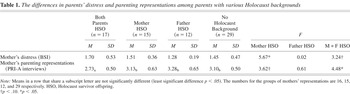
A 2 (Mother HSO, Mother Not an HSO) × 2 (Father HSO, Father Not an HSO) analysis of variance (ANOVA) was performed with psychological distress (BSI total score) serving as the dependent variable (see Table 1). Mothers' Holocaust background was significant, F (1, 78) = 5.67, p < .05, η2 = .07, observed power = .65, whereas fathers' Holocaust background and the interaction effect were not significant, F (1, 78) = 0.02, p < .90, η2 = .00, observed power = .05 and F (1, 78) = 3.24, p < .08, η2 = .04, observed power = .43, respectively. Mothers with Holocaust background showed a higher level of distress (M = 1.60, SD = 0.45) than mothers with no Holocaust background (M = 1.40, SD = 0.41; see also Table 1).
The differences in parents' distress and parenting representations among parents with various Holocaust backgrounds

Mothers' parenting representations
A 2 × 2 ANOVA was conducted with Holocaust background (mother HSO, father HSO) serving as the independent variables and mother's parenting representations (as assessed from mothers' interviews) serving as the dependent variables. The main effect for mothers' and fathers' Holocaust background was not significant, F (1, 72) = 3.72, p < .06, η2 = .05, power = .47, F (1, 72) = 0.61, p < .44, η2 = .01, power = .12, respectively, whereas the interaction was significant, F (1, 72) = 4.48, p < .05, η2 = .06, power = .55. The interaction effect was analyzed using a simple main effects analysis (pairwise comparisons using the least significant difference [LSD] adjustment for multiple comparisons). The comparisons showed that when both parents were HSO, mothers' parenting representations were more negative than were those in the other groups (see Table 1).
Third generation
Adolescents' relationship with parents
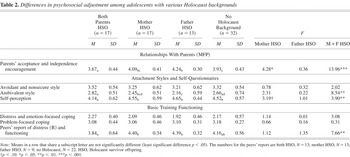
The ANOVA conducted with adolescents' perceptions regarding their relationship with their parents (MFP Questionnaire) revealed significant mother Holocaust background effects, F (1, 75) = 4.28, p < .05, η2 = .05, power = .53, nonsignificant father Holocaust background effects, F (1, 75) = 0.36, p < .55, η2 = .01, power = .09, and a significant interaction effect, F (1, 75) = 13.96, p < .001, η2 = .16, power = .96. As can be seen in Table 2, simple main effects analysis (pairwise comparisons using the LSD adjustment) indicated that parents from the both-parents HSO group were perceived by their sons as less accepting and encouraging of independence than were their counterparts. In addition, relationships with parents were perceived more positively by adolescents from the father HSO group than by adolescents with no Holocaust background. (See Table 2 for means and results of pairwise comparisons.) In sum, in line with the multiplicative model, parents from the both-parents HSO group were perceived less favorably than others with regard to their parenting, and in line with the notion of steeling effect, parents from the father HSO group were perceived more favorably than parents with no holocaust background.
Differences in psychosocial adjustment among adolescents with various Holocaust backgrounds

Adolescents' attachment style and self-perception
The multivariate ANOVA (MANOVA) conducted to examine adolescents' attachment styles and self-perceptions as reported via a questionnaire revealed no significant main effects, (F (3, 73) = 1.31, p = .28, η2 = .05, power = .34, F (3, 73) = 0.60, p = .62, η2 = .02, power = .17, for mother and father Holocaust background, respectively). However, the interaction effect was significant, F (3, 73) = 3.25, p < .05, η2 = .12, power = .72. Follow-up ANOVAs indicated two significant interaction effects for the ambivalent attachment style and for self-perception. Simple main effect analysis (pairwise comparisons using the LSD adjustment) showed that adolescents with both-parents HSO demonstrated higher levels of ambivalent attachment style in close relationships than were their counterparts from the father HSO and the mother HSO groups. In addition, adolescents from the father HSO group showed lower level of ambivalent attachment style than adolescents with no Holocaust background. Adolescents with both-parents HSO also showed the lowest self-perception of all the groups. No difference emerged between the groups in avoidant/nonsecure attachment style. (See Table 2 for means and results of pairwise comparisons.)
Adolescents' functioning during basic training
The MANOVA conducted to examine adolescents' reports regarding adjustment during basic training was not significant for mother's and father's Holocaust background effect, F (2, 69) = 0.78, p < .46, η2 = .02, power = .18, F (2, 69) = 0.13, p < .88, η2 = .004, power = .07, respectively, nor for the interaction effect, F (2, 69) = 1.84, p < .17, η2 = .05, power = .37.
MANOVA regarding peers' reports indicated no significant mother's or father's Holocaust background effect, F (1, 51) = 1.12, p < .30, η2 = .02, power = .18, F (1, 51) = 1.35, p < .25, η2 = .03, power = .21, whereas the interaction was significant, F (1, 51) = 7.66, p < .01, η2 = .13, power = .78. Pairwise comparisons using the LSD adjustment (see Table 2) showed that recruits from the both-parents HSO were perceived by peers as displaying lower levels of adjustment (high distress, low instrumental and social functioning) than those from the one-parent (mother or father) HSO group.
In sum, although adolescents themselves did not differ in their reports regarding coping, in line with the multiplicative model their peers perceived those from the both-parents HSO group as adjusting less effectively than those from the one-parent HSO groups.
Associations between parenting variables and adolescents' psychosocial outcomes
Parenting and adolescent psychosocial functioning
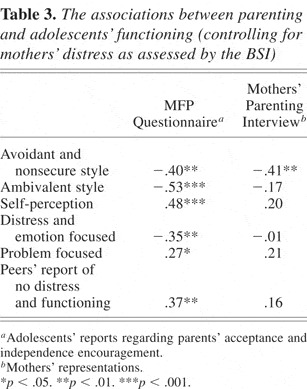
Next the associations between parenting variables and adolescents' psychosocial outcomes were examined, controlling for mothers' distress (BSI scores). As can be seen in Table 3, adolescents' perceptions regarding their relationships with parents were associated with their psychosocial functioning. In addition, mothers' parenting representations were negatively associated with the nonsecure/avoidant attachment style.
The associations between parenting and adolescents' functioning (controlling for mothers' distress as assessed by the BSI)

Examining the mediation of parenting variables in predicting psychosocial outcomes of adolescents
In line with the conceptualization that suggested that the secondary traumatization experienced by HSO might impair their parenting, and that this impaired parenting, in turn, could affect the psychosocial functioning of the third generation (Felsen, 1998), the mediating role of parenting was examined.
To examine whether parenting variables mediated psychosocial outcomes of adolescents, hierarchical regressions were performed following the three conditions for mediation suggested by Baron and Kenny (1986) and the additional condition suggested by Holmbeck (1997). The first condition suggested by Baron and Kenny (1986) requires that the independent variable (Holocaust background) predict the mediator (adolescents' relationships with parents). This condition was met for mothers' parenting representations, and for adolescents' perceptions regarding their relationships with parents (MFP Scale). The second condition requires that the independent variable predict the dependent variable (adolescents' outcomes). This condition was satisfied for the ambivalent attachment style, self-perception, and peers' report of positive adjustment. Holmbeck (1997) requires, in addition, that the mediator predict the dependent variable (see Table 3). Only the MFP Scale satisfied this condition. Consequently, three hierarchical regressions were conducted for predicting (a) ambivalent attachment styles, (b) self-perception, and (c) peers' report of distress and functioning using as mediator the MFP Scale regarding acceptance and independence encouragement by parents.
In the first step, we entered Holocaust background. For each regression Holocaust background was dummy coded depending on the results of the pairwise comparisons in which the effects of the Holocaust background were examined with regard to the dependent variable (adolescents' outcomes). Following the guidelines for coding contrasts, we coded the groups that were significantly different from each other as +1 and −1 and those that were not significantly different as 0. For example, as might be recalled adolescents with both-parents HSO demonstrated higher levels of ambivalent attachment style than were their counterparts from the father HSO and the mother HSO groups. In addition, adolescents from the father HSO group showed lower level of ambivalent attachment style than adolescents with no Holocaust background. Thus, in predicting ambivalent attachment style two contrasts were entered: (a) both-parents HSO (coded 1) versus one-parent HSO, mother or father (coded −1); the no Holocaust background group was coded 0. (b) Father HSO (coded 1) versus no Holocaust background group (coded −1); in this contrast both the father HSO and the mother HSO were coded as 0. Similarly, we followed the results of the pairwise comparisons in devising the contrasts in predicting self-perception. For this prediction we contrasted both-parents HSO group (coded 1) versus the other three groups (coded −1). Finally, in predicting peers' report of functioning we examined both-parents HSO group (coded 1), versus one-parent (mother or father) HSO (coded −1); the no Holocaust background group was coded 0.
In the second step we entered the parenting variable that was associated with the dependent variable (the MFP Scale; see Table 3). The regression analyses predicting ambivalent attachment styles, self-perception, and peers' report of functioning were significant.
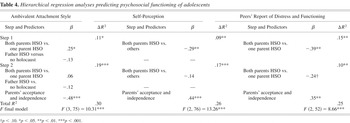
As can be seen in Table 4, reflecting previous analyses Holocaust background significantly predicted adolescents' psychosocial functioning in these regressions (besides the contrast between father HSO and the no Holocaust background groups for the ambivalent style). However, after the inclusion of the mediators in the regression model the beta coefficients of Holocaust background decreased and became nonsignificant. Application of the Sobel test (MacKinnon, Warsi, & Dwyer, 1995) to examine whether the mediator (MFP) carries the influence of the Holocaust background to the outcome variables (indirect pathway) showed that in each of these cases it was significant: ambivalent attachment style, z = 2.95, p < .01; self-perception, z = −2.56, p < .01; and peers' report of functioning, z = −2.18, p < .05. These results suggest that the association between Holocaust background and adolescents' ambivalent attachment style, self-perception, and peers' report of functioning is mediated by adolescents' perceptions of their relationships with their parents.
Hierarchical regression analyses predicting psychosocial functioning of adolescents

Discussion
This study examined the long-term effects of extreme war-related trauma by assessing the psychosocial functioning of the second and the third generation of HS with different degrees of Holocaust experience in the family of the second generation. The study benefited from the inclusion of a generally nonrisk sample, facilitating the examination of the long-term effects of trauma without other commonly accompanying risk factors (e.g., poverty). A multi-informant (mothers, fathers, adolescents, and peers) and multimethod (interviews, questionnaires) prospective design was used. The study examined the psychosocial functioning of the second and the third generation, not only psychopathology-related outcomes within different contexts of family risk. These outcomes were examined during late adolescence and during the leaving-home transition, a challenging period to most parents and children, which might increase the exposure of possible vulnerabilities.
The second generation
Mothers with Holocaust background showed higher levels of psychological distress, and their parenting representations were less positive than mothers with no Holocaust background. These findings indicate that Holocaust background is a risk factor for less favorable psychosocial functioning by the second generation. Their inner feelings as well as their relationships with their own offspring seem to implicate difficulties that might be associated with secondary traumatization (although the multigenerational effects of exposure to war-related trauma are moderate). In general, the findings with the second-generation accord with a general risk model, HSO mothers evinced some vulnerabilities compared to non-HSO mothers. However, as mothers' vulnerability was not within the clinical range, the results might indicate the resilience, the nonclinical nature, and the good adaptation of this sample. These could be the result of protective factors such as high education, successful task accomplishments, and availability of supportive relationships that might characterize these highly functioning families (Masten & Reed, 2003). Still, in later periods of life, or under conditions of prolonged and extreme stress the vulnerability of the second generation may be revealed (van IJzendoorn et al., 2003).
The third generation
Adolescents from both-parents HSO group perceived their parents less optimally compared to others. They perceived their parents as less accepting and autonomy granting than did their counterparts, and this perception by the adolescents may reflect in part the less positive parenting representations of the mothers themselves. Being a parent in a family with both-parents HSO increases the risk for stress and less effective parenting at least when it comes to adolescents' perceptions and to mothers' parenting representations as assessed in a parenting interview. This finding is similar to Marcus' results (1986) regarding the lesser responsiveness of HSO mothers and accords with the multiplicative (synergic) model of risk in that the combination of two HSO parents in the household provided an added risk compared with the simple additive risk involved with one-parent HSO.
In particular, being a relatively sensitive period, adolescence could expose otherwise covert vulnerabilities. Parenting adolescents could be a more challenging and complex task than dealing with young children (Steinberg & Silk, 2002). Young children are probably less fault finding and critical than adolescents, which could ease parents' coping and competence. Adolescents' refined ability for reflection enables them to view their parents and themselves more subtly. Further separation-individuation processes of adolescents might induce parents' own unresolved difficulties around those issues (Kellerman, 2001a, 2001b; Scharf & Shulman, 2006). Thus, parenting variables assessed either by mothers' interviews or adolescents' reports might be susceptible to trauma residuals.
In general, the psychosocial functioning of the third generation where both parents in the family were HSO was inferior to that of the other groups. This finding reflects the operation of synergistic rather than purely additive models of risk. Adolescents from the both-parents HSO group portrayed themselves with the lowest self-perception compared to others. In addition, adolescents from the both-parents HSO group perceived themselves as more ambivalent and their peers reported their inferior emotional, instrumental, and social functioning compared to adolescents from the one-parent HSO group. Together these results demonstrate the multiplicative nature of risk, showing that secondary traumatization was more apparent in adolescents from families where both parents were HSO than in any other group.
Similarly, in a recent meta-analysis (van IJzendoorn et al., 2003) secondary traumatization was more apparent in the offspring of two HS in the total set of studies (although it was argued that this result could not be replicated in the subset of studies whose samples were nonrandomly collected). Although presumably HSO in either group were exposed to a parent (HS) who had experienced trauma, it seems that it is not just this exposure that matters (Solomon, 1995; Solomon et al., 1992; Yehuda et al., 2001; Yehuda, Schmeidler, Elkin, et al., 1998; Yehuda, Schmeidler, Wainberg, Binder-Brynes, & Duvdevani, 1998). The parents from the one-parent HSO group also experienced this climate in their family of origin. Rather, it is probably the cumulative effect of stress whereby two parents in the family are offspring of HS.
It could be argued that from the outset the parents from the one-parent HSO group chose partners without a Holocaust background to avoid the burden bound up with this legacy. These parents might have been more resilient and less vulnerable than their counterparts from the start. Alternatively, it could be argued that being with a partner without such a background helped them to dispel their trauma-related emotions and symptoms and overcome related vulnerabilities especially in the family context, thus reflecting the operation of protecting factors. Both processes might have been operating. In any event these results probably reflect their resilience premarriage or acquired as a function of these relationships.
Of interest, adolescents from the father HSO group presented lower level of ambivalent attachment style than adolescents from the no Holocaust group. This might suggests some modest support for the steeling model. It could be the case that HSO fathers mate especially empathic and resilient women resulting in successful psychosocial functioning of their families. It is unclear why HSO mothers who are married to no HSO husbands did not show this profile of relationships. One possibility is that women who are not HSO might promote protective processes more than men who are not HSO because of their relationship-focused orientation and their good intimacy and caring competencies (Gilligan, 1982; Maccoby, 1990). This interpretation as well as the possibility of steeling effects should be very cautiously considered, and would need to be examined more directly in future research with larger samples.
Examination of possible processes involved in the intergenerational transmission of war-related trauma across generations in this study suggests that parenting practices, and especially adolescents' perceptions regarding their parents' affects and behaviors toward them partially mediate the linkage. Thus, sons' perception of lower acceptance and independence encouragement from parents in the both-parents HSO group seems to be one of the sources of these adolescents' lower levels of psychosocial functioning than in the others. HSO latent vulnerabilities might be discerned in their less effective parenting style, which then affects their sons' attachment styles and self-concept. The results regarding mediation in this study should, however, be viewed with caution, as they present only a very modest evidence for such mediation. Note the shared method for the assessments of mediators and outcomes: these variables were assessed by self-report and at the same time during senior year in high school and could be artifacts of monoinformant bias (except for peers' report regarding functioning in basic training). Further, only very few potential pathways were significant. Thus, other putative mediating mechanisms might be operating. For example, the general family climate, specific aspects in the parents–child relationships such as high expectations or role reversal that were not assessed in this study, and the quality of the marital relationship might all affect children in HSO families and lead to their lower functioning. Future research with third-generation HS may need to address differences in their functioning, but also the specific mechanisms by which these differences might be implicated.
The results with this study's nonclinical sample support theoretical formulations regarding the vulnerability of offspring of trauma survivors. The sense of difficulties in the family climate (Felsen, 1998; Solomon, 1998) may be what affected adolescents' perceptions and expectations regarding themselves and close others, as well as their capacity to cope with the leaving-home transition into military service. Thus, it seems that trauma may have long-term effects concerning the psychological well-being and parenting of mothers who are the offspring of trauma survivors, and that when both-parents are HSO, trauma may have long-term effects concerning the psychological well-being of the third generation, albeit, as Felsen (1998) noted, within the normative range of psychological functioning.
Limitations and implications
Some of the information gathered from the participants of this study relied on self-report questionnaires. These are open to various biases, for example, toward a desirable self-presentation. Although we cannot rule out such a bias, the different measures and sources converged in their reports of the same constructs (i.e., parenting representations and parenting practices), demonstrating a certain convergent validity of these accounts. This study was conducted in a unique cultural context and examined adolescents from intact middle-class families, so the generalizability of its findings to other contexts and social groups, as well as to families exposed to types of trauma other than the Holocaust, needs to be further explored (Solomon, 1998; Wiseman et al., 2002). In addition, the specific Israeli context, with constant war- and terror-related threats, could restrict its generalizability to other more peaceful contexts. Further, our study examined two-parent middle-class families, and did not include families that had recently immigrated to Israel. Holocaust background may have different ramifications depending on SES and the existence of other risk factors. All things considered, generalizations to less normative and less selective samples, other cultures, SES groups, and contexts should be made cautiously.
In addition, this study was conducted only with males, so replication with females is required before these results can be generalized to the other gender. Several theoretical frameworks suggest that girls' embeddedness in relationships (Chodorow, 1989; Gilligan, 1982) may be related differently to the relationship with parents and to the separation following the leaving-home transition (Frank, Avery, & Laman, 1988; Geuzaine, Debry, & Liesens, 2000). For example, it was found that daughters of HS showed more problems with separation and individuation from their parents (Brom, Kfir, & Dasberg, 2001; Wiseman et al., 2002), whereas sons evinced less independence with their wives (Wiseman et al., 2002). Therefore, future studies should consider gender and type of relationships when examining intergenerational transmission.
Despite the contention that the Holocaust background was the major variation among the different groups, the possibility that other variables contributed to the outcomes reported in this investigation cannot be dismissed (e.g., adolescents' temperament). Therefore, the conclusion regarding the long-term effects of the Holocaust on the psychosocial functioning of the second and third generation should be treated cautiously. Note, moreover, that lower self-perception, higher levels of ambivalent attachment styles, higher levels of distress, and lower functioning during basic training are not indexes of clinical impairment. They might indicate inner feelings of dissatisfaction and distress, which could reflect an intensified sensitivity because of secondary traumatization. Clinicians should acknowledge the possible consequences of secondary traumatization and might intervene to improve peoples' well-being even though they function well in their daily lives, yet they need to be cautious not to view these signs as pathological.
Because the current study did not use control groups consisting of offspring of people suffering from other types of trauma it is not clear to what extent these findings are applicable to other extreme traumas, or if they reflect the unique effects of the Holocaust. Future research may well examine these possibilities. This caveat notwithstanding, it seems that extreme trauma may have long-term negative effects on people's psychosocial adjustment even two generations after exposure. Grandchildren of trauma survivors such as war veterans or POWs might be a risk population, and future studies as well as clinical observations should try to identify shared characteristics and vulnerabilities in these individuals. By contrast, under certain circumstances, when stress levels are moderate people may adjust well despite adverse experiences.
This study underscores the importance of devoting more attention to understanding synergic models and identifying the processes leading to the multiplicative influence when both partners are HSO. Similarly, we should investigate more closely the contributing factors to what seems to be the successful psychosocial functioning of the one-parent HSO group. Future research is needed to thoroughly examine strengths and vulnerabilities, especially among the third generation, and to learn more about the distinctive features and processes leading to resilience or vulnerability.