Mechanical and, more recently, touchless hand hygiene dispensers (HHDs) are frequently being installed across hospital areas to facilitate hand hygiene with alcohol-based compounds.Reference Cure, Van Enk and Tiong 1 – Reference Boyce 4 Because touchless HHDs are typically more expensive than mechanical HHDs, the ease of use of touchless HHDs should be justifiable by high compliance rates and standardized dispensing of an appropriate volume of hand antiseptic solution over long periods of time without requiring regular maintenance. However, little is known about defect rates among touchless HHDs. Therefore, we compared the defect rate between touchless and mechanical HHDs at a tertiary-care center.
METHODS
The main visitor areas and the hematology reverse isolation unit at the University Hospital Basel, Switzerland, have been equipped with a single model of touchless HHD since September 2014 (list price $367 per device) and a single model of mechanical HHD since November 2011 (list price $254 per device) from a single manufacturer, respectively. These touchless and mechanical HHDs automatically record each hand hygiene event (HHE) and the device function, which are transmitted wirelessly to a common server. The local ethics committee approved this study as part of a continuing quality improvement program.
We analyzed the daily electronic HHD reports and handwritten HHD repair protocols to compare the defect rate between touchless and mechanical HHDs. An HHE was defined as 1 or more applications of hand antiseptic solution within 2 seconds, detected by the automatic counting device of each respective HHD. Based on the HHD reports and repair protocols, an HHD defect was defined as a recorded dispenser malfunction that prompted a device removal and repair. For all HHDs, an alcohol-based antiseptic formulation was used, with propan-2-ol (45%, w/w), propan-1-ol (30%, w/w), and mecetronium etilsulphate (0.2%, w/w) as the active ingredients (Sterillium classic pure; BODE Chemie GmbH, Hamburg, Germany).
Follow-up for each HHD was calculated from the first wireless signal until the occurrence of a recorded defect that prompted a device removal and repair, a device removal due to other reasons (eg, renovation works; censored), or after 28 months of follow-up (840 days; censored), whichever came first. The follow-up period was predefined to account for different introduction phases of touchless and mechanical HHDs and to reduce potential bias due to different lengths of follow-up.
We expressed quantitative data as median (interquartile range [IQR]) due to data skewness. We compared time-dependent differences in the defect rates between touchless and mechanical HHDs using the log-rank test. P values were 2-sided, with a significance level of .05. We analyzed and visualized all data using SPSS version 22 software (IBM, Chicago, IL).
RESULTS
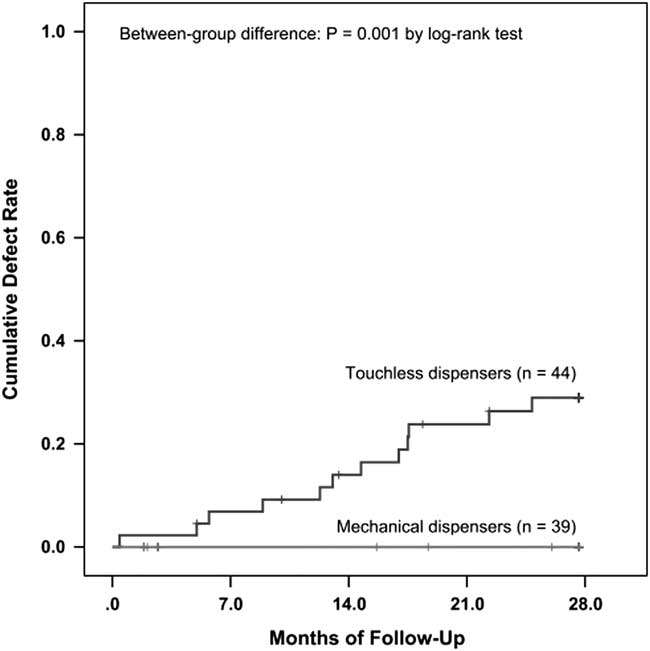
A total of 44 touchless and 39 mechanical HHDs were analyzed. The median follow-up in nondefective HHDs was 840 days (IQR, 840–840 days); the overall follow-up accounted for a total of 56,280 dispenser days. The cumulative defect rates were 27% (12 of 44) in touchless HHDs and 0% (0 of 39) in mechanical HHDs (P =.001 for difference over time) (Figure 1). According to the HHD repair protocols, all 12 device defects in touchless HHDs were likely caused by a mechanical pump malfunction after being used for a median of 422 days (IQR, 198–533 days) and a median of 6,296 HHEs (IQR, 1,452–11,160 HHEs).
Cumulative defect rates of touchless and mechanical hand hygiene dispensers.

DISCUSSION
To our knowledge, this is the first study in which defect rates have been compared between touchless and mechanical HHDs. We observed a significantly higher defect rate among touchless HHDs than among mechanical HHDs. These device defects were likely caused by mechanical defects or deficits of the automatic pump systems. Low batteries were another reason for nonfunctioning touchless HHDs, but these occurrences were related to management and were therefore not reported as dispenser defects.
In a cross-sectional survey-based study, Kohan et alReference Kohan, Ligi, Dumigan and Boyce 5 described a defect rate of 2% (4 of 166) in mechanical HHDs after having been in use for 16 months; the authors concluded that mechanical HHDs, even from the same manufacturer, may differ considerably in their design and may not function similarly.Reference Kohan, Ligi, Dumigan and Boyce 5 Although well-functioning HHD systems may be seen as a basis for adequate hand hygiene compliance and careful evaluation of newly introduced products is important to guarantee cost-effective allocation of financial resources in healthcare institutions, defect rates of touchless HHDs have not been reported in the literature previously.Reference Cure, Van Enk and Tiong 1 , Reference Pittet 6 , Reference Valenti and Herwaldt 7
Our study has 2 main limitations. First, we investigated defect rates of touchless and mechanical HHDs from a single manufacturer, which may limit the generalizability of the study results. Second, the definite cause of device or pump malfunctions could not be determined.
In conclusion, we observed a significantly higher defect rate among touchless HHDs than among mechanical HHDs. The ease of use of touchless HHDs for visitors should be balanced with the additional resources required for maintenance. Mechanical HHDs may be better suited for healthcare workers due to their high reliability, low maintenance requirements, and battery-free function. An evaluation of touchless HHDs from other manufacturers is warranted.
ACKNOWLEDGMENTS
Financial support. This work was funded by the Division of Infectious Diseases and Hospital Epidemiology, University Hospital Basel, Basel, Switzerland. No external funding was received.
Potential conflicts of interest. All authors report no conflicts of interest relevant to this article.