Introduction
Individuals with body dysmorphic disorder (BDD) are troubled by intrusive thoughts that they have a bodily imperfection that is visibly unsightly.Reference Grant and Phillips 1 In some cases, they have a minor physical flaw that would not be regarded as abnormal or noticeable by most people; in other cases, the defect is imaginary. They fear showing the “imperfection” in public,Reference Rosen 2 leading to social avoidance and isolation. They spend considerable time ruminating about the perceived defect, and engage in time-consuming checking, camouflaging, and reassurance-seeking rituals.Reference Veale and Riley 3
BDD has been relatively neglected by research, perhaps in part due to the assumption that it is a rare condition. However, extant epidemiological data contradict this perspective. In a German sample of approximately 2500 individuals, who were selected to be representative of the general population, the point prevalence of BDD was estimated at 1.2–2.1%.Reference Rief, Buhlmann, Wilhelm, Borkenhagen and Brähler 4 In a national household telephone survey conducted on approximately 2000 U.S. citizens, the point prevalence was estimated at 2.4%.Reference Koran, Abujaoude, Large and Serpe 5 Other studies, mostly conducted in college student samples, suggest a point prevalence rate of around 2.5% or greater.Reference Biby 6 – Reference Sarwer, Cash and Magee 9 In addition to being relatively common, BDD is associated with profound impairment in quality of life and everyday functioning.Reference Koran, Abujaoude, Large and Serpe 5 Insight is frequently impaired, and treatment adherence is noted to be poor.Reference Rashid, Khan and Fineberg 10 Furthermore, a prospective study conducted over 4 years in 185 subjects with BDD indicated that suicidality is a major concern. Across the four years studied, suicidal ideation occurred in more than 50% of individuals with BDD; 2.6% attempted suicide, and 0.3% completed suicide.Reference Phillips and Menard 11
Anorexia nervosa (AN) and bulimia nervosa (BN) are examples of eating disorders that are also associated with abnormal body image concerns, and subjects with both these disorders have been shown to demonstrate a greater avoidance of their own image and negative self-evaluation than healthy controls.Reference Rosen and Ramirez 12 Studies have demonstrated comorbid and familial overlap between eating disorders, OCD, and BDD.Reference Thornton and Russell 13 , Reference Bienvenu, Samuels and Riddle 14 In recognition of its nosological status as a compulsive disorder, the Diagnostic and Statistical Manual of Mental Disorders, Fifth Edition (DSM-5) has moved BDD into the same category as obsessive compulsive disorder (OCD), under an expanded grouping of Obsessive Compulsive and Related Disorders. In people with OCD, comorbid BDD has been reported in up to 37% of cases.Reference Costa, Lucas and Chagas Assunção 15 In patients with eating disorders (including both AN and BN), up to 45% have been found to show comorbid BDD.Reference Grant, Kim and Eckert 16 , Reference Dingemans, van Rood, de Groot and van Furth 17 Furthermore, in a seminal OCD family study, the first-degree relatives of OCD patients were at significantly elevated risk specifically for BDD, eating disorders, grooming disorder, and hypochondriasis, as compared to control relatives.Reference Bienvenu, Samuels and Riddle 14 These findings are suggestive of a familial overlap between BDD and OCD on the one hand, a fact supported by previous reviews of age of onset, personality characteristics, and course of illness,Reference Hartmann, Greenberg and Wilhelm 18 and similar cognitive deficits on the other hand, such as set-shifting,Reference Roberts, Tchanturia and Treasure 19 found in those with AN and BN.
Understanding of the neurobiology of BDD and related conditions may be informed by the use of cognitive tests that are dependent on the integrity of frontal lobe functioning. Various cognitive impairments have been identified in OCD using computerized paradigms from the Cambridge Neuropsychological Test Automated Battery (CANTAB), including in the domains of set-shifting [Extra-Dimensional Set-Shift (EDS)], inhibitory motor control [Stop-Signal Reaction Time (SSRT)], executive planning [Stockings of Cambridge (SOC) test], and affective bias toward negatively valenced stimuli (for reviews see Chamberlain et al Reference Chamberlain, Blackwell, Fineberg, Robbins and Sahakian 22 and Fineberg et al Reference Fineberg, Potenza and Chamberlain 23 , Reference Fineberg, Chamberlain and Goudriaan 24 ). These outcome measures can fractionate broad cognitive processes into constituent domains, and can be linked with different neural substratesReference Robbins, James and Owen 25 ; they have been used in translational research across species,Reference Fineberg, Chamberlain, Hollander, Boulougouris and Robbins 26 , Reference Keeler and Robbins 27 as well as in people with focal neurosurgical lesions and in acute drug manipulations. This background validation is of value in interpreting new cognitive findings in conditions such as BDD. For some deficits (EDS, SSRT, SOC), similar cognitive dysfunction exists in unaffected first-degree relatives of patients with OCD, and these therefore may represent predisposing or “vulnerability” markers.Reference Chamberlain, Fineberg and Menzies 28 – Reference Rajender, Bhatia, Kanwal, Malhotra, Singh and Chaudhary 30 The findings are broadly consistent with current neurobiological models of OCD, which implicate not only dysfunction within the classical orbitofrontal circuitry, but also the dorsolateral prefrontal cortical circuitry, which incorporate these cortical regions and also subcortical nodes including the ventral and dorsal striatum.Reference Fineberg, Potenza and Chamberlain 23 , Reference Menzies, Chamberlain, Laird, Thelen, Sahakian and Bullmore 31
There have been few published studies exploring neuropsychological function in BDD. Hanes et al compared 14 subjects with BDD with 10 subjects with OCD and 24 controls, using a variety of noncomputerized tests.Reference Hanes 32 Both the BDD and OCD groups were similarly impaired, compared to controls, on tests of executive planning (Tower of London task) and color-word interference (Stroop task), supporting the hypothesis that these two conditions are neurobiologically related. No significant deficits emerged in the BDD or OCD groups for category fluency and motor skill/speed on the Purdue Pegboard task, verbal learning on the Rey Auditory Verbal Learning task, or nonverbal learning/memory function on the Rey Complex Figures task (RCFT). In contrast, another study,Reference Deckersbach, Savage and Phillips 33 again using noncomputerized tests, identified impairment in nonverbal learning/mnemonic domains (Rey Complex Figures Task), along with verbal learning impairment (California Verbal Learning Test), in 17 patients with BDD compared to 17 healthy controls. The authors postulated that the deficits were mediated by poor organizational strategy. Dunai et al Reference Dunai, Labuschagne, Castle, Kyrios and Rossell 34 additionally explored cognitive functioning in 14 patients with BDD versus 14 healthy controls, using selected computerized paradigms from the CANTAB. Patients with BDD were impaired on spatial working memory (Spatial Working Memory test) and executive planning (SOC test); the findings were similar to those reported separately for OCD.Reference Chamberlain, Fineberg, Blackwell, Robbins and Sahakian 35 In a more recent study, executive dysfunction was investigated in 14 BDD participants, 14 matched (age and gender) healthy controls, and 23 participants with OCD. Similarities were seen in the BDD and OCD groups in spatial span, spatial working memory, pattern recognition, and spatial planning (SOC) tasks compared with healthy controls. However, those with BDD were found to have relatively greater deficits in executive functioning, on the accuracy measure of the SOC Task, than those with OCD and compared with healthy controls.Reference Labuschagne, Rossell, Dunai, Castle and Kyrios 36 A recent study by Toh et al Reference Toh, Castle and Rossell 37 found similarities between BDD and OCD groups on measures of attention and memory, compared with controls. This study used the Repeated Battery for the Assessment of Neuropsychological Status (RBANS), which assesses broad domains of memory, attention, and visuospatial skills and which benefits from the use of a healthy control group in the comparison of BDD and OCD samples. Their results showed some evidence of similarity in broad cognitive processing impairment that is unlikely to be disease specific. The study merits further exploration with tasks of greater neural specificity and robust evidence of impairment in OCD. It also offers further credibility to the idea that BDD falls within the category of obsessive-compulsive spectrum disorders.
Based on the above limited evidence, the current study sought to explore specific aspects of cognitive functioning in BDD and healthy volunteers using relevant tests from the CANTAB. We focused on motor response inhibition (using the SSRT), cognitive flexibility [using the Intra-Extra Dimensional (IED) Set Shifting Task], and affective processing [using the Affective Go/No-Go task (AGN)]. These 3 cognitive domains are linked to behavioral inhibition and have not previously been investigated in BDD, but have been found to be impaired in non-comorbid OCD. For example, Kerwin et al Reference Kerwin, Hovav, Hellemann and Feusner 38 found deficits in global and local processing, visual processing, and cognitive flexibility in unmedicated individuals with BDD compared with nonclinical controls. These deficits were greater in those with more severe illness with poor insight, and the finding merits further research to ascertain whether these areas serve to maintain BDD symptoms.
We also included a test of decision-making, the Cambridge Gambling Task (CGT), which tests aspects of reward-based impulse control, and which has previously been observed to be intact in OCD,Reference Chamberlain, Fineberg, Blackwell, Robbins and Sahakian 35 but which is impaired in patients with behavioral and substance addiction.Reference Fineberg, Chamberlain and Goudriaan 24 , Reference Zois, Kortlang and Vollstädt‐Klein 39 We hypothesized that BDD would be associated with a similar cognitive profile to that previously reported in OCD: namely, significantly impaired response inhibition and set-shifting, evidence of affective bias with increased sensitivity to negatively valenced cues, but intact decision-making.
Materials and Methods
Participants
BDD patients, aged between 18 and 65 years, were recruited from the specialist OCD/BDD outpatient clinic of one of the authors (NAF). All had a Diagnostic and Statistical Manual of Mental Disorders, Fourth Edition (DSM-IV) diagnosis of BDD, as ascertained by a semistructured diagnostic interview conducted by a consultant psychiatrist and a detailed clinical assessment amplified by the Yale–Brown Obsessive Compulsive Checklist and Scale for Body Dysmorphic Disorder (BDD-YBOCS)Reference Phillips, Hollander, Rasmussen and Aronowitz 40 to determine the degree of illness severity. In order to meet the inclusion criteria for the study, BDD was required to constitute the primary illness. All psychiatric comorbidity (such as OCD) as documented in the case notes was recorded. Healthy controls were recruited from a non-treatment–seeking population via the University of Hertfordshire email recruitment system. In order to meet the inclusion criteria for the study, healthy controls must not have a diagnosis of BDD or any other primary illness. Illness symptomatology was measured using the BDD-YBOCS, Montgomery–Åsberg Depression Rating Scale (MADRS), and the Hamilton Anxiety Scale (HAM-A).
Demographic analysis
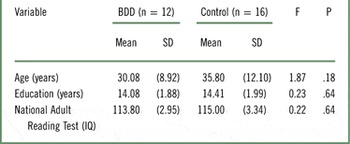
Twelve individuals with BDD [mean duration of illness 133.5 months (11.13 years)] and 16 healthy individuals without BDD (controls) completed cognitive tasks and clinical questionnaires (Table 1). Importantly, the 2 groups did not differ significantly with regard to age, education, and estimated IQ using the National Adult Reading TestReference Nelson 41 ; see Table 1).
Demographic analysis: BDD and control groups

Age, IQ, and education-matched control participants without a diagnosis of BDD were recruited from the University of Hertfordshire. Control participants were approached via speaking to individuals on the University premises or via the university’s SONA system (an online computerized system by which students can indicate their interest in participating in research studies). Participants were requested to be without body dysmorphic disorder and were screened to exclude the presence of the disorder symptoms using the BDD-YBOCS using a cut-off of >10. None of the participants in the control group scored more than 10 on this clinical rating scale.
Clinical measures
Severities of depression and anxiety symptoms were quantified in all participants using the MADRSReference Montgomery and Asberg 42 and the HAM-A.Reference Hamilton 43
Neuropsychological measures
Participants completed the following paradigms from the CANTAB. The tasks were administered in a fixed order (as below), in a quiet testing environment, supervised by a trained test administrator.
The Intra-/Extradimensional Set-Shift task (IED)
This is a 9-stage visual discrimination task that measures cognitive flexibility.Reference Lawrence, Sahakian and Robbins 44 Two stimuli are presented at a time, and participants ascertain, by computerized feedback, which of the stimuli is correct, and thus, the “rule” of the game. Following 6 consecutive indications of the correct stimulus, the “rule” alters. The extradimensional shift (EDS) stage of the task is crucial for determining divergent thinking deficits, as the participant is required to his or her their attentional focus from the previously relevant stimulus dimension to a previously irrelevant stimulus dimension. Such set-shifting depends on the ventrolateral prefrontal cortex.Reference Hampshire and Owen 45 The outcome measures of interest on this task include the total number of errors and total number of stages successfully completed.
The Cambridge Gambling Task (CGT)
This task assesses dissociable aspects of decision-making. Participants are asked to accumulate as many points as they can by making gambles across a range of different winning probabilities. Each trial has differing proportions of red and blue boxes from which participants are asked to place a bet on the location of a yellow token based on their confidence in their choice. The bet amount either increases incrementally (5%, 25%, 50%, 75%, 95% of total collected points) or decreases (reverse order) over time. Outcome measures include mean percentage of points gambled (total proportion of overall bets), quality of decision-making (this measures rational decision making and is measured by the calculating the proportion of trials where the participant chose the more likely outcome [box color]), risk taking (the mean proportion of points bet on trials where the most likely outcome was chosen), deliberation time (how long it took to decide on which bet to choose), and delay aversion (measured as the tendency for participants to bet larger amounts due to an unwillingness, or inability, to wait for bets to decrease on trials where bet amounts are presented in descending order compared with when bets are presented in ascending order).
The Stop Signal Task (SST)
This is a measure of pre-potent motor inhibition. Participants are required to respond rapidly to left or right oriented arrows, presented on a blank screen. When an audible sound emits (the “stop-signal”) from the task screen, participants are required to inhibit their response for that arrow and their degree of success is measured. Over the course of the test, the time between the presentation of the “go” stimulus and the “stop-signal” varies using a tracking algorithm. The main outcome measure on the task is the stop-signal reaction time (SSRT), which is an estimate of the time taken by the individual to stop or suppress a response that would ordinarily be undertaken; longer SSRTs equate to poorer motor response inhibition, or greater “motor impulsivity.” The other outcome measure of interest is the median reaction time for “go” trials, a generic measure of response speed not relating to inhibitory control.
The Affective Go/No-Go (AGN)
This task assesses mood processing bias. A series of positive and negative words is presented on screen. The participant is required to respond to predetermined “target” words by pressing a key pad when he or she sees a target word. This target word will be “positive” or “negative” in valence. Other non-affective words are considered “distractor” words, and participants are required to avoid responding to these words and to only respond to the target word. The outcome variables of interest include the mean correct latency, representing the length of time each participant takes to respond to target words, as well as the total number of commission errors (pressing for a positive target word when it is a negative one or vice versa) and omission errors (failing to respond when one should have done so).
Statistical analysis
Between-group differences were investigated by conducting a multivariate analysis of variance (MANOVA) using IBM SPSS. Further exploratory analysis in SPSS included a test of covariance using anxiety (Ham-A) and depression (MADRS) scores as covariates. This being an exploratory study, statistical significance was defined as p < 0.05 uncorrected.
Results
Clinical analysis
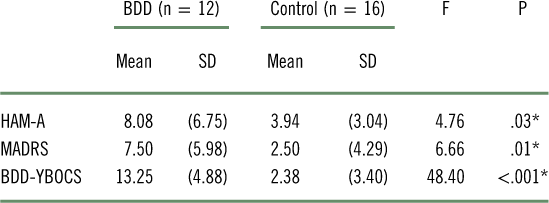
The BDD group showed a range of symptom-severity ranging from mild to moderately severe (BDD-YBOCS total range 7–24). The mean BDD Y-BOCS was 13.25 (SD 4.88), representing mild BDD. Control BDD-YBOCS scores ranged from 0–10 with an average score of 2.38 (SD=3.40). None of the 16 control participants was taking prescribed medication, while all 12 of the BDD participants were taking prescribed medication (2 citalopram, 6 escitalopram, 3 fluvoxamine, and 1 sertraline). Nine of the 12 BDD patients expressed symptoms of comorbid OCD. Two of the 9 were also diagnosed with comorbid social anxiety disorder, and 1 patient was diagnosed with gender dysphoria (DSM-5), previously called gender identity disorder. 20 These diagnoses were based on clinical assessments by a consultant psychiatrist. These details were not measured at the time of testing, but were taken from patient case notes and discussions with the treating psychiatrist. Although both groups showed low levels of anxiety and depressive symptomatology, the BDD group showed significantly greater severity of symptoms of depression (MADRS, p=.01) and anxiety (HAM-A p=.03); see Table 2. Of the participants with BDD, 50% scored very low on the MADRS (“normal or symptom absent” with a MADRS score of less than 7).Reference Müller-Thomsen, Arlt, Mann, Maß and Ganzer 46 The majority of the remainder (n=5) scored within the “mild depression” category, with scores between 7 and 19, and 1 participant scored 24, representing “moderate depression.”Reference Müller-Thomsen, Arlt, Mann, Maß and Ganzer 46
Clinical measures

HAM-A: Hamilton Anxiety Scale; MADRS: Montgomery–Åsberg Depression Rating Scale; BDD-YBOCS: Yale–Brown Obsessive Compulsive Scale for Body Dysmorphic Disorder. *=statistically significant result.
Neurocognitive analysis
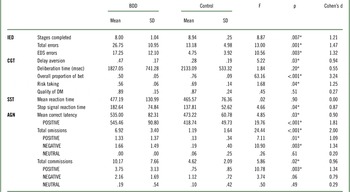
A MANOVA was conducted in order to ascertain differences between the BDD and control groups (see Table 3). The MANOVA revealed significant differences between groups overall [F(1,26)=6.89, p=.01].
Neurocognitive test performance

IED, Intra/Extra Dimensional shift task; CGT, Cambridge Gambling Task; SST, Stop Signal Task; AGN, Affective Go/No-Go task.
* denotes a statistically significant result.
Intra-/Extradimensional Set Shift task (IED)
The BDD group made significantly more total errors (adjusted) on the task versus controls. These errors were specifically seen at the extradimensional shift (EDS) stage (stage 8). All participants in both groups passed stages 1–7; however, only 50% (n=6) of the BDD group passed the EDS stage, while all control participants (n=16) passed the EDS stage (see Figure 1). No notable changes to the significance of each variable were seen when results were co-varied for anxiety and depression.
Percentage of BDD and control participants passing each stage on the IDED task. SD=simple discrimination; SR=simple reversal; CDA=compound discrimination adjacent; CDS=compound discrimination superimposed; CR=compound reversal; IDS=intradimensional shift; IDSR=intradimensional shift reversal; EDS=extradimensional shift; EDSR=extradimensional shift reversal.

Stop-Signal Task (SST)
The BDD group showed significantly longer SSRTs than the controls. General psychomotor speed (measured as median “go” reaction times) did not differ significantly between the groups. No notable changes to the significance of each variable were seen when results were co-varied for anxiety and depression.
Cambridge Gambling Task (CGT)
The BDD group showed significantly more delay aversion than controls. However, the BDD group gambled a significantly smaller proportion of total points overall. Between-group differences were also found in risk taking (measured by the proportion of total points bet over all trials), with the BDD group showing a significantly lower incidence of risk taking than controls. Groups did not differ significantly in terms of the proportion of rational decisions made overall. No significant differences were found with regard to the deliberation time when making bets. No notable changes to the significance of each variable were seen when results were co-varied for anxiety and depression.
Affective Go/No-Go (AGN)
Reaction time
Analysis of variance (ANOVA) showed that the BDD group was slower to respond correctly to presented words than the controls. Sub-analysis indicated that individuals with BDD took significantly longer to respond to positive words when compared to controls. The groups did not differ significantly for negative words.
Commissions
ANOVA showed that the number of commission errors differed significantly between the groups, due to higher errors in patients than controls overall. Sub-analysis indicated that there were significantly more commission errors in those with BDD than controls for positively and negatively valenced words but not neutral words.
Omissions
More nonresponses (omissions) were seen in the BDD group compared with controls overall. When exploring emotional valence, the BDD group made statistically more omissions for positively valenced words and for negatively valenced words, but not neutral words. No notable changes to the significance of each variable were seen when any of the AGN results were co-varied for anxiety and depression.
Discussion
This study contributes to the body of research documenting impaired neurocognitive performance in BDD. Differences were seen between individuals with and without BDD, and cognitive results generally appeared to be unaffected by severity of mood and anxiety symptoms.
Cognitive inflexibility
The BDD group made significantly more errors on the IED task, with a significantly higher error rate at stage 8 of the task (the EDS). Only 50% of the BDD group progressed to stage 8. Results from the IED task indicate significant attentional (or cognitive) inflexibility within the BDD group. A number of studies have found deficits in cognitive flexibility in OCD patients,Reference Chamberlain, Fineberg and Menzies 28 , Reference Chamberlain, Fineberg, Blackwell, Robbins and Sahakian 35 , Reference Veale, Sahakian, Owen and Marks 53 , Reference Watkins, Sahakian and Robertson 54 with the deficits appearing exclusively at the EDS, as was the case in the current study. The neurobiology of attentional shift flexibility has been the subject of translational study. Research into rodents,Reference Dias, Robbins and Roberts 55 primates,Reference Brown and Bowman 56 – Reference Hornak, O’Doherty and Bramham 58 and humansReference Müller-Thomsen, Arlt, Mann, Maß and Ganzer 46 , Reference Chamberlain, Fineberg, Blackwell, Clark, Robbins and Sahakian 47 , Reference Rogers, Andrews, Grasby, Brooks and Robbins 49 , Reference Nagahama, Okada and Katsumi 59 implicates the ventrolateral prefrontal cortex (or functionally homologous regions) as being required for intact cognitive flexibility.
The finding of cognitive inflexibility in the BDD group converges with published findings for OCDReference Chamberlain, Fineberg, Blackwell, Robbins and Sahakian 35 and with the clinical presentation of the disorder, specifically with the performance of compulsive (repetitive, urge-driven) behavior. Individuals with BDD engage compulsively in thoughts or behaviors related to appearance and find it difficult to divert attention to non-image–related thoughts or “purposeful” forms of activity. However, we cannot exclude the possibility that the cognitive inflexibility found in the BDD group in this study is attributable to the presence of comorbid OCD, which was present in 9 of the participants. Indeed, significant differences were seen for completed stage errors, when comparing the participants in the BDD group who had a diagnosis of OCD with those who did not, suggesting that the presence of OCD may have had an influence upon cognitive flexibility. This may be clinically relevant, in that people with BDD comorbid with OCD may have a more rigid response style, which could impede ability to adjust behaviors in day-to-day life and to engage with psychological treatments.
Decision making
The Cambridge Gambling Task (CGT) is a measure of decision-making abilities with the advantage of assessing different aspects of decision-making separately.Reference Rogers, Owen and Middleton 60 – Reference Deakin, Aitken, Robbins and Sahakian 62 . Individuals with OCD have been found to be unimpaired on the CGT,Reference Chamberlain, Fineberg and Menzies 28 though abnormal performance on the task versus controls can be elicited in OCD with acute serotonergic challenge.Reference Lochner, Chamberlain, Kidd, Fineberg and Stein 63 However, our results showed abnormal decision-making in a BDD sample. A higher incidence of delay aversion was seen in BDD patients (ie, participants were unwilling to wait for bets to increase/decrease), suggesting an increased degree of impatience (decision-making impulsivity). Hollander and Wong,Reference Hollander and Wong 64 in their investigation of gambling disorder and its associations with BDD, found that individuals with BDD showed an increased tendency for gambling.
Motor impulsivity
Significant differences in motor impulsivity were found between BDD patients and controls on the Stop Signal Reaction Time (SSRT) task. Impaired motor response inhibition has been proposed to represent an endophenotype of OCD, as studies have found that unaffected relatives are also impaired on the SSRT.Reference Chamberlain, Fineberg and Menzies 28 Performance on the SSRT is dependent on an intact right inferior frontal gyrus.Reference Hollander and Wong 64 , Reference Aron, Fletcher, Bullmore, Sahakian and Robbins 65 A number of further brain areas have been implicated in impaired response inhibition in OCD,Reference Menzies, Achard and Chamberlain 67 including the orbitofrontal cortex, anterior cingulate, parietal cortex, caudate-putamen, and cerebellum, suggesting involvement of circuits within and outside the orbitofrontal–striatal–thalamic loop.
Overall impulse control
Our data suggest that participants with BDD exhibit signs of both decision-making impulsivity and motor impulsivity. These findings align with the clinical phenomenology; many of the characteristic behavioral symptoms of BDD, eg, being unable to resist the urge to undertake cosmetic, and even “do it yourself (DIY)” surgery to “correct” perceived flaws, may be construed as poor impulse control. Indeed VealeReference Veale 68 reported that of the 25 patients he interviewed, 9 (36%) had carried out their own DIY surgery in an attempt to dramatically alter their appearance. In addition, suicidal acts are common in patients with BDD. A large prospective study of suicide showed that in 185 participants with BDD who were followed over 4 years, for each year spent in the study, an average of 57.8% reported suicidal urges, 2.6% attempted suicide, and 0.3% (2 people) completed suicide.
While “impulsivity” implies a predisposition toward performing rapid and unplanned reactions to stimuli, and “compulsivity” relates to the urge-driven performance of repetitive unwanted acts, both domains can be considered to represent a dysfunction in impulse controlReference Veale 68 and both may be represented in BDD. Separate cortico-striatal circuits are thought to sub-serve impulsivity (ventral) and compulsivity (dorsal).Reference Fineberg, Potenza and Chamberlain 23 Hyperactivity of the striatal circuit (generation of activity) and hypoactivity of the prefrontal circuit (inhibition) may represent a common mechanism underpinning impulse control deficits in a range of obsessive-compulsive disorders such as OCD and BDD.Reference Fineberg, Potenza and Chamberlain 23
Affective processing
On the AGN task, the BDD group showed a longer reaction time between the presentation of a target word and a correct response, ie, participants took longer to respond to the target word when a correct answer was given. In addition, individuals with BDD showed a higher instance of errors characterized by responding to distractor stimuli (nontarget words) and also a higher instance of nonresponse on target stimuli compared with controls. These data mirror previous findings for OCD, in which disorder-inappropriate motor responses to nontarget stimuli were observed in comparison to those seen in healthy controls.Reference Bannon, Gonsalvez, Croft and Boyce 70 , Reference Aycicegi, Dinn, Harris and Erkmen 71 Findings in OCD studies have been specific for word valance, with negative words being more difficult to forget in OCD groups—a potential suggestion of incorrect processing of negative words,Reference Wilhelm, Mcnally, Baer and Florin 72 but additional findings suggest that the type of word most difficult to forget in OCD groups is the type associated with their current OCD presentation, either positive or negative.Reference Tolin, Abramowitz, Przeworski and Foa 73 In the current study, individuals with BDD showed a longer reaction time,Reference Aron, Fletcher, Bullmore, Sahakian and Robbins 65 , Reference Aron, Robbins and Poldrack 66 more errors, and nonresponses for positive and negative target words, but not neutral target words. Previous OCD research revealed elevated commission errors for neutral words, compared with happy and sad words, in patients in one study,Reference Johansen and Dittrich 74 while another study found more omission errors for sad target words in OCD.Reference Chamberlain, Fineberg, Blackwell, Clark, Robbins and Sahakian 47 One interpretation for the current results in BDD patients is that the disorder is associated with more generalized dysregulation of emotional processing circuitry, with a global untoward impact of emotional information on attentional processing. Thus, the presentation of emotionally valenced stimuli (whether positive or negative) results in performance decrements that generalize across both commission and omission errors, with neutral stimuli not having such a pronounced effect.
Also, increased errors in the BDD group regarding positive and negative target and distractor words could result from individuals with BDD being unusually sensitive to emotional cues, ie, stimuli that have some meaning to the BDD disorder. These could be negative words such as “ugly” or even positive words such as “attractive.” Our findings revealed differences based on word valence, and not on neutral word trials, suggesting that the symptoms of BDD may rely on an inherent focus on both negatives and positives about appearance. Additionally, this bias within the BDD condition may result from cognitive inflexibility, in that individuals with BDD may become “stuck” in a routine of thinking about positive and negative aspects of themselves.
The development of self-image and the role of appearance is thought to be influenced by environmental factors, including significant life events and memories.Reference Bentall 75 – Reference Osman, Cooper, Hackmann and Veale 77 Individuals with BDD commonly report instances of bullying and teasing, potentially increasing their propensity for negative perception of themselves and of specific body parts.Reference Osman, Cooper, Hackmann and Veale 77 , Reference Silver, Reavey and Anne Fineberg 78 The finding of attentional bias toward affectively valenced words is consistent with this literature and may help to explain how such experiences become overvalued and may result in an obsessive preoccupation with body image. Few studies have tested attention in BDD. Our findings suggest that future research to investigate the effect of BDD on attention to environmental cues, and the consequent impact on psychosocial function, is desirable.
Limitations
Our modest BDD sample may have had reduced statistical power to detect other potential differences of relevance. Other BDD studies of this type have also reported a small sample size, and it may be that recruitment to BDD studies is particularly challenging. (Anecdotally, our perception was that BDD patients seemed reluctant to engage in research that focused attention on themselves.) Nonetheless, replication in larger samples is required. OCD and affective comorbidity could have had a confounding influence on the findings, considering 75% of our BDD group had comorbid OCD and 50% had comorbid depressive symptomatology. On the other hand, the BDD cases were drawn from a well-defined clinical cohort; BDD was recognized by the patients and their clinicians as the primary disorder and constituted the focus for clinical treatment. BDD in clinical cohorts is almost always comorbid with disorders such as OCD and depression,Reference Rashid, Khan and Fineberg 10 , Reference Vinkers, Van Rood and Van der Wee 79 and by including patients with relevant comorbidity, the results may be generalized to BDD patients seen in the clinical setting. While the relatively low magnitude of BDD-YBOCS scores in some of the BDD group participants may pose a limitation in clearly differentiating groups, this finding may be attributed to the effect of clinical treatment. This, in itself, does not invalidate our findings and may relate to trait, rather than state, illness. A clinical control was not used as a comparison to the BDD and healthy control groups. In future studies, it would be beneficial to compare those with a diagnosis of BDD with an OCD control group in order to further investigate cognitive correlates between these two clinical presentations and potentially further support the presence of BDD on the obsessive compulsive spectrum. Additional benefit would be gained from performing a full structured diagnostic screen on participants in order to gain a better picture of overall illness profile, or absence of illness.
Recognition of the influence that medication may have had on potentially changing the neurocognitive performance of BDD participants should be noted, as all 12 of the BDD participants were taking medication (2 citalopram, 6 escitalopram, 3 fluvoxamine, and 1 sertraline) at the time of testing. Certainly serotonin is known to play an important role in decision-making and emotional processing. Future research could be extended to investigate unaffected relatives, so as to avoid potential medication-related confounds. Research should also explore the functional impact of specific aspects of cognitive impairment on daily life, treatment adherence, and suicidal activity.
Conclusion
Patients with BDD were impaired compared to healthy controls on tests of cognitive flexibility, reward and motor impulsivity, and affective processing. Results from previous studies in the OCD population show similar deficits in cognitive flexibility and motor impulsivity; therefore our findings are consistent with the re-classification of BDD with OCD. However, the current study suggests that BDD may be characterized by additional abnormalities in domains of decision-making and emotional processing that differ from previous findings in OCD. While the study used a modest sample size and comorbid OCD may confound results, future work should explore the impact of these abnormalities on everyday functioning, the ability to engage successfully with treatment, and suicidality.
Disclosures
Kiri Jefferies-Sewell and Keith Laws do not have anything to disclose. Samuel R. Chamberlain has the following disclosure: Cambridge Cognition, consultant, consulting fees. Naomi Fineberg has the following disclosures: Janssen, educational support, research support; European College of Neuropsychopharmacology, researcher, research support; British Association of Psychopharmacology, conference attendance, support to attend scientific meetings and speaker fee; World Health Organization, scientific meeting attendance, support to attend scientific meetings; National Institute of Health Research, researcher, research support; College of Mental Health Pharmacists, scientific meeting attendance and lecture fee, lecture fee; Taylor and Francis, editorial duties, royalties; Oxford University Press, payment for book, royalties; International Forum for Mood and Anxiety Disorders, educational meeting attendance, research support.