Introduction
The families Graphidaceae and Thelotremataceae have undergone major systematic and taxonomic changes in recent years. Traditionally separated by lirellate versus round apothecia, the two families were found to be non-monophyletic and are now united under the older name Graphidaceae (Staiger et al. Reference Staiger, Kalb and Grube2006; Mangold et al. Reference Mangold, Martín, Lücking and Lumbsch2008). Also, the traditional ascospore-based concept of generic delimitation in both families and the excipulum-based concept of Thelotremataceae were abandonded in favour of a more natural concept (Staiger Reference Staiger2002; Kalb et al. Reference Kalb, Staiger and Elix2004; Archer Reference Archer2006; Frisch et al. Reference Frisch, Kalb and Grube2006; Lücking & Rivas Plata Reference Lücking and Rivas Plata2008). As a result, the emended family Graphidaceae now contains about 45 genera and possibly some 1,200 species.
While traditionally delimited by lirellate apothecia and hyaline, transversely septate ascospores (Müller Argoviensis Reference Müller Argoviensis1880, Reference Müller Argoviensis1882; Redinger Reference Redinger1933, Reference Redinger1935; Wirth & Hale Reference Wirth and Hale1963, Reference Wirth and Hale1978; Archer Reference Archer1999, Reference Archer2001), in the revised generic concept (Staiger Reference Staiger2002), Graphis s.str. is characterized by apothecia with well-developed lirellae, at least partially carbonized and often striate excipulum, lack of periphysoids, and hyaline, I+ violet ascospores. It includes the bulk of species formerly assigned to the artificial genera Graphis and Graphina sensu Müller Argoviensis, whereas the remaining species traditionally placed in Graphis are now assigned to genera such as Acanthothecis, Anomomorpha, Carbacanthographis, Diorygma, Dyplolabia, Fissurina, Glyphis, Hemithecium and Platythecium (Staiger Reference Staiger2002; Kalb et al. Reference Kalb, Staiger and Elix2004; Frisch et al. Reference Frisch, Kalb and Grube2006; Lücking & Rivas Plata Reference Lücking and Rivas Plata2008). Even with the revised concept, Graphis remains by far the largest genus in Graphidaceae, with over 300 accepted species (Lücking et al. Reference Lücking, Chaves, Sipman, Umaña and Aptroot2008, and unpublished).
In the framework of a world-wide revision of the genus Graphis s.str. (R. Lücking et al. unpublished), we found material collected by the first author in Venezuela that did not match any of the nearly 600 types investigated. It is described below as Graphis breussii.
Materials and Methods
The material was examined with a EUROMEX MIC 1642 ZHT stereo microscope at magnifications of ×7– 45 and a REICHERT NEOVAR compound microscope at magnifications of ×10–1000, with anatomical features studied on hand-cut sections of thallus and ascomata mounted in water and KOH. Microscopic measurements were made at a magnification of ×400 on vertical sections in water. Amyloidity of the ascospores was tested using Lugol's solution. Spot tests with KOH (20%) were performed on the thallus surface and on thin thallus sections. TLC was done using standard methods. Images of lirellae and ascospores were taken by a SONY W 17 digital camera including a microphotography set.
The Species
Graphis breussii Neuwirth & Lücking sp. nov
Thallus crustaceus, continuus, tenuis, cinereo-albus, KOH+ luteus ad sanguineus, acidum norsticticum continens. Ascomata elongata, simplicia vel ramosa, usque ad 8–12 mm longa et 0·3–0·5 mm lata, margine thallino instructa; labia convergentia, striata, margine thallino obtecta, thallo concolora vel obscuriora; excipulum in toto carbonaceum; asci 4-spori; paraphyses filiformes, simplices, 1–2 μm crassae, ad apicem leviter clavatae; ascosporae hyalinae, I+ caeruleo–violaceae, submurales septis transversalibus 7–11 et longitudinalibus 0–1, 30–50 × 9–12 μm.
Typus: Venezuela, Amazonas, Región Costa del Orinoco, Samariapo, 50 km south of Puerto Ayacucho, 5° 18′ N, 67° 15′ W, near the border with Colombia, on bark of dead branches of shrubs growing on granite rocks along eastern banks of Rio Orinoco, 100 m alt., November 2005, G. Neuwirth 8517. (W—holotype; hb. G. Neuwirth—isotypus).
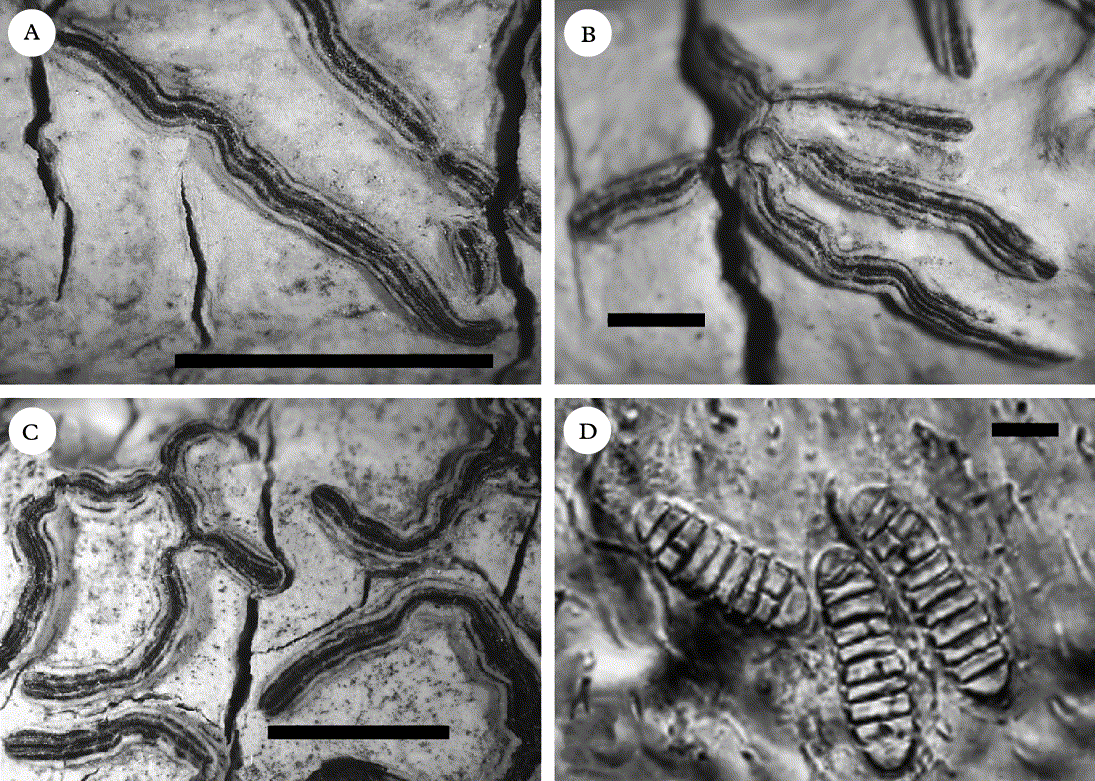
(Fig. 1)
Graphis breussii. A–C, ascomata with striate labia; D, ascospores. Scales: A = 4 mm; B = 1 mm; C = 2 mm; D = 10 μm.
Thallus corticolous, crustose, continuous, grey to whitish grey (with a slight yellowish tinge), thin, with dull surface, partly cracked, up to 5·5 × 1 cm.
Ascomata lirelliform, elongate to sinuous or curved and branched, sometimes stellate; lirellae up to 8–12 mm long and 0·3–0·6 mm wide, prominent, with convergent, distinctly striate labia, black but with conspicious thalline margin and therefore appearing dark grey (Fig. 1A–C). Excipulum basally closed and completely carbonized, deeply incised, with thalline cover (Fig. 1A–C); epithecium indistinct; hymenium colourless, not inspersed, I−, 165–200 μm high; paraphyses unbranched, 1–2 μm diameter. Asci 45–90 μm, oblong to almost cylindrical. Ascospores 4 per ascus, submuriform, with 7–11 transverse and 0–1 longitudinal septa per segment, 20–50 × 9–12 μm, hyaline, with rather thin walls and septa but I + blue-violet (Fig. 1D).
Chemistry: Norstictic acid (thallus K+ yellow turning red, in sections with yellow outflow precipitating red needles). PD negative.
Etymology: The new species is named in honour of our esteemed colleague, Dr Othmar Breuss (Vienna), for his contributions to the knowledge of pyrenocarpous lichens and the Costa Rican lichen biota. Othmar Breuss introduced the first author to tropical lichenology during many excursions in Central America.
Notes: The new species belongs in the Graphis acharii group, which is characterized by rather large, prominent, eventually striate lirellae with a completely carbonized excipulum. Thus far, there are five species in this group with muriform ascospores and containing lichen substances (Lücking et al. Reference Lücking, Chaves, Sipman, Umaña and Aptroot2008, and unpulished): G. granulosa (Müll. Arg.) Lücking and G. dealbata Nyl. with 1-spored asci, large ascospores, and hypostictic acid; G. hunanensis (Zahlbr.) M. Nakan. & Kashiw. with (2–)8-spored asci, small ascospores, and stictic acid; and G. componens Nyl. with 1-spored asci, large ascospores, and norstictic acid. Externally and anatomically species most similar to G. breussii are G. multisulcata (Müll. Arg.) Lücking & Chaves, which has the same lirellae morphology and anatomy but lacks lichen substances, and G. plurispora (Redgr.) Lücking & Chaves, with less emergent lirellae having a lateral thalline margin only, also lacking lichen substances. Graphis acharii Fée also looks similar, but has much larger ascospores and lacks lichen substances.
Since the taxonomic importance of striate lirellae is limited and specimens with striate lirellae might represent older forms of taxa originally described with entire lirellae (Staiger Reference Staiger2002; Lücking et al. Reference Lücking, Chaves, Sipman, Umaña and Aptroot2008, and unpublished.), we examined this possibility. The only species with a morphology, anatomy, and chemistry similar to Graphis breussii, but with entire lirellae, is the Australian saxicolous G. saxicola (Müll. Arg.) A. W. Archer (Archer Reference Archer2006); however, that species has less emergent lirellae and there is no evidence that it represents the first-generation form of G. breussii. We also compared species with a basally more or less non-carbonized excipulum. There is only one species in this group with norstictic acid, G. elongata Vain. [nom. illeg.; non Zenk.], but that species has immersed, very long and radially branched lirellae and produces stictic acid as an additional substance, and its ascospores are broader than those of G. breussii.
There are three taxa with similar lirellae structure and chemistry but with transversely septate ascospores: Graphis rimulosa var. parallela Müll. Arg. has ascospores of a similar size but its lirellae have a basal thalline margin only and are otherwise jet-black; G. lumbricina Vain. has very robust lirellae with the thalline cover easily flaking off, and its ascospores are much larger; and G. verminosa Müll. Arg. has lirellae very similar to those of G. breussii but its transversely septate ascospores are much longer and narrower (70–120 × 5–8 μm).
It might seem risky to describe a new species in a genus that is not yet well understood and in which hundreds of epithets have been described, but our revision of nearly 600 types belonging in Graphis s.str., and many more that do not belong in Graphis (Lücking et al. Reference Lücking, Chaves, Sipman, Umaña and Aptroot2008, and unpublished), give us confidence that G. breussii is indeed a previously undescribed species, especially as it belongs in a group where secondary substances are comparatively rare.
Distribution and ecology. The type locality is situated in the southern part of Venezuela, about 50 km from Puerto Ayacucho, near the border with Colombia, on the banks of the Rio Orinoco; it forms part of a protected area. The species was found growing on dead wood and dry bark of unidentified shrubs but was not found on living branches. The locality is characterized by solitary granite rocks with shrub vegetation at the margin of a tropical lowland rainforest along the river. The ecology of the new species thus contrasts markedly with that of most other species in the G. acharii group, which are predominantly found in montane rain forests (Lücking et al. Reference Lücking, Chaves, Sipman, Umaña and Aptroot2008).
We express our gratitude to Dr Othmar Breuss (Vienna) for many useful discussions and comments. The first author is grateful to Dr Anton Weissenhofer (Vienna) for organizing the Venezuelan tour in 2005 during which the material was collected.