Introduction
Rare earth elements represent a unique set of elements having coherent behaviour and very similar properties which are responsible for their similar geochemical properties. According to the International Union for Pure and Applied Chemistry, the term rare earth elements (REE) includes lanthanoids (Ln), yttrium (Y) and scandium (Sc). However, due to the substantially smaller ionic radius of Sc3+ with respect to the rest of the group, Sc frequently enters different crystal-structural sites, and therefore Sc is commonly not included in the REE in geological sciences, as is the case in this work. Due to the lanthanoid contraction phenomenon, the REE are further divided, by atomic number into light (LREE: La–Nd), middle (MREE: Sm–Dy) and heavy (HREE: Ho–Lu and Y).
Minerals belonging to the monazite group are anhydrous orthophosphates (with monoclinic symmetry, space group P21/n). They contain dominant trivalent LREE cations based on their preference of the monazite-type crystal structure (Ni et al., Reference Ni, Hughes and Mariano1995). Among them, monazite-(Ce) is the most common species, whereas monazite-(La), monazite-(Nd) and monazite-(Sm) are rare, found typically in specific pegmatite, post-magmatic or sedimentary environments (e.g. Maksimović and Pantó, Reference Maksimović and Pantó1980; Graeser and Schwander, Reference Graeser and Schwander1987; Demartin et al., Reference Demartin, Pilati, Diella, Donzelli and Gramaccioli1991; Pekov, Reference Pekov1998, Reference Pekov2000; Masau et al., Reference Masau, Černý, Cooper, Chapman and Grice2002; Dowman et al., Reference Dowman, Wall, Treloar and Rankin2017). Despite having a generally coherent behaviour, selective REE mobilisation and fractionation in aqueous systems is quite common and has been reported previously from different geochemical environments (e.g. Seredin, Reference Seredin1996; Morgan et al., Reference Morgan, Rate, Burton and Smirk2012; Göb et al. Reference Göb, Gühring, Bau and Markl2013; Lee et al., Reference Lee, Asahara, Tanaka, Lee and Lee2013; Ondrejka et al., Reference Ondrejka, Bačík, Sobocký, Uher, Škoda, Mikuš, Luptáková and Konečný2018, Reference Ondrejka, Uher, Ferenc, Milovská, Mikuš, Molnárová, Škoda, Kopáčik and Bačík2023; Abedini et al., Reference Abedini, Rayaei Azizi and Calagari2019; Migdisov et al., Reference Migdisov, Guo, Nisbet, Xu and Williams-Jones2019; Anenburg et al., Reference Anenburg2020). In contrast to numerous LREE-dominant minerals, there is currently only one Gd-dominant mineral approved by the Commission on New Minerals, Nomenclature and Classification of the International Mineralogical Association (IMA–CNMNC, Pasero, Reference Pasero2023): lepersonnite-(Gd) CaGd2(UO2)24(SiO4)4(CO3)8(OH)24⋅48H2O, a rare REE-uranyl carbonate from the Shinkolobwe U deposit in the DR Congo (Deliens and Piret, Reference Deliens and Piret1982). This mineral, however, contains a relatively low absolute concentration of essential Gd (2.1 wt.% Gd2O3) together with minor Dy, Y and Tb.
Here, we describe a new Gd-dominant mineral monazite-(Gd), discovered in a REE–U–Au quartz vein near Prakovce, Zimná Voda, Slovakia. Monazite-(Gd) is the Gd-dominant member of the monazite group, related to monazite-(La), monazite-(Ce), monazite-(Nd) and monazite-(Sm) by substitution of Gd for other REE and having the REE composition distinctly shifted towards the MREE. The new mineral was approved in accordance with recommendations of the IMA–CNMNC (IMA2022-055; Ondrejka et al., Reference Ondrejka, Uher, Ferenc, Majzlan, Pollok, Milovská, Mikuš, Molnárová, Škoda, Kopáčik, Orovčík and Bačík2022) and the Levinson modifier for rare earth minerals (Levinson, Reference Levinson1966; Bayliss and Levinson, Reference Bayliss and Levinson1988). The symbol Mnz-Gd was given to the new mineral. The holotype specimen of monazite-(Gd) (polished thin section ZV-2A) has been deposited in the collection of the Department of Mineralogy, Petrology and Economic Geology, Faculty of Natural Sciences, Comenius University in Bratislava, Ilkovičova 6, Mlynská dolina, 84215, Bratislava, Slovak Republic under the catalogue number MMUK7660. The cotype specimen (polished thin section ZV-2A1) is deposited in the collections of the Slovak National Museum, Natural History Museum, Vajanského nábrežie 2, P.O. BOX 13, 810 06 Bratislava, Slovak Republic under the catalogue number M-20411.
Occurrence
The Zimná voda occurrence was discovered in 1975, during exploration for uranium ores (Novotný and Čížek Reference Novotný and Čížek1979). The sample containing monazite-(Gd) was collected by Martin Ondrejka, Štefan Ferenc, Tomáš Mikuš and Alexandra Molnárová in September 2017 during reconnaissance of the Zimná Voda REE–U–Au quartz vein, Prakovce, eastern Slovakia. The site is located near the main ridge of the Slovenské Rudohorie Mts., ~5.6 km to the S of the village of Prakovce, 600 m to the NW of the Tri Studne elevation point (969 m a.s.l.) and 400 m NW of Trohánka bivouac shelter, at an altitude of ~950 m a.s.l., ca. 23 km WNW of Košice town. The geographical coordinates of the occurrence are 48.767°N and 20.913°E.
The Zimná Voda REE–U–Au vein mineralisation is located in the Lower Palaeozoic metamorphic rocks of the Bystrý Potok Formation, a part of the Gelnica Group in the Gemeric tectonic unit of the Western Carpathians, which is part of the Alpine–Carpathian Mountain belt (Bajaník et al. Reference Bajaník, Hanzel, Mello, Pristaš, Reichwalder, Snopko, Vozár and Vozárová1983; Ivanička et al., Reference Ivanička, Snopko, Snopková and Vozárová1989). Two quartz veins (Western and Eastern) containing U and Au mineralisation were found in the area. Monazite-(Gd) was found in the Western vein. The vein is located in fine-grained micaceous phyllites, with interbeds of fine-grained quartzites. It has an E–W strike, total length of ~90 m with an average dip of 65° to the S and conforms to the schistosity of the host rocks. The thickness of the vein ranges from 3 to 30 cm. Along with the contact, the rocks are intensively argillitised and locally silicified. The metamorphic rocks were intruded by Permian rare-metal granites that outcrop at a site called Hummel, ~600 m to the SW of the vein. The mineralisation probably originated by fluid-driven hydrothermal mobilisation of REE, U and Au from the surrounding metamorphic rocks induced by the intrusion of the granitic rocks (Rojkovič et al., Reference Rojkovič, Háber and Novotný1997; Reference Rojkovič, Konečný, Novotný, Puškelová and Streško1999). Further details and regional geology can be found in Ondrejka et al. (Reference Ondrejka, Uher, Ferenc, Milovská, Mikuš, Molnárová, Škoda, Kopáčik and Bačík2023).
Alongside the investigated monazite-(Gd), the following minerals were identified in the Western vein: quartz, uraninite, brannerite, rutile, gold, bismuth, bismuthinite, pyrite, arsenopyrite, cobaltite, glaucodot, molybdenite, galena, tetrahedrite-(Fe), fluorapatite, monazite-(Ce), monazite-(Nd), monazite-(Sm), xenotime-(Y), hingganite-(Y), muscovite, chlorite and tourmaline; supergene minerals are represented by goethite and other undifferentiated iron oxyhydroxides, pharmacosiderite, scorodite, arseniosiderite, zeunerite, other uranyl arsenates–phosphates (most abundant are nováčekite, kahlerite, threadgoldite, rarely autunite, chistyakovaite–arsenuranospathite related mineral phases and phosphuranylite). The gadolinium-bearing mineral assemblage also includes xenotime-(Y) and hingganite-(Y) (Ondrejka et al., Reference Ondrejka, Uher, Ferenc, Milovská, Mikuš, Molnárová, Škoda, Kopáčik and Bačík2023). Moreover, a Gd-dominant analogue of xenotime-(Y) is potentially the second new Gd-dominant mineral from this locality; a detailed structural study, necessary for its approval by the IMA–CNMNC, will be the subject of future investigations.
Experimental methods
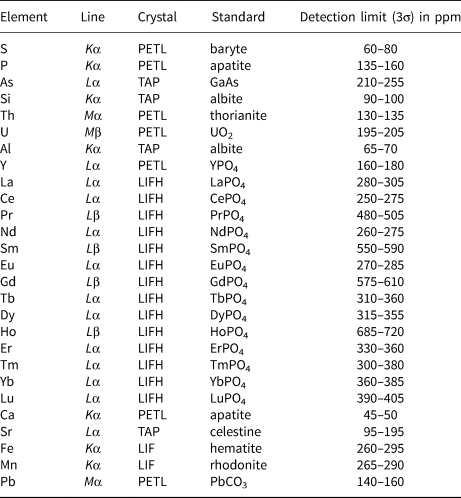
The chemical composition of selected minerals was studied by a JEOL JXA-8530F electron microprobe analyser (EMPA) in wavelength-dispersive spectrometry (WDS) mode, and X-ray element mapping at the Earth Science Institute, Slovak Academy of Sciences in Banská Bystrica, Slovakia. An accelerating voltage of 15 kV and a probe current of 20 nA were used. The typical spot beam diameter varied from 2 to 8 μm; a more focused ≤1–3 μm beam was used occasionally to avoid any intermediate composition in strongly heterogeneous micro-scale areas. The determination was calibrated using natural and synthetic standards (Table 1), and raw counts were converted to wt.% of oxides using the ZAF matrix correction. Corrections of line interferences were provided using the method by Åmli and Griffin (Reference Åmli and Griffin1975). Elements with reported detection limits are given in Table 1.
Conditions used for the electron microprobe analyses.

Depolarised Raman measurements of monazite-(Gd) were performed on a Labram HR800 spectrometer (Horiba Jobin-Yvon), coupled with an Olympus-BX41 optical microscope. Samples were irradiated using a 532 nm frequency-doubled Nd-YAG and 633 nm He–Ne lasers. The system resolution was 2 cm−1; band definition was improved using a 6-fold sub-pixel shift. Peaks were deconvoluted with a Gauss-Lorentzian function in PeakFit © (SeaSolve Software).
To determine the principal features of the crystal structure, we used transmission electron microscopy (TEM) on focused ion beam (FIB) lamella at the Institute of Geosciences, Friedrich Schiller University of Jena, Germany. This procedure enables measurement of electron diffraction patterns of the same phases that were analysed previously by EMP. The FIB preparation was conducted using a Quanta 3D FEG FIB-SEM instrument that enabled a progressive abrasion of the targeted area in the mineral using a focused beam of Ga ions, monitored by secondary electron (SE) and back-scattered electron (BSE) imaging. The monazite-(Gd) lamella was prepared by FIB as a TEM foil on a copper FIB lift-out grid. Selected-area electron diffraction (SAED) patterns of monazite-(Gd) were taken at 13 zone axis orientations on a single crystal.
Element contents in the mineral formula are expressed in atoms per formula unit (apfu), the monazite formula was normalised to 4 oxygen atoms.
Appearance and physical properties
Monazite-(Gd) forms anhedral domains (≤100 μm in size, mostly 10–50 μm), usually as intergrowths with other crystals or aggregates of monazite-(Sm) and Gd-bearing xenotime-(Y) (≤150 μm in size), fluorapatite, Gd-bearing hingganite-(Y) and uraninite scattered in quartz–muscovite gangue (Fig. 1). Among four monazite-group species recognised in the Western vein at Zimná Voda, monazite-(Ce) is the most common and is the only LREE phosphate which occurs in all of the six samples studied. Monazite-(Nd), monazite-(Sm) and monazite-(Gd) were found only in the ZV-2 sample, though in multiple thin sections. The lustre, hardness, cleavage and parting of monazite-(Gd) could not be determined, nor could density be measured due to an insufficient quantity for physical measurement. The density of 5.55 g/cm3 was calculated on the basis of average empirical formula and calculated unit-cell volume (see below). The density of the ideal formula GdPO4 is 5.99 g cm–3.
Back-scattered electron images of (a) large aggregate of monazite-(Gd) (Mnz-Gd) with xenotime-(Y) (Xtm-Y), Gd-bearing xenotime-(Y) (Gd-rich Xtm-Y) and uranyl arsenates–phosphates (U–As–P) in quartz–muscovite gangue (Qz + Ms). (b) Monazite-(Gd) (Mnz-Gd) and monazite-(Sm) (Mnz-Sm) with xenotime-(Y) (Xtm-Y) and Gd-bearing xenotime-(Y) (Gd-rich Xtm-Y) in quartz–muscovite gangue (Qz + Ms). (a) Holotype specimen, polished thin section ZV-2A; (b) cotype specimen: ZV-2A1; symbols from Warr (Reference Warr2021).

Chemical composition
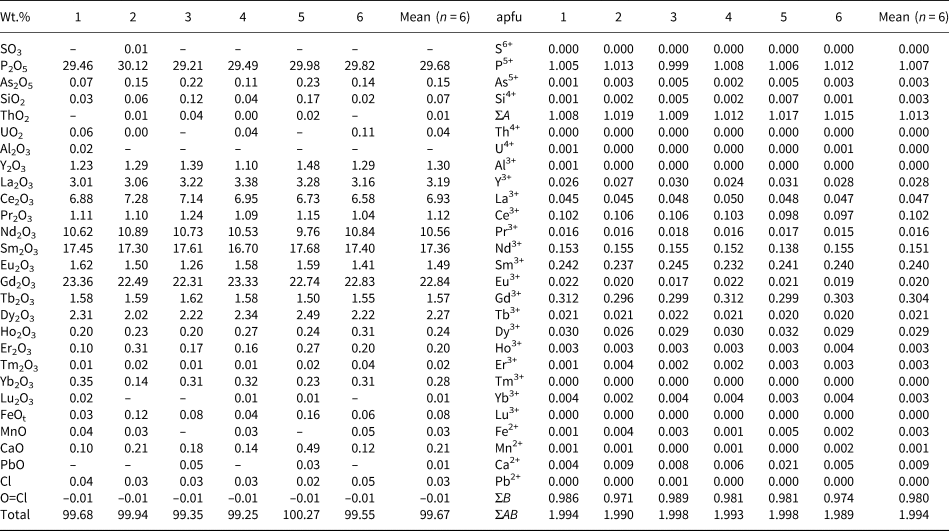
Chemical analyses were carried-out on crystals of the holotype specimen (ZV-2A thin section) and further crystals of the cotype specimen (ZV-2A1) and the composition is shown in Table 2. The individual crystals are chemically homogeneous, with no distinct variations in the core–rim profile. Locally, there may be a heterogeneous composition reflecting irregular μm-scale domains of different REE distributions. The crystals analysed have a composition with Gd>Sm>Nd>Ce>La (20.1–23.4 wt.% Gd2O3, 0.25–0.31 apfu Gd; 16.2–18.3 wt.% Sm2O3, 0.21–0.25 apfu Sm, 9.8–11.6 wt.% Nd2O3, 0.13–0.17 apfu Nd, 6.6–8.6 wt.% Ce2O3, 0.10–0.13 apfu Ce, 3.0–4.3 wt.% La2O3, 0.05–0.06 apfu La). The average chemical composition of monazite-(Gd) calculated from six point electron-microprobe analyses is as follows (wt.%): P2O5 29.68, As2O5 0.15, SiO2 0.07, ThO2 0.01, UO2 0.04, Y2O3 1.30, La2O3 3.19, Ce2O3 6.93, Pr2O3 1.12, Nd2O3 10.56, Sm2O3 17.36, Eu2O3 1.49, Gd2O3 22.84, Tb2O3 1.57, Dy2O3 2.27, Ho2O3 0.24, Er2O3 0.20, Tm2O3 0.02, Yb2O3 0.28, Lu2O3 0.01, FeO 0.08, MnO 0.03, CaO 0.21, PbO 0.01, Cl 0.03, total 99.67. The corresponding empirical formula calculated on the basis of 4 oxygen atoms is: (Gd0.30Sm0.24Nd0.15Ce0.10La0.05Dy0.03Y0.03Tb0.02Eu0.02Pr0.02Ca0.01)0.98P1.01O4 which leads to the end-member formula GdPO4 requiring 71.86 Gd2O3, 28.14 P2O5 and total 100 wt.%.
Representative and average electron microprobe analyses and mineral formula of monazite-(Gd).

– not detected
In general, the element distribution shows enrichment towards the MREE, depletion of LREE and negligible HREE (Ho–Lu)+Y abundances. The chondrite-normalised patterns exhibit conspicuous maxima at Sm and Gd (MREE hump) and a distinct downward concave W-type tetrad effect on the first tetrad (La–Nd) (for further details, see Ondrejka et al., Reference Ondrejka, Uher, Ferenc, Milovská, Mikuš, Molnárová, Škoda, Kopáčik and Bačík2023). Concentrations of Th and U were usually below the detection limit of the EPMA; Th rarely attains 1.1 wt.% ThO2 (0.01 apfu Th) in measurements having also increased Si content (≤0.7 wt.% SiO2, 0.03 apfu Si). These analyses attest to limited ThSiREE–1P–1 huttonite substitution. Satisfactory analytical totals (98−100 wt.%) and stoichiometry calculated on an anhydrous basis indicate that any potential role of a tetrahedral array of (OH)– groups is negligible. Other trace elements (Ca, Sr, Fe, Pb, S and As) have negligible concentrations or are below detection limits.
Crystallography
Monazite-(Gd) is isostructural with other monazite-group minerals; its monoclinic (space group P21/n) structure consists of isolated PO4 tetrahedra interconnected by (REE)O9 polyhedra (Ni et al., Reference Ni, Hughes and Mariano1995). A larger REE-containing polyhedron in monazite with the coordination of 9 compared to xenotime with the coordination of 8 allows the incorporation of larger cations; therefore, the monazite structure prefers LREE (Miyawaki and Nakai, Reference Miyawaki, Nakai, Gschneidner and Eyring1993). Consequently, monazite crystals with MREE enrichment are rare.
Single-crystal X-ray diffraction studies of monazite-(Gd) were not carried-out due to the small size of the crystals. However, the monazite structure is well known; therefore, selected-area electron diffraction (SAED) patterns were used to confirm the unit-cell dimensions and the symmetry of monazite-(Gd) (Fig. 2). Scanning transmission electron microscope (STEM) images at low magnification and high camera length (LMSTEM) were used to image the entire TEM-lamella. It consists of a large single crystal with sub-grains which are cross-cut by a veinlet. The neighbouring or included mineral is chlorite. The STEM images at low camera length (HAADF images) show contrast which is sensitive to the mean atomic number. These STEM images confirm the homogeneity of the sample. Slight contrast occurs at sub-grain boundaries, probably due to slight density changes there. Other changes in contrast can be correlated to thickness differences of the lamella which is an artefact from the FIB preparation.
Electron diffraction patterns of the monazite-(Gd) crystal along the zone axes specified in each panel.

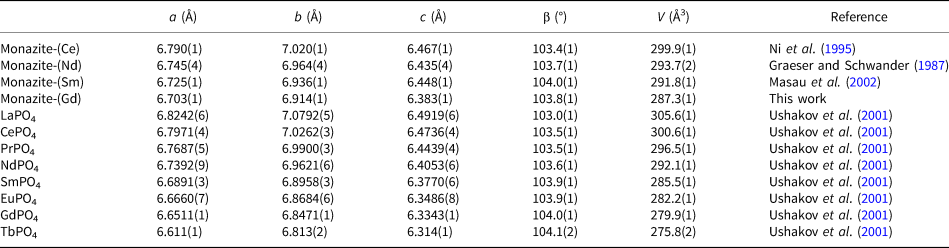
Selected-area electron diffraction (SAED) on various zone axes resulted in 45 unique reflections that allowed for a reasonable refinement of the lattice parameters (Table 3). Note that the values are less precise than those extracted from X-ray diffraction data because the θ angles in electron diffraction are extremely small. The limited number of reflections from only a part of the reciprocal space leads to a relatively large error – larger for c because the c axis is at a high angle to the FIB sample. Thus, the reflections from (001) could not be observed. The unit-cell parameters were calculated with the UnitCell program (Holland and Redfern, Reference Holland and Redfern1997) as a = 6.71(2) Å, b = 6.98(2) Å, c = 6.55(5) Å, β = 104.4(6)°, V = 297.1(4) Å3 and Z = 4.
Unit-cell parameters for natural monazite members and synthetic monazite REEPO4 compounds.

The monazite structure is relatively simple; therefore, there is a near-ideal linear trend of decreasing unit-cell parameters with decreasing ionic radii of REE cations in synthetic REEPO4 with a monazite structure (Ni et al., Reference Ni, Hughes and Mariano1995; Ushakov et al., Reference Ushakov, Helean, Navrotsky and Boatner2001). In contrast, the β angle has an inverse near-linear correlation with the REE ionic radii, it increases with smaller radii (Ni et al., Reference Ni, Hughes and Mariano1995). Consequently, it is possible to assume that the unit-cell parameters of the observed mineral probably correspond to the weighted average of the corresponding end-member unit-cell parameters. This assumption allowed the calculation of unit-cell parameters from the weighted sum of end-members as a = 6.703(1) Å, b = 6.914(1) Å, c = 6.383(1) Å, β = 103.8(1)°, V = 287.3(1) Å3 and Z = 4. These are, in general, lower than unit-cell parameters calculated from SAED. The difference can be attributed to the variations in REE, which, although not significant, is observable. This suggests that the average composition from which the unit-cell size was calculated could be slightly different to the composition of crystal fragments from which SAED patterns were measured. Moreover, the accuracy of the unit-cell parameters is limited by relatively large errors in SAED measurements, as explained above. For comparison, unit-cell parameters for natural monazite members and synthetic monazite REEPO4 compounds are presented in Table 3.
Raman spectroscopy
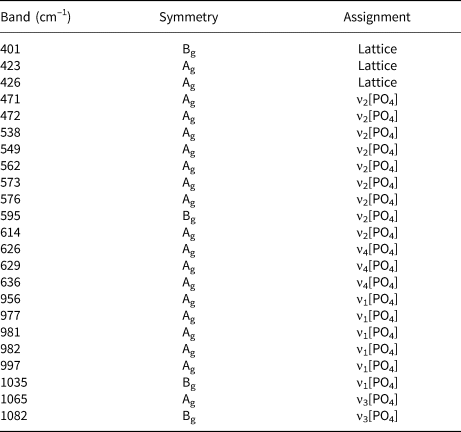
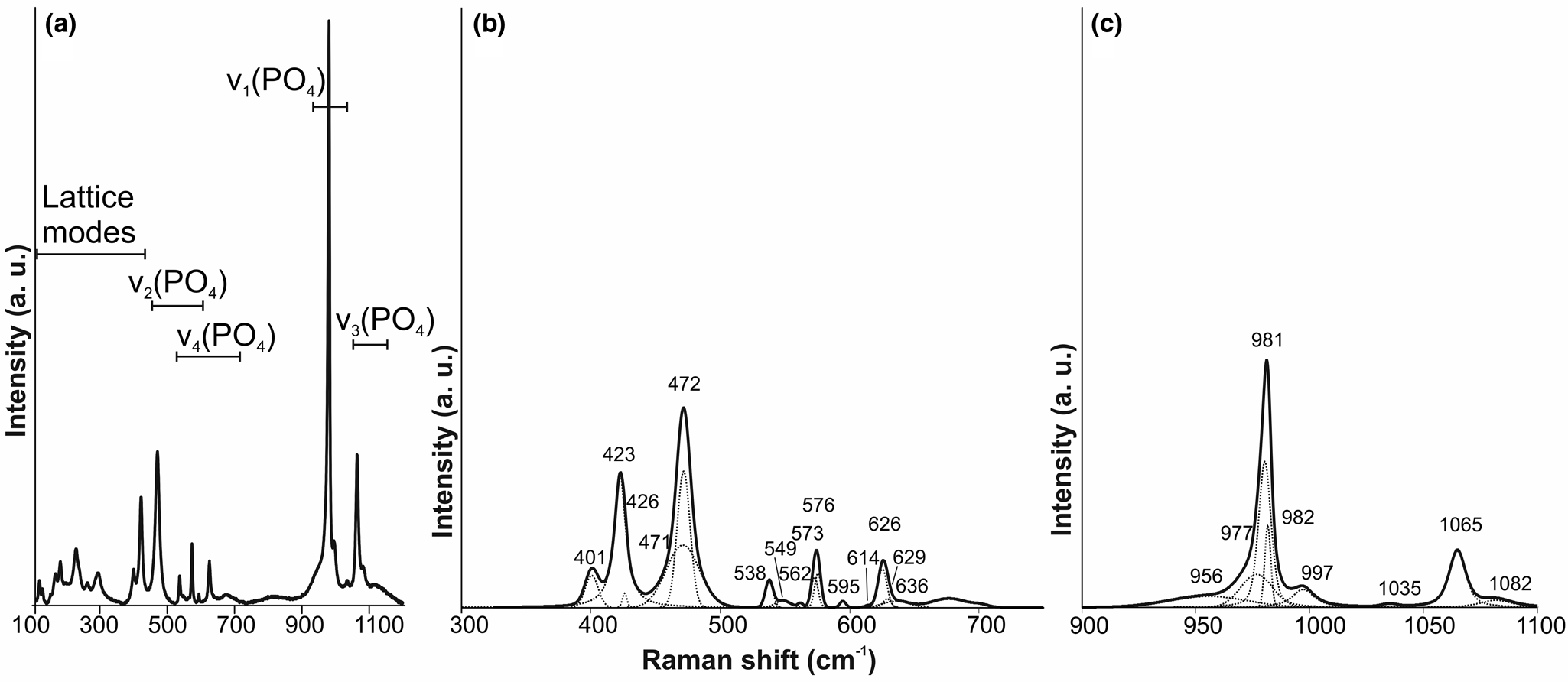
The Raman spectrum of monazite-(Gd) has already been published in supplementary material to Ondrejka et al. (Reference Ondrejka, Uher, Ferenc, Milovská, Mikuš, Molnárová, Škoda, Kopáčik and Bačík2023) and is in good agreement with other monazite-group mineral species. All the Raman bands of the monazite-(Gd) occur in the range of up to 1200 cm–1 (Table 4). Two groups of lines were observed: from 100 to 700 cm–1, with dominant bands at 423 cm–1 and 472 cm–1 and 950–1100 cm–1, with the most intensive bands centred at 981 cm–1 and having an asymmetric shape.
Raman bands for monazite-(Gd)

A Raman spectrum of monazite is predicted to contain 36 (18Ag + 18Bg) modes (Begun et al., Reference Begun, Beall, Boatner and Gregor1981; Ruschel et al., Reference Ruschel, Nasdala, Kronz, Hanchar, Többens, Škoda, Finger and Möller2012; Heuser et al., Reference Heuser, Bukaemskiy, Neumeier, Neumann and Bosbach2014). The bands below 700 cm–1 correspond to lattice vibrations, translations and rotations, the A-PO4 movements and symmetric bending (ν2), and asymmetric bending (ν4) vibrations of the PO4 tetrahedra. The symmetric (ν1) and antisymmetric stretching (ν3) vibrations region of the PO4-tetrahedra is expressed in the 900–1100 cm–1 region (Fig. 3), where ν1 are the most intensive.
Depolarised 532 nm-excited Raman spectrum of monazite-(Gd) with its peak wavenumbers. (a) Full range spectrum with assigned Raman bands. (b and c) Deconvolution of spectrum to single Gaussian–Lorentzian-shaped bands in the regions of 300–750 cm–1 and 900–1100 cm–1. Intensity scale bar in arbitrary units (a.u.).

Discussion
Monazite-(Gd) is a new lanthanoid orthophosphate mineral of the monazite group with a unique Gd-dominance over the other REE cations. It represents only the second Gd-dominant mineral, described in nature, and approved by IMA–CNMNC, after lepersonnite-(Gd), CaGd2(UO2)24(SiO4)4(CO3)8(OH)24⋅48H2O, from the Shinkolobwe uranium deposit, DR Congo (Deliens and Piret, Reference Deliens and Piret1982). However, monazite-(Gd) contains a significantly higher content of Gd: 20.1–23.4 wt.% Gd2O3 than lepersonnite-(Gd) (only 2.1 wt.% Gd2O3, Deliens and Piret, Reference Deliens and Piret1982). Beside monazite-(Gd), monazite-(Ce), monazite-(Nd) and monazite-(Sm) from the Zimná Voda quartz vein are also enriched in Gd (2.5 to 19.1 wt.% Gd2O3, 0.03 to 0.25 apfu Gd; Ondrejka et al., Reference Ondrejka, Uher, Ferenc, Milovská, Mikuš, Molnárová, Škoda, Kopáčik and Bačík2023). Moreover, rare occurrences of MREE (Nd, Sm and Gd)-rich compositions in the monazite-group minerals have been described from some magmatic rocks. Monazite-(Sm) from the Annie Claim #3 pegmatite, Canada had 12.1−13.5 wt.% Gd2O3 (0.16−0.18 apfu Gd; Masau et al., Reference Masau, Černý, Cooper, Chapman and Grice2002). Monazite-(Ce) to -(Sm) with 4.7−8.9 wt.% Gd2O3 (0.06−0.12 apfu Gd) was detected in the Utsumine and Siohira granites and Shimo-ono pegmatite, Japan (Hoshino et al., Reference Hoshino, Watanabe and Ishihara2012). There was 5.7−7.5 wt.% Gd2O3 (0.07−0.10 apfu Gd) in monazite-(Nd) from Sierra de Cobres carbonatite dykes, Argentina (Del Blanco et al., Reference Del Blanco, Ulbrich, Echeveste and Vlach1998) and 2.9−4.8 wt.% Gd2O3 in monazite-(Ce) to monazite-(Nd) from the Abu Rusheid lamprophyre dyke, Egypt (Ali, Reference Ali2012). Lesser Gd enrichment of up to 3.25 wt.% Gd2O3 (≤0.04 apfu Gd) has also been detected in skeletal monazite-(Ce) from the Oldřich pegmatite vein, Dolní Bory, Czech Republic (Výravský, Reference Výravský2014) and 2.2 to 2.8 wt.% Gd2O3 (0.03−0.04 apfu Gd) in low-temperature, authigenic monazite-(Nd) and monazite-(La) from bauxite deposits at Marmara, Greece and Liverovici, Montenegro (Maksimović and Pantó, Reference Maksimović and Pantó1980, Reference Maksimović, Pantó, Jones, Wall and Williams1996).
Such unusual enrichment of MREE (Gd, Nd and Sm) in monazite-group members as well as in some other REE minerals [e.g. xenotime-(Y) and hingganite-(Y)] could be a result of selective complexing of REE during granite to pegmatite sequence solidification in aqueous F–Li–CO2-bearing fluids (Masau et al., Reference Maksimović, Pantó, Jones, Wall and Williams2002). Moreover, late-hydrothermal alteration of MREE-enriched precursors (uraninite, brannerite and fluorapatite) is considered as the principal factor for precipitation of monazite-(Gd) and associated Gd-rich minerals (Ondrejka et al., Reference Ondrejka, Uher, Ferenc, Milovská, Mikuš, Molnárová, Škoda, Kopáčik and Bačík2023).
Acknowledgements
This work was supported by the Slovak Research and Development Agency under the contracts APVV-18-0065, APVV-19-0065, VEGA 1/0467/20, VEGA 1/0563/22 and by OP VVV project (Geobarr CZ.02.1.01/0.0/0.0/16_026/0008459 to R.S.). K.P. thanks F. Langenhorst for support and access to the FIB-SEM and TEM facilities in Jena, which are funded by the DFG via grant LA830/14-1. We thank Ľubomír Orovčík (Institute of Materials and Machine Mechanics, Slovak Academy of Sciences) for his attempt with the EBSD technique. Finally, we thank Peter Leverett, two anonymous reviewers, Ian Graham (Associate Editor) and Stuart Mills (Principal Editor) for their constructive suggestions.
Competing interests
The authors declare none.