Introduction
Patients with post-traumatic stress disorder (PTSD) have intrusive memories of a traumatic event, avoid stimuli associated with the event, and live in a constant state of heightened arousal (APA, 1994). They feel as if the traumatic event keeps repeating itself.
Based on reported neuroanatomical models and functional brain-imaging studies in PTSD, both temporal and prefrontal cortical brain regions are thought to be involved in the pathophysiology of PTSD (Pitman et al. Reference Pitman, Shin and Rauch2001; Bremner, Reference Bremner2002; Hull, Reference Hull2002). First, temporal structures are presumed to play a critical role in the acquisition and extinction of conditioned fear and in the expression of associated autonomic arousal (Davis & Whalen, Reference Davis and Whalen2001; Pitman et al. Reference Pitman, Shin and Rauch2001). Trauma-related stimuli may cause hyperactivity in these regions, especially in the amygdala and insula (Pitman et al. Reference Pitman, Shin and Rauch2001). Second, the medial prefrontal cortex modulates responses to fear through inhibitory connections with the amygdalar, peripheral sympathetic and peripheral hormonal responses to stress (LeDoux, Reference LeDoux2000; Devinsky et al. Reference Devinsky, Morrell and Vogt1995). In PTSD, dysfunction of the medial prefrontal cortex has been postulated as a reason why fear responses are not sufficiently suppressed (Bremner, Reference Bremner2002). A reciprocal relationship has been found between medial prefrontal cortex function and amygdala function in PTSD (Shin et al. Reference Shin, Orr, Carson, Rauch, Macklin, Lasko, Orr and Pitman2004). However, Gilboa and colleagues (Reference Gilboa2004) found only little evidence for failure of inhibition of cingulate or subcallosal cortex over the amygdala. Third, the dorsolateral prefrontal cortex may play an important role in the neural network, subserving the working memory that is responsible for the short-term storage, manipulation and utilization of mental representations (Smith & Jonides, Reference Smith and Jonides1999; LeDoux, Reference LeDoux2000; Levy & Goldman-Rakic, Reference Levy and Goldman-Rakic2000). The controlling of unwanted memories has been associated with increased dorsolateral prefrontal activation in a non-patient group (Anderson et al. Reference Anderson, Ochsner, Kuhl, Cooper, Robertson, Gabrieli, Glover and Gabrieli2004). In episodic memory studies activations in the right mid-dorsolateral prefrontal cortex were often reported, but such activations were absent in autobiographical memory studies (Gilboa, Reference Gilboa2004). In PTSD, abnormal patterns of frontal and parietal activity were found during working-memory tasks (Shaw et al. Reference Shaw, Strother, McFarlane, Morris, Anderson, Clark and Egan2002; Clark et al. Reference Clark, McFarlane, Morris, Weber, Sonkkilla, Shaw, Marcina, Tochon-Danguy and Egan2003; Weber et al. Reference Weber, Clark, McFarlane, Moores, Morris and Egan2005). Thus, dysfunction of the dorsolateral prefrontal cortex in PTSD might be hypothesized to explain at least some of the pathophysiology of PTSD.
The first hypothesis of our study concerns the pathophysiology of PTSD. Taking all the above information into consideration, we hypothesize that trauma-related stimuli in PTSD result in higher activation of the temporal structures and the dorsolateral prefrontal cortex, and lower activation of the medial prefrontal cortex.
Little is known as yet about changes in brain function after psychotherapy. Two studies have examined brain function changes in patients with major depression when treated with interpersonal psychotherapy (Brody et al. Reference Brody, Saxena, Stoessel, Gillies, Fairbanks, Alborzian, Phelps, Huang, Wu, Ho, Au, Maidment and Baxter2001) or cognitive–behavioural therapy (CBT; Goldapple et al. Reference Goldapple, Segal, Garson, Lau, Bieling, Kennedy and Mayberg2004). Similar studies were performed on patients with social phobia (Furmark et al. Reference Furmark, Tillfors, Martlinsdottin, Fischer, Pissiota, Langstrom and Fredrikson2002) or obsessive–compulsive disorder (Baxter et al. Reference Baxter, Schwartz, Bergman, Szuba, Guze, Mazziotta, Alazraki, Selin, Gerng and Munford1992) treated with CBT. For PTSD, only two single-case reports (Levin et al. Reference Levin, Lazrove and Van der Kolk1999; Fernandez et al. Reference Fernandez, Pissiota, Frans, Von Knorring, Fischer and Fredrikson2001) and one research report (Seedat et al. Reference Seedat, Warwick, Van Heerden, Hugo, Zungu-Dirwayi, Van Kradenbrug and Stein2004) have been published, describing the effects of eye-movement desensitization and reprocessing (EMDR; Levin et al. Reference Levin, Lazrove and Van der Kolk1999) and selective serotonin reuptake inhibitors (SSRIs; Fernandez et al. Reference Fernandez, Pissiota, Frans, Von Knorring, Fischer and Fredrikson2001; Seedat et al. Reference Seedat, Warwick, Van Heerden, Hugo, Zungu-Dirwayi, Van Kradenbrug and Stein2004) using single-photon emission computed tomography (SPECT; Levin et al. Reference Levin, Lazrove and Van der Kolk1999; Seedat et al. Reference Seedat, Warwick, Van Heerden, Hugo, Zungu-Dirwayi, Van Kradenbrug and Stein2004) and photon emission tomography (PET; Fernandez et al. Reference Fernandez, Pissiota, Frans, Von Knorring, Fischer and Fredrikson2001). The effects of SSRI treatment in PTSD patients were found in the temporal lobe structures (Fernandez et al. Reference Fernandez, Pissiota, Frans, Von Knorring, Fischer and Fredrikson2001; Seedat et al. Reference Seedat, Warwick, Van Heerden, Hugo, Zungu-Dirwayi, Van Kradenbrug and Stein2004) and the effects of EMDR were found in the prefrontal cortical regions (Levin et al. Reference Levin, Lazrove and Van der Kolk1999). Hence, the second hypothesis of this study postulates that effective psychotherapy influences regional blood flow in the prefrontal cortical regions.
To test the first hypothesis, we obtained psychometric ratings and measured regional cerebral blood flow (rCBF) changes induced by trauma script-driven imagery in patients with PTSD, comparing these to data obtained in traumatized control subjects. To test the second hypothesis, we used a randomized controlled study design to evaluate the effects of psychotherapy, comparing the baseline psychometric ratings and rCBF values with measurements repeated 4 months after baseline. For the intervening period, patients were randomly assigned to treatment or wait-list conditions. To the best of our knowledge, this is the first randomized controlled trial that assesses the effects of psychotherapy in PTSD in terms of psychometric ratings and changes in rCBF measured by 99mtechnetium hexamethyl-propylene-amine-oxime ([99mTc]HMPAO) SPECT.
Subjects and method
Subjects and clinical assessment
Twenty-four civilian Dutch out-patients with DSM IV-defined PTSD (APA, 1994) and 15 control subjects were included. The control subjects had experienced one or more traumatic events in their lives without ever developing PTSD. The patients with PTSD were referred by general practitioners and the academic out-patient clinic of the Department of Psychiatry. The traumatized control subjects were police officers who responded to an advertisement in police papers. The same control group was also part of another study in which rCBF changes were measured in police officers with PTSD (Lindauer et al. Reference Lindauer, Booij, Habraken, Uylings, Olff, Carlier, Den Heeten, Van Eck-Smit and Gersons2004). The study was approved by the Institutional Medical Ethics Committee of the Academic Medical Centre, Amsterdam. Before entering the study, all participants received study information and gave signed informed consent.
The diagnosis of PTSD was based on the DSM-IV criteria and was obtained using the Structured Interview for Posttraumatic Stress Disorder (SI-PTSD; Davidson et al. Reference Davidson, Smith and Kudler1989). For the Dutch version of the SI-PTSD, we found a Cronbach's α of 0.93 and a Cohen's κ of 0.88, which can be considered acceptable (Carlier et al. Reference Carlier, Lamberts, Van Uchelen and Gersons1998). In addition to assessing PTSD, the SI-PTSD elicits information about the presence or absence of the three symptom clusters (re-experiencing, avoidance, and hyperarousal) and scales their severity in both a current and a lifetime perspective. The Structured Clinical Interview for DSM-IV (SCID; Spitzer et al. Reference Spitzer, Gibbon, Janet and Janet1996) was administered to assess co-morbidity, and provided an indication of the severity of major depression, expressed as the intensity of major depression (mild to severe). The List of Traumatic Events is a semi-structured interview inquiring about any traumatic experiences participants have had (Carlier et al. Reference Carlier, Voerman and Gersons2000). They were asked whether they had experienced such events at any time in the past. An additional question about the perceived adverse effects of each specific event was rated on a 5-point scale (1=‘no effects’; 5=‘very strong effects’). The described events satisfy the stressor A(1) criterion for a diagnosis of PTSD. Sixteen of the 24 PTSD subjects had developed PTSD after exposure to interpersonal violence and eight had developed PTSD after exposure to accidents or disasters. Ten of the 15 control subjects had exposure to interpersonal violence and five had exposure to accidents. The traumatic events experienced by the control subjects were events that had had the greatest impact on their lives. The traumatic events of both groups satisfy the stressor A(1) criterion with a rating score of >3 on adverse effects. The Dissociation Experiences Scale (DES) assessed the severity of any dissociative symptoms (Bernstein & Putnam, Reference Bernstein and Putman1986). The DES was also translated into Dutch (Carlier et al. Reference Carlier, Fouwels, Lamberts and Gersons1996). A background questionnaire was also performed to collect demographic information.
Exclusion criteria for both groups included major lifetime or current medical or psychiatric diagnoses: organic mental disorder, head trauma with loss of consciousness, mental retardation, seizures, neurological disorders, schizophrenia, psychotic disorders, bipolar disorder, moderate and severe major depression, panic disorder, phobia, obsessive–compulsive disorder and dissociative disorders. Persons with lifetime or current alcohol or drug abuse or dependence, use of psychiatric medication, and left-handedness were also excluded.
Procedure
After inclusion, all participants visited the Department of Psychiatry to create a standardized script lasting 30–35 seconds on the traumatic event they had personally experienced. The scripts made conformed to the literature (Pitman et al. Reference Pitman, Orr, Forgue, De Jong and Claiborn1987). For the out-patients with PTSD, the traumatic event that was thought to have triggered the PTSD was chosen as the trauma script, and for the traumatized control subjects without PTSD it was the traumatic event that had made the heaviest impact on their lives. For about one third of both the patients and the control subjects, the trauma scripts involved accidents or disasters; the other two thirds of the scripts involved interpersonal violence. The scripts were audiotaped and were played back immediately prior to the SPECT scanning. Patients with PTSD showed a significantly stronger physiological response to the trauma script than the traumatized control subjects (an increase of ⩾5 heartbeats per minute [t(−2.91)=22.28, p=0.008]; Lindauer et al. Reference Lindauer, van Meijel, Jalink, Olff, Carlier and Gersons2005). After the baseline scanning, the patients with PTSD were randomly assigned to either the psychotherapy or the wait-list condition. A colleague who had performed no assessments used a computer program to randomly assign patients to each condition in a block design. Four patients dropped out after randomization due to emigration, illness in family, work obligations or technical problems in SPECT scanning. The wait-list patients were told they would receive treatment in 4 months' time. After the 4-month treatment period, all patients (both the treated and the wait-listed groups) were assessed a second time with SI-PTSD, List of Traumatic Events and SCID. A second SPECT scan, again using script-driven imagery to measure changes in rCBF, was obtained within 1 week from this clinical assessment. The clinical raters were blind to the scan data.
Psychotherapy
Details of our psychotherapy have been published previously (Gersons et al. Reference Gersons, Carlier, Lamberts and Van der Kolk2000) and are reviewed here only briefly. The treatment comprised brief eclectic psychotherapy (BEP) in 16 weekly individual sessions of 45–60 min each. The course of BEP was administered as prescribed by the manual (Gersons et al. Reference Gersons, Carlier and Olff2004). BEP incorporates several intervention techniques also used in the effective CBT protocols, such as psychoeducation, imaginal exposure, writing tasks, and cognitive restructuring. BEP also includes a focal psychodynamic approach as well as the use of a farewell ritual at the end of the treatment. The psychotherapists were clinically experienced psychiatry residents who were supervised by two senior psychiatrists (I.V. and B.P.R.G.). One of them had developed the treatment (B.P.R.G.). All sessions were audiotaped. A special rating system covering the five elements of BEP described above was developed to analyse treatment integrity. Five audiotapes of each treatment were scored. Treatment integrity was approximately 75%, with κ>0.81, indicating good adherence to the protocol.
SPECT method
rCBF imaging was measured by [99mTc]HMPAO SPECT. Image acquisition was performed with a brain-dedicated SPECT camera (Strichman 810X; Strichman Medical Equipment Inc., Medfield, MA, USA).
Before the scanning, all participants were prepared in a quiet environment. For a few minutes before the script was played, they lay still and relaxed, closed their eyes, and breathed through their mouth to minimize extracranial blood flow to the temporal muscles that might arise from teeth clenching (Drevets et al. Reference Drevets, Videen, MacLeod, Haller and Raichle1992). While listening to the script and for about 10 min thereafter, they were asked to imagine the traumatic event as vividly as possible, as though they were actually re-experiencing it. Twenty seconds after the start of the script, they received an intravenous injection of approximately 275 MBq of the radiotracer [99mTc]HMPAO. At the end of the 10 min following the script, they completed a State-Trait Anxiety Inventory-State (STAI-State) questionnaire to score their state of anxiety while imagining the event described by the script (Spielberger et al. Reference Spielberger, Gorsuch and Lushene1970). The SPECT imaging then commenced, 15 min after the injection. It recorded the subjects' condition at the time the radiotracer was injected, immediately after they had heard the script. Subjects were placed in the scanner with their head held in a holder to minimize motion, and positioned with the canthomeatal line parallel to an external laser light. Each acquisition consisted of approximately 20 slices at 3 min per slice from the cerebellum up to the vertex of the skull (interslice distance 5 mm). The energy window was set at 124–158 keV. Other acquisition parameters were set and the images reconstructed as described previously (Booij et al. Reference Booij, Tissingh, Boer, Speelman, Stoof, Janssen, Wolters and Van Royen1997).
Statistical and image analyses
Statistical analyses were performed with SPSS 11.0 for Windows (SPSS Inc., Chicago, IL, USA). Demographic characteristics and clinical variables were analysed with an independent t test (two-tailed) for the continuous variables and a χ2 test for the categorical ones. Treatment effects on clinical variables were analysed by multivariate analyses of covariance (MANCOVA), using the baseline measurements of the PTSD scores as covariates. The significance level was set at 5% (α=0.05).
Statistical parametric mapping [SPM99 (www.fil.ion.ucl.ac.uk/spm)] was implemented in Matlab 6.1 (Mathworks, Sherborn, MA, USA) (Friston et al. Reference Friston, Holmes, Worsley, Poline, Frith and Frakowiak1995) to analyse the SPECT data. SPM located areas of significant change in mean voxel intensity between groups of scans in different brain states and/or from different groups of participants. SPM (Friston et al. Reference Friston, Holmes, Worsley, Poline, Frith and Frakowiak1995, Reference Friston, Holmes, Poline, Price and Frith1996) performed automated co-registration of all brain images into standard stereotaxic space as defined by Talairach & Tournoux (Reference Talairach and Tournoux1988), followed by voxelwise statistical analysis based on the theory of Gaussian fields. Montreal Neurological Institute (MNI) coordinates were used, which differ from Talairach coordinates in their origin: MNI (0, 0, 0) is Talairach (−0.8, −3.3, −0.4) (Brett et al. Reference Brett, Johnsrude and Owen2002; Chau & McIntosh, Reference Chau and McIntosh2005). No smoothing filter was applied because of limited resolution. Statistical parametric maps of the t statistics, SPM (t), were then calculated and transformed to the unit normal distribution, SPM (z). Only clusters of connected voxels above an extent threshold of 20 voxels (voxel threshold probability of 0.01, z score=2.33, two-tailed, uncorrected) were tested for significance using special extent statistics (Worsley et al. Reference Worsley, Evans, Marrett and Neelin1992; Friston et al. Reference Friston, Holmes, Poline, Price and Frith1996). The voxel size (x, y, z) was 3.175 mm×3.175 mm×5 mm.
Four general steps were performed in the SPM analyses: (1) comparison of the baseline SPECT scans of the PTSD and the traumatized control groups; (2) comparison of the baseline SPECT scans of the treatment and wait-list groups; (3) interaction effects between time (pre v. post) and group (treatment v. wait-list); and (4) bivariate correlations between PTSD symptoms and rCBF. The first three steps were analysed within one linear statistical model. The last step was analysed by a regression analysis.
Results
Baseline comparisons across groups
Demographic and clinical variables for the entire PTSD group compared to traumatized controls
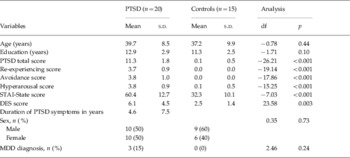
Demographic characteristics of patients (n=20) and drop-outs (n=4) showed no significant differences. In the statistical analyses, the net sample size was 20 for the PTSD group and 15 for the traumatized control group. No statistical differences were found between the PTSD and the traumatized control groups on the demographic characteristics of age, gender or education (Table 1).
Demographic and clinical variables of the PTSD and traumatized control group

PTSD, Post-traumatic stress disorder; STAI-State, State-Trait Anxiety Inventory-State; DES, Dissociation Experiences Scale; MDD, major depressive disorder.
The PTSD total scores, the re-experiencing, avoidance and hyperarousal scores, the STAI-State scores, and the DES scores were significantly higher in the PTSD group than in the traumatized control group. Three of the 20 patients with PTSD also had a current secondary (onset after PTSD) first-episode mild major depression, but no significant difference was found between the two groups in the occurrence of mild major depressions (Table 1).
SPECT data for the entire PTSD group compared to traumatized controls
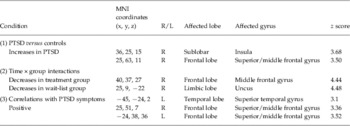
rCBF was significantly greater in the right insula (p=0.001) and the right superior/middle frontal gyrus (p=0.004) in the PTSD group compared to the traumatized control group (Table 2).
Statistical parametric mapping analyses showing (1) significant rCBF differences (p<0.01, unadjusted) between the PTSD and traumatized control group; (2) significant effects between time (pre v. post) and group (treatment v. wait-list) interactions; (3) correlations between PTSD symptoms and rCBF

rCBF, Regional cerebral blood flow; PTSD, Post-traumatic stress disorder; MNI, Montreal Neurological Institute; R, right; L, left; PTSD, post-traumatic stress disorder.
Treatment effects
Demographic and clinical variables for the PTSD treatment group compared to the PTSD wait-list group
Statistical analysis of the treatment effects was carried out on the net PTSD sample (n=20), comparing the treatment subgroup (n=10) to the wait-list subgroup (n=10); six male and four female patients received treatment, and four male and six female patients were on the wait-list. No significant differences existed between the treatment and wait-list groups on any of the demographic characteristics and clinical variables recorded at baseline. One patient who could not remain on the waiting list received treatment and was transferred to the treatment subgroup.
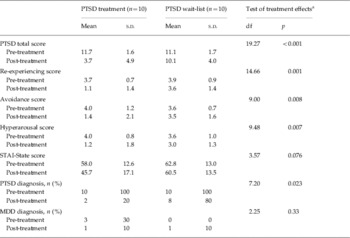
No significant baseline differences were found between the treatment and wait-list groups on any clinical variables. After treatment, the patients in the treatment group were significantly improved on all PTSD clinical variables in comparison to the wait-list group. There was a trend towards improvement on the STAI-State scores, but not for the prevalence of mild major depression (Table 3).
Treatment effects on clinical variables
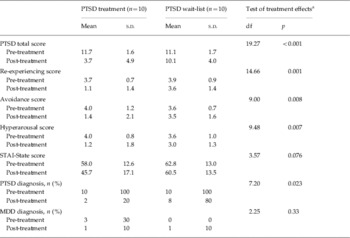
PTSD, Post-traumatic stress disorder; STAI-State, State-Trait Anxiety Inventory-State; MDD, major depressive disorder.
a Interaction effects between time (pre v. post) and group (treatment v. wait-list).
SPECT data for the PTSD treatment group compared to the PTSD wait-list group
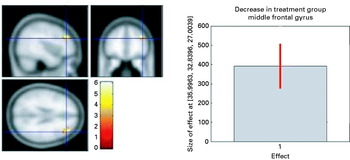
No significant differences in rCBF were found between the treatment and wait-list groups at baseline. Time (pre v. post) x group (treatment v. wait-list) interaction effects were found with significantly lower rCBF in the right middle frontal gyrus (p=0.004; Table 2 and Fig. 1) and right uncus (p=0.009; Table 2).
Treatment effects: lower regional cerebral blood flow (rCBF) in the right middle frontal gyrus (x, y, z=40, 37, 27).

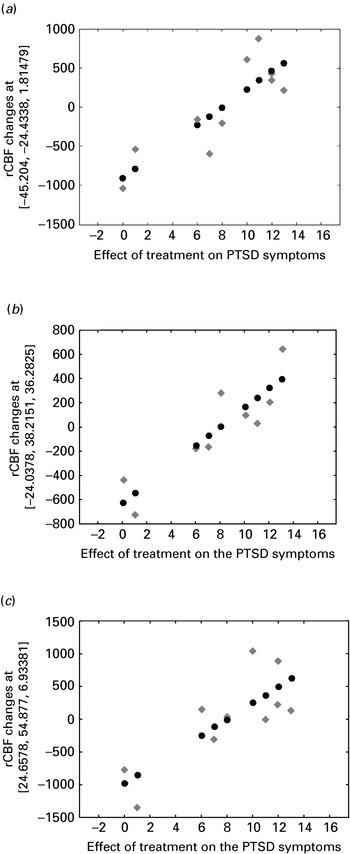
The effect of treatment on the PTSD total score correlated positively with the rCBF changes in the left superior temporal gyrus (p=0.016), and the middle frontal gyrus (left, p<0.001; right, p=0.02) (Table 2 and Fig. 2).
The effect of treatment on the PTSD symptoms correlated positively with the regional cerebral blood flow (rCBF) changes in (a) the left superior temporal gyrus (x, y, z=−45, −24, 2), (b) left superior/middle frontal gyrus (x, y, z =−24, 38, 36), and (c) right superior/middle frontal gyrus (x, y, z=25, 51, 7).

Discussion
Our study consisted of two parts, addressing two hypotheses. The first concerned the pathophysiology of PTSD. In support of our hypothesis, we found greater activation in the insula and the right dorsolateral prefrontal cortex (superior/middle frontal gyrus) in the PTSD subjects. Comparable results have been reported by others (Pitman et al. Reference Pitman, Shin and Rauch2001; Anderson et al. Reference Anderson, Ochsner, Kuhl, Cooper, Robertson, Gabrieli, Glover and Gabrieli2004). However, we found no differences in activation in the medial prefrontal cortex. Some studies have reported decreased activation of the medial frontal gyrus in PTSD (Bremner et al. Reference Bremner, Narayan, Staib, Southwick, McGlashan and Charney1999; Shin et al. Reference Shin, McNally, Kosslyn, Thompson, Rauch, Alpert, Metzger, Lasko, Orr and Pitman1999, Reference Shin, Whalen, Pitman, Bush, Macklin, Lasko, Orr, McInerney and Rauch2001; Semple et al. Reference Semple, Goyer and McCormick2000), while others have found no activation (Lucey et al. Reference Lucey, Costa, Adshead, Deahl, Busatto, Gacinovic, Travis, Pilowsky, Ell, Marks and Kerwin1997; Rauch et al. Reference Rauch, Savage, Alpert, Fischman and Jenike1997, Reference Rauch, Whalen, Shin, McInerney, Macklin, Lasko, Orr and Pitman2000; Mirzaei et al. Reference Mirzaei, Knoll, Keck, Preitler, Gurtierrez, Umek, Kohn and Pechenstorfer2001; Osuch et al. Reference Osuch, Benson, Geraci, Podell, Herscovitch, McCann and Post2001; Pissiota et al. Reference Pissiota, Frans, Fernandez, Von Knorring, Fischer and Fredrikson2003) or even increased activation (Rauch et al. Reference Rauch, Van der Kolk, Fisher, Alpert, Orr, Savage, Fischman, Jenike and Pitman1996; Liberzon et al. Reference Liberzon, Taylor, Fig and Koeppe1997; Shin et al. Reference Shin, Kosslyn, McNally, Alpert, Thompson, Rauch, Macklin and Pitman1997; Zubieta et al. Reference Zubieta, Chinitz, Lombardi, Fig, Cameron and Liberzon1999). Thus, decreased activation of the medial frontal gyrus has not been a consistent finding in PTSD. For example, in our previous study we found decreased activation of the medial frontal gyrus in police officers with PTSD which was not found in the present study (Lindauer et al. Reference Lindauer, Booij, Habraken, Uylings, Olff, Carlier, Den Heeten, Van Eck-Smit and Gersons2004). This difference could be explained by the different patient populations and/or the different scripts that were used for provocation. Other possible sources of this inconsistency include co-morbidity study design (e.g. healthy as opposed to traumatized controls), and/or imaging methods [SPECT versus PET or functional magnetic resonance imaging (fMRI)]. Future studies should examine the contribution of each item separately.
Up to now, functional brain-imaging studies in PTSD have recruited mostly victims of war (Semple et al. Reference Semple, Goyer, McCormick, Morris, Compton-Toth, Muswick, Nelson, Donovan, Leisure, Berridge, Miraldi and Schulz1993; Bremner et al. Reference Bremner, Innis, Ng, Staib, Salomon, Bronen, Duncan, Southwick, Krystal, Rich, Zubal, Dey, Soufer and Charney1997; Shin et al. Reference Shin, Kosslyn, McNally, Alpert, Thompson, Rauch, Macklin and Pitman1997, Reference Shin, McNally, Kosslyn, Thompson, Rauch, Alpert, Metzger, Lasko, Orr and Pitman2001; Liberzon et al. Reference Liberzon, Taylor, Amdur, Jung, Chamberlain, Minoshima, Koeppe and Fig1999; Zubieta et al. Reference Zubieta, Chinitz, Lombardi, Fig, Cameron and Liberzon1999; Rauch et al. Reference Rauch, Whalen, Shin, McInerney, Macklin, Lasko, Orr and Pitman2000; Pissiota et al. Reference Pissiota, Frans, Fernandez, Von Knorring, Fischer and Fredrikson2003) or sexual abuse (Bremner et al. Reference Bremner, Narayan, Staib, Southwick, McGlashan and Charney1999, Reference Bremner, Vythilingam, Vermetten, Southwick, McGlashan, Nazeer, Khan, Vaccarino, Soufer, Garg, Ng, Staib, Duncan and Charney2003; Shin et al. Reference Shin, McNally, Kosslyn, Thompson, Rauch, Alpert, Metzger, Lasko, Orr and Pitman1999; Lanius et al. Reference Lanius, Williamson, Densmore, Boksman, Gupta, Neufeld, Gati and Menon2001, Reference Lanius, Williamson, Boksman, Densmore, Gupta, Neufeld, Gati and Menon2002, Reference Lanius, Williamson, Hopper, Densmore, Boksman, Gupta, Neufeld, Gati and Menon2003; Osuch et al. Reference Osuch, Benson, Geraci, Podell, Herscovitch, McCann and Post2001). Most subjects have had long-term PTSD and have shown relatively high rates of co-morbidity (Semple et al. Reference Semple, Goyer, McCormick, Morris, Compton-Toth, Muswick, Nelson, Donovan, Leisure, Berridge, Miraldi and Schulz1993, Reference Semple, Goyer, McCormick, Compton-Toth, Morris, Donovan, Muswick, Nelson, Garnett, Sharhoff, Leisure, Miraldi and Schulz1996, Reference Semple, Goyer and McCormick2000; Rauch et al. Reference Rauch, Van der Kolk, Fisher, Alpert, Orr, Savage, Fischman, Jenike and Pitman1996, Reference Rauch, Whalen, Shin, McInerney, Macklin, Lasko, Orr and Pitman2000; Bremner et al. Reference Bremner, Innis, Ng, Staib, Salomon, Bronen, Duncan, Southwick, Krystal, Rich, Zubal, Dey, Soufer and Charney1997, Reference Bremner, Narayan, Staib, Southwick, McGlashan and Charney1999, Reference Bremner, Vythilingam, Vermetten, Southwick, McGlashan, Nazeer, Khan, Vaccarino, Soufer, Garg, Ng, Staib, Duncan and Charney2003; Liberzon et al. Reference Liberzon, Taylor, Fig and Koeppe1997; Shin et al. Reference Shin, Kosslyn, McNally, Alpert, Thompson, Rauch, Macklin and Pitman1997, Reference Shin, McNally, Kosslyn, Thompson, Rauch, Alpert, Metzger, Lasko, Orr and Pitman1999, Reference Shin, Whalen, Pitman, Bush, Macklin, Lasko, Orr, McInerney and Rauch2001; Lanius et al. Reference Lanius, Williamson, Densmore, Boksman, Gupta, Neufeld, Gati and Menon2001, Reference Lanius, Williamson, Hopper, Densmore, Boksman, Gupta, Neufeld, Gati and Menon2003; Osuch et al. Reference Osuch, Benson, Geraci, Podell, Herscovitch, McCann and Post2001) or use of psychiatric medication (Sachinvala et al. Reference Sachinvala, Kling, Suffin, Lake and Cohen2000; Osuch et al. Reference Osuch, Benson, Geraci, Podell, Herscovitch, McCann and Post2001), which are potentially confounding factors. Some studies did not include a traumatized, non-PTSD control group (Rauch et al. Reference Rauch, Van der Kolk, Fisher, Alpert, Orr, Savage, Fischman, Jenike and Pitman1996, Reference Rauch, Savage, Alpert, Fischman and Jenike1997; Semple et al. Reference Semple, Goyer, McCormick, Compton-Toth, Morris, Donovan, Muswick, Nelson, Garnett, Sharhoff, Leisure, Miraldi and Schulz1996; Bremner et al. Reference Bremner, Innis, Ng, Staib, Salomon, Bronen, Duncan, Southwick, Krystal, Rich, Zubal, Dey, Soufer and Charney1997, Reference Bremner, Vythilingam, Vermetten, Southwick, McGlashan, Nazeer, Khan, Vaccarino, Soufer, Garg, Ng, Staib, Duncan and Charney2003; Lucey et al. Reference Lucey, Costa, Adshead, Deahl, Busatto, Gacinovic, Travis, Pilowsky, Ell, Marks and Kerwin1997; Shin et al. Reference Shin, Kosslyn, McNally, Alpert, Thompson, Rauch, Macklin and Pitman1997; Mirzaei et al. Reference Mirzaei, Knoll, Keck, Preitler, Gurtierrez, Umek, Kohn and Pechenstorfer2001; Osuch et al. Reference Osuch, Benson, Geraci, Podell, Herscovitch, McCann and Post2001; Pissiota et al. Reference Pissiota, Frans, Fernandez, Von Knorring, Fischer and Fredrikson2003). The present study assessed a different PTSD patient population, which had experienced a wider spectrum of traumas and which exhibited relevant co-morbidity to a minimum; and the patient data were compared to that of a traumatized control group. We would therefore argue that the present results are specific to PTSD.
The second part of the study assessed the effects of psychotherapy on rCBF during trauma imagery in PTSD, using a randomized controlled study design. In our group of patients, BEP significantly reduced all PTSD symptom clusters and led to clinical recovery. This is a finding consistent with our previous study demonstrating the effectiveness of this treatment (Gersons et al. Reference Gersons, Carlier, Lamberts and Van der Kolk2000). In the present study, after using trauma imagery to revive traumatic memories during SPECT scanning, we similarly found greater activation in the dorsolateral prefrontal cortex in PTSD subjects versus controls at baseline, significantly decreased activation after psychotherapy, and positive correlations between PTSD symptoms and the activation in this brain region.
Only two case reports and one research report have similarly used functional brain imaging to describe treatment effects in PTSD. Levin and colleagues described a male patient who received EMDR therapy. They assessed rCBF changes using script-driven imagery and [99mTc]HMPAO SPECT. Blood flow in the anterior cingulate gyrus and left frontal lobe increased after successful treatment (Levin et al. Reference Levin, Lazrove and Van der Kolk1999). Fernandez and colleagues described a male patient with PTSD who received a SSRI. On a post-treatment PET scan, they found that activation had returned to normal in the insula, the prefrontal and inferior frontal cortices, the cerebellum, the precuneus and the supplementary motor cortex (Fernandez et al. Reference Fernandez, Pissiota, Frans, Von Knorring, Fischer and Fredrikson2001). Our study confirmed the finding of decreased blood flow in the dorsolateral prefrontal cortex after treatment. But comparability with these two case studies is limited, in that each dealt with only one male subject, while our study included both genders and a larger number of cases. Seedat and colleagues, on the other hand, described 11 adult patients with PTSD who received the SSRI citalopram. They assessed rCBF changes after 8 weeks of treatment using [99mTc]HMPAO SPECT. Treatment resulted in significant deactivation in the left medial temporal cortex and a correlation between PTSD symptoms decrease and activation of the medial prefrontal cortex was found (Seedat et al. Reference Seedat, Warwick, Van Heerden, Hugo, Zungu-Dirwayi, Van Kradenbrug and Stein2004). They did not compare the PTSD group with a non-PTSD group at baseline and also did not include a control group. Therefore, it is not possible to draw any conclusions about whether their results are due specifically to effective treatment.
How to integrate the biological findings into the theoretical model of psychotherapy for PTSD? Brewin (Reference Brewin2001) has argued that psychotherapy for PTSD generally involves two elements: detailed and repeated exposure to traumatic information, and modification of maladaptive beliefs about events, behaviours and/or symptoms. Although traumatic memories are believed to last forever (LeDoux, Reference LeDoux2000), psychotherapy may help to integrate them and control the symptoms they cause. Bouton (Reference Bouton2002) has similarly argued that extinction is not based on an erasure of original information, but reflects new learning. An aim of therapy might be to connect as many shared cues as possible in order to generalize the inhibition of fear to other contexts that resemble the safe situation. BEP uses imaginal exposure to have the patient relive the traumatic event in vivid detail, with a sharp focus on the most painful moment of the event, but now in a safe context in which the patient can learn from a new experience (Gersons et al. Reference Gersons, Carlier, Lamberts and Van der Kolk2000, Reference Gersons, Carlier and Olff2004). LeDoux has decribed the possible effects of different kind of treatments on the brain. SSRIs can go straight to the amygdala and other brain regions, and CBT is likely to require the working-memory functions of the prefrontal cortex (LeDoux, Reference LeDoux2002).
Key brain structures in the pathophysiology of PTSD are found in the prefrontal cortex. It has various parts (medial, orbital, dorsolateral) and functions. One critical function of the dorsolateral prefrontal cortex is in the neural network subserving working memory (Smith & Jonides, Reference Smith and Jonides1999; LeDoux, Reference LeDoux2000; Levy & Goldman-Rakic, Reference Levy and Goldman-Rakic2000; Anderson et al. Reference Anderson, Ochsner, Kuhl, Cooper, Robertson, Gabrieli, Glover and Gabrieli2004). Anderson and colleagues (Reference Anderson, Ochsner, Kuhl, Cooper, Robertson, Gabrieli, Glover and Gabrieli2004) have found greater activation in this region to be associated with increased control of unwanted memories. A hypothesis is that the dorsolateral prefrontal cortex controls memory intrusions and mediate their influence on the temporal lobe (LeDoux, Reference LeDoux2002). We speculate that after effective psychotherapy, the working memory is no longer occupied by traumatic memories as appears in decreased activation in the dorsolateral prefrontal cortex. Indeed, some PTSD studies found abnormal patterns of frontal and parietal activity during working-memory tasks (Shaw et al. Reference Shaw, Strother, McFarlane, Morris, Anderson, Clark and Egan2002; Clark et al. Reference Clark, McFarlane, Morris, Weber, Sonkkilla, Shaw, Marcina, Tochon-Danguy and Egan2003; Weber et al. Reference Weber, Clark, McFarlane, Moores, Morris and Egan2005).
Several limitations of the present study should be noted. The sample size for the treatment and wait-list groups were relatively small. However, exclusion of severe co-morbidity in the present study resulted in findings that are specific to PTSD. BEP was compared with a wait-list condition. Therefore, we could not conclude that the effects after the treatment period were specific for BEP. Changes in the dorsolateral prefrontal cortex in the psychotherapy-treated patients are due to a reduction of PTSD symptoms and might not be a direct effect of treatment. We could only use the trauma script in our pre-/post-treatment design and also no follow-up assessment was possible, because more than two SPECT scans in one year would have exceeded the maximum radiation burden allowed. Another limitation concerns SPM analysis, which describes the results in five stages from large to small brain areas: cerebrum, lobe, gyrus, grey and white matter and Brodmann areas. Given the limited spatial resolution of SPECT imaging and the wide variability in brain anatomy between individuals, the method is inadequate for describing our results in terms of Brodmann areas (Amunts et al. Reference Amunts, Schleicher, Burgel, Mohlberg, Uylings and Zilles1999; Uylings et al. Reference Uylings, Rajkowska, Sanz-Arigita, Amunts and Zilles2005). A further limitation was that, since SPECT cannot perform absolute measurements of rCBF, we normalized the values to the mean global activity. This prevented us from detecting changes in global cerebral blood flow, as have been reported in the literature to accompany acute anxiety. A limitation is that rCBF measurements with SPECT cannot be linearly related to PET measurements, therefore comparison is limited. A final limitation is that SPECT studies could measure only one emotional state per scan, and the PET and fMRI studies could compare different emotional states within one scanning procedure. However, the overall trauma script-driven imagery is recognized for its relevance in PTSD research.
The strenghts of the study are that we have recruited patients with PTSD who had a very low co-morbidity rate and a short duration of symptoms, which significantly reduces confounds in the assessment of the imaging results. The use of a traumatized control group without PTSD is important to control for the effects of traumatization. Furthermore, to the best of our knowledge, this study represents the first report to describe changes in rCBF after effective psychotherapy in patients with PTSD in a randomized controlled trial, going well beyond a few case reports.
In future studies, it will be important to examine the effects of treatment in different PTSD populations and to apply functional brain-imaging techniques that do not suffer from the radiation limitations of SPECT. Follow-up assessments are needed to investigate the neurobiological mechanisms that underlie long-term effects and relapse. Using functional brain imaging to assess state and trait effects in different kinds of treatment, including psychotherapy and medication, may further explain the underlying neurobiological mechanisms that influence the effectiveness of these treatments in PTSD.
We believe the study has helped to further unravel the underlying neurobiological mechanisms of psychotherapy in PTSD.
Acknowledgements
This study was financially supported by the Netherlands Organisation for Scientific Research (NWO), grant number 940-37-008. Thanks are due to Hans Reitsma, M.D., Ph.D., of the Department of Clinical Epidemiology and Biostatistics, Academic Medical Centre, University of Amsterdam, for his help with the statistical analyses; to Ineke Vrijlandt, M.D., and Gré Westerveld, M.A., both of the Centre for Psychological Trauma, Department of Psychiatry, the former for supervising the treatment and the later for randomizing the patients; and Bessel van der Kolk, M.D., Boston University Medical School, Boston, MA, for his substantial assistence in the research project.
Declaration of Interest
None.