Introduction
Chronic disease is rising [AIHW (Australian Institute of Health & Welfare), 2015a, 2017; Primary Health Care Advisory Group, 2016] and the need for renal care is also on the rise. Renal care is costly [AIHW (Australian Institute of Health & Welfare), 2015b; 2016] with Australian estimates to be $4.1 billion with the cost of treating end-stage kidney disease from 2009 to 2020 costing approximately $12 billion to the Australian government (Cass et al., Reference Cass, Chadban, Gallagher, Howard, Jones, McDonald, Snelling and White2010; Wyld et al., Reference Wyld, Lee, Chadban, Zhuo, White, Shaw, Morton and Colagiuri2014). Given these rising costs, there is increasing government interest in community-based healthcare [DHA (Department of Health & Ageing), 2011], including dialysis centres and home dialysis.
Renal care, or nephrology, is a specialty encompassing: the treatment of conditions that affect the kidneys and urinary tract, as well as the support required by patients and carers who are (or at risk of) living with these conditions (NSW Ministry of Health, nd). Liyanage et al. (Reference Liyanage, Ninomiya, Jha, Neal, Patrice, Okpechi, Zhao, Lv, Garg, Knight, Rodgers, Gallagher, Kotwal, Cass and Perkovic2015) reported that, in 2010, approximately 2,618 million people received renal replacement therapy, worldwide. Furthermore, they conservatively estimated that approximately 4,902 million people required this ‘life-sustaining treatment’ (p. 1980), leaving some 2,284 million people unable to access care. Kidney disease is expected to double in some countries (Hoerger et al., Reference Hoerger, Simpson, Yarnoff, Pavkov, Ríos Burrows, Saydah, Williams and Zhuo2015).
The Regional Dialysis Centre in Blacktown (hereafter, the RDC-B) is part of the Western Renal Service (WRS) in the Western Sydney Local Health District (WSLHD) in New South Wales, Australia. It is part of an integrated network service, the only one of its kind in Australia, serving the health needs of approximately 1.5 million people. As a cutting-edge service, the RDC-B is the largest provider of home haemodialysis in Australia and has received many awards to recognize its innovative and excellent healthcare. Other indications abound of the service being exceptional, such as its relatively low staff attrition (NSW Health, 2016).
Is the RDC-B a brilliant service? This paper investigates if it is, drawing on the experiences of those who use it most – namely, patients, their carers, and staff members. A two-part study was used, and this paper discusses the world café component. Specifically, it outlines: how the study emerged; how positive organizational scholarship in healthcare (POSH) and appreciative enquiry (AI) informed the study; and how the world café method was used to explore and understand user experiences of brilliance within the RDC-B. Rich accounts of brilliance are presented in a manner that respects the contribution of participants. This paper discusses how positive pragmatic fieldwork informed the study, something new to healthcare, providing insights for those interested in exploring positivity within healthcare contexts. The most salient user experiences are also discussed as emerging vocabularies of brilliance that we authenticated theoretically using the positive organizational scholarship (POS) constructs of ‘high-quality connections’ (HQCs) and ‘relational coordination’. This paper concludes by signposting future research opportunities, and identifying poignant research moments.
The What and How of the Study
This study began with a serendipitous conversation between one of the authors and a senior manager within the WRS, both of whom had collaborated over several years on a health management programme. During a chance meeting, the author mentioned a project she and her colleagues were undertaking on brilliance within Queensland Health. The manager was excited about including the RDC-B in a similar study, claiming it exemplified brilliant healthcare. Although the RDC-B regularly attracted praise from patients, carers, and staff members (both internal and external), as well as the reviewers of award applications, she and her RDC-B colleagues wanted to capture and share its brilliance with others.
Such a claim to brilliance is remarkable. However, in September 2016 two of the authors, who had considerable experience in health services, met informally with the senior manager and other renal staff members. They were offered a tour of the Centre and were invited to meet with staff and patients to get a ‘feel’ of the place. Upon leaving, both authors simultaneously declared a ‘wow’ factor – the RDC-B had ‘an impact which surpasses all impacts that may be more formally measured’ (Bamford, Reference Bamford2009: 18).
A reference group was formedFootnote 1 and met throughout 2017 and 2018 at the RDC-B. The group explored brilliance by: meeting regularly; respectfully asking critical questions of each other; viewing the artefacts and artwork that adorned the RDC-B; sharing stories; as well as envisioning ways to push methodological boundaries to capture and examine brilliance. Many emails, telephone calls, web-conferences, and other informal interactions also occurred in a stream of conversations. The authors circulated agendas and minutes and maintained reflective notes.
While a serendipitous conversation prompted the inquiry, securing unexpected seed funding from one of the university partners launched the study. This funding stimulated team activity in developing the seed funding application and applications to the four relevant human research ethics committees spanning healthcare and academia. The goal was to substantiate the overarching claim – namely, that the RDC-B was an exemplar of brilliant healthcare through using an innovative approach to examine this claim and gain ethics approvals. Some of the WRS partners were active researchers, enabling them to manage the challenges often associated with ethics protocols with less conventional social science research approaches. There was messiness, unpredictable, and unexpected trade-offs about what could be achieved, relational challenges, compromises, and harrowing deadlines to meet, once the seed grant was secured. The fieldwork was far from planned, orderly, or predictable, reflecting pragmatic choices and actions.
POSH
In pitching their approach to the reference group, the authors drew on a POSH approach to explore brilliance in healthcare (reference withheld for double blind review). We have appropriated the POS acronym and added healthcare to it to delineate our field of interest and enquiry. Thus, drawing on other POS scholars, POSH is ‘concerned primarily with the study of especially positive outcomes, processes, and attributes of [healthcare] organizations and their members’ (Cameron, Dutton, & Quinn, Reference Cameron, Dutton, Quinn, Cameron, Dutton and Quinn2003: 3). It ‘[has] an explicit interest in understanding and explaining flourishing in [healthcare] organizational contexts (including individuals, groups, units and whole organizations)’ (Dutton & Sonenshein, Reference Dutton, Sonenshein, Lopez and Beauchamps2007: 737). It therefore sensitizes scholarship to forms of positivity that collectively enable aspirational and socially-worthy goals to flourish. POSH encourages scholars and practitioners to recognize what: enlivens people; encourages creativity, positive deviance, and resourcefulness (Rose & McCullough, Reference Rose and McCullough2017); and what amplifies collaboration and inclusivity. Challenging the tendency to concentrate on all that is negative, POSH seeks to study triumphs and achievements because of their inherent appeal and allure; furthermore, triumphs and achievements help reveal opportunities for capacity-building. POSH is thus, ‘distinguished from traditional [healthcare] organizational studies in that it seeks to understand what represents and approaches the best of the human condition’ (Cameron, Dutton, & Quinn, Reference Cameron, Dutton, Quinn, Cameron, Dutton and Quinn2003: 3). Three approaches dominate the POS field and this paper draws on the first of these which is, ‘adopting a unique lens or alternative perspective’ (Cameron & Spreitzer, Reference Cameron, Spreitzer, Cameron and Spreitzer2012: 2) in healthcare that seeks to identify brilliance using positive inquiry and experiences as the cornerstone of inquiry.
In previous papers, the authors have demonstrated how POSH can help define and clarify brilliant healthcare, in its various manifestations and permutations (reference withheld for double blind review). This concept was initially conceived by MacLeod (Reference MacLeod2009) who spoke at a meeting in Sydney about the need to find ‘pockets of excellence’ or ‘brilliance in the system’ as exemplars for others and as levers for change. He described possible contenders as courageous units, innovative teams, and groups offering creative solutions to intractable problems. He spoke of how we can draw on such examples to create a ripple-effect in healthcare and focus on positive narratives, as opposed to the endless negativities that pervade change in healthcare.
Inspired by MacLeod (Reference MacLeod2009) as well as others (e.g., Bate, Mendel, and Robert, Reference Bate, Mendel and Robert2008), the authors and their colleagues began the brilliance project (reference withheld for double blind review). For example, using secondary data, they initially articulated 13 criteria that constitute brilliant healthcare, with references to ‘delight’, ‘relational dimensions’, and reflectivity, among others, with subsequent studies being undertaken (Collier et al., Reference Collier, Hodgins, Crawford, Every, Womsley, Jeffs, Houthuysen, Kang, Thomas, Weller, Van, Farrow and Dadich2018; Dadich, Collier, Hodgins, & Crawford, Reference Dadich, Collier, Hodgins and Crawford2018; Fulop, Kippist, Dadich, Hayes, Karimi, & Smyth, Reference Fulop, Kippist, Dadich, Hayes, Karimi and Smyth2018; Karimi et al., Reference Karimi, Dadich, Fulop, Leggat, Rada, Hayes, Kippist, Eljiz, Smyth and Fitzgerald2017, Reference Karimi, Dadich, Fulop, Leggat, Eljiz, Fitzgerald, Smyth, Hayes and Kippist2019).
Appreciative Inquiry
Early encounters with the WRS partners suggested they were relationally ‘hard-wired’ and experientially wise. The authors were struck by their passion for, and focus on patients, their carers, and their colleagues. They were similarly impressed by how often they spoke of empowering patients and making a difference in how they lived with and defined their kidney disease – a chronic and an incurable condition. The WRS partners were also committed to inclusion. They described the user groups they collaborated with to redesign their new facility – notably, patients, carers, and staff members, including the cleaner. They also spoke of their graffiti wall they created to capture the emotional loss of leaving their old ‘home’, and the importance of artwork and other media to respect and surface user experiences. In effect, the users were encouraged to design and co-construct their own service experience (Bate & Robert, Reference Bate and Robert2007).
Experience is complex and entails: affect (i.e., what a person feels); motivation; and values (i.e., how the experience is perceived in cost-benefit terms, as well as negative and positive treatment); and cognition (i.e., what a person knows, thinks, and believes regarding care and treatment) (Bate & Robert, Reference Bate and Robert2007). A key principle of experience-based design is that people know when they experience brilliant healthcare, have a wealth of knowledge about it, and that a ‘person's reality-as-experienced’ is multifaceted and complex (p. 42).
However, healthcare experiences occur within institutions where the language, vocabularies, and discourses of the medical profession typically prevail. Drawing from the AI literature (Cooperrider, Sorensen, Whitney, & Yaeger, Reference Cooperrider, Sorensen, Whitney and Yaeger2000; Cooperrider & Srivastva, Reference Cooperrider and Srivastva1987), Ludema (Reference Ludema, Cooperrider, Sorensen, Yaeger and Whitney2005) described how the scientific-medical profession creates or discovers illnesses, diagnoses, and treatments that can effectively translate patient (and carer) vocabularies into deficit ones. Once these vocabularies are widely used and culturally embedded, they can come to define illness and being a clinician, patient, or carer, effectively enfeebling and disenfranchizing different communities. He argues that countering these effects requires appreciative modes of enquiry and empowering vocabularies. Yet, in our case empowering vocabularies were prevalent in the RDC-B well before the study commenced (or conversations about it). The reference group's remit was to reframe these vocabularies so they had coherence, intelligibility, credibility, and could be shared.
While Ludema (Reference Ludema, Cooperrider, Sorensen, Yaeger and Whitney2005) focused on hope as a form of AI, our study was about authenticating vocabularies of brilliance. Ludema proposed six requirements for creating empowering vocabularies, four of which we used to explore brilliance. First, structuring vocabularies of brilliance is a relational process involving an inclusive community of enquiry, encompassing many voices brought together to share experiences of brilliance and identify new affordances and social possibilities. Second, a community of enquiry can create positive vocabularies by sharing experiences through stories, artwork, theories, and illustrations that create compelling accounts of brilliance. Third, the community must consensually and openly validate and enrich their vocabularies of brilliance through moral and/or normative dialogue and a collective distillation of ideas to envision the best of what there is and can be. Fourth, the emerging vocabularies of brilliance must be disseminated via multiple channels. Positive relational vocabularies, such as brilliance, must also be embedded within the culture of an organization and expanded to reconstruct and reimagine possibilities.
In essence, AI is both a theory and methodology and is described as a ‘cooperative co-evolutionary search for the best in people, their organizations, and the world around them’. As an epistemological orientation, AI privileges particular types of knowledge and thus, the types of questions asked from the outset. As Hayes et al. (Reference Hayes, Campbell, Curry, Dadich, Ditton, Eljiz, Fitzgerald, Fulop, Isouard, Herington, Karimi and Smyth2012) noted, developing AI skills requires an intensely relational, highly participatory modus operandi. Giving voice to experiences of brilliance requires methods that are fit-for-purpose.
Method
The world café method is a creative format to host group dialogue (Carson, Reference Carson2011). It is designed to promote conversations during which people: creatively explore complex issues; listen deeply (Oliveros, Reference Oliveros2005); and suspend personal views and judgement. It aims to foster engagement, openness, and idea-generation by engaging and energizing participants around questions that matter. The world café method is well-established and has been used to facilitate empowerment, workplace innovation, and interactive learning environments within health services (Anderson, Reference Anderson2011; Burke & Sheldon, Reference Burke and Sheldon2011) and was used in 2019 by the WSLHD in their ‘People Matter World Café’.
The world café method is a way of working with others to enquire about their world, and how it works is: context-sensitive; awards primacy to deep connections with participants; and recognizes multiple layers of relationships. The world café method is a dynamic process of enquiry that requires researchers to work with participants to reveal and respect how they perceive and experience brilliance. It was therefore fit-for-purpose for this study. This is particularly because RDC-B was known to have regular hosted gatherings for patients and carers in the form of seminars and support groups – they were therefore accustomed to a casual, respectful, and conversational context. As such, during these routine gatherings, the clinicians invited patients and carers to contribute to this study, providing detailed information to inform their decision.
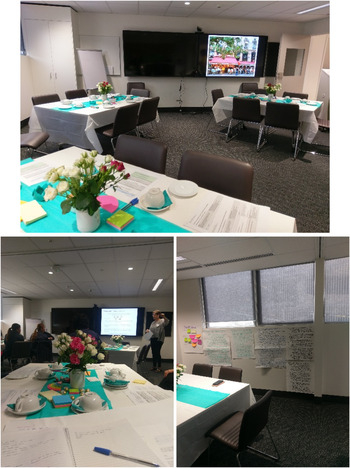
Two world cafés were conducted 2 weeks apart within an RDC-B meeting room. The room was transformed into a café, complete with tables adorned with flowers, refreshments, and colourful forms of stationery, to invite participants to gather in small groups within a ‘hospitable space’ (Brown & Isaacs, Reference Brown and Isaacs2005: 40, see Figure 1). The first world café involved 28 patients (n = 18) and carers (n = 10); while the second involved 18 staff members.
World café method

Each world café followed the same process of enquiry. One author presented an overview to: clarify and justify the study focus; set a positive ambiance; and stimulate ‘full participation and mutual giving’ (Brown & Isaacs, Reference Brown and Isaacs2005: 40). Following this, an author facilitated two 30-min conversations at each table. The first focused on participants' favourite stories about the RDC-B and recent experiences they considered to be brilliant. The second focused on the ingredients that enabled the RDC-B to be brilliant. The authors' role was to: ensure the conversations were focused, respectful, and inclusive and record participant contributions on large sheets of paper, laid on the table for all to view. The authors were aided by a guide, prompting them to: promote dialogue – not only about what participants observed or thought about the RDC-B, but also what they sensed in relation to it; invite participants to explicate their descriptions and ideas; use probing questions to seek clarification; request (and remind) participants to capture their thoughts by noting these on notepaper; and encourage participants to ‘listen together for patterns, insights, and deeper questions… [to] nurture coherence of thought without losing individual contributions’. This part of the world café was about gathering and recording as much information as possible for later distillation. Ample opportunity was given to the participants to wander around the room, share, and discuss findings and add additional posts as they saw fit. The intention was always to ensure that the facilitators did not impose their views onto participants.
To generate diverse conversations, participants were invited to move to different tables. Following the initial 30-min conversation with one group, half of the participants at each table were invited to relocate to a different table, which was hosted by a different author. This can help foster rich exploration and maintain energetic engagement. After each conversation, participants were invited to harvest their yield. They were asked to: stick all notes to the walls; peruse each other's contributions; identify statements or themes that resonated with them; consider why they might have selected these; and share these with the collective. One author facilitated this process inviting participants to offer their summated views on the harvest question and these were recorded and posted. This process served to encourage participants to ‘share collective discoveries [and] make collective knowledge and insight visible and actionable’ (Brown & Isaacs, Reference Brown and Isaacs2005: 40). After the second harvest, one author facilitated a collective discussion to invite all participants to identify terms that: epitomized what the RDC-B meant to them and captured why it was brilliant. In each world café, the collective views strongly mirrored the shared experiences recorded at each table. These collective views helped inform the thematic analysis.
The authors provided feedback to fellow members of the reference group and to the world café participants. According to group members, the themes resonated strongly with them and they were excited and intrigued by the picture that emerged. They were also favourable to the world café method and spoke fondly of their experience with it. The authors then shared the themes with the world café participants. Patients appreciated the opportunity to recount their experiences and contribute to the study. The affirming comments of both the reference group and the world café participants helped strengthen the authenticity of the findings.
Findings
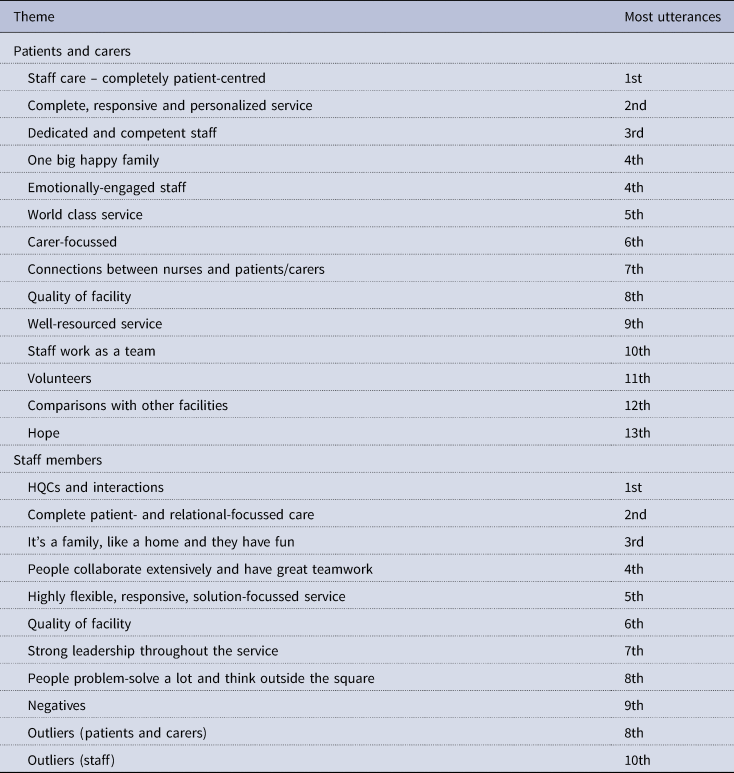
The world café method yielded rich accounts of what can make for brilliant service experiences within the RDC-B. A constant comparative method was used to analyse all notes recorded during the conversations (Glaser, Reference Glaser1965). This involved two stages. First, each author reviewed the notes recorded at their respective tables; constructed and described themes that typified participant perspectives; and constructed themes to epitomize the perspectives, accordingly. Second, two authors: collated these themes; identified similarities and differences; and constructed and described a more inclusive theming system, which was then discussed and critiqued with the remaining authors (see Table 1).
Themes

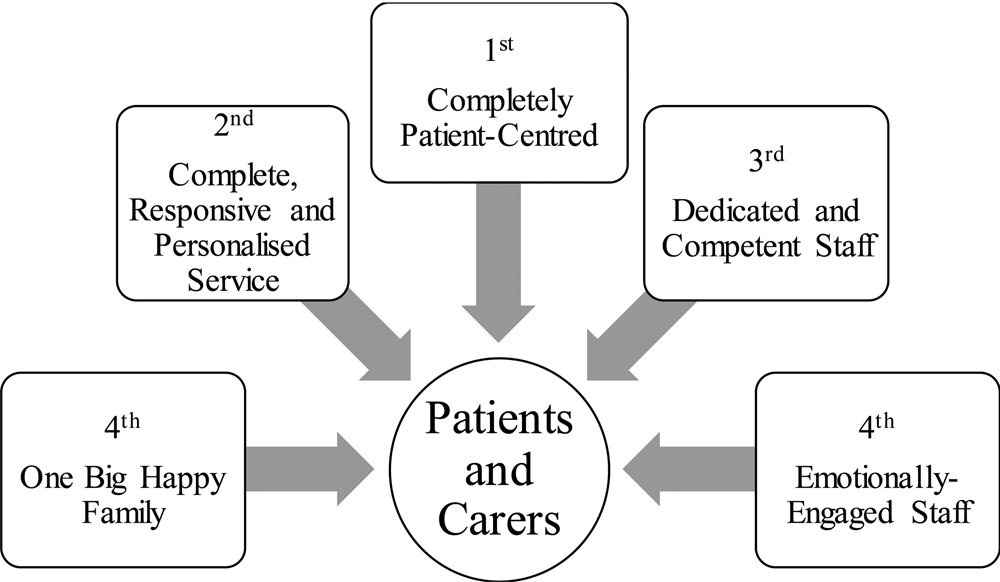
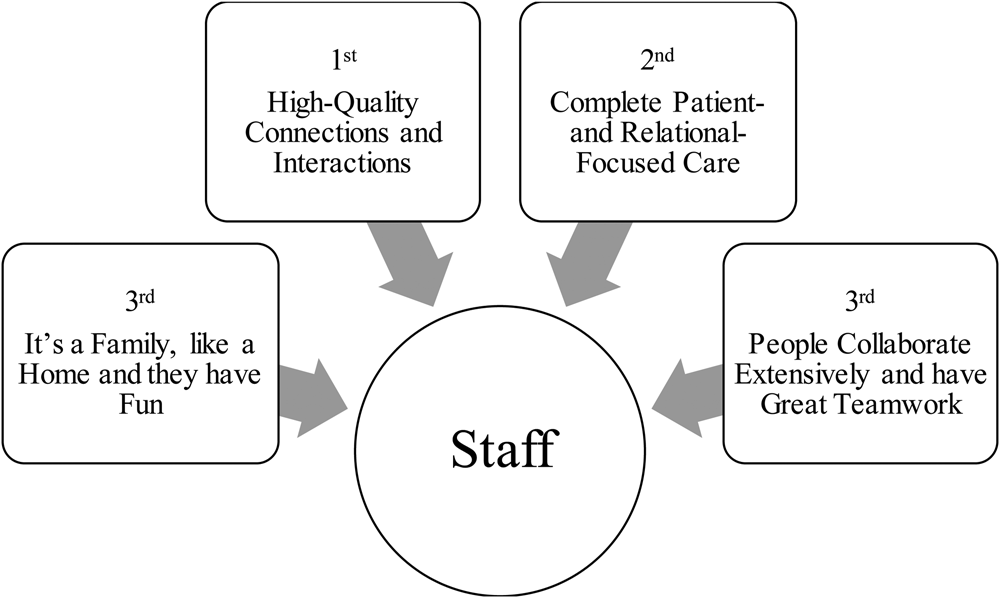
Given the wealth of themes that were constructed, this section presents those that were most salient. Specifically, the four most prominent themes described by the patients and carers are presented, followed by the four most prominent themes described by the staff members. Furthermore, their utterances are presented to substantiate the findings and to illustrate these salient themes. The text-based presentation of the findings is complemented by illustrations of the top four themes (see Figures 2 and 3). The outliers associated with both world cafés contained no identifiable themes. The findings are presented in a manner that captured and respected the experiences of participants in the world cafés and does not diminish their contributions.
User experience themes: Patients and carers

User experience themes: Staff members

Patients and carers
Completely patient-centred
According to the patients and carers, staff members who were completely patient-centred were a highly-cited brilliant experience. This was largely due to the following five reasons:
(1) They know you:
‘You don't feel like you're forgotten about’; ‘It's how we get treated’; ‘You're a person, not a number’; ‘They are not condescending’; ‘They're interested in us – we matter’; ‘Empathy – they understand their patients’.
(2) They are there for you:
‘When we need help, help is always available’; ‘As people, they are empathetic, caring, and they are able to fix problems’; ‘There is never a question that your call is not important’; ‘Nurses so encouraging in tough times’; ‘Panic over situation – they ease you mind’.
(3) There is respect:
‘Respectful staff – they know everyone – even the cleaner – there is mutual respect’; ‘Especially treating you with respect’; ‘[Staff members] show patients care and respect straight away – as soon as you come through the door’; ‘Non-judgemental’.
(4) There is compassion:
‘They have a human touch'; ‘Your first diagnosis is a very negative experience. The RDC-B give you peace of mind, vitalizes you and gives you a willingness to live’; ‘They care – they cuddle you – people in here like people’.
(5) They deliver:
‘It works – I am still here’.
Complete, responsive, and personalized service
Having a complete, responsive, and personalized service was said to be much more than just having a useful and usable service – it was about exceeding patient and carer expectations, and creating a truly flexible, comprehensive, integrated, 24-h service:
‘This is a complete, coordinated, and professional service'; ‘They find out about you and what is happening, even if you do not contact them’; ‘They work with you’; ‘They are unique and special human beings’; ‘They are able to tailor their care to each patient's situation’; ‘[The] Home delivery driver [of the home dialysis supplies] is lovely – brings things straight out’; ‘The service has developed good systems to monitor – they are not frustrating systems’; ‘things work and are easy to update’; ‘Staff arranged everything I needed for an emergency trip to the U.S. last year’.
Dedicated and competent staff
The patients and carers recounted the brilliant care they received from staff members who went well beyond the remit of their role:
‘They go above and beyond all the time'; ‘Nurses are very compassionate about the work that they put into their care of patients’; ‘It's not just a patient/nurse thing – it is a constant partnership in pursuit of excellence’; ‘Staff members are passionate they go that extra mile’; ‘They [staff] work at making home dialysis work’; ‘[The staff] always have answers for questions that we have’; ‘Staff are very caring well trained and very dedicated’; ‘Personal, professional, caring can do staff’; ‘When there is an emergency they are just there’.
One big happy family
The patients and carers described the welcoming feeling they had when they came to the RDC-B. They experienced a sense of belonging to a family comprised of other patients, carers, and staff members:
‘Staff members consider you as part of their family'; ‘I call this my dialysis family’; ‘[The nurse] said I will look after you like my own child’; ‘Feel like you are at home here – very comfortable’; ‘Feels like dad's second home’; ‘Nurse is like a mum to me – she looked after me when I stated haemodialysis and was scared and it was all new’; ‘Dad comes in for cuddles’; ‘The… [staff] know everyone; it is like being a family member’; ‘Staff are more like family, but nicer! They give you a hug’; ‘The unit treats all patients like a family’; ‘So friendly; being at the RDC-B is like coming home from work’.
Emotionally-engaged staff
The patients and carers described the emotional-engagement they experienced with staff members:
‘You don't feel like a patient here’; ‘Staff members are encouraging, supportive and reassuring. They acknowledge setbacks and recognize opportunities to pursue. They say, “It's okay”; they gave options when I was frightened’; ‘Staff members are compassionate. It is not just a job for them, they are not trained nurses, there born nurses’; ‘There is always a good sense of humour with all the nurses’; ‘Infectious, joyful and passionate staff’; ‘staff members have a demonstrated interest. You just feel it. As people, they are empathic, caring and they understand and are able to fix problems’; ‘You are treated like a human being all the way down the line – you are the most important persona at that point in time’.
Feedback received
Recounting their perceptions of, and experiences with the world café, the patients and carers were overwhelmingly positive. They valued the opportunity to share their experiences:
‘Great’; ‘awesome’; ‘informative’; ‘very useful experience sharing with others’; ‘grateful’; ‘positive’; ‘perfection’; ‘sharing and exchanging experiences’; ‘fun and friendly’; ‘great to discuss with other patients, enlightening, very good’; ‘professional teamwork’; ‘friendly’; ‘meeting new people’; ‘able to share experiences, informative’; ‘a great time to share experiences of hospital care and experiences’.
Staff members
High-quality connections and interactions
According to the staff members, the types of relationships they shared with each other (both within and beyond the RDC-B), patients, and carers were described to be important for brilliant renal care. These relationships manifested in different ways – namely:
(1) Strong internal connections:
‘[There is an] an appreciation for each other's differences in culture and work experiences'; ‘Rituals and ceremonies is really what cements them together e.g., farewell morning teas, celebrate triumphs, individual and collective’; ‘Staff are nurturing to each other and to the patients’; ‘Staff have a high level of passion, camaraderie and collaboration’.
(2) Trust among staff members:
‘They have my back with no questions asked'; ‘[There] is a lot of trust in relationships – GP, pharmacy, consultants and surgeons – whole service approach’; ‘Respect and trust of medical team (all of them – allied health and especially consultants)’.
(3) Strong relationships:
‘The doctors are amenable and very approachable. We have a very informal relationship with them – we can go up and ask them anything at all'; ‘Relationships are strong – personal touch – human factor is what binds them together makes you happy, makes your work life happy and comfortable’; ‘Relationships and rapport are developed through regular contacts with staff and patients’; ‘Post-transplant patients still come back for the social connections and ties they have with RDC-B – they don't need to come back, but they do’.
(4) Support and encouragement:
‘There is open communication – we ask, “Is there anything that I can do?”'; ‘Nurses are given a lot of respect for their role and allowed to solve problems’; ‘Staff are nurturing to each other and to the patients’; ‘Ambiance has genuine support and caring of staff for each other’.
(5) Reputation:
‘People on short-term secondments enjoy being here and when they leave, they spread our reputation’; ‘Even the student nurses ask if they can come back here’; ‘You get a reputation for how we work here – how wonderful it is to work here’.
Complete patient- and relational-focused care
Collectively, the staff members indicated that the RDC-B offered a service that was unreservedly focused on relational care. Specifically, they indicated that:
(1) Renal care was everybody's business:
‘That's the culture – it's different [at the RDC-B]. In other places, we solely look after our own patients'; ‘The patients are in the centre of what we do'; ‘We look at the bigger picture – the high commitment to patient care’; ‘We do our best for every patient – even the difficult ones’; ‘Doctors and allied health are all known to the patients – even… the cleaner is known to all of the patients’; ‘Being able to tap into the resources of all/whole service – everyone works to help patients no matter where they are located in the service or what type of dialysis they are on’.
(2) Shared responsibility:
‘We really get to know our patients'; ‘The patient is at the centre of everything – [we] always work out a problem they have… Someone always has their back’; ‘The staff are dedicated and passionate about what they do here – it is about caring for the patients at a high level’; ‘No one is left to flounder on their own’.
It's a family, like a home and they have fun
‘We are all happy to be here’; ‘We've all got heart – we have love for each other’; ‘Even though there are three subunits, we're actually family’; ‘It is the other home for patients and staff’; ‘We have social nights, like were going to see Mama Mia’; ‘We share our food’; ‘The patients will bring morning tea’; ‘Did we mention food? Because it brings us together’; ‘Even though we are three subunits, we're actually a family’; ‘We have fun at work and the patients notice; they say, ‘What are you doing having so much fun for at work?’’
People collaborate extensively and have great teamwork
The staff members frequently referred to collaboration and teamwork as key ingredients that contributed to brilliant renal care:
‘There are no hierarchical boundaries'; ‘Doctors respect nurses’ decisions’; ‘Doctors defer to nurses’ judgement’; ‘We use old fashioned teamwork – there is no allocation’; ‘Staff use initiative to complete tasks that are yet to be completed by colleagues to alleviate others To-Do lists. We don't count what we have already done’; ‘If someone needs help people are there. There are no boundaries around our roles’; ‘If another department asks for help, you help them – it helps build reciprocity, rapport, and shared care’; ‘Skilful staff working together as an excellent team’.
Feedback received
Deliberating on their perceptions of, and experiences with the world café, the staff members relished the opportunity to reflect on what the RDC-B meant to them, individually and collectively. The method helped to carve out time and space to contemplate poignant questions they had not previously considered:
‘This opened up ideas to help me understand why I work here'; ‘It's just nice to have the opportunity to reflect on the reasons why we're here and they're similar’; ‘Reaffirming’; ‘There's warmth, energy, love’; ‘You become more appreciative’; ‘Opportunity to reflect’; ‘Reaffirmation’; ‘More appreciative of what they have’; ‘Opens up’; ‘Appreciate what others are saying’; ‘World café brings us together more by sharing thoughts. I realize how significant our common belief to each other is’; ‘Affirmation of things I already know, but unable to put into words. Perfectly captured my thoughts and experiences’; ‘Affirmation of our individual and service ethos… [in] a novel way. I enjoyed it thoroughly; thanks’; ‘We opened up about how we feel about each other and appreciate each other’; ‘Learned new things about staff’; ‘Good venue and safe place to open up about opinions and ideas’; ‘Nice way to reflect and talk about why we all able to work here’; ‘Positivity about our service overall’; ‘Helped me [to be]… appreciative of my workplace’.
Common themes
The patients, carers, and staff members shared particular themes during their respective world cafés. Those most commonly articulated included ‘staff care and are completely patient-centred’ and ‘complete patient – and relational-focused care’. The second most commonly articulated themes included ‘one big happy family’ and ‘it's like a family, like a home and they have fun’. Collectively, the patients, carers, and staff members viewed this exploration of brilliance through different lenses. Notwithstanding these common themes, the patients and carers' experiences were a lot about having a completely responsive and personalized service while staff, about high-quality connections. The different order of ranked themes does not necessarily represent different preferences or values, but rather, different experiential lenses.
Discussion
There is international interest in, and a bona fide need to understand and promote exceptional healthcare (Fotaki, Reference Fotaki2015; Greaves, Ramirez-Cano, Millett, Darzi, & Donaldson, Reference Greaves, Ramirez-Cano, Millett, Darzi and Donaldson2015). This paper presents empirical findings to exemplify such healthcare, as experienced by the patients, carers, and staff members at the RDC-B. Using positive pragmatic fieldwork, the academics and clinicians forged a way to engage patients, carers, and staff members to capture, examine, and understand the experiences that contributed to the brilliance of the Centre.
Positive pragmatic fieldwork
Reflecting on this study, Huffman's (Reference Huffman2013a, Reference Huffman2013b, Reference Huffman2017, Reference Huffman2018) pragmatic fieldwork approach is very helpful in pulling it together. Initially developed to reframe action research in social justice and critical contexts, pragmatic fieldwork assumes the researcher enters the field armed with a claim and uses it to guide fieldwork – this includes the possibility of jettisoning the claim, if it does not sustain fieldwork practices. Huffman identified eight pragmatic fieldwork practices to consider during practitioner-focused action research. In this study, fieldwork practices focused on how to authenticate clinician claims of brilliance. In effect, from the very start, the study was enacting positive pragmatic fieldwork. Huffman (Reference Huffman2018) has linked pragmatism to a relational epistemology, the latter being foundational to POSH and AI.
According to Huffman (Reference Huffman2013a, Reference Huffman2013b, Reference Huffman2017, Reference Bate, Mendel and Robert2018), fieldwork practices (which are italicized) do not occur in any order, as was the case in this study. Reference group members asked questions – lots of them – and had many conversations about brilliance. The authors concurrently observed the setting, responsively seeking affirmations of brilliance. In effect, they became authentic partial ethnographers, ‘stepping into a culturally alien community to become, for a time and in an unpredictable way, an active part of the face-to-face relationships in that community’ (Bate & Robert, Reference Bate and Robert2007: 85). The members laboured and served to propel the study, writing grant applications, providing in-kind support, securing funding, securing clearance from the relevant human research ethics committees, staging and hosting the world cafés, and organizing presentations and theorizing about brilliance (Huffman, Reference Huffman2018: 24). The use of the world café method demonstrates how experiential knowledge was gathered and harvested. It also illustrates how claims of brilliance were collectively explored, allowing patients, carers, and the staff members to reflect, often for the first time, on their experiences of brilliance and its individual and shared meaning to them. The authors presented and co-presented the findings to audiences that mattered to the reference group to inspire others to envisage what brilliant renal care means and the lessons indicated by the study. Presenting went beyond the RDC-B to include academic outlets, and theorizing, as the study had to be credible and subject to peer review.
Bate and Robert (Reference Bate and Robert2007: 84) described such research as contextual enquiry. Specifically, empirical material is gathered within a setting; a partnership with practitioners is formed to gather the material; and the enquiry focuses on practitioner concerns to learn more about something, such as their brilliance. According to Bate and Robert, this mode of enquiry is necessary because it renders meanings and actions ‘intelligible in relation to the context in which they occur, and indeed are shaped by it’. Enquiry is also about democratizing research and creating equal partnerships and deep connections between academics and those with a stake in the research.
During the feedback session with the world café participants, the patients and carers said they ‘enjoyed it, were relaxed, felt good, had fun and felt cared for and often referred to feeling empowered’. Their energy, enthusiasm, and positive feelings lasted for days afterwards. This affirms the importance of fit-for-purpose methods. One author who has extensive experience in using the world café method observed, ‘the patients and carers had no problem remaining in the positive space’, which is relatively rare. Unlike the patients and carers, the staff members who participated in the world café were initially quieter and restrained – however, the energy levels rose as conversations progressed. They too referred to feeling empowered and proud to work at the RDC-B. They valued: the energy generated by the method; the opportunity to share their thoughts about why they worked at the RDC-B; the collective reflections that helped make the ordinary, extraordinary; and affirmations of their shared experiences.
Vocabularies of brilliance as positivity
The world café afforded patients and carers the opportunity to share and compare their experiences, helping them to recognize and articulate their vocabularies of brilliance portraying the RDC-B as unconventional or atypical. Regarding ‘staff care – completely patient-centred’ (see Figure 2), the patients and carers referred to RDC-B practices as not myopically clinical – but rather, the Centre and the staff members therein, warmly received patients and carers as people. Participants indicated they were acknowledged and respected, which was not always the case in other health services. These participants recognized a culture of mutual respect. The staff members ‘show[ed] care and respect straight away – as soon as you come through the door’. They never felt judged by the staff members, irrespective of seniority, as well as by fellow patients and carers. According to the participants, this was important for (at least) two reasons. First, it created an empathic ethos – this was particularly helpful during times of distress and grief. Second, it democratized care; it reinforced care as a practice that everyone could embody and enact, not only those with clinical responsibilities.
Regarding ‘complete, responsive and personalized service’ (see Figure 2), the patients and carers recognized the RDC-B as comprehensive, with the capacity to accommodate their diverse range of changing needs and preferences. Given their varied experiences with different health services, they had grown accustomed to ‘single organ medicine’ (Hillman & Bishop, Reference Hillman and Bishop2004: 2), whereby a health service or clinician solely attended to the matter of primary interest to them, rather than to that which was of primary interest to the patient or carer. However, the RDC-B was different – it was cross-functional. It offered different types of care in different forms at different times, pending what a patient or carer needed or preferred. Rather than naïvely delivering standardized or formulaic care to optimize organizational efficiencies, the RDC-B tailored its offerings. This in turn, demonstrated a different form of efficiency, offering what people required, when they required it.
Referring to ‘dedicated and competent staff’ (see Figure 2), the patients and carers described the brilliant care they received from staff members who went well beyond the remit of their role. The staff members were described as sympathetic to the long-term and challenging nature of kidney disease and renal care. Recognizing these difficulties, the staff members demonstrated a strong commitment to, not only what patients needed clinically, but also what they and their carers preferred. Their thoughtful actions often exceeded the expectations of patients and carers who deemed the staff members to be unfailingly compassionate, continually striving to do more than what they were required to do.
According to staff members, ‘high-quality connections and interactions’ (see Figure 3) were paramount. There was a strong sense of ‘genuine’ mutual care for colleagues, patients, and carers. Irrespective of their discipline, the staff members nurtured each other, rather than enact siloed healthcare. These strong internal connections were partly due to ‘regular contact’, sustained over ‘long periods of time’. Time afforded great opportunity to learn about, from, and with each other – as fellow clinicians; fellow employees at the RDC-B; and fellow humans. For instance, the ‘strong social network’ enveloped each other's personal worlds, whereby they ‘all know each other's families’. This suggests the RDC-B was underpinned by ‘a relational factor’. The staff members willingly came to the workplace with their whole (rather than partial) selves, having a positive impact on work engagement and renal care.
According to staff, HQCs and interactions were evident between staff members, patients, and carers. They described the ways in which patients and carers were supported and encouraged as renal disease progressed and as treatment regimens changed. Yet, perhaps the strongest evidence of these connections and interactions was found among the patients and carers who no longer required treatment. This is because many would regularly return to visit their clinical friends, as well as fellow patients and carers. Given they maintained these connections and interactions of their own volition, there was no separation between the clinical and personal worlds.
Regarding ‘complete patient- and relational-focused care’ (see Figure 3), the staff participants collectively recognized the RDC-B as offering a service that was steadfastly focused on relational care. The personnel – be they clinicians, managers, administrative personnel, domestic personnel, or drivers – enjoyed a shared responsibility for the patients and, by extension, their carers. Despite their respective positions, they comfortably extended their remit, without fear that colleagues would misread their actions as haughty, or a malevolent attempt to usurp another's job. This is because they functioned as a united front. The clinicians did not ‘own’ patients (or beds); nor did they shy away from the ‘difficult ones’ who were insubordinate. Renal care was everybody's business.
The shared responses between patients, carers, and staff members overwhelmingly indicated that the staff members cared – they were relationally-focused; they all recognized the respectful, compassionate, and caring atmosphere of the RDC-B. This was largely due to staff members who: were passionate about providing high-quality renal care as part of a collaborative, competent team; and wanted to provide a brilliant environment for patients and carers that was akin to a family home, in which care, understanding, and food were shared.
The vocabularies of brilliance present a credible and plausible account of brilliance in the RDC-B that went beyond anecdote and hearsay. Importantly, the study also pointed to the practices most identified by patients, carers, and staff members. The findings also provided rich and previously inaccessible knowledge and vocabularies about renal care to take into other forums for discussion and dissemination. Practically, the findings also gave WRS partners a method to use in other contexts to explore patient, carer, and staff experiences. Above all, the findings affirmed to all participants that they were indeed part of something very valuable, worthwhile, and exceptional.
Theorizing the RDC-B's brilliance was actually very challenging and was begun in the feedback sessions. The Oxford Handbook of Positive Organizational Scholarship (Cameron & Spreitzer, Reference Cameron, Spreitzer, Cameron and Spreitzer2012) contains 79 chapters many of which speak on the vocabularies of brilliance shared by participants in the world café. However, two in particular resonates with the brilliance spoken about the RDC-B, namely HQCs; (Stephens, Heaphy, & Dutton, Reference Stephens, Heaphy, Dutton, Cameron and Spreitzer2012) and relational coordination (Gittell, Reference Gittell, Cameron and Spreitzer2012), the latter helping explain organizational mechanisms that build and sustain HQCs. Dedicated and competent staff alone do not produce the brilliance of the RDC-B. There are many units that have such staff but are not brilliant units.
The notion of HQCs (or positive connections) is derived from relation theory and postulates that positive, mutually developmental experiences arise from being in connection with others. It also amplifies structural qualities of connections and their influence on improving performance and achieving positive outcomes. While initially focused on individual and dyadic levels, evidence suggests that HQCs have an impact at the collective level as well by for example creating greater levels of psychological safety and trust; forging greater unit-level learning from failures; building higher levels of interpersonal trust; and spawning spirals of cooperation and trustworthiness as well as improving organizational coordination and error detection (Stephens, Heaphy, & Dutton, Reference Stephens, Heaphy, Dutton, Cameron and Spreitzer2012).
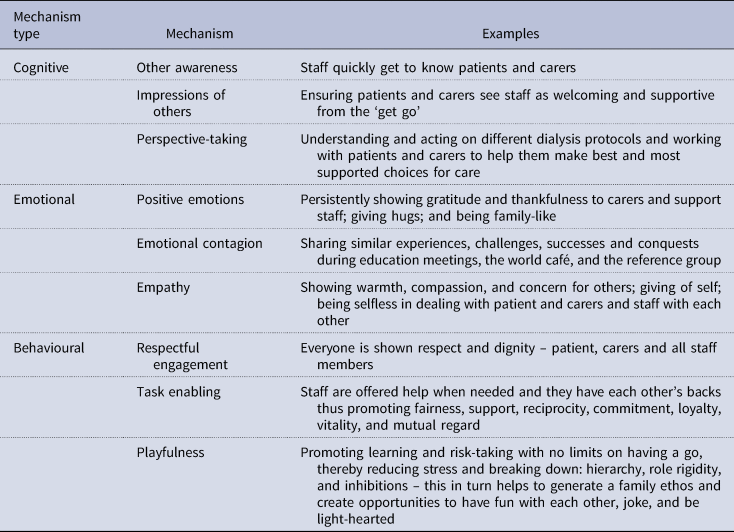
Four key mechanisms build and strengthen HQCs and are evident in our findings. They are as follows: cognitive, emotional, behavioural, and organizational. Table 2 illustrates three of these mechanisms, and their elements, explained using materials from the world café. Table 2 is provided as feedback to participants and other audiences in the WRS, presenting tantalizing new vocabularies of brilliance in renal care. Our findings also suggest that the organizational mechanisms that support and build HQCs are different though complementary to those identified by Heaphy et al. Our organizational mechanisms align with relational coordination theory.
HQCs (adapted from Stephens, Heaphy, and Dutton, Reference Stephens, Heaphy, Dutton, Cameron and Spreitzer2012)

Relational coordination is not new to healthcare (Gittell, Reference Gittell2009, Reference Gittell, Cameron and Spreitzer2012; Gittell et al., Reference Gittell, Logan, Cronenwett, Foster, Freeman, Godfrey and Collins Vidal2018; Havens, Vasey, Gittell, & Lin, Reference Havens, Vasey, Gittell and Lin2010; Hustoft, Biringer, Gjesdal, Aβmus, & Hetlevik, Reference Hustoft, Biringer, Gjesdal, Aβmus and Hetlevik2018; Hustoft, Hetlevik, Aβmus, Størkson, Gjesdal, & Biringer, Reference Hustoft, Hetlevik, Aβmus, Størkson, Gjesdal and Biringer2018), but linking it to HQCs is. It is simply impossible to imagine achieving great relational coordination without HQCs. In theory, relational coordination is meant to help redesign formal structures and diminish the need for newer structures such as networks. However, in practice, the RDC-B is so brilliant because the stuff of relational coordination is in its ‘DNA’ being practiced within and across the network, the hospital, teams and suppliers as well the formal hierarchy of the health district. Gittell (Reference Gittell2009, Reference Gittell, Cameron and Spreitzer2012) is the foremost exponent of relational coordination theory, building a three-part model identifying relational coordination, relational work practices, and contingency factors that ultimately lead to quality and efficiency outcomes.
Relational coordination is encapsulated by shared goals (e.g., as expressed in the intense patient and relational-centred care mantra of RDC-B and, is the thing that most everyone agreed on); shared knowledge (e.g., renal patients are everyone's business, they all have shared responsibility and nurses can make clinical decisions about patients); and mutual respect (e.g., great respect between doctors and nurses but also between staff, patients, carers, and suppliers). Relational coordination also depends on the following modes of communication: frequent communication (e.g., nurses are always in touch with patients and monitoring them so they know where they are in the system of care); timely communication (e.g., the home-app monitors patients in real time); accurate communication (e.g., patients often speak of how well informed they are and kept in the loop with new developments); and problem-solving and anticipation communication (e.g., the home haemodialysis app is very much about problem-solving home treatments, yet nurses also keep a keen eye on hospital admissions to circumvent dialysis crises). All these practices feed off each other.
Particular relational work practices drive relational coordination, and these were raised in the world café, complementing Gittell's (Reference Gittell, Cameron and Spreitzer2012) approach, and include the following: inclusive and respectful meetings where individuals are listened to and valued; great multidisciplinary, cross-functional, and multi-locational teams throughout the network; cross-functional and cross-network protocols and practices to support patients in any setting or place across the network; role-plasticity, role-autonomy and flexibility to act beyond a prescribed role in caring for patients and solving problems; accepted shared decision making and responsibility for patients; collaborative technologies for patients through the home haemodialysis app and cross-functional and network information technology systems to help monitor and track patients at all times; socialization and relational practices in meetings to cement trusting and respectful engagement evidenced through rituals and family centric staff patients and carers; wise selections for multidisciplinary, cross-functional, cross network teamwork because staff treat it as a privilege to work in RDC-B; shared conflict management because even though there are negatives they get on with caring for patients; and cross-functional and network boundary spanners because many staff work across the network and are hard-wired into this model of care, which also combines to create positive social capital and important forms of reciprocity (Baker, Reference Baker, Cameron and Spreitzer2012).
Following Gittell (Reference Gittell, Cameron and Spreitzer2012), relational coordination is critical when there is reciprocal interdependence, as is evident in the need for teamwork to deliver renal care, task uncertainty with the dialysing patients being a constant roller coaster with critical time constraints in delivering effective on time treatment to avoid emergencies and crises. Even though patients have a long-term relationship with staff and the RDC-B, the treatment for many is a daily struggle but nonetheless, largely a continuous brilliant experience for many. Both HQCs and relational coordination, and the positivity they generate, are vital to explaining experiences of brilliant renal care but as we conclude, the world café can only take us so far in understanding the brilliance we have heard so much about.
Conclusion
The indisputable fact of this study is that 46 patients, carers, and staff members collectively said great things about the RDC-B about what constitutes its brilliance. None questioned the researchers about what brilliance meant or how to define it.
Participants knew exactly what they were saying when their collective lived experiences of RDC-B brilliance were captured in the world cafés. The themes subsequently shared with them resonated with their experiences the themes had face validity and authentically depicted what they had contributed to the study. These views were consistent and persistent throughout the study from the world cafés to the feedback sessions. The themes are completely credible and plausible examples of the users' experiences of brilliant renal care.
How we undertook the study was largly driven by practitioners. The processes of enquiry positive pragmatic fieldwork can be reproduced in other contexts and the experiences of brilliance can be shared and worked through with other groups using fit-for-purpose methods, such as the world café, and positively-framed modes of enquiry, like POSH and A1. The challenge being to fully grasp the paradigmatic richness, paradoxes, limitations and even negativity of adopting a positive lens.
However, to make full sense of why participants responded as they did and what that tells us about their experiences of brilliance, it is important to understand the organizational context and dynamics in which they are immersed. Additional material gathered in the study via discovery interviews (Bate and Robert, Reference Bate and Robert2007) will be analysed to clarify the perspectives of key organizational players within and beyond the RDC-B with reference to positive institutional work (PIW) (reference withheld for double blind review; Nilsson, Reference Nilsson2015). Findings from this part of the study will help situate the demonstrated brilliance of the RDC-B within its larger context. Our two preliminary constructs of HQCs and relational coordination will add depth and greater understanding to PIW in healthcare, a relatively new field of study (reference withheld for blind review).
That said, it is well-neigh impossible to completely capture the fine-grained contextualizing that creates the brilliance reported in this paper and even more so, the poignant moments that defined the enquiry. Patients and carers showed up to the world café, even though they were not named participants for the ethics application. They had heard about the world café and wanted to be involved. When the authors shared their preliminary findings with the participants some months after the two world cafés, one patient agreed to recount his recollections of the experience and did so with great passion as if the world café had just happened. The research experience was also transformative for the authors and yes, the ‘wows’ just kept on coming!
Acknowledgements
This study was funded by the Western Sydney University and Griffith University. The authors thank the Western Renal Service and, within it, the Regional Dialysis Centre in Blacktown for their support, as well as the staff members, patients, and carers who kindly contributed to this study.
Louise Kippist is an academic in the School of Business, with 25 years' experience in the healthcare sector in both clinical and managerial roles. Louise's research experience is in health service management particularly in the fields of professional identity and brilliance in health care.
Liz Fulop is currently undertaking research across several areas of health management including: exemplary nurse unit manager leaders; brilliance in healthcare in Queensland Health; lesbian, gay, bisexual, trans, and/or intersex (LGBTI) aged care reforms; engaging clinicians in healthcare reform; as well as improving the decision making capacities of healthcare professionals. She has evaluated hospitals, especially their leadership development practices. For 11 years, she was the Academic Director for the first national Management for Clinicians Program in Australia. Liz has established several health research networks. She has been the recipient of competitive and industry research grants.
Ann Dadich is a registered psychologist and has scholarly expertise in health service management, particularly knowledge translation and diverse methodologies to understand these processes. This is demonstrated by her strong publishing record; the grants she has secured; and awards received to date.
Anne Smyth has worked for over 30 years in the public sector, not for profit, government and university settings – 20 as a senior lecturer. She works in health and community services as a consultant, facilitator, educator, and researcher in organization and leadership development and change, strategic thinking and planning, social research, evaluation and governance. She is an active scholarly practitioner/researcher.