Introduction
Evaluating the risks of violence either to the self or to others takes on a special urgency when a threat to suicide or to kill is uttered. Threats to kill can be directed at the clinician, colleagues, a named third person, or the target can be unspecified. Our medical colleagues often use mental health professionals as a referral resource when such threats are made, almost irrespective of whether the threatener is mentally ill or just angry and disturbed. Whether we like it or not, all mental health professionals, not just forensic specialists, are now expected to be able to evaluate the risks in those making threats to others. Failing to effectively evaluate threats to kill can create both professional and medico-legal problems should the patient subsequently act on the threats (Southard & Gross, Reference Southard and Gross1982; Carstensen, Reference Carstensen1994; Kennedy & Jones, Reference Kennedy and Jones1995).
The evidence base to guide the assessment of patients making threats to kill remains limited. The literature on threats in the workplace, specifically those witnessed by health professionals, is rich in detail about the context and nature of the threat, but rarely provides data on the subsequent behaviour of the threatener (Flannery et al. Reference Flannery, Hanson and Penk1995; Brown et al. Reference Brown, Dubin, Lion and Garry1996; Coverdale et al. Reference Coverdale, Gale, Weeks and Turbott2001; Davies, Reference Davies2001; McKenna et al. Reference McKenna, Poole, Smith, Coverdale and Gale2003). This contrasts with threats of self-harm, where an extensive literature is available to guide the clinician in an evaluation of risk; much of it deriving from studies of suicide in the general population rather than just patient groups.
Research has been conducted on threats to harm public figures. These studies broadly suggest that threats in this context are irrelevant to the prediction of violence (Dietz et al. Reference Dietz, Matthews, Martell, Stewart, Hrouda and Warren1991a; deBecker, Reference deBecker1997; Calhoun, Reference Calhoun1998) or even reduce its likelihood (Dietz et al. Reference Dietz, Matthews, Van Duyne, Martell, Perry, Stewart, Warren and Crowder1991b; Meloy, Reference Meloy2000). The research on threats and subsequent violence in the stalking situation has produced contradictory conclusions, although the balance of the evidence is in favour of a connection (Kienlan et al. Reference Kienlan, Birmingham, Solberg, O'Regan and Meloy1997; Harmon et al. Reference Harmon, Rosner and Owens1998; Mullen et al. Reference Mullen, Pathé, Purcell and Stuart1999, Reference Mullen, Mackenzie, Ogloff, Pathé, McEwan and Purcell2006). Threats to kill have not, however, emerged as a risk factor in the current crop of actuarial instruments for evaluating the probability of violence (Webster et al. Reference Webster, Douglas, Eaves and Hart1997; Monahan et al. Reference Monahan, Steadman, Silver, Appelbaum, Robbins, Mulvey, Roth, Grisso and Banks2001; Quinsey et al. Reference Quinsey, Jones, Book and Barr2006). Indeed, the recent literature examining the prediction of the risks of violence in the mentally disordered has generally either ignored threats to kill or dismissed them as of no particular relevance (Steadman et al. Reference Steadman, Mulvey, Monahan, Clark-Robbins, Appelbaum, Grisso, Roth and Silver1998; Meloy, Reference Meloy2000).
What is not disputed is that those who utter threats are often mentally disordered. For example, in a review of 102 threateners sent for court-ordered evaluations, 57.8% were assessed as suffering a mental illness with a high prevalence of personality problems and substance abuse (Barnes et al. Reference Barnes, Gordon and Hudson2001). Furthermore, a study of 69 bomb threateners suggested that 21% were mentally disordered (Häkkänen, Reference Häkkänen2006). The only study that has followed up threateners seen in a mental health context is the classic study by MacDonald (Reference MacDonald1963) of 100 psychiatric referrals who had made threats to kill. MacDonald (Reference MacDonald1968) reported that, after 5 years, three had committed homicide and four had killed themselves. These rates are orders of magnitude higher than would be expected by chance.
Those convicted of threats to kill form only a subset of those who make such threats. It may, however, not be as small a subset as might be assumed. Victim surveys in a range of countries including the UK, the USA and Australia suggest broadly similar rates of experiencing frightening and/or distressing threats with about 30% of such victims reporting this to the police (Hough, Reference Hough1990; Van Kestern et al. Reference van Kesteren, Mayhew and Nieuwbeerta2000). In Victoria, at the time of this study, most complaints of threats to kill in isolation from other more serious offending did lead to charges and most charges to convictions. This is of relevance as it is those whose threats are made in isolation from other types of criminal behaviour who most closely resemble those threateners seen for evaluation in clinical practice.
The current study reports on a 10-year follow-up of over 600 individuals who were convicted of making threats to kill in 1993–94 and whose prior contacts with the mental health services had been ascertained at the time of the offending.
Method
Sample
The initial sample consisted of all adults who appeared in the records of the courts of the State of Victoria, Australia, as having been convicted of making threats to kill in the years 1993 and 1994. In Victoria, the offence of uttering a threat to kill requires that it produces fear in the victim. The investigation examined the threat group as a whole, those whose threat charge was accompanied by more serious offences, and those where threatening to kill was the primary or only offence.
Mental health contact
The offenders' contacts prior to the index threat offence with the public mental health services were ascertained by linking the court conviction data with the Victorian Psychiatric Case Register (VPCR). This register was established in 1961, covering in-patient contacts, and expanded in the 1980s to include out-patient and community contacts. Approximately 95% of all contacts with the state's public mental health services, including emergency room consultations, were then covered. The diagnosis in each case is updated regularly, and recorded specifically at the beginning and end of each episode of care. The register records 0.7% of the population as having been treated for a schizophrenic disorder, suggesting relatively complete ascertainment. Other conditions, such as depressive disorders and serious personality disorders, are less comprehensively covered. In 1995, when the data linkage occurred, all contacts in the community, liaison and emergency rooms were included, in addition to admissions (Wallace et al. Reference Wallace, Mullen, Burgess, Palmer, Ruschena and Browne1998). Contacts with private sector services and general medical practitioners are not recorded on the VPCR, nor are any of the admissions to the 6% of beds in the private sector. The matching procedure has been described previously and involved both manual searches and a computer algorithm to maximize ascertainment (Wallace et al. Reference Wallace, Mullen and Burgess2004). The VPCR contains information on admissions, other contacts and diagnostic information.
Subsequent convictions
The subjects' criminal histories and subsequent convictions up to 2004 were obtained from the police's Law Enforcement Assistance Program (LEAP) database. As well as being a compendium of people's criminal records, the LEAP database contains data on the circumstances of each crime, idiographic details of each offender and basic information on victims. Violent reoffending was defined as a further conviction for a violent offence including assault, causing injury, attempted murder, murder, and rape.
Sudden death
The LEAP database includes details of deaths where the police were involved. This covers sudden unexpected deaths including suicide and homicide. Although far from a complete record of mortality in the group, it captures most unnatural deaths.
Plan of analysis
Simple descriptive statistics were used to characterize the sample, with categorical data being reported as numbers and percentages; and continuous data considered in relation to the mean, median and standard deviation. Univariate analyses sought to compare the characteristics of threateners who committed further offences and those who did not. The outcome of interest was subsequent violent offending (as defined above), which was considered as a binary ‘reoffended violently’ or ‘did not reoffend violently’ during follow-up. Associations between variables were converted into odds ratios (ORs) to describe the strength of the association between risk factors and outcomes, and to aid subsequent interpretation. Univariately significant associations were modelled using logistic regression to explore whether it was possible to develop a predictive model to identify those who reoffended violently as opposed to those who did not. Multivariate analyses accounted for possible confounding and effect modification between variables. The area under the curve (AUC) of the receiver operating characteristic (ROC) curve was plotted as a measure of the predictive accuracy of the resultant model (Mossman, Reference Mossman1994), and the ‘goodness of fit’ of the full model was checked using the Hosmer–Lemeshow test (Hosmer & Lemeshow, Reference Hosmer and Lemeshow2000). Analyses were carried out in stata version 9.0 (Stata Corporation, College Station, TX, USA).
Ethical issues
Data linkage studies, such as the present one, raise ethical questions about privacy and confidentiality. Obtaining informed consent in such studies is not only difficult but also might, at best, generate only a small and highly skewed sample. The method used ensured permanent de-identification of all data once the linkages were completed. Only group data are therefore generated without the possibility of reconstructing information on an individual.
Ethical approval for this study was obtained from the Ethics Committees of Monash University, the Victorian Department of Justice, Victoria Police and the Victorian Department of Human Services.
Results
The sample was composed of all 668 people convicted of threats to kill in the criminal courts in Victoria for the years 1993 and 1994. At follow-up, the records of 55 subjects could not be traced, leaving a final sample of 613. There were 369 (60.2%) subjects whose threat offence was one relatively minor element in the criminal conduct that brought them before the court. In the remaining 244 (39.8%) cases, the threat offence was the most serious charge in 164 (26.8%) and the only offence in 80 (13.1%).
Threatener characteristics
There were 565 male and 48 female offenders with a mean age of 31.3 years (s.d.=9.4; range 17–72 years). Information recorded on the LEAP database enabled relationships between the threateners and their victims to be established in 488 (80%) cases. Threats were to intimates and family members in 38.2% of cases, to acquaintances or co-workers in 36.4%, to strangers in 5.9%, and to public figures in 0.2%. The mode of delivery of the threat was available for 509 (83%) of the sample. Of these, 444 (87.2%) made threats verbally, 56 (9.1%) by telephone, five (0.8%) by letter and four (0.7%) by other means.
Prevalence of mental disorder
There were 252 (41.3%) cases recorded as having had contact with public mental health services prior to their index offence. Substance abuse was the most common recorded primary diagnosis, followed by schizophrenia and personality disorder, of which antisocial personality disorder was the most common designation. The sample as a whole contained 394 (64.3%) subjects who had also acquired a conviction related to drug or alcohol use and abuse or had received a primary or subsidiary diagnosis of substance abuse from the mental health services.
Recidivism
Subsequent convictions were recorded against 329 (53.7%) subjects. Nineteen (3%) went on to commit a homicide, and a further eight (1.3%) were convicted of attempted murder. Overall, 44.4% of the sample were subsequently convicted of violent offences. The original threat victim was subsequently a victim of the threatener in 85 (13.9%) instances. Five of the original victims were eventually killed by the threatener, and for three others the threatener was later convicted of attempting to murder them. Subjects also reoffended against the threat victim by assaults (n=50), rapes (n=3), stalking (n=11), and further death threats (n=10).
Recidivism rates and mental disorders
The rates of subsequent offending were significantly higher among the 246 threateners who had had prior contact with the mental health services [169 (69%) v. 159 (43%), χ2=37.4, p<0.001]. Subsequent violent offending was also higher in this group [140 (57%) v. 131 (36%), χ2=26.9, p<0.001]. Threateners with schizophrenia were significantly more likely to commit a homicide [3 (30%) v. 16 (2%), OR 3.9, 95% confidence interval (CI) 1.1–14.3, p<0.05]. Affective psychosis was found to increase the risk of violent reoffending [13 (72%) v. 268 (45%), OR 3.2, 95% CI 1.1–9.0, p<0.01], as were affective disorders [12 (75%) v. 269 (45%), OR 3.7, 95% CI 1.2–11.5, p<0.05]. Any diagnosis of substance misuse also increased the risk of violence [39 (68%) v. 242 (43%), OR 2.8, 95% CI 1.5–5.1, p<0.001].
Comparing subsequent convictions in the primary and subsidiary groups
The rate of imprisonment in those whose threat offence was one part of more serious offending was not significantly higher than for the primary or sole offence group [76 (20.6%) v. 37 (15.2%), p=0.09]. Nevertheless, differential lengths of sentence could have led to longer periods in prison, with a reduced opportunity to offend in those where threatening was accompanied by more serious offending. Comparisons were therefore made between the 207 pure or primary threat offences and the 213 subsidiary group who did not receive a prison sentence for the index offence.
The 207 subjects whose index offence had been primarily, or solely, threat to kill reoffended less often than those whose threats were only a relatively minor part of the offending behaviours [86 (41.6%) v. 163 (55.6%), χ2=9.63, p<0.002]. A similar pattern emerged for violent reoffending [68 (32.9%) v. 145 (49.5%), χ2=13.73, p<0.001]. Both groups subsequently committed homicides at similar rates [5 (2.4%) v. 8 (2.7%), p=0.8]. The rates of further offences perpetrated against the original threat victim did not differ significantly between the groups.
The risk factors for subsequent violence
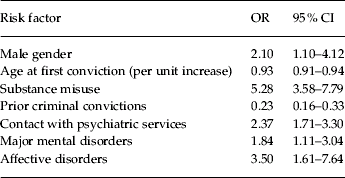
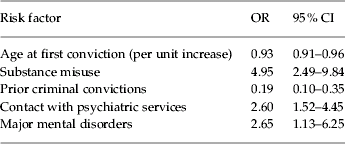
Again, only those cases that received a non-custodial sentence for the index offence were included in the analysis. A diagnosis of substance abuse, younger age at first conviction and mental disorder were associated with an increased risk of violence, but prior criminal convictions significantly reduced the risks in this population (Table 1). When the risks were examined in the group whose index offence was primarily or solely threat to kill (Table 2), the pattern of risk factors remained similar although the association between subsequent violence and the absence of prior criminal convictions strengthened.
Univariate significant associations risk factors and subsequent violence for group excluding those imprisoned for the index offence (n=613)

OR, Odds ratio; CI, confidence interval.
Univariate significant associations risk factors and subsequent violence for those whose index offence was primarily or solely threat to kill but who were not imprisoned for that offence

OR, Odds ratio; CI, confidence interval.
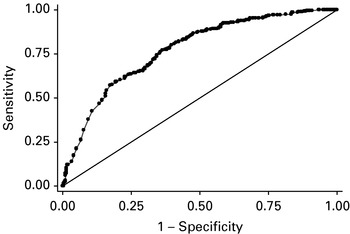
Logistic regression enabled predictive models for violence to be derived. For the threatener group as a whole, a combination of mental disorder, younger age at first conviction, substance abuse and an absence of prior criminal convictions predicted future violence with a sensitivity of 67%, a specificity of 71% and a positive predictive value of 64%. The ROC curve derived from this model produced an AUC of 0.76 (s.e.=0.02) (Fig. 1). Examining only those threateners with prior contact with the mental health services, the same variables predicted future violence, correctly classifying 69% with a sensitivity of 72%, a specificity of 61% and an AUC of 0.81 (s.e.=0.03). There was no evidence of lack of fit with either model (χ2=173.52, p=0.43 and χ2=96.87, p=0.570).
The receiver operating characteristic (ROC) curve for the multivariate logistic regression model predicting subsequent violence (area under ROC curve=0.7716). An ‘area under the curve’ (AUC) of 1.0 would indicate perfect discrimination whereas an AUC of 0.5 (below continuous line) would suggest only a chance association.

Death of threateners
Thirty-three (5.4%) threateners were recorded on the police database as having died. This included 16 (2.6%) who died by their own hand from an overdose, or by hanging or jumping. A further three were homicide victims.
Discussion
Those convicted of threats to kill have far higher rates of mental disorder in general, and schizophrenia in particular, than would be expected by chance. High rates of violence, including homicidal violence, were found subsequent to a conviction for threatening to kill. The level of violent recidivism was even higher in those known to have pre-existing psychiatric disorders and/or problems with substance abuse. Significant levels of violence were found during the follow-up period in the whole group irrespective of whether or not the threat to kill was the primary conviction or merely an addendum to more serious acts of violence. The rates of sudden death from suicide and overdose were elevated, as were the number of threateners ultimately killed by others.
The study is limited by the sample being population based rather than clinical, even though a high proportion had had contact with mental health services. As a result, only a broad overview of the nature of the sample is provided. The study will have underestimated the level of subsequent violence among threateners; first, because of the reliance on conviction data that miss most low-level, and some serious, interpersonal violence. Second, the linkage process is never perfect so some associations will be missed, thereby decreasing the final estimate of the relationship.
Threats, including threats to kill, may be mundane events, particularly in certain contexts where flamboyant expressions of opinion and feeling are accepted, as, for example, at sporting events. What is far from common, and never acceptable, is uttering threats in a manner that creates fear and distress. Crime surveys that gather data from general population samples about experiences of victimization suggest that between 1.5% and 2% of people report being threatened in the previous year in a way that had frightened them (Hough, Reference Hough1990; van Kesteren et al. Reference van Kesteren, Mayhew and Nieuwbeerta2000; Australian Institute of Criminology, 2001). This study concerns a highly selected subgroup whose threats raised sufficient concern to motivate the victim reporting, police laying charges, and the courts convicting. This may, however, not be so far removed from the subgroup of patients who utter threats to kill in a manner that raises sufficient concern in experienced health professionals to further assess the risk of violence. In clinical practice, for better or for worse, most threats by patients are ignored, or dealt with simply as unpleasant utterances with no long-term consequences (Dubin & Lion, Reference Dubin and Lion1992). Only a small minority trigger sufficient concern to justify a further evaluation of risk.
The study by MacDonald (Reference MacDonald1968) of psychiatric patients referred for evaluation following threats to kill found very similar rates of subsequent homicidal violence to the 3% reported here. The homicide rates in this study, like that of MacDonald, were over 100 times higher than would be expected by chance. A study of all homicides in Victoria over a similar period indicates a highly significant association between being a victim of homicide and having had a previous death threat from the killer recorded on the police database (L. J. Warren et al. unpublished observations), which reinforces the significance of the association reported here. In the 252 threateners with prior histories of psychiatric contacts, 147 (58.3%) went on to acquire convictions for violence, with the majority involving inflicting actual or grievous bodily harm, and with eight of the attacks being fatal. Those with schizophrenia were at significantly higher risk of committing a subsequent homicide. This high risk of subsequent serious violence cannot simply be transferred to the clinical situation but should at least raise a reasonable concern about patients who utter death threats in a manner that frightens and distresses.
This study indicated that those who threaten others with death are themselves at greatly increased risk of dying by their own hand. The death of three of the group from homicidal violence is also two orders of magnitude higher than expected. The clinical impression of high rates of subsequent violence against themselves in those making threats to kill others is confirmed by this study.
Threats were associated with subsequent violence in the absence of prior criminal convictions and even when not accompanied with other violence at the time. This is of potential clinical relevance. The population that clinicians are asked to evaluate have uttered threats in a manner that raised serious concern, have not usually committed other violent acts at the time, and may have no prior criminal record. Their pacific behaviour up to this point can no longer be a source of reassurance. The results of this study challenge the comforting suggestions in the literature that death threats do not predict violence, and that threats by psychotic subjects are less likely to be acted upon than those of non-psychotic threateners (deBecker, Reference deBecker1997; Meloy, Reference Meloy2000). Threats to kill emerge as a harbinger of violence. The risk is not, however, limited to the original threat victim.
Threateners who are at highest risk of subsequent violence are characterized by the presence of mental disorder, substance misuse and younger age, combined with the absence, rather than the presence, of a prior criminal record. The same variables in threateners who had had contact with the mental health services defined a group at high risk of future violence. Care should be taken in interpreting these findings as they apply to groups not individuals. Similarly, the accuracy of the multivariate models may be over-optimistic as the logistic regression equation is developed using, and then applied to, the same subjects. Therefore, these data can support only increased concern and greater therapeutic efforts, and not a label of high risk for each and every individual threatener who has these characteristics.
Those making threats to kill are at high risk of subsequent violence to themselves as well as others. This is not helpful for a clinician unless there are relevant management strategies capable of reducing that risk. We hope that our current clinical study of 150 patients seen after uttering threats to kill will point to specific management strategies. For the present, reliance can be placed on those interventions known to reduce the risk of violence in any population, including the mentally disordered (McGuire, Reference McGuire2003; Mullen, Reference Mullen2006).
Threats made by patients should trigger clinical concern. This concern in our view should lead to interventions aimed at reducing risk, not to attempts to reject or simply contain the patient by legal or other sanctions. Making death threats puts the patient in an high-risk group for future violence, but many individuals in this group will harm nobody, except possibly themselves. The clinical response should be one of increased therapeutic effort, targeting particularly those in the high-risk group. Safe practice should mandate taking threats that create fear seriously. Prudence dictates minimizing future liability by the careful recording of the assessment, the plan of intervention, and actions in the response to the threat.
Acknowledgements
We acknowledge the support of Victoria Police for allowing the principal author access to their records. This research formed part of the first author's Doctor of Philosophy studies.
Declaration of Interest
None.