Over the last two decades there has been increased interest in donkey milk. The nutritional properties and chemical composition of donkey milk have been extensively studied (Guo et al. Reference Guo, Pang, Zhang, Zhao, Chen, Dong and Ren2007; Salimei & Fantuz, Reference Salimei and Fantuz2012), and recently the effects of foaling season, milking regime, age and stage of lactation on donkey milk production have also been investigated (Cosentino et al. Reference Cosentino, Paolino, Freschi and Calluso2012; D'Alessandro & Martemucci, Reference D’ Alessandro and Martemucci2012; Bordonaro et al. Reference Bordonaro, Dimauro, Criscione, Marletta and Macciotta2013).
There are 43·5 million donkeys in the world and 14·6% of them are in China, mainly farmed in Northwest and Northeast China in the Xinjiang and Liaoning provinces (from FAO's corporate database, 2013). Several large scale donkey farms and donkey dairy companies were established in Xinjiang recently, to support the growing demand for donkey milk for human consumption. However, a recent report indicated that animal management and level of production are different between Europe and China (Zhou et al. Reference Zhou, Xiao, Zhao, Liu and Wen2012). For instance, compared to the European all year round milking systems (Faye & Konuspayeva, Reference Faye and Konuspayeva2012), China has a periodical and specialised production system. Farmers generally milk lactating donkeys for only part of the year, around 170 d, and then sell them to breeders or fatten them for meat and skin production. Though dietary formulation has been studied to improve donkey milk production in China (Zhou et al. Reference Zhou, Xiao, Zhao, Liu and Wen2012), limited investigation has been carried out to examine how parity and milking time affect donkey milk yield. Therefore, the objectives of this study were (1) to quantify donkey milk production over a whole lactation, and (2) to conduct a preliminary investigation on the effects of parity on milk production of donkeys milked three times a day.
Material and methods
All research animals had been acquired, retained, and used in compliance with animal protection laws and regulations of China.
Animals and management
The study was carried out on a commercial farm located in Kashi city at 1289 m a.s.l., Southwest of Xinjiang province, China. A total of 18 healthy Jiangyue breed donkeys, aged between 6 and 9 years and parities 3 and 4 were selected. All donkeys foaled in spring (7/4/2013 ± 18 d) and milk produced in the first 3 weeks of lactation was fully intended for the foal. Milk production was then measured weekly starting from the fourth week post-foaling with a total data collection of 170 d in milk (DIM; lactation length). During the study, donkeys were confined to stalls and feed was offered three times a day ad libitum (rations based on fresh weight) throughout the lactation with free access to water. A seasonal diet (on fresh weight basis) was offered to the donkeys, with the April to May diet consisting of carrot (1500 g/donkey) and bran mash (250 g/donkey) in the morning (AM, 07:00), leafy vegetables and straw (1500 g/donkey) at lunch time (Lunch, 12:30), and grass (2000 g/donkey), corn meal (1000 g/donkey), bran mash (1750 g/donkey) and salt (50 g/donkey) in the afternoon (PM, 18:30). The June to October diet consisted of melon peel (1250 g/donkey) and bran mash (250 g/donkey) in AM, leafy vegetables and straw (1500 g/donkey) at lunch time, and grass (2000 g/donkey), corn meal (1000 g/donkey), bran mash (1250 g/donkey) and salt (50 g/donkey) in PM.
Sampling and measurement
From the fourth week post-foaling, donkeys were milked mechanically using a portable milking machine (model 9J-11, Zibo Yuejiang Mechanic ltd, China) with 65 pulses/min and 50 kPa vacuum. Three daily milkings were performed at 08:00, 13:30, and 19:30. Foals were separated from mares, but were kept in the nearby stall, maintaining visual and acoustic contact. After the PM milking, the foal was given the chance to stay with the mare for 3 h.
Statistical analysis
To examine the effect of parity, milking time and DIM on milk production, a within-subject ANOVA model analysis was performed using Genstat v16 software (VSN International, Hemel Hempstead, UK). The 18 individual animals were treated as a random factor with the response variable defined as the milk yield of each donkey at each milking averaged over five ~30-d intervals (see Fig. 1 for actual time points). Parity (2 levels), DIM (5 levels) and milking time (3 levels) were defined as fixed factors in the model. To account for non-independence in the milk samples obtained, a ‘split-split-plot’ model was used, with each animal treated as the whole subject, subsequently split into DIM and then milking time. The F ratios and associated P-values for each strata of the ANOVA analysis were then calculated using the appropriate error sum of squares and error degrees of freedom.
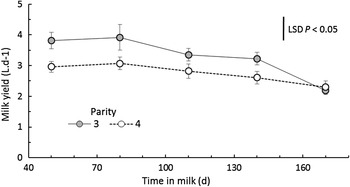
Average daily donkeys milk yield of two parities at different days in milk (mean ± se); parity 3 (n = 7) and parity 4 (n = 11).

Results and discussion
The lactation curves obtained from milk yield data of parity 3 and 4 donkeys are presented in Fig. 1. Mean milk yield of Jiangyue breed donkeys used in this study was higher (3·0 kg/donkey/d) than that reported in Ragusana donkeys (1·6 kg/donkey/d; Giosuè et al. Reference Giosuè, Alabiso, Russo, Alicata and Torrisi2008), and Jiangyue donkeys (1·3 kg/donkey/d; Guo et al. Reference Guo, Pang, Zhang, Zhao, Chen, Dong and Ren2007). The difference may be attributed to the feeding regime, lactation length and parity selected for the study.
Parity (F 1,16 = 4·56, P < 0·05) and DIM (F 4,62 = 23·11, P < 0·001) both had a significant effect on milk yield, but no interactive effect was found between parity and DIM on milk yield (F 4,62 = 2·04, P > 0·1). There were broadly similar temporal patterns in milk yield for both the parity 3 and 4 donkeys, with the peak of lactation between 51 to 80 DIM, similar to the report of D'Alessandro & Martemucci (Reference D’ Alessandro and Martemucci2012), and a general decline over the 170 DIM lactation period (Fig. 1). The milk yield dropped from 3·8 to 2·2 kg/donkey/d from the start to the end of lactation (170 DIM) for parity 3 donkeys and dropped from 3·0 to 2·3 kg/donkey/d for parity 4 donkeys. This trend is consistent with other studies that showed the stage of lactation was one of the most significant factors influencing milk yield. For example, milk yield decreased from 2·0 to 1·3 kg/donkey/d in the study by Giosuè et al. (Reference Giosuè, Alabiso, Russo, Alicata and Torrisi2008).
On average, parity 3 donkeys produced 22% more milk than parity 4 donkeys (3·3 kg/donkey/d vs 2·7 kg/donkey/d; Fig. 1). Further, since the donkeys used in this study differed only by one parity order, the difference in milk yield may be more related to the age (parity 3 donkeys mean age 6·6 years; parity 4 donkeys 8·3 years), with young donkeys in parity 3 producing more milk than older parity 4 donkeys. In support, Bordonaro et al. (Reference Bordonaro, Dimauro, Criscione, Marletta and Macciotta2013) showed that age can have some effect on donkey milk yield, with older donkeys (>10 years) producing 13% less milk compared to younger donkeys (6–10 years). Therefore, although there was some confounding between parity and age in this study, all the donkeys were in the range of 6–10 years old. The separation of effects of parity and age on donkey milk yield requires further study.
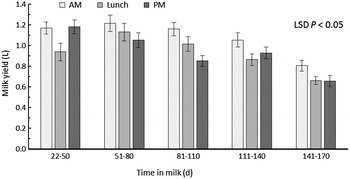
Overall, donkeys produced more milk from AM milking (1·1 kg/donkey) than lunch (0·9 kg/donkey) and PM milking (0·9 kg/donkey) (F 2,156 = 28·25, P < 0·001; Fig. 2). This result may in part be a reflection of the longer lapse period prior to the morning milking (approximately 9·5 h) compared to the lunchtime (5·5 h) and evening (6 h) milkings. Previous works suggested that milk synthesis processes are influenced by circadian rhythms, often with the greatest secretory activity occurring over-night (D'Alessandro & Martemucci, Reference D’ Alessandro and Martemucci2012) and higher milk yields have been associated with a longer interval between milkings (Alabiso et al. Reference Alabiso, Giosue, Alicata, Mazza and Iannolino2009). It is important to note that inconsistency in the period between milkings cannot fully explain the variation in milk yield over the course of the day, as the effect of milking time was not consistent over the whole lactation period (milking time x DIM interaction, F 8,156 = 4·78, P < 0·001). For example, in the 22–50 DIM period, when milk production was at a high level, the PM milking produced a similar quantity of milk as the AM milking (Fig. 2). This might be related to maximal rate of secretion during the first stage of lactation (Doreau et al. Reference Doreau, Boulot, Martin-Rosset and Dubroeucq1986). Further, we speculate that such variation in milk yield may be associated with change of seasonal diet (i.e. April–May diet vs June–October diet); as DIM period of 22–50 d coincidently matched April and May feeding period. Nevertheless, the patterns and processes behind variation in donkey milk yield over the course of the day is another aspect of this system that requires further clarification.
Milk yield of donkeys milked three times a day (morning- AM, lunch and afternoon-PM) at different days in milk (mean ± se; n = 18).

Conclusions
This short study demonstrated that in donkeys maintained under a typical Xinjiang, Chinese production system, milk yield is affected by parity, days in milk and time of milking. This information can be utilised by producers to better predict milk yields over the course of a production season, establish what milk yields might be expected from individual animals, and aid decisions in herd development in order to maximise potential milk yields in the future. Further research is required to examine additional aspects of donkey milk production systems in China, particularly in comparing the milk yields produced by primiparous and multiparous animals.
The authors acknowledge the financial support from the Nature Science Foundation of China (No. 31160461), and Key Laboratory of Tarim Animal Husbandry Science and Technology of Xinjiang Production & Construction Group (No. HS201309). We acknowledge the support of the AGMARDT Postdoctoral Fellowship and Prof. Grant Edwards (Lincoln University, New Zealand) to author Dr Long Cheng.