Attitudes toward the consumption of alcohol by the British working class had begun to shift during the last twenty years of the nineteenth century, as the environment and working conditions were gradually recognised as being a major contributory factor in drunkenness. Friedrich Engels had raised the environmental issue in 1845 in The Conditions of the Working Class in England, arguing that cramped, uncomfortable living conditions and harsh working practices drove the worker to drink. Engels states of the worker, “His enfeebled frame, weakened by bad air and bad food, loudly demands some external stimulus; his social need can be gratified only in the public house, he has absolutely no other place where he can meet his friends. How can he be expected to resist the temptation?” (133). But the power of the temperance movement's focus on individual responsibility and self-help during the mid-nineteenth century meant Engels's focus was not widely accepted until the resurgence of socialism at the end of the century. By then resentment was rising within both the working class generally and the socialist movement against the imposition of abstinence, especially when the consumption of other classes remained steady. As Brian Harrison states, “it was now suspected that [the workers] were being hypocritically inculcated by self-interested capitalists,” (402) and British socialists were keen to promote this perspective.
Although the promotion of socialist ideals and polemic took many forms – from the lecture to the Clarion van touring the country – the periodical was the most prolific form of contact with the working class. Almost any group calling itself socialist, no matter how short-lived, published its own journal. The use of the written word and its public voice is recognised by Margaret Beetham; the power of the periodical was “to define [the] world” and “make . . . meanings stick” (20). Journalism gave verity, connecting research to polemic, and the integration of fiction in the periodical's commentary reinforced the group's position through another medium: serialised fiction did not merely supply enjoyment in exchange for regular readership. What I want to argue is that the fiction serialised in four influential socialist periodicals – Justice, the Clarion, the Labour Leader, and the Workman's Times – showed evidence of consensus over Engels's environmental argument while simultaneously reinforcing the deep divisions within the socialist movement over the temperance debate, a division which grew out of the earlier political divide over the consumption of alcohol.
Henry Mayers Hyndman, founder of the Social Democratic federation and proprietor of its periodical, Justice, laid the blame for the cause of working-class drunkenness at the door of capitalist industrialism and environment. In The Social Reconstruction of England, Hyndman emphasises the moderation of the workers in relation to alcohol in the face of temptation.
When I look around me at the social conditions in which the workers live, when I take account of the fact that there are so few opportunities afforded them for healthful pleasure, when I note that the public-houses – there are far too many of them, no doubt – are the only places where workmen can conveniently meet their fellows, I wonder that, as a whole, the very poor should be as temperate, as saving, as quiet, as contented as they are. (20)
The double standards imposed on the workers meant, as both Hyndman and Engels pointed out, that alternatives to spending time in the public house were denied but capitalist economics provided few leisure opportunities other than drinking while simultaneously castigating the working-class drinker. Hyndman's argument for the inherent moderation of the worker was reiterated in the fiction of Justice. “A Working Class Tragedy,” published under the name of “H. J. Bramsbury” but possibly written by Hyndman himself,Footnote 1 is the story of a persecuted working-class man, Frank Wilson. It is through Wilson's encounter with fellow dock-worker and socialist, Nobby Wright, that Hyndman's polemic on the moderation of the responsible working-class man and the environment as a temptation to drink is reiterated. Wright the moderate socialist is elevated above the surrounding intemperate.
The environment argument is reinforced in the depiction of Wright's rented rooms through the contrast of the capitalist landlord's squalid property against the cleanliness of the respectable working-class family. The landlord's desire to accumulate money from rent at the expense of the renter's living conditions is signified by the shell of the rooms, where “the ceiling was blackened and cracked, the cornice was broken, and the paper on the walls was so torn and dirty with age that its pattern was quite indiscernible” (Bramsbury, Justice 20 November 1888: 2). Capitalist economics force Wright and his family into poverty, where rent per foot could be relatively higher than that of exclusive areas (Engels 72), but they resist the permeation of the sordid environment. Wright's wife's domestic work ensures that the degradation of their surroundings does not pervade their own property – and through that themselves: “One thing noticeable amidst all this poverty was the thorough cleanliness of everything subject to the application of soap and water. . . . The comparison between the care and cleanliness of the occupants of this room and the utter neglect of everything which belonged to the landlord was most remarkable” (Bramsbury, Justice 20 November 1888: 2). Bramsbury's juxtaposition of the respectable family with the landlord's neglected responsibility reinforces the socialist criticism of moral standards being imposed by a social group with a defective idea of morality, and who profit from the human beings they force to live in poverty. Despite its reversal of the criticisms levelled at the working classes, Bramsbury's fiction retains the division between gendered spheres: Wright's wife strives to remain respectable within the domestic sphere, while her husband's standards are shown in relation to the pub and his consumption. He is described as “not a thirsty soul,” but one who was fond of the pub “because he was very fond of conversation and discussion” (Justice 20 November 1888: 2). Bramsbury's fiction assimilates both Hyndman and Engels's polemic on environment.Footnote 2
Bramsbury's depiction does not suggest an idyllic, temperate working class who were unfairly vilified by the press and higher classes. Rather, he acknowledges the problems by having them enacted around Wright and his family. Christmas in Wright's court, Beulah Place (the darkness of which ironically contrasts with Bunyan's paradise) provokes both “beery jollity” and domestic violence (Bramsbury, Justice 22 December 1888: 4). While Wright and Wilson abstain – but only because they had not earned enough the previous week – the rest of the court indulge in their favourite pastime during one of the few holidays they were allowed. While nothing is shown of the “beery jollity,” the reader is treated to a small vignette of the negative aspect of drunkenness. The chimney sweep living opposite “got more than usually drunk” and “declared his willingness to fight any adjective Socialist in the court for a ‘pot.’ No one evincing any desire to contend with him for this valuable stake, he practised his pugilistic powers on his unfortunate better half, who appeared the next day with a couple of black eyes” (Bramsbury, Justice 22 December 1888: 4). There are two points being made here in relation to the SDF view on working-class drunkenness. First, Wright is being positioned as the responsible working-class socialist, the future political power that will lead the country to a better society. He is the embodiment of the hope in William Morris's empathetic comment, “If I were to work ten hours a day at work I despised and hated, I should spend my leisure I hope in political agitation, but I fear – in drinking” (Thompson, E. P. 752). Wright's temperate attitude (enforced in this case, but generally moderate when he can afford to drink) places him opposite the inebriate sweep, and implies the separation of the working-class socialist propagandist from the dissolute.
Second, Bramsbury uses the popular technique of involving a female in the scene to exacerbate its horror: the female is the target for the violence of those uncontrollable through drink. While Engels recalls Saturday nights in Manchester where he encounters “numbers of people staggering” and “others lying in the gutter” (152), Bramsbury confronts us not only with the dangers of drunken violence but raises the stakes by having it enacted upon a woman. The passive female recipient of the violence compounds the act in a way that an equal fight between two male inebriates would not. But while Bramsbury's imagery exacerbates the misuse of alcohol, other authors were using the figure of the woman to intensify the critique of environment as stimulation for drunkenness.
Andrew Barr notes that the “attendance, and acceptance, of women in pubs has fluctuated markedly since the middle of the eighteenth century” when “it was thought disgraceful . . . for a women to be seen in a public house” (181). Women were a common sight in the early dram shops and gin palaces, but their presence did nothing to overturn the moral panic about female drinking, and throughout the nineteenth century women were gradually re-situated in the domestic sphere, leaving the men in the pubs. The general inclination to disassociate women and alcohol meant that the depiction of the drunken woman was utilised to heighten the critique of excessive drinking and associated violence. Gill Davies notes George Gissing's shift of focus onto the female “whose description contains more horror and power than any of the criminal youths or men” (70), and James Sexton's pseudonymously serialised fiction, “The Blackleg,” uses both the environment and gender for a polemic on the abuse of alcohol under capitalism.
Published under the name “Citizen,” Sexton's journalist nom de plume, “The Blackleg” was serialised between August and December 1893 in Joseph Burgess's Independent Labour Party publication, Workman's Times, and takes a more rigorous look at the problems of environment and its relation to alcohol. Whereas Bramsbury leads the reader into Beulah Court under cover of darkness, Sexton shows us the conditions in daylight and thus raises three issues in his opening description of “Manchester-street, Shanty Town” (Citizen, Workman's Times 26 August 1893: 1): the degradation of the environment and its effect on the inhabitants; the connection between poverty, environment, and alcohol abuse; and the critique of alcohol exacerbated through the depiction of drunken working-class women.
Darkness is maintained in Sexton's description, as he shows us the street with “the steps leading down to the cellars beneath the pavement with their one narrow dark apartment, into which a ray of sunlight never strayed” (Citizen, Workman's Times, 26 August 1893: 1), but it is not used to hide the squalor of the working-class environment. His gaze is steadier than that of Bramsbury, looking directly at the squalor and poverty in which some were forced to exist. The court building, unseen in “A Working Class Tragedy,” is described in detail in “The Blackleg” during the visit of the capitalist's wife to the home of a widow of one of her husband's workers. Mrs. Crushem is forced to face her husband's greed and callousness as she enters the room to find the woman “stiff and dead on a filthy, reeking mattress in the corner of her dark, cheerless, miserable hovel” (Citizen, Workman's Times, 16 September 1893: 4). While it is not suggested that the dead woman drinks, the scene reinforces the environmental argument raised by the socialists as to the causes of drunkenness, and implies concurrence with Blatchford that if the workers had “healthy homes, human lives, due leisure and amusement, and pure meat and drink, [then] drunkenness will soon disappear” (“Merrie,” Clarion 5 August 1893: 6). Mrs. Brophy may not be drunk, but it is unsurprising that some would choose the route of alcoholic oblivion. However, the problem of drunken violence, raised by Bramsbury, is made more shocking by Sexton's description of the preparations for a fight between, and encouraged by, women. The scene, described by the ineffectual police witness, also critiques the capitalist values embraced by the women:
[I]t's only the usual Monday afternoon exchange of courtesies between the women . . . they're simply blowing the froth off the beer they've consumed on money raised on the bundles subscribed among them, and the present row is simply because Mrs. Brady over there, whom you see tying up her hair in preparation for a fight that won't come off with Mrs. Carson, who after helping to consume the price of Mrs. Brady's bundle, has ungratefully refused to return the compliment by also subscribing to keep up the fun. (Citizen, Workman's Times 26 August 1893: 1)
In this short passage, Sexton encapsulates the whole socialist polemic on the reinforcement of capitalism and alcoholism. The undemocratic Mrs. Carson is prepared to take from others without reciprocation; the general indulgence in alcohol both alleviates and aggravates the degradation of poverty; the frustrations of economic entrapment boil over into violence; and the imagery is intensified by being enacted by women. The dissipation of the women is reinforced through their language: not only do they drink and fight but they also use foul language, as they as “[fill] the air with terrible imprecations” (Citizen, Workman's Times, 26 August 1893: 1). The role of drink producing “unfeminine” behaviour is similarly addressed by Bramsbury during Frank Wilson's first night as Wright's lodger, as his sleep is disturbed by the sounds of women fighting, “either through excessive drinking or bad tempers.” The conflict is accompanied by “Yells, screeches, sounds of heavy substances falling; more curses, scuffling of feet, murmurs of approval or dissent” (Bramsbury, Justice 27 November 1888: 3). While Bramsbury refuses to make the direct link between the fight and alcohol that Sexton does – the fight could be as likely to stem from “bad tempers” as from drink – both recognise that the violent, drunken female is as much a production of environment, frustration, and economic entrapment as the alcoholic male, but the perpetuation of gender stereotyping reinforces the critique of excessive alcohol consumption and neither author can bring themselves to look frankly at female violence. Bramsbury's cat-fight occurs outside the vision of both Wilson and the reader as we listen but do not see the fight, and Sexton's ostensibly direct look at female fighting is undermined by the policeman's comment that it was “a fight that won't come off.”
Despite the revolutionary political polemic running through the pages, and the close association of the editor and proprietor of the periodicals, self-censorship was just as important for the author of socialist serialised fiction as it was for bound-text authors. Blatchford, in the chapter “On Realism” in My Favourite Books, argued that both social and editorial restrictions prevent a true representation of slum life:
What are the two commonest adjectives of the low-life Cockney? No publisher dare print them: yet in “Jago” conversation hardly a sentence is spoken without their use. And do women like Sally Green and Nora Walsh fight in silence, like bulldogs? I have known many such, and I have heard them, under stress of rage and gin, use language which I should not like to repeat even privately and to one of my own sex. (226–27)
Blatchford's criticisms apply similarly to the socialist depiction of female drunkenness and violence, with both authors and editors labouring under social rather than editorial restrictions.
The attempts to dissociate women and alcohol made the female presence in the pub unacceptable, but did not prevent publicans employing women to serve male customers. Andrew Barr notes the change from the eighteenth century public house, where the guests were waited on by waiters or pot boys, to the pub. No longer a private house open to the public, “[t]he pub became a shop in which goods were sold over the counter by smartly-dressed shop girls” (177). It was now acceptable for women to serve men, but not to join them in a drink (Barr 182).Footnote 3 The only image we get of bar-work in the socialist fictions studied here is that of Bramsbury's Alice Steggles, barmaid and daughter of the Red Lion's publican. Alice is described as a rustic beauty, but her forceful personality, her “originality, boldness and vivacity” is suggested in her having “a touch of firmness about the chin [and a] sensual appearance of the mouth” (Bramsbury, Justice, 30 June 1888: 3). Alice is not the stereotypical obedient female, as she runs away from home to find Frank after his disappearance. But neither is she the fallen or disreputable woman: her employer is also her father, so Alice holds a more respectable position behind the bar at the Red Lion because of her familial relationship with the publican.
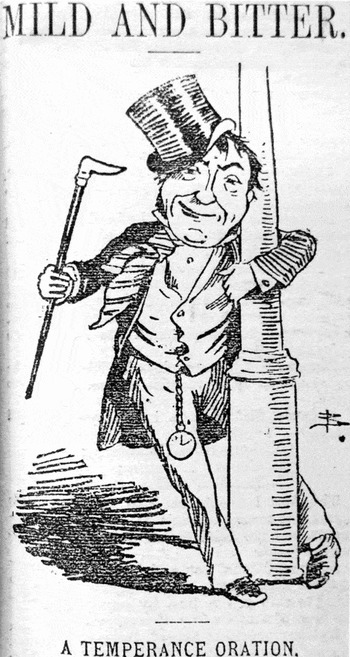
The issue of respectability was not reserved solely for women, but applied to every person regardless of class and gender. While Engels recognised that the spread of drunkenness in Manchester “has here ceased to be a vice, for which [only] the vicious can be held responsible” (133), others recognised the class bias in the attitudes of both the general population and the police. Brian Harrison notes the discrepancies between arrests for drunkenness in Sheffield, where analysis of the arrest records for 1863–64 revealed that of 515 arrests, 228 had no educational background, 276 had only “imperfect” educational experience, and only 11 were recorded as “good,” 77 were unemployed and only one recorded the arrest of a “gentleman” (397). This inconsistency (or, rather, a skewed consistency) was used by some to suggest the extent of the drink problem in the working class, but socialists rejected the idea and made a point of portraying the drinking habits of the upper classes through both journalism and creative writing. For instance, the image of the drunken aristocrat illustrates a poem by Boggs in the 10 June 1893 issue of the Clarion. Entitled “A Temperance Oration,” the content of the poem suggests the drunken narrator's upper-class status through reference to his “fob” and “glossy tile” (top hat), and the accompanying cartoon reinforces this image through the drunk's cane, frock coat, and cravat (Figure 10).
Illustration for “A Temperance Oration,” by Boggs, The Clarion 10 June 1893, 1. Courtesy of the Working Class Movement Library, Salford, United Kingdom.

The foundation of the socialist reversal relates to the recognition of the middle- and upper-class attempts to enforce temperance or abstinence without any attempt to lead by example (Harrison 402). In Crusade Against Drink in Victorian England, Lilian Lewis Shiman notes the shift of the early temperance groups from the predominantly upper- and middle-class societies of the 1830s, which sought to lead the nation by example, to the growing working-class involvement and focus on total abstinence after the 1840s (4–5). The aim of the early temperance movement was to reform national drinking practices, and the predominantly middle-class reformers “wanted their own class to set an example for the ‘lower orders’ and, with this end in mind, they concentrated on publicising temperance principles among the middle classes” (Shiman 9). Across the century, leading by example was gradually replaced with arguments for the necessity of working-class abstinence without reciprocation. Socialist polemic during the final quarter of the century reinterpreted the argument for working-class teetotalism in the fight against poverty as a means of reducing wages as expenditure decreased. Similarly, perception shifted from the middle class as leading by example to the hypocrisy of the upper and middle classes imposing temperance and teetotalism on the working classes while maintaining their own drinking habits. There was increasing resistance within the working class to external cultural impositions, and British socialists were willing to publicly criticise those who did not practice what they preached. The two main sources of imposed abstinence are personified in Sexton's capitalist employer, and Bramsbury's clergyman, both of whom imbibe while arguing the necessity of working-class teetotalism.
Bramsbury's fiction signifies the collusion of the Church and employers by situating the Rev. Mr. Grey inside the capitalist's home: readers do not encounter the clergyman anywhere else in the fiction. Such a positioning reiterates Hyndman's suggestion of collusion during the Trafalgar Square demonstrations of October and November 1887: “Where are the bishops who spoke so nicely of the people? Probably telling Sir Charles Warren at the dinner table of some Duchess not to show any mercy whatever to the scoundrels who dare to ask for work” (“Class,” Justice 22 October 1887: 1). The comfort of the bishops, housed within the opulence of the aristocracy and situated around the dinner table, is to be juxtaposed against the fight for work by the unemployed to be able to afford food. The dinner table, presumably, would include alcohol and the wine list would traditionally contain port.
Port was a particularly significant drink for the socialist author suggesting class hypocrisy, as it was not only closely associated with the luxury of the upper classes, but it also had a high alcoholic volume. Bramsbury uses it to signify double standards as the clergyman, Mr. Grey, discusses the intemperance and vice of the workers while “calmly sipping his port” (Justice, 25 August 1888: 2). The location of Mr. Grey strengthens the socialist critique of the un-Christian attitude of the Church as its representative is in agreement with the capitalist on the use of abstinence to lower wages while enjoying the pleasures of opulence and good drink. “If they would but inculcate the principles of sobriety and thrift among their labourers, they would be able to get labour much cheaper, and it is in this direction that they should seek to economise” (Bramsbury, Justice 25 August 1888: 3). Bramsbury's point emphasises the socialist perception of the capitalists' cynical use of the temperance argument for their own gain, and repeats the general socialist opinion that total abstinence by all would not profit the workers, as the temperance movement suggested, but would simply set lower standards to which wages could be reduced further. In response to a claim that local teetotallers had savings in the bank, ILP member Philip Snowden argued that “the sober minority profits by its teetotalism only because the majority drink” (Keighley News 5 January 1895, 7).
James Sexton not only addresses the double standards of the middle class, but also those who position themselves as temperance leaders. The capitalist Crushem's cant is made evident in Sexton's comment that “being a temperance leader, he never took anything stronger than port” (Citizen, Workman's Times 7 October 1893: 3). The term “temperance” was used during the period to suggest abstinence rather than moderation, so Crushem's consumption of any alcohol at all would underscore his duplicity with regard to the workers. This is then exacerbated by the choice of port as his drink. Andrew Barr traces its origins in the late seventeenth century as an unfortified wine, a type of Portuguese burgundy, which was made stronger in order to appeal to the English market. Portuguese distillers added brandy, ostensibly to enable the drink to survive the journey, but actually to pander to the English taste for strong drink (Barr 28–29). Thus, Crushem's choice of alcohol is far removed from the tea and water advocated by the temperance movement and reinforces his double standards. But Crushem's tippling can also be read as an illustration of the failure of the middle classes to mould the workers. Gareth Stedman Jones states that “[b]y the Edwardian period, it had become inescapably clear that middle-class evangelism had failed to re-create a working class in its own image. The great majority of London workers were neither Christian, provident, chaste nor temperate” (196), and Patrick Joyce makes the same claim for the working class in Lancashire (Work 286). Sexton's point is that the middle and upper classes were not moulding the workers in their own image, but imposing a restraint that they were either incapable or unwilling to exercise themselves, thus making them unfit for the leadership for which the socialists perceived themselves capable.
Crushem's hypocritical attitude towards alcohol is not restricted to the double standards of his own consumption and the imposition of temperance on his workers. Not only did he turn a blind eye to working-class drinking when it was convenient for him to do so, but when necessary for his business he supplied and encouraged the consumption of alcohol. He employs strike-breakers – “blacklegs” – during the dock dispute and distributes tobacco and alcohol in response to the blacklegs' demands. The blacklegs “drinking beer which was distributed to them by Crushem's foreman in the presence of Crushem, the great temperance advocate” because they “demanded that as they were shut out (or rather shut in) from the luxuries of beer and baccy, that such should be provided for them free of cost” (Citizen, Workman's Times 25 November 1893: 4) addresses two issues. The enclosure of the blacklegs by the dock area where they were both working and living symbolises the economic entrapment of the workers under capitalism with no life outside work and no opportunities for leisure or entertainment, as both Blatchford and Hyndman argued. Their only pleasures are drink and tobacco, the former being subjected to temperance campaigns to remove even this form of recreation from the workers' lives. Crushem's distribution of alcohol could be read as simply pandering to those who were enabling him to smash the union, but could also suggest both the power of the workers and the employer's fear of them. Although these are non-unionised men, Sexton points to the power held by workers en masse Crushem cannot operate the docks without workers, and although the strike-breakers are jeopardising the formal action, the fiction emphasises the power they hold over Crushem: their demands must be met and Crushem must set aside his own rules in order to get the work done.
Fear of the workers is another reason for the distribution of alcohol and tobacco: the fear that the sober working man could become revolutionary. Crushem's strike-breakers are a body of men from the lowest section of society, described by Sexton as “the half-starved miserable wretches whom hunger had driven to take the place of the men on strike” (Citizen, Workman's Times 25 November 1893, 4). Crushem's indulgence of the men's demands is not merely his attempt to keep them at the docks, but also to ensure that inebriation would prevent any revolutionary stirrings. Sexton's fiction thus echoes earlier Liberal accusations of the Tory aims to keep the workers drunk and so non-revolutionary. During a debate over the Representation of the People Bill in the 1860s, the Liberal Viscount Goschen accused the Tories of being “more afraid of the working classes when they think than when they drink” and perceives the workers “are more likely to combine if they are sober than if they have spent all their money on beer” (Barr 11). In socialist fiction, the sober workers are law-abiding, thoughtful, independent, unionised – and often socialist.
Brian Harrison recognises the socialists' concern that the centrality of the drink-problem in the poverty debate could shift the focus from capitalist economics to the responsibility of the individual (403–04), and the fiction thus far has reiterated the general acceptance of the environmental argument. Nevertheless, there were deep divisions between factions within British socialism over the presence of alcohol in working-class lives, and this is enacted in the first meeting between ILP founders, Robert Blatchford and James Keir Hardie.
Hardie recalled to fellow Independent Labour Party member, Katherine Bruce Glasier, that he had arranged to meet Blatchford at Hardacre's theatre in Manchester, where he walked into a room full of tobacco haze and the smell of whisky, where women were sitting on men's knees. Blatchford came forward to welcome Hardie, who was horrified by what he saw as debauchery, made an excuse about catching a train and fled (Benn 84). Blatchford's own recollections were somewhat different; he recalled that “I offered him the warmest welcome that I ever gave to another man, and he held out a hand like a cold toad, and ran away” (Thompson, L. 71). Blatchford's biographer, Laurence Thompson, notes Hardie's concerns about the theatre being run as a brothel, but Blatchford's view was that “Hardacre was not a brothel-keeper, nor anything but one of the naughty boys and girls, who was often drunk, was not quite respectable in his morals, but who was enormously generous to the unfortunate of his profession, and a fervent supporter of the Ancoats Cinderella club [Blatchford's children's club] until the good people who ran it requested him to take his tainted money elsewhere” (Thompson, L. 71). Hardie's disgust and Blatchford's acceptance signify the divisions within the British socialist movement.
The polarity within the socialist movement perpetuates the older political division on the issue of teetotalism. Gareth Stedman Jones notes that the early nineteenth century opposition of teetotallers and the drink trade was not generally politicised, but after the middle of the century the drive for abstinence – or teetotalism – was strengthened and politicised by the growing association of the temperance movement with the Liberal Party, an association which pushed the brewers and drink traders towards the Tory Party (232). The perpetuation of this earlier political division within the socialist movement illustrates the linguistic turn's argument that, as language interacts with social reality a re-formulation occurs over time and between different situations and conditions. Linguistic change is achieved through interpretation, as “every meaning is created starting from a previous meaning and as a result of the interaction between previous meanings and new specific social situations, hitherto unencountered” (Cabrera 82). The issue of alcohol and working-class leisure as a point of antagonism served to separate those who had reached socialism through the Liberal or Tory routes.
Tory politics has been noted for its embrace of drink, sport, and good food. Patrick Joyce in Visions of the People claimed that while “[t]he Liberals were the party of education and respectability, the Tories were associated with drink, violence and what may be termed the politics of bonhomie, of the good time” (35–36). The perpetuation of this polarity into socialist polemic divides the periodicals into two groups: Justice and the Clarion argue for the positive place of alcohol in the workers' lives, Workman's Times and the Labour Leader promote the benefits of teetotalism.
It is unsurprising that there is a pronounced Tory perspective within the fiction of both Justice and the Clarion. Hyndman, founder of the Social Democratic Federation, proprietor and some-time editor of Justice, was an upper-class barrister from a Tory family, and Blatchford, whose full name was Robert Peel Glanville Blatchford, was the son of an itinerant actor with Tory and High Church sympathies. Although the SDF were predominantly a metropolitan group, the main area of support outside of London was to be found in Lancashire, which had a strong working-class Tory base, and where during the mid-1890s the Lancashire SDF membership overtook that of London (Watmough, Table 1, Appendix). The Clarion was founded in Manchester and encompasses both Liberal and Tory discourses, but the Tory aspect of the Clarion group was declared by founding member, Alex Thompson, who “felt more at home with Hyndman than I ever did with Keir Hardie” (Thompson, Alex 98). The opposition was also acknowledged by Robert Blatchford in a letter to Thompson, in which he described the faction surrounding Keir Hardie's Labour Leader as “Puritans; narrow, bigotted [sic], puffed up with sour cant” (qtd. in Thompson, L. 230). While Blatchford, who described himself in the letter to Thompson as “a Tory democrat,” aligned the Clarion group with “the humour and colour of the old English tradition,” Hardie took the opposite view: the ex-Liberal party member and teetotaller was appalled by the sale of alcohol in the SDF's workingmen's clubs (Benn 51–52). Tory-socialists argued for rational recreation without removing the worker's enjoyment of alcohol and the pub, as Blatchford argued in “Merrie England” that “[i]f you do drink beer and spirits it would be better to have them pure” (Clarion 1 April 1893: 6). Both H. J. Bramsbury in “A Working Class Tragedy” and Edward Fay in “Strictly Proper” formulate a positive image of working-class drinking.
Fay's fiction opens with the socialist image of the public bar as a healthy place for meeting, socialising and recreation, with a scene in the rural public house after the funeral of the local aristocrat, Lord St Osyth (Clarion 22 April 1893: 1–2). Brian Harrison records the support for beer by the country gentry and landowners in the early part of the century, with the involvement of the landowners in the brewing and selling trades (57). The connection is signified through the rural workers toasting the old Lord in the “St Osyth Arms.” The uncommon event of the death of the local landowner gives a reason for more than moderate consumption, as the blacksmith is shown “[o]rdering a fresh mug (a St Osyth didn't die everyday)” (Fay, Clarion 22 April 1893: 2). Fay also associates the landowners with the brewing trade as the workers are described as imbibing wholesome ale rather than inebriating spirits, barley being a lucrative crop grown for brewing. The demarcation between alcoholic drinks was illustrated in Hogarth's opposition of Gin Lane and Beer Street, and the 1830 Beer Act favoured the healthy properties of beer by the removal of all taxes on beer and allowing the opening of beer shops without the need for a justices' licence. Whig politician Henry Brougham hoped the act would ensure that the workers would “have good beer instead of bad spirits . . . to the poor the beer [is] next to a necessity of life” (Barr 205, 248). The wholesome properties of beer consumed by the workers stand in contrast to the duplicitous consumption of spirits by those promoting abstinence.
The tradition of ale as part of British labouring life is reinforced by Fay through the rural worker's preference for “Potts Entire Ale.” The “Entire” was a blend of ales similar to porter, and the image of tradition is reinforced by the drinkers' occupations: the cobbler, blacksmith, and woodcutter. But while Fay celebrates the role of beer in British heritage, tradition is concurrently challenged for privileging heredity and looking backwards. The woodcutter's pride in his family lineage is sharply criticised as stasis by the new London landlord of the pub, criticism which produces new lines of thought that need to be considered over a pint of ale. The landlord's comment “appeared to put the matter in a new light. They had obviously never considered the matter from that standpoint before, and they fell into a silent contemplation of the ‘new criticism’ aided by three more mugs of Potts potent entire” (Fay, Clarion 22 April 1893: 1). Fay suggests that both alcohol and the space of the public house aid the progression of ideas. The bar as the arena for debate, conversation, and contemplation, and not the place of excessive consumption is also portrayed by Bramsbury through Nobby Wright's moderation, justifying the SDF's decision to allow bars in its clubhouses and rebutting ILP criticism of the practice. Where the ILP promoted teetotalism through dry meeting places, both Bramsbury and Fay position themselves and their socialist polemic on the side of what Brian Harrison refers to as the “pleasure-lovers” in opposition to the “puritans” (401).
It is not only the tradition of working-class drinking which is given a positive image; the nourishing value of beer is raised by Frank in “A Working Class Tragedy,” who states during his campaign to allow farm labourers to drink during harvest that “there's nothing more wholesome than mild ale, whatever teetotallers may say” (Bramsbury, Justice 9 March 1889: 4). Andrew Barr states that “[h]istorically, beer was regarded more as a food than as a means of dulling the pain of existence” (248), and the Beer Act's vision of beer as a less destructive drink than spirits had a two-fold aim: to control the previously illegal sale of beer from private houses, and to wean the population from the consumption of gin (Barr 205). This classification of healthy and destructive drink is maintained through the image of the healthful and moderate working-class beer-drinker juxtaposed in the fiction of both Bramsbury and Fay with the upper class consumption of spirits, as Bramsbury's clergyman signifies: “‘But I really should like to know’ – helping himself to another glass of port – ‘if this crime were in any way traceable to drink. It would considerably strengthen my hands in the crusade I am now carrying on against beer in the harvest field’” (Bramsbury, Justice 25 August 1888: 2).
The class critique and double-standards are also raised in Fay's fiction, as he introduces the reader to the licentious aristocrat, the new Lord St Osyth, in his drinking establishment, the Flotsam and Jetsam club. The imagery of the club is reminiscent of that of Egremont's in Disraeli's Sybil, (chapter 1) but, as the name implies, St Osyth is surrounded by “the cream of all that was knavish, vicious and dissolute” (Fay, Clarion 13 May 1893: 1). Fay depicts the aristocrat and his group drinking brandy rather than the wholesome ale of the rural labourers in the opening chapter, an image also used by Bramsbury to enforce the separation of the honest labourer and the evil capitalist. Fay's focus for aristocratic dissolution is not simply the choice of tipple, but also a gambling habit. As with contemporary George Moore in Esther Waters, Fay argues that the dangers of gambling as well as drink should be recognised as destructive. Nevertheless, the association of gambling and strong spirits reinforce the criticism, as St Osyth's friend Captain Wragge complains: “‘If Bumble Bee doesn't win the Ledger it's a case of India.’ And the Captain threw his cigar on the fender and ordered a soda and brandy” (Fay, Clarion 13 May 1893: 2). The Captain's habit has left him in a position where he will have to earn his money through a commission in India, and his displeasure at the thought of this turns him to drink just as Engels, Hyndman and Blatchford have argued happens with the workers. The enforcement of unappetising work turns the worker to drink regardless of social status, but it is only the workers who are manipulated into abstinence.
The difference between the respectable workers at the public house and Wragge is their choice of tipple, and Bramsbury similarly uses the connection between the upper classes and spirits to emphasise the moderation of the workers. The capitalist's son is the cause of the only trouble seen in the local pub, when he over-reacts to an accidental jolt and throws his brandy and water over one of the customers (Bramsbury, Justice, 30 June 1888: 3). Both authors reverse the criticism levelled at the workers for their drunkenness through the inclusion of the sottish upper classes, while taking the Tory perspective and celebrating the labouring tradition of ale-drinking.
Despite the separation of the aristocrats from the workers through their preference for spirits, Fay reinforces the Tory aspect of Clarion socialism by introducing a defence of theatres and music halls, and their connection with alcohol. Stedman Jones notes the rising enthusiasm by the upper classes for music hall entertainment, spearheaded by the Prince of Wales. The aristocratic fondness for drink meant that they spectacularly resisted the attempted imposition of abstinence at the entertainment. The association of the music halls and alcohol made them a target for middle-class temperance crusades. Mrs. Ormiston Chant's attempt to erect a screen in the Empire to separate the hall from the bar was physically resisted by a large group of aristocrats, led by Winston Churchill, who tore the screen down and marched around Leicester Square swinging fragments of it around on walking canes. The association of both upper and working classes in relation to the music hall was an image used to separate those groups from the “killjoys” in the middle (Stedman Jones 230–33, 237).
Fay's protagonist, the dispossessed aristocrat, is separated from respectable society through his appreciation of the music hall. Armand enjoys the bonhomie of the North Bar Music Hall to the dismay of his employer, and argues that the Hall is “one of the least depressing places in Smudgebrook. There are lights, an entertainment, and cheery people there” (Fay, Clarion 20 May 1893: 1). Fay contrasts the dour respectability of the middle class against the Tory embrace of enjoyment, which serves to position him and Clarion socialism generally on the Tory side of the socialist divide. Armand and the lights of the music hall are contrasted with the dreariness of the respectable middle classes. Armand's manager is “dismayed by the thought” of happy people, and Bill Froggatt, Armand's working-class friend, is rewarded for his courage in rescuing a woman from a fire in the theatre by being preached to and converted to temperance by the joyless middle class: “Maiden ladies of mature years and minimum dimensions [who] ministered unto Bill, and presented him with buns and tracts, and besought him to walk in the narrow path. And Bill looked at his feet and sighed” (Fay, Clarion 27 May 1893: 1). The ladies' “minimum dimensions” suggest their stringent attitudes and joylessness, which are being forced onto Froggatt when he should be celebrating his fame and courageous reputation.
The dour act of celebration by the Smudgebrook elite encourages Armand to overlook the middle classes and enjoy the “low company” of workers, the music hall, and cricket with the works club. The bright, jolly vision of Armand's music hall is juxtaposed with Smudgebrook's respectable “dingy brick theatre,” reinforcing the gap between the cheery – and presumably beery – attendees, and the association of joylessness with respectability: “To smile was, with them, an indiscretion; to laugh, a crime” (Fay, Clarion 20 May 1893: 1). Thus, those who are forced into work (and Armand works until his heritage is revealed) deserve some joy in their lives. The joyful respectability of Armand and his fellow workers reinforces Blatchford's point that alcohol can play a part in working-class leisure without overwhelming it, and this inclusive vision separates the polemic and fiction from the Liberal-socialist perspective.
While Bramsbury and Fay show the respectable working class enjoying drink in moderation, there was a concern that the issue of temperance was overriding the economic issues. Brian Harrison notes: “The suspicion kept cropping up among working men, and especially among socialist critics of the temperance movement, that working people suffered by the centrality of the drink problem in political debate” (404). Thus, the Tory-socialist authors found themselves on the back foot trying to defend the parries of the temperance movement by shifting the focus onto the economic and social situation, emphasising the restraint of the working classes and arguing that the excessive consumption of alcohol was not restricted to the working classes. Blatchford argued in “Merrie England” that “[m]any a highly-respectable middle-class gentleman spends more money on drink in one day than a labourer earns in a week, yet withal is accounted a steady man” (Clarion 5 August 1893: 6). The Tory-socialists were working against the powerful language of Liberal politics, which dominated the political, economic, social and moral tone of the nineteenth century, propounding the virtues of wealth, education, and liberty against a lazy and luxurious aristocracy and a miserable and stupid people (Wahrman 47–48).
Liberal politics focused on self-help, improvement and temperance. Patrick Joyce terms this attitude the “Romance of Improvement” (Democratic 161–76), and claims “[t]he soul of liberalism can be said to lie in this egalitarian narrative about the self-cultivation of the good, the moral and spiritual fruits” (Joyce, Democratic 174). This vision of their own virtue positioned the Liberals as the epitome of respectability, temperance, self-improvement, and self-help. But while this drive for improvement was maintained in the Liberal strand of British socialism – predominantly found in the ILP – the ideology of individual improvement was expanded to encompass the enhancement of the nation as a whole. In Visions of the People, Joyce argues that the influence of Liberalism on the ILP was shifted from the individual to the collective, and “independence' served to express that fusion of the personal and the communal evident in later socialism” (79). This attitude is apparent in the Liberal-socialist promotion of teetotalism through its fiction as engendering both self-improvement and being of benefit to the nation; the image of voluntary abstinence fed into the morality of socialist change.
Unlike the Tory-socialist promotion of the healthful and cheerful nature of moderation, Liberal-socialist authors could rely on the power of the temperance debate to suggest the superiority of their perspective rather than have to argue their case. Both Sexton's fiction and Lilian Claxton's “Nigel Grey,” published in Hardie's Labour Leader between 1896 and 1897, place greater emphasis on the abstinence of their protagonists than the display of louche behaviour of the drunken working class. The Liberal-socialist embrace of teetotalism was not simply the promotion of individual health and welfare but, as high-profile socialists such as John Burns and Ben Tillett argued, the sober worker would be more able to stand up to employers and to organise themselves economically and politically (Harrison 396). For the Liberal-socialist teetotalism would enable the workers to succeed both individually and collectively.
The message is reinforced by editorial positioning in Workman's Times, as Sexton's chapter dealing with Crushem's capitulation to the demands of the entrapped strike-breakers is prefaced with an advert for Epps's Cocoa. The importance of the advertisement does not only lie with the editorial juxtaposition of drink and non-alcoholic cocoa, but the brand name also reinforces the respectability of abstinence by connecting it to radical Liberal ideology. John Epps, the founder of Epps's Cocoa, was an important figure in the repeal of the Test Acts and the relief of Nonconformists, a Liberal who practiced and popularised homeopathy. The advert for Epps's Cocoa would illuminate the Liberal-socialism promoted through the paper and emphasise the entrapment of Crushem's workers through Epps's arguments for the abolition of slavery.
Just as the Tory-socialists placed an emphasis on the moderate drinking of the working classes to counter the prevalent discourse of teetotalism, so the Liberal-socialist fiction finds it unnecessary to enforce the temperance arguments through its fiction. Sexton shows the reader the zenith of working-class drinking with his female fight and the hypocrisy of the middle-class temperance drinker, but does not make as obvious a comment on the matter as Bramsbury and Fay do – the default position was that the workers should not drink, and anybody else must defend an alternative perspective. Rather than reiterate a well-known argument through their fiction, Claxton and Sexton both symbolically place water at the heart of working-class life. In “The Blackleg,” Sexton's description of Mrs Crushem's visit the home of Mrs Brophy, the widow of one of her husband's workers, Mrs Crushem enters the court though “a hole in the wall between two rows of warehouses (where the court of ten houses with three storeys each and a family in every storey, and one tap in the middle of the court and one w.c. close to the tap for the convenience of the whole colony)” (Citizen, Workman's Times 16 September 1893: 4). By positioning the tap next to the w.c. Sexton updates Engels's 1845 concerns about “miasma” and health to take into account John Snow's 1855 discovery of germ theory. The water-tap, at the very centre of the court as it should be at the very centre of working-class life, should allow easy access to clean water, but instead, as capitalist greed refuses to expand the water supply to more than one outlet, it threatens to poison the inhabitants by its proximity to the lavatory. The position of the court behind the warehouses symbolises both the entrapment of the worker in poverty through capitalist economics and work, and the attempts to hide such poverty behind the façade of economic prosperity, as Engels had noted of Manchester's town planning (87).
Lilian Claxton's fiction, “Nigel Grey,” similarly symbolically places access to clean water at the centre of the workers' lives. Nigel returns to his birthplace, Brierley, to sink a new well for the rural inhabitants to replace the old, infected water source. But the local resistance to change suggests the resistance to socialism generally. The conservative approach is voiced in the first chapter, when the local landowner's old nurse asks, “Who's doing all these things down in the village, Martha; a-bothering about a new well, and so on? . . . A h'epidemic now and then is the will of the Lord to clear off sickness” (Claxton, Labour Leader 19 December 1896: 438). The nurse's reactionary views are given to the reader in the only use of dialect in the fiction, suggesting the ignorance of the uneducated, the thoughtless reactionary views supported by the established church, and the battle socialists have against such ingrained views. The passivity of the rural workers is mirrored in that of the urban, but it is only within the urban that any aspect of working-class drinking is alluded to – and that only briefly. In a visit to Nelly Graham in her slum-dwelling, Nelly's sister is mentioned as having a drunken husband and Nelly asks Nigel to “look Jem up now and again. You can generally keep him straight – for a week or two anyway” (Claxton, Labour Leader 2 January 1897: 8). The request suggests that the influence of socialists would go some way towards the maintenance of teetotalism, but the stronger capitalist temptations would need to be removed before the worker could renounce alcohol permanently, rather than for “a week or two.” Similarly, Sexton's protagonist and future parliamentarian – the story has as its main focus the necessity of political independence – demonstrates the capability of the working class to organise its own destiny, and this capability is reinforced by the image of general working-class temperance. The foundation of the docker's union takes place, not in the communal arena of the public-house, but in the cocoa rooms near the docks. The building's proximity to the workplace, “in a by street leading up from the docks” (Citizen, Workman's Times 23 September 1893: 1), suggests its regular use by the dockers, as otherwise under capitalist economics it would have been converted into a public house to create or satisfy demand. The dilapidated state of the building suggests to the reader the non-threatening respectability of the cocoa rooms; it is a “large ramshackle building with a corrugated iron roof” (Citizen, Workman's Times 23 September 1893: 1), which is in stark contrast to the gaudy music halls and the lavishly decorated gin palace (Harrison 325, 66). But the description of the rooms is also reminiscent of the “tin chapel” (Citizen, Workman's Times 26 August 1893: 1) that is the Nonconformist church attended by the workers, reinforcing the quest of socialism and the development of the new life, the respectability and responsibility of the men who organise and attend the meeting which demonstrates their fitness to control their own destiny, and thus leads to the sober, responsible parliamentarian forecast at the end of the fiction. The relation of the cocoa rooms to the Nonconformist church similarly reiterates the regular editorial placement of the Epps's cocoa advertisement with the serialisation: John Epps's work for the freedom of worship and the abolition of slavery underpins that of the socialist work towards the freedom of parliamentary self-representation and the release of the worker from the bonds of the existing political parties.
The incendiary mixture of politics and alcohol is avoided in Sexton's novel by the centrality of the cocoa rooms to the union meetings, and the revolutionary address made to the men by the agent provocateur, Dan Curley, fails in its inflammatory intent through the sobriety of both the attendees and the reasoning influence of the union leader, Jack Goodman. While Curley, the committee secretary, gives “a covert speech of half an hour, in which the pent-up feelings of the ignorant men were cunningly appealed to,” Goodman, the chairman, persuades the men that “our only remedy is legal combination” (Citizen, Workman's Times 23 September 1893: 1). The boisterous, but non-violent agreement by the men to the suggestion of legal resistance, as “[t]he applause at the end of Jack's speech was supplemented by the audience standing on the forms and waving their caps” (Citizen, Workman's Times, 23 September 1893: 1), suggests that had the men been inebriated, they would have been much more difficult to persuade to take the long-term route of industrial combination, and much more inclined to enact an immediate physical resistance to their situation. Thus, the sober worker is separated from the revolutionary aspect of British socialism, implying that revolution is fuelled by alcohol.
Despite the emphasis being placed on the benefits of teetotalism, there is also pragmatism in the Liberal-socialist attitude towards alcohol. In Sexton's fiction the overcrowding of the widow's court and the paucity of the water supply reiterates Engels's argument for the necessity of escape, both physically through the pub and metaphorically through the oblivion of alcohol, the consumption of which is made more acceptable by the unhygienic proximity of the w.c. and the water supply. While Sexton allows the reader to raise this assumption of pragmatism, Claxton states the argument directly. At the suggestion of publicising the findings of bacteria in the water, the aristocratic Constance Compton is horrified at the thought of frightening the workers back into drinking. The socialist reply is “And a jolly good job, too, if that was the only kind [of water] they could get!” (Claxton, Labour Leader 26 December 1896: 454). This apparently contradictory statement expounds an earlier assertion in which Nigel expresses the limitations of temperance under capitalism: “You talked of bettering the people's condition by advocating temperance. Good. But the radical cure of drunkenness must begin further back than the pledge. Take the temperance movement in one hand, Miss Compton; but with the other stretch back and take hold of poverty, ignorance, and the wretchedness of life” (Claxton, Labour Leader 26 December 1896: 454). For the Liberal-socialists, temperance is to be achieved only with the foundations of a socialist society; despite the recognition that a sober worker is more likely to succeed in overturning capitalist society, there is an acknowledgement that for some the temptations capitalists place in their way will always be an obstacle. As Nigel Grey argues “[I]f alcohol where [sic] abolished from the land tomorrow, all these things, though in a lesser degree, would remain. The capitalist would see to that” (Claxton, Labour Leader 26 December 1897: 454). By placing water at the centre of their fictions, Sexton and Claxton symbolise the importance of teetotalism at the heart of Liberal socialism.
The importance of the socialist debate on the role of alcohol in working-class lives serves to both unify and divide the British socialist movement. The Tory-socialist acceptance of the healthy and joyful aspect of drinking stands in stark contrast to the Liberal-socialist ambitions for general working-class teetotalism. While there might be a general agreement over the root causes of the perceived drink problem in terms of the environment, the oppositional attitudes toward the working-class consumption of alcohol serve to reveal one of the reasons why British socialism was not a coherent, unified movement.