Implications
Chromium improves broilers meat quality, by increasing the protein concentrations and mineral composition. Chromium supplements showed beneficial effects on oxidative stability of meat. The oxidative processes in meat lead to rancidity, drip loss and meat texture and color changes, which are characteristics of an altered product. A higher oxidative stability of the animal product brings economic benefits for producers by increasing shelf life.
Introduction
Poultry meat is generally appreciated for its polyunsaturated fatty acids (PUFA) concentrations, but being low in natural antioxidants it is susceptible to quality deterioration by lipid oxidation during storage or cooking (Aziza, et al., Reference Aziza, Quezada and Cherian2010). The oxidative stability of poultry meat is affected by the birds’ diet and meat fatty acid composition.
Camelina meal (Camelina sativa) is a by-product that remains after oil extraction for biodiesel production that can be used as animal feedstuff beneficial in increasing the n-3 fatty acid content in eggs and it can also affect in a positive manner the meat quality of laying hens and broiler chickens. Previous studies conducted on the nutrient composition of Camelina meal indicated a 30% to 40% CP and 8% to 12% fat of which the α-Linolenic acid (ALA) (18:3n-3) fraction constitutes 25% to 30% (Cherian et al., Reference Cherian, Campbell and Parker2009; Panaite et al., Reference Panaite, Criste, Ropota, Cornescu, Alexandrescu, Criste, Vasile, Olteanu and Untea2016). An important number of studies reported that supplementing layer and broiler diets with Camelina meal conducted a significant increase in the n-3 fatty acids in eggs and broiler muscle tissues (Cherian et al., Reference Cherian, Campbell and Parker2009; Aziza et al., Reference Aziza, Quezada and Cherian2010; Panaite et al., Reference Panaite, Criste, Ropota, Cornescu, Alexandrescu, Criste, Vasile, Olteanu and Untea2016).
Polyunsaturated fatty acids are a class of molecules readily oxidized by reactive oxygen species (ROS) and the administration of Camelina-meal-supplemented broiler diet can increase the lipid peroxidation of meat. Antioxidant effects can be provided directly and/or indirectly by a wide number of molecules such as vitamins, lipids, proteins, plant-derived antioxidants, minerals and enzymes (Vertuani et al., Reference Vertuani, Angusti and Manfredini2004).
Trivalent chromium (Cr3+) is an essential trace element involved in glucose and insulin metabolism, and has a capacity of counteracting the oxidative stress associated with insulin resistance. Chromium supplements are used in poultry diets due to beneficial effects on broilers’ productive parameters, blood parameters (Kroliczewska et al., Reference Kroliczewska, Zawadzki, Dobrzanski and Kaczmarek Oliwa2004) or nutritive quality of meat (Toghyani et al., Reference Toghyani, Toghyani, Shivazad, Gheisari and Bahadoran2012). Chromium is considered an indirect antioxidant as it prevents auto-oxidation of glucose and activates certain enzymes and stabilization of proteins and nucleic acids (Sahin et al., Reference Sahin, Onderci and Sahin2002). Studies on chromium effect on nutritive value of broiler meat show that dietary inclusion rate of Cr3+ improved meat oxidative stability (Toghyani et al., Reference Toghyani, Toghyani, Shivazad, Gheisari and Bahadoran2012), decreased the muscle cholesterol and improved the muscle protein (Anandhi et al., Reference Anandhi, Mathivanan, Viswanathan and Mohan2006).
The objective of this study was to evaluate the organic chromium capacity to enhance oxidative stability of PUFA-enriched meat.
Material and methods
Experimental design
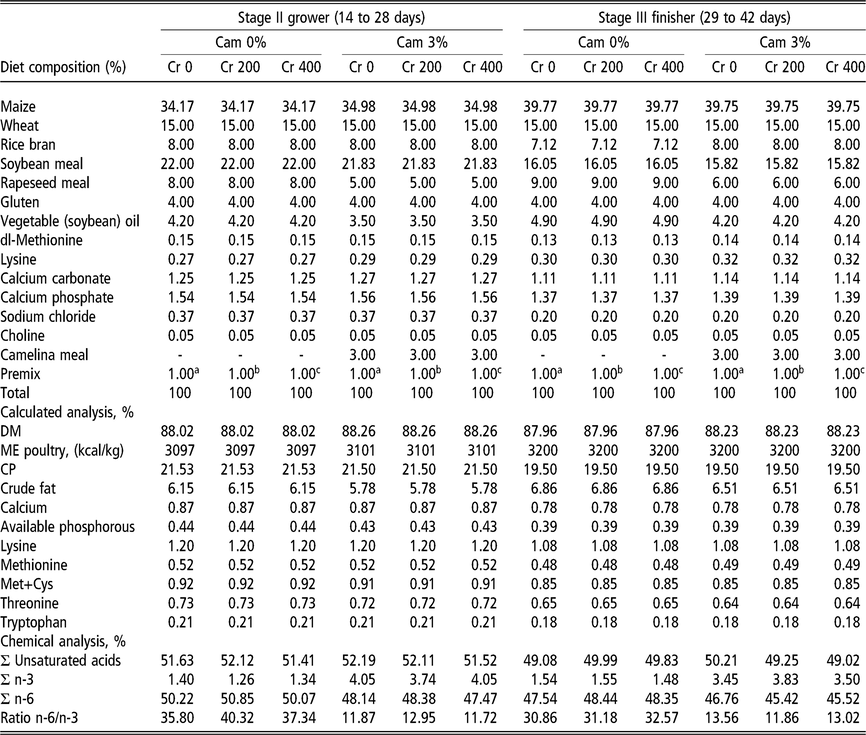
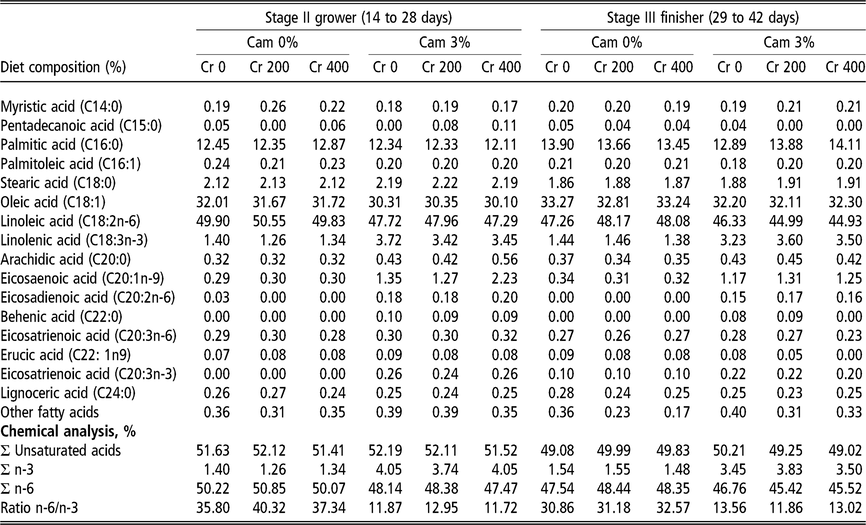
The experiment was conducted on 240 Ross 308 broiler chicken aged 14 days which were assigned to 6 dietary treatments in a randomized complete block design with a 2 × 3 factorial arrangement. Within the treatment arrangement, two concentrations of Camelina meal (0% and 3%) and three concentrations of Cr3+ (0, 200 and 400 μg/kg, Sigma Aldrich, Germany) as chromium picolinate (CrPic) were used. Camelina sativa was grown in southern Romania and seed material was processed by Marnews Olt, Craiova. The Camelina meal used in this study was a pressing residue from the manufacturing process of cold-pressed Camelina oil. The chemical composition of Camelina meal used in the experiment was published by Panaite et al. (Reference Panaite, Criste, Ropota, Cornescu, Alexandrescu, Criste, Vasile, Olteanu and Untea2016). Dietary treatments were: (1) Control diet (C) containing a corn–soybean diet with no added Camelina meal or Cr3+; (2) a C diet containing an additional 200 μg/kg of Cr3+ as CrPic; (3) a C diet containing an additional 400 μg/kg of Cr3+ as CrPic; (4) a C diet containing an additional 3% Camelina meal; (5) diet 2 containing an additional 3% Camelina meal; (6) diet 3 containing an additional 3% Camelina meal (Table 1), and fatty acids composition of diets is presented in Table 2.
Ingredients and chemical composition of broilers diets

ME = Metabolizable energy; Cam = Camelina meal; CrPic = Chromium picolinate; Met = Methionine; Cys = Cysteine.
a Premix contains: 11 × 105 IU/kg Vit. A; 2 × 10⁵ IU/kg Vit. D3; 2700 IU/kg Vit. E; 300 mg/kg Vit. K; 200 mg/kg Vit. B1; 400 mg/kg Vit. B2; 1485 mg/kg pantothenic acid; 2700 mg/kg nicotinic acid; 300 mg/kg Vit. B6; 4 mg/kg Vit. B7; 100 mg/kg Vit. B9; 1.8 mg/kg Vit. B12; 2000 mg/kg Vit. C; 8000 mg/kg manganese; 8000 mg/kg iron; 500 mg/kg copper; 6000 mg/kg zinc; 37 mg/kg cobalt; 152 mg/kg iodine; 18 mg/kg selenium; 6000 mg/kg antioxidant.
b Premix + 200 μg/kg CrPic.
c Premix + 400 μg/kg CrPic.
Fatty acids composition of broilers diets

Cam = Camelina meal.
The animals were housed in digestibility pens in a poultry experimental hall with controlled environmental conditions (average temperature/total period 25.57±0.880C; humidity 62.97±5.09%; ventilation/broiler 0.64±0.18%; CO2 level 888.48±101.31 ppm). The light regimen was adequate to the age of the broilers (23-h light/1-h darkness). Each treatment was replicated 4 times with 10 chicks per replicate pen. The birds were fed ad libitum and they had free access to the water. At the end of the experiment, 6 chicks aged 42 days from each group were slaughtered and samples of breast were collected for further analysis.
The productive parameters (average daily gain, feed conversion) were calculated from the weekly records of the BWs and daily feed intake.
Chemical analysis
Proximate composition of meat. The CP of the meat samples was determined with Kjeldahl reference method using a semiautomatic Kjeltek auto 1030 – Tecator (FOSS Tecator AB, Höganäs, Sweden) according to SR EN ISO 5983-2:2009 (International Organization for Standardization, 2009). The fat was extracted using an improved version of the classical method by continuous extraction in solvent, followed by fat measurement with Soxhlet after solvent removal (FOSS Tecator AB, Höganäs, Sweden) according to SR ISO 6492:2001 (International Organization for Standardization, 2001). Dry matter content was measured with a gravimetric method by drying samples at 103°C to constant weight in an oven BMT model ECOCELL Blueline Comfort (Neuremberg, Germany) according to Regulation (CE) nr. 152/2009 and with crude ash by heating at 550°C for 24 h using an ashing furnace Nabertherm Labotherm L15/11/ P320 Comfort (Bremen, Germany) according to Regulation (CE) No. 152/2009.
Trace minerals determinations. Trace minerals’ (Cu, Fe, Mn, Zn) concentrations were determined in meat samples using flame atomic absorption spectrometry (FAAS) as described by Untea et al. (Reference Untea, Criste and Vladescu2012) after microwave digestion, by using Thermo Electron – SOLAAR M6 Dual Zeeman Comfort (Cambridge, UK) equipment. For chromium determination, the graphite furnace atomic absorption spectrometry method was used according to Rêczajska et al. (Reference Rêczajska, Jêdrzejczak and Szteke2005).
Fatty acids determinations. A gas chromatograph Perkin-Elmer Clarus 500 (Massachusetts, USA), fitted with Flame Ionization Detector (FID) and capillary separation column with high polar stationary phase TRACE TR-Fame, (Thermo Electron, Massachusetts, USA), dimensions 60 m X 0.25 mm X 0.25 μm was used in order to determine fatty acids composition of meat samples. Each sample was prepared as described by Panaite et al. (Reference Panaite, Criste, Ropota, Cornescu, Alexandrescu, Criste, Vasile, Olteanu and Untea2016).
Oxidative stability parameters
Total lipids were extracted using the modified Folch procedure (Folch et al., Reference Folch, Lees and Sloane Stanley1957). The minced meat sample (5 g) was homogenized in 30 ml chloroform/methanol mixture (2:1, v/v). The homogenate was filtered in a separation funnel and 7.5 ml of a 0.88% KCl aqueous solution was added. The sample solution was left to rest for 20 h. The lower organic layer was collected and evaporated at room temperature to constant weight. The lipid extract results from the difference between initial and final weight of collector glass.
Primary oxidation products. Peroxide value (PV) was measured by ferric thiocyanate method and it was expressed as milliequivalents of oxygen molecule per kg of lipids (Meq O2/kg) (Pegg, Reference Pegg, Wrolstad, Acree, Decker, Penner, Reid, Schwartz, Shoemaker, Smith and Sporns2005). To the lipid extract sample (0.1 g), 9.9 ml chloroform/methanol (7:3, v/v) solution was added and the mixture was vortexed. After the addition of 50 µl of 10 mmol/l xylenol orange solution and 50 µl FeCl2 solution (1000 mg/kg), the mixture was left at rest for 5 min at room temperature and then, the absorptivity at 560 nm was measured using a V-530 Jasco (Japan Servo Co. Ltd., Japan) spectrophotometer. The value of conjugated dienes (CD) and trienes (CT) was determined by a spectrophotometric procedure (Pegg, Reference Pegg, Wrolstad, Acree, Decker, Penner, Reid, Schwartz, Shoemaker, Smith and Sporns2005) using a lipid extract sample dissolved in 2,2,4-trimethylpentane (iso-octane) and the absorbance values of sample solution at 233 nm (CD) and 268 nm (CT) were measured using a V-530 Jasco (Japan Servo Co. Ltd., Japan) spectrophotometer.
Secondary oxidation products. P-anisidine value was determined by a method based on the reaction between p-anisidine and aldehydic compounds present in lipid extract samples at acidic conditions (Pegg, Reference Pegg, Wrolstad, Acree, Decker, Penner, Reid, Schwartz, Shoemaker, Smith and Sporns2005). The lipid extract sample was dissolved in iso-octane and the absorbance of the sample solution was measured at 350 nm. The p-anisidine reagent was added to the cuvette, placed in the dark for 10 min and a new spectra was recorded. The values for thiobarbituric acid reactive substances (TBARS) were measured according to a method described by Botsoglou et al. (Reference Botsoglou, Fletouris, Papageorgiou, Vassilopoulos, Mantis and Trakatellis1994) using third derivative spectrophotometry with some modifications. Thiobarbituric acid reactive substances were expressed as milligrams of malondialdehyde (MDA) per kg of muscle (mg MDA kg-1). The minced meat sample (5 g) was mixed with 10 ml trichloroacetic acid (7.5%) and 5 ml butyrate hydroxytoluene in ethanol (0.8%). The sample solution was centrifuged at 3000×g for 3 min. Of the aliquot, 2.5 ml was mixed with 1.5 ml of 0.8% aqueous thiobarbituric acid solution in a test tube and further was incubated at 80°C for 50 min. Following incubation, the sample was cooled under running water and the absorbance was read at 532 nm (sp 0) and 540 nm (sp 3) using a spectrophotometer (Jasco V-530, Japan Servo Co. Ltd., Japan). Thiobarbituric acid reactive substance values were calculated against a standard curve obtained with 1,1,3,3-tetramethoxypropane (TMP).
The myoglobin (Mb) derivative concentrations were determined by a spectrophotometric procedure. The pigments were extracted according to the method of Viriyarattanasak et al. (Reference Viriyarattanasak, Hamada-Sato, Watanabe, Kajiwara and Suzuki2011) with some modifications. The frozen sample (2 g) was minced and placed into a 50-ml centrifuge tube. Then, 20 ml cold phosphate buffer (pH 6.8, 40 mM, 4°C) was added. The mixture was centrifuged at 7090×g for 30 min at 4°C using a laboratory refrigerated centrifuge (2-16KL, Sigma Laborzentrifugen GmbH, Germany). The supernatant was filtered and the spectra were recorded from 350 to 750 nm (V-530 Jasco, Japan Servo Co. Ltd., Japan) spectrophotometer using phosphate buffer as a blank.
Equations used in determining the relative concentrations of Mb derivatives (metmyoglobin (MetMb), deoximyoglobin (DeoMb) and oximyoglobin (OxiMb)) were proposed by Tang et al. (Reference Tang, Faustman and Hoagland2004):
 $$\% \;{\rm{metMb}}\; = \;( - 0.159{\rm{R}}1\; - \;0.085{\rm{R}}2\; + \;1.262{\rm{R}}3\; - \;0.52)\;{\rm{x}}\;100$$
 $$\% \;{\rm{deoMb}}\; = \;( - 0.543{\rm{R}}1\; + \;1.594{\rm{R}}2\; + \;0.552{\rm{R}}3\; - \;1.329)\;{\rm{x}}\;100$$
 $$\% \;{\rm{oxiMb}}\; = \;(0.722{\rm{R}}1\; - \;1.432{\rm{R}}2\; - \;1.659{\rm{R}}3\; + \;2.599)\;{\rm{x}}\;100$$
where: R1 = A582/A525; R2 = A557/A525; R3 = A503/A525
Statistics
The comparison for a randomized complete block design with a 2 × 3 factorial arrangement of treatments was performed using the GLM (Minitab version 13; Minitab Inc., State College, PA, USA) followed by Tukey’s HSD test (P < 0.05).
Results
The effects of various levels of chromium picolinate and Camelina meal on the productive parameters of broilers
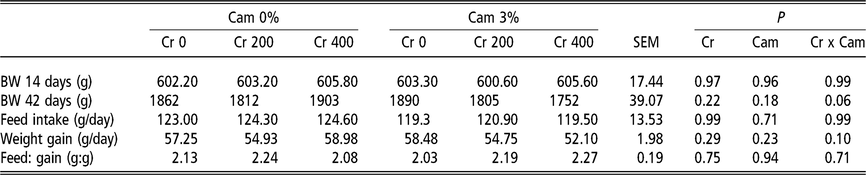
The effect of experimental treatments on broilers’ productive parameters is shown in Table 3.
Effect of supplemental CrPic (µg/kg) and Camelina meal on productive parameters of broilers

Cam = Camelina meal; CrPic = Chromium picolinate.
Supplemental CrPic or Camelina meal and experimental block were not significant contributors to productive parameters of broilers. During the experiment intervals at 14 and 42 days, the BW, feed intake and weight gain were similar (P > 0.05) among treatments.
The effects of various levels of chromium picolinate and Camelina meal on proximate composition of broiler breast
Table 4 shows the effects of dietary CrPic and Camelina meal on proximate composition. Chromium supplementation significantly (P<0.05) increased the CP concentrations and significantly (P<0.05) decreased the crude fat concentrations in breast samples. Crude ash was not affected by different levels of supplemental CrPic or Camelina meal (P>0.05).
Effect of supplemental CrPic (µg/kg) and Camelina meal on proximate composition of broiler breast

Cam = Camelina meal; CrPic = Chromium picolinate.
Means within a row with no common superscript differ (P < 0.05).
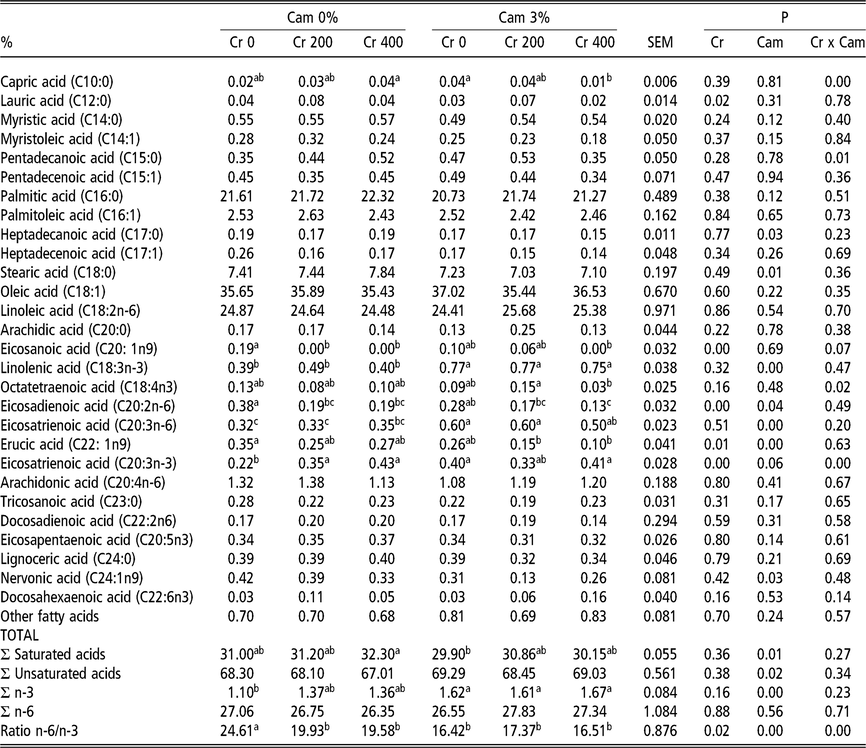
The effects of various levels of chromium picolinate and Camelina meal on fatty acids composition of broiler breast
The fatty acids profile of broiler breast samples is shown in Table 5. Broilers fed only CrPic supplements presented higher values of myristic and palmitic acids (C14:0 respectively C16:0) but the results are not statistically sustained. Under Camelina meal influence, the breast samples had the lowest stearic and nervonic acids values (C18:0 and C24:1n-9 respectively). The Camelina meal groups presented higher values of unsaturated fatty acids. The highest concentrations of oleic acid (C18:1) was registered for Camelina meal group only, but the results are not statistically sustained. In breast samples of birds fed CrPic, the levels of monounsaturated fatty acids (MUFA) were similar to those fed Camelina meal. Camelina meal groups showed higher values of ALA (C18:3n-3) compared with other groups.
Effect of supplemental CrPic (µg/kg) and Camelina meal on fatty acids composition of broilers breast samples

Cam = Camelina meal; CrPic = Chromium picolinate.
Means within a row with no common superscript differ (P < 0.05).
The results of the present study indicated that the n-3 fatty acids concentrations were significantly (P<0.05) increased by dietary Camelina meal in breast meat samples. Also, the ratio n-6/n-3 significantly decreased proved that Camelina meal supplements led to an improvement of breast broiler meat quality.
The effects of various levels of chromium picolinate and Camelina meal on mineral composition of broiler breast
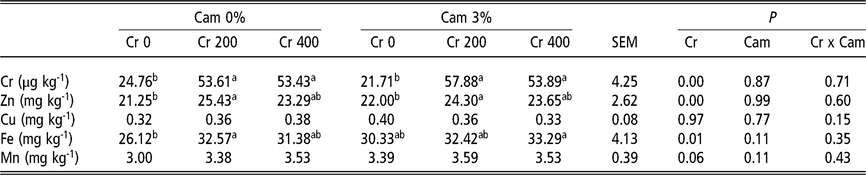
Trace mineral concentrations (Cr, Cu, Zn, Fe, Mn) in broiler meat are presented in Table 6. Chromium concentrations were significantly higher (P < 0.0001) than the control group in CrPic-supplemented groups. In CrPic groups, increased retention of Zn and Fe (P < 0.05) was observed in breast samples, compared to control group. The retention of Cu and Mn shows no difference between groups in breast samples.
Effect of supplemental CrPic (µg/kg) and Camelina meal on mineral composition of broiler meat

Cam = Camelina meal; CrPic = Chromium picolinate.
Means within a row with no common superscript differ (P < 0.05).
The effects of various levels of chromium picolinate and Camelina meal on oxidative stability of broiler breast
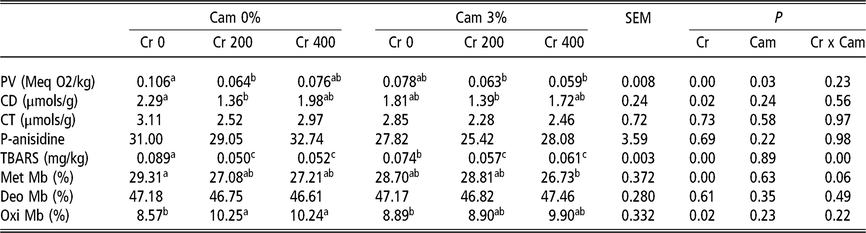
In Table 7, the oxidative stability parameters for the studied groups are presented. There were significant differences (P<0.05) in primary oxidation products between groups, except for CT concentrations. The secondary oxidative products were significantly (P<0.05) smaller for all experimental groups (CrPic- and Camelina-meal-supplemented groups), in terms of TBARS values.
Effect of supplemental CrPic (µg/kg) and Camelina meal on oxidative stability of broilers breast samples

Cam = Camelina meal; CrPic = Chromium picolinate; PV = Peroxide value; CD = Conjugated dienes; CT = Conjugated trienes; P anisidine = Para anisidine; TBARS = Thiobarbituric acid reactive substances; Met Mb = Metmyoglobin; Deo Mb = Deoximyoglobin; Oxi Mb = Oximyoglobin.
Means within a row with no common superscript differ (P < 0.05).
Myoglobin fractions’ concentrations differ significantly (P<0.05) from the control group for MetMb and OxiMb, under CrPic supplements’ influence.
Discussion
The effects of various levels of chromium picolinate and Camelina meal on the productive parameters of broilers
The lack of effects on the productive parameters is shown by the statistical analysis and revealed no significant differences and no interaction between CrPic and Camelina meal between groups. No impact of dietary Camelina meal on BW gain, feed conversion or feed intake of broiler was observed by Aziza et al. (Reference Aziza, Quezada and Cherian2010).
Our findings regarding CrPic effect on productive parameters were similar to Anandhi et al. (Reference Anandhi, Mathivanan, Viswanathan and Mohan2006) opinion expressed using 250, 500, 750 organic chromium for a period of 6 weeks. Hossain et al. (Reference Hossain, Barreto and Silva1998) found that supplementation with CrPic did not affect BW, feed consumption or feed:gain ratio of broilers. Other authors considered that CrPic used in broiler diets had beneficial effect on productive parameters but during the heat stress (Toghyani et al., Reference Toghyani, Toghyani, Shivazad, Gheisari and Bahadoran2012).
The effects of various levels of chromium picolinate and Camelina meal on proximate composition of broiler breast
Our results showed that CP increased and crude fat decreased (P<0.05) in breast meat samples under dietary CrPic influence. No interaction was observed between chromium and Camelina meal. Similar to our findings, Kim et al. (Reference Kim, Han, Choi, Shin, Chae and Kang1996) observed lower muscle fat content in broilers fed with 200 and 400 ppb Cr3+ compared to control. They concluded that CrPic supplements have an inhibitory effect on fat synthesis in broiler tissues. Samanta et al. (Reference Samanta, Haldar, Bahadur and Ghosh2008) showed that broiler diet supplementation with 500 ppb Cr3+ reduced ether extract and improved muscle protein, compared to control. Other researchers did not find significant influence of dietary Cr3+ on moisture, CP and crude fat content of broiler meat (Anandhi et al., Reference Anandhi, Mathivanan, Viswanathan and Mohan2006). Sakhari et al. (Reference Sakhari, Jeacock and Shepherd1992) explain that chromium facilitates insulin secretion which enhances protein synthesis and contributes to the transport of amino acids to the site of synthesis. Another theory is that chromodulin (low molecular weight chromium-binding protein) is linked to the action of the insulin receptor, glucose entry is increased into adipocytes, lipogenesis is increased and the net fatty acid release decreases (McNamara and Valdez, Reference McNamara and Valdez2005).
The effects of various levels of chromium picolinate and Camelina meal on fatty acids composition of broiler breast
The aim of Camelina feeding intake experiments is mainly to enrich the meat in n-3 fatty acids (Cherian, Reference Cherian and Makkar2012).
Alpha-linolenic acid is the only source of n-3 PUFA, eicosapentaenoic acid (EPA) and docosahexaenoic acid (DHA) did not exist in the diets. Linoleic acid (LNA) and ALA are the precursors for arachidonic acid (AA) and EPA and they are produced by desaturation and elongation, delta 6 desaturase being the rate limiting step in their synthesis (Aziza et al., Reference Aziza, Quezada and Cherian2010). Between ALA and LNA exists a competitive interaction in which n-3 PUFA suppress the metabolism of n-6 PUFA strongly than reverse, leading to a decreased n-6/n-3 ratio (Cherian et al., Reference Cherian, Campbell and Parker2009).
The results of our study showed a strong competition between ALA and LNA, due to an increased level of ALA from Camelina meal diets that did not had an inhibitory effect of LNA conversion to AA. Also, even if ALA concentrations significantly increased in breast tissues from Camelina-meal-supplemented groups, no significant differences were noticed for EPA and DHA between groups, the elongation and desaturation processes having a decreased reaction yield. A possible explanation might be that ALA is converted to EPA and DHA slowly, because it is not easy to incorporate ALA to lipid tissues, while LNA is rapidly converted to AA (Coetzee and Hoffman, Reference Coetzee and Hoffman2002). Total long chain n-3 PUFA significantly increased (P<0.05) in experimental groups, compared to control, except the group supplemented with 3% Camelina meal and 200 ppb CrPic, leading to a significant decrease of n-6:n-3 ratio (P<0.05).
Similar results were published by Aziza et al., (Reference Aziza, Quezada and Cherian2010) which concluded that Camelina meal inclusion rate of 2.5% to 10% in broiler diets didn’t produce any significant differences in EPA and DHA concentrations in breast meat. Also, they showed that thigh meat was more efficient in incorporating long chain n-3 fatty acids than breast meat.
The effects of various levels of chromium picolinate and Camelina meal on mineral composition of broiler breast
Significant increased concentrations of Cr, Zn and Fe compared to the control group were noticed under CrPic supplements’ influence. Wang and Xu (Reference Wang and Xu2004) reported that Cr deposition in tissues increased with the inclusion level of Cr3+ in diet. Sahin and Sahin (Reference Sahin and Sahin2002) showed that CrPic improved the utilization of Zn and Fe and Mn in laying hens reared in low temperature (7°C). Sirirat et al. (Reference Sirirat, Lu, Hung and Lien2013) reported that supplemental CrPic and ascorbic acid improved Zn retention in layer chickens. Supplemental CrPic led to increased Cr and Zn levels in serum, liver, kidney and longissimus muscle of laying hens (Sahin et al., Reference Sahin, Onderci and Sahin2002).
Feng et al. (Reference Feng, Li, Liu, Chai, Zhang, Gao and Zhao2003) reported that iron-binding proteins are involved in chromium binding, transport and storage. Chromium and iron share the same transport mechanism, binding with transferin and they are competitors for the same binding sites. Some authors (Pechova and Pavlata, Reference Pechova and Pavlata2007) showed that Cr may impair Fe metabolism and Cu has a synergetic relation to Fe and can be considered an indirect chromium antagonist.
Sahin and Kucuk (Reference Sahin and Kucuk2003) reported that Zn-supplemented birds have reduced lipid peroxidation products. They proposed the zinc’s action mechanism to be its capacity to displace transition metals (Fe, Cu) from binding sites. Iron is a redox active metal that can catalyze the propagation step of lipid oxidation. Zago and Oteiza (Reference Zago and Oteiza2001) observed an inverse correlation between the capacity of zinc to prevent iron binding to the membrane and the inhibitory effect of zinc on Fe2+-initiated lipid oxidation.
The effects of various levels of chromium picolinate and Camelina meal on oxidative stability of broiler breast
The oxidative stability of meat is usually established by using three primary oxidation products (PV, CD and CT) and two secondary oxidation products (TBARS, p-anisidine) (Shahidi and Zhong, Reference Shahidi, Zhong and Shahidi2005). The results of oxidative stability of breast meat showed that oxidation occurred slowly depending on the presence and level of CrPic in diet, indicating a dose-dependent impact of chromium on meat oxidative stability (Table 7). From the primary oxidation products, CD concentrations decreased under CrPic influence, and also, the TBARS values (secondary oxidation products) were significantly smaller for CrPic groups. Toghyani et al. (Reference Toghyani, Toghyani, Shivazad, Gheisari and Bahadoran2012) showed that the presence of trivalent Cr leads to the activation of insulin receptor kinase and potentiation the actions of insulin. Insulin metabolism influences lipid peroxidation and Cr3+, as an insulin potentiator, acts as an indirect antioxidant.
Myoglobin is considered to be the major catalyst for lipid oxidation in meat. Myoglobin is a monomeric globular heme protein composed of an atom of iron surrounded by an array of pyrole rings. The iron enables Mb to gain (reduction) or lose (oxidation) electrons (Min and Ahn, Reference Min and Ahn2005). There are three types of Mb which give the colour of meat: DeoMb and OxiMb the iron(II) state of Mb and a continuous oxidation of MetMb takes place (iron(III) state) despite to enzymatic reduction of met forms to deoxy forms. Postmortem processes inactivate the reductive enzyme systems and stimulate autooxidation of Fe2+ to Fe3+ (Baron and Andersen, Reference Baron and Andersen2002). Lynch and Faustman (Reference Lynch and Faustman2000) showed that the presence of secondary oxidation products increases OxiMb oxidation and decreases enzymatic reduction of metMb, resulting in quality deterioration of meat. In this study, lipid peroxidation was significantly reduced by CrPic supplements. In agreement with observation, a positive correlation between Mb fractions and chromium concentrations was observed (R2 between 0.79 and 0.83). By decreasing the level of MetMb and preventing the oxidation of iron, chromium may act as an indirect antioxidant.
Sahin et al. (Reference Sahin, Akdemir, Tuzcu, Hayirli, Smith and Sahin2010) proposed a mechanism for antioxidant properties of chromium, the potentiation of insulin action, and by this way, reducing lipid peroxidation. Another possible antioxidant mechanism of chromium is by stimulating zinc absorption and its deposition in tissues. Zinc does not directly attack free radicals but is important in prevention of their formation and it can retard oxidative processes (Vertuani et al., Reference Vertuani, Angusti and Manfredini2004). The antioxidant mechanism of zinc (Powell, Reference Powell2000) may be related to the antagonistic effect of zinc to catalytic properties of redox active transition metals (Fe, Cu). Other researchers showed that zinc can protect membranes from iron-initiated lipid oxidation (Zago and Oteiza, Reference Zago and Oteiza2001). Our findings showed a retard oxidation of MbFe2+ state (OxiMb) to Mb Fe3+ state (MetMb) in groups with high Zn concentrations in breast (chromium supplements groups).
This study found that broilers fed with CrPic supplements showed improved mineral composition and oxidative stability of breast meat, proving an effective protection of lipid molecules from oxidation. Under Camelina meal supplements’ influence, the fatty acids profile of breast meat was improved by increasing concentrations of PUFA. In conclusion, future research is needed to establish if CrPic–Camelina broiler meat can contribute to a human diet improved in nutritive value.
Acknowledgements
This study was supported by 8 PCCDI 043 PC3, Ministry of Research and Innovation (Romania).
A. E. Untea 0000-0003-3000-5024
Ethics statement
The experiment complied with Directive 2010/63/EU on the protection of animals used for scientific purposes and the experimental procedures were approved by Ethical Commission of National Research and Development Institute for Biology and Animal Nutrition.
Declaration of interest
None of the authors has any potential conflict of interest related to this manuscript.
Software and data repository resources
None of the data were deposited in an official repository.