Introduction
The modern poultry industry is largely dependent upon the use of antibiotics, either therapeutically to improve the health and well-being of animals, prophylactically to prevent disease, or subtherapeutically for growth promotion and better feed conversion ratios (Butaye et al., Reference Butaye, Devriese and Haesebrouck2003). The use of antibiotics as in-feed growth promoters has been an established practice for more than 60 years (Castanon, Reference Castanon2007). However, in recent years, there have been several reports of the development of resistance to commonly used antibiotics in various pathogens. There is also increasing concern about the potential risk to human health from drug residues and the possible transfer of antibiotic-resistance genes from animal to human microbiota (Castanon, Reference Castanon2007). Consequently, the use of antibiotics for growth promotion has been banned in the European Union since 2006.
The increasing consumer demand for meat that is free of microbiological and chemical hazards, together with the occurrence of antibiotic-resistant pathogens in poultry, means that viable alternatives must be developed (Lillehoj and Lee, Reference Lillehoj and Lee2012; Seal et al., Reference Seal, Lillehoj, Donovan and Gay2013). An effective in-feed alternative to antibiotics should have significant beneficial effects on poultry health and performance, be safe for both poultry and human beings, be easily administered and stored, and be economically feasible (Yegani and Korver, Reference Yegani and Korver2007). Passive immunization with egg yolk antibodies (IgY) directed against specific pathogens is one such potential alternative to antibiotics. IgY antibodies, considered as the major antibodies in serum and egg yolk of birds and functional equivalents of mammalian IgG, have been successfully employed in the prophylaxis and treatment of various enteric infections in food animals such as swine and cattle. Oral administration of specific IgY has been shown to protect pigs from diarrhea caused by enterotoxigenic Escherichia coli (Yokoyama et al., Reference Yokoyama, Peralta, Diaz, Sendo, Ikemori and Kodama1992; Marquardt et al., Reference Marquardt, Jin, Kim, Fang, Frohlich and Baidoo1999), porcine transmissible gastro-enteritis virus (Zuo et al., Reference Zuo, Fan, Fan, Li and Zhang2009), and porcine epidemic diarrhea virus (Kweon et al., Reference Kweon, Kwon, Woo, Kim, Woo, Son, Hur and Lee2000; Song et al., Reference Song, Xu, Wang, Yang and Lai2003). Similar protective effects of IgY have also been demonstrated against diarrhea in newborn calves caused by E. coli (Ikemori et al., Reference Ikemori, Kuroki, Peralta, Yokoyama and Kodama1992), bovine rotavirus (Kuroki et al., Reference Kuroki, Ohta, Ikemori, Peralta, Yokoyama and Kodama1994; Vega et al., Reference Vega, Bok, Chacana, Saif, Fernandez and Parreno2011), and bovine coronavirus (Ikemori et al., Reference Ikemori, Ohta, Umeda, Icatlo, Kuroki, Yokoyama and Kodama1997). This review briefly describes passive immunization, with an emphasis on hyperimmune egg yolk antibodies and their use in the poultry industry to treat various enteric infections.
Passive immunization
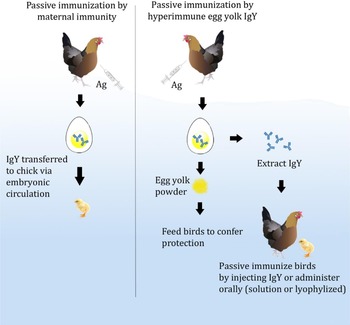
Passive immunization can be described as the process by which preformed antibodies or immunoglobulins (Igs) are administered to protect an animal against infection. The protection conferred is immediate, but short-lived. Passive immunity can be classified as natural or acquired (Baxter, Reference Baxter2007; Kovacs-Nolan and Mine, Reference Kovacs-Nolan and Mine2012). Natural passive immunity involves the transfer of maternal antibodies to offspring to defend against invading pathogens. In birds, maternal antibodies in the circulation (IgY) are deposited into the egg yolk and then transferred to the developing embryo through the embryonic circulation (Patterson et al., Reference Patterson, Youngner, Weigle and Dixon1962; Rose et al., Reference Rose, Orlans and Buttress1974). These transferred antibodies protect the chicks during the early stages of life when their immune systems are not fully developed (Fig. 1). The duration of the protection provided by maternal antibodies is very short (about 2 weeks) and their levels in the chick's plasma decrease substantially by day 7 after hatching, by which time the bird begins to synthesize its own Igs (Szabó, Reference Szabó2012).
Comparison of passive immunization by maternal immunity and by use of hyperimmune egg yolk IgY in poultry.

Passive immunity can also be induced by the artificial transfer of serum or antibodies from immune individuals to nonimmune or susceptible individuals via systemic, intravenous, or oral routes. Passive immunization by oral administration of specific preformed antibodies is an emerging approach as an alternative to antibiotics in the treatment of various human and animal enteric infections (Seal et al., Reference Seal, Lillehoj, Donovan and Gay2013). The transient nature of the immunity induced requires the continuous administration of the preformed antibodies, especially when they are administered orally, and this necessitates their large-scale production and processing (Chalghoumi et al., Reference Chalghoumi, Beckers, Portetelle and Théwis2009a). In recent years, the hyperimmunization of chickens, with the collection of antibodies from their egg yolks, is emerging as a popular approach to the production of large quantities of Igs. This technology takes advantage of the principles of both maternal immunity and the passive immunity induced by the transfer of antibodies (Fig. 1). Hens are immunized with specific antigens at regular intervals to induce the continuous deposition of antibodies into the egg yolks. The antibodies are then extracted from the egg yolks and used for human or animal immunotherapy and immunodiagnostics.
IgY technology
History
Klemperer (Reference Klemperer1893) was the first to demonstrate the protective effects of egg yolk extracts from immunized hens against tetanus in mice. He attributed this protection to the antibodies present in the egg yolk, which are transferred from the hen. His observations saw practical application only in the late 1900s, when concerns about animal welfare increased in the scientific community. Polson et al. (Reference Polson, von Wechmar and Fazakesley1980a) described the use of chickens as an alternative source of polyclonal antibodies. With the increased availability of reagents and methods to purify these antibodies, egg yolk IgY gained popularity and was used in many applications. The term ‘IgY technology’ came into use in 1996 to describe the production and use of IgY (Schade and Hilnak, Reference Schade and Hilnak1996). In 1996, a workshop on the Production of Avian Antibodies, organized by the European Centre for the Validation of Alternative Methods, recommended the use of IgY technology as an alternative to mammalian antibody production. The workshop proposed that the use of chickens for antibody production represents both a refinement (eliminating invasive blood collection) and a reduction of animal use (chickens produce larger amounts of antibodies than mammals) (Schade et al., Reference Schade, Staak, Hendriksen, Erhard, Hugl, Koch, Larsson, Pollmann, van Regenmortel, Rijke, Spielmann, Steinbusch and Straughan1996). In 1999, IgY technology was approved by the Swiss Government as another way to improve animal welfare (Anon, 1999).
Advantages
Chicken egg yolk antibody production offers several advantages over the use of mammals. Larger quantities of antibodies can be produced with IgY technology than by conventional mammalian production. Gottstein and Hemmeler (Reference Gottstein and Hemmeler1985) showed that an immunized hen produces 18 times more antibodies than an immunized rabbit in a 1-month period. According to Larsson et al. (Reference Larsson, Bålöw, Lindahl and Forsberg1993), the amount of antibody produced by a hen in 1 week is equivalent to that in 90–100 ml of serum or 180–200 ml of whole blood. Schade et al. (Reference Schade, Staak, Hendriksen, Erhard, Hugl, Koch, Larsson, Pollmann, van Regenmortel, Rijke, Spielmann, Steinbusch and Straughan1996) reported that approximately 1500 mg of IgY can be harvested in a 1-month period, 2–10% of which constitutes specific IgY. This is high compared with the yield of IgG antibodies in the same time period, which is about 200 mg, 5% of which constitutes specific antibody (Tini et al., Reference Tini, Jewell, Camenisch, Chilov and Gassmann2002). Xu et al. (Reference Xu, Li, Jin, Zhen, Lu, Li, You and Wang2011) described a laying hen as ‘small factory’ for antibody production because each hen produces more than 20 g of IgY per year, which is equivalent to the production of 4.3 rabbits in the same period.
Another advantage is that the quantity of antigen required for an efficient long-lasting immune response in chickens is much lower than is required in rabbits (Gassmann et al., Reference Gassmann, Thömmes, Weiser and Hübscher1990). The most important advantage of chicken egg yolk IgY is that the collection of eggs is noninvasive and eliminates the painful process of drawing blood (Larsson et al., Reference Larsson, Bålöw, Lindahl and Forsberg1993; Tini et al., Reference Tini, Jewell, Camenisch, Chilov and Gassmann2002). The cost involved in raising chickens is low and they are easier to handle than laboratory mammals (Gassmann et al., Reference Gassmann, Thömmes, Weiser and Hübscher1990). Thus, the production of egg yolk antibodies is a more hygienic, convenient, and cost-effective way than the traditional method of collecting antibodies from mammalian serum (Mine and Kovacs-Nolan, Reference Mine and Kovacs-Nolan2002). Compared with antibiotics, the use of IgY is environmentally friendly and does not elicit any undesirable adverse effects or resistance, or leave any toxic residues (Coleman, Reference Coleman, Sim, Nakai and Guenter1999).
Characteristics of IgY
Structure
Three distinct classes of Ig are found in chickens: IgA, IgM, and IgY. Chicken IgA and IgM are structurally and functionally analogous to mammalian serum IgA and IgM. Traditionally, the chicken IgY present in serum and egg yolk was considered to be IgG because it is similar in function to mammalian IgG. Leslie and Clem (Reference Leslie and Clem1969) first proposed that the Ig found in chicken serum and egg yolk be called IgY, rather than IgG, based on its physical, chemical, and antigenic characteristics. IgY is also considered the evolutionary ancestor of IgG and IgE (Warr et al., Reference Warr, Magor and Higgins1995) and is the predominant serum antibody in birds, reptiles, amphibians, and lungfish (Leslie and Clem, Reference Leslie and Clem1969; Warr et al., Reference Warr, Magor and Higgins1995). The serum concentrations of IgY (5–15 mg ml−1) are higher than those of IgA (0.3–0.5 mg ml−1) or IgM (1–3 mg ml−1) (Rose et al., Reference Rose, Orlans and Buttress1974). In the egg, IgY is selectively concentrated in the yolk, whereas IgA and IgM are present in the egg white.
IgY has two heavy (H) and two light (L) chains, and a greater molecular mass (~180 kDa) than mammalian IgG (~150 kDa). The distinctive difference between IgY and mammalian IgG is that the H chain of IgY has a molecular mass of ~68 kDa compared with 50 kDa in mammalian IgG (Leslie and Clem, Reference Leslie and Clem1969). The H chain of IgY is denoted by Y or the Greek letter upsilon (υ) and contains one variable (VH) and four constant (CH) regions, in contrast to mammalian IgG, which has only three CH regions. Sequence comparisons have shown that the CH3 and CH4 domains of IgY are equivalent to the CH2 and CH3 domains of IgG (Parvari et al., Reference Parvari, Avivi, Lentner, Ziv, Tel-Or, Burstein and Schechter1988; Fellah et al., Reference Fellah, Kerfourn, Wiles, Schwager and Charlemagne1993; Magor et al., Reference Magor, Higgins, Middleton and Warr1994; Warr et al., Reference Warr, Magor and Higgins1995). There is no domain in the CH of IgG equivalent to the CH2 region of IgY, because it has been replaced by the hinge region (Parvari et al., Reference Parvari, Avivi, Lentner, Ziv, Tel-Or, Burstein and Schechter1988; Fellah et al., Reference Fellah, Kerfourn, Wiles, Schwager and Charlemagne1993). The IgY L chain contains one VL and one CL region, and has a molecular mass of 25 kDa (Warr et al., Reference Warr, Magor and Higgins1995; Schade et al., Reference Schade, Calzado, Sarmiento, Chacana, Porankiewicz-Asplund and Terzolo2005).
IgY is less flexible than IgG because it lacks the hinge region between the CH1 and CH2 domains that occurs in IgG (Shimizu et al., Reference Shimizu, Nagashima, Sano, Hashimoto, Ozeki, Tsuda and Hatta1992). However, limited flexibility is conferred upon the IgY molecule by the short proline- and glycine-rich regions at the boundaries of the CH1–CH2 and CH2–CH3 domains (Warr et al., Reference Warr, Magor and Higgins1995). The Fc portion of IgY has two carbohydrate side chains, compared with only one in this portion of IgG, making it the site of most of its biological effector functions (Shimizu et al., Reference Shimizu, Nagashima, Sano, Hashimoto, Ozeki, Tsuda and Hatta1992; Schade et al., Reference Schade, Calzado, Sarmiento, Chacana, Porankiewicz-Asplund and Terzolo2005; Chalghoumi et al., Reference Chalghoumi, Beckers, Portetelle and Théwis2009a). The β-sheet content of IgY is much lower than that of IgG, indicating that the IgY conformation is more disordered and thus less stable than that of IgG (Shimizu et al., Reference Shimizu, Nagashima, Sano, Hashimoto, Ozeki, Tsuda and Hatta1992).
Physical and chemical properties
The isoelectric point (pI) of IgY is much lower than that of IgG. The average pI of human IgG is around pH6.8, whereas that of IgY is around pH5.8 (Benedict and Yamaga, Reference Benedict, Yamaga and Marchalonis1966; Polson et al., Reference Polson, von Wechmar and Fazakesley1980a). Dávalos-Pantoja et al. (Reference Dávalos-Pantoja, Ortega-Vinuesa, Bastos-González and Hidalgo-Álvarez2000) calculated the pI of rabbit IgG and egg yolk IgY with isoelectric focusing and reported them to be in the ranges of 6.1–8.5 and 5.7–7.6, respectively. The surface of IgY is more hydrophobic than that of IgG, because the Fc region (the most hydrophobic moiety in an antibody molecule) in IgY is larger than that in IgG (Dávalos-Pantoja et al., Reference Dávalos-Pantoja, Ortega-Vinuesa, Bastos-González and Hidalgo-Álvarez2000). This increased hydrophobicity of IgY allows its selective accumulation in the lipid-rich egg yolk.
Stability
The stability of IgY during various processing steps and under physiological conditions is extremely important for its successful use in passive immunotherapy (Kovacs-Nolan and Mine, Reference Kovacs-Nolan and Mine2012). IgY antibodies are fairly stable during storage and processing. Nilsson et al. (Reference Nilsson, Stålberg and Larsson2012) investigated the stability of IgY in eggs stored at room temperature or 4°C for 6 months. They reported that there was no loss of IgY activity and that it was possible to pool the eggs for up to 6 months and process them together to purify the IgY. Larsson et al. (Reference Larsson, Bålöw, Lindahl and Forsberg1993) reported that chicken egg yolk antibodies can be stored for up to 5–10 years at 4°C without any significant loss of antibody activity. They also showed that the antibodies retain their activity after storage for 6 months at room temperature or 1 month at 37°C. IgY solutions can be stored at 4°C for a period of a few months to a few years with the addition of 0.02% NaN3, 0.03% thimerosal, or 50 µg ml−1 gentamicin to prevent microbial growth (Schade et al., Reference Schade, Calzado, Sarmiento, Chacana, Porankiewicz-Asplund and Terzolo2005). The preferred method of long-term storage for IgY solutions is by freezing them at –20°C because storage at –70°C can cause up to 50% loss of IgY activity (Staak et al., Reference Staak, Schwarzkopf, Behn, Hommel, Hlinak, Schade, Erhard, Schade, Behn, Erhard, Hlinak and Staak2000).
Freezing and freeze-drying do not affect the stability of IgY unless repeated several times (Shimizu et al., Reference Shimizu, Fitzsimmons and Nakai1988). Few reports cite the minimal loss of antibody activity, but a significant loss in the solubility of IgY after freeze-drying has been reported (Chansarkar, Reference Chansarkar1998; Sunwoo et al., Reference Sunwoo, Lee, Menninen, Suresh and Sim2002). Fu et al. (Reference Fu, Huang, Wang, Liu, Wang, Cui, Gao, Li, Li and Kong2006) tested the stability of IgY before and after freeze-drying and reported that lyophilization did not affect the thermal stability of IgY at 90°C for 15 min or its stability when stored at –20°C, 4°C, or room temperature for 5 months. IgY preparations can also be spray-dried for long-term storage, with no loss of antibody potency. Although lyophilization minimizes bacterial growth and better maintains the structural integrity of the purified IgY, spray-drying is more economical (Yokoyama et al., Reference Yokoyama, Peralta, Diaz, Sendo, Ikemori and Kodama1992).
IgY antibodies are fairly heat stable, but their stability and binding activity decrease at very high temperatures. Lösch et al. (Reference Lösch, Schranner, Wanke and Jürgens1986) demonstrated that the IgY concentration did not decrease when eggs were cooked in boiling water for 6 min, but the concentration and antibody activity were reduced after 10 min. IgY is stable at temperatures between 60 and 70°C (Shimizu et al., Reference Shimizu, Nagashima, Sano, Hashimoto, Ozeki, Tsuda and Hatta1992) and retains most of its antibody activity after heating to 70°C for 15 min (Shimizu et al., Reference Shimizu, Fitzsimmons and Nakai1988). Hatta et al. (Reference Hatta, Tsuda, Akachi, Kim and Yamamoto1993a) reported that IgY retained 50% of its antibody activity after it was heated at 70°C for 30 min but only 10% activity when heated at 80°C for 10 min. Shimizu et al. (Reference Shimizu, Nagashima, Hashimoto and Suzuki1994) showed that the addition of 30–50% (w/v) sucrose or invert sugar to an IgY solution suppressed its heat denaturation at 75–80°C. The stability of IgY at high temperatures (up to 70°C) can also be increased by the presence of its natural matrix (egg yolk) or the addition of sugars, such as 30% sucrose, lactose, or trehalose (Jaradat and Marquardt, Reference Jaradat and Marquardt2000). The heat stability of IgY is extremely important when considering the addition of antibodies to animal feed because it must survive the associated pelleting processes, which commonly involve high temperatures. The addition of selected carbohydrates to IgY preparations reduces the loss of antibody activity at 82–95°C or during steam conditioning during pelleting (Bobeck et al., Reference Bobeck, Trott, Cook and Yang2006, Reference Bobeck, Cook, Gelbach, Yang and Cook2008). IgY antibodies show fairly good stability under pressure and no detectable inactivation was observed at pressures up to 4000 kg cm−2 (Shimizu et al., Reference Shimizu, Nagashima, Hashimoto and Suzuki1994).
IgY antibodies are stable at pH4–11, but sensitive to acid denaturation at very low pH. The activity of IgY decreases at pH ≤ 3.5 and is completely abolished at pH3 (Shimizu et al., Reference Shimizu, Fitzsimmons and Nakai1988, Reference Shimizu, Nagashima, Sano, Hashimoto, Ozeki, Tsuda and Hatta1992). Several other reports have demonstrated similar results, with the irreversible loss of IgY binding activity below pH3.5 (Lösch et al., Reference Lösch, Schranner, Wanke and Jürgens1986; Schmidt et al., Reference Schmidt, Wiedemann, Kühlmann, Wanke, Linckh and Lösch1989; Hatta et al., Reference Hatta, Tsuda, Akachi, Kim and Yamamoto1993a; Shimizu et al., Reference Shimizu, Nagashima and Hashimoto1993; Lee et al., Reference Lee, Chang, Lee, Lee and Koo2002b). This loss of activity is attributable to conformational changes, damaging the antigen-binding site, which proceed more rapidly in IgY than in other mammalian IgGs (Shimizu et al., Reference Shimizu, Nagashima and Hashimoto1993). The acid-induced inactivation of IgY can be suppressed by the addition of stabilizers, such as sugars, complex carbohydrates, or 30–50% sorbitol (Shimizu et al., Reference Shimizu, Nagashima, Hashimoto and Suzuki1994; Lee et al., Reference Lee, Chang, Lee, Lee and Koo2002b). Under alkaline conditions, IgY antibodies are stable up to pH11. However, their activity is markedly diminished at pH12 or higher (Lösch et al., Reference Lösch, Schranner, Wanke and Jürgens1986; Shimizu et al., Reference Shimizu, Nagashima, Sano, Hashimoto, Ozeki, Tsuda and Hatta1992).
The proteolytic stability of IgY in the stomach and intestines is of considerable importance, especially for the successful oral administration of the antibodies. IgY antibodies are relatively resistant to trypsin and chymotrypsin, but quite sensitive to pepsin digestion, especially at low pHs (Shimizu et al., Reference Shimizu, Fitzsimmons and Nakai1988; Otani et al., Reference Otani, Matsumoto, Saeki and Hosono1991; Reilly et al., Reference Reilly, Domingo and Sandhu1997; Jaradat and Marquardt, Reference Jaradat and Marquardt2000). The proteolytic activity of pepsin on IgY is abolished at pH5 and the antibodies retain both their antigen-binding and cell agglutination activities, whereas at pH < 4.5, both these activities are lost (Shimizu et al., Reference Shimizu, Fitzsimmons and Nakai1988; Schmidt et al., Reference Schmidt, Wiedemann, Kühlmann, Wanke, Linckh and Lösch1989). Trypsin has a considerably stronger inactivating effect on IgY preparations than chymotrypsin (Schmidt et al., Reference Schmidt, Wiedemann, Kühlmann, Wanke, Linckh and Lösch1989). Hatta et al. (Reference Hatta, Tsuda, Akachi, Kim, Yamamoto and Ebina1993b) reported the activities of IgY after digestion with pepsin, trypsin, or chymotrypsin, with different combinations of pH and incubation times. Digestion with pepsin at pH2 caused the complete cleavage of the antibody molecule, whereas at pH4, 91 and 63% of the IgY activity was retained after incubation for 1 and 4 h, respectively. After incubation for 8 h with trypsin or chymotrypsin, IgY retained 39 or 41% of its activity, respectively.
The matrix in which IgY antibodies are administered also influences the pH and enzymatic stability of the IgY in gut. Yolk and egg suspensions showed higher antibody activity after incubation for 3 h with trypsin or chymotrypsin compared with the activity of purified antibody solutions (Schmidt et al., Reference Schmidt, Wiedemann, Kühlmann, Wanke, Linckh and Lösch1989). This could be attributable to the buffering effect of the other proteins present in the egg. Therefore, the stability of IgY in the gut depends on various factors, including the gastric pH, enzyme levels, and transit time, which in turn depend on age, health status, and diet. Most available research data on the stability of IgY were obtained with pure IgY solutions in vitro. More research into IgY stability must be conducted in vivo in feed, egg yolk, and whole egg matrix, because these are used in commercial applications. Several studies have demonstrated the recovery of the biologically active forms of orally administered antibodies after their passage through the gut (Reilly et al., Reference Reilly, Domingo and Sandhu1997; Carlander et al., Reference Carlander, Kollberg, Wejåker and Larsson2000; Berghman et al., Reference Berghman, Abi-Ghanem, Waghela and Ricke2005). The fragments present after trypsin or pepsin digestion (Fab and F(ab′)2) still retain their binding and neutralizing activities, but cannot be detected with traditional detection methods because they lack the Fc portion.
Mechanism of action
Although the exact mechanisms of action of orally administered IgY remain unclear, it is well-known that they largely depend upon efficient antigen–antibody interactions (Rahman et al., Reference Rahman, Nguyen, Icalto, Umeda and Kodama2013). Several mechanisms have been proposed to explain this protection of the host. The major mechanism involves the binding of the antibodies to specific antigens on the pathogens, thus impairing their growth or biological functions. In the case of bacteria, IgY binds to structures such as flagella, fimbriae (pili), outer membrane proteins, and lipopolysaccharide (LPS), and inhibits the bacterial adhesion to the intestinal wall (Peralta et al., Reference Peralta, Yokoyama, Ikemori, Kuroki and Kodama1994; Tsubokura et al., Reference Tsubokura, Berndtson, Bogstedt, Kaijser, Kim, Ozeki and Hammarström1997; Yokoyama et al., Reference Yokoyama, Umeda, Peralta, Hashi, Icatlo, Kuroki, Ikemori and Kodama1998; Jin et al., Reference Jin, Baidoo, Marquardt and Frohlich1998). This reduction in bacterial adherence to intestinal cells reduces their growth and their colonization and/or invasion of the intestinal cells (Jin et al., Reference Jin, Baidoo, Marquardt and Frohlich1998; Sugita-Konishi et al., Reference Sugita-Konishi, Ogawa, Arai, Kumagai, Igimi and Shimizu2000; Sunwoo et al., Reference Sunwoo, Lee, Menninen, Suresh and Sim2002; Lee et al., Reference Lee, Sunwoo, Menninen and Sim2002a; Girard et al., Reference Girard, Batisson, Martinez, Breton, Harel and Fairbrother2006). Other mechanisms of action of IgY include (1) bacterial agglutination, leading to death by immobilization, and their expulsion as aggregates from the gut; (2) toxin neutralization (Wang et al., Reference Wang, Li, Jin, You, Zhou and Li2011); and (3) the inhibition of enzyme activity (Rahman et al., Reference Rahman, Nguyen, Icalto, Umeda and Kodama2013). The binding of specific IgY to bacteria may also alter the bacterial cellular signaling cascades and thus reduce their production and release of toxins (Xu et al., Reference Xu, Li, Jin, Zhen, Lu, Li, You and Wang2011).
IgY production
Although the development of chicken–chicken fusion technology has been described, in which chicken hybridoma cell lines are generated to produce chicken antibodies directed against specific immunizing antigens (Lillehoj et al., Reference Lillehoj, Sasai and Matsuda1994), IgY antibodies are usually produced by immunizing laying hens with the desired antigens. The different immunization protocols used and their various recommendations have been reviewed extensively by Schade et al. (Reference Schade, Staak, Hendriksen, Erhard, Hugl, Koch, Larsson, Pollmann, van Regenmortel, Rijke, Spielmann, Steinbusch and Straughan1996, Reference Schade, Calzado, Sarmiento, Chacana, Porankiewicz-Asplund and Terzolo2005). The antibody titers generated can be influenced by various factors, including the antigen (type, dose), adjuvant type, route of application, frequency of and intervals between immunizations, and the age and breed of the birds (Schade et al., Reference Schade, Calzado, Sarmiento, Chacana, Porankiewicz-Asplund and Terzolo2005; Chalghoumi et al., Reference Chalghoumi, Beckers, Portetelle and Théwis2009a). Various antigens, including complex multiantigens (bacteria, viruses, and parasites) or single antigens (proteins, polysaccharides, lipids, and nucleic acids) can be used for immunization (Chalghoumi et al., Reference Chalghoumi, Beckers, Portetelle and Théwis2009a). Protein antigens are highly immunogenic and are routinely used, but the use of DNA vaccines (antigen-expressing plasmid) has also been described (Romito et al., Reference Romito, Viljoen and Du Plessis2001; Cova, Reference Cova2005). The most common route of injection is intramuscular (in the breast muscle), whereas subcutaneous injection in the neck region is also acceptable for older birds. The recommended protocol for immunization involves two injections (with a 4–6-week interval) before the start of the laying period. Hens can be used for IgY production throughout their laying period, and subsequent booster injections (at 2–4-week intervals) can be given as required to maintain sustained antibody levels in the eggs. Pauly et al. (Reference Pauly, Dorner, Zhang, Hlinak, Dorner and Schade2009) monitored the IgY content and specific antibody titers of eggs from hens hyperimmunized with ricin and botulinum toxins over a 2-year period. Their results suggested that leghorns can be used to generate high yields of IgY for over 2 years.
Transfer of antibodies to the egg yolk
All types of antibodies found in chickens are transferred to the eggs of laying hens (Rose et al., Reference Rose, Orlans and Buttress1974; Lösch et al., Reference Lösch, Schranner, Wanke and Jürgens1986), but IgY is the predominant egg antibody. IgA and IgM are found in the egg white, but in very low concentrations (IgA ~0.7 mg ml−1 and IgM ~0.15 mg ml−1), and are secreted into the egg white in the oviduct together with albumen (Rose et al., Reference Rose, Orlans and Buttress1974). The concentration of IgY in the egg yolk is high (~8–25 mg ml−1) and is selectively transported from the maternal circulation to the yolk in the ovarian follicle. The transfer process is receptor mediated and the specific receptors for IgY occur on the surface of the yolk sac membrane (Loeken and Roth, Reference Loeken and Roth1983; Kowalczyk et al., Reference Kowalczyk, Daiss, Halpern and Roth1985; Tressler and Roth, Reference Tressler and Roth1987; Morrison et al., Reference Morrison, Mohammed, Wims, Trinh and Etches2001). The amount of IgY transferred to the yolk is proportional to its serum concentration (Loeken and Roth, Reference Loeken and Roth1983; Hamal et al., Reference Hamal, Burgess, Pevzner and Erf2006).
Isolation and purification of IgY from egg yolk
Egg yolk is a complex matrix comprised of lipids (31% of yolk) and proteins (17% of yolk). The yolk proteins are distributed into two fractions - the granules (precipitate on centrifugation) and the plasma (clear supernatant on centrifugation). Granules are composed of high density lipoproteins (70%), phosvitin (16%), and low density lipoproteins (LDL; 12%) (Burley and Cook, Reference Burley and Cook1961). The yolk plasma proteins constitutes LDL (86%) and α-, β-, γ-livetins (14%). Chicken IgY is the predominant fraction in the γ-livetins. Several methods have been employed for the isolation and purification of IgY and have been reviewed extensively by Meulenaer and Huyghebaert (Reference Meulenaer and Huyghebaert2001). The basic principle in isolation of IgY thus involves the separation of lipids and granule proteins to obtain the remaining water-soluble fraction (WSF). WSF can be considered as crude Ig concentrate together with some other livetins and lipoproteins. WSF can be obtained by several methods which include water dilution method (Jensenius et al., Reference Jensenius, Andersen, Hau, Crone and Koch1981), precipitation with polyethylene glycol (PEG) (Polson et al., Reference Polson, von Wechmar and van Regenmortel1980b, Reference Polson, Coetzer, Kruger, von Maltzahn and van der Merwe1985), sodium alginate (Hatta et al., Reference Hatta, Sim and Nakai1988), anionic polysaccharides (Jensenius et al., Reference Jensenius, Andersen, Hau, Crone and Koch1981; Chang et al., Reference Chang, Lu, Chen, Tu and Hwang2000), natural gums like carrageenan and xanthan (Hatta et al., Reference Hatta, Kim and Yamamoto1990), or organic solvents like isopropanol, chloroform (Bade and Stagemann, Reference Bade and Stagemann1984; Polson, Reference Polson1990; Ntakarutimana et al., Reference Ntakarutimana, Demedts, Van Sande and Scharpé1992). Further purification of IgY from WSF can be achieved by precipitation with PEG (Polson et al., Reference Polson, Coetzer, Kruger, von Maltzahn and van der Merwe1985; Akita and Nakai, Reference Akita and Nakai1993), with salts like ammonium or sodium sulphate (Akita and Nakai, Reference Akita and Nakai1992), chromatography (Yazawa et al., Reference Yazawa, Hosomi and Takeya1991; Yokoyama et al., Reference Yokoyama, Peralta, Horikoshi, Hiraoka, Ikemori, Kuroki and Kodama1993; Kuronen et al., Reference Kuronen, Kokko, Mononen and Parviainen1997; Fassina et al., Reference Fassina, Verdoliva, Palombo, Ruvo and Cassani1998) and filtration (Kim and Nakai, Reference Kim and Nakai1996, Reference Kim and Nakai1998). The purity of IgY can be increased by combination of the above methods like PEG precipitation followed by affinity chromatography (Schade et al., Reference Schade, Calzado, Sarmiento, Chacana, Porankiewicz-Asplund and Terzolo2005). Deignan et al. (Reference Deignan, Kelly, Alwan and O'Farrelly2000) compared several lipid removal and IgY precipitation methods and reported that dextran sulfate and phospohotungstic acid methods of lipid removal and precipitation of IgY by 12% PEG to purify fractions were superior compared with other methods.
The choice of the method of IgY isolation and purification is mainly dependent upon the scale of extraction (laboratory or industrial), quality of extraction, cost effectiveness, and technology (Schade et al., Reference Schade, Calzado, Sarmiento, Chacana, Porankiewicz-Asplund and Terzolo2005; Chalghoumi et al., Reference Chalghoumi, Beckers, Portetelle and Théwis2009a). For IgY applications in animal and poultry feeds, a large-scale production with high recovery and purity is necessary. Water dilution seems to be the most appropriate method for industrial isolation of IgY, and purification can be achieved by column filtration or ultrafiltration.
Passive immunization with IgY to improve growth and performance of poultry
Hyperimmune egg antibodies have been used as a viable alternative to antibiotics to improve the growth and feed conversion ratios of poultry. However, few research trials have been conducted to show the growth-promoting effects of egg antibodies when fed to broiler chickens (Cook et al., Reference Cook, Miller and Pimentel1998, Reference Cook, Miller and Pimentel1999). Unlike antibiotics, which target the intestinal microflora and reduce gut inflammation, the egg antibodies used in these studies targeted the regulation of growth by the immune system. The growth depression associated with immune stimulation is well established, and it is hypothesized that the interleukin 1 released during inflammation causes anorexia (through the release of neuropeptides) and muscle wasting (Goldberg et al., Reference Goldberg, Baracos, Rodemann, Waxman and Dinarello1984; Klasing et al., Reference Klasing, Laurin, Peng and Fry1987). Hyperimmune egg antibodies raised against various neuropeptides (cholecystokinin, neuropeptide Y) improved bodyweight and feed efficiency when fed to broiler chickens up to 3 weeks of age (Cook et al., Reference Cook, Miller and Pimentel1998, Reference Cook, Miller and Pimentel1999). Eicosanoids are also believed to play a proinflammatory role in immune stimulation, and the supplementation of feed with egg antibodies (BIG™) developed against phospholipase A2 (an enzyme involved in eicosanoid synthesis) for 3 weeks improved the mean weight gain of broilers by 5.4% and the feed conversion ratio by 6.2 points (Cook, Reference Cook2001, Reference Cook2002). Although these results seem encouraging, much more research must be conducted on the use of egg antibodies for growth promotion in poultry.
Passive immunization with IgY to control poultry pathogens
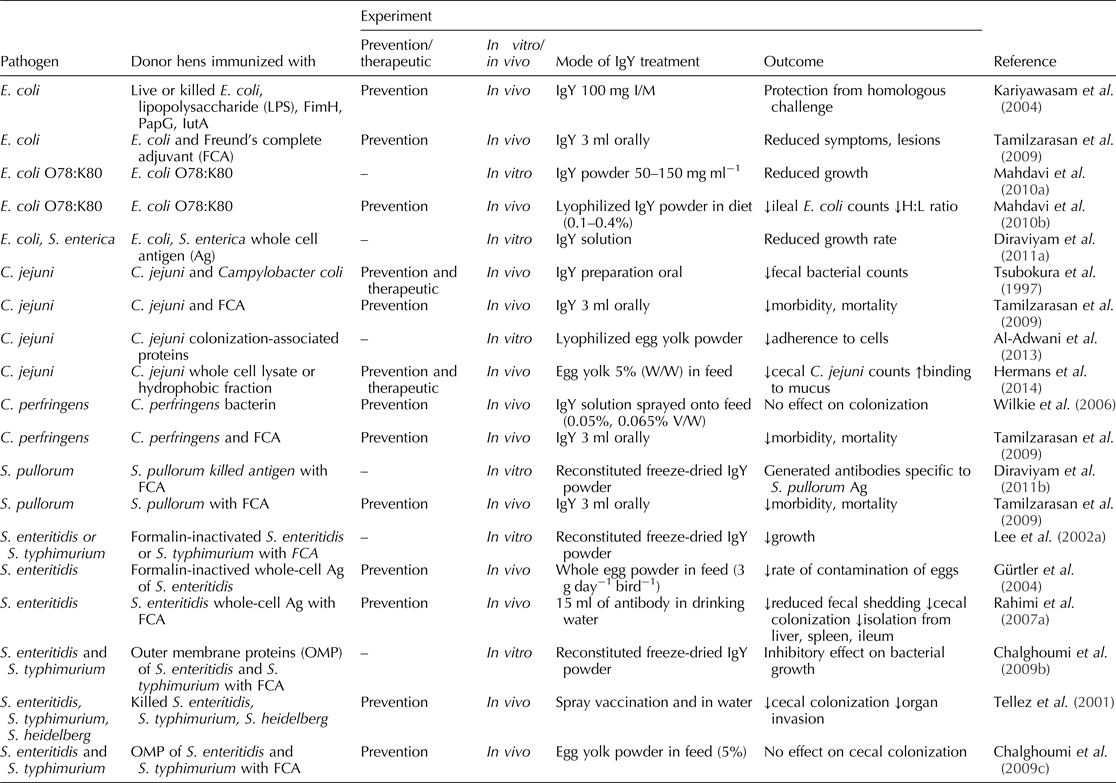
Disease prevention by passive immunization using IgY antibodies is emerging as a promising strategy because it provides an almost instantaneous effect compared with active immunization (vaccination), which takes several days to a few weeks to generate a specific immune response (Rahman et al., Reference Rahman, Icatlo and Sa2014). The use of hyperimmune egg-yolk IgY to prevent and treat human and animal infections has gained popularity in recent years as an alternative to antibiotic use. Because the absorption of orally administered egg antibodies is minimal, the majority of applications of egg antibodies are against enteric infections in both people and animals. Diraviyam et al. (Reference Diraviyam, Zhao, Wang, Scahde, Michael and Zhang2014) conducted a meta-analysis of research reports that focused on the therapeutic effects of IgY for enteric infections in domestic animals, and concluded that the administration of IgY significantly reduced the risk of infection in the treated groups compared with that in the untreated controls. Several research trials have been conducted in poultry to demonstrate the beneficial effects of egg yolk antibodies against various pathogens, and the details are summarized in Tables 1, 2, and 3.
Effect of hyperimmune egg yolk IgY on protozoan infections of poultry

Effect of hyperimmune egg-yolk IgY on bacterial infections of poultry

Effect of hyperimmune egg-yolk IgY on viral infections of poultry

IBDV, infectious bursal disease virus; NDV, Newcastle disease virus.
Protozoa
Eimeria
Coccidiosis is one of the most common enteric diseases of poultry, and is caused by protozoan parasites of the genus Eimeria. The disease is characterized by reduced weight gain and feed conversion, causing economic losses of billions of dollars to the industry. Vaccination with live or attenuated parasites or recombinant antigens is routinely used to confer protection by inducing active immunity. However, very little research has been conducted on the protection of poultry from coccidiosis by passive immunization using parasite-specific hyperimmune egg yolk antibodies. Lee et al. (Reference Lee, Lillehoj, Park, Jang, Morales, García, Lucio, Larios, Victoria, Marrufo and Lillehoj2009b) reported that the supplementation of broiler diets with 10 or 20% hyperimmune IgY egg yolk powder (Supracox®) protected the birds from subsequent challenge with Eimeria acervulina, and that the birds showed greater weight gain and lower oocyst production than the controls. Supplementation with lower levels (0.01, 0.02, 0.05, or 0.5% Supracox®) significantly reduced oocyst production but had no effect on bodyweight gain when the chickens were challenged with 1 × 10⁴ oocysts of E. acervulina. Lee et al. (Reference Lee, Lillehoj, Park, Jang, Morales, García, Lucio, Larios, Victoria, Marrufo and Lillehoj2009a) showed similar effects, with increased bodyweight gain and reduced intestinal lesions and fecal oocyst production, following challenge with either Eimeria maxima or Eimeria tenella when birds were fed diets supplemented with IgY egg yolk powder (Supracox®). In both these reports, hyperimmune IgY was raised in laying hens by immunizing them with three major species of Eimeria (E. acervulina, E. maxima, and E. tenella). In another study, IgY antibodies were raised by immunizing hens with five species of Eimeria (E. acervulina, E. maxima, E. tenella, E. necatrix, and E. praecox), and were isolated in pure form and lyophilized. When fed to birds at different levels, this lyophilized powder conferred protection against challenge with E. tenella (Xu et al., Reference Xu, Ren, Wang, Liu, Cao and Tao2013). Although the above mentioned studies used whole live parasites to hyperimmunize the hens, future strategies using defined Eimeria antigens will be desirable. The identification of immunogenic parasite proteins that are targeted by a protective antibody response against avian coccidiosis will allow the application of passive immunization technology, which will reduce the economic losses caused by avian coccidiosis. Chicken monoclonal antibodies against parasite molecules involved in cell invasion have been described (Sasai et al., Reference Sasai, Lillehoj, Matsuda and Wergin1996). Such technologies must be developed to identify the protective epitopes of Eimeria parasites. The construction of a single-chain variable fragment (scFv) that can block parasite invasion is another promising technology, which will lead to the development of molecular immunotherapeutic drugs (Kim et al., Reference Kim, Min, Lillehoj, Kim, Sohn, Song and Han2001; Min et al., Reference Min, Kim, Lillehoj, Sohn, Han, Song and Lillehoj2001). These reports suggests that supplementing diets with specific hyperimmune IgY is a promising strategy for controlling avian coccidiosis, and further research into this issue is warranted.
Bacterial pathogens
Escherichia coli
Escherichia coli infections continue to be a major problem for the poultry industry, resulting in great economic losses, mainly arising from the high morbidity and mortality attributable to pathogenic avian E. coli and from carcass condemnation (Gross, Reference Gross and Gyles1994; Dho-Moulin and Fairbrother, Reference Dho-Moulin and Fairbrother1999). Most research conducted with IgY has been directed against enteric infections, but a few studies have investigated respiratory infections. The efficacy of passively transferred egg-yolk antibodies in the prevention of respiratory E. coli infections in broiler chickens was investigated by Kariyawasam et al. (Reference Kariyawasam, Wilkie and Gyles2004). Intramuscular injections of purified IgY, isolated from hens immunized with different E. coli antigens, protected broilers from homologous E. coli challenge. Similar results were reported by Tamilzarasan et al. (Reference Tamilzarasan, Dinakaran, Selvaraju and Dorairajan2009) and chicks supplemented orally with specific IgY antibodies before E. coli challenge showed no pathognomonic symptoms or lesions compared with the controls. Egg yolk antibodies have also been used to reduce the colonization of chicken intestines by E. coli as a measure to reduce human food-borne illness. In vitro studies conducted by Mahdavi et al. (Reference Mahdavi, Rahmani, Nili, Samie and Soleimanian-Zad2010a) showed that the incubation of E. coli cultures with specific IgY powder reduced E. coli growth by 1.18 CFU ml−1 compared to controls after incubation for 6 h. Similar results were obtained when the trials were repeated in vivo using specific egg-yolk antibodies (Mahdavi et al., Reference Mahdavi, Rahmani, Nili, Samie, Soleimanian-Zad and Jahanian2010b). The dietary administration of at least 0.2% specific IgY egg yolk powder for 3 weeks not only reduced ileal E. coli counts, but improved the immunocompetence of broiler chicks challenged with E. coli O78:K80. An antibody consortium containing egg-yolk antibodies directed against E. coli and Salmonella enterica was also prepared and was shown to be effective in reducing the bacterial growth rates in vitro (Diraviyam et al., Reference Diraviyam, Jeevitha, Saravanan, Michael and Meenatchisundaram2011a).
Campylobacter
Campylobacter jejuni is a normal inhabitant of the large intestine of chickens (Welkos, Reference Welkos1984; Beery et al., Reference Beery, Hugdahl and Doyle1988). However, C. jejuni from undercooked chicken meat is considered to be the commonest source of acute gastrointestinal infection in human beings (Harris et al., Reference Harris, Weiss and Nolan1986; Beery et al., Reference Beery, Hugdahl and Doyle1988; Shane, Reference Shane1992). Alternatives to antibiotics to reduce cecal colonization by Campylobacter in poultry in order to reduce the contamination of chicken meat are in great demand, and the use of IgY antibodies for this purpose is still being explored. Tsubokura et al. (Reference Tsubokura, Berndtson, Bogstedt, Kaijser, Kim, Ozeki and Hammarström1997) raised egg yolk antibodies against C. jejuni and E. coli in laying hens and demonstrated their prophylactic and therapeutic capacities to reduce the fecal Campylobacter counts in broiler chickens. The oral administration of egg yolk IgY solution before C. jejuni challenge reduced the mortality and morbidity of chickens compared with those in the control group, which received no antibodies (Tamilzarasan et al., Reference Tamilzarasan, Dinakaran, Selvaraju and Dorairajan2009). Similar results were reported by Hermans et al. (Reference Hermans, Steendam, Verbrugghe, Verlinden, Martel, Seliwiorstow, Heyndrickx, Haesebrouck, De Zutter, Deforce and Pasmans2014), who showed that cecal C. jejuni counts were significantly reduced in broiler chicks fed diets containing egg-yolk antibodies compared with those in the controls. The transmission to nonseeder birds was reduced and purified IgY promoted mucosal clearance of the bacteria in the intestine. Al-Adwani et al. (Reference Al-Adwani, Crespo and Shah2013) also studied the effectiveness of hyperimmune IgY, raised against various C. jejuni colonization-associated proteins (CAPs), against C. jejuni colonization in vitro. CAP-specific IgY significantly reduced the adherence of C. jejuni to chicken hepatocellular carcinoma cells and also bound to heterologous strains. However, the therapeutic efficacy of the IgY antibodies was limited because the C. jejuni counts returned to normal when the treatment was stopped (Hermans et al., Reference Hermans, Steendam, Verbrugghe, Verlinden, Martel, Seliwiorstow, Heyndrickx, Haesebrouck, De Zutter, Deforce and Pasmans2014). Thus, hyperimmune IgY antibodies can be used as a passive immunotherapy to reduce C. jejuni colonization in chickens.
Clostridium perfringens
Necrotic enteritis, caused by C. perfringens, is a widespread enteric disease in broiler chickens, imposing a great economic burden on the poultry industry (Lee et al., Reference Lee, Lillehoj, Jeong, Jeoung and An2011; Timbermont et al., Reference Timbermont, Haesebrouck, Ducatelle and Van Immerseel2011). Very few and contradictory reports have been published on the effects of hen-egg antibodies on C. perfringens colonization in chickens. According to Wilkie et al. (Reference Wilkie, Van Kessel, Dumonceaux and Drew2006), feeding diets supplemented with anti-C. perfringens egg antibodies did not reduce the numbers of C. perfringens in the intestines of broiler chickens. However, Tamilzarasan et al. (Reference Tamilzarasan, Dinakaran, Selvaraju and Dorairajan2009) reported reduced morbidity and mortality in birds immunized with IgY before challenge with C. perfringens.
Salmonella
The genus Salmonella contains Gram-negative enterobacteria that cause disease in a broad range of domestic animals including human beings. Several serotypes have been described, of which Salmonella pullorum and Salmonella gallinarum are important, and both of these cause severe septicemic disease in chickens and turkeys (Shivaprasad, Reference Shivaprasad2000). Poultry also acts as an asymptomatic carrier for many serotypes of zoonotic importance, including Salmonella enteritidis (SE) and Salmonella typhimurium (ST), which are associated with human food-borne illnesses, transmitted by contaminated eggs and meat (Thorns, Reference Thorns2000). Egg-yolk antibodies have been used to reduce both poultry disease and their cecal colonization by zoonotically important Salmonella. IgY antibodies were raised in laying hens against S. pullorum and their specificity was tested in vitro, to assess their potential utility in reducing the horizontal transmission of pullorum disease with passive immunotherapy (Diraviyam et al., Reference Diraviyam, Elakkiya, Subbaraj, Avanthi, Meenatchisundaram and Michael2011b). Oral supplementation with S. pullorum-specific IgY from hyperimmune hens protected birds from challenge (Tamilzarasan et al., Reference Tamilzarasan, Dinakaran, Selvaraju and Dorairajan2009).
Lee et al. (Reference Lee, Chang, Lee, Lee and Koo2002b) examined the effects of specific egg antibodies against SE or ST on their growth in vitro and showed that Salmonella numbers were reduced after incubation with IgY. Gürtler et al. (Reference Gürtler, Methner, Kobilke and Fehlhaber2004) investigated the effect of orally administered spray-dried whole egg powder obtained from hens hyperimmunized with SE on the rate of egg contamination in laying hens. Treatment with antibody-containing egg powder significantly lowered the rate of Salmonella contamination of eggs compared with that in the controls. The drinking water of birds was supplemented with SE-specific egg yolk antibodies before the birds were challenged with SE, and this supplementation reduced fecal shedding and cecal colonization with SE, and also reduced the isolation of SE from the livers, spleens, and ileums of the chickens (Rahimi et al., Reference Rahimi, Shiraz, Salehi, Torshizi and Grimes2007a). Antibodies were also raised against both SE and ST simultaneously in the same egg yolk (Chalghoumi et al., Reference Chalghoumi, Théwis, Portetelle and Beckers2008), and these were shown to exert an in vitro inhibitory effect on bacterial growth in the late-exponential phase (Chalghoumi et al., Reference Chalghoumi, Théwis, Beckers, Marcq, Portetelle and Schneider2009b). The beneficial effects of feeding Salmonella-specific egg antibodies combined with probiotics to broilers have been reported by Tellez et al. (Reference Tellez, Petrone, Escorcia, Morishita, Cobb and Villaseñor2001) and Rahimi et al. (Reference Rahimi, Shiraz, Salehi, Torshizi and Grimes2007a). In both reports, cecal colonization and organ invasion by Salmonella were significantly reduced in the treated groups compared with the controls.
Although the protective effects of Salmonella-specific egg yolk antibodies have been demonstrated in several research studies, it is still argued that the protection observed is attributable to components of the egg yolk other than specific antibodies. Kassaify and Mine (Reference Kassaify and Mine2004) compared the efficacies of nonimmunized and immunized (SE) egg yolk powders in eliminating or preventing SE infection in laying hens. They showed that both nonimmunized and immunized (SE) egg powder reduced the numbers and incidence of SE in feces, and confirmed that the observed elimination of SE was due to novel anti-adhesive or immunomodulatory components in the egg yolk rather than to SE-specific antibodies. Chalghoumi et al. (Reference Chalghoumi, Marcq, Théwis, Portetelle and Beckers2009c) reported that supplementation with neither hyperimmunized nor nonimmunized egg yolk powder altered cecal colonization by SE or ST in broiler chickens.
Viral pathogens
Infectious bursal disease (IBD) virus
IBD is an acute, highly contagious disease of young chickens caused by birnaviruses. The disease is characterized by severe immunosuppression and heavy mortality (Lukert and Saif, Reference Lukert, Saif, Calnek, Barnes, Beard, McDougald and Saif1997; van den Berg, Reference van den Berg2000). The therapeutic effects of hyperimmune IgY on birds showing symptoms of IBD have been investigated by several researchers. Muhammad et al. (Reference Muhammad, Rabbi, Hussain, Riaz, Saeed and Hussain2001) showed that 28-day-old infected broilers passively immunized with anti-IBDV-hyperimmune yolk had an 80% recovery rate compared with that of the controls. A similar therapeutic effect in infected layer hens was shown by Yousif et al. (Reference Yousif, Mohammad, Khodeir, Abo Zeid, El-Sanousi, Saber and Reda2006), and the mortality in birds given IgY solution in their drinking water dropped by 66.6% and their morbidity shifted towards a milder syndrome. A dose-dependent increase in the recovery rate (92% at the highest dose) was observed when different mixed groups of IBDV-infected chickens (layers, broilers, breeders, and indigenous birds) were injected intraperitoneally with IgY solution, whereas the control birds showed only 10% recovery (Malik et al., Reference Malik, Ayub and Quereshi2006). Abd El-Ghany (Reference Abd El-Ghany2011) compared the efficacy of egg-yolk IgY against IBD viral infection with that of an IBD vaccine. The results indicated that the vaccine and IgY were equally effective in reducing morbidity and mortality in IBDV-challenged broilers, and their combination resulted in complete recovery.
Newcastle disease (ND) virus
ND, caused by virulent strains of avian paramyxovirus serotype 1, remains a threat to the poultry industry (Alexander et al., Reference Alexander, Aldous and Fuller2012). However, it has been shown that hyperimmune egg antibodies confer protection against ND in chickens. Phillips (Reference Phillips1956) investigated the therapeutic and prophylactic effects of hyperimmune egg-yolk antibodies on ND-affected chickens. The intramuscular injection of diluted egg yolk protected the birds from lethal challenge 12 days later, and prevented the development of ND when administered 72 h after infection. Wills and Luginbuhl (Reference Wills and Luginbuhl1963) reported that a significant amount of protection was afforded to birds by the subcutaneous injection of yolk containing high levels of antibodies directed against the ND virus. Box et al. (Reference Box, Stedman and Singleton1969) reported that the yolk obtained from hens that had recovered from a natural ND viral infection conferred passive protection against ND virus challenge. The intramuscular injection of egg yolk to 3-week-old chickens conferred protection against challenge with the live virus.
Conclusions/future perspectives
The evolutionary basis of passive immunity, in terms of protecting progeny by the transfer of maternal antibodies through the egg, is successfully exploited by the production of hyperimmune IgY to protect animals against diseases. Although the beneficial effects of egg yolk IgY in immunotherapeutic and immunoprophylactic strategies to control poultry diseases is well established, the technology has some limitations. The transient nature of the protection conferred requires the continuous administration of the antibodies in effective doses. This necessitates the large-scale production of antibodies, which could involve considerable expense. Therefore, methods for the efficient and economic production of high-quality antibodies on a massive scale must be developed. More research should be conducted into the choice of immunogens and adjuvants with which to immunize chickens to provide the maximum immunostimulatory effect and to increase the yield of specific IgY antibodies (Lévesque et al., Reference Lévesque, Martinez and Fairbrother2007). Novel immunogens, such as naked DNA, should be considered for raising hyperimmune egg antibodies because this would eliminate the need for protein expression and purification procedures, which are labor-intensive and expensive (Romito et al., Reference Romito, Viljoen and Du Plessis2001; Cova, Reference Cova2005). Further research should be undertaken to produce egg antibodies simultaneously directed against multiple pathogens, thus targeting different diseases at the same time.
Opinions are still mixed on the heat and proteolytic stability of IgY, although supplementation in its natural matrix (egg) confers some buffering action (Jaradat and Marquardt, Reference Jaradat and Marquardt2000). Measures to enhance the heat and gut stability of IgY should be undertaken during its commercial preparation, without greatly increasing the cost, to improve the feasibility of its use. Most IgY preparations added to feed are directed towards the prevention of enteric infections, and the difficulty associated with predicting the onset of enteric infection requires their continuous use. This could sometimes prove uneconomical because of the large volumes of antibody required. The efficacy of hyperimmune IgY in combination with other products, such as probiotics, prebiotics, and enzymes, should be investigated. Novel genomic technologies should be used in the future to design subunit antibodies, such as scFv, bispecific scFv, or scFv fusion proteins, with the same specificity and affinity as the whole Ig molecule (Kim et al., Reference Kim, Min, Lillehoj, Kim, Sohn, Song and Han2001; Min et al., Reference Min, Kim, Lillehoj, Sohn, Han, Song and Lillehoj2001).
Passive immunization with specific egg antibodies is a safer, noninvasive, and less toxic alternative to the use of antibiotics. More research into IgY is required because its acceptance as an immunodiagnostic and immunotherapeutic drug is increasing widely.
Acknowledgment
This project was supported by ARS-USDA CRIS in Animal Health (NP103) # 8042-32000-097-00D.