Introduction
Citrus is a major cash crop in Ghana and is cultivated in the semi-deciduous forest zone, which covers parts of the Ashanti, Brong-Ahafo, Eastern, Western, Central and Volta regions of the country (Anno-Nyarko, Reference Anno-Nyarko1998). Current production is estimated at over 20,000 tonnes annually (Ghana Export Promotion Council, 2006). Although the total land area under citrus cultivation in the Eastern region of Ghana has increased considerably over the past few years, the production of citrus has not reached its maximum potential because of a number of production constraints. Ranking high among these constraints is insect pest damage, mainly by the Mediterranean fruit fly Ceratitis capitata (Wiedemann) (Diptera: Tephritidae) (Afreh-Nuamah, Reference Afreh-Nuamah1985; Akotsen-Mensah, Reference Akotsen-Mensah1999).
Information on the seasonal abundance and peak periods of pest attack, as well as estimates of changes in pest numbers are important components of any pest management strategy (Dent, Reference Dent1992). This is because a warning of the timing and extent of pest outbreak can improve efficiency of control measures (Dent, Reference Dent1992). At the University of Ghana's Agricultural Research Centre, there has been a marked reduction in the quantity of citrus fruits harvested between March and April (previously recognized as the major harvesting season), while a considerable increase has been observed in the quantity of citrus fruits harvested between August and September, previously recognized as the minor harvesting season (K. Afreh-Nuamah, unpublished results). For example, in 2002 and 2003, a total of 385,000 and 440,000 Late Valencia fruits were harvested at the Research Centre, with the major season accounting for approximately 75% of the harvested fruits. In 2004 and 2005, however, a total of 480,000 fruits were harvested in each year, with the minor season accounting for approximately 55–60% of the fruits harvested. This trend has continued over the years until today with the season previously recognized as the minor one accounting for a higher percentage of harvested fruits each year. This change has been attributed partly to the changing climatic conditions, which now seem to favour the minor season. Since C. capitata utilizes ripening citrus fruits for propagating successive generations, such a change in the fruiting pattern is therefore likely to affect its population dynamics. This study was therefore undertaken to determine the abundance and distribution of C. capitata in relation to the ‘new’ fruiting pattern of Late Valencia citrus at the University of Ghana's Agricultural Research Centre in the Eastern region of Ghana. It also sought to identify alternative host crops of the pest and determine the effect of some climatic factors on the population fluctuations of C. capitata.
Materials and methods
Six sites at the research centre were selected for the study. There were two Late Valencia citrus orchards; CI-9 (4.8 ha) and CI-17 (5.8 ha), the Lake Tangelo orchard, Citrus Museum (an orchard with a collection of all the citrus varieties grown at the research centre), mango orchard, and a 0.8 ha pepper field interspersed with pawpaw trees. The abundance and distribution of the pest was assessed in the Late Valencia citrus orchards while the other sites were selected to help establish alternative host crops of the pest. The average height of citrus trees in these orchards was approximately 7 m.
Fly abundance and distribution
Yellow rectangular traps baited with trimedlure (Agrisense Ltd, Pontypridd, UK) were used to monitor the abundance and distribution of the pest from September 2006 to April 2007. The traps were suspended on branches of citrus trees (approximately 2 m from the ground) in the Late Valencia citrus orchards (CI-9 and CI-17) with a distance of 50 m between traps to prevent inter-trap interference (Ekesi and Billah, Reference Ekesi and Billah2006). The surfaces of the traps were cleared of all debris (twigs, dead insects and leaves) daily and ‘Trappit’ glue applied to the surfaces every 2 days to ensure that the efficiency of the traps was not compromised. The trimedlure plugs were replaced with new ones every 4 weeks. Traps were inspected twice daily (09.00 and 16.30 h) and the total number of C. capitata caught in each orchard (obtained by summing up the number of C. capitata caught by each trap in the orchard) entered into a datasheet. The trapped flies were then cleared off the surfaces of the traps and ‘Trappit’ glue applied if necessary. The total number of C. capitata trapped in a given month in a particular orchard was obtained by adding the daily captures.
Alternative host crops
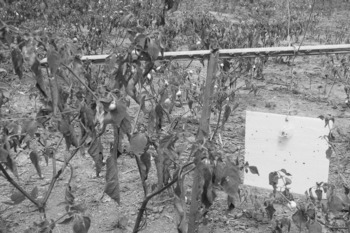
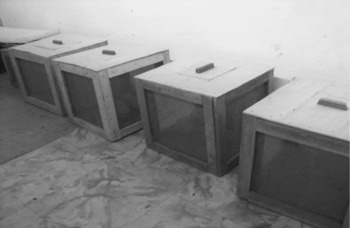
To establish whether other crops at the Research Centre served as alternative hosts for C. capitata, trimedlure-baited traps were placed in the mango orchard to trap fruit flies that may possibly attack mango fruits when citrus fruits are out of season. Traps were also placed in the pepper field and on pawpaw trees, 200 m away from the Late Valencia citrus orchards (Plate 1). Mango and pawpaw were selected because these fruits are known alternative hosts of this polyphagous pest (White and Elson-Harris, Reference White and Elson-Harris1992). Pepper was also selected as a possible alternative host because C. capitata has been reported to contribute significantly to fruit drop in pepper (Opoku-Asiamah et al., Reference Opoku Asiamah, Dawson Amoah and Adamu1987). Semi-ripe fruits of these crops were also collected and placed in wooden insect cages (50 cm × 50 cm) with sterilized sand and observed carefully for 30 days for possible emergence of C. capitata adults (Plate 2). Collection of semi-ripe fruits was done over a 3 month period and a total number of 50 mangoes, 50 peppers and 10 pawpaw fruits were sampled weekly. The wooden cages had an opening at the top and fine netting on all sides to ensure good ventilation. Traps were also placed in the Lake Tangelo citrus plot and the Citrus Museum, both of which shared a boundary with the Late Valencia citrus orchards, to establish whether the pest population is sustained by other citrus varieties, which ripen when Late Valencia fruits are out of season.
Trimedlure sticky trap placed in a pepper field to trap Ceratitis capitata adults

Cages used for rearing Ceratitis capitata from possible alternative host fruits

Climatic factors
Daily data for three climate variables: maximum temperature, relative humidity at 09.00 and 15.00 h GMT and total monthly rainfall were obtained from a local meteorological station at the Research Centre. The number of days with rainfall per month was also recorded.
Data analysis
A multiple regression analysis was carried out to establish the relationship between the mean monthly trap captures in the two citrus orchards (CI-9 and CI-17) and the monthly data for the recorded climatic factors. Excel graphs were used to illustrate the abundance and distribution of C. capitata over the study period using total monthly fly captures in the orchards. Correlation analysis was also done to determine the strength of the association between the monthly fly captures and each of the climatic factors recorded.
Results
Fly abundance and distribution
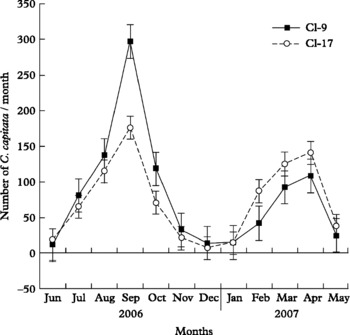
Ceratitis capitata adults were present in the two Late Valencia citrus plots throughout the study period. Two peaks of adult fly abundance were evident in both citrus orchards (CI-9 and CI-17; Fig. 1). These peaks occurred in September 2006 and April 2007, which fall within the major and minor harvesting seasons, respectively. The two peaks of fly abundance observed coincided with the period when most citrus fruits were ripening or ripe. The highest peak occurred in the month of September (previously recognized as the minor Late Valencia harvesting season) while the second peak occurred in April (previously recognized as the major Late Valencia harvesting season). The lowest fly captures were observed in the months of May and June and from November to January, when most citrus fruits were still green and unripe.
Mean ( ± SE) abundance of Ceratitis capitata in two Late Valencia citrus orchards in the eastern region of Ghana

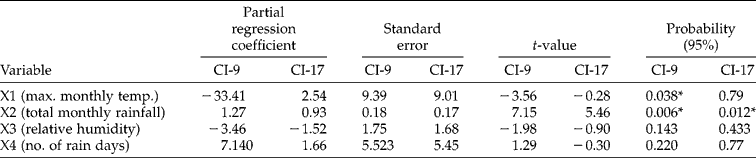
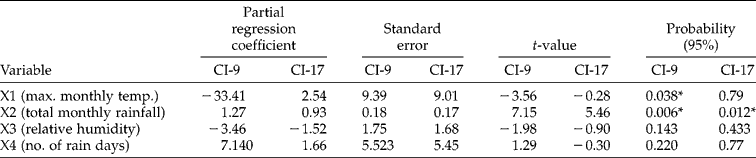
Maximum monthly temperature recorded over the study period ranged from 28.5 to 32.7 °C. The relationship between capture levels and temperature was not uniform, but overall higher temperatures were usually associated with significantly lower trap catches (P < 0.05) mainly in plot CI-9 (Table 1).
Multiple regression analysis of the effect of some climatic factors on the population of Ceratitis capitata in plots CI-9 and CI-17
*represents significance at P < 0.05.
The total monthly rainfall values of 235.9 and 0.0 mm were recorded in September 2006 and January 2007, respectively. The relationship between fly capture levels and total monthly rainfall was directly proportional, with higher rainfall values resulting in significantly higher fly capture levels. There was a strong positive correlation between rainfall and the number of flies captured in the two Late Valencia orchards (r 2 = 0.853 for plot CI-9 and r 2 = 0.883 for plot CI-17). Relative humidity over the months ranged from 37.3% in January 2007 to 69.7% in September 2006. Generally, as relative humidity increased, fly capture levels also increased. However, relative humidity and fly capture levels were not strongly correlated (r 2 = 0.49 for plot CI-9 and r 2 = 0.24 for plot CI-17).
Alternative hosts
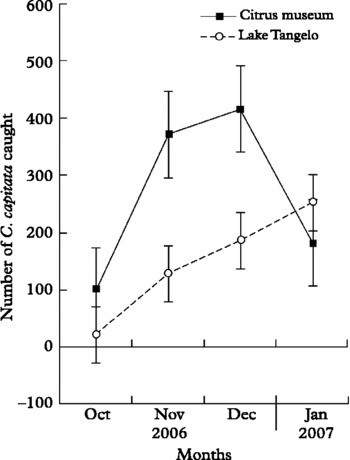
Adult C. capitata were not trapped in any of the trimedlure traps placed in the mango orchard and in the pepper field interspersed with pawpaw trees throughout the study period. The pest also did not emerge from any of the ripening fruits of these crops placed in emergence cages. However, traps placed in the Citrus Museum and the Lake Tangelo citrus site, both of which shared a boundary with the Late Valencia orchards and had abundant ripened and/or ripening fruits between November 2006 and January 2007, captured relatively high numbers of C. capitata when fruits on adjoining Late Valencia plots were green and immature (Fig. 2).
Mean ( ± SE) population fluctuation of Ceratitis capitata in the Citrus Museum and Lake Tangelo (Eastern Ghana) site between October 2006 and January 2007

Discussion
Results from this study show that the abundance and distribution of C. capitata (based on monthly fly captures) during the study period was influenced by the fruiting pattern of Late Valencia citrus. Trap captures were relatively low in months when Late Valencia citrus fruits were green and immature (November 2006–January 2007) but relatively high during months when citrus fruits were ripe (September–October 2006 and February–March 2007). Trap captures reduced considerably as the number of ripe citrus fruits in the orchards decreased and the major harvesting season came to an end (October–December 2006). There was an increase thereafter, which coincided with the onset of the minor harvesting season (February–April 2007; Fig. 1). The absence of ripe or semi-ripe fruits in the orchards between November 2006 and January 2007 may have accounted for the low capture levels, as semi-ripe or ripe succulent fruits are the most preferred by C. capitata (Thomas et al., Reference Thomas, Heppner, Woodruff, Weems, Steck and Fasulo2001). The relationship observed between trap capture levels and fruit phenology confirms results from an earlier study by Afreh-Nuamah (Reference Afreh-Nuamah1985) in which fly abundance reached a peak when most citrus fruits were ripe but reduced significantly in the absence of ripening citrus fruits. Furthermore, significantly higher numbers of C. capitata were captured in traps baited with trimedlure during the ripening periods in mango and apple orchards (Baker et al., Reference Baker, Howse, Ondarza and Reyes1990). This seems to be a common phenomenon in pest tephritids including those of other genera on their respective hosts like Bactrocera invadens (Drew, Tsuruta & White) on mango and citrus (Utomi et al., 2006), Anastrepha obliqua (Macquart) on mango (Zahler, Reference Zahler1991) and Bactrocera dorsalis (Hendel) on mango, peach and pear (Hui and Jianhong, Reference Hui and Jianhong2007).
Another observation is the high fruit drop, which occurred during periods when fruit fly captures reached a peak (September 2006 and April 2007) during this study. This also seems to be a common phenomenon in pest tephritids on their respective hosts; C. capitata on citrus (Akotsen-Mensah, Reference Akotsen-Mensah1999; Umeh et al., Reference Umeh, Olaniyan, Ker and Andir2004), B. dorsalis on mango, peach and pear (Hui and Jianhong, Reference Hui and Jianhong2007), and Bactrocera zonata (Saunders) in melon and guava in fields (Stonehouse et al., Reference Stonehouse, Mahmood, Poswal, Mumford, Baloch, Chaudhary, Makhdum, Mustafa and Huggett2002).
Some climatic factors also influence the population dynamics of a number of fruit fly species. High temperatures, which lead to reduced fly activity, have been associated with low trap captures of flies (Prokopy et al., Reference Prokopy, Papaj, Opp and Wong1987; Hendrichs and Hendrichs, Reference Hendrichs and Hendrichs1990; Cayol, Reference Cayol1996). In the present study, however, trap captures of C. capitata were relatively high in March 2007, which coincided with the period of the highest maximum monthly temperature. This may have been due to an abundance of ripe and ripening fruits in the citrus orchards during this period that may have had an even stronger influence on the fly population. On the other hand, the fly numbers were significantly influenced by amounts of monthly rainfall, with relatively high numbers captured when rainfall was around 200 mm and very low trap captures with rainfall below 55 mm. A similar effect was documented for B. dorsalis (Hui and Jianhong, Reference Hui and Jianhong2007). However, Aluja et al. (Reference Aluja, Celedonio-Hurtado, Liedo, Cabrera, Castillo, Guillen and Rios1996) did not find any relationship between rainfall and fruit fly trap captures in mango orchards in Mexico. In addition, while it may be difficult to separate the effects of rainfall from those of relative humidity, numbers of flies captured were positively, but weakly influenced by the latter.
Adult C. capitata were not trapped in pheromone traps placed in the pepper and mango fields and did not emerge from ripe and ripening fruits of mango, pawpaw and pepper. This suggests that these crops do not serve as alternative hosts for C. capitata at the study site as previously reported by Akotsen-Mensah (Reference Akotsen-Mensah1999). Thus citrus varieties in adjoining plots (Citrus Museum and Lake Tangelo plot), which started ripening when Late Valencia fruits were green and immature, served as alternative hosts for C. capitata during this period. This is consistent with the previous work (C. Akotsen-Mensah, personal communication), which concluded that the fruit fly population is sustained by different citrus varieties, which mature at different times of the year. It also shows that C. capitata does not utilize alternative host crops in the study region of Eastern Ghana, as long as there is an abundance of its preferred host (citrus) all year round. Another reason that could have accounted for the pest not emerging from potential alternative host may be because the mango orchard and the pepper field sampled cover only a small land area compared with the citrus trees that dominate the entire landscape at the Research Centre.
In conclusion, this study revealed a relationship between the abundance and the distribution of C. capitata and the fruiting pattern of Late Valencia citrus at the University of Ghana's Agricultural Research Centre in the Eastern region of Ghana. It also showed that rainfall and temperature have a significant effect on pest population. Our results corroborate earlier findings that the fruit fly populations are sustained by different citrus varieties, which mature at different times of the year. This underscores the need for control measures to be carried out in all citrus orchards in a given region, if effective control is to be achieved.
Acknowledgements
The authors wish to thank all research officers and technical staff at the University of Ghana's Agricultural Research Centre at Kade in the Eastern region of Ghana.
E.F. Appiah was supported by icipe through a grant from the Dutch Government (SII). Results are part of E.F.A.'s M. Phil. at the ARPPIS sub-regional centre for Western Africa, University of Ghana, Legon.