Implications
The results of the present experiment indicate that the fat source used in lactation diets for sows affect sow productivity, and is likely associated with the total amount of energy absorbed from the diet. Consequently, emphasis should be put on digestibility of fat sources used in the formulation of lactation diets for sows. Furthermore, the results indicate that fiber ingredients can be used for lactating sows to some degree. Investigation of relationships between the chemical composition of fibers in the diet, fermentability, and feed intake in sows may add more flexibility in the formulation of lactation diets including fiber-rich ingredients.
Introduction
Different properties of dietary fat sources are usually not taken into account in the formulation programs used for sow diets (National Research Council, 2012), although, characteristics such as the carbon chain length and the degree of saturation influence the digestion process, energy metabolism (Rossi et al., Reference Rossi, Pastorelli, Cannata and Corino2010) and potentially sow performance. Medium-chain triglycerides are readily digested, rapidly absorbed and transported to the liver via the portal vein, and efficiently oxidized (Zentek et al., Reference Zentek, Buchheit-Renko, Ferrara, Vahjen, Van Kessel and Pieper2011). Thus, energy from medium-chain fatty acids released in the liver may direct a greater proportion of glycogenic substrates of dietary origin to the peripheral tissues including the mammary glands as compared with long-chain fatty acids.
Ingredients rich in dietary fibers (DF) are generally excluded in diets for lactating sows, as high DF contents may compromise nutrient utilization, feed intake and consequently energy supply (Renaudeau et al., Reference Renaudeau, Anais and Noblet2003). Nevertheless, locally available crops and co-products may be cost-efficient alternatives to partly replace cereals in sow diets (Thingnes et al., Reference Thingnes, Gaustad, Kjos, Hetland and Framstad2013), some of which are high in DF. The composition of the DF fraction influences the properties of the ingredients, where diets with a high content of soluble non-starch polysaccharides (NSP) attenuates the nutrient absorption process (Serena et al., Reference Serena, Jorgensen and Knudsen2009) and reduces the gastrointestinal flow of digesta (Bach Knudsen, Reference Bach Knudsen2001), which in turn may compromise total nutrient intake capacity of the lactating sow. Diets high in insoluble NSP content increases intestinal bulk, but reduce the gastrointestinal transit time (Bach Knudsen, Reference Bach Knudsen2001). Thus, the potential to include DF-rich ingredients may depend on the source of the DF fraction.
It was hypothesized that dietary inclusion of glycerol trioctanoate (C8TG; medium-chain triglyceride) directs a greater proportion of glycogenic substrates toward the mammary glands, and consequently enhance milk production compared with palm fatty acid distillate (PFAD; rich in saturated long-chain fatty acids) and soybean oil (SOYO; rich in unsaturated long-chain fatty acids). It was further hypothesized that a high-fiber diet based on sugar beet pulp (SBP; high in soluble NSP) may impair feed intake, milk production and increase mobilization of body reserves, compared with sows fed a standard lactation diet (CON; low in DF) and a high-fiber diet based on alfalfa (ALF; high in insoluble NSP). The objective of the present experiment was to study feed intake, plasma metabolites, litter gain and the yield and composition of milk in sows fed different amount and sources of DF (CON, SBP, ALF) combined with SOYO, PFAD or C8TG as the dietary fat source.
Material and methods
All procedures involving animals, including blood sampling, housing and rearing, were in compliance with Danish laws and regulations for the humane care and use of animals in research (The Danish Ministry of Justice, 1995).
Animals and recordings
A total of 36 second parity sows (Danish Landrace×Yorkshire) were studied from late gestation and throughout lactation (weaning at day 28) in a 3×3 factorial design conducted with two repetitions (18 sows/repetition). On day 105 of gestation sows were stratified for BW to receive one of nine diets (three fiber diets×three fat sources). The number of replications for the main effects of fiber and fat was equal to 12, and four for each fiber×fat combination. The effects of these fiber and fat sources on colostrum production were presented in a complementary paper (Krogh et al., Reference Krogh, Bruun, Amdi, Flummer, Poulsen and Theil2015). Sows were housed in farrowing crates (2.7×1.8 m) with partly slatted floor and a heated piglet creep area (0.59 m2). Room temperature was set to 21°C when all parturitions were completed, and then gradually reduced to reach 17°C on day 28 of lactation.
Sow backfat thickness and BW were recorded in early lactation (day 3), peak lactation (day 17) and at weaning (day 28). Backfat thickness was measured about 65 mm from either side of the backbone at the last rib (P2 measurement) by ultrasound using a 7.5-MHz Linear Intraoperative Probe Aloka (UST-556/7.5; Simonsen & Weel, Vallensbæk Strand, Denmark). Blood samples were collected on the 3rd and 17th day in milk (DIM) by venipuncture from the jugular vein 4 h after provision of the morning meal. Blood was collected in 9 ml plasma sodium heparin blood collection tubes (Hettich Labinstrument ApS, Hillerød, Denmark); centrifuged (20 min; 1558×g; 4°C); and then plasma was harvested and stored at −20°C until analysis. Milk samples were manually collected from a single gland on days 3, 10, 17 and 24 of lactation. Piglets were removed from the sow ~30 min before milking, and sows were milked shortly after intramuscular injection of 2 ml oxytocin (10 IU/ml; Leo Pharma, Ballerup, Denmark). Milk samples were filtered through gauze, and 50 ml was stored at −20°C until analysis. All litters were standardized to 13 or 14 piglets between 24 and 48 h after birth of the first piglet according to the number of functional teats (visually assessed in late gestation). At litter standardization, all piglets with birth weights below 800 g were excluded from the experiment, as were superfluous piglets (i.e. >13 or 14 piglets/sows). If the number of piglets were inadequate after removal of the small piglets (i.e. below 13 or 14) then piglets were cross-fostered from other sows. Cross-fostered piglets were preferably taken from sows within treatment group. Alternatively newborn piglets from other sows not included in the experiment were used. Piglets were individually weighed on days 2, 7, 14, 21 and 28 of lactation. Castration of male piglets and iron injection was performed on day 4 of lactation.
Diet composition and feeding
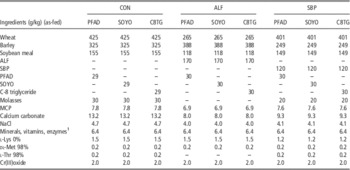
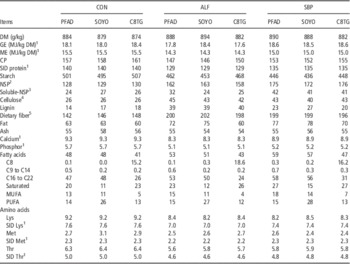
The CON diet was formulated based on wheat, barley and soybean meal to be low in DF content (155 g calculated DF/kg dry matter), whereas the SBP and ALF diets formulated contain equal amounts of DF (230 g calculated DF/kg dry matter), with a high and low content of soluble NSP, respectively. The diets were formulated to contain 33, 42 and 70 g soluble NSP/kg dry matter for the CON, ALF and SBP diet, respectively. The Danish nutrient recommendations (Tybirk et al., Reference Tybirk, Sloth and Jørgensen2012) were used to formulate the diets regarding the content of standardized ileal digestible protein and essential amino acids, minerals and vitamins, which are all expressed relative to the dietary energy content. The three basic diets (CON, ALF and SBP) were produced by DLG, Copenhagen. Before pelleting, each of the basic diets were supplemented with 3% PFAD, SOYO or C8TG, resulting in nine different fiber×fat combinations (Table 1). The fat sources rich in long-chain fatty acids (SOYO and PFAD) differed mainly in the degree of saturation, with the SOYO containing the highest amount of unsaturated fatty acids (especially differing in the content of polyunsaturated fatty acids). The C8TG contributed with fatty acids with chain lengths of eight carbon molecules esterified to glycerol (Table 2).
Ingredients of experimental diets fed to sows from day 105 of gestation until weaning on day 28 of lactation

CON=standard lactation diet; ALF=alfalfa meal; SBP=sugar beet pulp; PFAD=palm fatty acid distillate; SOYO=soybean oil; C8TG=glycerol trioctanoate.
1 Minerals, vitamins and enzymes supplied per kilogram of diet: retinyl acetate 8400 IU, α-tocopherol acetate 160 mg, thiamine 2.10 mg, cyanocobalamin 0.02 mg, riboflavin 5.2 mg, pyridoxine 3.15 mg, biotin 0.21 mg, d-pantothenic acid 15.80 mg, cholecalciferol 1400 IE, folic acid 1.58 mg, niacin 21 mg, 6-Phytase (Ronozyme®) 2500 units, 15 mg of Cu as CuSO4·5H2O, 110 mg of Zn as ZnO, 84 mg of Fe as FeSO4·7H2O, 0.21 mg Ca(IO3)2·6H2O, 42 mg of Mn as MnO, 0.40 mg of Se as Na2SeO3.
Chemical composition of diets fed to sows from day 105 of gestation until weaning on day 28 of lactation in g/kg dry matter (DM) unless otherwise stated

CON=standard lactation diet; ALF=alfalfa meal; SBP=sugar beet pulp; PFAD=palm fatty acid distillate; SOYO=soybean oil; C8TG=glycerol trioctanoate; GE=gross energy; ME=metabolizable energy; SID=standardized ileal digestible; NSP=non-starch polysaccharides; C8=octanoic acid; C9 to C14=medium-chain fatty acids; C16 to C22=long-chain fatty acids; MUFA=mono unsaturated fatty acids; PUFA=polyunsaturated fatty acids.
Analyzed contents are given, unless otherwise stated.
1 Calculated based on feed tables (Danish Pig Research Centre, 2013).
2 NSP determined by summation of measured sugar residues of the NSP fraction.
3 Soluble-NSP determined as difference between NSP and insoluble NSP, where insoluble NSP was determined by summation of measured sugar residues of the insoluble NSP fraction.
4 Cellulose determined as the difference in NSP glucose residues after hydrolysis with 12 and 2 M H2SO4, respectively.
5 Dietary fiber calculated as the sum of NSP and lignin.
During the experimental period, sows were fed three times per day (0800, 1400 and 2300 h), and offered the same amount of calculated metabolizable energy (ME; differing slightly in amounts of kg/day). From day 105 of gestation until day 2 of lactation sows were fed 38.6 MJ ME/day based on calculated ME content of feed ingredients. Feed intake was then increased by 5.3 MJ ME/day from days 3 to 16 of lactation, reaching maximum feed allowance of 110 MJ ME/day on day 16, which was applied until weaning (day 28). From day 8 of lactation onwards, feed allowance was reduced by 6.1 MJ ME/day for each piglet below 14 in the litter. Sow feed intake (corrected for refusals) was registered on a daily basis. No bedding material was provided to avoid interacting effects on the amount of DF supplied. Piglets had no access to creep feed. Weekly subsamples of the diets were collected and pooled for analysis.
Chemical analysis
Diets
Dry matter content was measured by drying to constant weight (~20 h) at 103°C, and ash was analyzed according to the Association of Official Analytical Chemists method no. 942.05. Nitrogen content was analyzed by the Dumas method (Hansen, Reference Hansen1989) and gross energy determined with an adiabatic bomb calorimeter (IKAC 400; IKA Werke, Janke & Kunkel, Staufen, Germany). Starch content was determined spectrophotometrically (Bach Knudsen, Reference Bach Knudsen1997). The constituent sugars in the dietary fractions of NSP were measured by GLC for neutral sugars and by colorimetry for uronic acid as described by Bach Knudsen (Reference Bach Knudsen1997), except that the acid hydrolysis in the procedure was performed in 2 M H2SO4 for 1 h instead of 1 M H2SO4 for 2 h. Klason lignin was measured as the sulfuric acid-insoluble residue as described by Theander and Aman (Reference Theander and Aman1979). Fat was extracted with a monophasic mixture of chloroform, methanol and water after hydrochloric acid hydrolysis as described by Bligh and Dyer (Reference Bligh and Dyer1959), and dietary fatty acids (⩾C8) were determined by GLC (capillary) after saponification and methylation, as described by Rotenberg and Andersen (Reference Rotenberg and Andersen1980), with substitution of hexane with heptane, and with C17:0 as the internal standard. Dietary amino acids were analyzed according to ISO 13903:2005, using a Biochrom 30+amino acid analyzer (Biochrom, Cambridge, UK).
Plasma and milk
Plasma was analyzed for short-chain fatty acid concentration as described by Brighenti (Reference Brighenti1998), although 2-ethyl butyrate (Fluka no. 03190; Sigma-Aldrich, St. Louis, MO, USA), rather than isovaleric acid, was used as internal standard. Plasma concentrations of non-esterified fatty acids were determined using the Wako, NEFA C ACS-ACOD assay method (Wako Chemicals GmbH, Neuss, Germany). Enzymatic assays were used to analyze glucose (hexokinase, glucose-6-phosphate dehydrogenase); lactate (lactate oxidase, peroxidase); and urea (urease, glutamate dehydrogenase) in plasma according to standard procedures (Siemens Diagnostics Clinical Methods for ADVIA 1650) using an auto analyzer (ADVIA 1650 Chemistry System; Siemens Medical Solution, Tarrytown, NY, USA).
Milk samples were analyzed for fat, lactose, protein and dry matter concentration by IR spectroscopy using a MilkoScan FT2 instrument (Foss MilkoScan, Hillerød, Denmark).
Calculations
Total NSP and insoluble NSP content in the diets were determined by summation of the measured constituent sugar residues from these respective dietary fractions. Soluble NSP was determined as the difference between total and insoluble NSP, whereas cellulose was calculated as the difference in NSPglucose after hydrolysis with 12 and 2 M H2SO4, respectively. Dietary fiber was quantified as NSP+Klason lignin. Crude protein content of feed was calculated as N×6.25. The milk yield of each sow was calculated based exclusively on the average daily litter gain and the average litter size during days 2 to 7, 2 to 14, 2 to 21 and 2 to 28 for weeks 1, 2, 3 and 4, respectively, according to Hansen et al. (Reference Hansen, Strathe, Kebreab, France and Theil2012). Sow digestible energy intake was calculated using the energy digestibility values presented by Krogh et al. (Reference Krogh, Bruun, Amdi, Flummer, Poulsen and Theil2015) for these diets.
Statistical analysis
The MIXED procedure of SAS (SAS Institute Inc., Cary, NC, USA) was used to evaluate the effects of dietary treatments on the measures obtained during lactation. The sow or the litter was considered to be the experimental unit. The following model was used to analyze repeated measurements:
 $$Y_{{ijklm}} \,{\equals}\,\mu {\plus}\alpha _{i} {\plus}\beta _{j} {\plus}\lambda _{k} {\plus}\delta _{{\rm l}} {\plus}\gamma _{m} {\plus}\left( {\alpha \gamma } \right)_{{im}} {\plus}\left( {\beta \gamma } \right)_{{jm}} {\plus}{\varepsilon}_{{ijklm}} $$
where Y ijklm is the response variable recorded at the mth DIM from the sow l in repetition k receiving fat treatment i and fiber treatment j; µ the overall mean; α i the fixed effect of fat (i=PFAD, SOYO, C8TG); β j is the fixed effect of fiber (j=CON, ALF, SBP); λ k the fixed effect of repetition (1, 2); δ l is the random effect of sow within fiber and fat treatment, specifying the sow as the experimental unit (m=1, …, 36); γ m the fixed effect of DIM (m=days 2, …, 28); (αγ) im the interaction between fat and DIM, (βγ) jm the interaction between fiber and DIM; and ε ijklm the error component (N, σ 2). If three or more repeated measures were obtained from one sow, a first-order autoregressive covariance structure was included in the statistical model, to account for the covariance between samples obtained from a single sow. The interaction between fat and fiber was initially tested; however, no significant interactions were found (P>0.05) and consequently removed from the model. Plasma lactate and non-esterified fatty acids were log-transformed before statistical analysis to correct for heterogeneity of variance. A reduced model, excluding DIM, was used to analyze sow weight and back fat on the 3rd DIM. Pearson’s correlations between litter weight gain, milk yield and milk protein concentration during each week of lactation were calculated using the CORR procedure of SAS (SAS Institute Inc.). One sow was excluded from the data analysis due to rather low feed intake (1.5 kg/day) during the 1st week of lactation, and one sow was excluded due to agalactia. Agalactia was defined as normal clinical health status of the sow (body temperature, feed intake, behavior, etc.), but unable to produce enough milk to support positive litter gain.
Results
Sow and litter performance
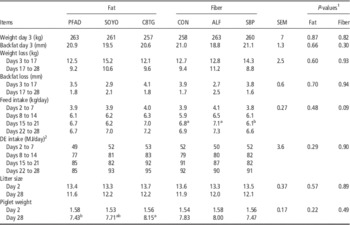
Overall feed intake was increased from 3.9 kg/day in the 1st week of lactation to 7.0 kg/day in the 4th week of lactation (P<0.001). Similarly, digestible energy intake was increased from 51 MJ/day in the 1st week of lactation to 91 MJ/day in the 4th week of lactation. Sow weight and backfat thickness (day 3) as well as loss of weight and backfat (days 3 to 28) did not differ between dietary treatments (P>0.10; Table 3). Litter size on days 2 and 28 of lactation did not differ between treatment groups (P>0.10).
Characteristics of sows fed different dietary fat and fiber sources from day 105 of gestation until weaning on day 28 of lactation

PFAD=palm fatty acid distillate; SOYO=soybean oil; C8TG=glycerol trioctanoate; CON=standard lactation diet; ALF=alfalfa meal; SBP=sugar beet pulp; DE, digestible energy.
a,bWithin a row and within a main effect, means with different superscript letters differ (P<0.05).
1 The fiber×fat interaction was not significant and consequently removed from the model. Backfat loss (P=0.002), feed intake (P<0.001), DE intake (P<0.001), litter size (P<0.001) and piglet weight (P<0.001), were affected by days in milk (DIM) and weight loss tended (P=0.06) to be affected by DIM. A fat×DIM interaction was observed for piglet weight (P=0.04). Neither a fiber×DIM nor a fat×DIM interaction was observed (P>0.10) for any of the other variables.
2 DE intake=apparent digestible energy intake (MJ/day) based on energy digestibilities presented by Krogh et al. (Reference Krogh, Bruun, Amdi, Flummer, Poulsen and Theil2015).
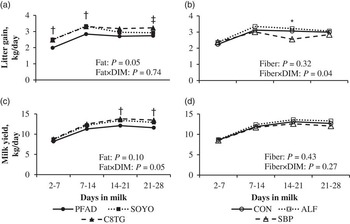
Litter weight gain during lactation was greater in sows fed C8TG and SOYO than in PFAD sows (P=0.05; Figure 1a). An interaction between fat and DIM was observed, where milk yield was lower during the 3rd and 4th week of lactation in PFAD sows than in C8TG and SOYO sows (P=0.05, Figure 1c). Piglet ADG between days 2 and 28 tended to be affected by dietary fat source (P=0.09; data not shown), with the fastest growth in piglets from C8TG sows (244 g/day), intermediate in piglets from SOYO sows (232 g/day) and lowest in piglets from PFAD sows (215 g/day). An interaction between DIM and fat source was observed for piglet weight (P=0.04), with no differences in piglet weight on day 2, whereas piglets from C8TG sows were heavier at weaning than piglets from PFAD sows (Table 3). Sow feed intake and digestible energy intake were not affected by dietary fat treatments (P>0.10; Table 3).
Litter gain of piglets (a) and sow milk yield (c) at different days in milk (DIM) of sows fed lactation diets including fat from palm fatty acid distillate (PFAD), soybean oil (SOYO), or glycerol trioctanoate (C8TG). Litter gain of piglets (b) and sow milk yield (d) at different DIM of sows fed a standard lactation diet (CON), a high-fiber lactation diet with a high insoluble non-starch polysaccharide (NSP) content from alfalfa (ALF) or a high-fiber lactation diet with a high soluble NSP content from sugar beet pulp (SBP). Pairwise comparisons: *SBP<CON and ALF (P<0.05); †PFAD<C8TG and SOYO (P<0.05); ‡PFAD<C8TG (P<0.05).

An interaction between fiber and DIM was observed, where litter gain was lower during the 3rd week of lactation in SBP sows than in CON and ALF sows (P=0.04, Figure 1b). Milk yield was not affected by fiber treatment (P=0.43, Figure 1d). Feed intake tended to be affected by fiber treatments (P=0.09), with a lower feed intake of SBP sows in the 3rd week of lactation than in CON and ALF sows (P<0.05), whereas no effect on digestible energy intake was observed (P>0.10; Table 3).
Plasma variables
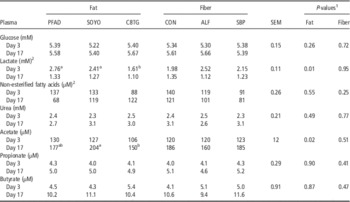
Plasma lactate was lower in C8TG sows on day 3 of lactation than in PFAD and SOYO sows on day 3 of lactation (P<0.05). Plasma acetate concentration on day 17 of lactation was greatest in SOYO sows, intermediate in PFAD sows and lowest in C8TG sows (P<0.05; Table 4). Other measured plasma metabolites were not affected by the dietary treatments (P>0.10).
Plasma metabolites in early (day 3) and peak lactation (day 17) obtained from the jugular vein 4 h after feeding in sows fed different sources of fat and fiber from day 105 of gestation until weaning on day 28 of lactation

PFAD=palm fatty acid distillate; SOYO=soybean oil; C8TG=glycerol trioctanoate; CON=standard lactation diet; ALF=alfalfa meal; SBP=sugar beet pulp.
a,bWithin a row and within a main effect, means with different superscript letters differ (P<0.05).
1 The fiber×fat interaction was not significant and consequently removed from the model. Lactate (P<0.001), urea (P=0.001), acetate (P<0.001), propionate (P<0.001) and butyrate (P<0.001) were affected by days in milk (DIM) and glucose tended (P=0.08) to be affected by DIM, whereas non-esterified fatty acid was not (P=0.49). Neither a fiber×DIM nor a fat×DIM interaction was observed for the plasma metabolites (P>0.10).
2 Data were logarithmic transformed. Least square mean values were backtransformed to original scale, whereas SEM is presented on a logarithmic scale. Confidence intervals (95%) can be calculated as: Exp(ln[least square mean]±1.96×SEM).
Milk composition
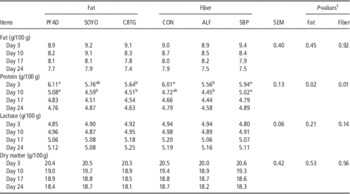
Milk protein concentration was affected by fat source (P=0.02), with a greater protein concentration in milk from PFAD sows than in milk from SOYO and C8TG sows on days 3 and 10 of lactation (Table 5). Milk protein concentration was lowest in ALF sows on days 3 and 10 of lactation (P=0.02; Table 5). Milk fat, lactose and dry matter concentration was not affected by fiber or fat treatment (P>0.10). Milk protein concentration on days 3 and 10 of lactation were negatively correlated with litter weight gain during 1st (r=−0.54; P=0.002) and 2nd (r=−0.49; P=0.004) week of lactation, respectively. Similarly, milk protein concentration on day 3 tended to be negatively correlated to milk yield during the 1st week of lactation (r=−0.33; P=0.07), and milk protein concentration on day 10 was negatively correlated to milk yield during the 2nd week of lactation (r=−0.36; P=0.04). In contrast, none of these correlations were significant during weeks 3 and 4 of lactation.
Composition of milk from sows fed different sources of fat and fiber, from day 105 of gestation until weaning on day 28 of lactation

PFAD=palm fatty acid distillate; SOYO=soybean oil; C8TG=glycerol trioctanoate; CON=standard lactation diet; ALF=alfalfa meal; SBP=sugar beet pulp.
a,bWithin a row and within a main effect, means with different superscript letters differ (P<0.05).
1 The fiber×fat interaction was not significant and consequently removed from the model. Fat (P<0.001), lactose (P=0.001), protein (P<0.001) and dry matter (P<0.001) were affected by day in milk (DIM). Neither a fiber×DIM nor a fat×DIM interaction was observed for any of the variables (P>0.10).
Discussion
Fat source
Litter weight gain and milk yield at peak lactation were greater in sows fed C8TG and SOYO, than in PFAD-fed sows, and were likely related to the lower apparent digestibility of fat and energy in PFAD compared with SOYO and C8TG-fed sows, as reported by Krogh et al. (Reference Krogh, Bruun, Amdi, Flummer, Poulsen and Theil2015). Saturated fat is indeed known to be less digestible than unsaturated fat (Powles et al., Reference Powles, Wiseman, Cole and Hardy1994) and medium-chain fatty acids are rapidly and easily absorbed from the gastrointestinal tract and into the portal vein leading to the liver (Zentek et al., Reference Zentek, Buchheit-Renko, Ferrara, Vahjen, Van Kessel and Pieper2011). Regardless of the reduced energy and fat digestibility, digestible energy intake was only numerically lower in PFAD-fed sows, which may be explained by variation originating from feed intake and analytical variation of dietary gross energy contents used to calculate digestible energy intake. In line with the present observations, Lauridsen and Danielsen (Reference Lauridsen and Danielsen2004) found that total litter growth was affected by the source of fat fed to sows, when 8% fat was added to the diets.
The reduced milk protein concentration of SOYO and C8TG sows during weeks 1 and 2 of lactation, combined with the negative correlation between litter gain and milk protein concentration, suggest that milk protein was diluted due to a higher milk yield, driven by increased energy available for milk synthesis, whereas the different fat source did not induce differences in available protein. This is in agreement with previous studies, indicating that milk yield and milk protein concentration are negatively correlated when variation in milk yield results from differences in feeding level (Van den Brand et al., Reference Van den Brand, Heetkamp, Soede, Schrama and Kemp2000) and litter size (Auldist et al., Reference Auldist, Morrish, Eason and King1998 and Reference Auldist, Carlson, Morrish, Wakeford and King2000). In addition, these results furthermore suggested that dietary amino acids to energy content might have limited litter gain in high yielding sows, as discussed by Vadmand et al. (Reference Vadmand, Krogh, Hansen and Theil2015). As a consequence, new experiments to evaluate the Danish recommendations of amino acids for lactating sows have recently been initiated.
Dietary medium-chain fatty acids are absorbed and directed to the liver via the portal vein system and are easily transported into cells and mitochondria, because the process is not reliant on the transport systems required by long-chain fatty acids (Kajimoto et al., Reference Kajimoto, Ledee, Olson, Isern, Des Rosiers and Portman2015). Accordingly, the low acetate and lactate in plasma of C8TG-fed sows might be a result of medium-chain fatty acids being utilized for oxidation to a greater extent than long-chain fatty acids. However, these potential metabolic changes related to medium-chain fatty acid metabolism did not affect milk yield and litter growth as compared with SOYO-fed sows. Although a limited number of sows was included in the present study, these results suggest that the observed impact of fat source on litter gain, milk yield and milk composition was likely related to the lower digestibility of PFAD, rather than post absorptive effects of the dietary fatty acids composition on energy metabolism.
High-fiber diets
A gradually increasing feed intake during early lactation is a frequently used strategy in commercial herds to minimize the percentage of refusals and variation in feed intake during lactation (Thingnes et al., Reference Thingnes, Ekker, Gaustad and Framstad2012). In the present experiment, the intake of feed and energy increased gradually during the first 2 weeks of lactation. However, feed intake during the 3rd week of lactation was lower than expected in SBP sows, whereas ALF sows were able to compensate for the lower energy density. Plasma metabolites were unaffected by the fiber treatment, thus the decreased litter gain observed in SBP-fed sows during week 3, was likely related to differences in feed intake, rather than post absorptive effects induced by the different composition of the DF fraction. Milk protein concentration was lower in ALF sows than in CON and SBP sows during weeks 1 and 2 of lactation, and might be associated with the numerically greater milk yield, and consequently diluting the synthesized milk protein, as discussed above. Overall, the present results suggest a potential to include DF in lactation diets, if energy intake and availability of essential nutrients are not compromised. However, the source of DF may affect the feed intake differently. Given the limited numbers of sows included in the present experiment, potential interactions between fiber and fat might not be detectable. Thus, the attention was directed toward the main effects of fiber and fat sources.
In conclusion, litter growth and milk yield were reduced in PFAD-fed sows, likely associated with a low digestibility of PFAD. Metabolic differences between SOYO- and C8TG-fed sows were observed, but the similar lactation performance suggests only negligible effects of medium-chain fatty acids on milk production. Furthermore, litter gain in the 3rd week of lactation was reduced, and feed intake tended to be lower in SBP-fed sows compared with CON and ALF-fed sows, suggesting that effects of DF content and fat sources on energy intake, rather than post absorptive effects, determine the potential to include high-fiber ingredients and to use different fat sources.
Acknowledgments
This research was supported by funds from the Danish Ministry for Food, Agriculture and Fishery (grant no. 3405-11-0342). The glycerol trioctanoate was donated by Proviron, Hemiksem, Belgium.