Autism spectrum disorder (ASD) is currently defined by the presence of social communication deficits as well as behaviors and interests that are restricted or repetitive (American Psychiatric Association, 2013). Theoretical models of the etiology of ASD frequently place social impairments squarely at the center, positing alterations to the neurobiology underlying social communication from very early in life. Within these models, the construct of social motivation is of particular interest, as several influential frameworks propose that social motivation deficits underlie social dysfunction in ASD (Chevalier, Kohls, Troiani, Brodkin, & Schultz, Reference Chevallier, Kohls, Troiani, Brodkin and Schultz2012; Dawson & Bernier, Reference Dawson, Bernier, Coch, Dawson and Fischer2007; Dawson, Webb, & McPartland, Reference Dawson, Webb and McPartland2005). In the context of typical development, they argue, social motivation is fundamental to social success, as it facilitates enhanced attention toward social stimuli (e.g., human voices over other sounds, and human faces over other images), promotes the development of neurobiological systems specialized for social information processing (e.g., face processing) and complex social cognition (e.g., perspective taking), and increases the frequency and quality of social approach and behavior (Dawson & Bernier, Reference Dawson, Bernier, Coch, Dawson and Fischer2007). Among individuals with ASD, in contrast, alterations to early social motivation and reward undercut this developmental cascade, affecting the trajectory and outcome of a range of social and communication skills and behaviors (Dawson et al., Reference Dawson, Webb and McPartland2005).
Not yet fully specified within social motivation models are the traits and characteristics that supplement and/or interact with social motivation to influence social cognition and behavior. Although ASD was once conceptualized as a rare, narrowly defined diagnosis, incredible heterogeneity among individuals with the same diagnosis has become increasingly clear in recent decades (Shen & Piven, Reference Shen and Piven2017). This is evident across levels of analysis, from the genetic bases thought to underlie the disorder (Arnett, Trinh, & Bernier, Reference Arnett, Trinh and Bernier2018) to the range of cognitive profiles observed (e.g., Munson et al., Reference Munson, Dawson, Sterling, Beauchaine, Zhou, Koehler and Abbott2008). Even within the core “social deficits” that define the disorder, there are individual differences in social interest, skill, and success (Wing & Gould, Reference Wing and Gould1979). Wing and Gould, for example, described children with ASD who had apparently low social motivation (termed “aloof”), others with a high degree of social motivation but poorly developed skills (termed “active”), and still others whose motivation fell in the middle (termed “passive”). Clearly, social skill and engagement are multiply determined, with contributions from social motivation as well as a host of other factors. Given the variability that characterizes ASD, understanding of the social skills and experiences of individuals with ASD requires elucidation of the individual differences that work in concert with social motivation to contribute to social functioning among children, adolescents, and adults with ASD.
Emotion Dysregulation in ASD
One source of variability that may influence social functioning relates to the emotional experiences of individuals with ASD. Alongside the core diagnostic deficits of ASD, differences in emotional experience (and dysregulation of emotion in particular) are commonly associated features of ASD, despite their absence from formal diagnostic criteria. As early as infancy, children later diagnosed with ASD display higher levels of parent-reported negative affect, including increased sadness and fear, less positive affect, and more difficulties with soothability than their peers without ASD (Filliter et al., Reference Filliter, Longard, Lawrence, Zwaigenbaum, Brian, Garon and Bryson2015; Garon et al., Reference Garon, Bryson, Zwaigenbaum, Smith, Brian, Roberts and Szatmari2009; Konstantareas & Stewart, Reference Konstantareas and Stewart2006). With time, these features appear to manifest in a number of diagnostic outcomes. Among these is increased prevalence of anxiety disorders by school age (White, Oswald, Ollendick, & Scahill, Reference White, Oswald, Ollendick and Scahill2009), with over 80% of children with ASD displaying significant symptoms of anxiety (Muris, Steerneman, Merckelbach, Holdrinet, & Meesters, Reference Muris, Steerneman, Merckelbach, Holdrinet and Meesters1998). Risk of depressive symptoms and formal mood disorder is similarly increased for children with ASD (Neuhaus, Bernier, & Beauchaine, Reference Neuhaus, Bernier and Beauchaine2014; Rieffe, De Bruine, De Rooij, & Stockmann, Reference Rieffe, De Bruine, De Rooij and Stockmann2014; Simonoff et al., Reference Simonoff, Pickles, Charman, Chandler, Loucas and Baird2008), with increasing symptoms of depression and associated suicidal ideation and behavior as children move into adolescence and adulthood (Brereton, Tonge, & Einfeld, Reference Brereton, Tonge and Einfeld2006; Cassidy et al., Reference Cassidy, Bradley, Robinson, Allison, McHugh and Baron-Cohen2014).
Often in conjunction with internalizing symptoms, children and adolescents with ASD display increased emotion dysregulation in some forms of externalizing behavior as well (Vaillancourt et al., Reference Vaillancourt, Haltigan, Smith, Zwaigenbaum, Szatmari, Fombonne and Bryson2017). Although challenging behaviors such as tantrums, irritability, and aggressive behavior are normative for young children, these are often heightened beyond developmental expectations for children with ASD (Mazefsky & White, Reference Mazefsky and White2014). Externalizing symptoms are one of the most common presenting concerns for families of children with ASD seeking mental or behavioral health services (Arnold et al., Reference Arnold, Vitiello, McDougle, Scahill, Shah, Gonzalez and Tierney2003) and represent a prominent source of stress for parents (Estes et al., Reference Estes, Munson, Dawson, Koehler, Zhou and Abbott2009). When such difficulties persist into adulthood, they have detrimental effects on quality of life and independence among adults with ASD (Ballaban-Gil, Rapin, Tuchman, & Shinnar, Reference Ballaban-Gil, Rapin, Tuchman and Shinnar1996).
Whether emotion dysregulation is an inherent feature within ASD itself or constitutes evidence of psychiatric comorbidity has yet to be resolved (Mazefsky et al., Reference Mazefsky, Herrington, Siegel, Scarpa, Maddox, Scahill and White2013; Mazefsky & White, Reference Mazefsky and White2014), but it is clear that such dysregulation is prevalent, long lasting, and clinically significant. As such, it almost certainly carries an impact for other areas of functioning, including the development and expression of social skill. Among children without ASD, symptoms of anxiety and depression correspond to poorer social skills and fewer friendships (Garaigordobil, Bernaras, Jaureguizar, & Machimbarrena, Reference Garaigordobil, Bernaras, Jaureguizar and Machimbarrena2017; Motoca, Williams, & Silverman, Reference Motoca, Williams and Silverman2012; Scharfstein, Alfano, Beidel, & Wong, Reference Scharfstein, Alfano, Beidel and Wong2011; Scharfstein & Beidel, Reference Scharfstein and Beidel2015). Paralleling the co-occurrence of social and emotional difficulties at the behavioral level, these processes also share neurobiological substrates. For instance, a range of neural regions and systems that subserve social cognition and behavior, and have been shown to be altered in ASD, are also fundamental to psychiatric functioning across the life span (e.g., amygdala and associated limbic structures, prefrontal cortex, and serotonergic and dopaminergic systems; see Neuhaus, Beauchaine, & Bernier, Reference Neuhaus, Beauchaine and Bernier2010, for review). Alterations to many of these neural regions appear to underlie emotion dysregulation across a variety of diagnostic categories (e.g., Beauchaine, Reference Beauchaine2015; Beauchaine & Zisner, Reference Beauchaine and Zisner2017), underscoring the transdiagnostic role of emotion dysregulation as it interacts with other influences to shape functioning across development.
Given these links, emotion-related processes and social functioning are likely highly intertwined in both typical development and ASD, and disruptions in emotion-related processes likely impact social engagement and success in ASD. In this paper, we hypothesize that emotion dysregulation may have both direct and interactive effects on the social functioning of individuals with ASD. Whereas dysregulation likely decreases social skill and success directly, it may also moderate the associations between social motivation and social skill, such that it interferes with an individual's ability to “translate” his or her motivation for social interaction into successful social engagement. For example, significant anxiety may inhibit social skill even when a child is highly motivated for social engagement, perhaps by decreasing social approach and thereby limiting opportunities to practice social skills (as well as other types of skills more broadly). Similarly, the presence of irritability may impede social interactions, even in the context of high social motivation, if a child displays frequent annoyance or negative reactions to his or her peers’ behavior. This may be especially relevant for children with ASD, for whom triggers for dysregulation can be idiosyncratic and may often appear unpredictable to peers without ASD (Mazefsky et al., Reference Mazefsky, Herrington, Siegel, Scarpa, Maddox, Scahill and White2013).
As these are complex constructs, and ASD is characterized by such heterogeneity, links between social and emotional processes in ASD are likely influenced by additional forms of individual differences. Two dimensions of difference are of particular interest in the current study. First is the role of biological sex. ASD is much more prevalent in males versus females (American Psychiatric Association, 2013), and profiles of ASD symptoms may differ on the basis of sex (Knutsen, Crossman, Perrin, Shui, & Kuhlthau, Reference Knutsen, Crossman, Perrin, Shui and Kuhlthau2018). In addition, sex may influence the forms in which emotion dysregulation appears, as girls with ASD are more likely than boys to experience anxiety and depression, whereas boys are more likely to exhibit aggressive and repetitive behaviors (Werling & Geschwind, Reference Werling and Geschwind2013). Moreover, developmental trajectories of internalizing and externalizing disorders over the course of early childhood may also differ by sex among children with and without ASD (Vaillancourt et al., Reference Vaillancourt, Haltigan, Smith, Zwaigenbaum, Szatmari, Fombonne and Bryson2017).
A second dimension of individual difference that warrants attention is cognitive and intellectual functioning. Early research suggested that nearly 70% of individuals with ASD experienced significant intellectual disability (Fombonne, Reference Fombonne2003), but more recent research reveals a wide spectrum of cognitive levels and profiles that spans the full range of ability (Ankenman, Elgin, Sullivan, Vincent, & Bernier, Reference Ankenman, Elgin, Sullivan, Vincent and Bernier2014; Autism and Developmental Disabilities Monitoring Network, 2010). As with biological sex, individuals’ intellectual ability may influence display of emotion dysregulation, both within diagnostic domains (e.g., differential distributions of anxiety disorders by IQ; White et al., Reference White, Oswald, Ollendick and Scahill2009) and across domains (e.g., differential relations to internalizing vs. externalizing symptoms; Estes, Dawson, Sterling, & Munson, Reference Estes, Dawson, Sterling and Munson2007; Neuhaus, Bernier, Tham, & Webb, Reference Neuhaus, Bernier, Tham and Webb2018). In particular, increased cognitive ability may be a particular risk factor for internalizing disorders, as it may enhance one's awareness of social difficulties (Sterling, Dawson, Estes, & Greenson, Reference Sterling, Dawson, Estes and Greenson2008).
Current Objectives
Our overarching objective in this paper was to characterize social and emotional functioning among children and adolescents with ASD, with particular attention to the links between these two domains. Within this objective, we aim to explore the contributions of social motivation and emotion dysregulation to children and adolescents’ social skill. Moreover, by capitalizing on a large cohort of well-characterized children with ASD, we aim to investigate the potential moderating role of emotion dysregulation in the association between social motivation and adaptive social skill, as emotion-related processes may blunt or facilitate social success. Furthermore, in keeping with the literature reviewed thus far, we sought to consider the roles of (a) child's biological sex, given sex differences in prevalence and trajectory of emotion dysregulation within the general population, as well as (b) cognitive ability, as risk for mental health concerns among individuals with ASD appears to vary, in part, with cognitive skill. To represent the breadth of forms in which dysregulation frequently appears among children with ASD, we considered five different measures of emotion dysregulation: internalizing symptoms, aggression, attention difficulties, irritability, and self-injurious behavior.
Method
Participants
These goals were investigated using data from the Simons Simplex Collection (SSC), a compilation of comprehensive behavioral, medical, and genetic data gathered across 12 sites in the United States (Fischbach & Lord, Reference Fischbach and Lord2010). Participating families had exactly one child with ASD between the ages of 4 and 18 years, with no additional family history of ASD in the immediate or extended family. Families underwent extensive screening and assessment procedures, and were excluded if they reported a diagnosis of any known genetic conditions (e.g., Down Syndrome or Fragile X), history of head injury or neurological disease, gestational age less than 36 weeks at birth, birth weight below 2000 g, extensive pregnancy or birth complications, sensory/motor impairments that could interfere with study measures, or a primary language other than English. All participating children and adolescents met Collaborative Program for Excellence in Autism criteria for ASD (Lainhart et al., Reference Lainhart, Bigler, Bocian, Coon, Dinh, Dawson and Volkmar2006) as assessed by research reliable clinicians, based on the Autism Diagnostic Observation Schedule (Lord, Rutter, DiLavore, & Risi, Reference Lord, Rutter, DiLavore and Risi2003) with revised algorithm scoring (Gotham, Risi, Pickles, & Lord, Reference Gotham, Risi, Pickles and Lord2007), Autism Diagnostic Interview—Revised (Lord, Rutter, & Le Couteur, Reference Lord, Rutter and Le Couteur1994), and expert clinical judgment.
From within the full SSC sample, we selected participants between the ages of 6 and 18 years for the current analyses. This age range was chosen to correspond with the school-age version of the Child Behavior Checklist/6-18 (Achenbach, Reference Achenbach1991) to ensure a consistent assessment battery across our sample. This resulted in a sample of 2,079 individuals (276 female, 1,803 male) with an average age of 123.7 months (SD = 37.45, range 72.0–216.0). Self-reported racial and ethnic backgrounds for participating families were as follows: African American (3.8%), Asian (3.9%), Native American or Hawaiian (0.3%), White (79.0%), more than one race (7.6%), and other/not reported (5.2%). The sample ranged in severity of ASD symptoms, with a mean calibrated severity score of 7.46 (SD = 1.70, range 4–10; Gotham, Pickles, & Lord, Reference Gotham, Pickles and Lord2009) on the Autism Diagnostic Observation Schedule. Cognitive skills varied markedly as well, with a mean full scale IQ score of 81.75 (SD = 28.35, range 7–167).
Measures
Emotion dysregulation
In order to capture multiple aspects of dysregulation, five indices were extracted from the larger SSC data set. From the Child Behavior Checklist (CBCL; Achenbach, Reference Achenbach1991), we extracted T scores from the anxious/depressed subscale to index internalizing symptoms of anxiety and depressed mood. Although the CBCL yields a broadband internalizing score, several of its items overlap closely with symptoms of ASD itself (e.g., preference to be alone or social withdrawal) and so the anxious/depressed subscale score was selected as a purer measure of internalizing emotional processes. In addition, we extracted the aggressive behavior subscale from the CBCL in order to index disruptive, violent, or defiant behavior; and the attention problems subscale to index impulsive behavior. Although this third subscale is not strictly within the domain of “emotion dysregulation,” it captures dysregulation common to individuals with ASD. In addition to these subscales, we extracted the irritability subscale score from the Aberrant Behavior Checklist (Aman, Singh, Stewart, & Field, Reference Aman, Singh, Stewart and Field1985), as well as the self-injurious behavior subscale from the Repetitive Behavior Scale—Revised (Bodfish, Symons, Parker, & Lewis, Reference Bodfish, Symons, Parker and Lewis2000).
Social functioning
Two types of social behavior were extracted from the SSC data set. Social motivation was reflected through the Social Motivation raw score from the Social Responsiveness Scale (Constantino & Gruber, Reference Constantino and Gruber2005). Widely used in research and clinic settings, this subscale includes items assessing social avoidance or disinterest, and higher scores indicate greater impairment in social motivation. Social skill/success was assessed through the socialization standard score from the Vineland Adaptive Behavior Scales—2nd edition (Vineland-2; Sparrow, Cicchetti, & Balla, Reference Sparrow, Cicchetti and Balla2005), a structured parent interview that contains items assessing social engagement and participation, peer play and interactions, and social understanding. Vineland-2 standard scores have a mean of 100 (SD = 15).
Cognitive skills
Participants’ cognitive skills were assessed with the Wechsler Intelligence Scales for Children—4th edition (Wechsler, Reference Wechsler2003), the Wechsler Abbreviated Scale of Intelligence (Wechsler, Reference Wechsler1999), the Differential Abilities Scale—2nd edition (Elliott, Reference Elliott2007), or the Mullen Scales of Early Learning (Mullen, 1984), and yielded full-scale IQ scores.
Analytic approach
We first sought to better understand the nature and degree of dysregulation difficulties in our sample, with particular attention to differential symptom/skill levels by biological sex. These relations were assessed via group comparisons of symptom levels and percentage of male and female participants exceeding clinical thresholds (when specified by measures). Correlations were then used to investigate relations between social and emotional functioning.
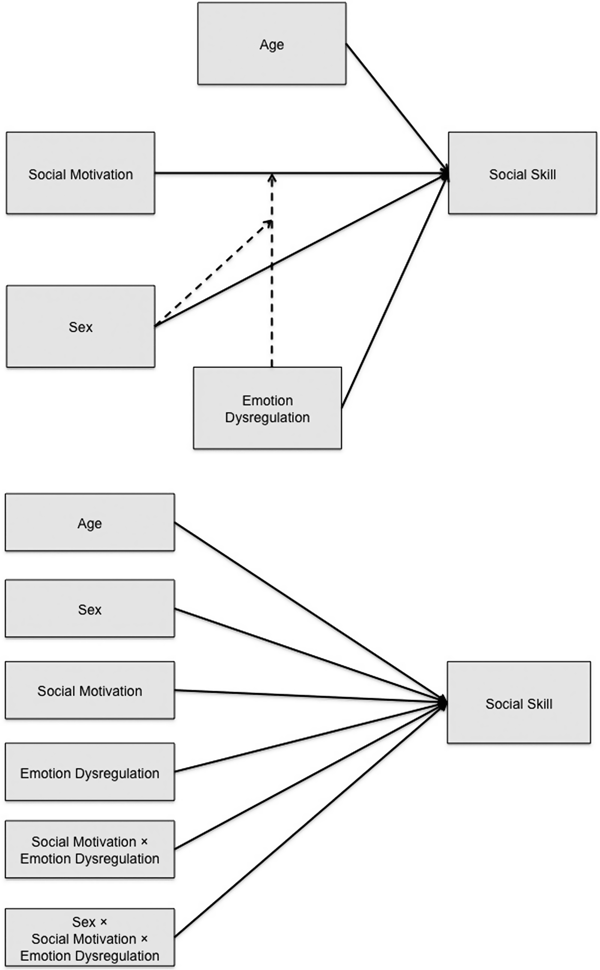
Next, in order to test the relations between social motivation, emotion dysregulation, and social skill, we created a series of general linear models. For each measure of dysregulation, the corresponding model contained the child's age, child's biological sex, parent-reported social motivation, the respective dysregulation measure, and the Motivation × Dysregulation interaction term. In addition, because the potential moderating effect of sex was of interest, a Sex × Motivation × Dysregulation interaction term was included as well. In all models, participants’ socialization standard score on the Vineland-2 was entered as the dependent variable reflecting social success. Figure 1 depicts conceptual and statistical models for this approach.
Conceptual and statistical models for social motivation and emotion dysregulation.

Finally, given our goal of understanding the role of cognitive skill in social–emotional well-being, models were replicated in the subgroup of individuals with ASD with full-scale IQ scores assessed to be 85 or higher, corresponding to cognitive skills in the average range or above (N = 1,073; 115 female, 958 male).
Results
Emotion dysregulation
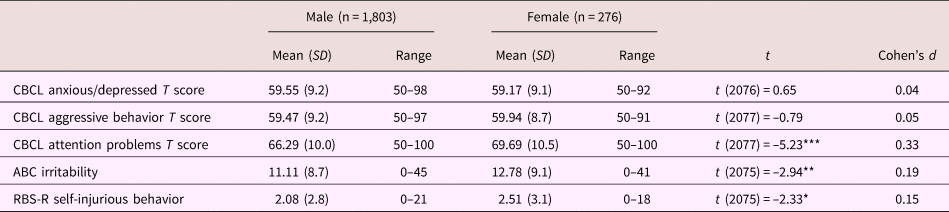
Table 1 presents descriptive statistics for measures of emotion dysregulation in the sample by participant sex. As shown, male and female participants did not differ in mean symptom level for measures of internalizing symptoms or aggressive behavior. In contrast, female participants displayed significantly higher levels of attention problems, self-injurious behavior, and irritability than males, consistent with previous findings among a subset of other research samples (e.g., Antezana et al., Reference Antezana, Factor, Condy, Strege, Scarpa and Richey2018; Holtmann, Bolte, & Poustka, Reference Holtmann, Bolte and Poustka2007).
Measures of emotion dysregulation for male and female participants across the full sample

Note: CBCL, Child Behavior Checklist (Achenbach, Reference Achenbach1991). ABC, Aberrant Behavior Checklist (Aman, Singh, Stewart, & Field, Reference Aman, Singh, Stewart and Field1985). RBS-R, Repetitive Behavior Scale—Revised (Bodfish, Symons, Parker, & Lewis, Reference Bodfish, Symons, Parker and Lewis2000). *p < .05. **p < .01. ***p < .001.
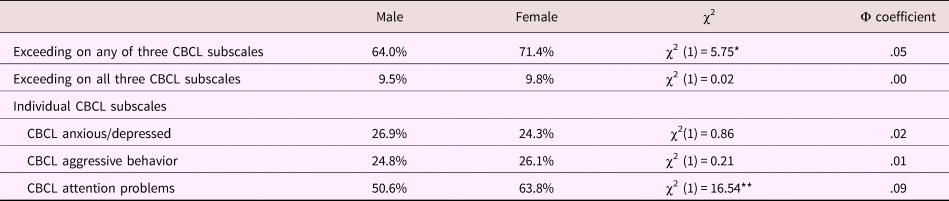
Measures of dysregulation extracted from the CBCL were then considered with regard to clinical significance. For the three CBCL subscales included here (anxious/depressed, aggressive behavior, and attention problems), T scores of 65 or higher correspond to “borderline clinical” or “clinical” levels of concern. For the entire sample, 64.9% of participants had a T score of 65 or higher on at least one of these CBCL subscales, indicating at least one area of significant concern. In addition, 9.6% of participants had T scores of 65 or higher on all three CBCL subscales, indicating significant dysregulation across multiple domains. Table 2 presents percentages of participants by sex whose CBCL T scores were 65 or higher. As shown, female participants were more likely than males to exceed this threshold on at least one subscale. However, there was not a significant sex difference in percentage of participants exceeding borderline clinical thresholds on all three subscales. Table 2 also presents percentages exceeding thresholds on individual CBCL subscales. Approximately one-quarter of participants of both sexes fell above the threshold for anxious/depressed and for aggressive behaviors. However, female participants were significantly more likely than males to fall above the borderline clinical threshold on attention problems, with nearly two-thirds of T scores exceeding 65.
Percentage of participants by sex exceeding borderline clinical thresholds on Child Behavior Checklist measures of emotion dysregulation

Note: CBCL, Child Behavior Checklist (Achenbach, Reference Achenbach1991). *p < .05. **p < .001.
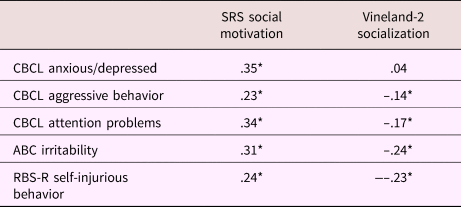
Next, we examined preliminary associations between social and emotional well-being among our participants. As displayed in Table 3, social motivation impairment was significantly positively correlated with all five measures of dysregulation. Greater impairment in social motivation was associated with greater dysregulation across all domains assessed. Social skill was negatively correlated with four of the five domains of dysregulation, such that poorer skill was associated with more aggressive behavior, attention problems, self-injurious behavior, and irritability.
Correlations between social and emotional measures

Note: CBCL, Child Behavior Checklist (Achenbach, Reference Achenbach1991). ABC, Aberrant Behavior Checklist (Aman, Singh, Stewart, & Field, Reference Aman, Singh, Stewart and Field1985). RBS-R, Repetitive Behavior Scale—Revised (Bodfish, Symons, Parker, & Lewis, Reference Bodfish, Symons, Parker and Lewis2000). SRS, Social Responsiveness Scale (Constantino & Gruber, Reference Constantino and Gruber2005). Vineland-2, Vineland Adaptive Behavior Scales—2nd edition (Sparrow, Cicchetti, & Balla, Reference Sparrow, Cicchetti and Balla2005). *p < .001.
Dysregulation, social motivation, and social skill
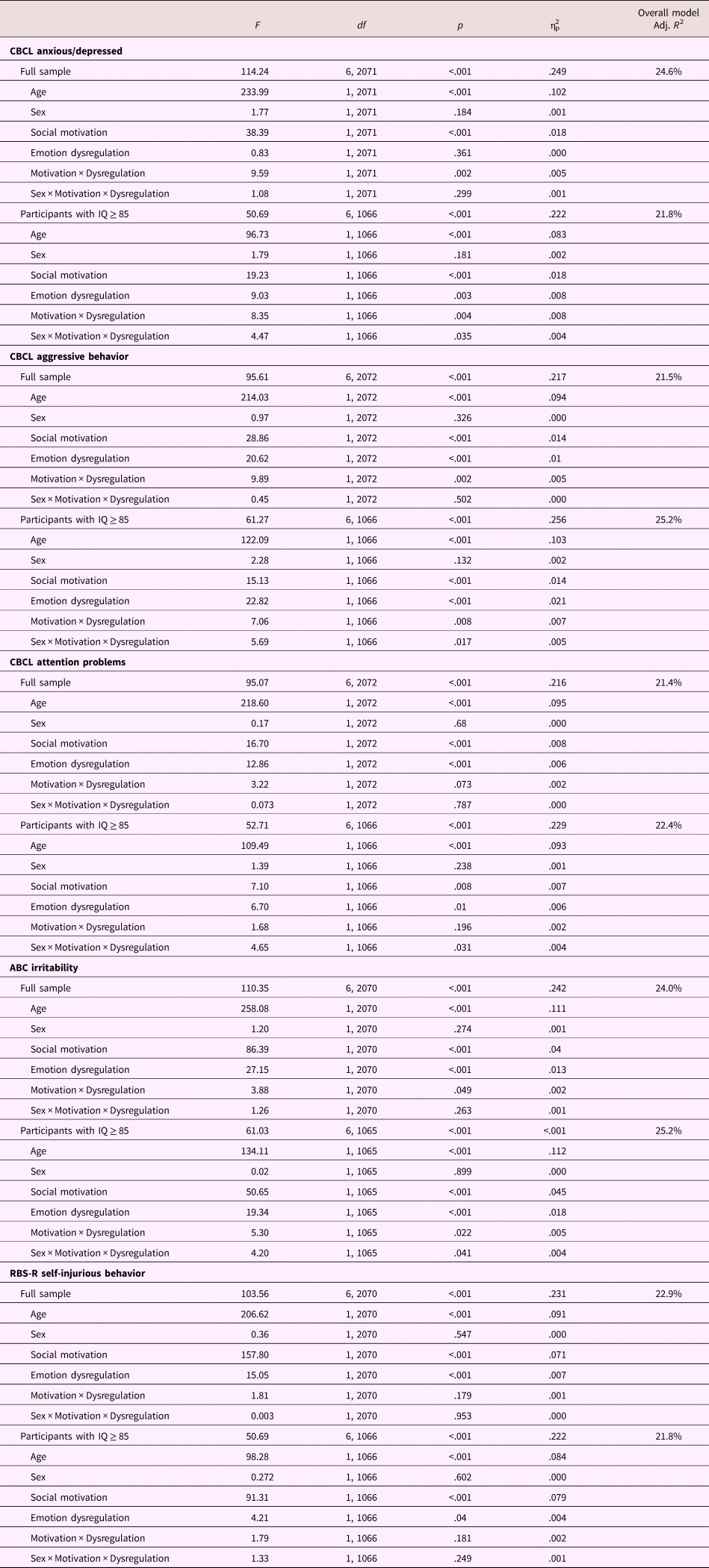
In order to more fully understand links between dysregulation, social motivation, and social skills, we next created a series of general linear models as described earlier. Models are presented by domain of emotion dysregulation, first for the full sample and then for the subgroup with cognitive skills in the average range or higher. In keeping with recommendations (Pedhazur, Reference Pedhazur1997), we prioritize interpretation of interactive effects over concurrent main effects in these models. Table 4 displays full model results.
Main and interactive effects of age, sex, social motivation, and emotion dysregulation on social skills

Note: CBCL, Child Behavior Checklist (Achenbach, Reference Achenbach1991). ABC, Aberrant Behavior Checklist (Aman, Singh, Stewart, & Field, Reference Aman, Singh, Stewart and Field1985). RBS-R, Repetitive Behavior Scale—Revised (Bodfish, Symons, Parker, & Lewis, Reference Bodfish, Symons, Parker and Lewis2000). *p < .05. **p < .01. ***p < .001.
Internalizing symptoms
For the full sample (N = 2,079), the model investigating the role of internalizing symptoms as contributors to social skill accounted for 24.6% of the variance in social skill, F (6, 2071) = 114.24, p < .001, ηp2 = .249. Within the model, there was a significant interaction between social motivation and internalizing symptoms, F (1, 2071) = 9.59, p = .002, ηp2 = .005. This interaction was such that the association between social motivation and social skill was stronger for children with fewer internalizing difficulties. In addition to this interaction, main effects were significant for child age, F (1, 2071) = 233.99, p < .001, ηp2 = .102, and child social motivation, F (1, 2071) = 38.39, p < .001, ηp2 = .018. Social skills were relatively stronger for children who were younger and who experienced less impairment in social motivation.
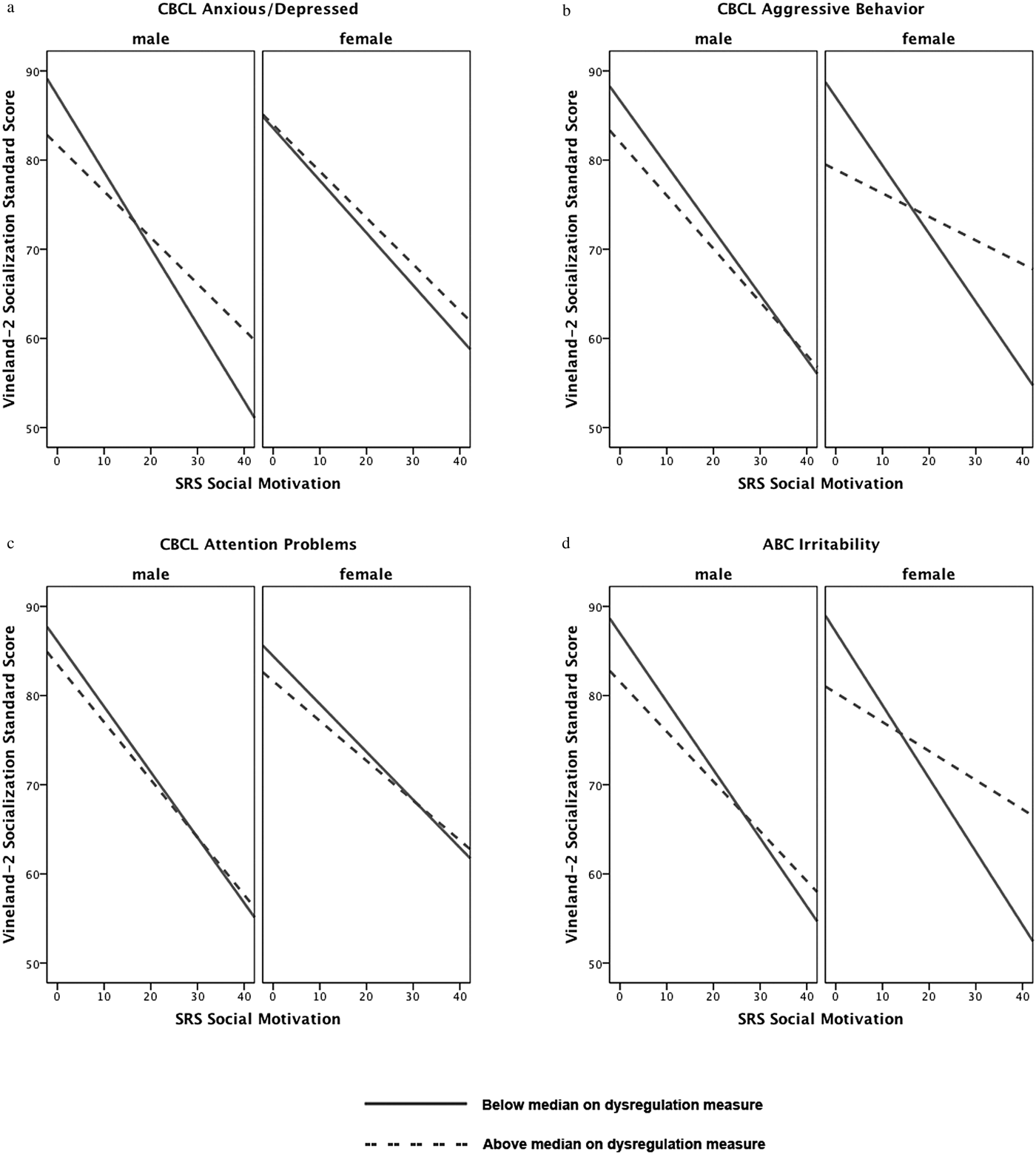
Among participants with average or higher cognitive skills (N = 1,073), the model containing internalizing symptoms accounted for 21.8% of the variance in social skill, F (6, 1066) = 50.69, p < .001, ηp2 = .222. Unique to participants with higher cognitive skills, a significant Sex × Motivation × Internalizing interaction effect, F (1, 1066) = 4.47, p = .035, ηp2 = .004, indicated that internalizing symptoms may moderate the relation between social motivation and social skill differently according to participant sex. As shown in Figure 2a, the moderating effect of internalizing symptoms may be limited to male participants, and internalizing symptoms may not carry a similar effect for female participants among this subgroup with average or higher cognitive skills. Within this model, we also observed an effect of the Motivation × Internalizing interaction, F (1, 1066) = 8.35, p = .004, ηp2 = .008. As with the full sample, a number of main effects were observed as well, including those for child age, F (1, 1066) = 96.73, p < .001, ηp2 = .083, social motivation, F (1, 1066) = 19.23, p < .001, ηp2 = .018, and internalizing symptoms, F (1, 1066) = 9.03, p = .003, ηp2 = .008.
Interactions of participant sex, social motivation, and emotion dysregulation in association with social skill among participants with average or higher IQ. The Vineland-2 Socialization standard scores have a mean of 100 (SD = 15). CBCL, Child Behavior Checklist (Achenbach, Reference Achenbach1991). ABC, Aberrant Behavior Checklist (Aman, Singh, Stewart, & Field, Reference Aman, Singh, Stewart and Field1985). SRS, Social Responsiveness Scale (Constantino & Gruber, Reference Constantino and Gruber2005). Vineland-2, Vineland Adaptive Behavior Scales—2nd edition (Sparrow, Cicchetti, & Balla, Reference Sparrow, Cicchetti and Balla2005).

Aggressive behavior
Within the broader sample spanning all levels of cognitive skill, the model assessing aggressive behavior accounted for 21.5% of the variance in social skill, F (6, 2072) = 95.61, p < .001, ηp2 = .217. A significant interaction between social motivation and aggressive behavior, F (1, 2072) = 9.89, p = .002, ηp2 = .005, indicated a stronger relationship between social motivation and social skill when participants had fewer aggressive behaviors. We also observed significant main effects for child age, F (1, 2072) = 214.03, p < .001, ηp2 = .094, social motivation, F (1, 2072) = 28.86, p < .001, ηp2 = .014, and aggressive behavior, F (1, 2072) = 20.62, p < .001, ηp2 = .01. Social skills were stronger among children who were younger, had stronger social motivation, and had lower levels of aggressive behavior.
Consistent with this, the model for the subgroup with average or higher cognitive skills accounted for 25.2% of variance in social skills, F (6, 1066) = 61.27, p < .001, ηp2 = .256. As we found with internalizing symptoms above, there was again a significant interaction with sex. The Sex × Motivation × Aggressive Behavior interaction was significant, F (1, 1066) = 5.69, p = .017, ηp2 = .005, and was such that social motivation and social skill were more closely related at lower levels of aggressive behavior for female participants only. See Figure 2b. The model also indicated a Motivation × Aggressive Behavior interaction, F (1, 1066) = 7.06, p = .008, ηp2 = .007, as well as significant main effects for age, F (1, 1066) = 122.09, p < .001, ηp2 = .103, motivation, F (1, 1066) = 15.13, p < .001, ηp2 = .014, and aggressive behavior, F (1, 1066) = 22.82, p < .001, ηp2 = .021.
Attention problems
The full sample model for attention problems accounted for 21.4% of variance in social skills, F (6, 2072) = 95.07, p < .001, ηp2 = .216. Neither interaction term reached significance in this model. Main effects were significant for child's age, F (1, 2072) = 218.60, p < .001, ηp2 = .095, social motivation, F (1, 2072) = 16.70, p < .001, ηp2 = .008, and attention problems, F (1, 2072) = 12.86, p < .001, ηp2 = .006. Stronger social skills were associated with younger age, more social motivation, and fewer attention problems.
Results from the model including only participants with average or higher cognitive skills were similar, with 22.4% of the variance in social skill accounted for, F (1, 1066) = 52.71, p < .001, ηp2 = .229. As with the other forms of dysregulation discussed thus far, this model revealed a significant interaction effect for Sex × Motivation × Attention Problems, F (1, 1066) = 4.65, p < .031, ηp2 = .004, such that the moderating effect of attention problems on the association between social motivation and social skill was stronger for male participants. See Figure 2c. Main effects of age, F (1, 1066) = 109.49, p < .001, ηp2 = .093, social motivation, F (1, 1066) = 7.10, p = .008, ηp2 = .007, and attention problems, F (1, 1066) = 6.70, p < .01, ηp2 = .006, remained significant.
Irritability
The model investigating irritability accounted for 24.0% of the variance in social skills, F (6, 2070) = 110.35, p < .001, ηp2 = .242. The interaction between social motivation and irritability was significant in this model, F (1, 2070) = 3.88, p = .049, ηp2 = .002, with a stronger association between social motivation and social skill when irritability was lower. We also observed main effects of age, F (1, 2070) = 258.08, p < .001, ηp2 = .111, social motivation, F (1, 2070) = 86.39, p < .001, ηp2 = .04, and irritability, F (1, 2070) = 27.15, p < .001, ηp2 = .013. Social skills were stronger for participants who were younger, had stronger social motivation, and had lower irritability ratings.
Among participants with cognitive skills in the average range or higher, we again observed significant variance in social skill accounted for by the model, 25.2%, F (6, 1065) = 61.03, p < .001, ηp2 = .256. The interaction between Sex × Motivation × Irritability was significant, F (1, 1065) = 4.20, p = .041, ηp2 = .004, such that a moderating effect of irritability was stronger for female participants than for male. See Figure 2d. Along with this, we observed a Motivation × Irritability interaction, F (1, 1065) = 5.30, p = .022, ηp2 = .005. Finally, consistent with the full sample, effects were significant for age, F (1, 1065) = 134.11, p < .001, ηp2 = .112, social motivation, F (1, 1065) = 50.65, p < .001, ηp2 = .045, and irritability, F (1, 1065) = 19.34, p < .001, ηp2 = .018.
Self-injurious behavior
For the full sample, the model investigating the role of self-injurious behavior accounted for 22.9% of variance in social skill, F (6, 2070) = 103.56, p < .001, ηp2 = .231, with main effects of child's age, F (1, 2070) = 206.62, p < .001, ηp2 = .091, social motivation, F (1, 2070) = 157.80, p < .001, ηp2 = .071, and self-injurious behavior, F (1, 2070) = 15.05, p < .001, ηp2 = .007. In keeping with the other measures of dysregulation discussed, stronger social skills were associated with younger age, more social motivation, and less self-injurious behaviors. There were no significant interaction effects in this model, indicating that self-injurious behaviors did not moderate the links between social motivation and social skill.
Finally, the comparable model analyzed only with participants of average or higher cognitive skill was quite consistent with the full sample, accounting for 21.8% of variance, F (6, 1066) = 50.69, p < .001, ηp2 = .222. Main effects of age, F (1, 1066) = 98.28, p < .001, ηp2 = .084, social motivation, F (1, 1066) = 91.31, p < .001, ηp2 = .079, and self-injurious behavior, F (1, 1066) = 4.21, p = .04, ηp2 = .004, remained significant, with no evidence of interaction effects.
Summary
Taken together, analyses indicate complex relations between social and emotional constructs in this sample. For domains of dysregulation including internalizing, aggression, and irritability, we observed interactive effects such that greater dysregulation corresponded to weaker associations between a child's social motivation and his or her social skills, suggesting that marked dysregulation blunts the facilitative effects of social motivation on social skill. When looking specifically at the subgroup of participants with average or higher cognitive skills, we observed additional moderating effects of participant sex, indicating differential effects of emotion dysregulation on social processes for males and females.
Discussion
From these results, it is clear that social and emotional functioning are tightly intertwined among children and adolescents with ASD, and that both biological sex and cognitive skill are important to understanding how these processes interact. As a whole, the participants in this sample experienced significant symptoms across the internalizing and externalizing spectra, with approximately two-thirds meeting or exceeding levels of borderline clinical concern on at least one measure (e.g., CBCL subscale), and approximately 10% demonstrating significant dysregulation across multiple measures by parent report. Symptom levels varied by participant sex in some domains of dysregulation, as girls displayed higher levels of attention problems, self-injurious behavior, and irritability than boys. Particularly striking, nearly two-thirds of girls in this sample demonstrated clinically elevated levels of attention problems. Moreover, the interactions between dysregulation in these domains and participants’ social functioning suggest that these symptoms are meaningful with respect to social engagement and skill.
Consistent across the domains of dysregulation assessed here were robust direct effects of dysregulation on social skills, such that more dysregulation (of any form assessed here) was directly associated with poorer social skills. This is consistent with findings of social difficulties among children with internalizing and externalizing difficulties but without ASD (Garaigordobil et al., Reference Garaigordobil, Bernaras, Jaureguizar and Machimbarrena2017; Motoca et al., Reference Motoca, Williams and Silverman2012; Scharfstein et al., Reference Scharfstein, Alfano, Beidel and Wong2011; Scharfstein & Beidel, Reference Scharfstein and Beidel2015). More novel, however, are our findings that dysregulation interacts with social motivation, effectively blunting or masking the facilitative effect of social motivation on social skill. This moderating effect was evident for a number of forms of dysregulation (i.e., internalizing, aggressive behavior, and irritability) across the full sample. Our analyses did not address possible mechanisms for these effects, but numerous possibilities exist. In one scenario, a child with relatively strong interest in others (high social motivation) might approach peers for interactions, but struggle with outbursts or aggression (high emotion dysregulation) when normative disagreements arise, resulting in negative peer interactions and decreasing receptiveness from peers (poor social success). Similarly, a child high in social motivation but also high in anxiety might avoid peer interactions, resulting in fewer opportunities to practice social skills and form relationships, resulting in relatively poor social skills despite high social motivation.
Adding another layer of nuance, within the subgroup of participants whose cognitive skills fell within the average range or higher, the models indicated that the moderating effect of emotion dysregulation on social processes might operate differently for male versus female participants. Across four of the five domains assessed—internalizing, aggression, attention problems, and irritability—we observed an interaction with participant sex. For the domains of aggressive behavior and irritability, moderating effects of dysregulation were stronger in females; aggression and irritability blunted the facilitative effect of social motivation on social skills for female more so than for male participants. In contrast, moderating effects of internalizing and attention problems were stronger for males. To some extent, these moderating effects occur in domains that are counter to typical sex-based behavioral norms. For example, among the general population, girls tend to have higher levels of internalizing symptoms than boys (Altemus, Sarvalya, & Epperson, Reference Altemus, Sarvalya and Epperson2014; Breslau et al., Reference Breslau, Gilman, Stein, Ruder, Gmelin and Miller2017; Cohen, Reference Cohen1989). It might be that displaying increased symptoms in the internalizing domain is more detrimental to social success for boys, precisely because those behaviors run counter to normative sex-based patterns. Likewise, we observed a stronger moderating effect of aggression for girls; perhaps heightened symptoms of aggression more strongly interfere with social processes in girls than in boys, again because they contrast with typical sex-based patterns of behavior. Our results suggest that having more symptoms in sex-congruent domains (aggression for male, internalizing for female) might be less detrimental to social success, at least with respect to a child's ability to act on their social motivation.
That sex-related effects emerged only for participants with relatively stronger cognitive skills is intriguing, and could suggest that dysregulation interferes more strongly with the ability to act on social motivation in a successful way in the context of average or higher cognitive skills. Previous research indicates that higher cognitive skills among individuals with ASD confers increased vulnerability to internalizing disorders, with positive correlations between children's IQ and anxiety (e.g., Sukhodolsky et al., Reference Sukhodolsky, Scahill, Gadow, Arnold, Aman, McDougle and Vitiello2008) and meta-analytic findings that elevations in anxiety among children with ASD compared to peers without ASD become more marked as IQ increases (van Steensel & Heeman, Reference van Steensel and Heeman2017). Even among young children with ASD, those with higher IQs exhibit higher levels of anxiety, which appear to be mediated in part by social understanding (Niditch, Varela, Kamps, & Hill, Reference Niditch, Varela, Kamps and Hill2012). Our findings that social–emotional mechanisms may function differently according to sex among individuals with higher IQs adds to the literature suggesting a unique set of vulnerabilities among this “higher functioning” population.
Findings of heightened vulnerability to detrimental social effects of emotion dysregulation among children with stronger cognitive skills may also reflect the behavioral expectations placed on this group relative to those with lower cognitive skills, and/or the moderating role of social supports provided to them by adults when dysregulation does arise. One might anticipate that children with average or stronger cognitive skills are more likely to participate in general education or integrated classroom settings in which behavioral expectations are less tolerant of emotional difficulties and social interactions receive less direct oversight than self-contained classroom settings. As part of this, teachers and caregivers may take a less forward role in scaffolding social interactions, resolving conflictual interactions (e.g., for children with impulsive or aggressive behaviors), motivating social approach (e.g., for children with anxiety), and tempering negative social consequences following episodes of dysregulation. In contrast, children with IQs below the average range may spend more time in self-contained or highly structured settings, in which adults may more readily supervise social interactions and provide emotional support, and in which episodes of significant dysregulation may be less unusual and therefore carry fewer social consequences.
Implications
To our knowledge, this study represents a first demonstrated interaction between social motivation and emotion dysregulation, particularly in such a large and diverse sample of individuals with ASD. Previous literature investigating social motivation and dysregulation in tandem have thus far approached these constructs in a number of ways, but none have previously shed light on their interaction in the prediction of social skill. For example, among adults with ASD, social motivation and emotion dysregulation appear to make independent but not interactive contributions to social anxiety (Swain, Scarpa, White, & Laugeson, Reference Swain, Scarpa, White and Laugeson2015). Among children, social motivation appears to partially mediate the relationship between anxiety and children's insistence on sameness, a core feature of ASD (Factor, Condy, Farley, & Scarpa, Reference Factor, Condy, Farley and Scarpa2016), and difficulties with social motivation are associated with the presence of symptoms of anxiety and ADHD (Factor, Ryan, Farley, Ollendick, & Scarpa, Reference Factor, Ryan, Farley, Ollendick and Scarpa2017). Clearly, relationships between social motivation and emotion dysregulation across many forms are multifaceted, with much yet to learn. Consistent across findings, however, are suggestions that difficulties with social motivation, social skills, and emotion dysregulation cluster together for individuals with ASD, such that difficulties in any portend risk for poorer outcomes in the others.
Findings discussed here not only delineate vulnerabilities for poorer social and emotional outcomes among children and adolescents with ASD but also highlight points of intervention. Whereas the main effects of dysregulation on social skill suggest a clear need to intervene in emotion-related processes in order to facilitate social functioning, the moderating role of emotion dysregulation on social functioning suggests that such support may be beneficial even when difficulties with dysregulation are not readily apparent. Although a substantial proportion of individuals in this sample displayed clinically elevated symptoms of dysregulation, many did not; yet, the moderating role of dysregulation was robust and consistent across domains. As such, emotion dysregulation even within the normative or subclinical ranges still merits consideration as a target of intervention as a vehicle to increasing social success by allowing the facilitative effects of social motivation on social skill. This may be particularly relevant for intervention approaches that aim to capitalize on or promote social motivation (e.g., pivotal response training), as they may benefit from adjunctive intervention to promote emotion regulation.
Despite the strengths of the sample investigated here, findings must be considered in the context of the sample's limitations. A primary limitation of the SSC data set is its cross-sectional nature, in which all data were gathered within a tight timeframe rather than across a developmental span. As a result, data presented here are not longitudinal in nature and associations cannot determine the direction of effects between variables. In addition, by design, the SSC contains only families who met very strict inclusion/exclusion criteria in order to enrich the frequency of de novo genetic events as the etiology of ASD (Fischbach & Lord, Reference Fischbach and Lord2010), yielding approximately 35% of the SSC sample with an identified genetic event (Sanders et al., Reference Sanders, He, Willsey, Ercan-Sencicek, Samocha, Cicek and State2015). Families in which ASD occurs in multiple individuals within the family or who may be less likely to meet the strict diagnostic and inclusion criteria for the SSC (e.g., Neuhaus, Beauchaine, Bernier, & Webb, Reference Neuhaus, Beauchaine, Bernier and Webb2018) may be less well represented in such data sets and resulting analyses.
Finally, the measures included in this study were all parent report in format. Although well established and used frequently in both research and clinical realms, such measures would be enriched by incorporation of complementary observational, self-report, and psychophysiological measures of social and emotional functioning. This may be particularly relevant for the construct of social motivation, which is almost certainly a multifaceted rather than a unitary construct, and might be best represented as a multidimensional construct in future research. In the same vein, the construct of emotion dysregulation itself is complex (as evidenced in literatures across genetic, psychophysiological, and behavioral approaches; Beauchaine, Reference Beauchaine2015) and thus is likely best assessed and modeled using multiple concurrent methods that span levels of analysis (Cole, Hall, & Hajal, Reference Cole, Hall, Hajal, Beauchaine and Hinshaw2017). Given the varied neurobiological systems that interact over time to result in significant dysregulation, increased methodological sophistication in the assessment of dysregulation, particularly approaches that allow integration of simultaneous sources of information (e.g., self-report with concurrent psychophysiological monitoring), would allow for greater richness and ecological validity in modeling of associated processes and risk factors (Adrian, Zeman, & Veits, Reference Adrian, Zeman and Veits2011).
Future directions
On a larger scale, the approach presented here represents an effort toward the field's larger goal of identifying factors and individual differences that influence qualitative variability in the phenotype of ASD, rather than looking solely at factors that contribute to the presence versus absence of the disorder. As we note earlier, one of the most distinctive characteristics of ASD is its heterogeneity—the variability in skills, subjective experiences, and developmental trajectories among individuals all receiving the same diagnosis. Further exploration of individual differences that shape trajectories related to social and emotional outcomes remains essential, particularly over the course of development (see Finucane, Challman, Martin, & Ledbetter, Reference Finucane, Challman, Martin and Ledbetter2016). Our findings present evidence that sex and cognitive skill are part of this variety of factors, but countless others remain to be explored.
Decades of research with families and youth without ASD have identified many factors that interact with individuals’ temperament and personality traits to determine social–emotional outcomes, from peer interactions (Snyder et al., Reference Snyder, Schrepferman, Oeser, Patterson, Stoolmiller, Johnson and Snyder2005), to family relationship patterns (e.g., coercive escalation; Patterson, Reference Patterson1982), to adverse life experiences (Mead, Beauchaine, & Shannon, Reference Mead, Beauchaine and Shannon2010). Over time, these factors interact in transactional and sometimes subtle ways to buffer against or exacerbate difficulties in social–emotional functioning, such as more extreme externalizing and internalizing symptoms (e.g., nonsuicidal self-injury; Beauchaine, Klein, Crowell, Derbidge, & Gatzke-Kopp, Reference Beauchaine, Klein, Crowell, Derbidge and Gatzke-Kopp2009). Extrapolation from research with these non-ASD populations provides intriguing hypotheses for how similar mechanisms might operate among populations with ASD. To this end, empirical understanding of (a) how these factors operate in the context of ASD, and (b) how the unique neurobiological and psychosocial aspects of ASD alter their influence will be essential to elucidating the nature, developmental processes, and intervention points for social and emotional difficulties.
Data
Approved researchers can obtain the SSC population data set described in this study (SSC distribution 15, obtained from SFARI Base) by applying at https://base.sfari.org.
Acknowledgments
We thank all of the families at the participating Simons Simplex Collection (SSC) sites, as well as the principal investigators (A. Beaudet, J. Constantino, E. Cook, E. Fombonne, D. Geschwind, E. Hanson, D. Grice, A. Klin, R. Kochel, D. Ledbetter, C. Lord, C. Martin, D. Martin, R. Maxim, J. Miles, O. Ousley, K. Pelphrey, B. Peterson, J. Piggot, C. Saulnier, M. State, W. Stone, J. Sutcliffe, C. Walsh, Z. Warren, and E. Wijsman). We appreciate obtaining access to phenotypic data on SFARI Base.