Many tropical tree species have buttresses at the standard breast height (1.3 m above ground) of diameter measurement, with a presumable role in improving nutrient acquisition or tree anchorage in the ground (Newbery et al. Reference NEWBERY, SCHWAN, CHUYONG and VAN DER BURGT2009, Richter Reference RICHTER1984). Measuring the diameter using standard dendrometrical tools such as callipers or graduated tapes, which require that the cross-section of the trunk has a convex shape, is then impossible (Nogueira et al. Reference NOGUEIRA, NELSON and FEARNSIDE2006). The recommended method in this case is to measure the diameter above the buttress (DAB), thus possibly leading to biased estimates of the basal area (West Reference WEST2009), of tree above-ground biomass (Dean & Roxburgh Reference DEAN and ROXBURGH2006, Dean et al. Reference DEAN, ROXBURGH, MACKEY, Amaro, Reed and Soares2003) and of tree growth (Metcalf et al. Reference METCALF, CLARK and CLARK2009). As an alternative, one can measure the basal area at breast height of buttressed trees, using a method that can deal with the irregular non-convex shape of the cross-section of the stem such as the Picus calliper, photogrammetry or 3D laser scanning (Badia et al. Reference BADIA, HAPCA, CONSTANT, MOTHE, LEBAN, SAINT-ANDRÉ, DAQUITAINE, BLAISE, Hu and Jaeger2003, Dean Reference DEAN2003, Newbery et al. Reference NEWBERY, SCHWAN, CHUYONG and VAN DER BURGT2009).
When compared with tree allometry and stem taper, very few dendrometrical studies have been devoted to the size and shape of buttresses. Nogueira et al. (Reference NOGUEIRA, NELSON and FEARNSIDE2006) compared the conventional diameter of trees (assuming that their cross-section is circular) with the diameter of the circular disc whose area equals the basal area of the tree. Dean et al. (Reference DEAN, ROXBURGH, MACKEY, Amaro, Reed and Soares2003) and Dean & Roxburgh (Reference DEAN and ROXBURGH2006) measured the three-dimensional shape of buttresses for Eucalyptus regnans in temperate Australia, and compared the basal area of the cross-section of the buttressed stem with the area of its convex hull. Newbery et al. (Reference NEWBERY, SCHWAN, CHUYONG and VAN DER BURGT2009) also measured the three-dimensional shape of buttresses for Microberlinia bisulcata in Cameroon, and established the relationship between buttress height and diameter above buttress. The current study focused on buttress allometry. It aimed at estimating the basal area at breast height of a buttressed tree using tree characteristics that are easier to measure, such as the diameter above buttress or the height of buttresses.
One hundred and two buttressed trees were measured in two sites 34 km apart, Ipassa (0°30′42″N, 12°48′9″E; 50 trees) and Kongou (0°17′27″N, 12°35′21″E; 52 trees), close to the city of Makokou, north-eastern Gabon, central Africa. Both sites are within the Ivindo National Park (UNESCO 1987). Average annual rainfall is 1700 mm, average temperature is 24 °C, and altitude varies around 500 m. The relief consists of an undulating plateau on an ancient crystalline base, interrupted with rivers. Vegetation consists of tropical moist forest, and is dominated by Fabaceae, Cesalpiniaceae and Euphorbiaceae (Doumenge Reference DOUMENGE1990).
Thirty-one species were included in the sample of measured trees, most of them being Fabaceae (Appendix 1, supplementary material). The sizes of the sampled trees were chosen to uniformly cover the widest possible range of sizes. The smallest tree of the sample had a DAB of 26.4 cm while the largest tree had a DAB of 94.5 cm (Appendix 1, supplementary material). Because some species (e.g. Aucoumea klaineana) develop buttresses only above a given size, the range of sampled DAB could not be covered for each species.
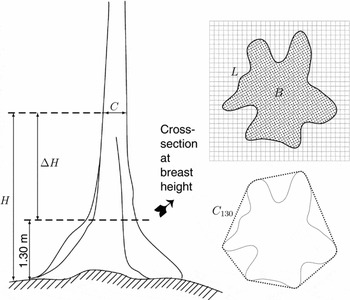
Five measurements were taken for each tree: (1) the girth at breast height (denoted C 130) was measured by a taut tape over the buttresses at a height of 1.30 m above ground (Figure 1, dotted line). (2) The girth above buttress (C) was measured using a graduated flexible tape at the vertical position along the trunk where the trunk cross-section became convex. The DAB is computed from C as C/π. (3) The height above ground where C was measured (H) was measured using a graduated stick. (4) The basal area at breast height (B) was non-destructively measured using a flexible wire. The wire was flattened against the trunk, following the shape of the buttresses at a height of 1.30 m above ground. The wire had to be flexible enough to mould the buttresses, but at the same time rigid enough to keep the shape without distorting. We used electric wire with a 1-mm diameter. Two pieces of wire were used, one for each half of the trunk. This enabled us to remove the moulded wire from the trunk without distorting it. The two pieces of wire were then put on a wooden board. A grid of 5 × 5-cm square cells was printed on the board. Let N be the number of square cells that were enclosed by the wire. Fractions of cells were counted for those cells that were crossed by the wire. The basal area at breast height was measured as N × 25 cm2. (5) The perimeter at breast height (L) was measured as the length of the wire necessary to surround the trunk (Figure 1, thick solid line).
Measurements for a buttressed tree: C is the girth above buttress; H is the height above ground where C was measured; ΔH = H − 1.30 m; C 130 is the girth at breast height (= length of the dotted line); the basal area at breast height (B) is the number of square cells inside the cross-section (here 316.4 cells) times the unit area of a square cell (= area of the stippled area); L is the perimeter at breast height (= length of the thick black line).

Two additional tree characteristics were computed from the five measured tree characteristics. The equivalent girth at breast height (denoted C eq) was defined as the girth that the tree would have if its trunk had a circular shape, without changing its basal area at breast height. It was computed from B as  and is the quantity that we are interested in measuring, in place of C. Following Dean et al. (Reference DEAN, ROXBURGH, MACKEY, Amaro, Reed and Soares2003), we defined the fractional basal area deficit (denoted D) as one minus the ratio of the basal area of the tree over the area of the circular disc with the same perimeter L as the tree: D = 1 − B / (
 ) = 1 − (Ceq / L)2. Because, for a given area, the shape with the smallest possible perimeter is the circular disc, 0 ≤ D < 1 (with D = 0 for a circular disc and D → 1 as buttresses get more irregular). This fractional basal area deficit depends on the shape but is dilation invariant. For example, the fractional basal area deficit of a regular n-sided polygon is 1−π[n tan(π/n)]−1 irrespective of its side (http://mathworld.wolfram.com; D ≈ 0.40 for an equilateral triangle, D ≈ 0.21 for a square, etc.).
Among the seven tree characteristics that were measured, three were considered as easy to measure (namely C 130, C and H) and were used as predictors in a model that predicts the quantity of interest (C eq). The girth at breast height C 130 was significantly correlated with the girth above buttress C (Pearson correlation coefficient: r = 0.87, t = 17.4, P < 0.001). The height H was not significantly correlated with C (r = 0.12, t = 1.19, P = 0.24) but was significantly correlated with C 130 (r = 0.35, t = 3.7, P < 0.001).
We fitted all possible combinations of the linear model based on these three predictors with interactions up to the third order (254 models). The full model is: C eq = a 0 + a 1C 130 + a 2C + a 3 ΔH + a 4C 130C + a 5C 130ΔH + a 6CΔH + a 7C 130CΔH + ɛ, where ΔH = H − 1.30 m is the height above breast level where C was measured, the ais (i = 1, . . ., 7) are the coefficients to estimate, and ɛ is the residual error. Power models (i.e. linear models on log-transformed data) were also tested, but they always provided a worse fit than the corresponding linear models. To account for the heteroscedasticity of residuals, a power model was chosen for the residual variance: Var(ɛ) ∝ Cz, unless z was close to zero in which case a standard linear model was fitted. The Akaike information criterion (AIC) was used to rank the models. Models were fitted using the nlme routine in the R package. A residual effect of species (with 31 levels), of site (Ipassa or Kongou), and of the fractional basal area deficit D was tested.
The mean value of the fractional basal area deficit was 0.39 (minimum: 0.09, maximum: 0.79). By comparison, Dean et al. (Reference DEAN, ROXBURGH, MACKEY, Amaro, Reed and Soares2003) found a maximum of 0.6 for Eucalyptus regnans in temperate Australia. When restricting to species for which at least four individuals were measured (Appendix 1, supplementary material), there was a significant difference of fractional basal area deficit among species (one-way ANOVA: F 10,64 = 2.41, P = 0.02). The species with the most regular trunk shape were Hymenostegia pellegrinii (D = 0.27 on average) and Aucoumea klaineana (D = 0.28), whereas the species with the most irregular trunk shape were Newtonia sp. (D = 0.57) and Gilletiodendron sp. (D = 0.59). Like Dean et al. (Reference DEAN, ROXBURGH, MACKEY, Amaro, Reed and Soares2003), we found a significant positive correlation between D and C 130 (r = 0.33, t = 3.52, P < 0.001) in the range of our measurements (103 ≤ C 130 ≤ 465 cm), indicating that buttresses develop as trees grow.
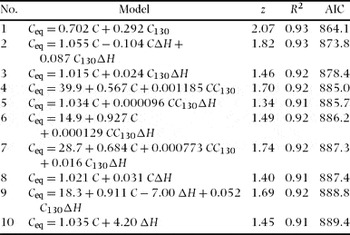
Among the 254 possible models, 71 had all their coefficients significantly different from zero. The intercept was most of the time not significantly different from zero, which is consistent with the fact that C eq must be zero when all tree characteristics are zero. The ten models with the lowest AIC are listed in Table 1 by increasing order of AIC. The best model is the one that predicts C eq from C and C 130. Because C and C 130 are strongly positively correlated, their effects on C eq are largely confounded, with C capturing the main variation of C eq. Since C and C 130 are quite easy to measure and ΔH does not add to the predictive power of these two variables, this model is designed to be the most useful. No residual effect of species was found for this model (ANOVA of weighted residuals: F 30,71 = 1.13, P = 0.33). No residual effect of site was found either (F 1,100 = 0.83, P = 0.36). However, adding D as an extra predictor significantly improved the model (t = −3.78, P < 0.001). The correlation between residuals and D was negative: all other things being equal, the equivalent girth at breast height increases as the trunk shape becomes circular, which is self-consistent.
Fitted models to predict the equivalent girth at breast height C eq from a combination of three predictors: the girth above buttress (C), the girth at breast height (C 130), and the height (ΔH) above breast level of measurement of C. Only the models whose coefficients are all significantly different from zero are shown. z is the exponent of the power model used for the residual variance. AIC is the Akaike information criterion (the smaller AIC is, the better the model is). C eq, C and C 130 are in cm, whereas ΔH is in m.

If C 130 is not available, the best model is the one that predicts C eq from C and C×ΔH, and is ranked as the eighth model (Table 1). ΔH most often occurs as a multiplying factor of C or C 130 (or of both of them) which is consistent with a constant linear taper curve of the stem. Considering that the coefficient associated to C in model 8 is close to one, model 8 can be interpreted as a Taylor first-order expansion at 1.30 m of the exponential taper equation (Metcalf et al. Reference METCALF, CLARK and CLARK2009): C = C eq exp(−α(H − 1.30)), where the tapering coefficient α > 0 corresponds to the coefficient associated to CΔH in model 8. The value found here (α = 0.031) is in the range of α values found by Metcalf et al. (Reference METCALF, CLARK and CLARK2009) for five tropical species (0.0149 ≤ α ≤ 0.1190).
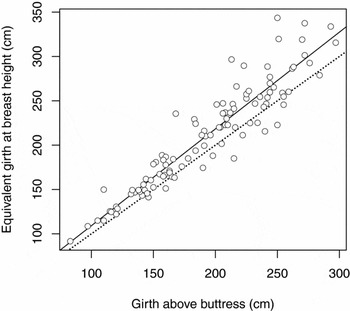
If C is the only variable that has been measured, the best model is: C eq = 1.091 C (Figure 2). This model is ranked 17th among the 71 models (AIC = 894.9, R 2 = 0.90). When C 130 is the only available variable, the best model is: C eq = 17.94 + 0.726 C 130. This model is ranked 38th among the 71 models (AIC = 949.1, R 2 = 0.83).
Equivalent girth at breast height (C eq) versus girth above buttress (C) for 102 buttressed trees measured in North-East Gabon. Solid line is the fitted model C eq = 1.091 C (R 2 = 0.90). Dotted line is the 1:1 line.

Because the equivalent diameter at breast height is on average 9.1% greater than the diameter above buttress (Figure 2), and because buttressed trees are often the largest trees with the largest contribution to basal area or above-ground biomass, using the former in place of the latter can have practical implications when estimating structural stand attributes. For instance, using the Chave et al. (Reference CHAVE, ANDALO, BROWN, CAIRNS, CHAMBERS, EAMUS, FÖLSTER, FROMARD, HIGUCHI, KIRA, LESCURE, NELSON, OGAWA, PUIG, RIÉRA and YAMAKURA2005) allometric equation for moist forest stands, the mean above-ground dry biomass of the sampled trees was 5.75 Mg when using C as a predictor, and 7.06 Mg when using C eq as a predictor (18.5% increase).
Nevertheless, the issue of estimating the biomass of large buttressed trees cannot be solved by simply replacing C with C eq. First, large trees are prone to hollows that detract from the cross-sectional area (Dean et al. Reference DEAN, ROXBURGH, MACKEY, Amaro, Reed and Soares2003, Nogueira et al. Reference NOGUEIRA, NELSON and FEARNSIDE2006). Second, using C or C eq to predict biomass will depend on how trees were measured to derive the biomass equations. Because biomass data sets most often mix buttressed trees that are measured above the buttresses and non-buttressed trees that are measured at breast height (Chave et al. Reference CHAVE, ANDALO, BROWN, CAIRNS, CHAMBERS, EAMUS, FÖLSTER, FROMARD, HIGUCHI, KIRA, LESCURE, NELSON, OGAWA, PUIG, RIÉRA and YAMAKURA2005), the uncertainty on the height of measurement is included in the prediction error of the biomass equation. Reducing this uncertainty would require clear documentation of the measurement and appropriate allometric relationships (Sillett et al. Reference SILLETT, VAN PELT, KOCH, AMBROSE, CARROLL, ANTOINE and MIFSUD2010).
Another pending question is whether buttresses correspond to a distortion of the shape of the stem without any change in basal area, or whether they induce a change of basal area as compared with a cylindrical tree with the same DAB. Considering that buttresses have a mechanical role (Newbery et al. Reference NEWBERY, SCHWAN, CHUYONG and VAN DER BURGT2009, Richter Reference RICHTER1984) but no specific role in sap transportation, it can be expected that the tapering of basal area will be the same with or without a buttress. Indeed, buttresses are often accompanied by a downward tapering of the central stem (i.e. a decreasing central radius), towards ground level (Newbery et al. Reference NEWBERY, SCHWAN, CHUYONG and VAN DER BURGT2009, Pallardy Reference PALLARDY2008, p. 12), or even sometimes a reversed taper in equivalent girth as shown by the points below the 1:1 line in Figure 2.
ACKNOWLEDGEMENTS
This study was supported by the ACP Secretariat and the European Commission under the EU-ACP “Establishment of a forestry research network for ACP countries” project (9 ACP RPR 91#1- FORENET). We are grateful to two anonymous reviewers who gave valuable comments on a previous version of this manuscript.
APPENDIX
Appendix is available as supplementary material on-line at http://journals.cambridge.org/tro