Introduction
In postmodern societies driving is considered a basic skill, allowing mobility for practical and leisure purposes as well as for active social involvement. Possessing a driver's licence and the prerogative of driving is of special value for older persons, as it can support their independence and non-age-related and non-stigmatised identity, as well as autonomy, self-esteem, sense of security (Ellaway et al. Reference Ellaway, Macintyre, Hiscock and Kearns2003) and general wellbeing (Siren, Hakamies-Blomqvist and Lindeman Reference Siren, Hakamies-Blomqvist and Lindeman2004). However, studies indicate that older adults involved in car accidents are at a higher risk for severe injuries and mortality than younger adults (Li, Braver and Chen Reference Li, Braver and Chen2003). Some studies show that older drivers are also more often involved in car accidents than younger adults (e.g. Braver and Trempel Reference Braver and Trempel2004; Li, Braver and Chen Reference Li, Braver and Chen2003; National Highway Traffic Safety Administration 2000), but others report opposite findings (Hakamies-Blomqvist, Wiklund and Henriksson Reference Hakamies-Blomqvist, Wiklund and Henriksson2005; Langford, Methorst and Hakamies-Blomqvist Reference Langford, Methorst and Hakamies-Blomqvist2006; National Road Safety Authority 2012). Considering that maintaining quality of life in old age for as long as possible has become one of the main priorities of ageing societies, such contrasting findings raise a dilemma for policy makers dealing with the practical questions of when and to what extent to restrict driving in old age. The literature suggests that a decline in health and function, which is prevalent in old age, causes older people to stop or limit their driving (Sims et al. Reference Sims, Ahmed, Sawyer and Allman2007). Therefore one of the related questions is if, and to what extent, societies can rely on their older adults to adjust their driving behaviours to their declining abilities. The purpose of this paper is to enhance the understanding of the effects of personal factors on self-regulation in driving among elderly Israelis.
Importance of driving
The importance of driving can be appraised through the negative outcomes of the cessation of driving. The results of a number of studies indicate that cessation of driving in old age can lead to depression, even when controlling for health status and socio-demographic characteristics (e.g. Fonda, Wallace and Herzog Reference Fonda, Wallace and Herzog2001; Ragland, Satariano and MacLeod Reference Ragland, Satariano and MacLeod2005). For instance, based on findings of a nationwide sample of 5,239 elderly persons, Fonda, Wallace and Herzog (Reference Fonda, Wallace and Herzog2001) reported that cessation of driving resulted in worsening of depressive symptoms, regardless of whether an alternative mode of transportation was available, such as a driving spouse. Depression related to cessation of driving is partly explained by a reduced sense of control over life (Windsor et al. Reference Windsor, Anstey, Butterworth, Luszcz and Andrews2007). In addition, cessation of driving has been reported to reduce engagement in out-of-home activities (Bailey Reference Bailey2004) and social contacts (Edwards et al. Reference Edwards, Bart, O'Connor and Cissell2009; Liddle et al. Reference Liddle, Turpin, Carlson and Mckenna2008; Marottoli et al. Reference Marottoli, Mendes de Leon, Glass, Williams, Cooney, Berkman and Tinetti2000; Mezuk and Rebuk Reference Mezuk and Rebok2008). The effects of driving cessation on perceptions of independence are inconclusive. Adler and Rottunda (Reference Adler and Rottunda2006) reported that a reduced sense of independence was a major theme for focus group participants in the United States of America (USA), while Buys and Carpenter (Reference Buys and Carpenter2000) found that former Australian drivers regained their sense of independence and ability to participate in activities and social interactions following a period of adjustment.
Cessation of driving negatively affects not only social and psycho-social wellbeing, but also physical health (Edwards et al. Reference Edwards, Bart, O'Connor and Cissell2009) and may even increase mortality (Edwards et al. Reference Edwards, Bart, O'Connor and Cissell2009; Fonda, Wallace and Herzog Reference Fonda, Wallace and Herzog2001). In addition to an actual decline in health, cessation of driving has been shown to affect elderly people's perception of their disabilities (Kelley-Moore et al. Reference Kelley-Moore, Schumacher, Kahana and Kahana2006). A study of 1,593 older adults found that subjects who stopped driving had a higher risk of entering a long-term care institution than those who continued to drive, even when adjusted for health and demographic variables (Freeman et al. Reference Freeman, Gange, Munoz and West2006). Results regarding the moderating effects of alternative transportation are inconclusive. Some studies have reported that although a decline in health, functional ability and psycho-social status are associated with cessation of driving, this loss is mitigated by the availability of alternative forms of transportation (Mann et al. Reference Mann, McCarthy, Wu and Tomita2005). Other studies indicate that available alternatives to driving are not always perceived as safe, convenient, accessible or suitable for older people, thereby limiting their mobility and independence (Bailey Reference Bailey2004; Gilhooly, Hamilton and O'Neill Reference Gilhooly, Hamilton and O'Neill2002; Taylor and Tripodes Reference Taylor and Tripodes2001).
The existing literature does not provide a definitive answer to the central question of whether old drivers are more or less likely to be involved in traffic accidents. Findings from several studies indicate that driving in old age is related to an increased risk of involvement in accidents (e.g. Braver and Trempel Reference Braver and Trempel2004; Li, Braver and Chen Reference Li, Braver and Chen2003; National Highway Traffic Safety Administration 2000), while others suggest that older drivers' crash risks are in fact equal to or lower than those of younger age groups, when factors such as yearly driving distance and accidents per driver licence are taken into account (Hakamies-Blomqvist, Wiklund and Henriksson Reference Hakamies-Blomqvist, Wiklund and Henriksson2005; Langford, Methorst and Hakamies-Blomqvist Reference Langford, Methorst and Hakamies-Blomqvist2006; National Road Safety Authority 2012). It thus appears that both driving in old age and the cessation of driving pose risks to the health, functioning and wellbeing of older adults. The question addressed in this paper is to what extent are older people aware of a decline in their driving capabilities due to changes in their health and/or function, and do they act accordingly by limiting their driving?
Correlates of self-regulation and cessation of driving in older drivers
Various health problems are associated with difficulties in driving in certain conditions as well as with reduced driving, including high blood pressure, cataracts, visual and/or functional impairment, falls, kidney disease and stroke (Lyman, McGwin and Sims Reference Lyman, McGwin and Sims2001). Many studies highlight visual impairments as a common cause of problems in driving. For example, drivers between 55 and 85 years old with decreased visual acuity and contrast sensitivity have been shown to experience difficulty when driving in risky situations (McGwin, Chapman and Owsley Reference McGwin, Chapman and Owsley2000). Older drivers with visual impairment also report higher levels of avoidance of driving than non-impaired drivers (Ball et al. Reference Ball, Owsley, Stalvey, Roenker, Sloane and Graves1998). In general, the literature indicates that self-awareness of difficulties and risks of driving in difficult conditions leads older drivers to limit their driving. In a recent study, 25 per cent of drivers aged 65 years and older reported self-regulating their driving (Molnar and Eby Reference Molnar and Eby2008).
The causal association of health problems with driving avoidance is supported by a large Swedish study of drivers aged 55–92 years (Rimmo and Hakamies-Blomqvist Reference Rimmo and Hakamies-Blomqvist2002). Another study of drivers aged 55 years and older found that age, gender, health status and cognitive functioning directly affected the degree of driving avoidance (Vance et al. Reference Vance, Roenker, Cissell, Edwards, Wadley and Ball2006). In addition, self-perception of the cognitive abilities that are necessary for driving was found to be a strong predictor of driving self-regulation in a sample of French drivers (Gabaude Reference Gabaude2010). Some driving conditions are more frequently avoided by older drivers than others. These include driving at night and in the rain (Baldock et al. Reference Baldock, Mathias, McLean and Berndt2006; Ball et al. Reference Ball, Owsley, Stalvey, Roenker, Sloane and Graves1998; Charlton et al. Reference Charlton, Oxley, Fildes, Oxley, Newstead, O'Hare and Koppel2003, Reference Charlton, Oxley, Fildes, Oxley, Newstead, Koppel and O'Hare2006; Ruechel and Mann Reference Ruechel and Mann2005), heavy traffic (Ball et al. Reference Ball, Owsley, Stalvey, Roenker, Sloane and Graves1998) and parallel parking (Baldock et al. Reference Baldock, Mathias, McLean and Berndt2006).
Avoidance of risky driving situations is one form of self-regulation, while deciding to stop driving altogether is a more extreme measure. Cessation of driving can be associated with of a range of objective factors such as various measures of vision (Freeman et al. Reference Freeman, Munoz, Turano and West2005), eye disease (Ramulu et al. Reference Ramulu, West, Munoz, Jampel and Friedman2009), severity of disease, cognitive deterioration (Herrman et al. Reference Herrman, Rapoport, Sambrook, Herbert and McCraken2006) and lower frequency of driving (Edwards et al. Reference Edwards, Bart, O'Connor and Cissell2009). Other studies have also shown the significant contribution of subjective health evaluation to driving cessation. In two studies subjective evaluation of health was found to be the most important predictor of self-cessation of driving (Sims et al. Reference Sims, Ahmed, Sawyer and Allman2007), and more powerful than objective health evaluations (Anstey et al. Reference Anstey, Windsor, Luszcz and Andrews2006). Furthermore, a US study found that older former drivers who had attributed driving cessation to medical reasons had, in fact, fewer medical conditions than respondents who continued to drive (Dellinger et al. Reference Dellinger, Sehgal, Sleet and Barrett-Connor2001). The reasons given by older drivers for voluntary cessation of driving include deteriorating health (Adler and Rottunda Reference Adler and Rottunda2006; Brayne et al. Reference Brayne, Dufouil, Ahmed, Dening, Chi, McGee and Huppert2000; Donorfio et al. Reference Donorfio, D'Ambrosio, Coughlin and Mohyde2008; Kostyniuk, Connell and Robling Reference Kostyniuk, Connell and Robling2009), visual difficulties (Charlton et al. Reference Charlton, Oxley, Fildes, Oxley, Newstead, Koppel and O'Hare2006; Gilhotra et al. Reference Gilhotra, Mitchell, Ivers and Cumming2001) and physician and family advice (Adler and Rottunda Reference Adler and Rottunda2006; Johnson Reference Johnson2008; Kostyniuk, Connell and Robling Reference Kostyniuk, Connell and Robling2009). Deteriorated health is the most frequently given explanation for cessation of driving by older men (Hakamies-Blomqvist and Wahlström Reference Hakamies-Blomqvist and Wahlström1998) and women (Hakamies-Blomqvist and Siren Reference Hakamies-Blomqvist and Siren2003). Among the psychological reasons given by older drivers for cessation of driving are reduced confidence in driving abilities (Brayne et al. Reference Brayne, Dufouil, Ahmed, Dening, Chi, McGee and Huppert2000; Charlton et al. Reference Charlton, Oxley, Fildes, Oxley, Newstead, Koppel and O'Hare2006; Johnson Reference Johnson2008; Kostyniuk, Connell and Robling Reference Kostyniuk, Connell and Robling2009) and fear of the possibility of causing an accident (Adler and Rottunda Reference Adler and Rottunda2006). Confidence in driving can thus derive from objective and subjective health status as well as from overall sense of self-esteem.
Global self-esteem and driving-related self-efficacy in older drivers
According to Rosenberg et al., global self-esteem is ‘a positive or negative attitude toward the self as a totality’ (1995: 141). Currently, the ten-item Rosenberg Self-Esteem Scale is a popular tool for measuring global self-esteem. In contrast with global self-esteem, Rosenberg et al. defined specific self-esteem as the confidence in one's ability to succeed in a certain domain. The concept of self-efficacy, referring to a person's confidence in his or her abilities to confront various problems, was developed by Bandura (Reference Bandura, Pajares and Urdan2006). For the purposes of the study reported on in this paper, we assumed that the confidence one has in her or his ability to drive successfully corresponds to the notion of Rosenberg et al. (Reference Rosenberg, Schoenbach, Schooler and Rosenberg1995) of a ‘specific self-esteem’ and to Bandura's concept of specific self-efficacy. We therefore assessed the effects of global self-esteem and ‘driving-related self-efficacy’ (DRSE) on driving self-regulation.
Regarding DRSE, studies indicate that in general drivers tend to rate themselves as better drivers than their peers who drive (e.g. Harre and Sibley Reference Harre and Sibley2007) and better than the average driver (e.g. Delhomme Reference Delhomme1991). This general finding has also been shown to apply to older drivers. For instance, a 1998 study of 125 older drivers found that all participants rated themselves as average or better than average drivers (Marottoli and Richardson Reference Marottoli and Richardson1998). Similarly, a study found that 32 per cent of older drivers thought they would perform as well as their peers on a driving test and 65 per cent thought they would perform better (Freund et al. Reference Freund, Colgrove, Burke and McLeod2005). Researchers have also attempted to assess the level of confidence older drivers have in various driving and road conditions, and have found that the specific situations that drivers avoid are the ones they perceive as most dangerous for driving (e.g. Baldock et al. Reference Baldock, Mathias, McLean and Berndt2006; Molnar and Eby Reference Molnar and Eby2008). Various measures of DRSE have been presented in the literature, for example the Adelaide Driving Self-efficacy Scale (George, Clark and Crotty Reference George, Clark and Crotty2007). Such measures must be adapted to the societal context in which they are used.
Overall, there is a paucity of research on antecedents of levels of confidence in driving and DRSE. The few studies that have been carried out include an Australian study, which found that driving confidence is associated with cognitive performance, biomarkers and self-rated hearing in older drivers (Anstey and Smith Reference Anstey and Smith2003). According to another study, confidence in driving in different situations is related to driving experience, and more specifically to frequency of driving and mileage driven (Marottoli and Richardson Reference Marottoli and Richardson1998).
The aim of the study presented in this paper was to enrich the body of knowledge in this area by (a) investigating the roles of self-perceived health and vision, driving experience, and the psychological factors of global self-esteem and DRSE in self-regulation of driving by avoiding driving in various driving conditions; and (b) assessing the associations between the above variables and driving self-regulation by means of driving cessation.
Causal model
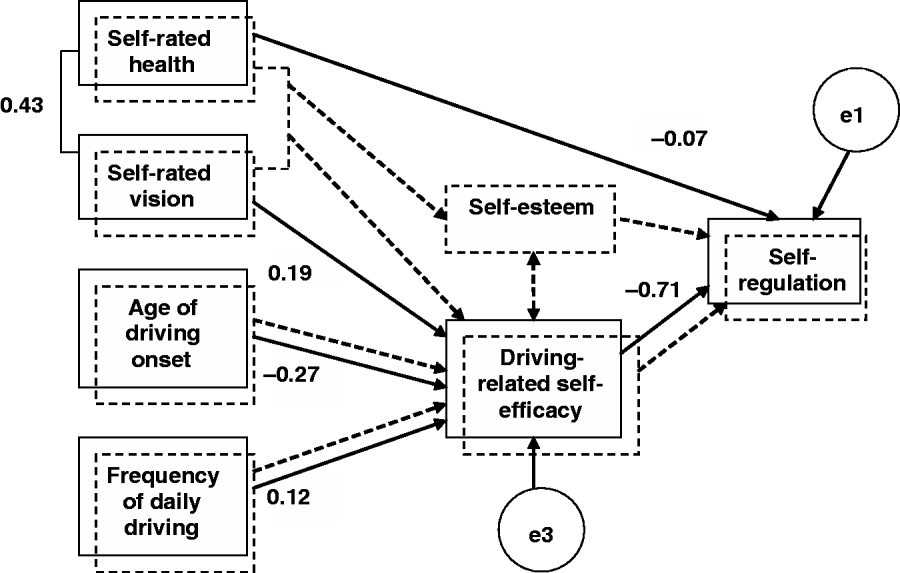
We designed a causal model for assessing the effects of physical and psychological factors on driving self-regulation by avoidance of various driving conditions based on a number of hypotheses (Figure 1, dotted model). We hypothesised that self-regulation by avoidance of certain driving conditions was directly influenced by global self-esteem and by DRSE, and that global self-esteem influenced DRSE, and vice versa. We further hypothesised that global self-esteem was influenced by perceptions of health and vision, and that DRSE was influenced by perception of health and vision, as well as driving experience (age of driving onset and frequency of daily driving). Finally, we hypothesised that the same set of factors, as well as the level of self-regulation by avoidance of various driving conditions (before driving cessation), would differentiate between drivers still active at the time of their participation in the study and participants who had already ceased driving of their own volition.
Results of a structural equation analysis for explanation of self-regulation in driving by avoidance of various driving conditions – the solid lines model (dotted lines demonstrate the proposed model).

These hypotheses were tested using data collected from older Israeli drivers. Israel differs from many countries across a number of driving-related features. It is a multicultural society of immigrants from more than a hundred countries, many of whom arrived in old age with no driving skills and could not afford to buy a car. Israel is also a small country with relatively short distances and wide availability of relatively inexpensive (subsidised) public transportation (except for Saturdays and Jewish holidays when public transportation does not operate). The retirement age in Israel is 67 for men and 62 for women and the vast majority of people aged 70 or over (94%) live in urban settings. Israelis tend to maintain close family ties, getting together often and extending high levels of mutual support. These characteristics can help explain the relatively low proportion (36.7%) of licensed drivers who are aged 65 or over in comparison to the general population of people aged 17 and over (66.8%). Among older men 57.9 per cent are licensed drivers, while only 20.4 per cent of older women have a licence. This figure drops to 22.2 per cent among people aged 75 and over (40.8% of men and 9.4% of women). However, the percentage of older drivers, especially women, is rising over time (Mashav 2010). From the age of 70 Israeli drivers must renew their licence every five years, and from the age of 80 every two years, after proving suitability to drive based on a medical report from their primary physician and a vision test. The rate of older drivers aged 65 or over involved in car accidents in Israel (fatal or with severe injury) is higher than among adults aged 45–64, but lower than among those aged 17–44 (National Road Safety Authority 2012).
Method
Participants and procedure
The Israeli Ministry of Transportation provided a stratified random sample of older drivers (aged 70 or over), comprised of 000 men and 4,000 women. Two-thirds of the sample group had a valid driving licence while the remaining third had not renewed their driving licences for up to three years previously. Prospective participants were randomly selected from this list and contacted by telephone to request their willingness to participate in the study. We used three criteria to select participants: (a) whether participants spoke Hebrew or Russian, (b) whether they held a valid driver's licence or had held one up until three years prior to the study, and (c) whether they successfully passed a mental competence test, based on eight questions from a scale designed to assess cognitive functioning by telephone (Beeri et al. Reference Beeri, Werner, Davidson, Schmidler and Silverman2003). We conducted interviews in the homes of those who met the above criteria. Before the start of the interview participants were asked to sign a consent form and were informed that they could stop the interview at any time. This procedure of telephone screening and face-to-face interviewing was repeated until we reached 860 participants (mean age = 77.75, standard deviation (SD) = 4.78, range 70–94) out of 1,747 post-screening names that we were able to reach by phone (a response rate of 49.23%). The response rate was negatively correlated with age group, decreasing from 52.6 per cent for participants aged 70–75 years to 33.9 per cent for participants 86 years and older. Of the 860 participants in the study, 670 were licensed active drivers, 36 were participants who held a licence but had ceased to drive (licensed non-drivers) and 154 participants no longer held a licence. Of these 154, 117 (87.3%) did not renew their licence of their own volition, 14 (10.4%) had their licences revoked or were prohibited to drive by a doctor, and three (2.2%) did not renew their licence for technical reasons. The remainder did not give a reason. Altogether, 153 of our participants voluntarily stopped driving. Participants included 426 men and 423 women. Fifty-three per cent of the participants had a high school education and on a scale from 1 to 6 (6 = excellent) they had an average self-assessed economic status of 4.29 (SD = 0.77). Sixty-six per cent lived with a partner, and 89.5 per cent were city-dwellers. All procedures were approved by the Ethics Committee for the Conduct of Clinical Studies at the Soroka Medical Center, in accordance with the Helsinki Declaration.
Dependent variables
Self-regulation of driving by avoidance of certain driving conditions
Self-regulation of driving was measured by degree of avoidance of 16 driving and road conditions at the time of the interview, or when the participant had last driven. Responses ranked from 1 = ‘do not avoid at all’ to 6 = ‘greatly avoid’. The conditions included driving in the neighbourhood, on urban roads, on a congested urban road, on a highway, on an unfamiliar road, merging from a side street or from a parking space, passing another car on a high-speed road with heavy traffic, driving at night or in the dark, driving in heavy rain or in foggy conditions, driving at high speed, parking in narrow spaces, entering large junctions, driving at dawn or dusk, driving in a traffic jam, long distances, and inter-city driving. An index was calculated based on the average score of responses to the 16 items (Cronbach's alpha = 0.93).
Self-regulation of driving by cessation of driving
The sample was divided into two groups, drivers (N = 670) – licensed drivers who continued to drive and non-drivers (N = 153) – participants who had voluntarily stopped driving, whether licensed or non-licensed.
Independent variables
Driving-related self-efficacy
A scale was developed for assessing DRSE, based on Bandura's (Reference Bandura, Pajares and Urdan2006) guide for constructing self-efficacy scales and adjusted to Israel. It included 15 items relating to different driving and road conditions, ranking from 1 = ‘very low’ to 10 = ‘very high’ on the degree of self-efficacy for each driving situation. The list of items was similar to that used for evaluating self-regulation of driving by avoidance of driving in difficult driving conditions (see above) with the exception of ‘driving at dawn or dusk’ which was missing in this list. An index was calculated based on the average score of the responses to the 15 items (Cronbach's alpha = 0.96).
Confidence in driving
Confidence in driving was assessed by a single question regarding self-rated confidence in general (for drivers in the present and for non-drivers in the past – ‘before you stopped driving’) with a scale ranging from 1 = ‘very confident’ to 6 = ‘not at all confident’.
Global self-esteem
Self-esteem was measured using Rosenberg's (Reference Rosenberg1965) self-esteem scale, which is comprised of ten items measuring personal dispositions. We used a five-item scale, ranking from 1 = ‘very low’ to 5 = ‘very high’ (Cronbach's alpha = 0.73).
Self-rated health
Health status was measured by an item for self-evaluation of general health with a scale from 1 = ‘very poor’ to 6 = ‘excellent’.
Self-rated vision
Vision was assessed by self-evaluation of vision (1 = ‘very poor’ to 6 = ‘excellent’).
Number of chronic diseases
Number of diseases was assessed by a closed question with yes/no answers to a list of 14 chronic diseases and three more possibilities to add unlisted diseases. The score range was from 0 to 17.
Driving experience
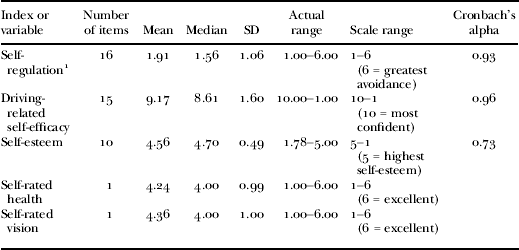
Driving experience was assessed using two questions: (a) ‘How old were you when you started to drive?’ This question enabled people to report unlicensed driving that started at a very young age, occurring mainly on farming vehicles in rural settings. The responses to this question ranged from age 11 to 65 (mean = 24.65, SD = 7.18, with a total of ten people starting to drive before the age of 16 and three after the age of 60). (b) ‘On average, how many times do you drive during a day?’ (or ‘how many times a day did you drive before you stopped driving’ for non-drivers. Responses ranged from 0 to 15 (mean = 2.16, SD = 1.66). The characteristics of these variables are presented in Table 1.
Description of the variables, indices and psychometric properties of scales
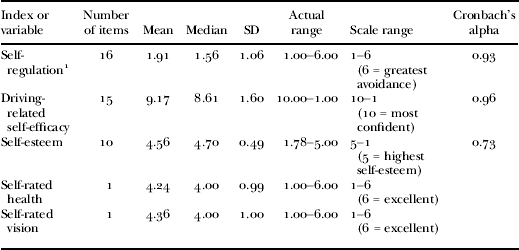
Notes: N = 860. 1. Self-regulation is the avoidance of various driving conditions. SD: standard deviation.
Data analysis
Antecedents of self-regulation by avoidance of driving in certain conditions
Raw data were analysed using SPSS (version 17.0) and structural equation modelling (SEM) with maximum likelihood estimation was carried out using AMOS 7.0. Fit of the models was evaluated by using the Normed Fit Index (NFI) and the Comparative Fit Index (CFI). These indices both range from zero to one, with higher scores indicating better fit. The chi-square difference test was used to compare the nested models with one another in our exploratory phase, and the root mean square error of approximation (RMSEA) served as an indicator of the final model's likelihood of being replicated in additional samples of the same size drawn from the same population (Byrne Reference Byrne2001). An RMSEA value less than 0.08 indicates a reasonable error of approximation (Browne and Cudeck Reference Browne and Cudeck1992). We estimated paths between self-rated health, self-rated vision, age of driving onset, frequency of daily driving, DRSE, global self-esteem and self-regulation of driving by means of avoidance of various driving conditions. This led to the development of the model presented in Figure 1 that includes all variables as well as the global self-esteem index, and the associations between variables as shown by dotted lines.
Non-significant paths were removed one at a time and the model was re-estimated until only significant paths remained. These are indicated by the solid lines in Figure 1.
Comparisons between drivers and voluntary non-drivers
We used t-tests for independent samples to assess differences between drivers and voluntary non-drivers on each of the independent variables, as well as on self-regulation by level of avoidance of various driving conditions (in the present for participants who were active drivers; in the past for participants who had chosen to stop driving). In order to assess the unique contribution of each variable while controlling for all the others, we then introduced the variables that were found to significantly differentiate between the two groups in the univariate analyses, using a logistic regression analysis.
Results
Explanation of self-regulation by avoidance: model results
SEM resulted in a partial fit of the observed data with the hypothesised model (Figure 1). After excluding global self-esteem, the updated model fit indices were acceptable (χ2 = 50.1, df = 9, p < 0.01; CFI = 0.96, NFI = 0.95, RMSEA = 0.07). According to this model, DRSE had the strongest direct effect on self-regulation of driving. This final model explained 47 per cent of the variability in self-regulation (R 2 = 0.47).
In turn, and as hypothesised, age of onset of driving and frequency of daily driving, both indicators of driving experience, as well as self-rated vision had direct affects on DRSE. The less driving experience older people have, and the poorer their self-perceived vision, the less confident they are in their driving abilities, and hence the more they regulate their driving by avoidance of various driving conditions. These variables explained 15 per cent of the variability in DRSE.
Our hypothesis that the effect of self-rated health on driving avoidance would be mediated by global self-esteem and by DRSE was not corroborated. Rather, self-rated heath had a significant, but relatively weak, direct effect on self-regulation. The less people are confident in their driving abilities, and the less healthy they perceive themselves to be, the more they voluntarily regulate their driving by a greater level of avoidance of various driving conditions. Finally, self-evaluation of health was found to be strongly associated with self-evaluation of vision. Participants who evaluated themselves as having better vision also evaluated themselves as being healthier.
Differences between drivers and voluntary non-drivers
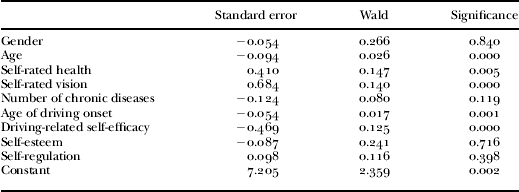
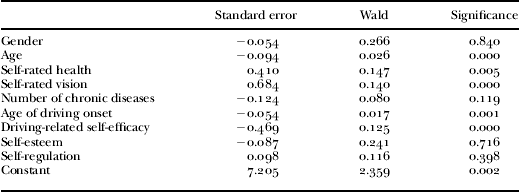
In comparison to drivers, voluntary non-drivers ranked themselves significantly lower on DRSE (t = 6.14, degrees of freedom (df) = 790, p = 0.000), on general confidence in driving and on global self-esteem (t = 4.18, df = 798, p = 0.000). Non-drivers also reported greater avoidance of the studied driving conditions (t = 5.90, df = 797, p = 0.000) and had lower scores on self-rated health (t = 7.89, df = 813, p = 0.000), self-rated vision (t = 9.48, df = 818, p = 0.000) and number of chronic diseases than drivers. On average, the non-drivers were five years older than drivers when they began driving (t = 8.47, df = 815, p = 0.000). Frequency of daily driving of drivers (in the present), and of non-drivers (in the past) did not differ significantly between drivers and non-drivers. The results of a logistic regression analysis indicate that the most important variables for explaining cessation of driving were, in order of significance: self-rated vision, general confidence in driving, age, age of driving onset and self-rated health status. Avoidance of driving in difficult conditions was not found to be significant in this model, probably due to its strong correlation with general confidence in driving (Table 2).
Comparison between drivers and non-drivers: results of a logistic regression analysis
Most avoided driving conditions
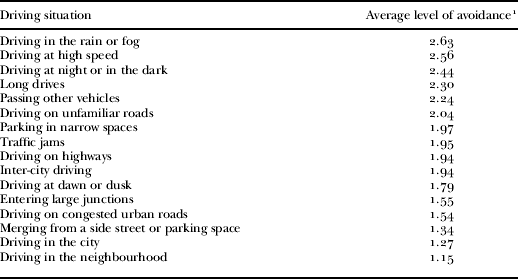
In the present study, road and driving conditions that were most avoided by the total sample (N = 860) were, in descending order: rain and fog, driving at high speed, driving at night, long drives, passing other vehicles and driving on unfamiliar roads (Table 3).
Ranking of average levels of avoidance of various driving situations
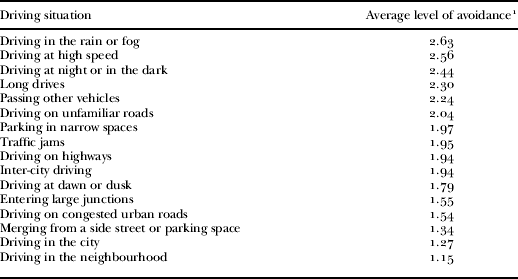
Notes: N = 860. 1. 1 = not at all, 6 = to a very large extent.
Discussion
The purpose of this study was to investigate the explanatory factors of self-regulation in driving among older adults. Two means of regulation were assessed, driving cessation and avoidance of various driving conditions. According to our findings, drivers who voluntarily stop driving are older and have less confidence in their driving-related abilities than drivers who continue driving. Prior to driving cessation, these drivers are also more likely to avoid driving in certain conditions than older drivers who continue driving. This suggests that subjective evaluations such as less confidence in driving abilities lead either to avoidance of driving in difficult road conditions at first, and later to driving cessation, or directly to driving cessation. In addition, older drivers who stop driving of their own volition have poorer self-rated vision and health, and began driving at an older age.
The ability of older drivers to recognise their relevant declining driving skills is of the utmost importance for road safety. Studies indicate that, similar to drivers of other age groups, older drivers feel as confident as, or more confident than, their driving cohorts (e.g. Freund et al. Reference Freund, Colgrove, Burke and McLeod2005; Marottoli and Richardson Reference Marottoli and Richardson1998; Molnar and Eby Reference Molnar and Eby2008) and several studies have found discrepancies between DRSE and actual driving performance of older drivers. For example, no relationship was found between DRSE and actual driving performance in a US study (Marottoli and Richardson Reference Marottoli and Richardson1998), and another study on older drivers found that more than half of those who considered themselves better drivers than their peers actually drove unsafely in a simulated test (Freund et al. Reference Freund, Colgrove, Burke and McLeod2005). Such studies suggest that some older drivers are over-confident with regard to their driving skills. However, most participants in our study who provided an explanation as to why they did not renew their licences said they did so of their own volition (87.3 per cent). Only 10.4 per cent of the participants who no longer had valid licences had them revoked, or were prohibited from driving by a doctor. This suggests that older Israeli drivers who sense a decline in their ability to drive safely do self-regulate by driving cessation. Similarly, a national survey in Finland found that only 6.9 per cent of former drivers aged 70 years and older were advised to stop driving by professionals (Hakamies-Blomqvist and Wahlström Reference Hakamies-Blomqvist and Wahlström1998). In other words, although there are older drivers who overestimate their driving skills and continue driving, most of the old drivers (at least in some countries) are sensitive to the decline in their driving abilities and decide to stop driving, even though no professional had advised them to do so. Considering the close ties between family members in Israel, this process is probably also influenced by family members, who become aware of their relatives' problematic driving, as reported by Donorfio et al. (Reference Donorfio, D'Ambrosio, Coughlin and Mohyde2009). They found that older people living alone are less likely to limit their driving, and that household composition plays an important role, both in providing mobility and encouraging self-regulation when necessary.
In our attempt to explain the variability in older drivers' level of avoidance of various driving conditions, we found that DRSE is a powerful explanatory variable, with lower levels leading to greater self-regulation by avoidance. In turn, we found that DRSE is predicted by three variables. Age of driving onset had the greatest explanatory weight, followed by self-assessed vision and frequency of daily driving. In other words, for older drivers the fewer years of driving experience they accumulate, the worse their perceived vision, and the less they drive on a daily basis, the less confident they are in their driving abilities, leading to greater avoidance of difficult driving conditions. Regarding impaired vision, our study lends support to previous research indicating that impaired vision is associated with older drivers' difficulties in driving in various road and weather conditions (Lyman, McGwin and Sims Reference Lyman, McGwin and Sims2001; McGwin, Chapman and Owsley Reference McGwin, Chapman and Owsley2000), and therefore, with avoidance of those conditions (Ball et al. Reference Ball, Owsley, Stalvey, Roenker, Sloane and Graves1998). Indeed, in line with previous findings (Baldock et al. Reference Baldock, Mathias, McLean and Berndt2006; Ball et al. Reference Ball, Owsley, Stalvey, Roenker, Sloane and Graves1998; Ruechel and Mann Reference Ruechel and Mann2005), our participants avoided most driving in conditions that necessitate good visual acuity such as in rain, and in the dark. These are also situations that older drivers are most wary of (Baldock et al. Reference Baldock, Mathias, McLean and Berndt2006; Molnar and Eby Reference Molnar and Eby2008).
The main contribution of the study reported in this paper is in signifying the role of DRSE – the confidence one has in his or her abilities to confront various driving conditions – as a mediating psychological factor. Our final model suggests that, rather than having a direct effect on avoidance of driving in difficult conditions, the impacts of driving experience and self-assessed visual acuity are channelled through DRSE. It is the subjective psychological assessment of one's ability to cope with various driving conditions that influences older drivers' decisions whether to continue driving in those road and weather conditions, or to self-regulate by avoiding those conditions. This theme and our finding that the vast majority of our non-driving participants stopped driving voluntarily, lend support to the argument that self-limitation of driving is more often an outcome of the drivers' subjective evaluations of their capability to drive rather than of objective functioning and formal restrictions.
Our hypothesis that general self-esteem will influence and be influenced by DRSE, and will in turn influence driving self-regulation, was not corroborated by the results of this study. This suggests that older people's general self-esteem is not influenced by their ability to drive and supports the claim of Rosenberg et al. (Reference Rosenberg, Schoenbach, Schooler and Rosenberg1995) that specific self-esteem is a better predictor of performance in that domain than global self-esteem. However, our univariate analyses did find that older drivers who voluntarily ceased driving had, on average, a lower level of self-esteem than current drivers. We therefore suggest that while voluntary cessation of driving is associated with a decrease in global self-esteem, the prior stage of self-regulation by avoidance does not have a similar negative impact. This conclusion has important practical implications on the wellbeing of older adults and suggests a need for further longitudinal prospective studies in this area.
In addition, and as reported in previous research (Sims et al. Reference Sims, Ahmed, Sawyer and Allman2007), we found that self-assessed health status can help explain avoidance, with poorer health leading to greater avoidance. However, in this study self-rated health status predicted only a small amount of the variability. Self-rated health was not found to contribute to the prediction of DRSE, but was a good predictor of self-rated visual acuity, and vice versa.
Regarding more objective factors, we found that older drivers with less driving experience are also more likely to self-regulate their driving by avoidance of driving in difficult conditions, in support of Rimmo and Hakamies-Blomqvist's findings (2002). It thus appears that driving experience, in terms of age of driving onset and driving frequency, has an important influence on old drivers' self-regulation of driving.
In drawing conclusions from this study, some limitations should be mentioned. In addition to vision, cognitive function is one of the factors in driving cessation. This factor could not be evaluated in our study, which is based on personal interviews of drivers and former drivers. Regarding drivers who had stopped driving, we only know that they stopped driving up to three years before the study, but not the exact point at which they stopped. We acknowledge that the retrospective study design for this group and the implications for the participants' accuracy of responses due to memory and possible changes in psychological self-perceptions over time is another limitation. Therefore, our findings need further testing by more comprehensive longitudinal studies in Israel and other countries.
Some of the more objective and subjective factors found important in our study for self-regulation in driving, such as driving skills and experience and DRSE, respectively, can be promoted by appropriate interventions. Numerous studies have shown that special training can improve functioning relevant to safe driving in older drivers, including improved perception of driving hazards (Horswill et al. Reference Horswill, Kemala, Wetton and Scialfa2010; Rosenbloom et al. Reference Rosenbloom, Shahar, Elharar and Danino2008), reaction time, response time, visual attention (Marmeleira, Godinho and Fernandez Reference Marmeleira, Godinho and Fernandez2009) and speed of information processing (Roenker et al. Reference Roenker, Cissell, Ball, Wadley and Edwards2003). Positive feedback to drivers regarding their improved skills can strengthen their DRSE. Furthermore, a longitudinal study in the USA found that training reduced the rate of at-fault motor-vehicle collisions among older drivers by half over a six-year period after training, when compared to a control group (Ball et al. Reference Ball, Edwards, Ross and McGwin2010).
Some studies of interventions for assisting older adults to adjust to the cessation of driving have also shown positive outcomes. For example, Shaheen, Allen and Liu (2008) reported that participation in a community transit training class for elderly in California resulted in a positive shift in attitude toward using public transportation, and a significant decrease in use of a motor vehicle two years following the training.
Considering the findings reported in this paper in the context of the current literature, the importance of driving to older peoples' health and general wellbeing and the societal dilemma regarding restrictions of driving in old age (as presented in the introduction to this paper), the best ‘road’ to take seems to be acting concurrently on a number of tracks: improving public transportation adapted to older and frail people's needs; introducing driving instruction programmes to high schools; developing driving intervention programmes for older adults; and moderating national driving licensing policies for those who participate in such programmes. We suggest that intervention programmes for older adults should include a diagnosis of driving capabilities, incorporating assessments of discrepancies between drivers' actual driving competencies, and their DRSE and driving habits. Based on the results of such screenings, driving programmes could address the needs of three different groups of older drivers. For those who are objectively capable of continuing driving, programmes should promote their driving skills and reinforce their DRSE. For those with restricted driving capabilities, programmes can improve driving skills and teach ways for self-regulating their driving. Last, but not least, special efforts should be made to convince those who objectively cannot drive to stop driving through attitude change and the provision of alternative ways for maintaining their independence and wellbeing.
Such initiatives should be accompanied by positive incentives for using them. For example, allowing free or minimal-fare use of public transportation for all older adults, and for people who participate in driving intervention programmes, reducing payments to car insurance companies, and lowering requirements for medical and vision examinations for periodical licence renewals, which currently exist in Israel as well as in some other countries. Although Israel differs from other countries in a number of driving-related characteristics (e.g. driving policies, availability of low-priced public transportation, and socio-cultural characteristics which may influence elderly persons' driving-related behaviours), we believe that our findings regarding the importance of psychological factors and driving experience in explaining driving-related self-regulation have global implications, and therefore some of the above recommendations also apply to other countries. The initiatives that we propose should be based on local studies and adapted to the specific cultural and societal context of each country, including driving-related cultural beliefs, specific needs and existing infrastructure in terms of current licensing policies, training programmes, incentives, quality of roads and other means which facilitate driving, as well as availability and accessibility of public transportation adapted to older persons' needs.
Acknowledgement
The study presented in this paper was supported by the Ran Naor Foundation for the Advancement of Road Safety Research, Israel.