Surge capacity describes the ability of a health care system to respond to a sudden increase in patient care demands. Conceptually, a surge system has the following components: supplies, personnel, physical space, and management infrastructure, sometimes referenced as “stuff, staff, and structure.”Reference Kaji, Koenig and Bey1, Reference Barbisch and Koenig2 When health care demands increase dramatically above the usual capability and capacity of the facility, a rapid needs assessment must be performed and appropriate resources mobilized to meet these requirements.
Model systems to improve health care facility emergency management programs3 and incident management implementationReference Barbera and Macintyre4, 5—including the Hospital Incident Command System, which is compliant with the required Federal National Incident Management System—have greatly improved health care facility preparedness.
These systems provide insufficiently detailed guidance and tools for health care personnel assigned to an incident command or section chief position who are required to perform initial assessments and initiate response activities. These employees, particularly medical staff, may assume unfamiliar roles and may have little practical experience assessing such situations. They may thus face significant challenges in their efforts to prioritize initial response activities. We propose a practical and easily understood tool for health care facility personnel to apply after initial assignment of incident command positions that may help to anticipate hospital surge capacity and other needs during the initial response to a disaster.
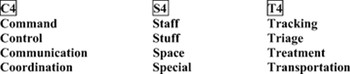
The CO-S-TR tool (Fig. 1) is a conceptual framework that will provide facility incident command staff with the framework to make informed and consistent decisions during chaotic circumstances. It is intended as an adjunct tool to the Hospital Incident Command System and similar systems and may be incorporated in job action sheets or stand alone as a reference card or poster.
The CO-S-TR framework.

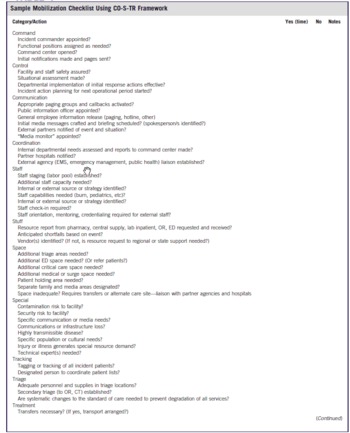
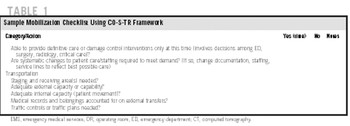
Implementation of the essential elements of the CO-S-TR model should include a brief, facility-specific mobilization checklist (Table 1) to enable rapid identification and prioritization of resource needs, recognition of key objectives, and earlier incident control. This checklist also may include contact and notification information, available resources, triggers for different levels of activation (partial vs full or other graded system), and mechanisms and metrics that can assist in determining which staff and support elements to activate based upon incident demands.
Sample Mobilization Checklist Using CO-S-TR Framework

Sample Mobilization Checklist Using CO-S-TR Framework

C4—Command, Control, Communication, and Coordination
Command
Command refers to the designation of an incident commander (IC) and implementation of an incident management system with defined roles and responsibilities according to the facility emergency management plan. Ideally, the facility's chief executive officer authorizes a preincident policy that designates authority to this individual or group of individuals immediately at the time of an incident.5, 6
Control
Initial command goals are to protect the staff and facility and prevent event expansion (although this may not be under the control of the health care facility IC). Control of an event requires continuous information gathering to assess the impact of the event on health care facility operations and may also involve initial scope-limiting actions such as controlling access to certain areas to protect the facility and employees. Based on this information, adequate internal and external resources must be mobilized to meet event-generated demands. The response must be flexible, scalable, and adjusted to the dynamic situation. A balance must be struck between requesting adequate resources and unnecessarily disrupting hospital operations and staffing patterns. Control relies on incident management principles such as incident action planning and action planning cycles6, 7 to effectively manage the event. Employees should automatically know what actions to take in the initial, reactive stage of a surge event and refer to their department-specific job action sheets or plan when notified of an event.
Communication
Communication with internal and external partners is critical to successful event management. Troublesome communications are virtually emblematic of a disaster. Information flow may be rendered useless by failure of usual communication mechanisms (eg, telephone, radio). The facility should have an emergency communications plan that can be implemented quickly with redundant, interconnected, and power grid independent methods of communication.Reference Bey and Moecke8
Staff notification of an event may be accomplished in many ways, including overhead paging and intranet for employees at work and paging, messaging, and hotlines for those away from work. Optimizing these communication links often relies on prior real-life experience, education and training, and exercises. External partners also may need to be notified. Employees and outside agencies must know what assistance is needed (and not needed) so that they can take appropriate action. Knowing who to contact for what resources, and how to reach them, is critical information that the IC must have easily available.
Sharing information and intelligence between agencies and employees is essential to optimizing response. Health care providers and managers also may need law enforcement or security information during an event that may be difficult to access unless there are trusted partners in public safety and preexisting commitments to share such information.
Finally, plans to manage the media and prior designation of qualified medical spokespeople are essential elements of public risk communicationReference Glik9 and can potentially greatly reduce the burden of telephone calls (eg, by redirecting to a family reunification hotline) or patient visits (eg, by communicating case definitions and information on when to seek emergency care). Monitoring the media during an event for messages that are inconsistent with the response plan also is important (eg, “Please go to your local hospital to give blood”) to allow early correction.
Coordination
Institutional Response: Connecting the Dots
Key clinical and support staff must be present in the health care facility command center to coordinate the planned actions with the staffing capabilities to facilitate timeliness in meeting resource needs, prioritizing actions, and identifying future goals. Initial departmental responses should proceed on the basis of their emergency operations plans, with updates provided to command staff frequently on the situation in key areas (emergency department, security, surgery, critical care). As the incident evolves, more top-down management strategies will be implemented.
Community Public Safety Agencies
Coordination with outside agencies when specific assets (eg, decontamination assistance, law enforcement augmentation) are needed is an important part of a facility response. Communication drills and coordination mechanisms will improve interaction between health care and public safety agencies during an event. Defining how these agencies coordinate and what roles and responsibilities each has before an event is important, so that hospital personnel are not, for example, relying on fire department decontamination resources that will not be available to them during an incident.
Public Health and Health Care Partners
Ideally, each health care facility should have mutual aid agreements with nearby inpatient and outpatient facilities allowing staff and resource sharing and specifying coordination mechanisms. Health care facilities must also coordinate with the broader health and medical community, including public health and emergency medical services (EMS) systems during a major event. Nonhospital health care entities—such as clinics, nursing facilities, home health services, and hospices—will play an important role in providing patient care services during a major disaster. The concept of operations for coordination of multiple agencies and facilities 10–12 should be planned and exercised in advance of an event. In some cases, this coordination will occur at the community emergency operations center level; in multijurisdictional events a separate multiagency coordination center may be required.
S4—Staff, Stuff, Space, and Special (Logistics)
Staff
Early mobilization of appropriately trained staff to fulfill needs imposed by disasters is critical to effective response. A staff staging area or labor pool helps to centralize and organize staff deployment. The plan must be able to mobilize both the appropriate number and types of staff (eg, medical/surgical nurses vs burn nurses). A system must be in place to manage staff (both volunteer and regular) to efficiently use them and avoid diverting resources to such activities as ad hoc verification of credentials. Local agreements to share staff may prove invaluable because staff may be shared between facilities, be drawn from Medical Reserve Corps or other programs, and potentially drawn from federal sources such as the National Disaster Medical System.Reference Cone, Weir and Bogucki13–Reference Schultz and Stratton17 Prior agreements that detail shared staff compensation, liability, and workers' compensation are invaluable in improving staff sharing. Staff relief efforts need to be reassessed continuously to adjust the response to the event as it evolves over time.
Fortunately, few hospitals experience staffing shortages during noncatastrophic disasters,Reference Auf Der Heide18 although in certain circumstances (eg, smaller facility, agent that poses a threat to responders) staff may be inadequate to meet the needs of the event. In that case, work practices must be modified (medical records reduction, closing certain departments to support others, relaxation of regulatory requirements such as nurse–patient ratios, etc) to allow existing staff to expand capacity for patient care activities.19 Certain statutes and regulations may require modification in these instances and will require assistance from government and licensing entities.
Assessment of staff needs for future operational periods is important so that adequate numbers of staff are in the right place at the right time. Hospitals may find daily staffing grids useful for forecasting needs for subsequent time periods with modifications if the patient acuity on the unit does not represent usual practice. (For example, are ventilated patients now receiving care in postanesthesia areas or on monitored floor areas if appropriate?) These staffing grids can be coupled with surge capacity grids listing bed and floor space so that staff or space shortages can be anticipated as soon as possible and mitigated, or policies approved to adjust the standard of care to a level appropriate for the resource constrained environment.
Stuff
The IC may need to rapidly direct movement of specific resources to a number of different areas:
• Usual supplies in larger quantities than usual (eg, chest tube trays, opioid analgesia for emergency departments)
• New supplies needed to set up triage or treatment areas (these should be set aside or catalogued ahead of time so that they can be assembled quickly and moved to the designated location)
• If usual supplies are exhausted (eg, atropine, external fixators), an appeal may be made to mutual aid hospitals, usual suppliers, or other predetermined sources of medical supplies. Many hospitals rely on the same suppliers, complicating resource procurement in a major disaster. If supplies are not available through existing channels, then a mechanism must be in place for the facility to request them from the state or federal levels. This usually occurs via the local emergency management agency for the community in which the hospital resides. These processes should be clearly understood in advance of an incident. Partnerships with private entities that may provide supplies, communications, and logistical support also can be critical during a disaster, but must be negotiated in advance of an event to be most effective.
Anticipation of resource shortages is important. Regular communication with the pharmacy, emergency department, intensive care unit, and support services (eg, laboratory, radiology, respiratory care, food services), and monitoring of the types of injuries and illnesses helps to anticipate supply replacement needs in sufficient time to mitigate most shortages. A process of vendor managed inventory by which private partners manage and store supplies for disasters has been useful on the federal level as part of the Strategic National Stockpile. Local implementation of similar strategies can further improve the flow of supplies and equipment, lessening the burden on individual facilities or public partners to buy and store large caches of pharmaceuticals or supplies.20
Space
Adequate physical space and appropriate structures are often underestimated needs. A comprehensive assessment of space and structural options is necessary before an event to rapidly reconfigure or establish space to accommodate a surge of patients and associated support needs during a disaster. Triage, treatment (including critical care), transportation staging, and discharge holding areas may need to be initiated rapidly (eg, lobby areas, gymnasium, or conference room areas).Reference Rubinson, Nuzzo and Talmor21 Additional considerations include requirements for staff, family, and media support areas. Alternate care sites may be located within facilities (eg, cots in designated areas) or external to facilities (eg, tenting, adjacent building, community-identified locations).Reference Hick, Hanfling and Burstein22–Reference Hick, Hanfling and Burstein25
Special
Certain situations require specialized responses. For example, patients contaminated by radiological materials from a radiological dispersion device or “dirty bomb” may have combined injuries that require radiological contamination assessment and management as well as decontamination in addition to usual medical care.Reference Koenig, Goans and Hatchett26 Other specialized situations may include highly infectious patients (eg, those with severe acute respiratory syndrome or viral hemorrhagic fevers),Reference Cone and Koenig27 burn patients, or pediatric patients. These situations may require assignment of staff with additional training and usually require specialized resources (eg, radiological survey meters and personal protective equipment).Reference Koenig, Boatright and Hancock28, Reference Hick and Thorne29 The IC should be familiar with the supplies and technical expertise available at the facility and within the community and region.
Early assessment regarding what is “special” about any given event may lead to additional objectives or actions. For example, a school bus accident that generates a few patients easily managed by the emergency department may result in a deluge of telephone calls and family members on the facility. If this is unanticipated, and resources such as a telephone bank and family support area are not initiated, then a significant disruption of facility operations and unnecessary emotional distress for the victims' family and friends may occur.
T4—Tracking, Triage, Treatment, and Transportation (Operations)
Tracking
A system should be in place at the facility to track patients from the time of arrival at the facility through discharge or transfer. This may or may not be the same as that used during daily operations. The decision to activate a disaster tracking system must be made early, and personnel should be assigned as soon as possible to prepare a master list of patients and record their dispositions.
Triage
Although they have limitations, triage tags may be used and an abbreviated assessment performed to rapidly categorize patients.Reference Benson, Koenig and Schultz30 An appropriate number of experiencedReference Tanabe, Travers and Gilboy31, Reference Tanabe, Gimbel and Yarnold32 triage officers should be appointed and equipped with vests and other required equipment. In large incidents, plans should be made to triage patients in nontraditional locations (hospital lobbies, outdoors, other locations) and to triage low-acuity patients to other waiting areas in the facility or to off-site outpatient clinics (per agreements with these locations). A process for secondary triage and a secondary triage officer (or other title assuming this function) should be activated and implemented within the emergency department to decide who will have priority for the operating room, who will go to computed tomography, who will receive the last intensive care bed, and so forth.
In the face of patient volumes that exceed available resources, the focus of triage shifts from a goal of optimizing care for an individual patient to optimizing care for a population of patients (“doing the greatest good for the greatest number”). Decision making based on best outcomes may present practitioners with ethical dilemmas such as deciding who receives critical resources in short supply. Preliminary guidance is available for these situations but requires facility-based planning before an event to be effective.Reference Auf Der Heide18
Treatment
Medical treatment of injured and ill people should focus on stabilizing measures. Diagnostic studies and definitive care should be limited in the initial aftermath of a disaster (eg, dress wounds but defer suturing, and splint clinical fractures rather than performing radiographs). Decisions need to be made at the command level about how many patients can be definitively managed at the facility and which patients will require transfer to other facilities, if available. The degree of medical treatment in some cases may be limited by the resources available. The IC may have to be creative to stretch the capacity and capability of clinical providers or resources to ensure the best care possible given the situation. Reference Dacey18,20,33 Concurrent attempts to obtain needed staff and resources or accomplish transfers is critical to ensure a return to baseline operations as rapidly as possible.
Transportation
Internal transportation plans facilitate the rapid movement of patients from initial triage and treatment areas to inpatient wards or operating rooms. External transportation plans focus on rapid and safe transfer and evacuation of patients to other facilities or an evacuation point (eg, an airport). Anticipating transportation needs, the IC must consider the local and regional availability of ground and rotor-wing EMS units. These units may be unavailable in significant numbers during a disaster because of system demands or limited access (eg, due to flooding, debris, or other impediments).
If multiple ground or air ambulances are used, the establishment of safe loading zones and local air traffic control, and the assignment of a staging officer to these locations, helps ensure safety and orderly patient flow. Communications and coordination with outside agencies is required because EMS agencies may have to prioritize their missions.
Mutual aid agreements with local EMS agencies (including private organizations) and augmentation plans should be in place before an event. Understanding timelines for obtaining external assistance is particularly important for smaller, more rural facilities. In addition, usual referral hospitals may be overwhelmed by the same event and thus less frequently used partners may be needed.
Conclusions
Disaster management is challenging even for experienced providers. With rapid application of the CO-S-TR (or “coaster”) model, health care facility incident commanders or section chiefs can quickly define and assess critical elements of institutional surge capacity, and determine initial priorities and resource requirements. The CO-S-TR tool, as an adjunct to the institutional incident management system, provides a means to proactively determine what resources are needed and how to deploy them to minimize omissions and optimize outcomes. Validation of the model is necessary to confirm a benefit to incident management practices and early creation of surge capacity at health care facilities.
Authors' Disclosures
The authors report no conflicts of interest.