Implications
Heifer rearing is a significant cost of dairy production. A quicker repayment of the investment can be facilitated by optimizing first-lactation performance. Results of this study indicate age and BW at first calving to be important factors positively associated with milk yield. In addition, seasonal effects were found, with heifers born in winter producing the least and heifers born in summer producing the largest amount of milk. As these summer-born heifers were born with lower basal insulin concentrations, it is suggested that higher temperatures at the end of gestation might induce an increased peripheral insulin sensitivity, leading to higher first-lactation milk yield. However, further research is necessary to assess the impact of birth season on long-term performance and economic benefit.
Introduction
In order to reduce costs, farmers have been encouraged to shorten the non-productive period of dairy heifers by reducing age at first calving (AFC). However, the latter has repeatedly been associated with unsatisfactory performance during first lactation (Ettema and Santos, Reference Ettema and Santos2004), postponing the full return on investment. According to Archer et al. (Reference Archer, Mc Coy, Wapenaar and Green2013), a production of 8535 kg milk is required to compensate for rearing costs, representing more than one lactation in most herds. Thus, to enhance economic benefits, it is important to identify and optimize all factors influencing first-lactation milk yield. Besides genetic predisposition, the prenatal and early postnatal environment have been shown to influence adult performance, possibly via permanent changes in the metabolism (Hanson et al., Reference Hanson, Godfrey, Lillycrop, Burdge and Gluckman2011). However, studies concerning these effects show ambiguous results, highlighting the necessity to further research the underlying mechanisms. In cattle, the potential negative effect of high milk yield during gestation on offspring performance has been repeatedly investigated, most often leading to contradictory results: Berry et al. (Reference Berry, Lonergan, Butler, Cromie, Fair, Mossa and Evans2008) reported a reduced first-lactation yield in heifers born out of high-yielding dams, whereas other authors found no effect of maternal milk yield (Banos et al., Reference Banos, Brotherstone and Coffey2007; Astiz et al., Reference Astiz, Gonzalez-Bulnes, Sebastian, Fargas, Cano and Cuesta2014). The lack of a clear association between the amount of milk yielded by the dam during gestation and long-term effects on offspring production capacity might be due to other maternal factors, like maternal age (Astiz et al., Reference Astiz, Gonzalez-Bulnes, Sebastian, Fargas, Cano and Cuesta2014) or energy status (Kamal et al., Reference Kamal, Van Eetvelde, Depreester, Hostens, Vandaele and Opsomer2015) exerting modifications in the metabolism of the offspring. In addition, the postnatal environment during rearing has been shown to be important, in order to achieve a sufficient BW at first parturition and maximize milk production after calving (Bach and Ahedo, Reference Bach and Ahedo2008). In this regard, focus should be put on early life, as early BW accretion is more efficient than in later stages of growth (Bach and Ahedo, Reference Bach and Ahedo2008) and has been positively correlated to first-lactation milk yield (Soberon et al., Reference Soberon, Raffrenato, Everett and Van Amburgh2012). In contrast, implementation of accelerated growth programs has led to conflicting results. Prepubertal accelerated growth has been associated with a decreased first-lactation milk yield (Hoffman et al., Reference Hoffman, Brehm, Price and Prill-Adams1996), potentially due to reduced mammary development (Sejrsen et al., Reference Sejrsen, Huber, Tucker and Akers1982). However, as accelerated growth is generally accompanied by early calving, young age might be the factor impairing milk production, mediated by lower frame size and dry matter intake (Hoffman et al., Reference Hoffman, Brehm, Price and Prill-Adams1996). In addition to factors related to the heifer, the calf whose birth initiates lactation has been shown to influence milk yield, due to influences via its gender (Hinde et al., Reference Hinde, Carpenter, Clay and Bradford2014) or its birth weight (Visker et al., Reference Visker, Wang, van Pelt and Bovenhuis2015). Finally, an effect of birth and calving season on lactation performance have been demonstrated (Rius and Dahl, Reference Rius and Dahl2006; Soberon et al., Reference Soberon, Raffrenato, Everett and Van Amburgh2012; Froidmont et al., Reference Froidmont, Mayeres, Picron, Turlot, Planchon and Stilmant2013). However, as seasons combine the effect of photoperiod, temperature and nutritional status, multiple hypotheses have been suggested but the exact underlying mechanism of these effects remains unclear.
In most of the previously mentioned studies, the effect of one or a limited number of factors on milk yield was demonstrated. However, as results so far were often conflicting and many factors intercorrelated, there might be other determining factors which have not yet been revealed.
Primary aim of the present study was to assess which factors are of decisive importance concerning first-lactation milk yield, including seasonal and maternal effects, heifer development and the effect of the calf that initiates first lactation. In addition, the underlying mechanisms of these effects, with special attention on metabolic adaptations, were further elucidated.
Material and methods
All experimental procedures were approved by the Ethical Committee of the Faculty of Veterinary Medicine (Ghent University, Belgium) and by the Ethical Committee of the Institute for Agricultural and Fisheries Research, Merelbeke under no. 2011/166.
Animals and management
The present study concerns a prospective cohort study for which data on body growth, reproduction and milk yield of 74 Holstein Friesian heifers on three herds in Flanders (Belgium) were collected between November 2012 and January 2016. Herd size ranged from 50 to 122 lactating cows, with an average 305-days milk yield between ~9000 and ~11 000 kg. All herds participated in official milk recording. In one herd, cows were milked twice a day while in the other two herds, using automatic milking systems, an average of 2.5 milkings a day was recorded.
Animals were housed in free-stall barns and were fed according to their requirements for maintenance and production, based on results of the monthly production tests. Rations consisted of high-quality roughages (maize silage, grass silage, sugar beet pulp and fodder beets), supplemented with concentrates. For reproductive management, heifers were first inseminated around 14 to 15 months and cows were generally inseminated at the first observed estrus after a 50-day waiting period. When the animals approached parturition, they were separated in a maternity pen and closely monitored by the herd employees. After calving, all calves were immediately removed into individual calf pens with straw bedding and were given 2 l colostrum. Care was taken that all calves received 4 l of colostrum within 12 h after birth. Similar rearing conditions were applied in all three farms and no enhanced feeding was implemented. Calves were fed whole milk (at 10% of their BW), supplemented with hay and concentrates. At the age of ~8 weeks and a concentrate intake of at least 1 kg, calves were gradually weaned over a 1-week time frame. After weaning, calves were fed rations mainly consisting of hay and concentrates, with a gradual introduction of grass and maize silage. After 10 months of age, grass silage and hay were fed to prevent overconditioning by fat accumulation and heifers were kept indoors until diagnosed pregnant. A period of 2 months before expected parturition, pregnant heifers were housed with the dry cows.
Measurements and data collection
All purebred singleton female Holstein Friesian calves born at the herds between September 2011 and November 2012 were enrolled in the study. Of these 108 calves, three calves died and four calves were sold within the 1st year of life. During the second year of life, three heifers were sold because of not being pregnant after ⩾2 inseminations and two heifers were sold before parturition. Of the 96 heifers that reached first parturition, 19 left the herd before second parturition (due to suboptimal milk yield or reproductive problems) and three heifers were <305 days in milk by the time of the analysis. Hence, full lactation production of 74 heifers could be assessed.
Newborn calves were weighed and heart girth, wither height (WH) and diagonal length of both dam and calf were measured as described earlier (Kamal et al., Reference Kamal, Van Eetvelde, Bogaert, Hostens, Vandaele, Shamsuddin and Opsomer2014). Dam information, including parity, age and monthly milk weights, were extracted from the herd databases. On day three postpartum, after an overnight fast, a blood sample of the calf was taken using a Venoject® needle and gel-coated and fluorinized tubes (Vacutainer®; Terumo Europe NV, Leuven, Belgium). Blood samples were centrifuged at 2460×g for 20 min to isolate plasma and serum that was stored at −20°C until analysis. Plasma glucose was measured using the hexokinase method (GLUC3 Cobas®; Roche Diagnostics GmbH, Mannheim, Germany). The intra- and inter-assay coefficients of variation for glucose measurements were 0.8% and 1.3%, respectively. Insulin was measured in serum using the bovine ELISA test kit (Mercodia®, Uppsala, Sweden), with intra- and inter-assay coefficients of variation 2.9% and 2.7%, respectively.
Body measurements of heifers were repeated every 3 months until parturition, and gender and weight of their first calf was recorded immediately following calving. Information on inseminations, pregnancy and first-lactation milk yield was collected form the herd databases.
Season of birth and parturition were grouped as follows: winter (21 December to 20 March), spring (21 March to 20 June), summer (21 June to 20 September) and fall (21 September to 20 December). To further elucidate seasonal effects, data on daily temperatures and photoperiods were recorded from the database of the Belgian Royal Meteorological Institute (Brussels, Belgium). No artificial lighting, cooling or heating was implemented on the herds.
Calculations
Monthly milk records of the dams were fitted to the MilkBot model (Erlich, 2011) to summarize the magnitude and shape of each lactation curve. Using the model, milk yield at the day of conception and during the entire gestation of the dam were estimated (Erlich, 2011; Kamal et al., Reference Kamal, Van Eetvelde, Bogaert, Hostens, Vandaele, Shamsuddin and Opsomer2014 and Reference Kamal, Van Eetvelde, Depreester, Hostens, Vandaele and Opsomer2015). For the heifers, 305-day energy corrected milk (ECM) yield was estimated based on 305-day milk, fat and protein yields (International Farm Comparison Network et al., Reference Kiel and Hemme2012).
Statistical analyses
All statistical analyses were performed using SAS version 9.4 (SAS Institute Inc., Cary, NC, USA). Normality of the data and error terms of the models were checked using the Kolmogorov–Smirnov test (P<0.01). To identify the variables associated with first-lactation milk yield, generalized linear mixed models were built using PROC MIXED. All analyses were run with herd as random effect to account for differences in management between the herds. First, univariable associations between 305-day ECM and independent factors were examined with statistical significance assessed at P<0.15. Second, Pearson’s correlation coefficients were calculated among the significant variables to avoid multicollinearity in the next steps. A correlation coefficient>0.60 among two factors led to the selection of one of the two variables for further analysis, based on significance and physiological relevance. Finally, a multivariable model was fit using backward stepwise elimination. Statistical significance and tendency were declared at P<0.05 and 0.05<P<0.1, respectively.
Results
Descriptive analysis
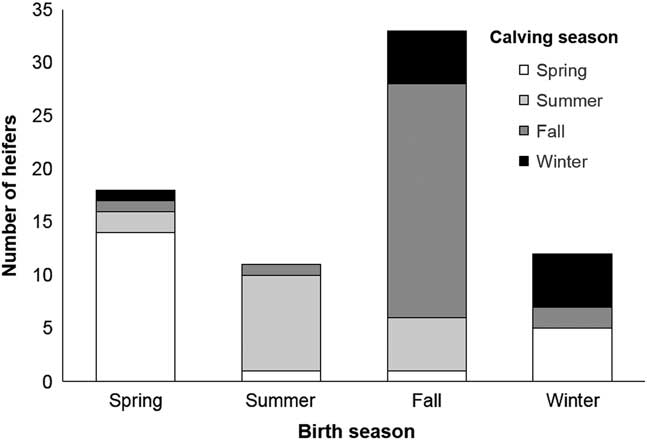
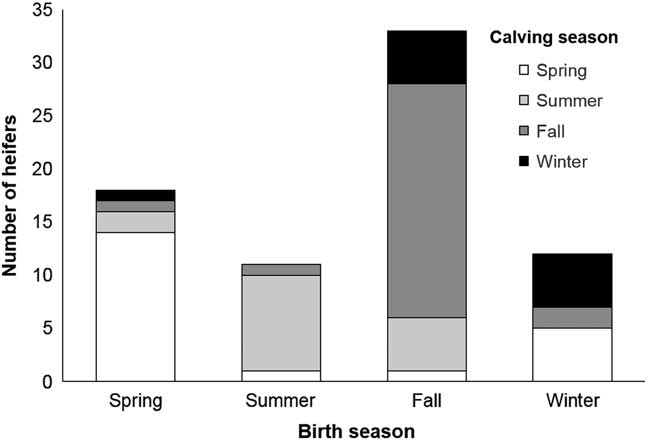
Most heifers were born in fall (45%) and spring (24%), with only 16% and 15% of heifers born in winter and summer, respectively (Figure 1). No calvings were recorded in June. In all, 33 heifers were born out of primiparous dams, with an age of 25.6±2.89 months at the time of parturition. A total of 26 heifers were born out of second-parity dams and 15 heifers were born out of dams with parities ranging from three to seven. Pregnant dams produced 32±7.0 kg milk at the day of conception and 5699±1287.4 kg milk throughout the entire gestation. Dams were dried off 57±16.2 days before parturition.
Frequency of births and calvings per season. On the horizontal axis, birth seasons are shown, with the number of heifers born in each season displayed on the vertical axis. For heifers born within the same season (same birth season bar), different colors present different seasons of calving. Although most heifers calved in the same season they were born in, 24 out of 74 heifers calved in a different season.
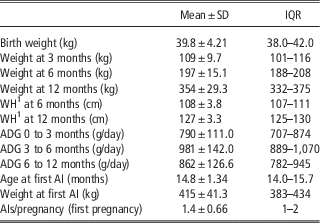
Descriptives on body growth and fertility of the heifers are shown in Table 1. Heifers weighed 39.8±4.21 kg at birth and during the 1st year of life an average daily weight gain (ADG) of 867±80.7 g/day was recorded. First insemination took place at the age of 14.8±1.34 months and 1.4±0.66 inseminations were needed per pregnancy.
Descriptive statistics on body growth and fertility of Holstein Friesian heifers

IQR=inter quartile range; WH=wither height; ADG=average daily weight gain; AI=artificial insemination.
1 Measured with a metal caliper on the left side of the standing animal.
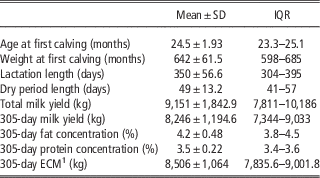
Age at first calving was 24.5±1.93 months with an average BW before calving of 642±61.5 kg (Table 2). In 68% of heifers, calving season was identical to birth season, whereas six heifers (with AFC<24 months) calved in a previous and 18 heifers (with AFC>24 months) calved in a subsequent season (Figure 1). At parturition, 38 female and 36 male calves were born and no dystocia was recorded. First-lactation length varied between 263 and 493 days, with an average of 350±56.6 days. During a 305-day lactation, heifers produced 8246±1194.6 kg milk with 4.2±0.48% fat and 3.5±0.22% protein. This represented a total of 8506±1064 kg ECM.
Descriptive statistics on first-lactation performance of Holstein Friesian heifers

IQR=inter quartile range; ECM=energy-corrected milk.
1 Calculated based on the milk, fat and protein yield.
Regression models for first-lactation milk yield
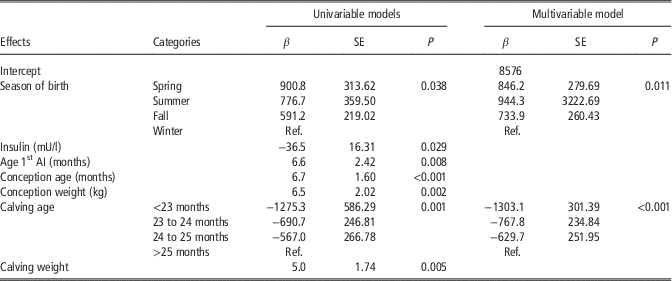
In Table 3, significant results of the univariable analyses are shown. Univariable analyses revealed no dam-factors to be associated with milk yield of the heifers. Body size and glucose concentrations of newborn calves did not affect milk yield, but higher basal insulin concentrations were negatively associated with milk yield during first lactation (P=0.029). Heifers that were older and heavier at conception and calving, produced more milk during first lactation when compared with their counterparts (P⩽0.002). Despite the fact that 50 out of 74 heifers calved in the same season they were born in, only birth season but not calving season had a significant effect on 305-day ECM (P=0.038 and P=0.90, respectively). Gender of the calf had no effect on first-lactation performance.
Results of the univariable and multivariable linear regression models for factors affecting the 305-d energy corrected milk (ECM)Footnote 1 yield during first lactationFootnote 2

AI=artificial insemination.
1 Calculated based on the milk, fat and protein yield.
2 Results of the models are shown as estimates (β) and standard errors (SE).
Based on the final multivariable model (Table 3), AFC and birth season were the most important factors influencing first-lactation milk yield. Heifers older than 25 months at first parturition produced 9207±620.6 kg ECM, which was significantly more than heifers younger than 23 and between 23 and 24 months (7904±645.3 and 8440±609.4, respectively; P⩽0.01). Milk yield of heifers with AFC between 24 and 25 months (8578±618.1) was similar to younger, but tended to be lower compared with older heifers (P=0.09). In addition, season of birth had a significant influence on the 305-day ECM (P=0.011). Heifers born in winter produced only 7901±634.0 kg 305-day ECM, which was significantly lower compared with heifers born in any other season (P⩽0.038).
Birth season, temperature and metabolism
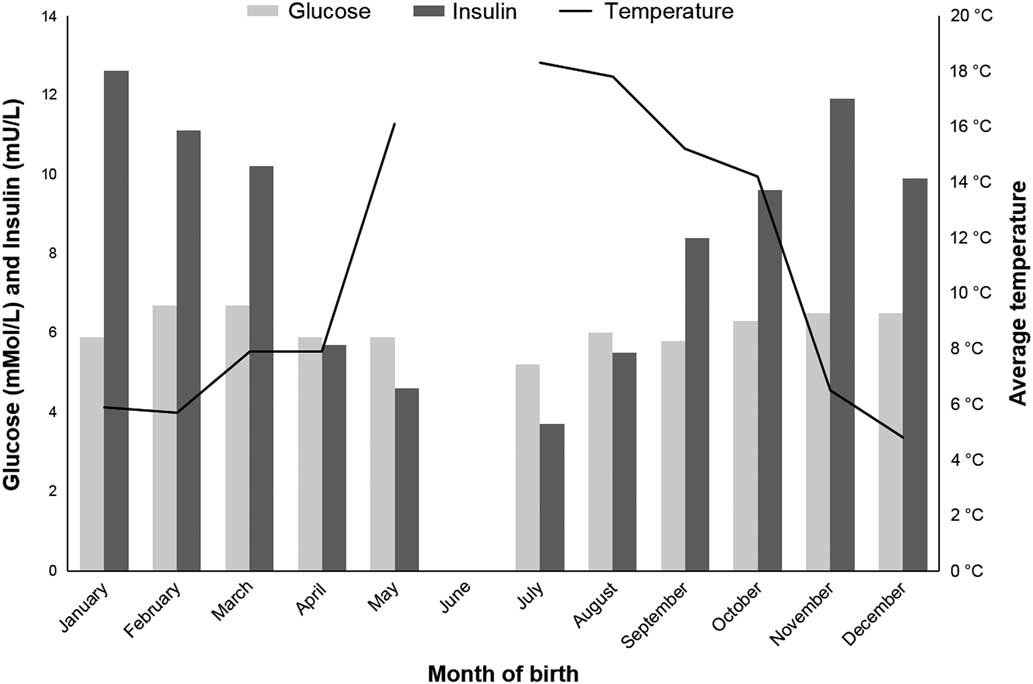
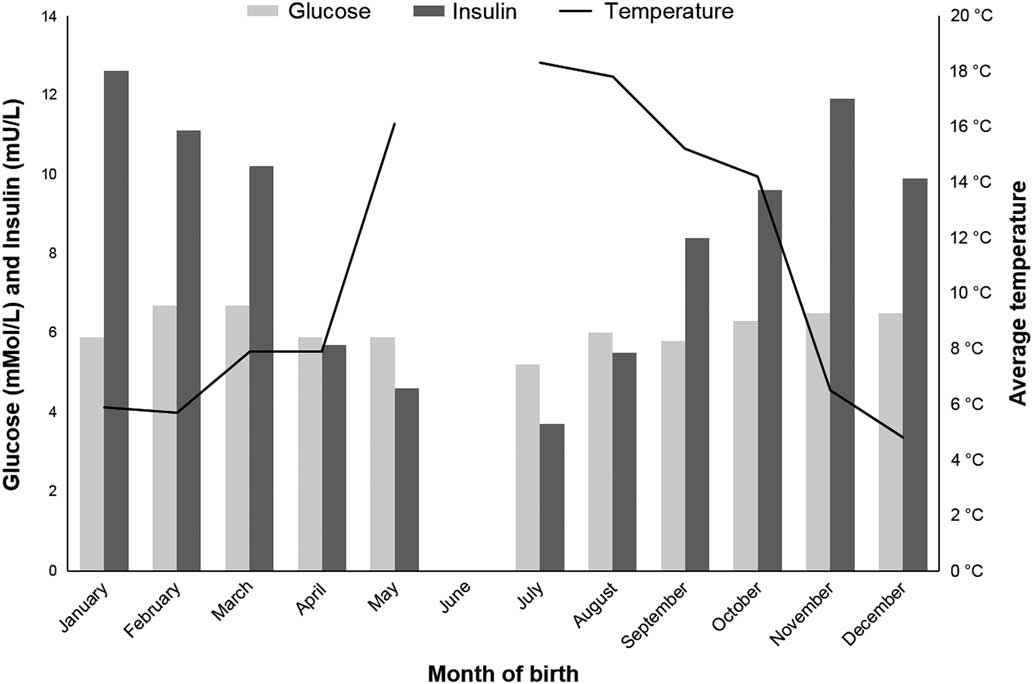
Although insulin concentration at birth had a significant effect on milk yield, it could not be withheld in the final model due to multicollinearity with season of birth. The relationship between birth season and insulin concentrations was further explored in relation to ambient temperature. Winter-born calves had a basal insulin concentration of 12.3±6.64 mU/l, which was significantly higher than calves born in spring (5.1±2.22 mU/l, P=0.002) and tended to be higher than calves born in summer (6.7±6.50 mU/l, P=0.056). Ambient temperature (on a 24-h basis) differed significantly between seasons, with significantly lower temperatures in winter (5.7±2.31°C) compared with spring and summer (11.4±3.01 and 16.5±2.09°C, P<0.01). Basal insulin concentrations were significantly negatively correlated with temperature at birth (r=−0.32, P=0.005; Figure 2).
Relation between glucose and insulin levels and the environmental temperature at birth. The left axis presents the average glucose (mMol/l) and insulin (mU/l) levels of the calves by the month of birth. On the right axis, the average ambient temperature at the birth month is shown. Despite similar glucose concentrations, insulin concentrations were significantly affected by month of birth (P<0.01) and negatively correlated with temperature (r=−0.32, P=0.005).
Discussion
There are many factors that influence milk yield during the first lactation, and a lot of them are difficult to account for when analyzing records across herds. Herd-specific factors were accounted for in the statistical model by including herd as random factor.
Dam factors
No association was found between milk yield of the dam during gestation and first-lactation production of the daughter, which is consistent with previous studies (Banos et al., Reference Banos, Brotherstone and Coffey2007; Astiz et al., Reference Astiz, Gonzalez-Bulnes, Sebastian, Fargas, Cano and Cuesta2014). Despite the absence of an effect on first-lactation milk yield, Banos et al. (Reference Banos, Brotherstone and Coffey2007) did report a negative impact of high maternal milk yield on daughter yield in lactation 2 and 3. The authors suggested cows to be more responsive to other factors once they completed their own growth, preventing them from reaching their full production potential during subsequent lactations. Hence, the productive life of first-lactation cows might be too short to draw any conclusions and heifers should be followed up into their second and third lactation in order to fully assess the impact of maternal milk yield during gestation. Astiz et al. (Reference Astiz, Gonzalez-Bulnes, Sebastian, Fargas, Cano and Cuesta2014) reported high yielding cows to be born from the youngest dams and concluded that maternal age is the single most important factor influencing life performance of daughters. According to Fuerst-Waltl et al. (Reference Fuerst-Waltl, Reichl, Fuerst, Baumung and Solkner2004), the negative impact of high maternal age on offspring production is already present in the first lactation of the offspring. However, this could not be confirmed in the present study, possibly due to the young age of the studied population. As 80% of dams were younger than 4 years, limited variation in maternal age could be responsible for the fact that it was not found to be associated with offspring performance.
Body weight and size
No relationship was found between the heifer’s birth weight and ADG during the 1st year of life on the performance during first lactation. This supports the results of Swali and Wathes (Reference Swali and Wathes2006), who reported that an animal’s birth weight does not affect its future performance. On the other hand, the lack of a relationship between juvenile ADG and adult performance is in contrast with other studies (Soberon et al., Reference Soberon, Raffrenato, Everett and Van Amburgh2012). Svensson and Hultgren (Reference Svensson and Hultgren2008) classified animals gaining >738 g/day between weaning and first service as high-gaining and reported an increase in 305-day milk yield in these heifers. As in our study, only three heifers had an ADG <738 g/day, the effect of juvenile growth might be masked by the fact that heifers included in the present study were reared under optimal conditions. Hence, the weight gain of studied heifers might be sufficient to assure optimal body size and adequate milk yield during the first lactation.
Age at first parturition
In agreement with the results of Svensson and Hultgren (Reference Svensson and Hultgren2008) and Nor et al. (Reference Nor, Steeneveld, Van Werven, Mourits and Hogeveen2013), an increase in age at first parturition resulted in a higher 305-day ECM. Calving at a very young age (<22 months) is known to compromise first-lactation production and profitability (Ettema and Santos, Reference Ettema and Santos2004; Froidmont et al., Reference Froidmont, Mayeres, Picron, Turlot, Planchon and Stilmant2013), with several authors describing a maximized milk yield at an AFC between 24 and 26 months (Wathes et al., Reference Wathes, Brickell, Bourne, Swali and Cheng2008; Froidmont et al., Reference Froidmont, Mayeres, Picron, Turlot, Planchon and Stilmant2013). However, in the present study the positive association between calving age and yield even persisted in older heifers. This is presumably due to the fact that in older animals, a lower energy requirement for growth is necessary (Svensson and Hultgren, Reference Svensson and Hultgren2008). Elvira et al. (Reference Elvira, Hernandez, Cuesta, Cano, Gonzalez-Martin and Astiz2013), who found similar results in sheep, suggested animals older at first lactation to achieve higher yields because their udder development was more complete by the time of first parturition. However, this advantage is not necessarily carried over to subsequent lactations, as in these older dams a more limited improvement from the first to second lactation has to be expected (Froidmont et al., Reference Froidmont, Mayeres, Picron, Turlot, Planchon and Stilmant2013). Hence, although younger dams have a decreased first-lactation yield, a higher lifetime production is expected in these cows, mainly caused by a longer productive life (Nilforooshan and Edriss, Reference Nilforooshan and Edriss2004).
A lower BW in heifers calving at a younger age might explain the compromised performance during first lactation, caused by a reduced dry matter intake. However, in the present study, in contrast with the results of Ettema and Santos (Reference Ettema and Santos2004), AFC was a better predictor of first-lactation performance than BW at first calving. Thus, even when a similar BW is reached at a younger age, reduced lactation performances are expected (Hoffman et al., Reference Hoffman, Brehm, Price and Prill-Adams1996). The latter adds to the idea that, despite the heifers’ BW, mammary gland development might be incomplete by first lactation in younger heifers.
Seasonal effects
Recently, several studies in sheep and cattle have described seasonal variation in milk yield, often attributed to the season of parturition (Elvira et al., Reference Elvira, Hernandez, Cuesta, Cano, Gonzalez-Martin and Astiz2013; Froidmont et al., Reference Froidmont, Mayeres, Picron, Turlot, Planchon and Stilmant2013; Astiz et al., Reference Astiz, Gonzalez-Bulnes, Sebastian, Fargas, Cano and Cuesta2014). However, most of these authors didn’t consider season of birth as an explainable variable in their models.
In our study, season of birth had a significant effect on milk yield, with winter-born heifers having the lowest 305-day ECM. In contrast, and despite the fact that birth and calving season were identical in most heifers, season of calving did not influence the first-lactation production. The latter suggests that the cause of the observed effect should be found in the prenatal or early postnatal life, rather than in the period around first parturition. This seasonal difference in performance of animals is likely to be a remaining physiological feature, caused by seasonal metabolic adaptations to enhance survival of the animal in different circumstances. However, the underlying factor driving this physiological response to season has yet to be elucidated. Therefore, several explanations are suggested why the birth season affects the heifers’ performance during first lactation.
Nutritional status
One possible explanation is a different nutritional status of the pregnant dam, which influences fetal development of the heifer. In our study, pregnant dams were intensively managed, a balanced ration was fed and no permanent grazing was allowed. Hence, a limited influence of season on nutritional status was expected. In addition, no effect of season was found on the body condition score of the dams at parturition, suggesting dams to have a comparable nutritional status at the end of pregnancy.
Prenatal and early postnatal photoperiod
Rius and Dahl (Reference Rius and Dahl2006) reported a tendency toward higher milk yield in heifers exposed to long-day photoperiods (LDPP, 16 h light, 8 h dark) during the prepubertal period compared with heifers exposed to short-day photoperiods (8 h light, 16 h dark). As LDPP heifers that tended to produce more milk had a greater WH before calving, the larger frame of the dam was suggested to explain at least partly the higher milk yield. However, in our study, body measurements at parturition were not related to birth season, so the higher ECM could not be attributed to a larger body frame. A second mechanism by which photoperiod length might influence milk yield, is by the effect of prolactin on mammary gland development. In LDPP heifers, an increase was seen in the concentration of prolactin (Rius and Dahl, Reference Rius and Dahl2006). This mechanism was previously suggested by Petitclerc et al. (Reference Petitclerc, Kineman, Zinn and Tucker1985), who reported a 40% increase in mammary parenchymal tissue weight in LDPP heifers. The researchers concluded that photoperiod treatment should be implemented during the prepubertal period, as a LDPP may initiate an earlier onset of allometric mammary growth. However, between weaning (3 months) and puberty (9 months), the summer-born and spring-born heifers in our study were exposed to an average daily photoperiod of only 10.8 h, compared with 13.9 h in fall-born and 14.1 h in winter-born heifers (P<0.05). Thus, the higher milk yield in heifers born in spring and summer cannot be attributed to longer prepubertal photoperiods.
Environmental temperature
Observed seasonal effects are often attributed to differences in temperature, inducing metabolic adaptations. In our study, lower insulin concentrations were recorded in heifers born in spring and summer when compared with heifers born in winter, which is consistent with previous studies (Kamal et al., Reference Kamal, Van Eetvelde, Bogaert, Hostens, Vandaele, Shamsuddin and Opsomer2014; Tao et al., Reference Tao, Monteiro, Hayen and Dahl2014). These results indicate differences in the metabolism of newborn calves, which are suggested to be related to environmental temperatures at the end of pregnancy. Although heat stress during late gestation is generally accepted to influence both dam and fetus (Tao and Dahl, Reference Tao and Dahl2013), these effects are expected to be less explicit in the moderate Belgian climate. However, according to Johnson (Reference Johnson1987), the critical upper air temperature for dairy cows is 20°C. In Belgium, from April till October, temperatures have been shown to climb repeatedly above 20°C, with more than 20 days of >20°C during July 2012. Thus, it is not unlikely that during hotter months, the cow and fetus experience a certain level of heat stress. The latter has recently been confirmed in a study by Van Laer et al. (Reference Van Laer, Moons, Sonck and Tuyttens2014), who reported that even in temperate climates the daily average Temperature Humidity Index exceeded 62 and 68 on 15% and 3% of the days, respectively.
Research in sheep has shown that higher environmental temperatures result in a shift of blood flow to peripheral tissues and a reduced blood flow to the uterus (Dreiling et al., Reference Dreiling, Carman and Brown1991). As this can prevent adequate delivery of nutrients – especially glucose – to the uterus, mainly at the end of gestation, the fetus might alter its metabolic phenotype to ensure survival (Yates et al., Reference Yates, Green and Limesand2011). The secretion of catecholamines is described to be the primary adaptive mechanism, ensuring maintenance of glucose supply by suppressing insulin secretion (Leos et al., Reference Leos, Anderson, Chen, Pugmire, Anderson and Limesand2010). Consequently, insulin-independent tissues (e.g. brain, nerves) have a competitive advantage over insulin-dependent tissues (e.g. liver, muscle) and glucose is preserved for vital organs. Eventually, when plasma insulin remains low, skeletal muscles might restore glucose uptake by increasing the receptor concentration, resulting in an enhanced insulin sensitivity (Limesand et al., Reference Limesand, Rozance, Zerbe, Hutton and Hay2006). In accordance with these results in sheep, Tao et al. (Reference Tao, Monteiro, Hayen and Dahl2014) reported reduced insulin concentrations and enhanced insulin sensitivity in calves born following heat stress during late gestation.
In our study, calves with a lower insulin level at birth produced more milk during first lactation. The exact mechanism behind this association is unknown, but several explanations can be suggested. A higher insulin sensitivity might induce a better accretion of tissues (including mammary tissue) during early life, resulting in a better first-lactation performance. In human babies, high insulin sensitivity at birth has indeed been associated with a rapid body growth (often referred to as ‘catch up growth’) (Ibáñez et al., Reference Ibáñez, Ong, Dunger and de Zegher2006). However, these babies have also been shown to be more prone to develop insulin resistance at an early age. Although insulin sensitivity around parturition was not assessed in the studied heifers, remarkable similarities between metabolic states in humans and dairy cows have been shown (De Koster and Opsomer, Reference De Koster and Opsomer2012). Thus, it is reasonable to believe that first-calving heifers with low insulin concentrations at birth, might, besides a rapid body growth, have a higher risk for insulin resistance when they reach the age of first calving. In dairy cattle, it is generally accepted that an insulin-resistant state in early lactation is necessary to ensure an adequate glucose supply to the udder (Bell, Reference Bell2006). Hence, the higher insulin sensitivity at birth might induce a higher insulin resistance and thus explain the higher milk yield during first lactation.
More research is necessary to explore the association between insulin sensitivity at birth, the insulin state at first parturition and its relation to milk yield.
Conclusions
Results of the present study indicate AFC and birth season to be of importance for first-lactation milk yield, with the highest milk yield seen in heifers born during hotter months. In addition, these animals had an enhanced insulin sensitivity at birth, supporting the hypothesis that seasonal effects on milk yield may be attributed to differences in outdoor temperature and mediated by specific metabolic adaptations.
Acknowledgments
The authors wish to thank the farm staffs for their contribution to this study.