


Introduction
Malaria remains one of the most serious health problems, killing 1 to 2 million people every year (WHO, Reference Yan, Severson and Christensen2005). In the last decades, efforts at controlling malaria have combined the use of anti-malarial drugs, insecticides, impregnated bed-nets and curtains. However, the success of these methods is threatened by the spread of parasites that are resistant to anti-malarial drugs (Hyde, Reference Hyde2005) and of mosquitoes that are resistant to insecticides (Hemingway, Field and Vontas, Reference Hemingway, Field and Vontas2002). Novel methods of malaria control are therefore indispensable.
A potential method that is attracting considerable attention is the genetic manipulation of mosquitoes (e.g. Beaty, Reference Beaty2000), which could reduce transmission in different ways. One of the most discussed is to transform mosquitoes with genes that make them resistant to infection by malaria and then to release them into natural populations with the hope that the genes can spread, thereby making most of the mosquitoes resistant and blocking the transmission of malaria.
Rapid advances have made solutions to some of the molecular problems of genetic manipulation appear within reach. Genes involved in resistance against malaria have been described (Dimopoulos, Reference Dimopoulos2003), artificial peptides (SM1: Ito et al. Reference Ito, Ghosh, Moreira, Wimmer and Jacobs-Lorena2002; PLA2: Moreira et al. Reference Moreira, Ito, Ghosh, Devenporti, Zieler, Abraham, Crisanti, Nolan, Catterucia and Jacobs-Lorena2002) impede the development of rodent malaria in mosquitoes and methods for genetic transformation (using, for example, transposons or homing endonuclease genes) are being developed (Catteruccia et al. Reference Catteruccia, Nolan, Loukeris, Blass, Savakis, Kafatos and Crisanti2000; Lobo et al. Reference Lobo, Clayton, Fraser, Kafatos and Collins2006). Such recent successes, in particular that mosquitoes have been transformed to be partially resistant to rodent malaria (Ito et al. Reference Ito, Ghosh, Moreira, Wimmer and Jacobs-Lorena2002), have given reason for limited optimism.
In contrast, the ecological and epidemiological problems (reviewed in Takken and Scott, Reference Takken and Scott2003) remain substantial. Two major questions are: (1) Under what conditions can resistance spread in a natural population of mosquitoes? and (2) If mosquitoes are not completely resistant, how will the release of transgenic mosquitoes affect malaria transmission?
We have recently studied these questions (Boëte and Koella, Reference Boëte and Koella2002) with an extension of the standard Macdonald-Ross model of malaria epidemiology (Macdonald, Reference Macdonald1957), which relates the prevalence, y, of malaria to its basic reproduction number R 0 (a measure of (unconstrained) transmission) with the equation  (where a is the mosquito's biting rate on humans and μ is the rate of the mosquito's mortality; see Table 1 for a list of parameters). As the intensity of transmission of malaria is extremely high in many areas, with R 0 reaching values up to 3000 (Smith et al. Reference Smith, McKenzie, Snow and Hay2007), our main conclusion was that, even if the genes coding for increased resistance become fixed (i.e. reach a frequency of 100%) with sufficiently efficient genetic drive mechanisms, the malaria prevalence in highly endemic areas is likely to decrease substantially only if the genes for resistance are almost completely effective (Boëte and Koella, Reference Boëte and Koella2002).
List of variables and parameters. The values are the ones used in the simulations.

 and the other parameters to be 362.
Unfortunately, the most effective genes may be the ones that are least likely to spread to fixation. The reason is that resistance to malaria comes with an evolutionary cost: it is associated with lower fecundity (Hurd et al. Reference Hurd, Taylor, Adams, Underhill and Eggleston2005) or smaller size (Yan, Sevenon and Christensen, Reference Yan, Severson and Christensen1997). Whether this cost is associated with the efficacy of resistance is not clear. Rather, it may depend on the details of the mechanism underlying resistance, as suggested by the difference between two artificial peptides, SM1 and PLA2. While mosquitoes transformed with either peptide show similar levels of resistance to infection by rodent malaria, SM1 is associated with a lower cost than PLA2 (Moreira et al. Reference Moreira, Wang, Collins and Jacobs-Lorena2004). The cost may also depend on the type of antigen that stimulates the immune response: melanising a Sephadex bead decreases the fecundity of Aedes aegypti if the bead is negatively charged but not if it has a neutral surface (Schwartz and Koella, Reference Schwartz and Koella2004). Nevertheless, in the absence of such variability, the cost of resistance appears to increase with its efficacy, as the ability to melanise a negatively charged Sephadex bead is negatively genetically correlated with the rate of larval development of Ae. aegypti (Koella and Boëte, Reference Koella and Boëte2003). If such an association is general, as seems reasonable, the genes leading to the most resistant mosquitoes will indeed be those that are least likely to spread.
Nevertheless, there may be scope for more optimism. In insects, one of the costs of immunity (which is the basis of resistance to malaria) is that stimulating immune responses increases the insect's mortality rate. This has been demonstrated for bumble-bees (Moret and Schmid-Hempel, Reference Moret and Schmid-Hempel2000) and has been suggested for mosquitoes (Boëte, Paul and Koella, Reference Boëte, Paul and Koella2004) (although it was not seen in an experiment that selected mosquitoes for resistance to malaria (Hurd et al. Reference Hurd, Taylor, Adams, Underhill and Eggleston2005)).
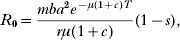
Such a cost would not only slow the spread of resistance (as mentioned above), but would also directly affect the epidemiology of malaria, as the adult mosquito's mortality rate is the parameter with the most influence on the intensity of transmission R 0 (Macdonald, Reference Macdonald1957). This is seen in the equation  (where m is the number of mosquitoes per human, b is the probability of transmission from infected humans to mosquitoes, T is the duration of the parasite's development in the mosquito, and r is the recovery rate of humans), where the mortality rate, μ, appears twice and influences R 0 exponentially.
Thus, although highly effective resistance with its high cost spreads less easily than less effective resistance, this disadvantage might be compensated by an indirect epidemiological benefit of higher vector mortality.
We studied this conflict between the evolutionary and the epidemiological effects of the cost of resistance by asking: What combination of efficacy and cost of resistance is best for malaria control? In other words: is it better to aim for less effective resistance that can be fixed, or to aim for higher efficacy of the resistant mosquitoes (but maintaining some susceptible mosquitoes in the population)? We proceeded by first considering the independent effects of cost and efficacy of resistance on the intensity of transmission and then assuming different relationships (i.e. trade-offs) between cost and efficacy to determine the optimal efficacy.
The model
The model is based on one that describes the spread of resistance genes in a population by combining epidemiological and population genetic processes (Boëte and Koella, Reference Boëte and Koella2002). We describe the model in three steps: the behaviour of the resistance gene (i.e. the population genetics), the effects of malaria and of the resistance gene on the transformed and untransformed mosquitoes (i.e. the mosquitoes' fitness), and the epidemiology.
Population genetics
Resistance is assumed to be determined by a single gene and the dynamics are described by discrete generations. As the costs and benefits of the resistance gene differ between males and females, we base our model on the standard population genetics equations for sex-dependent fitness (Hartl and Clark, Reference Hartl and Clark1989). Genetic manipulation is achieved by linking the resistance gene to a genetic drive mechanism that passes the gene to the offspring with a higher probability than the 50% of Mendelian genetics. (Note that we are optimistic by assuming that linkage between the drive mechanism and the resistance gene is complete and that the resistance gene cannot mutate.) Thus, we let the offspring of heterozygote mosquitoes harbour the resistance gene with the probability 0·5(1+∂), where the factor ∂ is the efficacy of the genetic drive. Thus, if p f describes the frequency of the resistance gene in female gametes at generation t, p m describes the frequency of the resistance gene in male gametes, W f,RR describes the fitness of females that are homozygous for the resistance gene, and W f,RS describes the fitness of females that are heterozygous for the resistance gene, then the frequency of the resistance allele in female gametes at generation t+1 can be described by

where the prime denotes the next generation, q=1−p is the frequency of the susceptible allele and  describes the mean fitness of females.
An analogous equation describes the spread of the allele for the males.
Fitness
We assume that fitness is proportional to the expected life-span of adults. While this implies that the females' fecundity and the males' mating rate are independent of their age, relaxing the assumption will not change the qualitative conclusions as long as fitness increases with lifespan.
According to our assumption, the fitness of males is proportional to 1/μxy, where the subscript xy gives the genotype of the mosquito (RR: homozygous for the resistant gene; SS: homozygous for the susceptible allele; RS: heterozygous). Mortalities are given by a cost of resistance, such that susceptible males have a mortality μSS=μ, homozygous resistant males have an increased mortality μRR=μ(1+c), and the mortality of heterozygotes is determined by the level of dominance, h, of the resistance allele and is given by μRS=μ(1+hc), (Note that by resistant (resp., susceptible) males, we mean carriers (resp., non-carriers) of the resistant alleles.)
The fitness of females is given by the cost of resistance c xy (1 for homozygous susceptibles, 1+hc for heterozygotes, or 1+c for homozygous resistants) and by the additional detrimental effect of malaria infection. The rate of being infected is the product of the prevalence of malaria in humans (y), the mosquito's biting rate (a), and the likelihood that a bite on an infected person leads to infection in the mosquito (b xy). If infected, the mosquito's probability of dying, i.e. the parasite's virulence, is α. Thus, a female's mortality rate is μxy,f=(μxy+ab xyyα)c xy. For susceptible mosquitoes, the probability of infection is the baseline value b SS=b, for homozygous resistant mosquitoes, it is b RR=b(1−s), where s is the efficacy of resistance, and for heterozygote mosquitoes, it is b RS=b(1−hs).
In summary, the fitness of males is 1/μ for homozygous susceptibles, 1/μ(1+c) for homozygous resistants and 1/μ(1+hc) for heterozygotes; the fitness for females is 1/(μ+abyα) for homozygous susceptibles, 1/(μ+ab(1−s)yα)(1+c) for homozygous resistants and 1/(μ+ab(1−hs)yα)(1+hc) for heterozygotes.
Epidemiology
Finally, as mentioned above, the prevalence of infection in the human population is determined by the classical Macdonald-Ross equation describing the epidemiology of malaria, The equation was modified to include mosquitoes with the three levels of mortality determined by the cost of resistance

where R 0 is the basic reproduction number of malaria, a is the mosquito's biting rate and  is its mean mortality rate, given by
 (if the population of mosquitoes is at Hardy-Weinberg equilibrium), where q=1−p is the allele frequency of the susceptible allele and the subscripts f and m denote females and males, respectively.
The basic reproduction number is the sum of the reproduction numbers associated with each genotype of mosquitoes. Again assuming that the population of mosquitoes is at Hardy-Weinberg equilibrium, we can write

(Note that the parasite's virulence does not enter the equation, as the basic reproduction number is calculated under the assumption that infections are rare, i.e. that the parasite's prevalence and thus its effect on mortality are very close to 0).
Evolutionary equilibrium
As described above, the basic reproduction ratio determines the prevalence in the human population (equation 2), which determines the fitness of each genotype of the mosquito (section ‘Fitness’). Fitness then determines the frequency of alleles (equation 1) and the genotype frequencies in the next generation, which determine the basic reproduction ratio (equation 3). To find the equilibrium situation, we iterated these processes 50 000 cycles and confirmed that the basic reproduction number had reached its equilibrium.
Results
Equilibrium
We first describe the equilibrium conditions of these equations. All of the simulations are based on an efficacy of genetic drive of ∂=0·1 and an intensity of transmission in the absence of control of R 0=100. Changing these parameters had no qualitative influence on the results.
If resistance is dominant (h=1), resistance becomes fixed (i.e. reaches a frequency of 100%) if the cost of resistance is low or the efficacy of resistance is high. If resistance is not fixed, it is generally eliminated from the population (Fig. 1A).
Equilibrium situation after invasion by a genetically manipulated mosquito, as a function of the cost of resistance (ranging from 0 [no cost] to 1 [a doubling of adult mortality]) and the efficacy of resistance (ranging from 0 [the allele that is intended to cause resistance has no effect on susceptibility] to 1 [homozygotes cannot be infected]). Panels (A) and (C) show the frequency of the resistance allele (the transposon), (B) and (D) show the intensity of transmission R 0. In (A) and (B) the resistance gene is dominant (i.e. heterozygotes are as resistant as the individuals carrying two copies of the allele), in (C) and (D) the resistance gene is recessive (i.e. heterozygotes are susceptible). Parameters are: a=0·5 day−1, μ=0·1 day−1, T=10 days, b=0·3, α=0·3, ∂=0·1, R 0 (before control)=100 (so m/μ=362).

Naturally, if resistance is eliminated, the control programme has no influence on the malaria situation, so that R 0 stays at its pre-control level. If resistance is fixed, complete resistance (s=1) eliminates malaria. If resistance is not 100% effective, malaria is not eliminated, but increasing cost of resistance (i.e. increased adult mortality) helps the control efforts by decreasing R 0, in particular when the efficacy of resistance is low (Fig. 1B).
This latter result can be understood if one considers that fixed resistance (p f=p m=1) reduces equation (3) to

which decreases as the cost of resistance, c, increases.
If resistance is recessive (h=0), the results are more complex. Again, at low costs of resistance or effective resistance (i.e. high benefits of resistance), the resistance allele is fixed (Fig. 1C), and in this situation increasing the cost of resistance decreases the intensity of transmission. In contrast to the dominant case, if resistance is not fixed, it is not eliminated from the population, but maintained at an intermediate frequency. As the cost of resistance increases or its efficacy decreases, the frequency decreases and the intensity of transmission increases towards its pre-control level.
Our expectation (see introduction) was that the decreased transmission associated with a higher cost of resistance (i.e. the epidemiological consequence of the cost) should more than compensate for the lower frequency due to the cost (i.e. the evolutionary consequence), leading to reduced transmission overall. However, Fig. 1 and extensive simulations not shown here suggest that this expectation is wrong. In all of the cases that we simulated, as the cost of resistance increases (above the limit that allows resistance to be fixed), the overall intensity of transmission increases from its minimal level (at no cost of resistance) towards its pre-control level. In other words, the effect of the cost of resistance on the frequency of the resistance allele is so high (i.e. the surface in Fig. 1C is so steep at the edge of fixation) that it cannot be compensated by the epidemiological effect of decreased longevity of mosquitoes. At the limit (if resistance is eliminated), this is trivial; in this case intensity of transmission is unaffected by the control programme. The result is, however, also valid if the cost is increased to such a small degree that resistance remains close to fixation.
This section thus shows (1) that a cost of resistance is beneficial for control if resistance is fixed in the population despite the cost, but (2) that any increase of the cost of resistance is detrimental to malaria control if resistance cannot be fixed.
Optimal level of resistance
If the cost and the efficacy can be chosen freely, it is thus clear that the optimal strategy would be to choose highly effective resistance with a cost that enables resistance to be fixed. But the cost of resistance is likely to increase in some way with its efficacy (see, for example, Koella and Boëte, Reference Koella and Boëte2003), so that the choice of the two parameters is constrained. Although there is no study in mosquitoes or any other host that has determined the shape of this constraint, we here assume three general shapes – a cost that increases linearly, more than linearly or less than linearly with the efficacy of resistance. More specifically, we assume that the cost increases with efficacy as  , where c max gives the maximal cost at 100%-effective resistance and where B=1 gives a cost that increases linearly with efficacy of resistance, B>1 gives an accelerating cost (low efficacies cost relatively less than high efficacies) and B<1 gives a decelerating cost (low efficacies are very costly). We then ask for each shape: what efficacy of resistance would lead to the strongest reduction of malaria transmission?
It is clear that for any trade-off between efficacy and cost of resistance, if the maximal cost is sufficiently low that resistance is fixed, the optimal efficacy is 100% (Fig. 2).
Estimate of the optimal efficacy of resistance if the cost c is related to efficacy s as , where cmax is the maximal cost (at complete resistance). Panels (A) and (C) show the optimal efficacy of resistance, (B) and (D) show the resulting intensity of transmission R 0. In (A) and (B) the resistance gene is dominant (i.e. heterozygotes are as resistant as the individuals carrying two copies of the allele), in (C) and (D) the resistance gene is recessive (i.e. heterozygotes are susceptible). Note that the orientation of the maximal cost is reversed in panels (B) and (D), so that the shapes of the surfaces are visible. Parameters are as in Fig. 1 except the parasite's virulence, which is α=0·2.

If resistance is dominant (h=1), the optimal efficacy is the highest level that can be fixed in a population, whatever the relationship between efficacy and cost of resistance (as long as it increases monotonically). If the efficacy is higher than this threshold, the associated high cost ensures that resistance is eliminated from the population. If the cost accelerates with efficacy (B>1), it remains low up to fairly high efficacies. Therefore, a more effective resistance can be fixed than in situations where the cost increases less than linearly with efficacy (B<1) (Fig. 2A). As the efficacy increases, so does the cost, reducing the mosquito's life-span and thus R 0 (Fig. 2B). Thus, a limited cost of resistance is beneficial for malaria control. This benefit, however, is very small if the efficacy of resistance is high, which is the only case of interest.
If resistance is recessive, the situation is more complex. For accelerating costs (B>1), the optimal efficacy is at the edge of fixation, i.e. at the highest level that can be be fixed in the population. This can be seen graphically by imagining a trade-off curve plotted onto the surface of Fig. 1D. As the cost accelerates, the curve relating cost to efficacy crosses the threshold of fixation at high efficacy, and as efficacy and cost increase beyond this threshold, the intensity of transmission is higher than at the threshold of fixation. Therefore, for accelerating costs, the optimal efficacy of resistance increases gradually with increasing exponent B and decreasing maximal cost.
If, on the other hand, the cost is decelerating (B<1), the curve relating cost to efficacy either never crosses the threshold (i.e. 100% resistance is fixed) or crosses it at a low efficacy (see Fig. 1D). Therefore, the optimal efficacy is either at 100% or quite low (Fig. 2C).
In both cases (recessive or dominant resistance), intensity of transmission is strongly reduced only if the maximal cost of resistance is low (so that very effective resistance is fixed), or if the cost of resistance accelerates strongly with its efficacy (B>1) (so that the cost is high only if efficacy is close to 100%) (Fig. 2B, D).
Discussion
We tested the idea that the evolutionary consequences of a cost of resistance (i.e. a lower frequency of resistant mosquitoes) can be compensated by its epidemiological consequences (reduced R 0), if the cost of resistance is expressed as a shorter life-span of adults. Our model indeed shows that a cost of resistance is advantageous, if the cost is low enough that resistance is fixed. In this case, any increase in adult mortality decreases the intensity of transmission of malaria. Therefore more costly resistance is beneficial for malaria control as long as the cost does not reduce the probability of fixation. However, in contrast to our expectation, if resistance is not fixed, the evolutionary consequence of the cost of resistance cannot be compensated by its epidemiological consequence; any increase of the cost of resistance will increase the intensity of transmission. The reason for this appears to be the high sensitivity of the frequency of resistance to changes in adult mortality (Fig. 1). Thus a small increase in adult mortality leads to a large decrease in the frequency of resistance, so that this evolutionary consequence overwhelms the epidemiological advantage. This sensitivity is extreme if resistance is encoded with a dominant gene; in this case, resistance is either fixed in the population or eliminated.
Our model further predicts that, if the cost and efficacy of resistance are linked, the optimal level of resistance is at the ‘edge of fixation’. For some relationships between cost and efficacy, resistance can be almost completely effective before it reaches the edge of fixation and its cost decreases the probability of fixation. In practice, however, this prediction may be of little use, as environmental variability and stochastic dynamics would prevent fixation unless the parameters were far from the edge of fixation.
The negligible impact of a shorter life-span in many situations of our model is in stark contrast to control programmes with impregnated bed-nets, which achieve their success with a combination of reduced biting rate and shorter life-span. There are two reasons for this difference. First, bed-nets directly protect the individuals using them, while genetic manipulation relies on the community effect of decreasing transmission. Second, in bed-net programmes, both (epidemiological) effects work in the same direction to reduce transmission, while genetic manipulation relies on a balance between the evolutionary pressure (lower frequency of resistance) and the epidemiological consequences (shorter life-span).
Of course, our conclusions are only as robust as our assumptions. In particular, we have not attempted to model a precise genetic mechanism of resistance. We have, for example, incorporated neither the recent suggestion that resistance is overdominant (i.e. that a resistance allele leads to resistance in heterozygotes and homozygotes but is costly only in homozygotes) (Marrelli et al. Reference Marrelli, Li, Rasgon and Jacobs-Lorena2007) nor the possibility that resistance is determined by more than one gene. However, omitting such aspects enables the model to remain simple, but should not affect the conclusions qualitatively. On the other hand, we do include some critical aspects of the epidemiological dynamics, in particular that, in an epidemiological context, any fitness advantage conferred by the transgene progressively decreases when its frequency rises, as increased resistance reduces the rate of disease transmission and thus the probability that a mosquito is infected and experiences higher mortality.
Overall, despite our attempt at being optimistic, our main conclusion remains as in our earlier paper (Boëte and Koella, Reference Boëte and Koella2002). So that transformed and therefore resistant mosquitoes can help to control malaria, resistance must be highly effective and have a low evolutionary cost so that resistance can reach a very high frequency. This means (1) that the cost must accelerate sharply with efficacy, so that the cost remains low unless efficacy is very close to 100% or (2) that an effective mechanism of genetic drive can overcome the evolutionary cost.
Fortunately, a relatively modest genetic drive can drive costly genes to fixation. The model described above was used to find these levels by trial and error, and gave the thresholds shown in Fig. 3. Even if the cost is twofold, a dominant gene can be driven to fixation if there is a 20% bias in passing on genes from heterozygous mothers to their offspring (i.e. resistant alleles are expected in about 60% rather than 50% of the offspring). Such drivers exist in some insects. Thus, in a recent population replacement experiment in Drosophila, a synthetic selfish genetic element was successfully transmitted at a very high frequency (>99%) to the progeny of heterozygous females (Chen et al. Reference Chen, Huang, Ward, Su, Schaeffer, Guo and Hay2007).
The level of genetic drive (bias of meiosis) required to fix resistance, as a function of the cost of resistance. The genetic drive is given as the expected proportion of a heterozygote's offspring that carry the resistance allele. This would be 0·5 for Mendelian inheritance (no genetic drive). Parameters as in Fig. 2.

Unfortunately, to date we know of no transposons in mosquitoes with any level of genetic drive.
Acknowledgements
We thank the Vector Group at Silwood Park for useful discussions, and two anonymous reviewers and Maria-Gloria Basáñez for comments that helped to improve the paper.



