Implications
Immunological castration is an effective means to reduce the occurrence of off-odor and off-flavor pork products from entire male pigs, while providing the opportunity for flexible immunization schedules that exploit the efficient growth and nutrient utilization of entire male pigs to obtain specific carcass composition goals. The linear relationship between time after surgical castration and body lipid and protein content may be used to predict carcass composition, and could be employed to determine the ideal immunization schedule of entire male pigs to meet specific market demands.
Introduction
In growing-finishing pigs, whole-body protein deposition (PD) is closely associated with lean growth, carcass value, as well as efficiency and profitability of pork production (National Research Council, 2012). The rate of PD is the primary factor determining amino acid requirements and entire male pigs (EM) exhibit greater rates of PD than male pigs castrated soon after birth (e.g. Mártinez-Ramírez et al., Reference Mártinez-Ramírez, Jeaurond and de Lange2008a and 2008Reference Mártinez-Ramírez, Jeaurond and de Langeb; NRC, 2012). However, male pigs that are castrated either surgically or immunologically after the transitory rise in testicular hormones that occurs within the first 4 weeks of life (Booth, Reference Booth1975; Schwarzenberger et al., Reference Schwarzenberger, Toole, Christie and Raeside1993) may partition dietary amino acids and energy differently than those castrated early in life (i.e. within 7 days of birth), or not castrated at all.
The global swine industry is moving toward more welfare-conscientious practices to reduce the occurrence of off-odor and off-flavor pork products from EM. Immunocastration may facilitate flexible castration schedules that optimize nutrient utilization and meet specific carcass composition goals. With castration later in the growth cycle, producers can exploit the relatively efficient growth of an entire male while still producing a boar taint-free product (Dunshea et al., Reference Dunshea, Colantoni, Howard, McCauley, Jackson, Long, Lopaticki, Nugent, Simons, Walker and Hennessy2001; Lealiifano et al., Reference Lealiifano, Pluske, Nicholls, Dunshea, Campbell, Hennessy, Miller, Hansen and Mullan2011). To determine the ideal immunization schedule however, data must first be collected from male pigs that grow with (and without) the influence of testicular hormones for varying periods of time. The objectives of this study were to determine the effect of age at surgical castration on indicators of boar taint and physical and chemical body composition at slaughter and to evaluate the effect of immunological castration on these same factors.
Material and methods
Animals, feeding, blood and back fat sampling
The experimental protocol was approved by the University of Guelph Animal Care Committee and followed Canadian Council of Animal Care guidelines (Canadian Council on Animal Care, 2009). This was part of a larger study (Huber et al., Reference Huber, Squires and de Lange2013) where animals and feeding regime are described in detail. In brief, 36 male pigs (PIC Line 42×Line 23; Floradale Farms, Floradale, ON, Canada) from nine different litters were used for serial blood and fat tissue sampling to measure the dynamics of boar taint factors, and to evaluate physical and chemical body composition at a final live BW (LBW) of ~115 kg. Four management regimens were used (n=9): (1) EM, (2) EM surgically castrated at ~40 kg BW and 10 weeks of age (late castrates; LC), (3) conventional, early surgical castrates (castrated within 4 days of birth; EC) and (4) EM immunized with a gonadotropin-releasing hormone (GnRH) analog (IM). Late surgical castration was conducted by a veterinarian as described by Huber et al. (Reference Huber, Squires and de Lange2013). The IM were injected subcutaneously behind the ear at ~30 kg (primary dose; 8 weeks of age) and 70 kg BW (booster dose; 14 weeks of age) with GnRH analog (IMPROVEST; Zoetis (formally Pfizer Animal Health), New York, NY, USA). An additional 12 male pigs were randomly selected from the treatment groups and used to determine chemical body composition at the initial BW (~70 kg; 4 EC, 3 EM, 2 IM (after administering the initial and before the booster dose of GnRH analog), and 3 LC). The study was conducted in three blocks, each using three litters and at least four male pigs per litter; littermates were randomly assigned to each of the four treatment groups. All pigs in each block had the same sire. Starting at ~50 kg LBW, pigs were individually housed and fed corn and soybean meal-based diets (Huber et al., Reference Huber, Squires and de Lange2013) in two equal feedings per day at 0800 and 1600 h; diets were not limiting in essential nutrients for high PD, but intake was controlled to simulate the feed intake of group-housed pigs as described previously (Huber et al., Reference Huber, Squires and de Lange2013).
Blood was collected from each pig ~4 h after the morning meal on days −4, −1, 2, 5, 8, 11, 14, 19, 28 and 37, relative to administering the booster dose of GnRH analog at day 0 to IM, to monitor plasma concentrations of androstenone and skatole. Three 5-ml blood samples were collected from the orbital sinus in heparinized vials at each sampling time and centrifuged for 20 min at 1500×g at 4oC. Plasma was aspirated, placed in microcentrifuge tubes and frozen at −20°C until further analysis. Samples of back fat were collected from the neck, anterior to the shoulders on days −3, 8 18 and 42 relative to administering the booster dose of GnRH analog at day 0, for androstenone and skatole analysis. For back fat sampling, pigs were restrained and 2% Lidocaine Hydrochloride was administered using local subcutaneous infiltration technique (20 mg/ml; Alveda Pharma, Belleville, ON, Canada; 2 to 5 ml, 15 min before procedure). After disinfection, a small incision was made using a scalpel and ~5 g of fat tissue was removed and stored at −20oC until further analysis. The incision was sutured and then coated with antibiotic cream. Sutures were removed after ~10 days. The final back fat sample (day 42) was collected after slaughter.
Serial slaughter and carcass evaluation
In all, 36 pigs were killed at a final LBW of 116±4 kg (41± 2 days after administering the booster dose of GnRH analog to IM males) using electrical stunning and exsanguination at the University of Guelph Meat Laboratory (Guelph, ON, Canada) after a 15-h fasting period, as described previously (Mártinez-Ramírez et al., Reference Mártinez-Ramírez, Jeaurond and de Lange2008a and 2008Reference Mártinez-Ramírez, Jeaurond and de Langeb). All pigs from each block were processed on the same day. Slaughter occurred at ~10 and 20 weeks after surgical castration for LC and EC, respectively, and 6 weeks after administering the booster dose of GnRH analog for IM. After slaughter, the eviscerated carcass was split longitudinally through the vertebral midline. Hot carcass weight (HCW) was measured, which included the head, feet and leaf lard but excluded the testes and accessory glands. Back fat thickness and longissimus muscle (LM) depth between the third and fourth last ribs were measured on the left side at ~7 cm from the midline using a Hennessy grading probe (Hennessy Grading Systems, Auckland, New Zealand; Anonymous, 1986). Protocols for processing the internal organs to determine gut fill and organ weights and for processing the right carcass sides (including head and feet) to determine chemical body composition have been described previously (Mártinez-Ramírez et al., Reference Mártinez-Ramírez, Jeaurond and de Lange2008a and 2008Reference Mártinez-Ramírez, Jeaurond and de Langeb). Left carcass sides were chilled at ⩽4°C for 24 h before re-weighing and dissection into total lean, fat and bone by trained personnel. For determination of chemical body composition at the initial LBW of 68±2 kg, 12 pigs were killed and processed as described above; dissection of the left side and measures of meat quality were not conducted.
During carcass dissection at the final LBW, subcutaneous fat depth was measured with a ruler at the grading site. Two 3-cm thick LM chops were then cut from the loin, trimmed of epimysium and external fat and deboned by trained personnel to determine loin meat quality measurements (i.e. color, firmness, wetness and marbling) according to National Pork Producers Council (1999) guidelines and 48-h drip loss (i.e. measured between 24 and 48 h postmortem) according to the method described by Honikel (Reference Honikel1998). For assessment of LM color, boneless LM chops were allowed to bloom for ~30 min to enhance color development. A Konica Minolta Chroma Meter (Model CR-400; Konica Minolta, Mississauga, ON, Canada) was used for objective measurements of lean color (lightness, redness and yellowness represented by L*, a* and b* values, respectively) per chop, whereas lean color was also assessed subjectively based on Japanese color assessment standards (1=extremely pale pink to gray, to 6=dark purplish red). Ultimate pH was obtained from the average of two measurements from one loin chop using a stainless steel, spear-tipped electrode (IQ Scientific Instruments, Loveland, CO, USA) attached to a Model IQ150 pH meter (Spectrum Technologies Inc., Aurora, IL, USA). The LM area (LMA) was measured by tracing the chop on acetate paper and determining the area with an electronic planimeter (Carl Zeiss, Inc., Toronto, ON, Canada).
Determination of androstenone and skatole in back fat and plasma
Frozen back fat samples were cut into small pieces, placed in 12×75 mm disposable glass tubes and heated in a microwave oven for 4 min at 30% of maximum power output. Liquid fat was collected into a second tube which was capped and stored at 4oC until further analysis. Plasma and fat samples were assayed in duplicate for androstenone using ELISA, according to Squires and Lundström (Reference Squires and Lundström1997). Intra-assay variability was 3.99% and 2.05% for plasma and fat, respectively. Inter-assay variability was 4.51% and 2.85% for plasma and fat, respectively. The minimum detection level was 1.56 ng/ml for plasma and 156 ng/g for liquid fat.
Plasma and fat skatole concentrations were determined using HPLC according to Claus et al. (Reference Claus, Dehnhard, Herzog, Bernal-Barrasgan and Giménez1993). Intra-assay variability was 5.38% and 4.96% for plasma and fat, respectively. Inter-assay variability was 4.55% and 5.96% for plasma and fat, respectively. The minimum detection level was 15.6 ng/ml for plasma and 15.6 ng/g for liquid fat.
Calculations and statistical analysis
Empty BW (EBW) of the pigs was calculated as LBW minus gut fill. Gut fill was considered the difference between full and empty gut weights. The physical and chemical compositions of the right and left carcass sides were considered equal, but standardized for differences in weight (i.e. due to unequal carcass splitting; Mártinez-Ramírez et al., Reference Mártinez-Ramírez, Jeaurond and de Lange2008b). Blood composition was calculated according to Möhn et al. (Reference Möhn, Gillis, Moughan and de Lange2000). Carcass dressing percentage, gut fill, PD and lipid deposition (LD) were calculated according to Mártinez-Ramírez et al. (Reference Mártinez-Ramírez, Jeaurond and de Lange2008b). Given that EM and IM do not differ physiologically after the initial dose of GnRH analog (Dunshea et al., Reference Dunshea, Colantoni, Howard, McCauley, Jackson, Long, Lopaticki, Nugent, Simons, Walker and Hennessy2001), results for initial whole-body chemical analysis were pooled to calculate PD and LD for IM and EM. The average daily BW gain (ADG) was calculated using the initial and final LBW.
Statistical analyses of physical and chemical body composition and meat quality were conducted using the mixed procedure of SAS (SAS Institute Inc., Cary, NC, USA) with individual pig as the experimental unit. The model included the fixed effects of treatment and the random effects of block and litter within block. When a significant treatment effect was detected at P<0.10, differences among individual means were assessed using the Tukey–Kramer post hoc test. To determine the effect of time after surgical castration on physical and chemical carcass characteristics at slaughter, a linear contrast was conducted among EM, LC and EC, where slaughter occurred with no surgical castration (EM), and 10 and 20 weeks after surgical castration for LC and EC, respectively. Fat and plasma androstenone and skatole concentrations were also analyzed with a mixed model but using the repeated measures option of SAS for the repeated sampling of blood and back fat. The models included the fixed effects of treatment, time (i.e. sampling day for repeated measures), and the interaction between treatment and time, and the random effects of block and litter within block. Plasma and back fat androstenone and skatole concentration data were log transformed to normalize the distributions. Preplanned contrasts were constructed to compare treatments within sampling day: EC v. LC; EM v. EC and LC; EM v. IM; and IM v. EC and LC. Probability levels <0.05 were considered significant, whereas 0.05<P<0.10 was considered a trend and P>0.10 was considered not significant.
Results
Androstenone concentrations in back fat and plasma
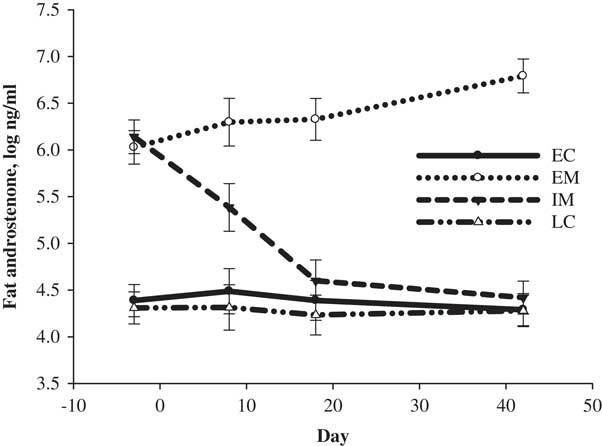
All pigs were healthy except 1 IM and 1 EM which were excluded due to illness and lameness, respectively; all data from these two pigs were omitted before analysis. No behavior abnormalities were observed in the remaining animals and pigs readily consumed their feed. An interactive effect between treatment and time relative to administration of the GnRH analog booster dose was observed for androstenone concentration in fat (P<0.001; Figure 1). Throughout the experiment, there were no differences in fat androstenone concentrations between EC and LC (actual overall mean values: 88 v. 74 ng/g, respectively), which were lower than in EM (780 ng/g; P<0.001). The concentration of androstenone in fat was not different between IM and EM on day −3 relative to administering the GnRH analog booster dose (520 v. 533 ng/g). Between days 8 and 42, concentrations of fat androstenone in IM were lower than those in EM (mean concentration between days 8 and 42: 173 v. 863 ng/g; P<0.01). Fat androstenone concentrations in IM were greater than in EC and LC between days −3 and 8 (404 v. 87 ng/g (mean for EC and LC between days −3 and 8); P<0.01) and not different between IM and EC and LC after day 18 (116 v. 75 ng/g (mean for EC and LC between days 18 and 42)).
Androstenone concentrations in back fat of early castrates (EC), entire male pigs (EM), immunized male pigs (IM) and late castrates (LC) across days relative to administering the booster dose of gonadotropin-releasing hormone (GnRH) analog (day 0; 14 weeks of age) to IM. EC: male pigs surgically castrated within 4 days after birth; IM: EM immunized GnRH at 30 and 70 kg BW (8 and 14 weeks of age, respectively); LC: male pigs surgically castrated between 25 and 40 kg BW (10 weeks of age).

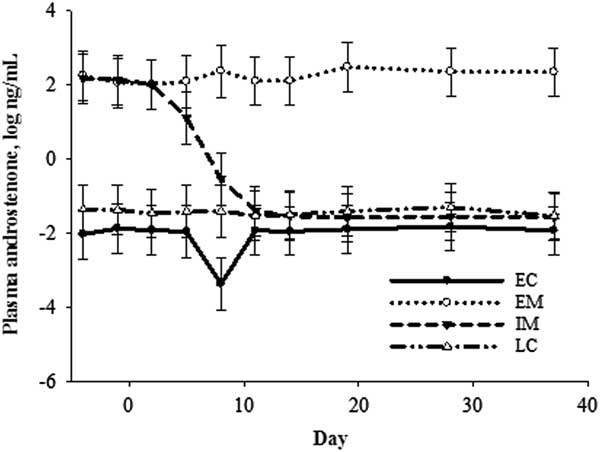
An interactive effect between treatment and time relative to administration of the GnRH analog booster dose was observed for androstenone concentration in plasma (P<0.001; Figure 2). Plasma androstenone concentrations were not different between EC and LC (actual overall mean values: 0.4 v. 0.3 ng/ml), which were lower than in EM (14.7 ng/ml; P<0.001) throughout the study. The concentration of androstenone in plasma was not different between IM and EM between days −4 and 2 relative to administering the GnRH analog booster dose (11.0 v. 11.1 ng/ml). Between days 5 and 37, plasma androstenone was lower in IM than in EM (1.1 v. 16.2 ng/ml; P<0.05). Plasma androstenone concentrations were greater in IM than in EC and LC between days −4 and 5 (9.1 v. 0.4 ng/ml (mean for EC and LC between days −4 and 5); P<0.001) and were not different between IM and EC and LC between days 8 and 37 (0.5 v. 0.4 ng/ml (mean for EC and LC between days 8 and 37)).
Androstenone concentrations in blood plasma of early castrates (EC), entire male pigs (EM), immunized male pigs (IM) and late castrates (LC) across days relative to administering the booster dose of gonadotropin-releasing hormone (GnRH) analog (day 0; 14 weeks of age) to IM. EC: male pigs surgically castrated within 4 days after birth; IM: EM immunized against GnRH at 30 and 70 kg BW (8 and 14 weeks of age, respectively); LC: male pigs surgically castrated between 25 and 40 kg BW (10 weeks of age).

Skatole concentrations in back fat and plasma
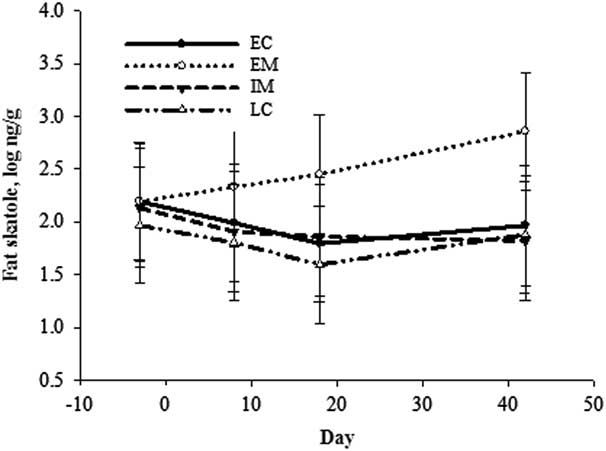
There were no main effects of treatment or time on fat skatole concentrations and there was no interactive effect of treatment and time relative to administering the GnRH analog booster dose (Figure 3). Based on preplanned contrasts, fat skatole concentrations were lower in IM and EC and LC (actual overall mean values: 9.6, 10.8 and 8.1 ng/g, respectively) than in EM (26.3 ng/g; P<0.05) at slaughter (day 42). Plasma skatole concentration decreased over time across treatments (P<0.001; data not shown); treatment did not have an effect on plasma skatole concentrations and no interactive effect of treatment and time after booster dose administration was observed.
Skatole concentrations in back fat of early castrates (EC), entire male pigs (EM), immunized male pigs (IM) and late castrates (LC) across days relative to administering the booster dose of gonadotropin-releasing hormone (GnRH) analog (day 0; 14 weeks of age) to IM. EC: male pigs surgically castrated within 4 days after birth; IM: EM immunized against GnRH at 30 and 70 kg BW (8 and 14 weeks of age, respectively); LC: male pigs surgically castrated between 25 and 40 kg BW (10 weeks of age).

Physical body composition
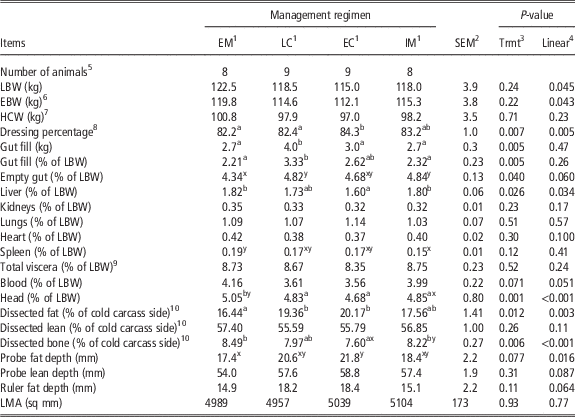
Although LBW and EBW decreased with time after surgical castration (linear; P<0.05), there were no differences among treatments for HCW (Table 1). In contrast, dressing percentage increased with time after surgical castration (linear; P<0.01). Dressing percentage was greater in EC than in LC and EM (P<0.05), whereas intermediate values were observed for IM. Gut fill was greater in LC than in any other treatment group (P<0.05) but was not influenced by time after surgical castration. Gut fill as a percent of LBW was greater for LC v. IM and EM (P<0.05), whereas intermediate values were observed for EC.
Physical carcass characteristics for early castrates (EC), entire male pigs (EM), immunized male pigs (IM) and late castrates (LC) at the final slaughter BW (115 kg)

LBW=live BW; EBW=empty BW; HCW=hot carcass weight; LMA=Longissimus muscle area.
a,bWhen a significant treatment effect was detected at P<0.10, differences among individual means were assessed using the Tukey–Kramer post hoc test. Means within a row with different superscripts differ (P<0.05).
x,yMeans within a row with different superscripts tend to differ (P<0.10).
1 EC: male pigs surgically castrated within 4 days after birth; IM: EM immunized against gonadotropin-releasing hormone at 30 and 70 kg BW (8 and 14 weeks of age, respectively); and LC: male pigs surgically castrated between 25 and 40 kg BW (10 weeks of age).
2 Based on the smallest number of observations per mean.
3 Main effect of management regimen.
4 The linear effect was calculated, using three groups EM (time=0), LC (time=10 weeks after surgical castration) and EC (time=20 weeks after surgical castration) and excluding the IM group.
5 Data from 1 IM and 1 EM were eliminated before analysis due to illness and lameness, respectively.
6 EBW (kg)=LBW−gut fill.
7 HCW includes head, leaf lard and feet but excludes weight of testes and accessory glands.
8 Dressing percentage=HCW/LBW×100.
9 Viscera excluding testes.
10 The difference from 100% of cold carcass side is made up of: skin, foot and tail, jowl, hock, shank, side ribs and back ribs.
The empty gut as a percent of LBW tended to increase with time after surgical castration (linear; P=0.060). There was also a trend for empty gut (% of LBW) to be greater in IM and LC than in EM (P=0.053 and P=0.057, respectively), whereas intermediate values were observed for EC. Liver as a percent of LBW decreased with time after castration (linear; P<0.05). Livers from EM and IM made up a greater percent of LBW than from EC (P<0.05), whereas intermediate values were observed for LC. There were no treatment differences in the weights of specific organs as a percent of LBW for kidneys, lungs or heart. The weight of the spleen tended to make up a greater percent of LBW in EM than in IM (P=0.083); intermediate values were observed for EC and LC. There were no differences among treatments for weight of the total viscera as a percent of LBW when testes were excluded. The weight of blood as a percent of LBW tended to decrease with time after surgical castration (linear; P=0.051). The weight of the head as a percent of LBW decreased with time after surgical castration (linear; P<0.001). The head made up a greater percent of LBW in EM than in EC or LC (P<0.05), and this trait tended to be greater in EM than in IM (P=0.084).
Total dissected fat as a percent of cold carcass side increased with time after surgical castration (linear; P<0.01; Table 1). The EC and LC had a greater total dissected fat content as a percent of the cold side weight than EM (P<0.05); intermediate values were observed for IM. Total dissected bone as a percent of cold carcass side weight decreased with time after surgical castration (linear; P<0.001). The EM and IM had greater total dissected bone as a percent of the cold side weight than EC (P<0.05 and P=0.065, respectively); intermediate values were observed for LC. Conversely, there were no differences in dissected lean as a percent of cold side weight among treatments. Probe fat depth increased with time after surgical castration (linear; P<0.05; Table 1). The EC tended to have a greater probe fat depth than EM (P=0.090), whereas intermediate values were observed for IM and LC. Probe lean depth and ruler fat depth both tended to increase (linear; P=0.087 and P=0.064, respectively) with time after surgical castration. The LMA did not differ among treatments.
Meat quality measurements
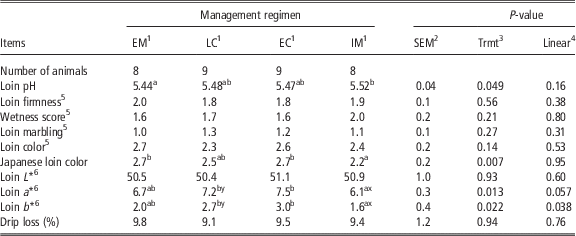
The 24-h LM pH was greater in IM than in EM (P<0.05) with intermediate values observed for EC and LC; time after surgical castration did not influence LM pH (Table 2). The subjective carcass measurements for firmness, wetness score, marbling and color were not different among treatment groups. Longissimus muscle from EC and EM had a greater Japanese loin color score than those from IM (P<0.05) with an intermediate value observed for LC; time after surgical castration did not influence Japanese loin color score. There was no treatment effect on LM L*values, whereas a* and b* values increased with time after surgical castration (linear; P=0.057 and P<0.05, respectively). The LM a* and b* values were greater in EC than in IM (P<0.05) and tended to be greater in LC than in IM (P=0.059 and P=0.099 for a* and b*, respectively), whereas intermediate values were observed for EM. Drip loss was not influenced by treatment.
Subjective and objective loin chop characteristics for early castrates (EC), entire male pigs (EM), immunized male pigs (IM) and late castrates (LC) at slaughter (115 kg)

a,bWhen a significant treatment effect was detected at P<0.10, differences among individual means were assessed using the Tukey–Kramer post hoc test. Means within a row with different superscripts differ, P<0.05.
x,yMeans within a row with different superscripts tend to differ, P<0.10.
1 EC: male pigs surgically castrated within 4 days after birth; IM: EM immunized against gonadotropin-releasing hormone at 30 and 70 kg BW (8 and 14 weeks of age, respectively); and LC: male pigs surgically castrated between 25 and 40 kg BW (10 weeks of age).
2 Based on the smallest number of observations per mean.
3 Main effect of management regimen.
4 The linear effect was calculated, using three groups EM (time=0), LC (time=10 weeks after surgical castration) and EC (time=20 weeks after surgical castration) and excluding the IM group.
5 Based on National Pork Producers Council (1999).
6 L*: lightness; a*: redness; b*: yellowness based on two measurements from boneless LM chops using Konica Minolta Chroma Meter.
Chemical body composition
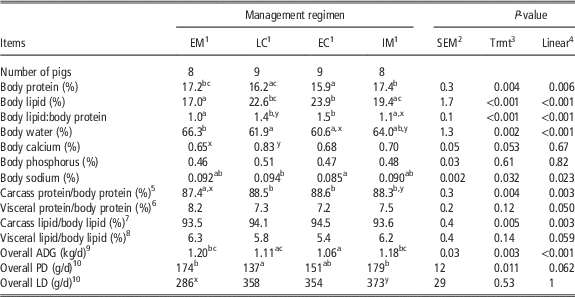
There were no differences in chemical body composition among treatments for pigs slaughtered at 70 kg LBW when initial body composition (data not shown) was assessed, except EC tended to have greater body lipid content than IM (17.9% v. 11.6%±2.1; P=0.090) with intermediate values observed for EM and LC (12.2% and 15.8%, respectively).Chemical body composition at the final LBW is presented in Table 3. Body protein content decreased with time after surgical castration (linear; P<0.01). It was greater in EM and IM than in EC (P<0.05) and greater in IM than in LC (P<0.05). The body lipid content increased with time after surgical castration (linear; P<0.001). It was greater in EC and LC than in EM (P<0.05), and greater in EC than in IM (P<0.05). The body lipid:body protein ratio increased with time after surgical castration (linear; P<0.001). This ratio was greater in EC than in EM or IM (P<0.05), and greater in LC than in EM (P<0.05) or IM (P=0.056).
Chemical body composition for early castrates (EC), entire male pigs (EM), immunized male pigs (IM) and late castrates (LC) slaughtered at 115 kg BW

ADG=average daily BW gain; PD=whole-body protein deposition; LD=whole-body lipid deposition; LBW=live BW.
a,b,cWhen a significant treatment effect was detected at P<0.10, differences among individual means were assessed using the Tukey–Kramer post hoc test. Means within a row with different superscripts differ (P<0.05).
x,y,zMeans within a row with different superscripts tend to differ (P<0.10).
1 EC: male pigs surgically castrated within 4 days after birth; EM: entire male pigs; IM: EM immunized against gonadotropin-releasing hormone at 30 and 70 kg BW (8 and 14 weeks of age, respectively); and LC: male pigs surgically castrated between 25 and 40 kg BW (10 weeks of age).
2 Based on the smallest number of observations per mean.
3 Main effect of management regimen.
4 The linear effect was calculated, using three groups EM (time=0), LC (time=10 weeks after surgical castration) and EC (time=20 weeks after surgical castration) and excluding the IM group.
5 Percentage of total body protein content in carcass.
6 Percentage of total body protein content in viscera.
7 Percentage of total body lipid content in carcass.
8 Percentage of total body lipid content in viscera.
9 ADG between ~70 and 115 kg BW.
10 Based on the differences in body protein and body lipid (g) between the initial LBW (at 70 kg) and the final LBW (at 115 kg) and the number of days between these LBW.
The body water content decreased with time after surgical castration (linear; P<0.001) and was greater in EM than in EC or LC (P<0.05); IM tended to have a greater body water content than EC (P=0.079). There were no treatment differences in total body calcium or body phosphorus contents. Total body sodium content decreased with time after surgical castration (linear; P<0.05) and was greater in LC than in EC (P<0.05), whereas intermediate values were observed for EM and IM.
The percentage of body protein present in carcass increased with time after surgical castration (linear; P<0.01). It was greater in EC and LC than in EM (P<0.05) and tended to be greater in IM than in EM (P=0.075). The percentage of body protein present in viscera tended to decrease with time after surgical castration (linear; P=0.050). The percentage of body lipid in carcass increased (linear; P<0.01) and the percentage of body lipid in viscera tended to decrease with time after surgical castration (linear; P=0.059).
Overall ADG decreased with time after surgical castration (linear; P<0.001). It was greater in EM and IM than in EC (P<0.05), whereas an intermediate value was observed for LC. Whole-body PD tended to decrease with time after surgical castration (linear; P=0.062). The EM and IM had greater PD than LC (P<0.05) and an intermediate value was observed for EC. The IM tended to have greater overall LD than EM (P=0.051), whereas intermediate values were observed for EC and LC; time after surgical castration did not influence LD.
Discussion
The objective of this study was to determine the effect of time after castration, either surgical or immunological, on indicators of boar taint and physical and chemical body composition at slaughter. The current study demonstrated that the transient rise in testicular hormones that occurs within the first 4 weeks of life in intact male pigs (Schwarzenberger et al., Reference Schwarzenberger, Toole, Christie and Raeside1993) has a lasting impact on physical and chemical carcass composition. Increasing the interval between surgical castration and slaughter (i.e. EM v. LC surgically castrated 10 weeks before slaughter v. EC surgically castrated 20 weeks before slaughter) decreased LBW and carcass protein concentration and increased carcass fat content in a linear manner. In addition, IM, that received the booster dose of GnRH analog 6 weeks before slaughter, had some physical and chemical composition characteristics that were intermediate to EM and EC including dressing percentage and dissected fat, whereas other characteristics such as liver weight as a percent of LBW and body protein and body lipid contents were more similar to EM than EC. The aforementioned indicates that additional time is required (i.e. >6 weeks) for the body composition of IM males to become similar to surgically castrated male pigs. However, IM may always have intermediate body composition to EM and EC due to the early impact of testicular hormones in a manner similar to LC. Therefore, administering the booster dose of GnRH analog earlier than 14 weeks of age may still offer some advantages to carcass composition at slaughter relative to EC, while providing technical benefits (i.e. administering the booster dose of GnRH analog to smaller pigs; e.g. Lealiifano et al., Reference Lealiifano, Pluske, Nicholls, Dunshea, Campbell, Hennessy, Miller, Hansen and Mullan2011). In addition, the relationship between time after castration and body composition may be used to predict carcass composition and to target specific markets.
In the current study, EM and IM demonstrated similar and high levels of PD, which were comparable with previous observations of EM (Mártinez-Ramírez et al., Reference Mártinez-Ramírez, Jeaurond and de Lange2008b; as reviewed by Millet et al., Reference Millet, Gielkens, De Babrander and Janssens2011). The serial slaughter determination of PD in the current study exceeded typical levels for EM between ~70 and 115 kg BW as predicted by NRC (2012). However, PD determined by nitrogen balance in these same pigs began to decrease in IM at ~day 10 after administering the booster dose of GnRH analog relative to EM (Huber et al., Reference Huber, Squires and de Lange2013), indicating a dynamic response to the endocrine environment and feed intake. Conversely, the IM also demonstrated a ‘compensatory’ increase in LD while maintaining high levels of PD after the booster dose relative to EM. These results indicate that the retention of dietary energy in carcass protein is maintained in IM after the administration of the GnRH analog booster dose for up to 2 weeks. However, with an accompanying increase in feed intake, IM will also increase LD to eventually reach a new body lipid:body protein ratio (Batorek-Lukač et al., Reference Batorek-Lukač, Dubois, Noblet, Čandek-Potokar and Labussière2016). Therefore, reducing the dietary energy content for IM males may not be a feasible method to control body composition after the booster dose as PD may also be reduced. An earlier booster dose or increased slaughter weight may produce greater differences in lipid and PD and allow producers to meet specific body composition goals (Lealiifano et al., Reference Lealiifano, Pluske, Nicholls, Dunshea, Campbell, Hennessy, Miller, Hansen and Mullan2011).
In the current study, absolute gut fill was greater in LC than any other treatment group and gut fill as a percent of LBW was greater in LC v. IM and EM. In previous studies, positive correlations between gut fill and pre-slaughter feeding levels were observed (de Lange et al., Reference de Lange, Morel and Birkett2003). It was therefore anticipated that gut fill would be highest in IM, lowest in EM and intermediate in EC and LC based on previous feed intake and behavior studies for these and other pigs (Dunshea et al., Reference Dunshea, Colantoni, Howard, McCauley, Jackson, Long, Lopaticki, Nugent, Simons, Walker and Hennessy2001; Huber et al., Reference Huber, Squires and de Lange2013). It should also be noted that feed was withdrawn from pigs in the current study 15 h before slaughter, and therefore feed intake effects on gut fill are likely to be reduced. Gut fill is rather variable and was based on a relatively small number of observations per treatment. Meanwhile, the treatment effects on dressing percentage can partly be attributed to the inclusion of testes and accessory glands in the visceral weight for the IM and EM and the relatively high gut fill for LC, and generally align well with the literature (e.g. as reviewed by Millet et al., Reference Millet, Gielkens, De Babrander and Janssens2011). Heads from EM made up a greater percent of LBW than for the other treatment groups and may be due to difference in skeletal growth among treatment groups.
In the current study, loin pH was greater for IM than for EM, whereas firmness, wetness, marbling and drip loss did not differ. There were some differences among treatments for objective color scores and some aspects of subjective meat quality evaluation. Of note was the increase in redness (a*) and yellowness (b*) with time after surgical castration. To our knowledge, this relationship has not previously been demonstrated; however, the magnitudes of differences were small and treatment mean values were within the range for consumer acceptability. In the current study, the a* and b* scores were not different between IM and EM, which contrasts with the results of Moore et al. (Reference Moore, Dunshea, Mullan, Hennessy and D’Souza2009) where IM had greater L*, a* and b* values. Differences in meat color may occur with differing breeds of pigs (Choi et al., Reference Choi, Lee, Jung, Jung, Jung, Jung, Choi, Jin and Choi2016), but based on a meta-analysis of 28 published studies using pigs of various genotypes, Pauly et al (Reference Pauly, Luginbühl, Ampuero and Bee2012) found no difference in meat color or eating quality among EM, IM and EC.
The reduction in carcass sodium content with time after castration in the current study was also unexpected. To our knowledge, this has not been reported previously among pigs fed the same diet. It is likely that sodium is associated with body water and the contents are proportional to one another. In addition, body water paralleled body protein for all pigs, which is consistent with the treatment effects on chemical body composition (NRC, 2012).
The efficacy of immunological castration against a GnRH analog has been well established, especially in controlled studies (Dunshea et al., Reference Dunshea, Colantoni, Howard, McCauley, Jackson, Long, Lopaticki, Nugent, Simons, Walker and Hennessy2001; Claus et al., Reference Claus, Lacorn, Danowski, Pearce and Bauer2007; Bauer et al., Reference Bauer, Lacorn and Claus2009); products are licenced in both Europe and North America for use on commercial farms. In the current study, plasma and fat androstenone were reduced in IM males within 8 and 18 days of the booster dose, respectively, and remained similar to surgically castrated males until slaughter, 6 weeks later. Therefore, immunization with a GnRH analog successfully interrupted the GnRH axis, and the effects did not diminish for at least 6 weeks when the booster dose was administered at 70 kg BW. Providing the booster dose of GnRH analog earlier increases the risk that the GnRH axis may regain functionality which increases the risk for boar tainted pork. Previous research has demonstrated that GnRH antibodies remained elevated up to 22 weeks and that plasma concentration of testosterone remained lower in IM than in EM for the same time period, indicating that testicular function remained inhibited for at least 22 weeks after administering the booster dose of GnRH analog (Zamaratskaia et al., Reference Zamaratskaia, Rydhmer, Andersson, Chen, Lowagie, Andersson and Lundström2008b). Conversely, others demonstrated an increase in plasma testosterone as early as 8 (Wicks et al., Reference Wicks, Crouch and Pearl2013) or 10 (Claus et al., Reference Claus, Rottner and Rueckert2008) weeks after administering the booster to 20- and 26-week-old pigs, respectively. Therefore, the degree of sexual maturity at the time of booster dose administration may influence the long-term effect on the GnRH axis. As for fat skatole, concentrations were below the human level of detection in all treatment groups (Dunshea et al., Reference Dunshea, Colantoni, Howard, McCauley, Jackson, Long, Lopaticki, Nugent, Simons, Walker and Hennessy2001); some herds have low concentrations of skatole, regardless of gender (Bonneau et al., Reference Bonneau, Dufour, Chouvet, Roulet, Meadus and Squires1994; Zamaratskaia et al., Reference Zamaratskaia, Andersson, Chen, Andersson, Madej and Lundström2008a).
In conclusion, castration of male pigs after 6 weeks of age may have a lasting effect on physical and chemical body composition. Increasing the interval between surgical castration and slaughter (i.e. EM v. LC surgically castrated 10 weeks before slaughter v. EC surgically castrated 20 weeks before slaughter) decreased LBW and carcass protein content and increased carcass fat content. Immunization against GnRH was effective at reducing boar taint compounds in fat tissue within 18 days after administering the booster dose of GnRH analog, which remain low for at least 24 days thereafter. In addition, IM, that received the booster dose of GnRH analog 6 weeks before slaughter, had some physical and chemical composition characteristics intermediate to those of EM and EC including dressing percentage and dissected fat, whereas other characteristics such as liver weight as a percent of LBW and body protein and body lipid contents were more similar to EM than EC. The relationship between time after castration and body composition may be used to predict carcass composition and can be used to determine the ideal immunization schedule aimed at specific markets in the future.
Acknowledgments
The authors acknowledge technical support from D. C. Wey, C. Zhu, Y. Lou, C. Campbell and the staff at the University of Guelph Meat Laboratory, as well as, statistical analysis support from E. G. Miller. This research was supported by funds from Zoetis (formally Pfizer Animal Health; New York, NY, USA), Swine Innovation Porc (Quebec City, QC, Canada), Ontario Pork, and the Ontario Ministry of Agriculture, Food and Rural Affairs (Guelph, ON, Canada). Mention of a trade name, proprietary product or specific equipment does not constitute a guarantee or warranty by the University of Guelph, and does not imply approval to the exclusion of other products that may be suitable.