Implications
The efficiency of energy utilization in the diet can influence the reproductive performance of sows and their litters’ growth performance, thus having a direct impact on the economy. Normally, lipids containing long or saturated fatty acids have lower digestibility than those containing shorter or unsaturated fatty acids. Emulsifier can increase the utilization of lipids. Our results showed that lysophospholipids (LPL) in diets decreased BW loss and backfat thickness loss while improving apparent nutrient digestibility and milk nutrient concentration. Therefore, using emulsifier such as LPL might be able to solve the problem of lipid utilization in sows and increase the income of producers.
Introduction
Energy utilization is limited in the diet of lactating sows. Energy influences the milk production and maintenance functions such as basal metabolism, feed digestion and blood circulation, thus impacting litter performance and reproductive performance of sows. Dietary energy encompasses energy produced from oxidation of proteins, lipids and carbohydrates after digestion and absorption. Energy generated from oxidation of fatty acids derived from dietary lipids is more than twofold higher than that generated from starch. Therefore, adding dietary lipids has been considered as an important means to increase energy concentrations in swine diets. The addition of fat to the diet of lactation sow can improve litter weight gain and reproductive performance of sows (Rosero et al., Reference Rosero, Odle, Mendoza, Boyd, Fellner and Van Heugten2012 and Reference Rosero, Van Heugten, Odle, Cabrera, Arellano and Boyd2015).
Emulsifiers can distribute oil droplets in the emulsion which contributes to the digestion and absorption of lipids. LPL are emulsifiers that can improve the digestion of lipids. The addition of LPL into a diet with reduced energy content can improve average daily gain (ADG), the apparent total tract digestibility (ATTD) of dry matter (DM), nitrogen (N), gross energy (GE) and crude fat in weanling pigs (Zhao et al., Reference Zhao, Li, Hossain and Kim2015). Dierick and Decuypere (Reference Dierick and Decuypere2004) have reported that emulsifier does not influence the apparent ileal or fecal digestibility of rendered animal fat. However, the apparent ileal digestibility of DM, organic matter, CP and energy are improved in growing pigs with emulsifier added to the diet. In addition, the apparent fecal digestibility of DM, organic matter, CP and ash are improved in growing pigs when emulsifiers are added to the diet (Dierick and Decuypere, Reference Dierick and Decuypere2004). Research investigating the use of emulsifiers in sows is very limited. In addition, in most cases, lactating sows do not consume enough feed to supply their daily energy needs for maintenance and milk production (Aherne, Reference Aherne2010). As a consequence, these sows will mobilize energy from both body protein and body lipid stores, which in a long term can impact the reproductive performance of sows (Dourmad et al., Reference Dourmad, Etienne, Prunier and Noblet1994). We hypothesize that emulsifiers could increase the digestibility of nutrients, influence milk composition and improve litter growth performance. Therefore, the objective of this study was to determine the effect of dietary LPL supplementation in diets differing in fat contents on the growth performance, nutrient digestibility and milk composition in lactating sows, as well as performance and fecal score in piglets.
Material and methods
The experimental protocols describing the management and care of animals were reviewed and approved by the Animal Care and Use Committee of Dankook University.
Experimental design, animals and housing
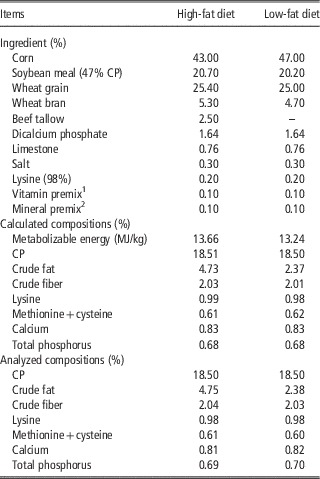
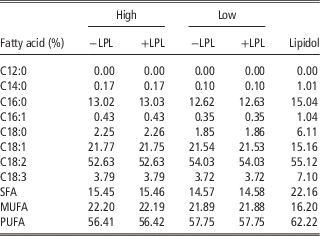
A total of 32 multiparous sows (Landrace×Yorkshire) were used in a 21-day experiment. On gestation day 110, sows were weighed, moved into a farrowing facility and randomly assigned in a 2×2 factorial arrangement according to their BW with two levels of LPL (0 and 30 mg/kg) and two levels of fat (4.75% and 2.38% fat; 13.66 and 13.24 MJ/kg). Dietary nutrients were formulated to meet or exceed National Research Council (NRC) (Reference Nelssen, Lewis, Peo and Crenshaw2012) recommendations (Table 1). Lipidol is the source of LPL, which was obtained from soybean lecithin using an exclusive proprietary technology developed by UK-based company Pathway-Intermediates (EASY BIO Inc., Seoul, South Korea). Lipidol contains 3% LPL, 47% other lipids (phospholipids and triglycerides) and 50% calcium silicate. LPL consisted of one hydrophilic head (choline and phosphate) and one hydrophobic tail (one fatty acid chain). LPL was included in the diets by replacing the same amount of corn. The fatty acid composition of Lipidol and experimental diets are shown in Table 2. Sows were housed in farrowing crates (2.1×0.6 m) containing an area (2.1×0.6 m) for newborn piglets on each side. The temperature in the farrowing house was maintained at a minimum of 20°C. Heat lamps were provided for piglets. Within 24 h after farrowing, all litters were standardized to nine piglets per litter. Piglets were subcutaneously injected with iron dextran (1 ml/pig) within 24 h of birth. After farrowing, daily feed allowance was increased gradually. Sows were provided with free access to drinking water throughout the experimental period. They were provided ad libitum access to feed by day 6. Piglets received no creep feed.
Composition of experimental diets (as-fed basis)

1 Provided per kilogram of complete diet: vitamin A, 10 000 IU; vitamin D3, 2000 IU; vitamin E, 48 IU; vitamin K3, 1.5 mg; thiamine, 1.7 mg; riboflavin, 6 mg; niacin, 40 mg; d-pantothenic, 17 mg; biotin, 0.2 mg; folic acid, 2 mg; choline, 166 mg; vitamin B6, 2 mg; and vitamin B12, 28 μg.
2 Provided per kilogram of complete diet: Fe (as FeSO4·7H2O), 90 mg; Cu (as CuSO4·5H2O), 15 mg; Zn (as ZnSO4), 50 mg; Mn (as MnO2), 54 mg; I (as KI), 0.99 mg; and Se (as Na2SeO3·5H2O), 0.25 mg.
Analyzed fatty acid composition of Lipidol and experimental diets (as-fed basis)

High=high-fat diet (4.75%; 13.66 MJ/kg) minus (−) or plus (+) 30 mg/kg lysophospholipids (LPL); Low=low-fat diet (2.38%; 13.24 MJ/kg) minus (−) or plus (+) 30 mg/kg LPL; SFA=saturated fatty acids; MUFA=monounsaturated fat acids; PUFA=polyunsaturated fatty acids.
Experimental procedures and sampling
Individual sow was weighed and scanned for backfat thickness on the day of farrowing and on day 21 of lactation. Backfat thickness of sows (6 cm off the midline at the 10th rib) was measured using a real-time ultrasound instrument (Piglot 105; SFK Technology, Herlev, Denmark). During the experimental period, the numbers of piglets born alive and dead per litter were recorded to calculate survival ratio. Individual pig weight was recorded at birth and weaning (day 21 of lactation) to determine weight gain. After farrowing, daily feed allowance was increased 1 kg/day until day 6 postpartum. Sows were provided ad libitum access to feed and water. During lactation, feed consumption was recorded for each sow to calculate average daily feed intake (ADFI). After weaning, the weaning to estrus interval was recorded for each sow.
Chromium oxide (0.2%) was added to the diet as an indigestible marker for 7 days before fecal collection to determine the ATTD of DM, N and GE (Fenton and Fenton, Reference Fenton and Fenton1979). Fecal samples were collected directly from sows via rectal stimulation at weaning (day 21). They were placed on ice for transportation to the laboratory. All feed samples and fecal samples were stored at −20°C until analysis.
Fecal score in piglets was recorded daily per pen from day 0 to day 7 and day 8 to weaning by the same person using the following score system: 1=hard, dry pellets in a small, hard mass, 2=hard, formed stool that remains firm and soft, 3=soft, formed and moist stool that retains its shape, 4=soft, unformed stool that assumes the shape of the container, 5=watery, liquid stool that can be poured. Scores were recorded on a pen basis following observations of individual pig and signs of stool consistency in the pen. The score was reported as an average daily fecal score of individual pig.
Milk samples were collected from each sow on day 10 and day 20 of lactation. Sows were intravenously injected with 10 IU of oxytocin. Milk (45 ml) was collected from all functional glands by hand milking and stored in opaque plastic bottles at −20°C until analysis.
Laboratory analysis
Fatty acids were extracted from Lipidol and experimental diets samples by a one-step direct transesterification procedure (Lepage and Roy, Reference Lepage and Roy1986). These samples were then assayed for total fatty acid content using a (HP-6890) gas chromatograph fitted with an (HP-7683) automatic injector and a (HP-5973) mass selective detector (all Hewlett-Packard, Avondale, PA, USA) using a 60-m capillary column (0.25 mm i.d.; model DB-23; Agilent, Santa Clara, CA, USA). Helium was the carrier gas at 0.5 ml/min (1 : 50 split ratio). Oven temperature was increased from 50°C to 235°C over a 26-min period, whereas injector and detector were maintained at 250°C. Identification of fatty acid peaks was performed by comparison with purified standard samples (Sigma-Aldrich Co., St. Louis, MO, USA). Before chemical analysis, fecal samples were dried at 57°C for 72 h, after which they were ground to pass through a 1-mm screen. Experimental feeds were analyzed for CP (method 990.03; Association of Official Analytical Chemists (AOAC), 2007), calcium and phosphorus (method 985.01; AOAC, 2007) and crude fat (method 960.39; AOAC, 2007). The amino acid profile of diets was analyzed by HPLC (Hitachi L-8800 Amino Acid Analyzer, Tokyo, Japan) as described in Lu et al. (2008). All samples were hydrolyzed at 110°C for 24 h in 6 N HCl before analysis. Methionine was analyzed as Met sulfone after cold performic acid oxidation overnight before hydrolysis. The feces were analyzed for DM (method 930.15; AOAC, 2007) and CP (method 990.03; AOAC, 2007). Chromium was analyzed via UV absorption spectrophotometry (Shimadzu UV-1201; Shimadzu, Kyoto, Japan). The GE was determined by measuring the heat of combustion in the samples using a Parr 6100 oxygen bomb calorimeter (Parr instrument Co., Moline, IL, USA). The ATTD was calculated using the following formula:
 $${\rm Digestibility}\,\left( \,\%\, \right)\, {\equals}\, \left\{ {1{\minus}\left[ {\left( {{\rm Nf}{\times}{\rm Cd}} \right)\!/\!\left( {{\rm Nd}{\times}{\rm Cf}} \right)} \right]} \right\}{\times}100$$
where Nf is the nutrient concentration in feces (% DM), Nd the nutrient concentration in diet (% DM), Cd the chromium concentration in diet (% DM) and Cf the chromium concentration in feces (% DM).
Milk CP (method 990.03; AOAC, 2007) and crude fat (method 960.39; AOAC, 2007) were measured according to the AOAC. The immunoglobulin G concentration was analyzed by ELISA using commercial quantification kits for porcine immunoglobulin G (references E100-104; Bethyl Laboratories, Montgomery, TX, USA). Lactose was assayed using an enzymatic method (reference 01766303, lactose/d-galactose test combination; R-Biopharm, Darmstadt, Germany).
Statistical analysis
Data were analyzed as a randomized complete block design with a 2×2 factorial arrangement using GLM Procedure of SAS (SAS Institute Inc., Cary, NC, USA) using sow as the experimental unit. The model included the main effects of fat and LPL as well as the interaction between fat and LPL. When interaction effect was significant, differences among treatment means were determined using Tukey’s range test. Variability in data was expressed as SEM. Statistically significance was considered when P-value was <0.05.
Results
Growth performance of sows and piglets
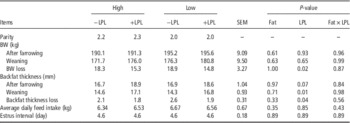
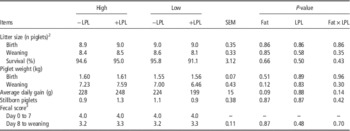
BW loss and backfat thickness loss were significantly decreased (P<0.05) after LPL supplementation compared with those with non-LPL supplementation (Table 3). At weaning, backfat thickness of sows fed LPL supplementation diets was significantly higher (P<0.05) than that of sows fed non-LPL diets. Neither LPL supplementation nor diets with different fat content affected (P>0.05) BW of sows after farrowing and weaning, as well as backfat thickness of sows after farrowing. The ADFI and the interval from weaning to estrus of sows were not affected (P>0.05) by either LPL supplementation or diets with different fat content. Litter size (number of live births, number of weaning), piglet weight (birth, weaning), stillborn piglets, survivability, ADG and fecal score were not affected (P>0.05) by either LPL supplementation or diets with different fat content (Table 4). No interaction effects (P>0.05) were observed on growth performance of sows and piglets.
Effect of lysophospholipids (LPL) in diets differing in fat contents on growth performance in lactating sowsFootnote 1

High=high-fat diet (4.75%; 13.66 MJ/kg) minus (−) or plus (+) 30 mg/kg LPL; Low=low-fat diet (2.38%; 13.24 MJ/kg) minus (−) or plus (+) 30 mg/kg LPL.
1 A total of 32 sows was used in the experiment. The results are presented by mean values and the SEM. Each mean represents eight sows.
Effect of lysophospholipids (LPL) in diets differing in fat contents on growth performance in pigletsFootnote 1

High=high-fat diet (4.75%; 13.66 MJ/kg) minus (−) or plus (+) 30 mg/kg LPL; Low=low-fat diet (2.38%; 13.24 MJ/kg) minus (−) or plus (+) 30 mg/kg LPL.
1 A total of 32 sows was used in the experiment. The results are presented by mean values and the SEM. Each mean represents eight sows.
2 n piglets at birth mean liveborn piglets.
3 Fecal scores: 1=hard, dry pellets in a small, hard mass; 2=hard, formed stool that remains firm and soft; 3=soft, formed and moist stool that retains its shape; 4=soft, unformed stool that assumes the shape of the container; 5=watery, liquid stool that can be poured.
Nutrient digestibility and milk composition
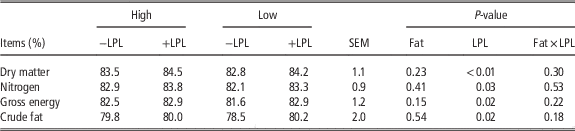
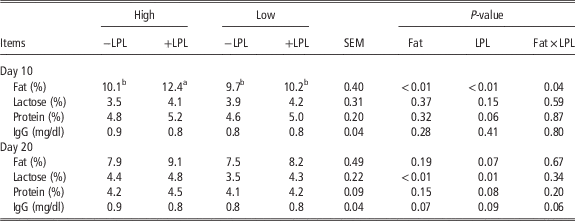
The ATTD of DM, N, GE and crude fat in sows fed LPL diets were increased (P<0.05) compared with those fed non-LPL diets (Table 5). No difference (P>0.05) in the ATTD of DM, N, GE and crude fat was observed between high- and low-fat diets. No interaction effects (P>0.05) were observed on the ATTD of DM, N, GE and crude fat in sows. Sows fed the high-fat diets had higher (P<0.05) milk fat on day 10 and milk lactose on day 20 than those fed low-fat diets (Table 6). The concentrations of milk fat and lactose in LPL supplementation treatments were increased (P<0.05) compared with non-LPL treatments on day 10 and day 20, respectively. Positive interaction effects (P<0.05) between fat diets and LPL were observed on milk fat concentration on day 10. In addition, the milk fat concentration in sows on the high-fat diet with LPL was higher than that in the other three treatments. The concentrations of milk protein and IgG were not affected (P>0.05) by either LPL supplementation or diets with different fat content.
Effect of lysophospholipids (LPL) in diets differing in fat contents on the apparent total tract digestibility of nutrients in lactating sowsFootnote 1

High=high-fat diet (4.75%; 13.66 MJ/kg) minus (−) or plus (+) 30 mg/kg LPL; Low=low-fat diet (2.38%; 13.24 MJ/kg) minus (−) or plus (+) 30 mg/kg LPL.
1 A total of 32 sows was used in the experiment. The results are presented by mean values and the SEM. Each mean represents eight sows.
Effect of lysophospholipids (LPL) in diets differing in fat contents on milk composition in lactating sowsFootnote 1

High=high-fat diet (4.75%; 13.66 MJ/kg) minus (−) or plus (+) 30 mg/kg LPL; Low=low-fat diet (2.38%; 13.24 MJ/kg) minus (−) or plus (+) 30 mg/kg LPL; IgG=immunoglobulin G.
a,bMeans in the same row with different superscripts differ (P<0.05).
1 A total of 32 sows was used in the experiment. The results are presented by mean values and the SEM. Each mean represents eight sows.
Discussion
Higher energy level (metabolizable energy (ME)=14.08 MJ/kg) can result in decreased BW and backfat loss, shorter wean-to-estrus interval and greater BW gain of piglets (Park et al., Reference Park, Yang, Choi, Yoon, Ahn, Lee, Yang, Lee and Chae2008). Nelssen et al. (Reference Meng, Yan, Ao, Zhou, Wang, Lee and Kim1985) have also demonstrated that sow weight and backfat loss are decreased linearly as energy intake is increased (41.84, 50.21 or 58.58 MJ ME/day), whereas litter weight at weaning increased with sow energy intake. It has been reported that sows fed 50.21 and 58.58 MJ ME/day have slightly shorter intervals from weaning to first estrus than sows fed low energy intakes (Nelssen et al., Reference Meng, Yan, Ao, Zhou, Wang, Lee and Kim1985). As we know, if energy intake exceeds requirements for maintenance and milk production, it will be used to gain both body lipid and body protein by lactating sows (NRC, Reference Nelssen, Lewis, Peo and Crenshaw2012). But in most instances, energy intake is insufficient to meet requirements for maintenance or milk production. Therefore, both maternal body lipid and body protein are mobilized and used as sources of energy. Insufficient energy intake will influence growth performance of sows and litters over the entire lactation period (Dourmad et al., Reference Dourmad, Etienne, Prunier and Noblet1994; Aherne, Reference Aherne2010). In our study, the difference in energy contents in the two diets studied was very small and no difference was observed on feed intake, which might explain why no difference in growth performance of lactating sows and litters was observed between high-fat diets and low-fat diets. Similarly, sow BW loss, ADFI, number of live births and number of stillborn piglets were not affected by dietary supplemental fat compared with basal diet (Shurson et al., Reference Shurson, Hogberg, DeFever, Radecki and Miller1986). No differences were found on litter weaning weights between sows received basal diets and diets containing fat (Cox et al., Reference Cox, Britt, Armstrong and Alhusen1983). Seerley et al. (Reference Seerley, Snyder and McCampbell1981) also reported that no differences were noted in sow BW loss and feed intake, as well as average 21-day litter weight between sows fed control, 10% supplemental corn oil or 10% supplemental animal fat diets.
High energy in diets will cause low feed intake, whereas low energy in diets will cause high feed intake in sows (Thaler and Holden, Reference Thaler and Holden2010). However, Meng et al. (Reference Lu, Li, Yin, Zhang and Wang2010) have reported that there was no difference in ADFI when different energy and nutrient density diets are supplied to growing-finishing pigs. This might be due to the fact that sows fed ad libitum might not be able to effectively adjust their feed intake to obtain a suitable amount of dietary energy when dietary energy level is increased (Herr et al., Reference Herr, Kendall, Bowers and Richert2000; Du et al., Reference Du, Li, Zhao, Yin and Kong2009). In this study, no difference in ADFI between low-fat and high-fat diets was observed. Yan and Kim (Reference Yan and Kim2013) have demonstrated that high energy (GE of 17.92 MJ/kg) and low energy (GE of 17.27 MJ/kg) diets do not have influence on the ATTD of DM, N or GE in growing-finishing pigs. In addition, Jorgensen et al. (Reference Jorgensen, Gabert, Hedemann and Jensen2000) have found that growing pigs fed various diets (basal diet, fish oil diet, rapeseed oil diet and coconut oil diet) with different GE (16.78, 20.04, 20.23, 19.84 MJ/kg) or crude fat (39, 190, 192, 189 g/kg) have no difference in ATTD of DM, protein or GE. Our results also revealed that there was no difference in ATTD of DM, N, GE or crude fat in sows fed high-fat diets compared with those fed low-fat diets. However, pigs fed oil diets have higher ATTD of fat than those fed basal diet (Jorgensen et al., Reference Jorgensen, Gabert, Hedemann and Jensen2000). The different results in ATTD of fat between these studies might be due to differences in dietary fat content. Jorgensen et al. (Reference Jorgensen, Gabert, Hedemann and Jensen2000) have suggested that supplemented fats did not greatly affect digestion. This may explain why there was no difference in ATTD of DM, N, GE or crude fat between high and low dietary fat treatments in this study.
Many other studies also have shown that dietary fat supplementation enhanced milk fat concentrations in sows (Jackson et al., Reference Jackson, Hurley, Easter, Jensen and Odle1995; Averette et al., Reference Averette, Odle, Monaco and Donovan1999; Tummaruk et al., Reference Tummaruk, Sumransap and Jiebna2014). Shurson et al. (Reference Shurson, Hogberg, DeFever, Radecki and Miller1986) demonstrated that milk fat is readily influenced by dietary fat during lactation in sows. In this study, high-fat diets increased milk fat concentration and milk lactose concentration on day 10 and day 20, respectively, compared with low-fat diets, and sows fed LPL supplements had higher milk fat concentration on day 10 of lactation. Fat in milk mostly consists of long-chain fatty acids (Le Dividich et al., Reference Le Dividich, Rooke and Herpin2005). It can be affected by the compositions of the feed during gestation and lactation, especially dietary fat supplementation (Seerley et al., Reference Seerley, Griffin and McCampbell1978a and Reference Seerley, Maxwell and McCampbell1978b; Pettigrew, Reference Pettigrew1981; Laws et al., Reference Laws, Amusquivar, Laws, Herrera, Lean, Dodds and Clarke2009). Addition of dietary fat may improve negative energy balance of lactating sows (Babinszky et al., Reference Babinszky, Verstegen and Den Hartog1993), milk production or fat content of sow milk (Boyd et al., Reference Boyd, Moser, Peo, Lewis and Johnson1982; Shurson and Irvin, Reference Shurson and Irvin1992). Fatty acids in milk are derived from blood lipids (including endogenous and dietary fatty acids) and de novo synthesis in mammary glands. Therefore, the concentration of fat in colostrum and milk can be increased by increasing fat level in sow’s diet (Lauridsen and Danielsen, Reference Lauridsen and Danielsen2004; Beyer et al., Reference Beyer, Jentsch, Kuhla, Wittenburg, Kreienbring, Scholze, Rudolph and Metges2007; Park et al., Reference Park, Yang, Choi, Yoon, Ahn, Lee, Yang, Lee and Chae2008). Drochner (Reference Drochner1989) has shown a linear relationship between dietary fat content and milk fat concentration. We added 2.5% beef tallow into two lactation diets, and LPL might have increased the utilization of tallow. This might explain why sows fed high-fat diets or LPL supplements had higher milk fat concentration on day 10 of lactation.
In this study, the BW loss of sows fed LPL supplemented diets was lower compared with that of sows fed diets without LPL. In addition, backfat thickness at weaning was higher but backfat thickness loss was lower in sows fed LPL diets compared with those fed with non-LPL diets. This indicated that sows fed LPL supplemented diets might have used less stored body tissues to supply the energy for maintenance requirement and milk production during lactation compared with those fed non-LPL supplemented diets. Therefore, LPL addition might have enhanced the digestion and absorption of lipids, thus supplying more energy to lactating sows in this study.
Van Heugten and Odle (Reference Van Heugten and Odle2000) have reported that the ATTD of fat, energy and proteins is higher when an emulsifier in the form of lysolecithin is added into feed of piglets. The digestibility of crude fat, CP, crude fiber, N free extract and ash is also increased when lecithin emulsifier is added to diets of weanling pigs (Daněk et al., Reference Daněk, Paseka, Smola, Ondráček, Bečková and Rozkot2005). Zhao et al. (Reference Zhao, Li, Hossain and Kim2015) have also demonstrated that LPL can increase the ATTD of DM, N, GE and crude fat in weanling pigs. In this study, LPL supplementation increased the ATTD of DM, N, GE and crude fat. As no study has reported the effect of emulsifier in sows, no comparison could be made. We believe that LPL can increase nutrient digestibility in lactating sows due to its emulsification characteristics. The capacity of bile salt micelles to solubilize long-chain saturated fatty acids is increased in the presence of phospholipids, additionally, amphiphiles emulsifier such as lecithin can increase the size of bile salt micelles, thereby increasing the interior capacity of micelles so that more fatty acids may be incorporated (Freeman, Reference Freeman1969; Borgstrom, Reference Borgstrom1974; Reynier et al., Reference Reynier, Lafont, Crotte, Sauve and Gerolami1985). Thus, the fat digestibility may be increased. The mechanism of LPL to improve the ATTD of DM, GE and N is still unknown, but Zhao et al. (Reference Zhao, Li, Hossain and Kim2015) demonstrated that the increased ATTD of DM, GE and N may attribute to the increased fat digestibility.
No interaction effect of fat and LPL supplementation on sow and piglet growth performance or sow nutrient digestibility was found. However, a positive interaction effect of fat and LPL supplementation on milk fat concentration was observed on day 10 of lactation. We hypothesized that there was a complementary positive effect of fat content and LPL, because the effect of LPL was more pronounced in the high-fat diets than in the low-fat diets.
In conclusion, LPL supplementation improved milk fat and lactose concentrations, the ATTD of DM, N, GE and crude fat, as well as decreased BW loss and backfat thickness loss. In addition, the interaction of increased dietary fat and LPL increased milk fat concentration in lactating sows.
Acknowledgements
This study was funded by EASY BIO Inc. (Seoul, South Korea). The authors thank Dr Hanlin Li and Dr Jianping Wang for their suggestion and participation in the discussion.