The last third of the nineteenth century was an era of modernization and abrupt growth for many cities in Europe and North America. Russia was no exception, and among its cities Moscow, though obviously not unique, was a striking example of this process. Though Moscow possessed many characteristic features of Russian urbanization and developed within the same legislative space as the rest of the urban centres, it was not a typical industrial town, both because the patterns of industrialization varied across the regions of the country and because, even if we consider only the central industrial region, the sheer size of the population and complexity of the area set Moscow aside.
The size and metropolitan claims of Moscow put it in the same league as major European cities. Yet, Moscow was not an imperial centre as were London, Vienna or St Petersburg, nor did it gain any specific status, as did Berlin and Budapest – the cities that entered the metropolitan circle at around the same time. By the turn of the twentieth century, among European metropolises Moscow was ranked sixth in population and was the biggest city without a capital status.Footnote 1
That said, drastic urbanization resulted in considerable reshaping not only of the city's economy but also of the urban environment, social structure and settlement patterns. Some urban historians believe that with regard to social topography modernity brought about the spatial segregation of classes. Capitalism eliminated the traditional status hierarchy and its attributes, making geographical localization one of the key instruments of status distinction and privileges. Starting from the middle of the nineteenth century, many European and American cities were transformed into increasingly segregated areas. The homogenization of the neighbourhoods generally followed one of two main strategies. The first, typical of British and American cities, led to middle-class suburbanization,Footnote 2 while the second, more common in continental Europe, was marked by driving the poor out to the city border and creating a bourgeois centre in opposition to the working-class outskirt, often with a chain of boulevards as a demarcation line between them.Footnote 3
The present article examines whether Moscow followed the other European metropolises with regard to the structure of social topography. The title of this article, referring to the name of a chapter in a famous book by Donald Olsen, points to the main question of my research. I am interested in how Moscow met the challenge of being a home to thousands of migrants, that is providing accommodation and spatial location within the urban environment. The relation between the residential patterns of the Moscow working class and the character of the migration process that affected their experience of city as a home will also be discussed.
I must state that I use the term working class in a descriptive sense rather than as an analytical category, thus also disengaging my work from the debates the analytical use of the term may imply. The questions of class identity and collective agency remain beyond the scope of this article.
When discussing the working class, I mean the population engaged in manual labour. This application of the term also contains a direct reference to what is implied in the statistical sources I used in my research. By working class or working population (the terms are used interchangeably) Russian statisticians understood wage workers, both skilled and unskilled, employed in factories, artisan workshops, transport, construction or various commercial enterprises, including day-labourers and apprentices.Footnote 4 Thus, the term working class or workers is the collective identification of a certain mass of the population by outsiders, but it does not imply any unity among the people described. The Moscow labouring population was by no means a homogeneous group, as its members differed in their professional status, specialization, wages, education, intensity of connections with the rural world as well as in their demands, aspirations and identity. In fact, even the direct meaning of the word worker (rabochii) was quite ambiguous when interpreted by workers themselves until the term as understood by the intelligentsia penetrated the lower classes and took over the alternative versions of self-naming.Footnote 5
This inquiry into the life of Moscow workers, apart from general interest in the history of metropolitan transformation and social settlement, is stimulated by the questions that inevitably face anyone dealing with modern Russian history. Though the destiny of the urban poor was deplorable everywhere, one might assume that there must have been certain peculiarities about the Russian working class that, in combination with other socio-political realities, provided the background for the revolutionary troubles that shook Russian society in the first decades of the twentieth century.
The migrant character of Moscow workers
The task of accommodating hundreds of thousands of new urbanites was familiar to many metropolises of the time. To cite Hohenberg and Lees, urban centres like Vienna, Berlin and Paris ‘attracted a great deal of industry and consequently exploded in size’.Footnote 6 It can be argued, however, that in the case of Moscow the sequence of events was quite the opposite. The growth of the city was connected not so much to the developing industry that attracted the migrant workers but rather to the tremendous influx of migrants who rushed to Moscow and constituted the cheap labour force for the developing urban economy.
The bifurcation point in the growth of Moscow can be dated with precision – it was the abolition of serfdom in 1861. Located at the heart of the agricultural provinces, Moscow immediately felt the impact of the liberation, as thousands of peasants flooded into the city in search of work. If during the 34 years from 1830 to 1864 the population increased only by 30,000, after 1864 in a mere seven years it grew by 238,000, reaching 602,000 in 1871. This pattern continued in the following decades, and in 1897 Moscow had already 1,043,000 residents followed by 1,346,000 in 1907 and 1,612,000 in 1912.Footnote 7
Most of the migrants belonged to the peasant estate and came from the central provinces of European Russia – a region that suffered from over-population and lack of land.Footnote 8 The allotments peasants received were not sufficient even to support the family: the average household lived on its own grain for less than five months; for the rest of the year, extra grain had to be bought.Footnote 9 Consequently, the peasants were forced to look for alternative means of subsistence, and going to the city in search of wages (otkhod) became a frequent solution. The abolition of serfdom intensified the peasant migration to Moscow due to the facilitation of the process and, what is more important, due to the necessity of redemption payment for the land after emancipation, which exceeded the peasants’ ability to pay and actually made rural life worse than it had been under serfdom.Footnote 10
Moscow became a true city of immigrants, since almost three-quarters of its population was non-native. Naturally, the fact that immigration was the dominant factor of substantial urban growth was not something peculiarly Russian. Yet, in the 1880s, among the major European cities Moscow had the greatest proportion of immigrants – and still held this position 20 years later (see Figure 1). The ratio of immigrants was particularly striking among the labour force – in 1902, a mere 12 per cent of the entire active male population could call Moscow their hometown.Footnote 11 The volatility of population in Moscow was impressive even by Russian standards, and reached a higher level than in St Petersburg.Footnote 12
The proportion of immigrants in the population of European cities (%) Sources: Statisticheskiy atlas goroda Moskvy (Moscow, 1887); Statisticheskiy atlas goroda Moskvy (Moscow, 1911).

Though immigrants did not necessarily belong to the working class, the working class was largely composed of migrant peasants.Footnote 13 According to the 1897 Russian census, almost two-thirds of Moscow workers and domestic servants were born outside the province of Moscow.Footnote 14 Five years later, migrants comprised an astonishing 90 per cent of the Moscow industrial labour force.Footnote 15
What is peculiar about the Russian urbanization experience, and also highly relevant for understanding the lifestyle of workers, is the transient character of migration and the strong ties of migrants to the village. The common survival strategy was constructed around the combination of agricultural labour and additional wages in the city within the same family. Throughout the period discussed in the article, otkhod remained a predominantly male phenomenon: husbands and sons went off to the city, while wives together with children and older family members remained working in the village.Footnote 16 The gender composition of Moscow is a good illustration of this pattern – while in London, Paris, Berlin, Vienna and Budapest, women outnumbered men,Footnote 17 Moscow had only 700 females per 1,000 males in 1871, the figure slowly increasing to 755 in 1897 and to 767 in 1902.Footnote 18
The important consequence of this organization of family economy was that Moscow, or any other Russian city for this matter, was not perceived as a permanent place of abode. The true home of a migrant remained in a village, where his children were born and raised, where he left his wife, where he was going more or less regularly to see his relatives and where he would return in times of hardship or in the later years of his life.Footnote 19 Given the underdeveloped welfare system, keeping the allotment in the village and remaining part of the communal rural world were the only forms of social security available to the workers.
Naturally, the ties with the countryside could be stronger or looser in each particular instance. They were more intense in the case of unskilled workers and day-labourers, or in professions which had a high risk of seasonal unemployment, such as the garment industry or construction. Thus, E.A. Oliunina, conducting a study of Moscow tailors in 1910–11, concluded that more than two-thirds of male workers in the workshops maintained their bonds with the village, and the more liable their particular industry was to off-season decline, the longer they spent in the countryside and the more they were engaged in rural life.Footnote 20 Other possible factors influencing the intensity of the rural–urban connection included place of employment and factory regulations, income, professional position, family relations and distance to the village. The amount of time spent in the countryside varied from several months to one visit in several years. It is striking that marriage in the village did not necessarily make visits to the countryside longer and more frequent: in his memoirs, the former worker P. Timofeev mentions cases where husbands and wives did not see each other for up to five years.Footnote 21
Yet, the mere fact of having a home and a family in the village determined the expectations and needs of migrants and allowed them to reduce the demands for domesticity and privacy in the city to a minimum. Since the urban household was not meant to be settled and family-based, it was organized as a temporary living space for people with no particular personal connection to each other. One of the possible housing arrangements was a so-called artel – a kind of co-operative in which a group of workers, usually from the same village, shared the costs of lodging and boarding. Timofeev provides a vivid description of this housing solution:
He lived in an artel with seventeen other men. The apartment consisted of one large smoke-blackened room with two windows . . . In the centre of the room was a long trestle table and two equally long benches. There was a small kerosene lamp hanging between the windows. Underneath the lamp was a cheap print of the Tsar's family. A holy icon, blackened with age, hung in the corner. The kitchen, which also served as an entrance hall, was off to one side of the room and contained the cook's bed. This was all the furniture for eighteen people.Footnote 22
On the other hand, rising rental prices were placing an increasing burden on all Muscovites. Therefore, the absence of dependants gave the worker more freedom when choosing accommodation and let him opt for the most basic lodging in order to cut expenses, saving the money to pay rural taxes for land. The lack of proper housing in the city and the higher expenses of urban life built an additional barrier to bringing the relatives from the village, forcing the family to stay divided between the two places.
The spatial distribution of the workers
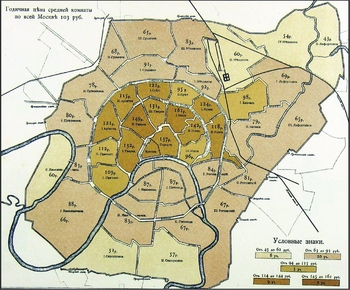
Before examining the housing and settlement patterns of the working class, it is worth noting that the social topography of Moscow was utterly centralized – the historically developed radial-concentric structure of the city endowed the centre with the highest economic and social potential. Land prices can serve as a memorable illustration of the situation, as the price of one square sazhen’ (4.6 square metres) in the inner city was 100 times higher than in the outskirts.Footnote 23 Rental prices for apartments followed the same pattern in a less extreme form. Figure 2 shows the annual price of an average room in each of the city districts around 1890. Though the apartments, naturally, varied in size and quality, it is still obvious, however, that the monetary and symbolic value of Moscow districts was decreasing gradually from the centre to the city border, with the most well-off neighbourhoods located on the northern bank of the river within the Garden Ring (Sadovoye koltso), and the outer chain of boulevards that followed the line of the former city walls (Zemlyanoi gorod). The appearance in the late 1890s of modern amenities (plumbing and sewage systems) that primarily covered central districts strengthened the existing infrastructural advantage of downtown versus the outskirts even more. Taking into account that cultural institutions were located also almost exclusively inside the Garden Ring, it becomes clear why this area was preferred by the upper classes.Footnote 24
Average price of an apartment (numbers show the annual price of an average room in each district). Source: Statisticheskiy atlas goroda Moskvy. Vladenia, stroenia, kvartiry i khozyaistva (Moscow, 1890).

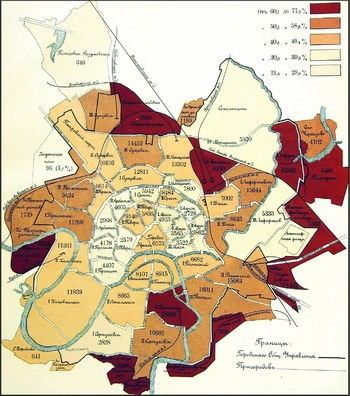
It would be quite natural to expect, therefore, that the economic and symbolic value of the central zone meant that the poor were driven out towards the city border, while downtown was appropriated by the upper and middle classes. In fact, it appears that the working population of Moscow was, remarkably, spread all over the city territory (see Figure 3). While, indeed, the outskirts show the highest number of working-class inhabitants – in some of them up to three-quarters of the entire self-supporting population were working class – all districts of the city had a working-class element to them. Surprisingly, in the quarters with the highest land and apartment prices around Tverskaya Street and the Kremlin itself, the working class accounted for almost 50 per cent of the population. Although Arbat and Prechistenka, the districts traditionally inhabited by aristocratic families, the so-called ‘faubourg Saint-Germain’ of Moscow,Footnote 25 featured the lowest percentage of residents engaged in manual labour, even there more than one fifth of the population belonged to the working class. Furthermore, every fifth member of the working class (not including dependants and unemployed) lived inside the Garden RingFootnote 26 – a very small area (no more than 8 per cent of the entire city territory),Footnote 27 notably with the highest rental prices.
The distribution of commercial and industrial workers across Moscow districts in 1902 (numbers show their absolute quantity in the district, the hatchings shows their ratio against the total self-supporting population in the district) Source: Statisticheskiy atlas goroda Moskvy (Moscow, 1911).

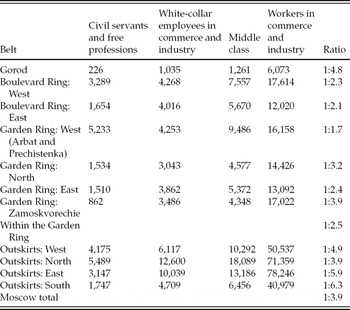
Statistical data from the city census of 1902 allows us to compare the absolute numbers in the white-collar and blue-collar occupations for each particular part of the city (see Table 1). The first group, comprising professionals, civil servants and managers of the commercial and industrial enterprises, stands for what can be referred to as ‘middle class’, at least in a descriptive sense, because, as is the case with ‘working class’, the analytical usage of the term when speaking about Russian realities is debatable.Footnote 28 The ratio between the two groups shows that in no single part of the city did the middle classes manage to ensure quantitative domination, and in all but one (Arbat and Prechistenka) they were significantly outnumbered by the blue-collar workers. It can be argued, therefore, that no district of Moscow was restricted to or even principally inhabited or used by the middle class. The presence of the lower classes was actually even more considerable because the data in the table excludes the large numbers of domestic servants or self-employed petty bourgeois producers. In addition, since the aristocracy and the top ranks of the army and state bureaucracy were attached to the imperial court in St Petersburg, the presence of these elite groups in Moscow was minimal and did not influence the overall social topography.
White-collar and blue-collar occupations

Source: Statisticheskiy atlas goroda Moskvy (Moscow, 1911).
It can be argued that horizontal social segregation, which at that time was becoming more pronounced in the spatial organization of Western metropolises, was not typical of Moscow. Naturally, horizontal stratification existed, yet it was expressed not in the form of class segregation but rather in the presence or absence of the upper classes.
When analysing intra-urban mobility in St Petersburg, James Bater noted the striking proximity between the home and the workplace in the Russian capital, even among the privileged classes.Footnote 29 It can be assumed that the situation in Moscow was very similar. The explanation probably lies in the limited availability of public transport. A more developed system of mass transportation could foster daily intra-urban mobility and facilitate the exodus of particular groups to the outskirts. The electric tram only appeared in Moscow in 1898, but its network, though rapidly expanding, could not provide effective transportation for a city with more than a million inhabitants. The outskirts were particularly disadvantaged in terms of transport accessibility. On the other hand, the tram was simply expensive and hardly affordable for the working class. The price of one ride was 10 kopeckFootnote 30 (0.1 rouble) while the average monthly wage of the industrial worker in the province of Moscow in the 1900s was below 20 roubles,Footnote 31 hence daily commuting would have taken more than a quarter of a very modest worker's budget.
Limited availability of public transport combined with long working hours forced the lower classes to live as close as possible to their workplace, wherever it was. The high percentage of workers in the central districts is explained by the constant demand for their labour force in commerce, retailing, the catering business and other similar centrally located urban professions. Since the proper functioning of the upper classes required the involvement of the lower, both were condemned to cohabitation in the same space. The wide geographical distribution of industrial workers was connected to the wide dispersion of industrial enterprises in Moscow, which did not cluster in one particular part but were scattered across the city territory. Even the island between the Moskva river and Vodootvodny canal, to give one example, hosted storage houses, a municipal electrical power plant and a tram park, as well as several textile and confectionary factories, with two of them immediately facing the Kremlin.Footnote 32
This dependence upon the workplace made other factors irrelevant for a worker when he or, less likely, she was choosing the dwelling – the only factor that mattered apart from location was price. Since the growth of residential construction lagged far behind that of population, it provoked constant demand for housing and kept the rental prices very high. Contemporaries with different social backgrounds noted the lack of adequate housing in Moscow. Thus, in 1907, a special census about the living conditions among the students organized by the Law Department of Moscow University revealed a strong need for housing and a general deficit in suitable apartments.Footnote 33 In 1910, the municipality itself had to create a special Society for the Satisfaction of Housing Need in order ‘to protect its employees’ from the ‘endless rise in price of Moscow apartments’.Footnote 34
Yet, obviously, the need for housing hit the urban poor the most. In 1908, an average monthly rent for a one-room apartment in Moscow was 16 roublesFootnote 35 – a sum beyond imagination for a 20-rouble worker's budget. In fact, the average Moscow worker spent no more than 17 per cent of his income on housingFootnote 36 – that is, around 4 roubles. How was it possible?
In many cases the housing demands of Moscow workers were reduced to, literally, a roof over their heads. Overcrowding and insanitary conditions thrived in Moscow arguably more than anywhere else in Europe. The housing shortage was known to all other metropolises, but nowhere else were people so crammed together as in Moscow. Even though the overall city population density per unit of territory was relatively low by contemporary European standards – the same as in London and half that of in Paris or BerlinFootnote 37 – the statistics of the Moscow council reveal that the density per housing unit was notably higher. In 1912, Moscow had 8.7 persons per housing unit compared to 4.5 in London, 4.3 in Paris, 4.2 in Vienna and 3.9 in Berlin.Footnote 38 Even St Petersburg, which in the Russian view always embodied the evil of the modern city, had 7.4 persons per average housing unitFootnote 39 – significantly less than ‘patriarchal’ Moscow.
However, poverty alone cannot explain why the workers opted for the most basic and cramped accommodation. Even when wages allowed a worker to improve living conditions, change of accommodation was not the first priority. Collective forms of living, common among Moscow workers, united people of a different status, at least within the working class, but the inequality of income and position was expressed in attributes other than accommodation. Thus, S.I. Kanatchikov in his memoirs, describing the experiences at Moscow factories, mentions that his master, Korovin, lived in the same room with him and another apprentice. Korovin, an experienced skilled worker in one of the best-paid blue-collar occupations – metalwork – could have definitely afforded a better lodging than a ‘tiny, dark, windowless, corner room . . . dirty and stuffy, with many bedbugs and fleas’, which he had to share with two boys.Footnote 40 When Kanatchikov himself became a skilled worker and had an impressive daily wage of a rouble and 60 kopecks, he still chose to share a room.Footnote 41
Comparison with the students, the poorest group among the white-collar occupations, is telling. Though the monthly budget of an average student – 25 roubles – was similar to that of a skilled worker (and sometimes even below), students spent twice as much on housing and required separate rooms, retrenching their expenditure in other spheres.Footnote 42
It is plausible that these modest housing demands among the working class, apart from mere poverty, resulted from the transience of urban residence. The temporary character of the accommodation and the absence of families subdued the needs of privacy and domesticity. Taking into account an 11- to 13-hour working day, it becomes clear that workers spent a very limited time in their abodes and this, perhaps, explains why they cared so little. On the other hand, the migrants hardly had any higher standards of living to look back to. Housing conditions in rural Russia were equally notorious for poor hygiene and congestion, with several generations often sharing the same living space,Footnote 43 and this village experience set the expectations and requirements of those who went to the city at a very low level.
The housing question and the response of the authorities
There were several types of housing available to migrant workers in Moscow. One was employer-provided housing – Bradley cites census data of almost 120,000 Muscovites using this type of accommodation in 1912 – and these numbers are still said to be underestimated.Footnote 44 This type of accommodation meant living with the employer or immediately at the workplace – the latter common in the small artisanal workshopsFootnote 45 – or in the workers’ dormitories at the factories, which were a particularly common type of housing for industrial workers.Footnote 46 The sanitary doctor of Moscow zemstvo, making a survey of these dormitories, described them as long barracks apportioned into small sections with wooden partitions. The living conditions in these barracks were estimated as utterly overcrowded, as each small section hosted several families or single workers, with just about five cubic metres of air per person; moreover, people often used the same living space in turns, according to their work shifts in the factories. The only existing housing regulation, the survey reports, was ‘the physical inability to fit inside another family or single person’.Footnote 47
Another option was private housing. Often unable to afford a flat or even a room, workers opted for so-called cot-and-corner apartments (ko  echno-komorochnye kvartiry) where renting only a part of the room allowed them to save on housing expenses. The municipal survey in 1899 examined 16,144 of these cot-and-corner apartments which served as homes for almost 175,000 people – the numbers and ratio tell their own story. The average monthly price of the corner was six roubles, and a cot could be rented for just two.Footnote 48
The housing situation was characterized not only by insufficient space but also by the very poor condition of the available housing resources. The municipal survey, cited above, found the living conditions there to be very unhealthy and insanitary, reporting that 89 per cent of the examined apartments were damp and more than a third not heated.Footnote 49 Ten years later a sanitary doctor, examining the housing conditions in his district around Taganka echoed these impressions:
The buildings are occupied by various apartments for workers . . . To get to the basement floor one needs to walk down the six to eight steps of dirty and dilapidated stairs to the equally dirty halls. Here trickles the liquid sewage from the courtyard and the draughts . . . The stink from the draughts spreads to all the floors and all the apartments . . . The most typical apartments are located in the basement, there are ten of them and they are mostly with cots to rent. Usually with the ceiling height of 2½ arshins [178 cm] they have no more than 0.4–0.5 cubic sazhens [4.8 cubic metres] of air per person though the number of residents reaches 15 per room. The prices of apartments are relatively high, depending on which floor they are located – from 10 to 30 roubles per month. Window ventilation is insufficient and because of the overcrowding and poor maintenance the flats are dirty, stuffy and damp.Footnote 50
It is noteworthy that the primary construction material in Moscow was wood. In 1902, only one third of the city's residential buildings were built from stone or brick and over a half exclusively from wood, with the rest being a combination of these materials.Footnote 51 The dominance of wood as a construction material suggests the prevalence of low-rise buildings. Only 4 per cent of residential houses in 1890 and 15 per cent on the eve of World War I had more than two floors.Footnote 52
Yet, though the wooden houses of Moscow were often looked down on, both by contemporaries and historians,Footnote 53 and regarded as a sign of provincialism, backwardness and lack of urbanism, this alleged inferiority of wood as a construction material can be questioned. Cold Russian winters and short summers favoured the usage of wood because it ensured quicker construction and better thermo-isolation, while preventing excessive humidity. Even the city estates of Moscow nobility in Arbat district were built mostly from wood.Footnote 54 In fact, the lowest-quality housing was connected rather to stone than to wooden buildings. When the Russian Technical Society in 1898 organized a survey of the cot-and-corner apartments, it showed that, despite the overall prevalence of wooden construction in the city, 74 per cent of these flats were located in stone houses.Footnote 55 Dampness was the most obvious defect of the stone buildings. Apart from the general difference in qualities between the wooden and stone structures, the latter were characterized by the shortcomings of the building planning, improper ground preparation and the lack of windows, ventilation or ovens. Moreover, the technological rules of stone construction were often neglected or abused. In particular, Moscow building acts forbade daubing plaster to the walls for one year after the end of the construction process in order for the building to dry out, which obviously increased the time and costs of the works and was, therefore, frequently avoided. According to the investigations of sanitary doctors, the stipulated period of one year, even when observed, was still not enough for the drying out of the stone structures, particularly in the basement parts that remained damp for years.Footnote 56
It is remarkable that living in the basement was a frequent phenomenon in Moscow. Approximately 10 per cent of Moscow apartments were located there – twice the number in Berlin in 1900Footnote 57 – and this proportion remained almost unchanged for 30 years from 1882 until 1912, despite the construction boom. While in other European cities housing regulations helped to diminish the quantity of basement dwellers – thus, in Budapest, their proportion reduced from 9 per cent in the early 1880s to just 1 per cent in 1906Footnote 58 – in Moscow the number of people occupying these apartments was actually growing, accounting for more than 7 per cent, or 120,000 people in 1912.Footnote 59
This fact suggests the existence of a certain degree of vertical segregation, so that the socially inferior groups were pressed down to basements that remained particularly undesirable dwellings due to their humidity and liability to flood. The attic flats were relatively expensive compared to the basement ones.Footnote 60 Yet, taking into account the prevalence of low-storey buildings, it can be concluded that in Moscow vertical social segregation did not develop to the extent it did in late nineteenth-century Paris or Vienna.Footnote 61 The relatively small Moscow buildings were unlikely to accommodate a wide spectrum of social groups with a distinctive status for each residence.
The overcrowded cot-and-corner apartments still were not regarded as the ‘lowest step of human wellbeing’.Footnote 62 The most notorious form of low-cost housing was the flophouse that provided the cheapest and simplest form of night lodging. The majority of the flophouses were located around the Khitrov market – this place was the first destination of the newly arrived migrants, as it was there that the contractors came to hire their workers, and, perhaps, the last resort of the most marginalized groups of Moscow society – jobless, beggars, prostitutes and criminals. If for a Viennese the ‘dark continent’ of imagined and real threats was in the suburbs, outside the line of boulevards,Footnote 63 the worst slum of Moscow, Khitrovka, was located in its immediate centre, just 1 kilometre eastward from the Kremlin wall. Like Viennese journalist Max Winter, who explored the life beyond Ringstrasse, reporter and writer Vladimir Gilyarovkii was interested in the lives of the Moscow poor, and created the vivid description of Khitrovka, ‘a rotten stirring hole’ where ‘no authority dares to enter’:
Two- and three-storey buildings around the square were all full with flophouses where almost ten thousand people huddled and found a shelter. These houses were bringing enormous profit to their owners. Each lodger paid five kopecks per night, while ‘rooms’ cost twenty. Below the lower plank bed, placed one arshin [71 cm] above the floor, were the dens for couples; they were separated from each other by curtains. This space . . . between two curtains was called a ‘room’, where people slept without any bedding except for their own rags.Footnote 64
The 1910 sanitary inspection of Khitrovka reported 6,171 persons living there, which exceeded the police norm (demanding only 7.4 cubic metres of space per person) more than twice. The inspector even managed to interview the inhabitants of the infamous neighbourhood about their occupations. The most widespread professions were unskilled workers among men (32 per cent) and prostitutes among women (54 per cent); over a quarter of the whole population were reported to be beggars, with the rest comprising day-labourers, laundresses, tailors, peddlers, printers, waiters and those ‘involved in shady business’.Footnote 65
The poor sanitary conditions in the overcrowded houses provided a fertile ground for infectious diseases, which were responsible for Moscow's extremely slow decrease in death rates. This fact allowed Blair Ruble to call Moscow ‘the deadliest metropolis’ in Europe after St Petersburg in the 30 years between 1881 and 1910.Footnote 66 Yet, the morbidity in Khitrovka was up to three times higher than the Moscow average. During the cholera epidemics of 1909 as much as 55 per cent of all registered cases came from its overcrowded flophouses.Footnote 67
When looking for the causes of the city's mortality rates, which were extraordinarily high despite the modern water-supply and sewage systems, organized sanitary inspection and a chain of hospitals, a contemporary researcher could give only one explanation: ‘Our mortality rates are high because Moscow's attempts to improve the housing of the poor have been very limited and haphazard.’Footnote 68 When the municipalities of British and Belgian cities were initiating the mass construction of cheap apartments for workers, Moscow City council, he continues, considered it unacceptable to spend any significant sum of money from the city budget to ease the housing need. Even though the problems of overcrowding and lack of sanitation, especially in Khitrovka flophouses, were admitted and widely discussed, the question of providing alternative affordable housing was believed to be a matter of private charity. In 1913, the Moscow municipality owned only six lodging houses giving cheap or free shelter to 5,700 people – a small number for a city with a population of one and a half million.Footnote 69
One of the reasons for municipal failure to regulate the housing problem was, certainly, tight finances. As Robert Thurston estimates, the municipal revenues from taxation in Moscow were per capita between three and four times less than in other major European cities.Footnote 70 Despite the particular profitability of several municipal enterprises, the Moscow local government was in fact in constant and increasing deficit which in the last pre-war decade amounted on average to almost a million roubles a year.Footnote 71 The costly construction projects were thus hardly affordable for the city, unless the alternative funding could be ensured.
Another obstacle was simply the lack of authority to regulate private housing. Contemporaries echoed each other in their complaints about the impotence of the municipal housing control.Footnote 72 Even though responsible for urban public health and able to issue the rules in this sphere, the council was deprived of the actual power to control their implementation and to punish the violators. Any initiative to widen the responsibilities of the municipality was cut short by the central administration. When the Moscow City council sent a petition to the Ministry of the Interior asking for a right to close the flophouses which did not comply with basic sanitary requirements, it got the response (four years after the original request had been sent) saying that the ‘widening of the rights of a city administration could take place only after the whole City Statute had been changed’.Footnote 73 Reforming local government was indeed becoming an issue among those who were concerned with the life of the urban masses. The existing order was regarded by many as the key obstacle on the way to make Russia healthier, while the solution of the very practical and mundane urban problems was too often associated with a much wider and more radical transformation of social relations.
Conclusion
The social topography of Moscow shows the absence of the clear spatial segregation of urban classes. No single part of the city managed to ensure a homogeneous bourgeois population. Middle-class suburbanization was not typical of Moscow, so the city periphery had a definite working-class character. Yet, despite the prestige and high land prices inside the Garden Ring, this area not only featured a significant proportion of workers, but also enclosed the most notorious city slum in the centre of the middle-class neighbourhood. The prevalence of low-storey buildings in turn impeded the development of strict vertical segregation. It can be assumed that social distinctions proceeded house by house, depending on the quality of each, rather than floor by floor within the same building, which still entailed the mixture of classes within the same neighbourhood.
In fact, the social topography of Moscow with no clear segregation can be regarded as a physical manifestation of the profound lack of urban policy and of the lassez-faire approach to the housing problem. The spatial separation of the classes in the other cities, even though, perhaps, a socially discriminatory measure, was a conscious action of urban planning that required acute attention and large expenditures on behalf of the local authorities and, usually, certain initiatives in providing housing for the urban poor. The social topography of Moscow reveals the absence of these practices and the general spontaneity of the urbanization process. It also reflects the transitory character of urban experience which, since the city was not perceived as a home by many of its inhabitants, kept the housing demands very low.
Another assumption could be made that the gap between the Moscow upper middle class and the working population was so vast that there was no demand for any additional demonstration of the status hierarchy such as residential segregation. Moscow workers, mostly first-generation urbanites, coming from the patriarchal and largely illiterate rural world, with their traditional appearance and vernacular speech and manners, were different enough from the Westernized and increasingly better-educated bourgeoisie to stand out even when the two groups inhabited the same area.
The poor conditions of urban life did little for the inclusive socialization of the newcomers. The inadequate housing which excluded any privacy or domesticity was just one of the evils that waylaid the migrant workers in Moscow. When added to the long hours of exhausting monotonous labour, insufficient wages and the lack of social security, it shows that the Moscow working class was indeed becoming a group that, to paraphrase the Communist Manifesto, had even less to lose than elsewhere.
Nineteenth-century modernization transformed Moscow into an urban giant, allowing the city to regain soon the capital status which it had lost two centuries earlier. The price of this apparent ‘success’ was, however, very high. The challenge of accommodating hundreds of thousands of newcomers, that were in fact making this economic growth come true, did not receive any adequate response and finally brought the city to the verge of a social catastrophe.