Introduction
A disaster is an event that causes great damage or loss of life and results in “severe disruption, ecological and psychological, which greatly exceeds the coping capacity of the affected community.” 1 A disaster is an event that is “collectively experienced, has an acute onset, and is time delimited; Disasters may be attributed to natural, technological, or human causes.” Reference McFarlane, Norris and Norris2 Disasters impacting individuals, families, communities, and nations occur daily around the world, and include hurricanes, floods, fires, terrorism, and mass violence, to name a few. Behavioral health research focused on disasters is both necessary and challenging.
Disasters have widespread adverse psychological impacts on exposed populations. They affect a variety of groups with unique structural and cultural characteristics. As a consequence, scientists studying the effects of disasters must utilize specialized knowledge and approaches depending on the research questions asked and populations of interest. Mass violence is a particular type of disaster that incorporates many of the characteristics common to other disasters, including war. However, a key element is that mass violence is human-caused and intentional. Because of this, preparedness for, and response to, mass violence events are typically led by law enforcement rather than emergency management. In the aftermath of these events, the criminal justice system is part of the recovery tapestry. Mass violence can severely disrupt the social fabric of communities, resulting in different recovery duration and more downstream negative behavioral health effects among the individuals and communities affected than other types of disasters. Reference Norris, Friedman, Watson, Byrne, Diaz and Kaniasty3 The study of mass violence in varying populations can present unique challenges, given the complicated social and legal aspects of these events. These multiple and interrelated characteristics are particularly complex for disaster behavioral health research of mass violence events in military organizations and communities, which have their own unique set of cultures and structures that are a part of society yet stand apart from the rest of society. Reference Meyer, McCarroll and Ursano4,Reference Meyer, Writer and Brim5 Members of the military are drawn from communities across the country and bring with them all of the beliefs, customs, and social structures of their communities. However, becoming a member of the military involves a transition away from many of the norms of civilian society and adopting elements of a shared military culture.
Military members dress differently by wearing uniforms and speak differently using military jargon and formal titles expected by military courtesy. Military members form closed communities within secure bases. Their occupational and societal roles are different, reflecting the primacy of their shared mission: fighting and winning the nation’s wars. Training, preparation, and execution based on the likelihood of numerous violent contingencies are common, yet violence within their own community is not one of these contingencies. On the contrary, mass violence events may be especially disruptive and psychologically harmful within military communities, where the ethos of selfless service and trust and community cohesion are central to the culture. This helps explain why, in such structured, preparedness and response focused environments as the military, mass violence often presents complex challenges. It also underscores the need for further research in this area, which is limited compared to the extent of research done on mass violence in non-military settings.
The focus of the current paper is to describe considerations for disaster behavioral health research within military facilities and populations, especially in the context of mass violence.
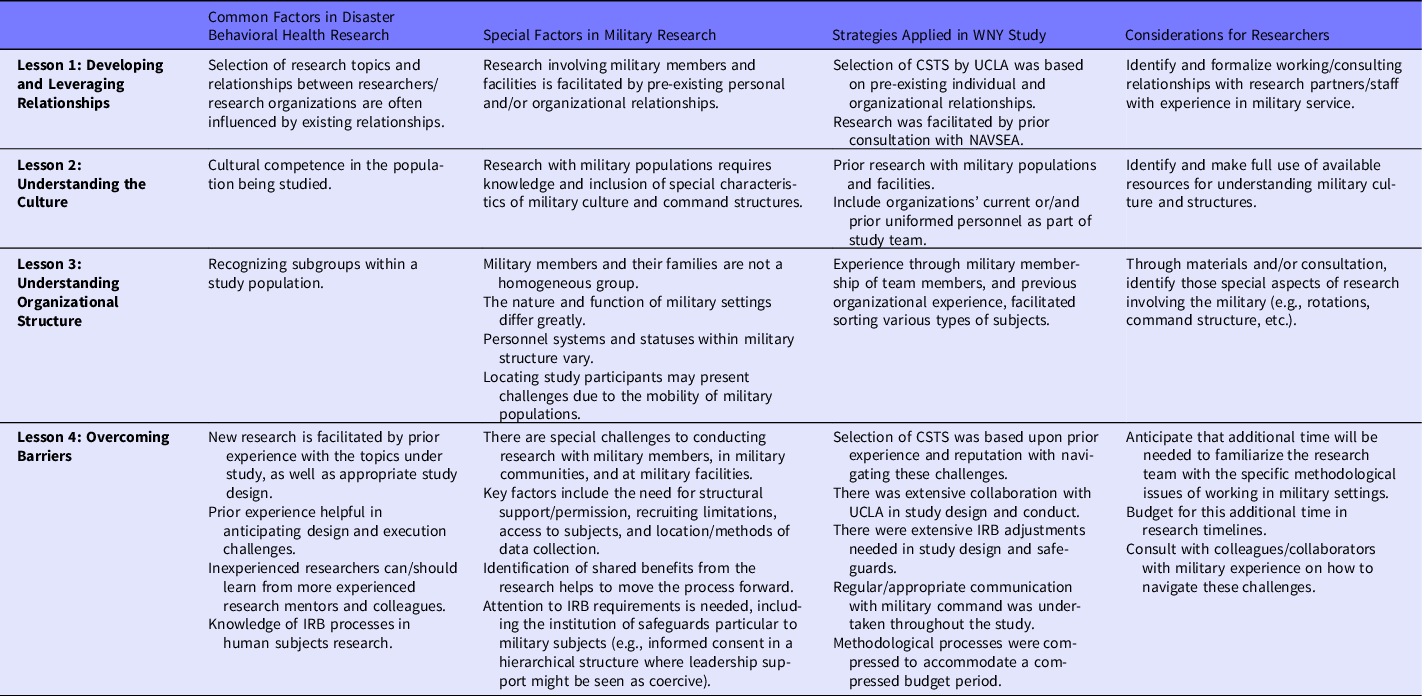
Building upon the history and experience of the Uniformed Services University’s Center for the Study of Traumatic Stress (CSTS) in disaster behavioral health research within military settings, the goal is to inform and educate on this specialized area of research. This article will begin with a description of our study on the impact of mass violence following the 2013 Washington Navy Yard shooting. 6-8 Then, using this example to illustrate lessons learned, the article will focus on 4 specific factors that contribute to success in disaster behavioral research with military service members, families, and facilities: (1) developing and leveraging relationships with military authorities, (2) understanding military culture, (3) understanding organizational structure, and 4) overcoming regulatory and access-related barriers (Table 1).
Factors that contribute to success in disaster behavioral research with military organizations

Importantly, this paper has implications for investigators outside of the military seeking to conduct disaster research within military organizations. This article may also inform investigators already associated with the military and entities evaluating proposals for funding. Organizations that are considering sponsoring this type of research will find factors they can use to assess whether proposals demonstrate sufficient knowledge and cultural competency about the special characteristics of military populations, particularly in the context of mass violence, to warrant support. The content of this paper may also inform research involving other populations that share characteristics with the military population, such as police, fire, and rescue workers.
2013 Washington Navy Yard Shooting
On September 16, 2013, a lone gunman entered the headquarters of Naval Sea Systems Command (NAVSEA) in Building 197 on the Washington Navy Yard in Washington, DC. NAVSEA is a military organization employing active-duty military, government, and contract employees responsible for engineering and acquisition of ships for the U.S. Navy. The gunman was a non-military contract employee with authorized access to the base and the building for his work. He smuggled multiple weapons past security checkpoints into the building. For over an hour he moved throughout the building, shooting and wounding employees he encountered.
A total of 12 people were fatally shot and three others were injured, before security personnel fatally shot the attacker. The building, the entire Navy Yard base, and the surrounding community, including 8 nearby schools, were kept in lockdown for 11 hours. For much of the day, there was concern that a second gunman might still be at large, which spread concern throughout the community surrounding the base. 9
In the immediate aftermath of the shooting, military and civilian community mental health resources mobilized to offer support and services both on-base and within the local community. The building in which the shooting occurred was removed from use for over a year to facilitate crime scene investigation and to renovate and redesign the interior space. As a result of the closure, the workforce was fragmented and displaced to offices around the DC area.
The Washington Navy Yard (WNY) Research Study
CSTS developed a consulting relationship with the leadership of NAVSEA starting in April, 2016. NAVSEA leadership was seeking consultation to better understand persisting stress responses in their workforce and consider what services might be needed for their workforce as they approached the 3-year anniversary of the shooting. The initial consultation included multiple meetings with the senior leaders of NAVSEA and key people involved in ongoing support of the workforce. The consulting team conducted a small number of key informant interviews to develop a baseline understanding of the exposures and responses of employees to the event, their perceptions of the organizational response to the event, how their mental health needs were met, and any current concerns. From these interviews, several themes of persisting distress among workers were identified, and this information was shared with leadership to help develop strategies for communication and to pursue additional resources for employee support. In 2017, the University of California, Los Angeles (UCLA)/Duke University National Child Traumatic Stress Network (NCTSN) was awarded a grant from the National Institute of Justice (NIJ) to conduct a mixed-methods study of 6 mass violence events. These events included the 2012 Aurora movie theater shooting, 2013 Boston Marathon bombing, 2013 Washington Navy Yard shooting, 2015 San Bernardino Community Center shooting, 2015 Charleston Church shooting, and 2016 Pulse Nightclub shooting. Due to the existing relationship with NAVSEA, and access to the workforce, CSTS was added to the NCTSN project to conduct the study at the WNY site.
The purpose of this mass violence study, including the WNY portion, was to obtain information on the acute and long-term effects of mass violence events, including their impact on a diverse array of affected populations, responses, and recovery efforts; the factors influencing individual, family, peer, school, and community experience; the amount and type of services and support received; and the perceived benefits of victim services. Additional areas of study included the impact of media coverage of the events, social media related to the events, and participation in criminal justice activities pertaining to the events. The ultimate goals of this project were to (1) expand the evidence base about the impact of these types of events and (2) assist the NIJ in providing national guidance and policy development in anticipation of, and in response to, such events in the future. The WNY study was reviewed by the Uniformed Services University Institutional Review Board.
Key informant data were collected for quantitative/thematic analysis. Informants were recruited through solicitation emails transmitted from the Commander, Naval Sea Systems Command describing our team and the purpose of the study. The email went to all employees and contained links to a website where individuals could learn more about the study. In addition to emails, flyers were posted in common areas throughout the building containing links and a QR code that directed interested individuals to the study data collection site. Interested individuals were presented a series of pre-screening questions and asked for contact information. All information was collected using a secure REDCap server. Key informant interviews were conducted over telephone by trained research assistants using a prepared script. Interviews were recorded and transcribed for thematic analysis.
Over 100 individuals responded to pre-screening, and 30 were chosen to create a representative sample. Key informants were sampled from specified groups identified in advance by the research team to ensure sufficient distribution of exposures and demographics.
Specifically, we sought a total of 30 informants stratified by military member, government civilian, and contract workforce. Of the 30 participants, we selected a sample of individuals from 3 exposure groups: Individuals directly exposed to the shooting, individuals present at the time of the shooting but not directly exposed, and family members. We also sampled from individuals who began working at NAVSEA after the event.
Unique Challenges of Conducting Research within a Military Organization
There are noteworthy challenges and barriers to conducting research within a military organization that our research team had to overcome in order to successfully study this population. This paper focuses specifically on elements of the present study that offer unique insights on disaster behavioral health research within military organizations after mass violence. The 4 lessons learned are identified and summarized in Table 1.
Lesson 1: Developing and Leveraging Relationships
The importance of developing and leveraging relationships with military authorities when conducting disaster behavioral health research is critical to the success of the research effort.
This is true in disaster research in general, but even more so when military organizations are the subject of study. The disaster response adage that states, “A disaster is not the time to be handing out business cards,” is also true of research. Optimally, in order for a disaster-affected population to trust a group of outsiders wanting to conduct research, that group of outsiders should ideally have already established relationships with the populations and organizations affected, well in advance of the disaster. Gaining entry to military organizations that have experienced a mass violence event may be difficult. They may not be receptive to overtures by outsiders, as the underlying ethos of military organizations emphasizes self-reliance and “taking care of our own.” In the case of CSTS’s work with the Washington Navy Yard shooting, prior work with NAVSEA in 2016 created a foundation of trust upon which to establish a new collaborative effort. At that time, care was taken to thoroughly assess the community’s needs, build relationships with base leadership, and make actionable recommendations. Although this was all done before either CSTS or NAVSEA became aware that a study would later be conducted on the shooting, the relationship thus established groundwork for a successful research endeavor.
Researchers without military background seeking to study military organizations may consider working with consultants who have previous relationships with the military organizations they wish to study. Doing so presents the opportunity to connect with someone either familiar to the military organization, or, at a minimum, someone who has an understanding of the organizational culture and can facilitate connection.
Lesson 2: Understanding the Culture
Knowledge of military culture is a critical component in order to successfully engage in studies with military personnel and facilities. With any population studied, it is important to understand the culture and norms of that population in order to design and implement studies in a way that is sensitive to the needs and wishes of the community under study. For the military in particular, this includes understanding their unique attitudes, behavior, symbolism, and language, in addition to the specifics of the locations in which they live and work and the operational tasks they perform. Reference Meyer, McCarroll and Ursano4 Movement of potential subjects is an example. Although society as a whole is highly mobile, the military has regular movement that can be significant, with average moves at a much greater rate than the general population. Achieving this understanding is easier if members of the study team have military experience. Members of the study team with military experience should inform the study design and implementation. Specifically, they should be able to assist in identifying the most effective recruitment messages for the population and inform the development of study procedures in such a way as to be most acceptable to military members and their leaders. Without this, it is still incumbent on the study team to attain a working level of cultural competency through training. A number of organizations such as the Center for Deployment Psychology, 10 offer online courses for those interested in understanding military culture. In the case of the WNY study, 4 senior members of the study team had either current or past active-duty military/uniformed experience, and 1 was a senior naval officer who previously worked at NAVSEA. They provided guidance on the design and implementation of the study and facilitated the primary liaison between CSTS and the NAVSEA leadership. The liaison role played a crucial part in obtaining buy-in for the study from the NAVSEA commander, without whose support and coordination the study could not have taken place.
Lesson 3: Understanding Organizational Structure
Understanding the organizational structure and the diverse roles of participants being studied is necessary to the design of a study that captures all salient features of the population. Many military organizations, including NAVSEA, include several different types of workers, e.g., active-duty uniformed military, civilian federal employees, and private contractors. Each of these types of workers has a different organizational affiliation, lines of authority, and resources available to them. In the case of the WNY study, this was particularly true of the difference in employment benefits such as access to healthcare. Active-duty military had access to a centralized universal healthcare system, while civilian employees and contractors used various forms of private health insurance. With this in mind, these groups should not be treated as a homogeneous group for the purposes of a study. NAVSEA’s workforce composition was unique even among military installations. Specifically, unlike most military installations, the vast majority of personnel were government civilians and contractors, rather than active-duty military. This impacted study design because, rather than a near complete turnover in active military as would be expected with standard 3 year rotations, the large composition of non-active duty in the workforce meant that approximately 80% of the personnel who were employed at the time of the 2013 shooting were still working at NAVSEA when the research was conducted in 2019.
Lesson 4: Overcoming Barriers
There are specific regulatory barriers that often apply to research in military organizations. IRBs within military organizations are faced with a unique challenge: They must not only protect human subjects, they must also apply additional regulations for research participation of military members specified by Department of Defense regulations. A notable regulation is that active-duty service members may not receive compensation for participation in research. Investigators applying usual recruitment strategies may find that these are not allowed.
In the case of the WNY study, IRB approval required repeated reviews and 9 months to complete. There are additional regulatory challenges to studying military organizations. As a result of paperwork reduction legislation, any research collecting data using surveys some may also need to be reviewed by the U.S. Office of Personnel Management for compliance with regulations to reduce the number of surveys of government employees. Foreseeing this delay, the study team worked closely with a NAVSEA leader to expedite the process of recruiting participants by readying strategic messaging to facilitate recruitment. When studying military populations, not only is gaining access to the populations challenging, physical access to the secure bases where they are located is another administrative barrier. Military facilities maintain physical security by controlling access to bases, and non-military individuals requesting access must have an on-base entity assist them with the process. In the WNY study, NAVSEA personnel worked not only on a secure base, but also within a limited-access building with additional security screening required to enter. Due to these access challenges, the WNY study team chose to employ electronic recruitment and telephonic interviews over in-person activities. With the COVID pandemic now limiting face-to-face research activities, this proved to be valuable experience.
Retirement and separation are issues that impact military transitions and access to military populations. For instance, military members may only give their military email for contact, and these mail.mil accounts are restricted access accounts (e.g., not accessible off-base, protected by a firewall). Once military members are out of the service or change jobs, then they cannot be easily reached, especially as message forwarding from military to non-military accounts is generally prohibited.
Therefore, special care should be taken when working with military personnel to obtain multiple types of contact information, and to periodically ensure that these are up-to-date. Understanding these specific bureaucratic, logistical, and other challenges of working with military populations and installations is critical to the successful planning and execution of a research project. In addition, these populations may be experiencing community- wide grief, not uncommon in close-knit organizations and occupations, which can impact willingness to engage in research or with people outside the community.
Discussion
This case study of a mass violence disaster within a military organization illustrates important considerations with implications for future research in comparable and civilian populations. Developing and leveraging relationships, knowing and respecting military culture, recognizing heterogeneity within military populations, and planning for additional regulatory steps are important considerations in the planning and execution of any disaster research study of military organizations. Hence, in this case, investigators at CSTS and USUHS, by virtue of their military affiliation, had advantages over investigators from non-military organizations. However, despite this “insider” status, the same challenges and barriers existed for our team as for any other research team. While our experience may not be generalizable to all disaster events, our findings have implications for gaining entry to military populations and other uniformed personnel, e.g., police, disaster workers, and firefighters.
Developing and leveraging relationships has value beyond researching military organizations and has been broadly applied within disaster research. Experienced disaster researchers will seldom venture into a community following an event without first consulting with community leaders to identify areas of need and specific populations of concern. Doing so generates a beginning to an understanding of community dynamics, relationships, and vulnerabilities. Working through a trusted agent offers researchers a level of credibility with study populations as well. Such relationships are ideally developed in advance of a disaster event, or may carry over from work within a community on a previous event. Either way, having some understanding of cultural norms of a community is also necessary in examining psychological and behavioral responses to disaster. Understanding unique regulatory challenges and barriers can also be broadly applied to disaster research. Disaster researchers do not often have protocols reviewed and approved by IRBs in advance of events. Knowing the nuances of studying vulnerable populations and incorporating appropriate protections into protocols can speed regulatory review and approval.
Military organizations, their members, and families are an important subset of a society’s culture. They reflect values, priorities, and structures that have evolved through centuries. Military organizations possess unique cultures and infrastructures which prepare service members for all manner of stressful experiences. Disasters, including mass violence events, represent a special case of stressful experience in this population. Research-based understanding of how these groups experience, understand, and react to such events informs intervention options.
The field of disaster behavioral health deserves increased attention, in the context of increased recognition of the psychological and behavioral consequences of severe and large-scale traumatic experiences and exposure. The numbers of mass violence events and other disasters in the United States and around the world, 11,12 continue to increase, necessitating continued development of specific expertise in disaster behavioral health. The growth of this field will heavily depend on continuing to broaden and deepen understanding of factors, including the consequences of various event types; victim/survivor characteristics, and the nature and extent of event preparedness, response, and recovery.
Acknowledgments
The authors would like to thank Robert Pynoos and Melissa Brymer for their support and encouragement of this project.
Funding statement
This work was supported in part by National Institute of Justice grant 2015- VF-GX-K113.
Disclaimer
The opinions and assertions expressed herein are those of the authors and do not necessarily reflect the official policy or position of the Uniformed Services University, the Henry M Jackson Foundation for the Advancement of Military Medicine, the Department of Defense, or the United States Government. This work was prepared by military and civilian employees of the US Government as part of the individual’s official duties and therefore is in the public domain and does not possess copyright protection (public domain information may be freely distributed and copied; However, as a courtesy it is requested that the Uniformed Services University and the authors be given appropriate acknowledgement).
Conflict of interest
The authors declare no conflicts of interest.