Introduction
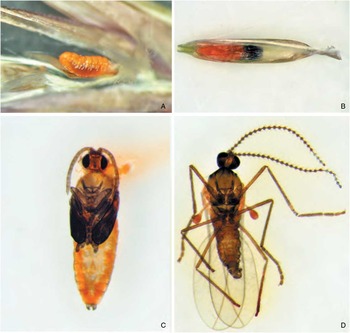
Common reed (Phragmites australis (Cavanilles) Trinius ex Steudel; Poaceae) is a tall, rhizomatous, emergent aquatic grass with a global distribution (Mal and Narine Reference Mal and Narine2004). Following the cryptic introduction of a nonnative subspecies (P. australis subsp. australis) to eastern North America its distribution increased dramatically (Saltonstall Reference Saltonstall2002) and the plant is considered highly invasive (Galatowitsch et al. Reference Galatowitsch, Anderson and Ascher1999). A native, noninvasive subspecies (P. australis subsp. americanus Saltonstall, Peterson, and Soreng) has an overlapping distribution with the invasive subspecies and appears to be declining in abundance (Saltonstall Reference Saltonstall2002). The spread of P. australis within habitats is associated with clonal (rhizomatous) growth (Mal and Narine Reference Mal and Narine2004), however, there is also evidence that colonisation and gene flow between stands of the invasive subspecies is aided by seed dispersal (Belzile et al. Reference Belzile, Labbe, Leblanc and Lavoie2010; Kettenring et al. Reference Kettenring, McCormick, Baron and Whigham2010; Kirk et al. Reference Kirk, Paul, Straka and Freeland2011). Indeed, P. australis is a prolific seed producer, with individual shoots producing hundreds of seeds (e.g., Ishii and Kadono Reference Ishii and Kadono2002). Although many insects are known to attack various above-ground and below-ground tissues of P. australis, there are no prior reports of insects that consume the reproductive structures (Tewksbury et al. Reference Tewksbury, Casagrande, Blossey, Häfliger and Schwarzländer2002). In March 2010, the larvae of a gall midge (Diptera: Cecidomyiidae) were discovered within the glumes of P. australis (Fig. 1A, B) at Peterborough, Ontario, Canada. These insects appeared to be themselves attacked by a parasitoid wasp.
Stenodiplosis phragmicola. (A) larva within flower; (B) pupa inside Phragmites australis floral husk; (C) adult emerging from pupa; and (D) adult male, ventral view.

Gall midges (Cecidomyiidae) are small flies with long antennae and slender bodies (Fig. 1D), and several species are widespread pests of crops such as wheat, rice, sorghum, barley, and rye (Harris et al. Reference Harris, Stuart, Mohan, Nair, Lamb and Rohfritsch2003). Although the gall-making habit gives this family its common name, some species (including the new species) form no obvious gall in association with florets. For example, the larvae of sorghum midge (Stenodiplosis sorghicola (Coquillett)) feed on the developing seeds (caryopses) of sorghum (Sorghum bicolor (Linnaeus) Moench; Poaceae) and do not induce galls. Sorghum is widely grown to feed livestock, and S. sorghicola has been shown to substantially reduce global crop yields (Damte et al. Reference Damte, Pendleton and Almas2009). Populations of this gall midge are influenced by interactions with parasitoid wasps in the genus Aprostocetus Westwood (Hymenoptera: Eulophidae) (Nwanze et al. Reference Nwanze, Reddy, Nwilene, Kausalya and Reddy1998).
The insect herbivores associated with common reed have received considerable attention, in part because of the desire to identify potential biological control agents (Tewksbury et al. Reference Tewksbury, Casagrande, Blossey, Häfliger and Schwarzländer2002). Indeed nonnative populations of P. australis in North America appear to host a greatly reduced community of insects in comparison with their European counterparts, suggesting that biological control could be a useful management tool for reducing the numbers and spread of this plant (Blossey Reference Blossey2003). In Europe, 171 arthropods have been reported as phytophagous on P. australis (Tewksbury et al. Reference Tewksbury, Casagrande, Blossey, Häfliger and Schwarzländer2002). By contrast, only 26 species are reported from North America, and only five of these are native (Tewksbury et al. Reference Tewksbury, Casagrande, Blossey, Häfliger and Schwarzländer2002; and see Eichiner et al. Reference Eichiner, Hoebeke and Nartshuk2011). All but one of the North American species attacks leaves and/or stems, with the remaining species also feeding on rhizomes. None of the species reported from North America were noted to attack any part of inflorescences; in Europe only Thysanoptera were noted to feed on floral structures (Tewksbury et al. Reference Tewksbury, Casagrande, Blossey, Häfliger and Schwarzländer2002; and see Ishii and Kadono Reference Ishii and Kadono2002). Cecidomyiids are an important subset of the insects feeding on P. australis: three species, including one native species of stem-feeding midges occur in North America; in Europe eight species of leaf-feeding and stem-feeding midges have been documented (Tewksbury et al. Reference Tewksbury, Casagrande, Blossey, Häfliger and Schwarzländer2002).
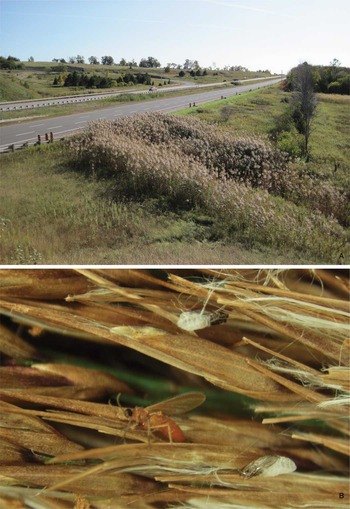
In this paper a new species of Stenodiplosis, the common reed midge (Stenodiplosis phragmicola), is identified. This is the first time insects have been reported parasitising common reed seeds (Gagné Reference Gagné1989; Tewksbury et al. Reference Tewksbury, Casagrande, Blossey, Häfliger and Schwarzländer2002). Swarms of these midges can be seen on common reed inflorescences throughout the flowering period, which in the study region occurs in late summer and early autumn. In the related sorghum midge, S. sorghicola, females are reported to oviposit between glumes (Knutson and Cronholm Reference Knutson and Cronholm2007) and their progeny feed on the developing ovary within florets, thus destroying the seed. Although we have not made direct observations of oviposition, larvae of S. phragmicola occupy the same position within florets (Fig. 1A, B) and have the same effect on seed production of the host plant. Pupation occurs within the florets (Fig. 1C) and adults were observed to emerge in late summer; often leaving the pupal exuviae attached to the plant (Fig. 2B).
(A) Road-side stand of Phragmites australis typical of those in the study area and (B) Stenodiplosis phragmicola adult and pupal exuviae on P. australis inflorescence.

The objectives of this study were to (1) describe the new species of gall midge collected from florets of common reed, (2) provide preliminary information on the plant–insect interaction, and (3) document whether the midge attacks stands of native and/or invasive lineages of P. australis in the study region. For the second objective, we evaluated the following questions: is the presence of the midge associated with the area occupied by the stand (i.e., are larger stands more likely to host midge populations)? Is the proportion of shoots with developing fly larvae associated with the abundance of reproductive plants per stand? Does inflorescence size, and presumably therefore, the number of oviposition sites per inflorescence, influence the abundance of midges?
Materials and methods
Host species
Phragmites australis can be found in a variety of wetland habitats (Mal and Narine Reference Mal and Narine2004) and in the study region is particularly noticeable in disturbed wetlands (Trebitz and Taylor Reference Trebitz and Taylor2007) and road-side ditches (e.g., Fig. 2A). Its high capacity for clonal growth, the ability of small rhizome fragments to lead to the establishment of new shoots, and low (or variable) seed production in some regions led to the suggestion that vegetative propagation is the primary means of population growth and spread (Mal and Narine Reference Mal and Narine2004). However, more recent genetic evidence from eastern North America is consistent with a substantial contribution by seeds to recruitment and dispersal (Belzile et al. Reference Belzile, Labbe, Leblanc and Lavoie2010; Kirk et al. Reference Kirk, Paul, Straka and Freeland2011).
Morphological terms used in the descriptions of the adult midges follow McAlpine (Reference McAlpine1981) and those of larvae and pupae follow Yukawa (Reference Yukawa1971). Type material is housed in the Canadian National Collection of Insects, Ottawa, Canada (CNC).
Study sites
In September 2010, we sampled mature inflorescences of P. australis from 12 stands in Peterborough County, Ontario, Canada, including the site from which the gall midge had first been observed earlier that year (Supplementary Table 1, available at http://www.journals.cambridge.org/tce2013003). The 11 additional sites were selected to represent a range of stand sizes and densities, and independently of the presence of gall midges. All stands in the study were at least 500 m away from any other stands of P. australis. These inflorescence samples yielded collections of flies representing several developmental stages, including larvae, pupae, and adults. All stands occurred in road-side ditches and, based on the results from previous sampling in this region by Paul et al. (Reference Paul, Vachon, Garroway and Freeland2010), Vachon (Reference Vachon2010), and Kirk et al. (Reference Kirk, Paul, Straka and Freeland2011), represent the nonnative lineage of the species (i.e., P. australis subsp. australis; Saltonstall et al. Reference Saltonstall, Peterson and Soreng2004).
To evaluate whether the native subspecies also hosts gall midge populations, a previously identified stand of P. australis subsp. americanus in Norfolk County, Ontario (Kirk et al. Reference Kirk, Paul, Straka and Freeland2011), was also sampled in September 2011. For this putatively native stand, we documented the presence/absence of adult flies and developing larvae. To reconfirm the native status of this stand, we followed the protocol for the identification of North American P. australis populations using restriction fragment length polymorphism analysis given by Saltonstall (Reference Saltonstall2003) with modifications outlined by Kirk et al. (Reference Kirk, Paul, Straka and Freeland2011). This site was not included in the analyses reported below.
At each site, we collected 10 inflorescences at regular intervals along a transect that ran through the widest portion of the stand [note, terms describing the morphology of P. australis follow those used by Mal and Narine (Reference Mal and Narine2004); see their fig. 1]. We estimated the fresh weight of each inflorescence to the nearest 0.01 g and then dissected 20 randomly chosen mature florets under a stereo microscope to evaluate the presence/absence of larval gall midges (total n = 2400 florets from 120 inflorescences). We estimated the area occupied by flowering shoots within stands by walking between flowering shoots at the edge of each stand and calculating its area using the built-in function on a Garmin Oregon 300 (Garmin, Olathe, Kansas, United States of America). We estimated the density of flowering shoots per stand using a 1.4 m2 quadrat placed at two randomly chosen locations in each stand.
We investigated associations between the area occupied by P. australis shoots per stand and the presence versus absence of flies using logistic regression. For this analysis, the presence of fly larvae within the stand was the (binary) dependent variable and stand area was the predictor variable. The model was calculated using the “glm” function in the stats package in R (v. 2.13.1, R Core Team 2011) by specifying binomial errors. Again using logistic regression, we evaluated associations between the proportion of shoots per stand containing fly larvae and stand density (the number of shoots per m2), stand area, and their interaction. This model was calculated using the glm function in R and by specifying quasibinomial errors to account for overdispersion (Crawley Reference Crawley2007). Finally, we evaluated associations between gall midge attack and inflorescence mass at two levels of biological organisation. First, to evaluate the association between the reproductive productivity of stands and the proportion of shoots hosting fly larvae, we used a linear model with the proportion of shoots attacked per site as the dependent variable and average inflorescence mass per site as the predictor variable. Second, using only those sites at which we detected S. phragmicola, we used a generalised linear mixed model (GLMM) to evaluate the association between fly prevalence (measured as the estimated proportion of florets per inflorescence containing fly larvae) and the mass of individual inflorescences within stands. The GLMM was specified using binomial errors (and a logit link function), by including site as a random grouping variable, and calculated using the “lmer” function in the lme4 package (Bates et al. Reference Bates, Maechler and Bolker2011) in R.
Stenodiplosis phragmicola Sinclair and Ahee, new species
Diagnosis. The species is distinguished by the two-segmented palpus; female cerci with stout, evenly distributed, spine-like sensillae, including a short apical sensilla; gonostylus widest at middle, tapered on apical third.
Etymology. The specific name is from the Latin cola (inhabitant) in reference to its host plant, Phragmites.
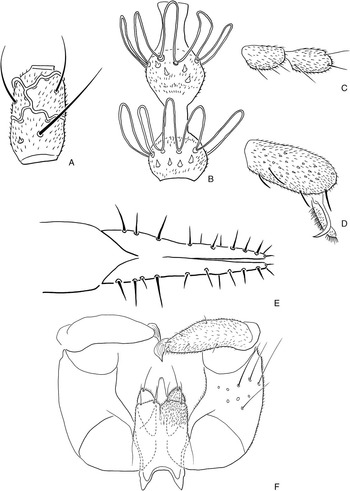
Description. Adult. Eye bridge four to five facets long. Palpus two segmented, subrectangular in profile, nearly longer than twice width; segments subequal in length (Fig. 3C). Antenna: Scape with four to six setae; 12 flagellomeres in both sexes; male binodal, with one series of circumfila on each node (Figs. 1D, 3B); female cylindrical, horizontal circumfila with short loops (Figs. 1C, 3A). Frontoclypeus with 9–12 setae.
Stenodiplosis phragmicola. (A) Female fifth antennal flagellomere; (B) male third antennal flagellomere; (C) male palpus; (D) acropod of male mid leg (tarsomere 5); (E) female cerci, dorsal view; and (F) male terminalia, dorsal view.

Thorax. Wing 1.2–1.4 mm long in male (n = 10), 1.3–1.4 mm in female (n = 10). Scutum with setal rows uniserial, somewhat unevenly positioned posteriorly; scutellum with two setae mid-dorsally and rows of four to six submarginal setae; anepisternum with five to six setae, otherwise pleura bare. Tarsal claw (Fig. 3D) untoothed, empodia reaching or slightly surpassing bend in claw.
Male abdomen. Tergites 1–7 rectangular with anterior pair of trichoid sensilla, posterior margin with pair of rows of setae, setae sparse medially on anterior tergites; tergite 8 narrower laterally than preceding tergites, with anterior pair of trichoid sensilla and widely spaced pair of setae on posterior margin. Sternites 2–7 with single posterior row of setae and mostly biserial row of setae medially; sternite 8 similarly shaped, with double row of posterior and medial setae. Terminalia (Fig. 3F). Cercus subrectangular, with truncate apex; with three to four setae along posterior margin. Hypoproct bifid apically with V-shaped notch, tapered, bearing apical seta. Gonocoxite compact, cylindrical, slightly tapered. Gonostylus widest in middle, tapered on apical third; setulose throughout. Aedeagus glaborous, longer than hypoproct and cercus; apex arched dorsally.
Female terminalia. Ovipositor elongate, retractable, sparsely covered with sensilla. Tergites 1–6 rectangular, wider than long, with single posterior row of setae, lacking setae medially. Tergite 7 rectangular much narrower than preceding segment, with complete posterior row of setae; anterior margin bearing pair of trichoid sensilla. Tergite 8 quadrate with posterior row of setae and anterior margin bearing pair of trichoid sensilla; sternite 8 not evident. Sternites 2–6 rectangular with single posterior row of setae and mostly biserial row of setae medially; sternite 7 quadrate with single posterior row of setae and mostly biserial row of setae medially. Cerci separate, tightly appressed, narrow, tapered and pointed apically (Fig. 3E); sensillae stout, spine-like, evenly distributed, including apical short sensilla.
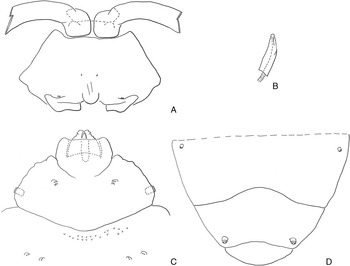
Pupa. Body elongate-cylindrical. Antennal bases separate, each slightly pointed anteriorly (Fig. 4A). Cephalic sclerite with short anteriorly directed seta on each side, not extending beyond antennal base. Frons smooth, with prominent triangular projection at mid-height, anterior to apex of palpal sheath; pair of facial papillae near base of palpal sheath. Prothoracic spiracle arched anteriorly (Fig. 4B). Spicules covering posterolateral face of tergite 1; tergites 2–3 mostly clothed in spicules; tergites 4–6 with median patch of spicules; tergites 7–8 lacking spicules.
Stenodiplosis phragmicola. (A) Head of pupa, ventral view; (B) prothoracic spiracular horn; (C) third instar larva, anterior segments, ventral view; and (D) third instar larva, posterior segments, dorsal view.

Third instar larva. Orange-yellow (Fig. 1A), generally spindle form, posterior end rounded. Integument lacking projections and papillae reduced. Antenna very short, little longer than wide, not extending beyond head capsule (Fig. 4C). Spatula absent. Pair of sternal papillae clusters closely positioned on thoracic segment 1, pair of more widely positioned sternal papillae clusters on thoracic segment 2; pleural papillae not developed. Spiracles present on prothorax and on first through eighth abdominal segment. Abdominal segment 8 lacking papillae; terminal segment smoothly rounded (Fig. 4D).
Material examined. Holotype. Male, reared from inflorescences of P. australis, collected Peterborough, Ontario, Canada, N44°17.635′ W78°20.150′, 28.viii.2011, leg. J. Ahee (CNC Diptera no. 12257). Paratypes: same data as holotype (10 males, 10 females, CNC).
Additional material. Numerous males, females, pupae, and larvae in alcohol between 2010 and 2011 seasons (CNC).
Remarks. This is a cosmopolitan genus, with 10 described species, all reared from inflorescences of grasses (Gagné Reference Gagné2004, Reference Gagné2010). In North America, there are two native and three introduced species. Previously, only gall midges associated with stem tissue were known from Phragmites (i.e., Calamomyia Gagné, Giraudiella Rübsaamen, and Lasioptera Meigen) and none have been reported from florets (Gagné Reference Gagné1989; Tewksbury et al. Reference Tewksbury, Casagrande, Blossey, Häfliger and Schwarzländer2002). The genus is distinguished by the lack of lateral setae on the adult abdominal tergites, females with very long ovipositors and usually has four or fewer palpal segments (R. Gagné, personal communication 2011). The larvae lack the spatula and the papillae are greatly reduced (Gagné Reference Gagné1989).
Among Nearctic species of Stenodiplosis, only Stenodiplosis albescentis (Gagné) (host: Triodia flava (Linnaeus) Smyth; Poaceae) bears a two-segmented palpus. The latter species differs from S. phragmicola in the empodium shorter than the claws, the male cerci are rounded apically, not truncate and female cerci lack apical setulae.
Ecological association with P. australis
Stands of P. australis subsp. australis ranged from 13 to 1585 m2 in area (average = 411.3 m2 ± 161.9 SE) and were representative of stands commonly found along roadsides in southern Ontario where the plant is considered invasive. The density of flowering shoots within stands ranged from 18 to 48 inflorescences per m2 (average = 28.6 ± 9.8 SE). Across sites we found considerable variation in the mass of inflorescences, which ranged between 1 and 44 g (n = 120). At two of the 12 stands, wasp larvae within florets and mature adults on inflorescences were observed. Adult specimens were identified by John T. Huber (CNC) as a species of Aprostocetus (Hymenoptera: Eulophidae).
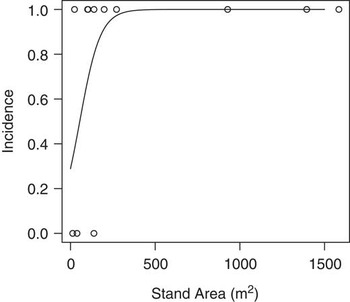
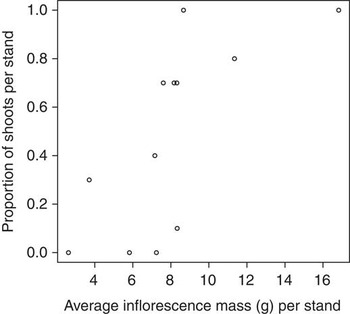
The overall proportion of sampled florets containing S. phragmicola larvae was 0.095 (n = 2400). Across inflorescences (n = 120), between 0% and 65% of florets contained developing larvae. Infestations of S. phragmicola were detected at three-quarters of all stands sampled (i.e., 9 of 12 sites). On average, 47.5% of the sampled shoots per site were infested with midge larvae. Although the largest stands in our sample all hosted fly populations (Fig. 5), there was no association between stand area and the presence versus absence of S. phragmicola (logistic regression coefficient: 0.02 ± 0.01 SE, Z = 1.23, P > 0.20). We found no association between the proportion of shoots parasitised per stand and stand area (logistic regression coefficient: −0.003 ± 0.004 SE, t = −0.70, P > 0.50) or the density of flowering shoots per stand (logistic regression coefficient: −0.04 ± 0.05 SE, t = −0.82, P > 0.40). There was also no interaction between stand area and flowering shoot density for the proportion of shoots parasitised (logistic regression coefficient: 0.00005 ± 0.00009 SE, t = 0.6, P > 0.50). However, inflorescence mass was significantly associated with the occurrence of the gall midge, but in a contrasting manner at the stand versus the inflorescence level. There was a significant positive association between the average mass of inflorescences per stand and the proportion of shoots per stand containing fly larvae (R 2 = 0.48, F 1,10 = 9.35, P < 0.05; Fig. 6). By contrast, within stands, there was a negative association between the mass of inflorescences and the proportion of florets per inflorescence containing fly larvae (GLMM: parameter estimate = −0.04 ± 0.01 SE, Wald's Z = −3.03, P < 0.01).
Association between the area occupied by Phragmites australis stands and the incidence (i.e., a binary presence/absence variable) of larval Stenodiplosis phragmicola for the 12 stands sampled.

Association between the average mass of inflorescences in each of the 12 stands of Phragmites australis sampled and the proportion of shoots sampled per stand containing Stenodiplosis phragmicola larvae.

The native stand of P. australis subsp. americanus in Norfolk County, Ontario was positively confirmed as host to adult flies and developing larvae. Rates of infestation were not quantified, but were comparable to those observed for many of the inflorescences sampled from the invasive subspecies of P. australis in the Peterborough region.
Discussion
Stenodiplosis phragmicola, the common reed midge, is the first insect reported that specifically parasitises common reed seeds (Gagné Reference Gagné1989; Tewksbury et al. Reference Tewksbury, Casagrande, Blossey, Häfliger and Schwarzländer2002). Another midge in the genus Stenodiplosis (S. sorghicola) is an important pest of the agriculturally valuable plant sorghum (S. bicolor), that is grown globally (Nwanze et al. Reference Nwanze, Reddy, Nwilene, Kausalya and Reddy1998; Franzmann et al. Reference Franzmann, Lloyd and Zalucki2006; Lloyd et al. Reference Lloyd, Franzmann and Zalucki2007; Damte et al. Reference Damte, Pendleton and Almas2009). The sorghum midge is parasitised by members of the wasp genus Aprostocetus (Nwanze et al. Reference Nwanze, Reddy, Nwilene, Kausalya and Reddy1998; Lloyd et al. Reference Lloyd, Franzmann and Zalucki2007). Stenodiplosis sorghicola also attacks the related, but noncrop plant Sorghum halepense (Johnson grass), where it is also host to members of the genus Aprostocetus (Lloyd et al. Reference Lloyd, Franzmann and Zalucki2007). In that system, the midge exhibits negative density-dependent growth, which appears to be at least partly due to a density-dependent increase in mortality by parasitoids (Lloyd et al. Reference Lloyd, Franzmann and Zalucki2007). Results such as these suggest that the efficacy of S. phragmicola as a potential control agent for P. australis could be influenced by Aprostocetus spp., and particularly that the wasp might reduce the maximum size of S. phragmicola populations.
Although the ecological data reported here are preliminary (and see below), our observations suggest that S. phragmicola has the potential to substantially reduce seed production in P. australis stands. On average, almost half of the shoots in our sample were infested with S. phragmicola larvae and in two of the sampled stands 100% of shoots were infested. Although not statistically significant, our results suggest a positive association between the size of P. australis stands and the occurrence of S. phragmicola. However, note that these data were analysed independently of the degree of isolation between stands of P. australis, which occur in close proximity to one another. Future examinations of stand-level associations with the gall midge should also evaluate how the landscape availability of the host plant influences the abundance of S. phragmicola. Within stands, we found that larger inflorescences contained more midges but that a lower proportion of florets were infested than in smaller inflorescences. Taken together, this suggests that inflorescences, not florets are the targets for oviposition by female midges; if flies select inflorescences for oviposition independently of their size, larger inflorescences would, on average, have lower rates of infestation than smaller inflorescences, as was found in this study.
For two reasons, our estimates of the proportion of florets occupied by S. phragmicola larvae, and therefore the proportion of seeds destroyed by the midge, are likely to be conservative. First, the lowest florets on a spikelet are male and therefore do not contain seeds. Because we sampled florets randomly, they were included in our counts, thus reducing the estimated proportion of seeds destroyed by midges. Second, because inflorescences were only sampled once, after anthesis was complete, some florets might have been sampled after adult emergence, further reducing our estimates of larval incidence. In spite of this, we found that up to 28% of florets per stand contained midge larvae (and/or pupae). This value (and our average value of ∼10%) is substantially higher than estimates of infestation rates for S. sorghicola on the related Johnson grass (S. halapense), where fewer than 5% of spikelets were found to be infested (Lloyd et al. Reference Lloyd, Franzmann and Zalucki2007).
Patterns of genetic variation in P. australis in northeastern North America have revealed relatively high genetic diversity within stands (Belzile et al. Reference Belzile, Labbe, Leblanc and Lavoie2010; Kirk et al. Reference Kirk, Paul, Straka and Freeland2011) implying colonisation and dispersal by seeds. Our data suggest that the seed output of P. australis is substantially reduced by S. phragmicola, which may therefore be a useful agent of biological control of the common reed. However, the use of S. phragmicola for the control of P. australis is complicated by the fact that it also attacks the native subspecies of Phragmites, which appears to have been replaced by the invasive lineage in some parts of its range (Saltonstall Reference Saltonstall2002). The native stand was sampled along the northern shore of Lake Erie, Ontario where native common reed stands occur in close proximity to the invasive subspecies. Moreover, it is not clear whether the midge is native to North America or whether it was co-introduced with European lineages of P. australis; a probable conspecific midge has been reared from florets in Serbia (M. Skuhravá, personal communication 2012). In either case, differences in the effect of S. phragmicola on the seed production of the native versus the introduced subspecies should be determined before considering its use in the control of invasive P. australis.
Acknowledgements
Raymond J. Gagné (Systematic Entomology Laboratory, Agricultural Research Services, United States Department of Agriculture, Washington, DC, United States of America) provided valuable comments and advice concerning the identification of Stenodiplosis and insightful review comments. John T. Huber (CNC) kindly provided a generic identification of the parasitoid wasps. Marcela Skuhravá (Czech Zoological Society, Prague, Czech Republic) kindly provided unpublished data on European species. The authors would like to thank Joanna Freeland who reviewed earlier drafts of the manuscript and provided locality information for native reed stands in southern Ontario, Canada. Jennifer Paul assisted in determining the status of the native reed stand. The research was funded by the Natural Sciences and Engineering Research Council via a Discovery Grant to M.E.D.