Several theories of developmental psychopathology implicate poor self-regulation as a contributor to multiple types of psychopathology, including aggression and depression (Beauchaine, Reference Beauchaine2001; Carver, Johnson, & Joorman, Reference Carver, Johnson and Joormann2008; Nigg, Reference Nigg2000, Reference Nigg2006). Understanding why self-regulatory deficits predict these alternate outcomes is critical to refining theories of psychopathology as well as to designing appropriate prevention and intervention programs. According to a developmental psychopathology framework, multifinality in developmental pathways occurs when the effect of a particular vulnerability is moderated by other risk or protective factors (Cicchetti & Rogosch, Reference Cicchetti and Rogosch1996; Richters, Reference Richters1997). The present research examined the proposition that individual variation in the mental health consequences of self-regulatory deficits is shaped by children's social motivation. This idea was examined during middle childhood, a stage during which independent self-regulatory abilities mature (Calkins & Keane, Reference Calkins and Keane2009; Nigg, Reference Nigg2000), and individual differences in social approach–avoidance motivation can be detected and make significant contributions to children's adjustment (Erdley, Cain, Loomis, Dumas-Hines, & Dweck, Reference Erdley, Cain, Loomis, Dumas-Hines and Dweck1997; Rudolph, Abaied, Flynn, Sugimura, & Agoston, Reference Rudolph, Abaied, Flynn, Sugimura and Agoston2011).
Self-Regulation and Psychopathology
Self-regulation has been conceptualized in multiple ways across diverse theoretical paradigms. Developmental theories of temperament focus on the constructs of effortful control (Rothbart & Bates, Reference Rothbart, Bates, Eisenberg, Damon and Lerner2006; Rothbart & Posner, Reference Rothbart, Posner, Hartlage and Telzrow1985; Sulik et al., Reference Sulik, Huerta, Zerr, Eisenberg, Spinrad and Valiente2010), constraint (Nigg, Reference Nigg2006), or executive inhibition (Nigg, Reference Nigg2000), as reflected in individual differences in attentional control (i.e., the ability to focus and shift attention as needed) and inhibitory control (i.e., the ability to intentionally direct internal resources toward goals or to inhibit inappropriate behaviors). Neurocognitive theories focus on the construct of executive function, a complex set of cognitive processes involved in the strategic deployment of resources to effortfully guide problem solving and goal-directed behavior, such as planning, judgment, decision making, abstract reasoning, attentional control, and response inhibition (Banich, Reference Banich2009; Nigg, Reference Nigg2000; Posner & Rothbart, Reference Posner and Rothbart2007). Other models focus on the neurochemical (e.g., serotonergic function; Carver et al., Reference Carver, Johnson and Joormann2008), psychophysiological (e.g., parasympathetic nervous system function; Beauchaine, Reference Beauchaine2001), or neuroanatomical (e.g., prefrontal cortex and anterior cingulate cortex; Milham & Banich, Reference Milham and Banich2005; Nigg, Reference Nigg2000) underpinnings of self-regulation.
The present study focused on a specific behavioral index of the executive system as reflected in temperamental inhibitory control. However, in light of the overlap among varying theoretical perspectives, we drew from theory and research on self-regulation more broadly to generate our hypotheses. These perspectives share the view that individuals with poor self-regulation, as reflected in weak “top-down” control processes (Nigg, Reference Nigg2000), have fewer resources for effectively organizing their actions and managing their impulses in support of nonimmediate goals, thereby increasing the likelihood that they engage in automatic and reflexive rather than effortful and reflective cognitive, emotional, and behavioral reactions to the environment (Calkins & Keane, Reference Calkins and Keane2009; Carver et al., Reference Carver, Johnson and Joormann2008; Compas, Connor-Smith, & Jaser, Reference Compas, Connor-Smith and Jaser2004; Nigg, Reference Nigg2000, Reference Nigg2006; Rothbart & Bates, Reference Rothbart, Bates, Eisenberg, Damon and Lerner2006). Chronic governance by these automatic reactions, in turn, heightens risk for the development of psychopathology. Poor self-regulation may trigger disinhibited cognition coupled with dysregulated outward expression of emotion (e.g., anger) and consequent impulsive action and aggression; alternatively, poor self-regulation may trigger disinhibited cognition coupled with dysregulated inward experience of emotion (e.g., sadness) and consequent ruminative perseveration and depression (Beauchaine, Reference Beauchaine2001; Carver et al., Reference Carver, Johnson and Joormann2008; Nigg, Reference Nigg2000).
Research guided by these models supports the idea that self-regulation deficits contribute to multiple types of psychopathology (for reviews, see Beauchaine, Klein, Crowell, Derbidge, & Gatzke-Kopp, Reference Beauchaine, Klein, Crowell, Derbidge and Gatzke-Kopp2009; Carver et al., Reference Carver, Johnson and Joormann2008; Nigg, Reference Nigg2000). Poor self-regulation, as reflected in low effortful control and executive inhibition, poor executive function, low serotonergic function, and reduced baseline respiratory sinus arrhythmia, predicts heightened aggressive and antisocial behavior (Calkins & Keane, Reference Calkins and Keane2009; Eisenberg et al., Reference Eisenberg, Fabes, Murphy, Maszk, Smith and Karbon1995; Eisenberg et al., Reference Eisenberg, Zhou, Spinrad, Valiente, Fabes and Liew2005, Nigg, Reference Nigg2000; Olson, Sameroff, Kerr, Lopez, & Wellman, Reference Olson, Sameroff, Kerr, Lopez and Wellman2005; Valiente et al., Reference Valiente, Eisenberg, Smith, Reiser, Fabes and Losoya2003) as well as heightened depression (Joormann, Reference Joormann, Engle, Sedek, von Hecker and McIntosh2005; Lengua, Reference Lengua2003; Levin et al., Reference Levin, Heller, Mohanty, Herrington and Miller2007; Muris & Ollendick, Reference Muris and Ollendick2005; Muris, van der Penner, Sigmond, & Mayer, 2008; Shannon, Beauchaine, Brennar, Neuhaus & Gatzke-Kopp, Reference Shannon, Beauchaine, Brenner, Neuhaus and Gatzke-Kopp2007).
Approach–Avoidance Motivation and Psychopathology
Diverse theoretical paradigms also implicate approach–avoidance motivation in the development of psychopathology. Gray's (Reference Gray, Strelau and Angleitner1991) neurobiological framework of personality proposes two motivational systems: (a) a behavioral activation or approach (appetitive) system, which governs sensitivity to reward cues and is associated with reward-seeking and approach behavior, and (b) a behavioral inhibition (defensive) system, which governs sensitivity to threat or nonreward cues and is associated with the suppression or avoidance of behavior. Models of temperament (Nigg, Reference Nigg2006; Rothbart & Posner, Reference Rothbart, Posner, Hartlage and Telzrow1985) and emotion (Lang, Reference Lang1995) similarly propose distinct incentive–response systems that guide reactions to reward (approach) and nonreward or punishment (avoidance); these approach–avoidance tendencies are believed to reflect involuntary reactions that map onto distinct neural systems (Beauchaine, Reference Beauchaine2001; Beauchaine et al., Reference Beauchaine, Klein, Crowell, Derbidge and Gatzke-Kopp2009; Nigg, Reference Nigg2000).
Collectively, these perspectives suggest that an overactive approach system and an underactive avoidance system are linked to aggression and associated conduct problems, whereas an overactive avoidance system and an underactive approach system are linked to depression and associated emotional distress. In other words, individuals with a strong approach orientation or a weak avoidance orientation would disregard social norms or potential consequences of their actions to pursue their own self-interest, potentiating the likelihood of aggression and antisocial behavior; individuals with a strong avoidance orientation or a weak approach orientation would show heightened withdrawal behavior, lack of support seeking, and emotional distress, potentiating the likelihood of depression (Carver et al., Reference Carver, Johnson and Joormann2008; Nigg, Reference Nigg2006).
Research supports the idea that individual differences in approach–avoidance motivational systems contribute to psychopathology. Although approach motivation is associated with heightened extraversion and affiliation, and modulates positive affect in the context of reward, it also has been linked to impulsivity, risk taking, aggression, and conduct problems (Gray, Reference Gray, Ekman and Davidson1994; Heym, Ferguson, & Lawrence, Reference Heym, Ferguson and Lawrence2008; Muris, Meesters, de Kanter, & Timmerman, Reference Muris, Meesters, de Kanter and Timmerman2005), perhaps because it engenders frustration or outwardly directed anger when goals are thwarted (Cooper, Gomez, & Buck, Reference Cooper, Gomez and Buck2007). Further, approach motivation is negatively associated with depression (Coplan, Wilson, Frohlick, & Zelenski, Reference Coplan, Wilson, Frohlick and Zelenski2006; Hundt, Nelson-Gray, Kimbrel, Mitchell, & Kwapil, Reference Hundt, Nelson-Gray, Kimbrel, Mitchell and Kwapil2007). Psychophysiological models also link depression to underactivation of the approach system, as reflected in diminished left frontal lobe activity (Davidson, Reference Davidson2000). In contrast, excessive avoidance motivation is associated with heightened negative emotions, neuroticism, fearfulness, anxiety, suppression of aggression, and internalizing symptoms, including depression (Cooper et al., Reference Cooper, Gomez and Buck2007; Coplan et al., Reference Coplan, Wilson, Frohlick and Zelenski2006; Gomez & Cooper, Reference Gomez, Cooper and Corr2008; Gray, Reference Gray, Ekman and Davidson1994; Gunnar, Wewerka, Frenn, Long, & Griggs, Reference Gunnar, Wewerka, Frenn, Long and Griggs2009; Heym et al., Reference Heym, Ferguson and Lawrence2008), whereas deficient avoidance motivation is associated with behavioral disinhibition (Beauchaine, Reference Beauchaine2001).
Given the salient role of peer relationships as a context of development during middle childhood (McHale, Dariotis, & Kauh, Reference McHale, Dariotis, Kauh, Lerner, Easterbrooks and Mistry2003), the present study focused on approach–avoidance motivation specifically within a social context. According to social goal theory (Erdley et al., Reference Erdley, Cain, Loomis, Dumas-Hines and Dweck1997; Rudolph et al., Reference Rudolph, Abaied, Flynn, Sugimura and Agoston2011; Ryan & Shim, Reference Ryan and Shim2008), children show individual variation in their sensitivity to social reward versus social punishment. Children with a high sensitivity to social reward are motivated by a need to obtain social approval, positive judgments, and status in the peer group, whereas children with a high sensitivity to social punishment are motivated by a need to avoid social disapproval, negative judgments, and loss of status in the peer group (Bohn & Rudolph, Reference Bohn and Rudolph2013; Rudolph et al., Reference Rudolph, Abaied, Flynn, Sugimura and Agoston2011; Rudolph, Caldwell, & Conley, Reference Rudolph, Caldwell and Conley2005; Ryan & Shim, Reference Ryan and Shim2008). Competition between these approach and avoidance motivations is believed to guide children's social and emotional adjustment (Asendorpf, Reference Asendorpf1990; Coplan et al., Reference Coplan, Wilson, Frohlick and Zelenski2006; Rubin, Coplan, & Bowker, Reference Rubin, Coplan and Bowker2009). Sensitivity to the social rewards and punishment associated with success or failure in peer relationships is likely to be intensified as children navigate increasingly challenging social worlds during middle childhood; thus, we expected that social motivation would be particularly relevant to predicting aggressive behavior against peers and depressive symptoms during this stage. Similar to findings for general approach and avoidance motivation, research reveals that heightened social approach motivation predicts both prosocial and aggressive behavior, whereas heightened social avoidance motivation suppresses aggressive behavior and predicts avoidant behavior and emotional distress (Bohn & Rudolph, Reference Bohn and Rudolph2013; Rudolph et al., Reference Rudolph, Abaied, Flynn, Sugimura and Agoston2005, Reference Rudolph, Caldwell and Conley2011; Ryan & Shim, Reference Ryan and Shim2008).
Because the present study used a more specific conceptualization of approach–avoidance motivation than is reflected in much of the prior theory and research, analyses were conducted to validate the correspondence between social approach–avoidance motivation and more general approach–avoidance systems. We examined whether the two dimensions of social motivation were associated in the expected ways with established dimensions of approach (behavioral activation) and avoidance (behavioral inhibition).
Self-Regulation × Motivation Interactions
Building on these main effects models, several theories propose interactive contributions of self-regulation and motivation to psychopathology. Temperament theorists (Eisenberg et al., Reference Eisenberg, Spinrad, Fabes, Reiser, Cumberland and Shepard2004; Nigg, Reference Nigg2000, Reference Nigg2006; Rothbart, Ellis, & Posner, Reference Rothbart, Ellis, Posner, Baumeister and Vohs2004; Valiente et al., Reference Valiente, Eisenberg, Smith, Reiser, Fabes and Losoya2003) distinguish dimensions of reactive undercontrol, in which the automatic system governing approach dominates the automatic system governing avoidance, and reactive overcontrol, in which the automatic system governing avoidance dominates the automatic system governing approach. Reactive undercontrol is believed to predict impulsivity and aggression, whereas reactive overcontrol is believed to predict inhibition and depression. Inherent to this perspective is the idea that both these systems are most potent in the context of poor effortful control or top-down regulation. In a complementary model, Carver and colleagues (Reference Carver, Johnson and Joormann2008) propose that the divergent mental health consequences of self-regulatory deficits are determined by the approach–avoidance system: Poor self-regulation combined with a sensitive reactive approach or an insensitive reactive avoidance system is reflected in the impulsive pursuit of incentives, hostility, and consequent aggression, whereas poor self-regulation combined with a sensitive reactive avoidance or an insensitive reactive approach system is reflected in cognitive perseveration, “reflexive freezing” (Carver et al., Reference Carver, Johnson and Joormann2008, p. 915), absorption in emotions, and consequent depression. From these perspectives, effortful self-regulation (i.e., top-down executive control) is critical both for restraining inappropriate approach impulses and for overriding inappropriate avoidance impulses.
These interactive models therefore involve three components: a top-down effortful control system, an approach system, and an avoidance system (for a similar integrative model, see Beauchaine, Reference Beauchaine2001). Deficits in the effortful control system can enable (a) overactivity of the approach system and consequent aggression or (b) overactivity of the avoidance system and consequent depression. Despite the theoretical convergence of these models, little empirical research directly examines whether the contribution of poor effortful self-regulation to psychopathology is contingent on approach–avoidance motivation. The present study provided one of the first explicit empirical tests of this idea by examining the interactive contribution of self-regulatory deficits (i.e., poor temperamental inhibitory control) and approach–avoidance motivation (i.e., sensitivity to social reward in the form of approval and positive evaluation versus sensitivity to social punishment in the form of disapproval and negative evaluation).
Sex differences
This research also examined sex differences in the interactive contribution of inhibitory control and social motivation to psychopathology. Theory and research suggest that the consequences of self-regulatory deficits diverge in females and males (Beauchaine et al., Reference Beauchaine, Klein, Crowell, Derbidge and Gatzke-Kopp2009). Disrupted serotonergic function is more strongly associated with depressive symptoms in women than in men (Booij et al., Reference Booij, van der Does, Benekelfat, Bremner, Cowen and Fava2002; Moreno, McGahuey, Freeman, & Delgado, Reference Moreno, McGahuey, Freeman and Delgado2006). Moreover, women carrying at least one short allele in the promoter region of the serotonin transporter linked polymorphic region gene are at heightened risk for depression (Sjoberg et al., 2006; Walderhaug et al., Reference Walderhaug, Magnusson, Neumeister, Lappalainen, Lunde and Refsum2007), particularly in combination with an avoidance motivation (reflected in high levels of neuroticism; Jacobs et al., Reference Jacobs, Kenis, Peeters, Derom, Vlietinck and van Os2006), whereas men carrying the short allele are at heightened risk for aggression (Reif et al., Reference Reif, Rösler, Freitag, Schneider, Eujen and Kissling2007; Verona, Joiner, Johnson, & Bender, 2006). It has been suggested that aggression and depression represent sex-specific manifestations of an underlying temperamental vulnerability to poor self-regulation (Beauchaine et al., Reference Beauchaine, Klein, Crowell, Derbidge and Gatzke-Kopp2009; Carver et al., Reference Carver, Johnson and Joormann2008). We therefore anticipated that poor self-regulation would predict aggressive behavior in boys with a high approach motivation or a low avoidance motivation and depressive symptoms in girls with a high avoidance motivation or a low approach motivation. These hypotheses were examined in third graders using a prospective design and a multiple-informant (child, parent, teacher) approach.
Method
Participants and procedures
Participants were 419 third graders (223 girls, 196 boys; M age = 8.92, SD = 0.36; 71.8% White, 16.5% African American, 6.2% Asian, 4.1% multiracial, 1.4% other; 32.2% received a subsidized school lunch), their parents, and their teachers. Parents provided written consent, and children provided oral assent. These children represented a subsample of participants in a longitudinal study who were selected for analysis based on availability of the relevant data. Participants in the longitudinal study were selected as a representative sample from mainstream classrooms in several small urban and rural school districts. Of the targeted children, 80% received consent and participated in the study; participants and nonparticipants did not differ in age, t (723) = 0.63, ns; sex, χ2 (1) = 0.15, ns; ethnicity, χ2 (1) = 0.59, ns; or school lunch status, χ 2 (1) = 0.35, ns. Of the original 636 participants, 427 had parent reports (97.3% maternal caregivers; 2.7% paternal caregivers) of inhibitory control in third grade. Of these, 406 had third- and fourth-grade teacher reports of aggressive behavior and 412 had third- and fourth-grade child reports of depressive symptoms. Children with and without the relevant data did not significantly differ in sex, χ2 (1; N = 636) = 0.00, ns; avoidance, t (595) = 0.11, ns; aggressive behavior, t (594) = 1.11, ns; or depressive symptoms, t (591) = −0.68, ns. Children with relevant data were less likely to be members of minority groups, χ2 (1; N = 636) = 14.78, p < .001, and recipients of subsidized lunch, χ2 (1; N = 631) = 4.31, p < .05, and they had lower levels of approach, t (595) = 2.95, p < .01.
Participants completed the questionnaires twice, 1 year apart. Questionnaires were administered in small groups (up to four children) in classrooms. All items were read aloud while participants circled their responses. Parent surveys were distributed and returned by mail or during home visits. Teacher surveys were distributed and returned at school. On average, teachers had known children for 6 months prior to completing the surveys. Children received a small gift; parents and teachers received a monetary reimbursement.
Measures
Inhibitory control
Parents completed the inhibitory control subscale of the Temperament in Middle Childhood Questionnaire (Simonds, Kieras, Rueda, & Rothbart, Reference Simonds, Kieras, Rueda and Rothbart2007; Simonds & Rothbart, Reference Simonds and Rothbart2004). This 8-item subscale assesses children's capacity to suppress inappropriate approach responses (e.g., “Can stop her/himself when s/he is told to stop”) and to plan appropriate goal-directed behavior (e.g., “Likes to plan carefully before doing something”). Parents rated each item on a 5-point scale (1 = almost always untrue to 5 = almost always true). Scores were computed as the mean of the items (α = 0.76). Parent reports of temperament have been found reliable (Rothbart, Ahadi, Hershey, & Fisher, Reference Rothbart, Ahadi, Hershey and Fisher2001; Simonds et al., Reference Simonds, Kieras, Rueda and Rothbart2007; Simonds & Rothbart, Reference Simonds and Rothbart2004) and stable (Rothbart et al., Reference Rothbart, Ahadi, Hershey and Fisher2001). In addition, validity of parent reports of temperament has been established through correlations with child report (Lengua, Reference Lengua2003; Simonds & Rothbart, Reference Simonds and Rothbart2004), behavioral observations (Wilson, Reference Wilson2006), and computer-based assessments (Simonds et al., Reference Simonds, Kieras, Rueda and Rothbart2007; for a review, see Rothbart & Bates, Reference Rothbart, Bates, Eisenberg, Damon and Lerner2006).
Social approach–avoidance motivation
Two measures were used to assess social approach and avoidance motivation. First, children completed the Social Achievement Goals Survey (Rudolph et al., Reference Rudolph, Abaied, Flynn, Sugimura and Agoston2011; Ryan & Shim, 2006). The six-item demonstration–approach subscale assesses goals that focus on demonstrating competence by gaining positive judgments (e.g., “My goal is to show other kids how much everyone likes me”); the seven-item demonstration–avoidance subscale assesses goals that focus on demonstrating competence by avoiding negative judgments (e.g., “My main goal is to make sure I don't look like a loser”). Children received the prompt “When I am around other kids …” and checked a box indicating how true each item was on a 5-point scale (1 = not at all to 5 = very much). Scores were computed as the mean of the items within each subscale. Factor analysis supports distinct approach and avoidance factors; construct validity has been established through associations with other types of social goals and multiple indexes of social adjustment (Rudolph et al., in press).
Second, children completed the Need for Approval Questionnaire (Rudolph et al., Reference Rudolph, Caldwell and Conley2005). The four-item approach-oriented need for approval subscale assesses sensitivity to peer approval (the extent to which peer approval and acceptance augment a child's sense of self-worth; e.g., “Being liked by other kids makes me feel better about myself”); the four-item avoidance-oriented need for approval subscale assesses sensitivity to peer disapproval (the extent to which peer disapproval and rejection weaken a child's sense of self-worth; e.g., “I feel like I am a bad person when other kids don't like me”). Children checked a box indicating how true each item was on a 5-point scale (1 = not at all to 5 = very much). Scores were computed as the mean of the items within each subscale. Factor analysis supports distinct approach and avoidance factors; convergent and discriminant validity have been established through associations with global self-worth, social–evaluative concerns, social behavior, and emotional distress (Rudolph et al., Reference Rudolph, Caldwell and Conley2005).
Research reveals significant associations between social achievement goals and need for approval. In this sample, approach-oriented need for approval significantly predicts demonstration–approach but not demonstration–avoidance goals, whereas avoidance-oriented need for approval significantly predicts demonstration–avoidance but not demonstration–approach goals (ps < .001; Bohn & Rudolph, Reference Bohn and Rudolph2013). Moreover, the pattern of findings for the validation analyses (see Results Section) was parallel for the individual approach and avoidance measures. Thus, we created approach (α = 0.79) and avoidance (α = 0.83) motivation composites by standardizing and averaging scores on the relevant subscales. Composite scores provide increased reliability and reduce the impact of measurement error (Rushton, Brainerd, & Pressley, Reference Rushton, Brainerd and Pressley1983).
General approach–avoidance motivation
Children completed the behavioral activation and behavioral inhibition subscales of the Behavioral Inhibition System/Behavioral Activation System Scale (BIS/BAS). This measure was developed for adults (Carver & White, Reference Carver and White1994) and modified for children (Muris et al., Reference Muris, Meesters, de Kanter and Timmerman2005). Both the adult (Coplan et al., Reference Coplan, Wilson, Frohlick and Zelenski2006; Hamill, Scott, Dearing, & Pepper, Reference Hamill, Scott, Dearing and Pepper2009) and the child (Bjørnebekk, Reference Bjørnebekk2007; Muris et al., Reference Muris, Meesters, van den Hout, Wessels, Franken and Rassin2007) versions show strong reliability and validity in youth. For this study, we primarily used the child version; for a few items, we adopted the adult version item or a slightly modified child version item to maintain the integrity of the original wording. The BAS (approach) subscale includes 13 items (e.g., “I feel excited and full of energy when I get something that I want”). The BIS (avoidance) subscale includes 7 items (e.g., “I usually get pretty tense when I think something unpleasant is going to happen”). Children checked a box indicating how true each item was on a 4-point scale (1 = not true to 5 = very true). Scores were computed as the mean of the BAS (α = 0.86) and BIS (α = 0.75) items. Supporting the validity of this measure, BAS and BIS are associated in the expected ways with personality (Heym et al., Reference Heym, Ferguson and Lawrence2008), achievement motivation (approach vs. avoidance; Bjørnebekk, Reference Bjørnebekk2007), and neurocognitive processes (Amodio, Master, Yee, & Taylor, Reference Amodio, Master, Yee and Taylor2008).Footnote 1
Aggressive behavior
Teachers completed the overt aggression subscale of the Children's Social Behavior Scale (Crick, Reference Crick1996). This four-item subscale assesses children's engagement in behaviors intended to harm others through physical damage or threat of such damage (e.g., “This child hits or kicks peers”). Teachers rated each item on a 5-point scale (1 = never true to 5 = almost always true). Scores were computed as the mean of the items (α = 0.96). Teacher reports of overt aggression on this measure show strong correspondence with peer reports (Crick, Reference Crick1996); moreover, teacher reports of aggression have been found to be more valid than child reports (Monks, Smith, & Swettenham, Reference Monks, Smith and Swettenham2003).
Depressive symptoms
Children completed the Short Mood and Feelings Questionnaire (Angold et al., Reference Angold, Costello, Messer, Pickles, Winder and Silver1995). This 13-item measure assesses children's depressive symptoms (e.g., “I felt unhappy or miserable”). The response format was modified from a 3- to 4-point scale to provide a format similar to other study questionnaires (see also Lau & Eley, Reference Lau and Eley2008). Scores were computed as the mean of the items (α = 0.87). This measure shows significant correlations with scores on the Children's Depression Inventory and the Diagnostic Interview Schedule for Children (Angold et al., Reference Angold, Costello, Messer, Pickles, Winder and Silver1995), and it differentiates depression from other psychiatric diagnoses (Thapar & McGuffin, Reference Thapar and McGuffin1998).
Results
Preliminary analyses
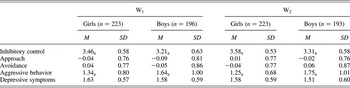
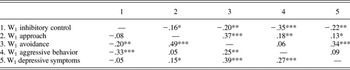
A series of t tests was conducted to provide descriptive information about sex differences (Table 1). At both waves, girls showed significantly higher levels of inhibitory control than did boys, whereas boys showed significantly higher levels of aggressive behavior than did girls. These findings are consistent with prior research suggesting that girls show higher levels of inhibitory control than do boys (Else-Quest, Hyde, Goldsmith, & Van Hulle, Reference Else-Quest, Hyde, Goldsmith and Van Hulle2006), whereas boys show higher levels of overt aggression than do girls (Crick & Grotpeter, Reference Crick and Grotpeter1995). No other significant sex differences were found. Table 2 presents intercorrelations among the variables for girls and boys.
Third and fourth grade descriptives

Note: Values with the same subscript letter differ at p < .001. W1, Wave 1; W2, Wave 2.
Correlations among inhibitory control, social approach–avoidance motivation, and psychopathology

Note: Correlations above the diagonal are for girls, and correlations below the diagonal are for boys. W1, Wave 1; W2, Wave 2.
*p < .05. **p < .01. ***p < .001.
Construct validity of social approach and avoidance motivation
Validity of the composite social approach and avoidance motivation subscales was examined in a subset of 369 children who completed the BIS/BAS. Hierarchical multiple regression analyses were conducted to examine whether the two dimensions of social motivation mapped onto the predicted dimensions of general motivation. In each regression, social approach and avoidance were entered simultaneously to examine unique effects; separate regressions were conducted to predict behavioral activation and behavioral inhibition. As expected, approach significantly predicted more behavioral activation, β = 0.55, t (368) = 8.46, p < .001, but not behavioral inhibition, β = −0.08, t (368) = −1.26, ns, whereas avoidance significantly predicted more behavioral inhibition, β = 0.58, t (368) = 9.30, p < .001, but not behavioral activation, β = −0.12, t (368) = −1.84, p < .07. These results provide strong convergent and discriminant validity for the constructs of approach and avoidance as operationalized in this study.
Inhibitory Control × Motivation contributions to psychopathology
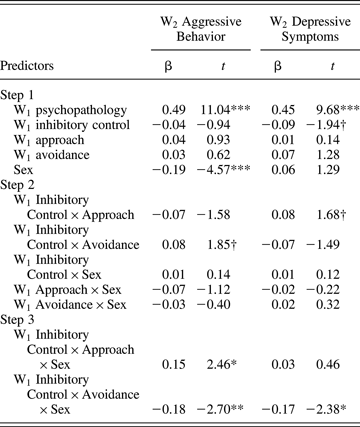
Two hierarchical multiple regression analyses were conducted to examine the interactive contribution of third-grade inhibitory control and motivation to fourth-grade psychopathology (aggressive behavior and depressive symptoms), adjusting for third-grade psychopathology. Sex and the mean-centered main effects of third-grade psychopathology, inhibitory control, and motivation were entered at the first step, the two-way interactions (Inhibitory Control × Motivation, Inhibitory Control × Sex, and Motivation × Sex) were entered at the second step, and the three-way interactions (Inhibitory Control × Motivation × Sex) were entered at the third step. Approach × Avoidance interactions were nonsignificant in both analyses and were not included in the final models. Significant three-way interactions were interpreted by using formulas provided by Cohen, Cohen, West, and Aiken (Reference Cohen, Cohen, West and Aiken2003; see also Preacher, Curran, & Bauer, Reference Preacher, Curran and Bauer2006). Simple slopes were estimated at low (–1 SD), moderate (mean), and high (+ 1 SD) levels of motivation. To further examine whether significant moderation of inhibitory control was limited to boys or girls, when three-way interactions were detected, follow-up two-way interactions also were examined within each sex. The first regression predicted fourth-grade aggressive behavior and the second regression predicted fourth-grade depressive symptoms. Approach and avoidance motivation and their respective interactions were entered in the same equations to examine unique effects.
Aggressive behavior
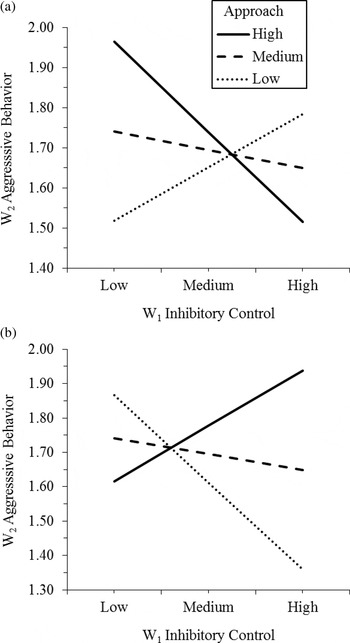
The regression predicting aggressive behavior revealed a significant positive main effect of third-grade aggressive behavior and a significant negative main effect of sex as well as significant Inhibitory Control × Approach × Sex and Inhibitory Control × Avoidance × Sex interactions (ΔR 2 = 0.02, p < .01; Table 3). As shown in Figure 1a, decomposition of the first interaction revealed that low levels of inhibitory control significantly predicted aggressive behavior in boys with high, β = −0.37, t (393) = −2.83 p < .01, but not moderate, β = −0.08, t (393) = −0.85, ns, or low, β = 0.22, t (393) = 1.67, ns, levels of approach. Inhibitory control did not predict aggressive behavior in girls with high, β = −0.03, t (393) = −0.23, ns; moderate, β = −0.07, t (393) = −0.76, ns; or low, β = −0.11, t (393) = −0.80, ns, levels of approach. As shown in Figure 1b, decomposition of the second interaction revealed that low levels of inhibitory control significantly predicted aggressive behavior in boys with low, β = −0.42, t (393) = −3.06, p < .01, but not moderate, β = −0.08, t (393) = −0.85, ns, or high, β = 0.27, t (393) = 1.95, p < .10, levels of avoidance. Inhibitory control did not predict aggressive behavior in girls with low, β = −0.06, t (393) = −0.44, ns; moderate, β = −0.07, t (393) = −0.76, ns; or high, β = −0.09, t (393) = −0.73, ns, levels of avoidance.
Predicting W2 aggressive behavior in boys from the interactive contribution of W1 inhibitory control and (a) approach motivation and (b) avoidance motivation, adjusting for W1 aggressive behavior.

Predicting W2 aggressive behavior and depressive symptoms from W1 inhibitory control, social approach–avoidance motivation, and sex
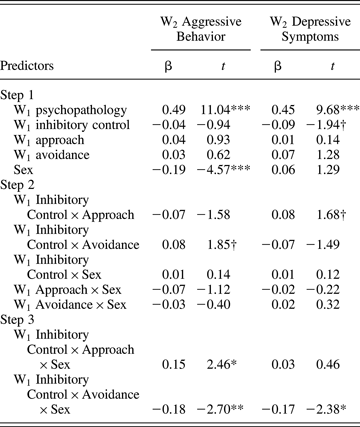
Note: The βs and ts represent statistics at each step of the regression equation. W1, Wave 1; W2, Wave 2.
†p < .10. *p < .05. **p < .01. ***p < .001.
Regressions run separately in boys and girls confirmed that approach and avoidance motivation moderated the link between low inhibitory control and aggressive behavior in boys (ΔR 2 = 0.04, p < .01); Inhibitory Control × Approach interaction: β = −0.18, t (185) = −2.58, p < .05; Inhibitory Control × Avoidance interaction: β = 0.20, t (185) = 2.82, p < .01, but not in girls, ΔR 2 = 0.00, ns; Inhibitory Control × Approach interaction: β = 0.03, t (207) = 0.53, ns; Inhibitory Control × Avoidance interaction: β = −0.01, t (207) = −0.21, ns.
Depressive symptoms
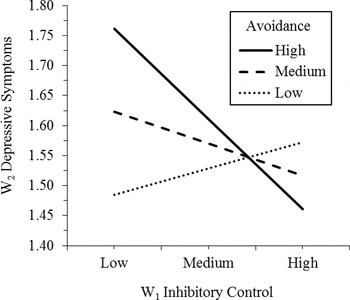
The regression predicting depressive symptoms revealed a significant positive main effect of third-grade depressive symptoms as well as a significant Inhibitory Control × Avoidance × Sex interaction (ΔR 2 = 0.01, p = .05; Table 3). As shown in Figure 2, decomposition of this interaction revealed that low levels of inhibitory control significantly predicted depressive symptoms in girls with high, β = −0.24, t (399) = −2.76, p < .01, but not moderate, β = −0.09, t (399) = −1.38, ns, or low, β = 0.07, t (399) = 0.79, ns, levels of avoidance. Inhibitory control did not predict depressive symptoms in boys with high, β = −0.03, t (399) = −0.36, p < .01; moderate, β = −0.10, t (399) = −1.60, ns; or low, β = −0.17, t (399) = −1.74, ns, levels of avoidance.
Predicting W2 depressive symptoms in girls from the interactive contribution of W1 inhibitory control and avoidance motivation, adjusting for W1 depressive symptoms.

Regressions run separately in boys and girls confirmed that avoidance motivation moderated the link between low inhibitory control and depressive symptoms in girls (ΔR 2 = .03, p < .05); Inhibitory Control × Avoidance interaction: β = −20.16, t (215) = −22.60, p < .01, but not in boys, Inhibitory Control × Avoidance interaction: ΔR 2 = .01, ns; β = 0.07, t (183) = 0.90, ns.
Discussion
Theory and research highlight the critical role played by poor self-regulation in the emergence of psychopathology. However, little empirical research has clarified why poor self-regulation predicts diverging pathways across development. This study examined how children's social motivation and sex shape the mental health consequences of poor self-regulation. In boys, low inhibitory control interacted with both approach and avoidance motivation to predict aggressive behavior; in girls, low inhibitory control interacted with avoidance motivation to predict depressive symptoms. These findings were consistent with our hypotheses and support theories emphasizing the interactive contribution of self-regulation, as reflected in top-down executive control, and approach–avoidance motivation to psychopathology (Beauchaine, Reference Beauchaine2001; Carver et al., Reference Carver, Johnson and Joormann2008; Nigg, Reference Nigg2000, Reference Nigg2006; Rothbart et al., Reference Rothbart, Ellis, Posner, Baumeister and Vohs2004). This research also informs the creation of targeted intervention programs that consider heterogeneity among children with poor self-regulation, including the different needs of boys and girls.
Multifinality in the consequences of poor self-regulation
A core principle of the developmental psychopathology perspective is the idea that a single underlying vulnerability may be expressed in multiple behavioral manifestations (Cicchetti & Rogosch, Reference Cicchetti and Rogosch1996; Richters, Reference Richters1997). Consistent with this idea, some children with poor self-regulation follow a path of increasing movement “against the world” (Caspi, Elder, & Bem, Reference Caspi, Elder and Bem1988a), as reflected in aggressive and antisocial behavior (Calkins & Keane, Reference Calkins and Keane2009; Eisenberg et al., Reference Eisenberg, Zhou, Spinrad, Valiente, Fabes and Liew2005; Olson et al., Reference Olson, Sameroff, Kerr, Lopez and Wellman2005), whereas others follow a path of increasing movement “away from the world” (Caspi, Elder, & Bem, Reference Caspi, Elder and Bem1988b), as reflected in inhibition and depression (Lengua, Reference Lengua2003; Muris & Ollendick, Reference Muris and Ollendick2005; Muris et al., Reference Muris, van der Pennen, Sigmond and Mayer2008). Findings from the present study reveal that these different outcomes of poor self-regulation are determined by children's social motivation and their sex.
Aggressive behavior
In boys, poor inhibitory control predicted subsequent aggressive behavior in the context of high approach motivation and low avoidance motivation. These findings suggest that top-down self-regulatory deficits constrain children's ability to effectively manage their impulses. When combined with a strong approach or a weak avoidance motivation, boys are likely to pursue their self-interest without considering the impact of their behavior on others or the consequences of their actions. This pattern supports theories predicting that poor self-regulation coupled with a strong sensitivity to reward or a weak sensitivity to punishment promotes aggression (Beauchaine, Reference Beauchaine2001; Carver et al., Reference Carver, Johnson and Joormann2008; Nigg, Reference Nigg2006; Rothbart et al., Reference Rothbart, Ellis, Posner, Baumeister and Vohs2004).
These findings also are consistent with the idea that aggressive behavior stems from different sources (Frick & White, Reference Frick and White2008). Overarousal theories of aggression (Nigg, Reference Nigg2006; Scarpa & Raine, Reference Scarpa and Raine1997; van Goozen et al., Reference van Goozen, Matthys, Cohen-Kettenis, Gispen-de Wied, Wiegant and Van Engeland1998) suggest that physiological overreactivity heightens negative emotionality (e.g., frustration and anger) and maladaptive reward-oriented engagement with the environment; negative emotionality and a readiness to fight promote reactive aggression, which is an impulsive behavior that occurs following provocation or frustration (Crick & Dodge, Reference Crick and Dodge1996; Nigg, Reference Nigg2006). Our finding that low inhibitory control predicted aggression in boys with a high approach motivation is consistent with this profile; these boys are driven by a need to seek social rewards (e.g., social approval, status, or control) and have inadequate resources for regulating negative emotions, formulating adaptive strategies for achieving their goals, or considering how their actions affect their peers. Collectively, these deficits promote aggressive behavior over time.
Underarousal theories of aggression (Beauchaine, Gatzke-Kopp, & Mead, Reference Beauchaine, Gatzke-Kopp and Mead2007; Nigg, Reference Nigg2006; Raine, Reference Raine2002; van Goozen et al., Reference van Goozen, Fairchild, Snoek and Harold2007) propose that chronic physiological underactivation drives low levels of fear or avoidance (fearlessness theory) or efforts to reach an optimal level of arousal (sensation-seeking theory); fearlessness and disinhibited sensation seeking promote proactive aggression, which is a goal-driven behavior that occurs without provocation (Crick & Dodge, Reference Crick and Dodge1996). Our finding that low inhibitory control predicted aggression in boys with a low avoidance motivation is consistent with this profile; these boys are not constrained by a fear of social punishment (e.g., social disapproval or negative evaluation) and associated social norms that typically suppress aggressive behavior.
Although our findings are consistent with the idea that aggressive behavior can stem from oversensitivity to social reward or undersensitivity to social punishment, our assessment did not allow us to distinguish reactive and proactive aggression. Thus, we were unable to determine whether the specific form of aggression differed based on boys' motivational profile. Moreover, it is unclear whether the tendencies toward high social approach and low social avoidance reflect distinct motivational profiles or whether some boys show both high approach and low avoidance, which would be consistent with research supporting a high correlation between proactive and reactive aggression (Dodge & Coie, Reference Dodge and Coie1987). Future research efforts designed to disentangle these two etiologies and forms of aggression, perhaps through the use of person-oriented analyses, would be helpful for clarifying the contribution of effortful self-regulation and motivation to specific trajectories of aggressive behavior across development.
Depressive symptoms
In girls, poor inhibitory control predicted subsequent depressive symptoms in the context of high avoidance motivation. These findings support the idea that top-down self-regulatory resources serve not only to constrain inappropriate approach behavior but also to override inappropriate avoidance behavior (Beauchaine, Reference Beauchaine2001; Carver et al., Reference Carver, Johnson and Joormann2008; Nigg, Reference Nigg2000, Reference Nigg2006). The idea that poor self-regulation contributes to depressive symptoms may seem contrary to some theoretical perspectives, which propose that internalizing symptoms stem from difficulties with overcontrol (e.g., Asendorpf, Borkenau, Ostendorf, & van Aken, Reference Asendorpf, Borkenau, Ostendorf and van Aken2001; Block & Block, Reference Block, Block and Collins1980; Eisenberg et al., Reference Eisenberg, Zhou, Spinrad, Valiente, Fabes and Liew2005). However, an inability to purposefully regulate cognition, emotion, and behavior can permit internally oriented and impulsive maladaptive responses to stress (e.g., ruminative perseveration, emotional arousal, freezing, or inaction), which in turn contribute to depressive symptoms (Beauchaine, Reference Beauchaine2001; Carver et al., Reference Carver, Johnson and Joormann2008; Compas, Connor-Smith, Saltzman, Thomsen, & Wadsworth, Reference Compas, Connor-Smith, Saltzman, Thomsen and Wadsworth2001). In particular, girls with poor self-regulation and a high avoidance motivation may have difficulty allocating attention away from their concerns about peer disapproval and overriding their inclination toward avoidance, leading to inhibition, social withdrawal, and depressive symptoms.
Contrary to expectations, poor inhibitory control did not predict depressive symptoms in the context of low approach motivation. According to several theoretical approaches (Carver et al., Reference Carver, Johnson and Joormann2008; Davidson, Reference Davidson2000; Heller et al., Reference Heller, Johnstone, Shackman, Light, Peterson and Kolden2009), low approach motivation prompts an inability to upregulate approach-oriented emotions (e.g., positive affect or enjoyment) and behavior (e.g., effortful engagement with the environment), thereby heightening risk for depression. However, anhedonia (i.e., a lack of enjoyment and engagement) and low positive affect, reflections of diminished reward sensitivity, become increasingly associated with depression across development (Hammen & Rudolph, Reference Hammen, Rudolph, Mash and Barkley2003; Larson, Raffaelli, Richards, Ham, & Jewell, Reference Larson, Raffaelli, Richards, Ham and Jewell1990), perhaps due to puberty-driven changes in the neural substrates underlying reward systems (Forbes & Dahl, Reference Forbes and Dahl2005). Younger children may, therefore, be less sensitive to the influence of a relatively inactive approach system on depression; perhaps low approach is reflected in other behaviors earlier in development, such as shyness and social withdrawal (Fox, Schmidt, Calkins, Rubin, & Coplan, Reference Fox, Schmidt, Calkins, Rubin and Coplan1996; Rubin et al., Reference Rubin, Coplan and Bowker2009). It will be important for future research to examine the relative contribution of poor self-regulation coupled with an oversensitive avoidance system versus an undersensitive approach system to depression across development.
Implications for sex differences in the development of psychopathology
The observed pattern of sex differences suggests one intriguing explanation for the well-established sex-differentiated pathways in psychopathology across development, namely, an upsurge in antisocial behavior in boys (Lahey et al., Reference Lahey, Van Hulle, Waldman, Rodgers, D'Onofrio and Pedlow2006) and depression in girls (Hankin & Abramson, Reference Hankin and Abramson2001) over the course of the adolescent transition. Whereas self-regulatory deficits may serve as a shared risk factor for increasing psychopathology, social motivation may explain divergence in these trajectories toward specific forms of psychopathology in boys versus girls over time.
Social motivation versus general motivation
Prior theory and research on the contribution of approach–avoidance motivation to psychopathology focus on general sensitivity to reward versus punishment. Complementing this approach, the present study examined approach and avoidance motivation within a social context. That is, an emphasis was placed on the drive to seek social reward in the form of approval, positive evaluation, and attainment of status, versus the drive to avoid social punishment in the form of disapproval, negative evaluation, and loss of status. Validation analyses confirmed that social approach and avoidance motivation mapped onto general approach and avoidance motivation. Moreover, our pattern of findings was quite consistent with theories proposing an interactive contribution of self-regulation and general approach–avoidance motivation to psychopathology, suggesting that social motivation likely acts in a similar manner to general motivation. Given that the peer context plays a salient role in children's socialization and development in middle childhood (Ladd, Reference Ladd1999), it is critical to understand the contribution of social motivation to psychopathology during this time. Because indexes of general approach–avoidance motivation were available in only a subset of children, and this measure was administered after the time frame of the current analyses, we could not examine whether similar results emerged using these indexes. Future analyses will be able to explore whether general approach–avoidance motivation interacts in a similar fashion with inhibitory control to predict psychopathology. It also would be interesting to explore whether approach–avoidance motivation within alternative specific contexts (e.g., the academic domain) makes similar contributions to psychopathology.
Trade-offs of social motivation
Beyond the predicted effects, this research also revealed an intriguing pattern of findings suggesting trade-offs in the consequences of social approach and avoidance motivation. Although high approach and low avoidance motivation intensified aggression in boys with poor inhibitory control, these same types of motivation, especially low avoidance, were associated with particularly low levels of aggression in boys with strong inhibitory control. High approach motivation and low avoidance motivation in the context of strong self-regulation may drive the adaptive expression of extroversion, such as prosocial and affiliative behavior, and may suppress aggression (Elliot & Thrash, Reference Elliot and Thrash2002; Gable, Reference Gable2006; Gray, Reference Gray, Ekman and Davidson1994). Likewise, although high avoidance motivation intensified depressive symptoms in girls with poor inhibitory control, this same type of motivation was associated with particularly low levels of depressive symptoms in girls with strong inhibitory control. High avoidance motivation in the context of strong self-regulation may drive sensitivity to social cues and adaptive emotional responses to the environment. These findings suggest that individuals who are sensitive to social reward and punishment may be particularly likely to reap the benefits of strong self-regulatory resources but to pay the costs of poor self-regulatory resources. Future research exploring these possible trade-offs can help to elucidate under which circumstances certain profiles of social motivation set children onto varying developmental trajectories.
Mechanisms underlying Self-Regulation × Motivation contributions to psychopathology
Despite the novel contributions of this research, these findings do not identify the pathways through which Self-Regulation × Motivation interactions contribute to psychopathology. Consistent with prior conceptualizations, we suggested that poor inhibitory control may predict maladaptive cognitive, emotional, and behavioral responses to stress, which then heighten risk for psychopathology. For example, poor cognitive inhibition may undermine children's ability to redirect attention away from threatening stimuli or to suppress unwanted information from memory, resulting in cognitive perseveration (Carver et al., Reference Carver, Johnson and Joormann2008; Lonigan & Phillips, Reference Lonigan, Phillips, Vasey and Dadds2001; Nigg, Reference Nigg2000, Reference Nigg2006). Such perseveration could take the form of hostile attributional biases, thereby leading to aggression, or rumination, thereby leading to depression. Likewise, poor regulation of emotions may heighten negative emotional reactivity to stress, resulting in excessive anger or sadness. Poor regulation of behavior may trigger either impulsive action and consequent aggression or an inability to override withdrawal tendencies and consequent depression (Carver et al., Reference Carver, Johnson and Joormann2008). The precise nature of these maladaptive responses and subsequent psychopathology would depend on children's social motivation. Further research is needed to directly explore these and other potential pathways.
Understanding the interactive contributions of self-regulation and approach–avoidance motivation to psychopathology across development also requires a consideration of the presumed neural systems underlying these temperamental dimensions (for a review, see Nigg, Reference Nigg2000). According to contemporary neuroscience perspectives, the capacity to exert top-down effortful control is dependent upon circuits in the prefrontal cortex and the anterior cingulate cortex; significant maturation of these systems occurs during middle childhood and adolescence, providing the basis for increasing intentional regulation of behavior (Calkins & Keane, Reference Calkins and Keane2009; Nigg, Reference Nigg2000, Reference Nigg2006). Thus, it is critical to identify how deficits in this typical growth of executive control processes during middle childhood sets the stage for the rise in psychopathology across the adolescent transition. Activity in the prefrontal cortex also modulates subcortical limbic regions involved in driving reactive approach (e.g., nucleus accumbens) and reactive avoidance (e.g., hippocampus and amygdala) tendencies (Nigg, Reference Nigg2000, Reference Nigg2006). Thus, interventions aimed at bolstering self-regulatory resources may prevent the emergence of psychopathology by helping children to modulate approach–avoidance motivation in ways that augment the benefits and dampen the costs of these orientations.
Limitations
It is important to note several limitations of this research. First, although we integrated across a wide range of theories and empirical findings to formulate our hypotheses, our study relied on questionnaire measures of self-regulation, specifically inhibitory control, and motivation. It will be critical for future research to examine whether a similar pattern of findings emerges when examining other components of self-regulation (e.g., executive function and serotonergic system) as well as when using alternative measurement approaches (e.g., neurocognitive or physiological assessments). Second, although our original sample of participants was representative of the school districts from which they were drawn, those with and without parent data differed in ethnicity, socioeconomic status, and levels of approach motivation. To determine the generalizability of these results, they will need to be replicated in representative samples. Third, despite the strength of the longitudinal design, this research focused on a short period of development prior to the marked rise in clinically significant levels of psychopathology. Although it is important to understand the early emergence of symptoms, research will need to determine whether or not the risk processes examined here do contribute to increases in more severe antisocial behavior in boys and depression in girls across the adolescent transition.
Conclusion
The present research revealed that poor inhibitory control predicts diverging pathways of psychopathology contingent on children's social motivation. Moreover, consistent with expectations, poor inhibitory control interacted with social motivation to predict aggressive behavior in boys but depressive symptoms in girls. These findings support the perspective that poor self-regulation represents a single underlying vulnerability to psychopathology with sex-differentiated behavioral expressions (Beauchaine et al., Reference Beauchaine, Klein, Crowell, Derbidge and Gatzke-Kopp2009). Moreover, this study suggests that preventive interventions must consider children's specific motivational profile to determine the most appropriate strategies for redirecting children's developmental pathways such that they move toward rather than against or away from the world. Interventions can be directed toward building self-regulatory skills in ways that enhance children's ability to meet their social goals through adaptive strategies that minimize aggressive behavior in boys (e.g., gaining status through prosocial and affiliative means, considering the consequences of their actions) and minimize depressive symptoms in girls (e.g., being socially sensitive without excessive concern about evaluation).