

Roman Law and Economics comprises two volumes with 24 chapters written by 30 authors, running to 800 pages. Edited by Giuseppe Dari-Mattiacci and Dennis Kehoe, it offers a rich variety of approaches by eminent legal scholars and leading Roman historians. The varied approaches, ranging from abstract new institutional economics to detailed historical accounts, will stimulate readers, but make a systematic and comprehensive review impossible. Given their own priors, readers will find something of value; my priors favor chapters anchored in the political, social, and economic realities of the Roman world, and they are influenced by critiques of new institutional economics.
There is no doubt that Roman law was a highly sophisticated intellectual achievement. R. Harris (1: 187) notes that the legal institutions found in the 2nd-c. CE Muziris Papyrus documenting trade with India are more developed than those in the later Geniza archive from 11th-c. CE Cairo. A central question for Roman historians is: what were the consequences of the legal developments for the economy? The two dozen chapters answer this question in different and sometimes contradictory ways. Perhaps that is not surprising in view of the basic limitations of the evidence. The Preface (1: v) rightly describes legal institutions as “well documented,” but the following chapters do not always take account of the “streetlight effect” – that is, looking for lost keys under the streetlight because that is “where the light is.” We know far more about institutions than patterns of daily practice. The lack of statistical data for the latter from the Roman Empire makes it difficult to assess the economic and social consequences of legal institutions. The chapter on “What can the endogenous institutions literature tell us about ancient Rome” points to the Babatha archive from 2nd-c. CE Judaea as evidence of “a very vigorous legal culture” (1: 18), but the archive also shows that Roman law was not so determinative as to prevent Babatha being wed as a second wife in a bigamous marriage.
The chapters show in rich detail the “spectacular innovations” as Roman law evolved to accommodate growing commercial activity with the expansion of the Empire (L. De Ligt, 1: 93). Some authors assume or argue that the innovations were deliberately designed to stimulate economic growth, but De Ligt rightly distinguishes between legal creativity responsive to economic developments and creativity intended to promote development, and concludes that “there is nothing to suggest that praetors or jurists perceived economic development or growth as an important goal of those responsible for introducing new legal remedies or for the creative reinterpretation of existing ones. Instead, we find clear indications that law-making magistrates and jurists were intellectually disposed to perceive any challenges created by new economic developments from a strictly juridical angle” (1: 104).
E. Lo Cascio articulates the case for the positive effects of legal institutions on the economy:
The integration of the local economies within the Mediterranean space produced a “Smithian growth”…. On the other hand, the political unification of the Mediterranean world under Roman rule and, even more, the establishment of lasting peaceful conditions with the advent of the Principate, in so far as they produced a drastic reduction of transaction costs, are deemed to have been at the root of the various developments that brought about both economic growth and intensification of trade: these were the suppression of piracy and the resulting increased safety of the seaborne commerce, a better circulation of information, which could mitigate the asymmetric positions of the individual economic actors, the spread of common metrological systems, the creation of a single monetary area, and the diffusion of common legal rules in what we can call commercial law….
And all of this was accomplished with “a rather small proportion of the surplus” collected as taxes (1: 113).Footnote 1 He must be right about the reduction of transaction costs, but the reader may wonder what fraction of the total cost of trade lay in the transaction costs in comparison, for example, with transport costs (see below).
Lo Cascio (1: 117) argues that imperial policy defended competitive free markets based on the concept of “pretium iustum, pretium aequum,” and thereby encouraged economic growth. Here again we would like to have quantitative evidence for enforcement and actual practice. The effect of Diocletian's Price Edict, the most famous and comprehensive intrusion into the market, is unclear. Lo Cascio (1: 131) suggests that it was consistent with the aim of a competitive market, but criticisms of modern price controls would interpret it otherwise, and the Preamble expresses outrage at greed rather than an interest in promoting market competition.
Many of the chapters discuss the possible economic implications of the financial rules and instruments, including security and asset partitioning (chs. 8 and 16), partnership (societas, ch. 9), slavery and peculium (chs. 10 and 14), accounting (ch. 10), mandate (ch. 11), loans and banking (ch. 15), and auctions (chs. 15, 16, and 24). These chapters are valuable insofar as they effectively explore the potential of the instruments and rules, but, again, the evidence for actual practice and economic impact is very limited. As J. Andreau notes, even after the extension of Roman citizenship to the free population of the Empire by Caracalla in 212 CE, “legal norms of Roman law were not applied everywhere, nor were they applied to all populations” (2: 93). The documents of the Sulpicii archive from Puteoli offer invaluable insights for lending and security in practice and are repeatedly cited (chs. 5, 11, 15, 16, 19), but since they come from one of the most active commercial centers of the Empire, it is unclear how far they should be generalized.
As is inevitable with such a diverse set of contributors, the chapters are uneven in the degree to which they take account of the technological, cultural, social, and political context of the Roman world. With regard to technology, Lo Cascio rightly suggests that it is debatable whether technical innovation contributed as much to economic growth as institutions (1: 112). On the other side, R. Ellickson claims that “[a]s its role in the Golden Age of Latin literature illustrates, Rome was a center of innovation in the arts, sciences, and engineering, all potentially of benefit to outsiders” (2:175). The claim is said to show that Rome was not a parasite city and is supposedly substantiated by a list of 41 prominent Roman writers and teachers who lived in Rome over four centuries from 200 BCE to 200 CE, nearly all of whom were not native to Rome. However, a close look at the list suggests a different conclusion: in fact, there are no scientists, and the three technical writers were not themselves innovators. The elder Pliny complains (hyperbolically) that in his day “no addition whatever is being made to knowledge by means of original research” (HN 2.117), and his list of 166 important discoveries at the end of Book 7 included only one innovation by a Roman, daily shaving (HN 7.191–215). To the extent that original research in science and mathematics was pursued in the Roman Empire, the center was Alexandria, with figures such as Ptolemy and Hero. But even in Alexandria there was a decline, noticed by Pliny, from the earlier Hellenistic era (HN 2.118–19).Footnote 2
The technical constraints meant that the Roman economy relied heavily on somatic energy from humans and animals.Footnote 3 Overland transport was by donkey or oxcart and was slow and perhaps 25 times more costly than sea transport. Pliny illustrates this fundamental point in his discussion of esparto grass used to make rope: it was grown in Spain only within 30 miles of the coast because “the costs of transport prohibit longer distance” (HN 19.30). Consequently, as A. Schiavone observes (2: 12), in the ancient economy the “mercantile side involved almost exclusively the coastal areas,” where legal instruments had their greatest impact.
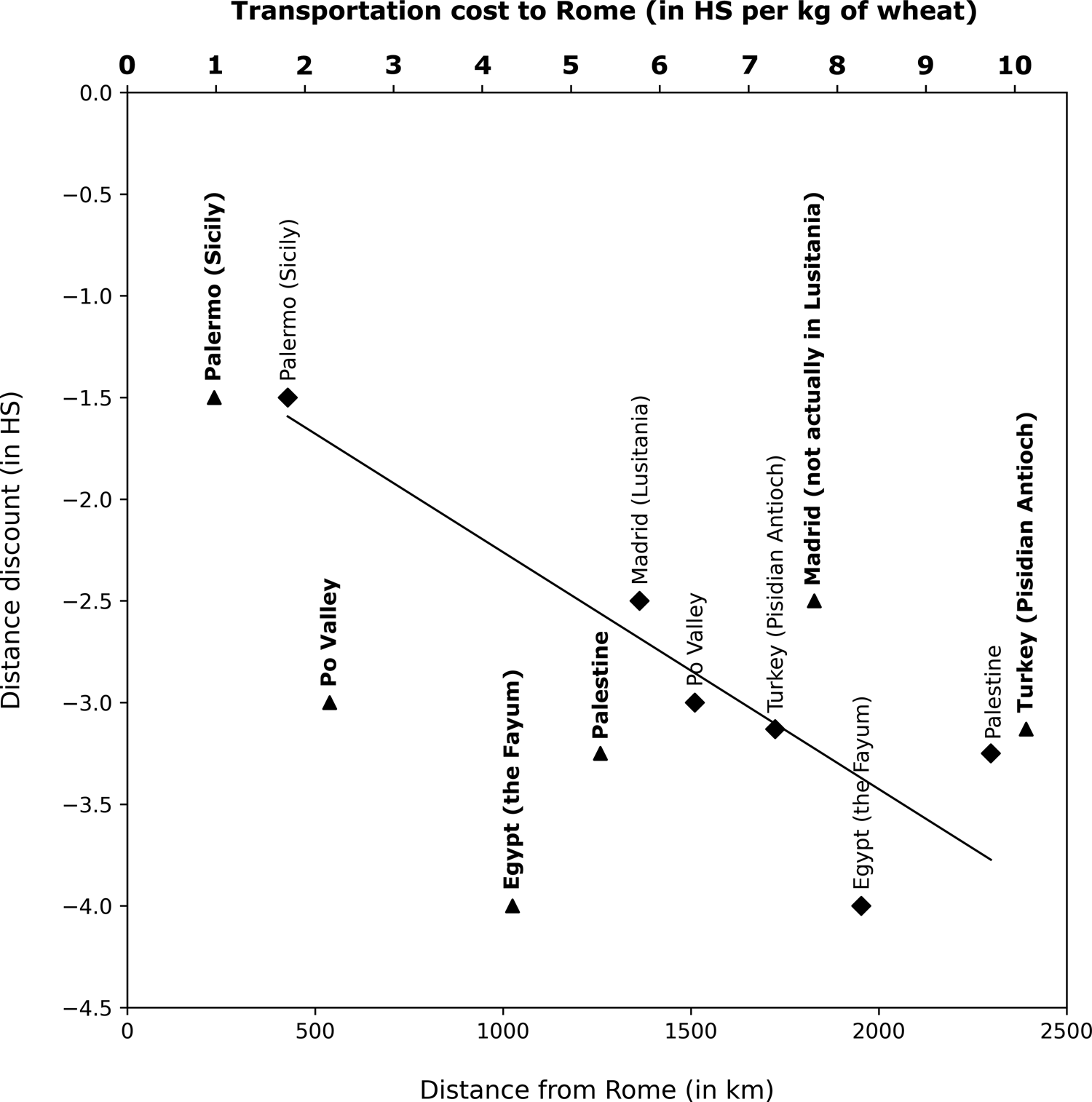
P. Temin tries to make the case (again) that the whole Empire, not only the coastal areas, was integrated as a network of interdependent markets.Footnote 4 To demonstrate this assertion, he (again) produces a graph to show that the prices of grain in localities across the Empire were inversely related to straight-line distance from Rome as a proxy for transportation cost. But of course the transport was not a straight line, and the cost was heavily influenced by whether the grain was carried by ship or by oxcart. W. Scheidel's powerful online tool, ORBIS, enables us to estimate the cost by mode of transport and thus to avoid the crude proxy of straight-line distance. Figure 1 duplicates Temin's graph in black with diamonds, showing the relationship between distance from Rome and price discount in six locations across the Empire (in his chapter Figure 6.2, 1: 146); in bold with triangles I have shown the relationship of the transportation cost from each location to the price discount. Clearly, the transport cost is the relevant consideration, and its correlation with price discount disappears. The transportation from Egypt or Palestine to Rome was mainly by sea; as a result, straight-line distance as a proxy overestimates the real cost, which would have been less than that from the closer Lusitania with its expensive overland transport. The revision of Temin's graph substituting costs supports Schiavone's argument for fragmentation of the Empire's market network rather than interdependence. It is puzzling that Temin cites Scheidel's article explaining the power of ORBIS and then fails to use it.Footnote 5 In my view, studies that seek to evaluate the aggregate impact of Roman law on trade and the economy should take account of Schiavone's point about coastal bias.
Relationship between distance and Roman distance discount (black with diamonds); relationship between transport cost and Roman distance discount (bold with triangles).

Many of the contributions investigate how, in the absence of corporations, Roman law enabled commercial activities through the familia and societas, and the limitations imposed by these alternatives. And yet as a social historian, I think that overall the two volumes are unbalanced in their focus on commerce and as a result sometimes misleading. For example, there is no systematic treatment of the economic consequences of the law of marriage and dowry, even though much of the property was owned by women and orphans, and many of the transactions in this primarily agrarian economy took place within the family. In the Digest, dowry receives three titles (out of 50), but the institution receives only three passing mentions in the 24 chapters (e.g., 2:85). The financial complexities of marriage sine manu are not explored: contrary to B. Arruñada's caricature of the “concentration of rights in the paterfamilias,” the wife in most marriages of the Classical era had fully independent property rights and could use those rights as leverage in marriages. J. Crook in a fascinating study of household financial arrangements considered the endless legal complexities of Roman households with two separate property regimes.Footnote 6 Whether this legal institution, unusual in European history, reduced or increased transaction costs would be worth exploring.
The paterfamilias typically did not have legal power over his wife, but he did have authority over his children and slaves. Sons and slaves are seen as vehicles for agency in an economy without corporate entities. More attention should have been given to the demography of the family. It is simply not true, as H. Hansmann, R. Kraakman, and R. Squire assert, that “[t]hese attributes made the Roman family both large and, from the point of view of someone who might make contracts with it, robust. It had an indefinitely long lifespan, remaining intact over multiple generations” (1: 201). A simulation of Roman kinship suggests that late male marriage and high mortality meant that nearly 50% of males died without a son to inherit and 25% had no living offspring; furthermore, contrary to the claim of the “prevalence of adoption” (2: 287) an empirical study points to a rate of adoption of only 4%.Footnote 7 Another consequence of late male marriage and high mortality is that few fathers (probably less than 15%) would have had sons in potestate over the age of 25 and mature enough to serve as agents.
The important consequences for partnerships of a demographic regime of high mortality are underlined by A. Fleckner. One of the ways in which societas was not a full substitute for corporations was its limited durability. On the death of any partner the societas was dissolved by law – the more partners, the higher the likelihood of a mandatory dissolution. Fleckner estimates that “[w]ith an annual mortality rate of, say, 1 percent, there is a probability of roughly 2 percent that a firm of two partners will be dissolved within the next year; with ten partners, the probability rises to almost 10 percent….” He realizes that his calculation is based on a conservative estimate of mortality rates. In my view, a more realistic estimate, based on a life expectancy at birth of 32.5 years, is that 15% of 30-year-olds would die before the age of 40, implying that the risk of dissolution on death of a small three-person societas of 30-year-olds was roughly 45% over 10 years. Regarding the potential of societas as an institutional basis for large commercial ventures, Fleckner concluded: “The essence of these observations is that Roman business associations were surprisingly small (often limited to two partners, the absolute minimum of an ‘association’ or a ‘joint’ business venture)” (1: 234).
Fleckner's “high level of instability” (1: 234) in business associations is of a piece with Andreau's observation that medium- and long-term loans were “very rare” (2: 101). B. Shaw's recent intriguing study associates these characteristics of Roman commerce with “dominant Roman concepts of the future [that] seem more short-term, fragmented and tentacular in nature and more dependent on personal connections and immediate concerns.”Footnote 8
A recurrent topic in the two volumes (chs. 1, 5, 7, 10, 11, 19, 20, 24) is how Roman law dealt with asymmetries of information in commercial transactions. Early on, the Aediles’ Edict allowed for the reversal of a sale of a defective slave or draft animal if the defect was not disclosed by the seller, regardless of the seller's intent to deceive. Partnerships introduced additional challenges of asymmetric information, because each partner could be held fully liable for the debts of the societas. Consequently, insufficient information about the assets and liabilities of one's partners or a slave's peculium could have serious financial repercussions. The Romans kept accounts, but their format provided only limited insight into the net financial positions, as B. Abatino and G. Dari-Mattiacci explain: “The main purpose of accounts (rationes) was to record events chronologically in terms of debts and credits per activity, without a system of double-entry bookkeeping. Moreover, there is no evidence of any statistical aggregation of data or certification by an independent agency. As a result, ancient accounting provided far less reliable information and could be used to convey information to third parties only to a limited extent” (1: 291–92). In a large slave familia with sub-slaves (vicarii) running separate businesses, the web of loans and debts could be very complex. E. Koops notes that “Roman jurists consider it near-normal that the accounts of master and slave become entangled…” (2: 38). While bankers could be required to produce rationes in court, other individuals were not required, and there was no regular auditing institution to certify the integrity of business accounts, so essential to modern commerce (1: 291). As a result, personal relationships in an “economy of friends” were important for fostering trust.Footnote 9 Alternatively, to manage these problems of asymmetric information, Verhagen points out the advantages to the creditor of requiring real security, as illustrated in the Sulpicii archive (1: 114).
The institution of slavery is pervasive in the two volumes, as it was in Roman law and society. Schiavone views slavery as “both a factor of strength and a limit to any further growth” in the economy (2: 11). I worry that a reader of the two volumes without a deeper knowledge of Roman history will come away with a stronger impression of the strength of the slave system than its limits, because of the detailed treatments of the law regarding urban slaves in business. Schiavone rightly notes that these slaves were “only a minority – albeit not small” (2: 31). He and Koops point out the reality of “terrible coercion” and (sexual) vulnerability of slaves (2: 20, 54). But none of the chapters attempts a systematic analysis of the ways in which the legal institution of slavery was inefficient. More broadly, it would have been useful to assess the economic effects of growing inequality, as reflected in the emergence in the 2nd c. CE of the formal distinction in law between honestiores and humiliores. “Humiliores” appear only once in the two volumes, in a quotation showing differential penalties for speculators (1: 118). In view of these institutions and trends of domination, I find it impossible to accept G. Parsons Miller's premise of new institutional economics that in both ancient and modern societies “the essential challenge remains the same: to establish stable institutions that achieve the benefits of cooperation without creating undue potential for oppression…” (1: 4). This premise strikes me as open to S. Ogilvie's critique of new institutional economics in her article “‘Whatever is, is right’? Economic institutions in pre-industrial Europe.”Footnote 10 She argues that the historian should engage in holistic assessments of the efficiencies and inefficiencies of institutions within the context of competition and conflict for resources and status.
What do these chapters demonstrate about the effect of highly developed legal institutions on economic performance in the Roman Empire? My own priors incline me to agree with Schiavone (2: 13) that it is not easy to identify causality between law and the economy, given the available evidence for practical impact. The chapters certainly show the potential for legal institutions to engender efficiencies, but estimating the aggregate effects is difficult or impossible. De Ligt's conclusion seems to me to be persuasive: “It would, however, be going too far to characterize the impressive body of remedies, concepts, rules, and interpretations created by Roman law-makers as a prime mover of economic change” (1: 105).
As a painfully ironic postscript, I cannot pass over E. Posner's statement, obviously written before January 6, 2021: “In the United States, politics is not a life and death struggle. The low stakes ensure that power is given up voluntarily and transfers of power are peaceful. Elected officials have weaker incentives to rig the game in the incumbent's favor. If incentives to perform well are less strong, by the same token the incentives to challenge the constitutional system are weaker, and so political stability is greater” (1: 71). Would that it were so.Footnote 11