Introduction
The incorporation of ethnic-religious minorities has been a key topic of political and academic thinking for a long time. It has constituted a special challenge in terms of religious pluralism and tolerance. During the last centuries, this applied in Europe to various Christian minorities such as Protestants migrating from France to the Netherlands in the eighteenth century. It also applied to Jews moving between various countries, mostly from east to west. More recently, it applies to Muslims that migrated from Mediterranean countries like Morocco and Turkey to Western European countries such as the Netherlands.
The arrival and settlement of ethnic-religious minorities in Europe and the United States has been one of the main sources of inspiration that spurred the development of theories of assimilation (e.g., Alba Reference Alba2005; Alba and Nee Reference Alba and Nee2003; Brubaker Reference Brubaker2001; Gans Reference Gans2007; Morawska Reference Morawska2009; Vermeulen Reference Vermeulen2010; Waters and Jiménez Reference Waters and Jiménez2005). Assimilationist theory defines several processes and factors that may account for differences in degree and timing of assimilation between ethnic-religious minorities. In recent assimilation theory, as developed by Alba and Nee (Reference Alba and Nee2003), the conditions under which ethnic-religious minorities cross, shift, or blur the boundaries with other groups come to the fore. This article seeks to contribute to this literature on boundary crossing, shifting, and blurring by a comparative analysis of the assimilation of two non-Christian minority groups in different periods of Dutch history.
The assimilation of present-day minorities of Mediterranean Muslims in the Netherlands is currently receiving much attention. Before the settlement of Muslims in the Netherlands, the last fair-sized non-Christian minority group were the pre–World War II Jews. This article provides a historical-sociological analysis of the assimilation of pre–World War II Jews and present-day Mediterranean Muslims into Dutch society. Such an analysis can contribute to our understanding of the assimilation of religious minorities, just as, for example, Engelen and Puschmann's (Reference Engelen and Puschmann2011) comparison of nuptiality in historical Western Europe and the contemporary Arab world contributes to our understanding in marriage behavior in the present-day Arab world. Similarly, Lucassen (Reference Lucassen2005) has conducted various studies in which integration processes or “paths of integration” of migrant groups in different historical episodes were analyzed and compared.
The comparison between the assimilation of pre–World War II Jews and that of contemporary Muslims in the Netherlands is not only academically relevant, but it is also a comparison that is often made in the context of current Dutch (political) discourses on assimilation. The former mayor of Amsterdam, Job Cohen, as well as the then alderman of Amsterdam and later on minister of Social Affairs and Integration, Lodewijk Asscher, often made historic references to the integration process of Jews when discussing the assimilation of nowadays Muslims in the Netherlands.Footnote 1 These references might suggest that studying the assimilation process of pre–World War II Jews is useful for understanding and putting into (historical) perspective the assimilation process of present-day Mediterranean Muslims.
The aim of this study is to capture assimilation processes of both pre–World War II Jews and present-day Mediterranean Muslims using assimilation theory. This might enable us to compare assimilation processes of both groups. Following the aim, we address the question, what assimilation trajectories were manifest among present-day Mediterranean Muslims and pre–World War II Jews in Dutch society? We will discuss, following Lucassen (Reference Lucassen2005: 5), whether it is reasonable to believe that the assimilation process of contemporary minorities, such as Mediterranean Muslims, will be different in the long run from that of immigrant minorities in the past, such as the Jews.
Information on the assimilation process of Jews in the Netherlands is mainly based on findings from recent (quantitative) empirical research on the assimilation of pre–World War II Jews in the Netherlands (e.g., Tammes Reference Tammes2010a, Reference Tammes2011a, Reference Tammes2012a, Reference Tammes2012b) that expanded on earlier overviews and findings about the process of Jewish assimilation in the Netherlands (e.g., Blom and Cahen Reference Blom, Cahen, Blom, Fuks-Mansfeld and Schöffer1995; Boekman Reference Boekman1936; Kruijt Reference Kruijt and Hendrik1939; Leydesdorff Reference Leydesdorff1987; Reijnders Reference Reijnders1969; Schöffer Reference Schöffer1981; Van Zanten Reference Van Zanten1926). Information on the assimilation of Mediterranean Muslims is based on a collection of research reports that included crude data such as the yearly integration reports published by Netherlands Institute for Social Research (Sociaal en Cultureel Planbureau [SCP]), and the state on integration of ethnic minorities in Amsterdam and Rotterdam jointly published by the two municipal departments for research and statistics (Centrum Onderzoek en Statistiek Rotterdam [COS] and Bureau Onderzoek en Statistiek Amsterdam [O+S] 2012).
Assimilation Theory and the Incorporation of Minorities
Assimilation theory is one out of several theoretical perspectives on intergroup relations. Unlike multiculturalist and integrationist theories, assimilationist theory stresses the element of spanning and altering of boundaries between minority groups then recognizing and possibly reifying differences (Alba and Nee Reference Alba and Nee2003; Brubaker Reference Brubaker2001, Reference Brubaker2009; Gans Reference Gans2007; Park Reference Park1914). Assimilation theory emerged in the early twentieth century as a spin-off from the Chicago School of Sociology. Park's conceptualization of the race relations cycle (Reference Park1914; Park et al. Reference Park, Burgess and McKenzie1984) provided a first example of assimilationist theory. Park assumed that relations between racial minorities and the majority population would pass through a cycle of contact, conflict, accommodation, and eventually assimilation. As Brubaker argues (Reference Brubaker2001), this original concept of assimilation involved an organic transition of a specific homogeneous group into the majority culture. It defines assimilation as a cultural process of becoming ever more similar and eventually becoming an unrecognizable part of the majority population. It also defines assimilation as something linear and irrevocable; it is a process that cannot be reversed. Many scholars have shown that promoting assimilation was at the heart of race relations and minority policies of many nation-states (Bloemraad et al. Reference Bloemraad, Korteweg and Yurdakul2008; Brubaker Reference Brubaker2009; Joppke and Morawska Reference Joppke and Morawska2003).
More recent stands of assimilationist theory have a different conceptualization of assimilation. Many argue that the original transitive and organic form of assimilation was never really achieved; the “melting pot” did not happen (Alba and Nee Reference Alba and Nee1997; Glazer Reference Glazer1997; Glazer and Moynihan Reference Glazer and Moynihan1963). Various efforts have been made to redefine and conceptualize assimilation to make sense of the more differentiated outcomes of assimilation trajectories. Gordon's framework distinguished various dimensions on which assimilation could take place, ranging from simple acculturation to structural assimilation (Gordon Reference Gordon1964). Lucassen (Reference Lucassen2005) also distinguished between identificational forms of assimilation, also described as cultural assimilation, and structural forms of assimilation that refer primarily to full participation rather than to identification. Portes defined what he called segmented assimilation as a process in which assimilation may take place in some spheres or segments of immigrants’ lives while not or very differently affecting other segments (Portes and Zhou Reference Portes and Zhou1993). Brubaker (Reference Brubaker, Christian and Morawska2014) redefines assimilation in a more abstract manner as a heterogeneous and an intransitive process that usually takes place over various generations and relates to socioeconomic as well as sociocultural issues. In Morawska's ethnicization approach (Reference Morawska1994), assimilation does not involve a homogeneous process, but different stages of assimilation and variations in pace of assimilation among immigrant or minority groups, considering concrete historical circumstances. Furthermore, Gans (Reference Gans1992) introduced the concept of the bumpy-line trajectory, and argued that the assimilation of successive generations does not always follow a linear trajectory, but assimilation processes or outcomes could vary over time or between generations.
These changes in the conceptualization of assimilation are included in the conceptual framework of the modernized assimilation theory developed by Alba and Nee (Reference Alba and Nee2003). Within their framework of modernized assimilation theory, a variety of mechanisms shape the paths of assimilation. In addition to individual incentives and motives, the path of assimilation can be affected by cultural, social, financial, and human capital. Network mechanisms, or social-exchange mechanisms, monitor and enforce the norms and informal rules that provide the guidelines for group or individual actions, possibly even blocking particular (individual) patterns of social or economic mobility. At the same time, changes in the formal and informal rules of mainstream society can result in a decline of religious or ethnic distinctions, which may contribute to a wider acceptance of different cultural and social values in society.
Alba and Nee give much prominence to institutions due to their focus on assimilation of migrants in the United States and the racial barriers, especially the deeply rooted color-coded racism African Americans have faced (Alba and Nee Reference Alba and Nee2003: 59). In Europe, however, religion has had a profound impact upon values and relationships for ages because European societies have deeply institutionalized religious (Christian) identities (e.g., Foner and Alba Reference Foner and Alba2008). Religion is therefore considered an important layer of the European individual identity.
Elaborating this intransitive and heterogeneous conceptualization of assimilation, Alba and Nee have conceptualized processes of spanning and altering group boundaries in terms of crossing, blurring and shifting Alba and Nee (Reference Alba and Nee2003: 56–60). Boundary crossing comes closest to the original conception of individual-level assimilation (ibid.: 60). It refers to social practices and behavior of members of minorities that stress being part of the majority population rather than the minority population, such as changing their names, taking on its habits of speech, dress, and behavior (ibid.: 61). Such boundary crossing may take place in some spheres while preserving boundaries in other spheres; for instance, boundary crossing into the economic or even the cultural sphere may take place without crossing boundaries in the religious sphere.
Boundary blurring refers to social practices and behaviors that involve intergroup relations, signaling that a boundary can be transgressed rather than being crossed or that boundaries have become irrelevant altogether. It can refer, for instance, to intergroup contact of members by marriage, socioeconomic and residential opportunities supported by institutional mechanisms, such as law, public perception, and social values, enforcing equal rights (ibid.: 61–63, 287). Finally, boundary shifting involves the inclusion of previously disparaged groups by changing racial perceptions or by redefinition of the racial status of a group (ibid.: 61, 132, 288–89). This may involve changing ways of imagining the national community (Anderson Reference Anderson1983).
To measure the degree of blurring, crossing, and shifting one ideally needs indicators that are measured over time. This timing is not necessarily related to generations, age, or a fixed time span. In the next section, we will describe the indicators to measure processes of boundary altering or spanning.
Measuring Boundary Crossing, Blurring, and Shifting
To conduct a historical-sociological study we collected data on boundary shifting, blurring, and crossing among pre–World War II Jews and present-day Muslims in the Netherlands. To study these assimilation process and to be able to compare across these two groups we selected specific indicators of each of these three elements of assimilation. Whereas the distinguished boundary-altering processes might be seen as ideal types (Alba and Nee Reference Alba and Nee2003: 60), we assigned indicators to each of the three types based on the labeling by Alba and Nee in their book Remaking the American Mainstream and other academic publications (e.g., Alba Reference Alba2006; Kivisto and Faist Reference Kivisto and Faist2009). Furthermore, we selected only indicators on which we could collect adequate data or information for both pre–World War II Jews and contemporary Muslims.
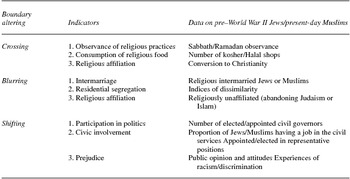
Table 1 shows the indicators that we will focus on. For boundary crossing we focus first on the observances of religious practices. Therefore, we gathered data on the percentage of Jewish families in Amsterdam that observed Sabbatical and the percentage of Muslim that observed Ramadan. Second, we focused on the consumption of kosher and Halal food, within, respectively, the Jewish community and Muslim community, by determining the number of shops that provide these special foods. Third, we focused on conversion. Hence, we need to collect data that presents the percentages converted to Christianity. Higher percentages converted Jews or Muslims and lesser observance of religious practices indicates a stronger level of boundary crossing.
Indicators of boundary altering

To investigate boundary blurring we focused on intermarriage, residential segregation, and religious (dis)affiliation. Intermarriage, the most intimate form of mixing, will be measured as the percentage of religious intermarried Jews and Muslims. Higher level of intermarriages indicates stronger boundary blurring. Secularization in the Netherlands started in the first decades of the twentieth century. This trend blurred boundaries between persons who were previously separated by their religious denomination. Higher proportion of religious unaffiliated Jews or Muslims indicates that these groups joined the national trend in secularization. The process of residential segregation or a group's spread is described through the index of dissimilarity (ID), one of the generally accepted standards by which means residential segregation may be measured (Massey and Denton Reference Massey and Denton1988). The ID varies between 0 and 100, and represents the proportion of group members who would have to relocate for the minority group to have the same spatial distribution as the remainder of a city's population. The higher this index, the more residentially segregated members of a group live; values of 70 or more are seen as very high, in the 60s as moderately high, and in the 50s as high.
Finally, boundary shifting may be manifested in growing minority involvement in politics and in civic services. The participation in politics will be determined by collecting information on appointed Jews and Muslims as civil governors at the national, provincial, and municipal level. To measure civic involvement, we collected data on the proportion of Jews or Muslims having a job in the civil service sector. When Jews or Muslims are appointed in representative positions, such as mayors or elected members of local or provincial assemblies, boundaries are shifting as governors had apparently no objection to appoint them and voters no objections to elect them. Furthermore, higher proportions of Jews or Muslims within public-sector jobs also indicate a shifting of boundaries.
For all the selected indicators, data is available for both the pre–World War II Jews and for present-day Muslims. In this study, we will primarily use quantitative data because these data are more useful in defining patterns or trends over time.
A caveat in terms of data availability and comparability is that some of the data sources for both groups differ. Whereas nearly all information on pre–World War II Jews involves data from census or local registry, some of the information on Muslims are also derived from inquiries. A second caveat might be that much of the available data collected on pre–World War II Jews applies to Amsterdam only. About 60 percent of the Jews in the Netherlands lived in Amsterdam around 1900. Hence this study will focus on pre–World War II Jews in Amsterdam. To analyze assimilation trajectories of Mediterranean Muslims we also collected local data on Amsterdam. Furthermore, we used comparable data relevant to our study on Muslims in Rotterdam because a second large concentration of Muslims lives in this city. Focusing on urban setting for both groups will result in findings on urban assimilation that might differ from assimilation in small towns or rural settings (Morawska Reference Morawska1996). Third, while Jews in this study are those who belonged to an Israelite congregation, data on those belonging nowadays to an Islamic congregation (Muslims) is harder to find because religion is less often registered or administrated. Hence most of the data on Muslims involve Moroccan and Turkish inhabitants. Finally, a caveat in the analysis is that most of the families of pre–World War II Jews had been in the Netherlands for a long time or several generations, whereas the families of contemporary Muslim in the Netherlands are only first, second, or third generation at most. However, we do not distinguish between first, second, and subsequent generations because the available data for both the contemporary Muslims (i.e., Turks and Moroccans) and the pre–World War II Jews often do not allow us to make such a distinction. The difference in length of stay between both groups might affect our findings regarding the assimilation in both groups. Nonetheless, it does not obscure our focus on understanding the process of assimilation of religious minorities.
Assimilation Trajectories of Pre–World War II Jews
Although Jews settled permanently in Amsterdam from the beginning of the seventeenth century onward, they were granted full civic rights in 1796. Only a small and wealthy group of Jews experienced more general emancipation and showed tendencies toward integration after the granting of civic rights. In the first decades of the twentieth century most were still excluded from trade, craft, or public positions, which limit integration (Sonnenberg-Stern Reference Sonnenberg-Stern2000). Furthermore, reforms were needed to emancipate Jews; Jewish schools were ordered to teach their pupils Dutch (Zwiep Reference Zwiep2000); and Jewish congregations needed to adapt and reorganize in line with Dutch legislation of separation of state and church or “privatization” of religion (Daalder Reference Daalder1978; Reijnders Reference Reijnders1969: 110–12). The great majority of Jews could experience, social, cultural, and economic emancipation only after the Netherlands witnessed industrial growth from 1870 onward; the religious reorganization of the Jewish congregation, due to the granted civil rights, was completed (Blom and Cahen Reference Blom, Cahen, Blom, Fuks-Mansfeld and Schöffer1995); and discriminatory measures were removed (Sonnenberg-Stern Reference Sonnenberg-Stern2000). In this section, the focus is therefore mainly on the assimilation process of Amsterdam Jews in the first four decades of the twentieth century.
Around 1900, about 103,000 Jews lived in the Netherlands and about 60,000 of them in Amsterdam; among the Amsterdam Jews about 92 percent belonged to the Dutch Israelite congregation and about 8 percent to the Portuguese Israelite congregation (Tammes Reference Tammes, Matthijs, van de Putte, Kok and Bras2010b). In our study, we do not make a distinction between these groups, mostly because religious and social differences between the two groups diminished in the nineteenth century and intermarriage rates were high (Boekman Reference Boekman1936: 21, 66). At the end of the 1930s nearly 80,000 Jews lived in Amsterdam, about 56 percent of all Jews in the Netherlands. At that time, around 15 percent was non-Dutch, mostly German Jews, more than half of them migrated in the 1930s to the Netherlands (Tammes Reference Tammes, Matthijs, van de Putte, Kok and Bras2010b).
Boundary Blurring: Jewish–Gentile Intermarriage
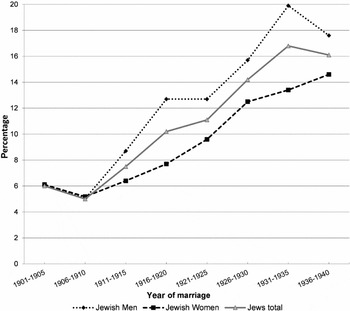
Jewish–Gentile intermarriage constitutes a key indicator of the assimilation process of Jews in the Netherlands. Figure 1 shows the trend for religious intermarried Jews covering the period from 1901 to 1940 in five-year intervals. In the first decade of the twentieth century around 5 percent of the Jews who entered into matrimony married a Gentile. In the second decade, this percentage doubled. In the first half of the 1930s about 17 percent of the Jews who entered into matrimony married a Gentile, though in the second half of the 1930s this percentage dropped slightly. Despite the sharp increase of mixed marriage among Jews, they had not reached the share of mixed marriage among Catholics and Protestants (Boekman Reference Boekman1936: 64–65). More important might be with whom Jews intermarried.
Percentage of Jews married to a Gentile of all Jews who got married in Amsterdam (1901–40), split for Jewish men and Jewish women.

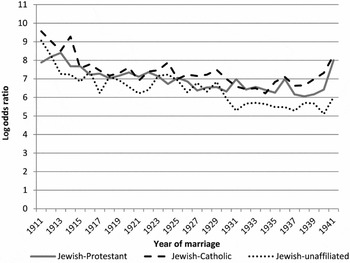
By calculating odds ratios, we can determine the preferences for spouses in religious intermarriages because this statistical measure considers the compositional factor or group size of different ethnic-religious groups. Our log odds ratio calculations are based on marriage tables for 1911 through 1941, which were published in the Amsterdam statistical yearbooks (see Tammes Reference Tammes2010a; Ultee and Luijkx Reference Ultee and Luijkx1998).Footnote 3 We have put all the calculated log odds ratios together in figure 2 allowing us to analyze intermarriage patterns. In this figure, a general preference pattern can be noticed: Jewish–unaffiliated intermarriages were most common, while Jewish–Catholic intermarriages were least common and Jewish–Protestant intermarriages are in-between. This distinction in preferences becomes clearer during time, as the log odd ratios for especially Jewish–unaffiliated intermarriages decrease more strongly in the beginning of the 1930s. The remaining higher log odds ratios for Jewish–Catholic marriages indicate aversion between both groups to intermarry, especially among Catholics (Tammes Reference Tammes2010a).
Log odds ratios for Jewish–Protestant, Jewish–Catholic, and Jewish–unaffiliated intermarriage in Amsterdam, 1911–41.

A sample of several hundred Amsterdam born persons of Jewish origin, that is having Jewish grandparents, of whom it was known whether they were married to a Gentile or to a Jew between 1901 and 1941 allowed Tammes (Reference Tammes2010a) to determine the impact of people's preferences, and opportunities to meet co-members and members of other groups and third parties on intermarriage (see e.g., Kalmijn Reference Kalmijn1998). His findings showed that successive marriage cohorts of persons of Jewish origin who still belonged to a Jewish congregation had a higher chance to marry a Gentile. A similar but weaker effect is found for those born in the original Amsterdam Jewish neighborhood. These differences in effect on later marriage cohorts indicate that religious and social barriers within the Jewish community to marry a Gentile had diminished. Opportunities or restrictions such as the wider social network of an Amsterdam-born mother, and a higher proportion of Jewish inhabitants in one's living district during one's adolescents’ age, decreased the likelihood to meet and marry a Gentile.
Boundary Blurring: Residential Segregation
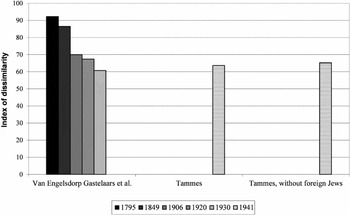
Amsterdam's Jewish neighborhood was founded centuries ago and generations of Jews had lived there already. For Jews, this neighborhood was a place with its own social atmosphere and culture where people maintained both work and social day-to-day contacts. Van Engelsdorp Gastelaars et al. (Reference Van Engelsdorp Gastelaars, Vijgen, Wagenaar and Francois1985) calculated the ID for 1795, 1849, 1906, 1920, and 1930 for Jews, individuals belonging to the Portuguese or Dutch Jewish congregation, in Amsterdam. Figure 3 shows that between 1795 and 1906, and especially in the second half of the nineteenth century, the ID dropped by approximately 20 points, indicating decreasing residential segregation of Jews in Amsterdam. From 1906 to 1930 the ID dropped another 10 points. Although the ID continued to fall during the first decades of the twentieth century, the downward trajectory of this trend had come to a halt by 1941, as the calculated ID by Tammes (Reference Tammes2011a) shows in figure 3 (see also Ultee and Luijkx Reference Ultee and Luijkx1998). A calculation omitting foreign Jews shows a slightly higher ID level, indicating that the halt in residential segregation was not due to the settlement of German Jewish immigrants arriving in the second half of the 1930s.
ID calculated by Van Engelsdorp Gastelaars et al. and Tammes.

A continuing decrease in these indices might have been expected because of the demolition of slums in the Jewish neighborhood and the large increase in the construction of council housing in quarters outside this neighborhood after World War I (Leydesdorff Reference Leydesdorff1987: 122, 138, 175). As with Tilly's (Reference Tilly and Yans-McLaughlin1990) transplanted networks, Jewish settlement in the newly-built areas could have attracted other Jews to these areas, resulting in new areas of Jewish concentration. However, a halt in the process of spatial assimilation was observed, which aligns with a decrease in Jewish–Gentile marriages in the second half of the 1930s, suggesting that the blurring of boundaries between Jews and Gentiles did not continue on a straight-line trajectory from previous decades, but followed a “bumpy” course, to use Gans's term (Reference Gans1992).
Boundary Blurring: Religiously Unaffiliated
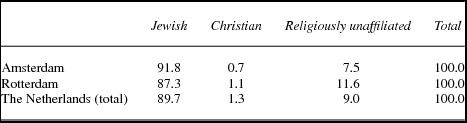
According to the census results of 1920, the proportion of religiously unaffiliated was among the lowest in the Jewish neighborhood compared to other Amsterdam districts (Kruijt Reference Kruijt1933: 265–67). Jews dropping their religious affiliation became more common in the 1920s and 1930s, resulting in about 10 percent of those descended from Jewish grandparents being religiously unaffiliated in 1941 (table 2). These findings might indicate that Jews shared the more general societal process of church leaving in Dutch society and that religious boundaries started to blur (Tammes Reference Tammes2012a).
Religious affiliation of descendants of three or four Jewish grandparents in Amsterdam and Rotterdam, October 1941, in percentages

Source: Rijksinspectie (1942).
Boundaries Crossing: Conversion and Adherence to Rituals and Practices
Jews who abandoned Judaism without converting, that is became unaffiliated, are excellent examples of minority members who assimilated by boundary blurring, whereas Jews who converted to Christianity are a good example of minority members who assimilated by boundary crossing. Around 1900 nearly all Jewish descendants belonged to a Jewish congregation. Table 2 shows that the rate of conversion to Christianity among Jewish descendants in 1941 is still very low, indicting hardly any crossing of religious boundaries.
Judging from adherence to three pivotal Jewish rituals, we might conclude that the Jews in Amsterdam maintained strong ties with Jewish tradition during the twentieth century: About 95 percent of the Jewish-born boys were circumcised, 92 percent of Jewish marriages were solemnized according to Jewish rites, and virtually all Jewish dead were buried in Jewish cemeteries in the 1930s (Boekman Reference Boekman1936: 67–68, 104, 119). However, for Sabbath observance—a fundamental part of Judaism and Jewish family life—we see a different picture. In 1896, the Dutch New Israelite Weekly (Nieuw Israëlietisch Weekblad) discussed several times the rising number of Jewish Sabbath-breakers. Sabbath observance was also the subject of an ongoing discussion within the Diamond Workers’ Guild between 1901 and 1903 regarding whether the union should support observance of the Sabbath, only supported by less than a quarter of the members (Hofmeester Reference Hofmeester2004). Jewish film exhibitors kept their theaters open on the Sabbath, but according to De Jong and Thissen (Reference De Jong and Thissen2010) privately honored it. Although these Jewish exhibitors, a small group of mainly traditional Jews from Eastern and Central Europe, might have observed Sabbath with family and friends (and thus leaving business that day to non-Jewish employees), most Jews in Amsterdam might not have observed Sabbath. Tammes (Reference Tammes, Kraaykamp, Levels and Need2011b) determined that about one-third of the Jewish families in Amsterdam observed Sabbath in 1900. Furthermore, Reijnders (Reference Reijnders1969: 119–20) stated that about 13 percent of the Jewish shop owners in Amsterdam observed Sabbath closing times in 1941, while among Jewish food shops about 12 percent was kosher. These numbers might indicate a further decrease in Sabbath observance and kosher food consumption among Jews in Amsterdam during the first decades of the twentieth century (none other than Jewish shops sold kosher food). This signifies further boundary crossing regarding working and shopping on Friday afternoon and Saturday, and food preparation and consumption.
Boundary Shifting: Political and Civic Involvement, and Prejudice
After the granting of civic rights in 1796 and after the guilds in 1798 officially ceased to exist, Jews could legally enter any kind of profession, including occupations in civil service, education, and advocacy (Reijnders Reference Reijnders1969: 46). When we look at the occupational structure, Jews were employed primarily in the diamond sector and in trade (Kruijt Reference Kruijt and Hendrik1939; Tammes Reference Tammes2012b). To measure boundary shifting it might be more important to look at the appointment of Jews in civil service or public sector. In 1851, about 1.8 percent of all civil servants in Amsterdam belonged to an Israelite congregation.Footnote 4 This percentage is much lower than their share in the Amsterdam population, at that time around 11 percent. Although this percentage had increased to 4.5 percent in 1906, the percentage was still lower than their share among the Amsterdam population.Footnote 5 The percentage of Jews in civil services in Amsterdam was again around 2 percent in 1941 (Michman Reference Michman1995: 49). Only after World War II did Amsterdam have an appointed Jewish mayor, while probably in none of the other Dutch municipalities a Jew was mayor before 1940 (Daalder Reference Daalder1978: 187–88).
When looking at elected representative positions, the first Jews in the Dutch assembly were elected in 1797, and out of the 1,600 members of parliament who were elected since 1848, 30 of them were Jews whereas another 20 were of Jewish descent but had abandoned Judaism (ibid.: 186–87). By the end of the nineteenth century Jewish representation in the Lower House had become a structural element (Hofmeester Reference Hofmeester, Frishman, Wertheim, Haan and Cahen2011). At lower governmental levels, de Vries (Reference de Vries1996) shows Jews being member of the Provinciale Staten (Provincial Assembly) of North Holland, including Amsterdam, from 1850 onward increased, especially during the second decade of the twentieth century. Brasz (Reference Brasz1985) presents a similar overview of Jews being a member of the Gemeenteraad (Municipal Assembly or city council). Although her overview is a selection of 62 Dutch municipalities, it shows that the appointment of Jews increased from around 1900 onward. In 1798 two Jews became a member of the Amsterdam city council, and in the first half of the nineteenth century representation of Jews in the Amsterdam city council was nearly continuous (Daalder Reference Daalder1978: 187; Wallet Reference Wallet2005). In the 1930s four Jewish aldermen served simultaneously in Amsterdam (Daalder Reference Daalder1978: 188).Footnote 6
Prejudice might be a barrier to assimilation. Whereas Jews in the Netherlands did not face discriminatory laws of political, economic, or financial nature in the beginning of the twentieth century, anti-Jewish sentiments were present in Dutch society. In memoirs and interviews, restrictions for Jews in Amsterdam to enter some clubs and restaurants are often mentioned (e.g., Bergstein and Bloemgarten Reference Bergstein and Bloemgarten1999; Leydesdorff Reference Leydesdorff1987). Furthermore, some companies or employers did not hire Jews, and some instances of humiliations or maltreatment in public are mentioned. One of the strongest anti-Jewish sentiments was anti-Judaism among Catholics; this aversion might be one of the main causes for a lower Jewish–Catholic intermarriage rate when compared to other Jewish–Gentile intermarriages rates. Although Ramakers (Reference Ramakers2006) and Poorthuis and Salemink (Reference Poorthuis and Salemink2006) concluded from their research into anti-Judaism within Catholic magazines that the level of anti-Judaism varied over time, most evidence of anti-Jewish sentiments among different (religious) groups in Dutch society is anecdotal and hardly any quantitative evidence is presented.
One might take the electoral support in the 1930s for the National Socialist Movement (NSB) in the Netherlands in the 1930s as an indicator of anti-Semitism. The NSB became more and more anti-Semitic during the 1930s, following the national socialist party in Nazi Germany, and higher local electoral NSB support was associated with relative greater number of Jewish inhabitants in a municipality (Flap and Tammes Reference Flap and Tammes2008). During the provincial elections in 1935 the NSB received 11 percent of the votes in Amsterdam while this dropped to 6 percent during the provincial elections in 1939. One might argue that a higher local electoral support indicates a higher local level of anti-Semitism. However, other factors such as the level of unemployment, urbanization, and the degree of pillarization, or segmentation, also impact local electoral support for NSB (e.g., ibid.). Altogether, on the existing knowledge of anti-Semitism we are reserved to bring electoral NSB support forward as a key factor that prevented boundary shifting and dictated the path of integration.
Creating a New Intermediate Zone by Boundary Blurring
Both intermarriage and residential segregation show a continuous process of boundary blurring between Jews and Gentiles. However, this process came to a halt in the second half of the 1930s, which might be caused by the economic recession or the future shadow of the Nazi occupation. Most of the Jewish–Gentile couples created a nondenominational family as Jewish–unaffiliated intermarriages were most common. Moreover, most of the children born in mixed households were officially registered as “religiously unaffiliated” (Tammes Reference Tammes, Matthijs, van de Putte, Kok and Bras2010b). Furthermore, Jews who abandoned Judaism became religiously unaffiliated rather than convert to Christianity. These trends indicate that Jews shared the process of secularization in the Dutch society. Our analysis shows, besides the previously mentioned evidence of boundary blurring, less evidence of boundary crossing or shifting.
We might argue, in line with some other scholars, that Jews gradually vanished as a minority and were on their way to assimilate structurally and culturally (e.g., Blom and Cahen Reference Blom, Cahen, Blom, Fuks-Mansfeld and Schöffer1995; Kruijt Reference Kruijt and Hendrik1939; Lucassen Reference Lucassen, Berg, Wijsenbeek and Fischer1994). This would, however, overlook the structure and composition of the Dutch society where none of the ethnic-religious or denominational groups formed a majority, except for the Roman Catholics in the southern part, or ignore the process of assimilation, for example the importance of different types of boundary alternation. The Netherlands was at that time a pluriformous society highly segmented along religious or ideological sections or pillars, which Dutch scholars labeled verzuiling (pillarization) (e.g., Reference KruijtKruijt 1957). Jews, however, never coalesced into a real pillar for several reasons (Daalder Reference Daalder1978). One of the reasons was the attraction of liberalism and socialism. Especially the rise of socialism was a new segment, or to phrase the term used by Alba and Nee (Reference Alba and Nee2003: 287) an “intermediate zone,” in the pillarized Dutch society that attracted and was created by intermarrying Jews, and Jews and Christians who had abandoned their religious affiliation. Religious-ethnic background was of less importance within the socialist and liberal segments, though individuals could maintain some rituals or practices. However, especially Sabbath observance and kosher food regulations were often not honored; probably these rituals were harder to maintain in a more nonreligious environment. Most of the elected Jews or persons of Jewish origin on representative positions were members of the socialist or liberal party and were mainly elected for that reason (e.g., Hofmeester Reference Hofmeester, Frishman, Wertheim, Haan and Cahen2011).
Assimilation Trajectories of Present-Day Mediterranean Muslims
Over recent decades, Islam has developed into the second largest religion in the Netherlands, after Christianity. From the early seventies to the early 2000s, the percentage of Muslims in Dutch society increased from less than 0.5 percent to about 5 percent in 2006 (Centraal Bureau voor de Statistiek 2009: 37). Mediterranean Muslims of Moroccan and Turkish descent make up for the largest part of Muslims in Dutch society, nearly 70 percent (ibid.: 38). In 2010 about 733,000 Moroccans and Turks lived in the Netherlands, of whom about 27 percent lived in Amsterdam and Rotterdam.Footnote 7 In 2010, Amsterdam counted 40,370 Turkish and 69,439 Moroccan inhabitants, respectively 5.3 percent and 9 percent of the Amsterdam population, and Rotterdam counted 46,868 Turkish and 38,982 Moroccan inhabitants, respectively 7.9 percent and 6.6 percent of the Rotterdam population (COS and O+S 2012: 14). In this section, we focus on Turkish and Moroccan inhabitants in those two cities, nearly all Muslims.
Boundary Blurring: Intermarriage among Muslims
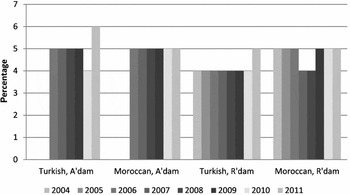
When looking at intermarriage as an indicator of boundary blurring, it becomes clear that over the period 1998 to 2011, a stable majority of Muslims considers it important that “their daughter marries a Muslim” (SCP 2012: 123–24). This attitude is reflected in the overall marriage figures for the Netherlands presented by the Netherlands Institute for Social Research (ibid.: 49–50): Turks and Moroccans mainly choose a partner of their own ethnic-religious group, although the preference for a partner born in the same country of origin decreased sharply between 2001 and 2010. Local data from the city of Amsterdam and Rotterdam show that of the total number of married Turkish and Moroccan men around 5 percent of them was married with someone outside their own ethnic-religious community between 2004 and 2011. These percentages of intermarried Turkish and Moroccan men do hardly show any change during this period (figure 4).
Percentage of Turkish and Moroccan men married to someone outside their religious-ethnic group of all Turkish and Moroccan men married in Amsterdam or Rotterdam, 2004–11.

Although intermarriage rates are low, it is interesting to see who were more likely to intermarry; such an analysis might give an indication about future perspectives on intermarriage. In their annual integration report, the Netherlands Institute for Social Research (SCP 2012: 50–52, appendices B2.6 and B2.7) made use of the framework preferences, opportunities, and third parties on intermarriage (see e.g., Kalmijn Reference Kalmijn1998; see also section on Jewish–Gentile intermarriage) to determine the likelihood of intermarriage among members of present-day minority groups. Their analyses show that those who are descendants of Dutch-born parent(s) and those who marry at a later age had a higher chance to marry someone outside their own ethnic group. The chance to intermarry decreases when living in a neighborhood with a high number or a high proportion of inhabitants from their own ethnic group and when the neighborhood had a higher level of ethnic diversity. A higher proportion of Western migrants increases this chance to intermarry, especially to marry a native Dutch man or woman.
Boundary Blurring: Residential Segregation among Muslims
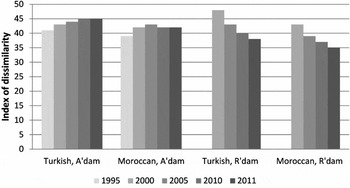
In the preceding section, it is shown that the likelihood to intermarry is affected by the proportion of members of one's own ethnic group in the living district. The extent to which Muslims live concentrated in the Netherlands might have increased. The number of neighborhoods where migrants make up for more than half of the population increased from 23 in 1998 to 52 in 2011, even with seven neighborhoods with more than 75 percent migrant population (SCP 2011: 180). A better indicator to measure the degree in residential segregation is the ID. In the joint publication by COS and O+S (2012), IDs are given for several ethnic minority groups, such as Turkish and Moroccan, in Amsterdam and Rotterdam. In figure 5, the IDs show a slight increase from 41 to 45 for Turkish citizens and 39 to 42 for Moroccan citizens in Amsterdam. In the first decade of the twenty-first century the proportion of non-Western citizen, for a greater part Turkish and Moroccan citizen, had fallen in the older Amsterdam districts while their proportion had increased in the newer or suburban districts (ibid.: 13; Kullberg and Kulu-Glasgow Reference Kullberg and Kulu-Glasgow2009: 73). As with Tilly's (Reference Tilly and Yans-McLaughlin1990) transplanted networks, Turkish and Moroccan settlement in the newer districts resulted in new areas of concentration in Amsterdam (see also Kullberg and Kulu-Glasgow Reference Kullberg and Kulu-Glasgow2009: 87). Consequently, their IDs hardly changed between 1995 and 2011.
Indices of dissimilarity for Turkish and Moroccan citizens in Amsterdam and Rotterdam, 1995–2011.

Also in Rotterdam, the proportion of non-Western citizens in the older districts, for a greater part Turkish and Moroccan migrants and their descendants, had decreased while their proportion in the newer districts had increased (COS and O+S 2012: 13). Contrary to Amsterdam, this trend resulted in less concentration in newer areas but more spreading across Rotterdam as the IDs for both groups dropped about 10 index points (figure 5). This drop indicates less spatial segregation and blurring of boundaries in Rotterdam.
Boundary Blurring: Abandoning Islam
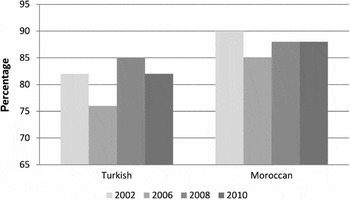
Although there is no data on religious conversion per se, there is data on self-ascription in terms of religious affiliation for Turks and Moroccans. These data show that a vast majority of first- as well as second-generation Turks and Moroccans in the Netherlands defines itself as being Muslim (95 percent and 97 percent, respectively, for Turks and Moroccans [SCP 2012: 117, B6, 8–9]), though there is some evidence that second-generation Muslims identify less strongly in terms of religion than the first generation (Maliepaard, Lubbers, and Gijsberts Reference Maliepaard, Lubbers and Gijsberts2010). We believe that the small percentages who do not define themselves as Muslims are rather religiously unaffiliated than convert to Christianity. In Rotterdam in 2008 and 2010, nearly all Turks and Moroccans are religiously affiliated, most likely Islam (COS and O+S 2012: 22, 54). In Amsterdam for both groups the percentages religiously affiliated is about 10 percentage points lower, though slightly fluctuating across the first decade of the twenty-first century (figure 6). However, one might conclude that Turks and Moroccans are (still) strongly religiously affiliated, especially when compared to members of other ethnic minority groups (ibid.: 22, 54).
Percentage of Turkish and Moroccan citizen in Amsterdam religiously affiliated, 2002–10.

Boundary Crossing: Adherence to Islamic Rituals and Practices
Local data from Amsterdam show that a vast majority (91 percent) of Turkish and Moroccan Muslims observe the month of Ramadan (O+S 2008). Furthermore, for the first generation about 40 percent of Amsterdam's Muslims and for the second generation about 30 percent visits a mosque at least once a week. In fact, these percentages have increased slightly between 2002 and 2010 (COS and O+S 2012). The number of Halal butcher shops provides an approximation of the demand for Halal food. Between 1975 and 1995 the number of Halal butchers went up from 8 to 88, probably due to the continuous increase of the Muslim population. However, between 1995 and 2005 it went down to 67—around that time supermarkets started to offer Halal meat, although the percentage of total butcher shops remained stable between 32 percent and 34 percent (O+S 2008). These findings from Amsterdam, reveal that a great majority of Turks and Muslims are (still) religiously affiliated and rituals such as the observing Ramadan and eating Halal food are regarded as important, while visiting the Mosque (on Friday) is of less importance.
Boundary Shifting: Political and Civic Involvement, and Prejudice
An indicator as to if boundaries are shifting involves whether public attitudes to ethnic-religious minorities are shifting. Local data shows that about 14 percent of the total Amsterdam population has a negative or very negative attitude toward Muslims in general (O+S 2011: 29). Especially the perception of Moroccans is very negative (about 30 percent of the population), whereas Turks are perceived relatively more positively. Trend data show that these negative images have increased since the period 2004 to 2007 where the percentage of the population that had a negative perception of Moroccans peaked as high as 41 to 45 percent.
Another indicator of boundary shifting is political participation of members of Muslim communities (Tillie Reference Tillie2004). In national politics, the number of Turkish and Moroccan members of the Second House of Parliament increased over the last decade, from just three Turks and two Moroccans in 2003 to six Turks and five Moroccans in 2010 (Instituut voor Publiek en Politiek 2010: 11). At the local level, a similar trend can be identified from only about 30 Turkish and less than 10 Moroccan members of municipal councils in 1994, to a total of about 160 Turkish and about 60 Moroccans in 2010 (ibid.: 8). These totals, however, do not include information on location and cannot provide as details on the city council members in Amsterdam and Rotterdam. For Rotterdam, it is important to observe that a Mayor of Moroccan descent was appointed in 2009.
Besides political participation, being employed in governmental occupations such as police, school, and municipal offices is a sign of being accepted and trusted by natives in the host country. Combining information given in O+S reports (COS and O+S 2012: 70, 94–95; O+S 2009: 93–94) such as the potential labor force among Turkish and Moroccan populations, the percentage of those groups participating in labor, and the percentages of the participating labor force of those groups working in governmental jobs, allow us to calculate the percentages of Turks and Moroccans of all those working in governmental jobs around 2008—respectively, 4.8 and 6.1 percent. The percentage of Turkish civil servants of all civil servants nearly equals their share in the Amsterdam population; 5 percent of the Amsterdam population was Turkish in 2008. The percentage of Moroccan civil servants of all civil servants is about two-thirds of their share in the Amsterdam population; 9 percent of the Amsterdam population was of Moroccan descent in 2008.
Prejudice can, in contrast to the preceding indicators, be an obstacle to boundary shifting. Data for Amsterdam shows that inhabitants of Turkish and Moroccan descent feel much more discriminated against than natives, though there seems to be a slight decreasing trend between 2007 and 2010: In 2007 no less than 53 percent of Turkish and 39 percent of Moroccans in Amsterdam indicated that they are sometimes or even often confronted with discrimination, whereas these figures were 39 percent and 32 percent, respectively, for 2010 (COS and O+S 2012). Similarly, for Rotterdam the number of Moroccans and Turks that had experienced discrimination over the preceding year decreased from 28 percent and 27 percent, respectively, in 2008 to 26 percent and 24 percent, respectively, in 2010. More in general, Dutch data confirms that mutual perceptions of Muslims and non-Muslims in Dutch society are very negative (SCP 2009), which according to Sniderman and Hagendoorn (2007) indicates “rejection” and “cultural conflict.” The percentage of Dutch natives who agreed that “Muslims can make a contribution to Dutch culture” decreased initially from 45 percent in 1998 to 34 percent in 2004 and then gradually increased again to 36 percent in 2006 and 41 percent in 2008 (SCP 2009: 272). Also, the percentage of Dutch natives who considered the European way of life and Islam to be incompatible decreased from 53 percent in 1998 to 41 percent in 2008 (ibid.).
Voting for anti-immigrant parties that focus specifically on Islam can also be considered a proxy for prejudice toward Muslims. Several of these parties can be identified in Dutch national politics in particular, which due to high turnout rates is usually the best indicator of political preference. Especially the Pim Fortuyn Party (LPF) and the Freedom Party (led by Geert Wilders) ran an explicit anti-Islam agenda. In 2002, the LPF obtained 26 of a total of 150 seats in parliament, which decreased rapidly to eight in 2003 before vanishing from parliament in 2006. The Freedom Party entered parliament in 2006 with nine seats, increasing to 24 in 2010 and decreasing again to 15 in 2012. This shows that over the last decade or so there has been significant electoral support for an anti-Islam agenda—that is, the Freedom Party attracted more electoral support in 2006 in municipalities with a higher percentage of non-Western immigrants and where native residents were more likely to be exposed to non-Western migrants in daily life (Van der Paauw and Flache Reference Van der Paauw and Flache2012). Though these figures are also representative for Rotterdam, it should be added that these parties never acquired a similar power basis in Amsterdam. In Amsterdam, the percentage of voters for one of these parties for the national elections has never been higher than 16.5 percent in 2002.
Assimilation Trajectory of Muslims: Virtual Absence of Boundary Altering
Boundary blurring has hardly taken place as interreligious marriage remains exceptional among Muslims in the Netherlands. The low intermarriage rate might be due to the discrepancy between Mediterranean Muslim stressing the relevance of faith and the secularized Dutch society whereas restrictive migration policies might have enforced marriage from the homeland (Lucassen and Laarman Reference Lucassen and Laarman2009). Furthermore, local concentration of Mediterranean Muslim does not stimulate intermarriage. Their residential segregation in Amsterdam slightly increased, though in Rotterdam it showed a decreasing tendency.
There seems also hardly any evidence of boundary crossing, as Mediterranean Muslims continue to observe many religious practices, with indications of a slight increase of religious observance. When it comes to political participation there is some evidence of boundary shifting as more and more Muslims are involved in local politics and public administration. However, the high levels of prejudice against Muslims show that the foundation of this boundary shifting might be weak. Although another research addressed the significant progress of especially young Muslims in the spheres of education and labor market participation (SCP 2011), our analysis shows less evidence of boundary altering amongst present-day Mediterranean Muslims, in both Amsterdam and Rotterdam.
These findings might indicate perseverance of boundaries between Dutch Muslims and Dutch society. However, they should not be interpreted as a sign of pillarization. Indeed, we do see evidence of socioeconomic participation without sociocultural assimilation, like in the period of pillarization. Dutch Islam is not at all organized as a pillar (see also Maussen Reference Maussen2012) and by means of comparison, nor did the pre–World War II Jews (Daalder Reference Daalder1978). Because their organizational structure is weak and fragmented, their position in Dutch society is too weak to speak of a pillar that would be in equilibrium with other pillars or organized segments.
Rather, the slow process of boundary altering are indications that Muslims are not going through a process of secularization (see also SCP 2012: 133–34). This may be due to endogenous reasons, such as the genesis of a Dutch Islamic community, but it may also be related to global developments in the Islamic world or even be an inadvertent effect of the negative discourse on Islam that has prevailed in the Netherlands over the past decades (see also Buijs Reference Buijs2009).
Boundary Altering among Two Non-Christian Groups in the Netherlands
Alba and Nee's operationalization of assimilation theory was used in this research as a framework for a historical-sociological analysis of assimilation trajectories of pre–World War II Jews and present-day Mediterranean Muslims in Dutch society. Examining assimilation trajectories of pre–World War II Jews might give us a great insight into processes of assimilation of a fair-sized non-Christian group in a Christian society spanning some decades and that is well-documented and studied recently. Understanding the pre–World War II experiences of Jews can be a key to understanding the more recent assimilation of non-Christian groups and might in this case contribute to our knowledge of assimilation processes of present-day Mediterranean Muslims.
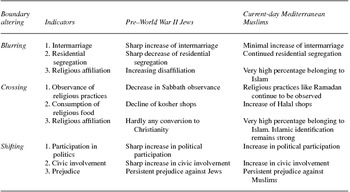
What stands out from our analysis is that the assimilation trajectories of both religious groups have been distinctly different. As table 3 shows, the assimilation trajectory of pre–World War II Jews for a great extent altered boundaries. This seems to apply less to current-day Mediterranean Muslims. The difference between both groups is perhaps clearest when it comes to boundary blurring. For pre–World War II Jews, intermarriage and residential spreading across different neighborhoods form the clearest signs of assimilation. For current-day Muslims intermarriage remains rare although marriages between Muslims from different migrant communities have become more common and marriages with Muslims from the (parents’) country of origin have become less common. Also, residential segregation seems persistent, especially in Amsterdam, though is already at a lower level than pre–World War II Jews ever had reached. However, regarding residential segregation, the internal heterogeneity of Muslims in the Netherland should be taken into consideration; living in specific neighborhoods might indicate an ethnic rather than a religious factor, and might also be driven by socioeconomic factors.
Boundary altering amongst prewar Jews and current-day Mediterranean Muslims: Summary of findings

In addition, whereas the religious affiliation of pre–World War II Jews was decreasing as more Jews became secular, the religious affiliation of contemporary Muslims remains strong. Furthermore, both communities also showed a different picture regarding boundary crossing. The observance of religious practices, like Sabbath and eating kosher food, was decreasing among pre–World War II Jews while observing Ramadan among Mediterranean Muslims remained steady and the number of Halal shops even increased. Both boundary blurring and crossing seem to be weak among current-day Muslims.
We found more evidence for boundary shifting. The increasing number of Muslim members of parliament or local councils and the fact that a Dutch-Moroccan could become mayor of Rotterdam are clear signs. Civic involvement and political participation had increased significantly among both Muslims and Jews, though it should be observed that it never reached the average level for the whole society. Furthermore, for both groups the religious character of political and civic involvement should not be overrated. The political participation of Jews largely followed the lines of specific pillars (i.e., socialist and liberal) whereas the political participation of Muslims is also differentiated along different mainstream political parties. Also, in contrast to these signs of boundary shifting or the inclusion of a new group within society, we found persistent prejudice against both groups. These are clear signs that both groups had not (yet) become part of the national imagined community.
Accounting for Differences in Boundary Altering
How to account for the differences in patterns of assimilation, with pre–World War II Jews showing signs of boundary blurring in particular and current-day Muslims showing some signs of boundary shifting? Several sociohistorical factors are relevant in this context. First, there seems to be a difference in the stage of the assimilation process of both groups. In the beginning of the twentieth century, many Jewish families had been in Dutch society much longer than current-day Muslims have been, resulting for example in proficiency of Dutch language. Thus, it may be that the differences in boundary altering between both groups are based on the different stages of assimilation that both are in, and that future Muslim generations in the Netherlands may also reveal more boundary blurring.
Second, the process of assimilation of pre–World War II Jews coincided with the beginning of the process of secularization of Dutch society. This secularization process might have made it easier for Jews to assimilate in the wider Dutch society. In contrast, contemporary Muslims are assimilating in a context where religion may be contested but is still widely discussed in public discourse, especially Islam. Such public discourses may inadvertently contribute to a reawakening of religious identification.
Third, the first-generation Muslims entering the Netherlands in the 1970s faced economic hard times due to the 1980s recession; an economically bad time to start an integration process (Lucassen and Lucassen Reference Lucassen and Lucassen2011: 63). Fourth, contemporary Muslims assimilate in a much more globalized context, whereas pre–World War II Jews might have been more focused on the national context. This may affect the assimilation trajectory of current-day Muslims, especially when it comes to boundary blurring. A fifth factor that might have slowed down the assimilation process is the constant influx of settling Muslim migrants, at least until the beginning of the 2000s, that confronted settled Muslims with their original religious and ethnical background. Sixth, changing ideologies on immigrants or ethnic minorities from 1980 onward shifted policies from promoting multiculturalism to problematization of cultural or religious differences (Schrover Reference Schrover2010). This resulted in a confusing landscape for ethnic-religious minorities whereby secularization was promoted but schools affiliated to a religious denomination could still receive governmental subsidy. Finally, our analysis does not incorporate all relevant indicators. When including information on friendship, language use, and clothing among Muslims we might see signs of boundary “brightening” (Alba Reference Alba and Foner2015) as especially the second and third generation could have developed friendship outside the Muslim community impacting both their clothing and Dutch language skills.
Assimilation of Muslims in Reflection of Assimilation of Pre–World War II Jews
Although this study shows that assimilation trajectories of both religious groups have been distinctly different, the process of Jewish assimilation provides us some insights that can be of importance in understanding the contemporary assimilation trajectories of Muslims in the Netherlands. The Jewish community in the Netherlands grew rapidly in the seventeenth century because of an influx of Jewish immigrants. In the nineteenth century the settlement of new Jewish migrants was low. Although from the end of the nineteenth century onward the Jewish community experienced and helped many transmigrants, most of them traditional or orthodox Jews from Eastern Europe fleeing for the worse political-economic situation, only a small number of these migrant settled in Amsterdam or Rotterdam (Tammes Reference Tammes2013). While the influx confronted the assimilating Dutch Jews with their orthodox origin, most Jews in Amsterdam and Rotterdam hardly had any contact with these Eastern European Jews. Thus, the much higher settlement of Muslim newcomers nowadays might not only increase the number of (first-generation) Muslims but also might affect attitudes and behavior of settled Muslims.
From the Jewish case, we learnt that the increase of Jewish–Gentile intermarriage was preceded by a decrease in residential segregation, a decrease in Sabbath observance and kosher food consumption, and an increase in political participation. When reflecting results of pre–World War II Jewish–Gentile intermarriage on contemporary Muslims in Dutch society, the policy to restrict family migration will not be a sufficient means to stimulate Muslims to integrate in the wider society. Mutual aversion, like we have seen among Jews and Catholics, prevents sharper increase in intermarriage of members of these groups. Although the aversion toward a Muslim spouse for one's son or daughter slightly decreased over the last decade among Dutch natives, the existing aversion is still high (SCP 2009). Furthermore, according to the SCP Jaarrapport Integratie 2009, the religious devotion among Muslims is high. Religious and social barriers within the Muslim community to marry a non-Muslim are therefore probably still strongly present. Moreover, a further increase of residential segregation among Muslims was noticed in Amsterdam, though in Rotterdam there were signs of a decreasing tendency, while religious practices like Ramadan continue to be observed. Relating the present position of Muslims in Dutch society to previous findings on assimilation experiences of pre–World War II Jews, an increase of Muslim–non-Muslim intermarriage may be unlikely soon.