1 Introduction
Computer or video gaming represents a new type of learning that contemporary people enjoy, and learning through gaming has attracted many researchers’ attention (Gee, Reference Gee2007; Squire, Reference Squire2005; Steinkuehler, Reference Steinkuehler2007; Thorne & Black, Reference Thorne and Black2007). The relationship between gaming and learning is found not only in the interaction between players and games, but also in the interaction amongst players who enrich their gameplay through online discussions and collaboration. Games gain a new life beyond designers’ intended “in-game” activities into “beyond-game” culture (Gee, Reference Gee2008; Steinkuehler, Reference Steinkuehler2006). Though participants engage in beyond-game culture primarily to enhance their skills as players, interactions with peers can result in language learning. The beyond-game culture involves traditional literacy practices, such as discussion and debate of skills or strategies, and new literacy practices such as the creation and distribution of fan-fictions, game scenarios, or screenshots (Ryu, Reference Ryu2011).
Many researchers have focused solely on learning that takes place during game play (e.g., Squire, Reference Squire2005; Steinkuehler, Reference Steinkuehler2006; Steinkuehler & William, Reference Steinkuehler and William2006) although a few have been interested in beyond-game culture (e.g., Gee & Hayes, Reference Gee and Hayes2010; Williams, Ducheneaut, Xiong, Yee, & Nickell, Reference Williams, Ducheneaut, Xiong, Yee and Nickell2006). Moreover, little attention has been paid to language learning through gaming culture, particularly beyond-game culture. From an activity theory perspective, language learning requires repeated and collaborative interactions in the situated contexts (Lantolf & Thorne, Reference Lantolf and Thorne2006). The acquisition of a few words or cross-cultural interaction while playing games is less likely to lead to enduring language learning (e.g., Steinkuehler, Reference Steinkuehler2007; Thorne, Reference Thorne2008). Thus, to investigate language learning through gaming a new perspective is necessary in order to examine game play and beyond-game culture together.
Employing non-native English speaking (NNE) game players, this study explores their participation in the activity of English learning through gaming culture from an ecological perspective, which encompasses game play and beyond-game culture. The point of view shows that English learning can take place not only while playing games, but also – often, more actively – while participating in the online community after game play ends. Both kinds of engagement in gaming culture are important for the understating of language learning through gaming. On the basis of an activity theory and a multiple-case study design, which help structured and compelling interpretation, a new insight is suggested into language learning through gaming.
2 Language learning through gaming
From the perspective of second language acquisition, language learning while playing games comes from interaction with native speakers or more fluent peers (Peterson, Reference Peterson2010a, Reference Peterson2010b). Researchers have claimed that the communication environment in massively multiplayer online games (MMOGs) could present valuable opportunities for language learning (Thorne, Black & Sykes, Reference Thorne, Black and Sykes2009). The combination of communication tools provided by MMOGs with the purposeful and highly engaging social interaction provides an optimal environment for language learning (Peterson, Reference Peterson2011; Rankin, Morrison, McNeal, Shute & Gooch, Reference Rankin, Morrison, McNeal, Shute and Gooch2009). Language learners have opportunities to develop second or foreign languages in the online contexts and to participate in the valuable language practices through collaborative interaction in a socially appropriate manner (Meskill, Guan & Ryu, Reference Meskill, Guan and Ryu2012).
Nardi, Ly & Harris (Reference Nardi, Ly and Harris2007) investigated learning culture in the MMOG, World of Warcraft. The authors analyzed the way that players learned this complex game through chat conversations with co-players. They concluded that learning from conversation in World of Warcraft was erratic, spontaneous, contextual, and driven by small events in the game. The authors showed possibilities of language learning through gaming although they focused more on the learning itself. Steinkuehler (Reference Steinkuehler2007) examined young people's various participation practices in the context of one popular MMOG, Lineage. Based on the data from online ethnography, the author argued that gaming was a new literacy practice that many adolescents enjoyed out of school. The findings presented the potential of gaming for literacy learning from sociocultural perspectives. Rankin et al. (Reference Rankin, Morrison, McNeal, Shute and Gooch2009) explored learner interactions among eighteen English language learners and eight native speakers of English in the MMOG, EverQuest. The results showed that learners who played the game with native speakers recorded higher rates of comprehension of vocabulary items, and that communication patterns were characteristic of collaborative social interaction in the context. These studies empirically explored language or literacy learning through playing games, but they overlooked the other aspect of learning after playing games, which is the essential part of gaming culture (Gee, Reference Gee2007, Reference Gee2008). The interaction for learning was more active and richer when game play ended and players gathered in the online community.
Some researchers have argued that educational implications did not lie in the game play itself, but in the context and activities related to and extending from the game play (Arnseth, Reference Arnseth2006; Squire, Reference Squire2011). They have examined what game players did after game play from various points of view. Jakobson and Taylor (Reference Jakobson and Taylor2003) explored the ways in which social interactions after playing games played an integral role in EverQuest. Based on the analysis of the data collected on the bulletin board and webpage, the authors argued that online social networks formed a powerful component of its game experience. Creating “Projective Massive”, Seay, Jerome, Lee, and Kraut (Reference Seay, Jerome, Lee and Kraut2004) assessed MMOG players’ social experiences inside and outside of games and the impact of these activities on their everyday life. The data were collected from a series of interviews and a survey was completed online. The results illustrated game play patterns, commitment to player organizations, and personality characteristics. However, the quantitative methods employed were often criticized for ignoring the richer meaning contexts of gaming culture.
To explore language learning through gaming from a wider perspective, Thorne, (Reference Thorne2008) analyzed in-game and game-related interactions employing two game players – an English native speaker and a speaker of Russian – in World of Warcraft. The findings showed that participants were involved in a range of language learning activities. They formed a supportive relationship in and out of game play, which encouraged a high degree of collaboration for language learning. The author tried to understand language learning through gaming from a comprehensive perspective to include game play and beyond-game activities together. Focusing on the literacy practices in beyond-game culture, Ryu (Reference Ryu2011) investigated non-native English speaking game players’ interaction with native or more fluent speakers of English in Civfanatics.com. Drawing on the New London Group's (1996) multiliteracies, the author analyzed interactions for traditional, multimodal, multilingual, and multicultural literacy practices. The study showed that more active and various literacy practices also took place in the online community after playing games. Given the literature reviewed, less attention has been paid to language learning through gaming culture, and fewer empirical studies have been done on language learning through beyond-game culture.
3 Research questions
To fill these gaps in the literature on language learning through gaming and to provide an ecological perspective on language learning through gaming culture, this study addressed the following questions:
1. How do non-native English speaking (NNE) game players participate in the activity of English learning through game play?
2. How do NNE game players participate in the activity of English learning through beyond-game culture? Specifically, in beyond-game culture,
- What cultural norms, rules or regulations are governing the activity of English learning?
- What is the environment in which the activity of English learning is carried out?
- Who is responsible for what, when carrying out the activity of English learning and how are the roles organized?
3. How are these two kinds of participation related in the activity of English learning through gaming culture?
4 Method
4.1 Research setting and participants
This study was conducted at Civfanatics.com (CFC), one of the biggest unofficial fan-based websites of Civilization (Civ), one of the most popular game series. The website is a center of beyond-game culture for Civ, in which 52,209 members were enrolled as of 25 April 2011. CFC is an open online community that requires a simple registration process to join rather than an approval process. While anybody can read postings and members can write their thoughts, the site also employs twenty-three staffers, moderators, and administrators who help and manage game players’ interactions and collaborations within the community.
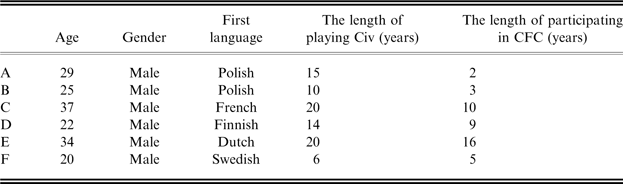
Recruitment of participants began with certain criteria – explicit interest or engagement in language learning, language backgrounds, current availability, and CFC participation at least once a week. Those who actively participated in the discussion about language learning were identified, and similar postings were found through Google Search installed in the website. Participants whose first language was not English were ascertained through their open personal profile, their interaction with peers, or the first email interview. At the initial contact, eleven potential NNE game players were asked if they would participate in the study. Four people did not respond to the email and one respondent was not interested in the study. Thus, six game players were selected as essential participants while the other five participants’ online interactions were reviewed as well. The number of participants was so small that they could not represent all the language learners in CFC or gaming culture. However, the small number enabled the researcher to examine game players’ language learning in more depth. In addition, although participants’ basic information was shown in Table 1, such offline information was not considered to be of primary importance because game players mainly focused on their common interest in gaming (Gee, Reference Gee2007).

4.2 Research design
This study was part of a larger project to investigate beyond-game culture. Although three studies were conducted using similar methods in the same setting, each study had different purposes, questions, and participants. Here, a multiple-case study design was employed to produce robust and compelling data through “replication logic” (Yin, Reference Yin2009: 47). Because setting pre-determined variables could obscure the nuances of meaning-making practices in the emerging online research, ethnographic methods – such as observation or interview – were adopted to articulate the meaning around gaming culture (Mann & Stewart, Reference Mann and Stewart2000). This was an exploratory case study. It qualitatively described and analyzed the ways in which NNE game players participated in the activity of English learning through gaming culture, rather than quantitatively measured and generalized how much they learned English.
The study originally began with an exploration of language learning through beyond-game culture. However, data analyses at the initial stage presented an interesting connection between language learning through game play and beyond-game culture. Thus, adopting an ecological perspective, the exploration was expanded to integrate language learning through both sides of gaming culture.
4.3 Data collection
4.3.1 Observation
To investigate game players’ participation in the activity of English learning through beyond-game culture, their asynchronous computer-mediated communications (CMCs) were repeatedly observed from May 2010 to February 2011. The observation implied a repeated review of CMC archived in CFC, which differed from observation in offline research. The observation was an essential element of ethnographic methods in helping to understand language learning from the participants’ points of view (Creswell, Reference Creswell2007). In particular, the observation had great advantages given that gaming culture is emergent, incompletely understood, and innately unpredictable (Boellstorff, Reference Boellstorff2006). The participants’ interactions in CMC regarding language learning were copied and recorded in files, which led to a further examination of language learning through beyond-game culture or game play. The data of CMC observed were all open sources and past records, and few ethical issues arose.
4.3.2 Email interview
To triangulate a preliminary interpretation of the observations and to examine game players’ participation in the activity of English learning through game play, interviews were conducted from November 2010 to April 2011. Because participants lived throughout the world, email interviews were employed to overcome geographical and temporal limitations (Bampton & Cowton, Reference Bampton and Cowton2002). The interview was composed of three stages, which were initiated not in a straight line but rather circulated to affect each other for an accurate understanding of language learning through gaming culture. The first stage was conducted to explore participation in the activity of English learning through beyond-game culture. On the basis of the observations, interview questions were designed in order to ascertain the ways in which participants learned English in CFC, and the learning patterns and features that were identified from the observations (see Appendix).
Because it was impossible to directly observe individual participants’ game play, interview as self-reporting was employed in the second stage of the interview process in order to investigate language learning during game play. Self-reporting without support from direct observation might impair the reliability of the results, but it was the only tool available that could facilitate an understanding of participants’ game play.
The quality of self-reporting was also guaranteed through triangulation with repeated observation and in-depth interviews (Denzin & Lincoln, Reference Denzin and Lincoln2000). The questions asked how participants learn English through game play, which also helped to understand English learning through beyond-game culture (see Appendix).
At the final stage of interview, the relationship between English learning during and after game play was queried. The initial analyses of observation and two stages of interview helped to construct questions at the third stage. Questions were asked such as ‘how each part of gaming culture influenced English learning’ or ‘how one side of English learning through gaming culture was related to the other side’ (Appendix). After analyses of these three stages of interview, ‘membership checking’ was done to verify that the preliminary interpretation was appropriate and something important was not missed (Creswell, Reference Creswell2007). The interview scripts were automatically recorded in the email account and securely protected from external access.
4.4 Data analysis
Participation patterns in the activity of English learning through game play and beyond-game culture were analyzed and categorized through repeated review and cross-case analysis of participants’ CMC collected from observation and interview (Stake, Reference Stake2006). The categories were encoded using elements of three generations of activity theories – such as subjects, objects, tools, rules, community, or distribution of labors – to systemically explore a structure of participation in the activity of English learning. Analyses of participants’ asynchronous CMC illustrated how they interacted to learn English through gaming culture. Computer-mediated discourse analysis (CMDA) formed a rigorous data-driven basis for participants’ interaction for English learning (Androutsopoulos, Reference Androutsopoulos2008; Herring, Reference Herring2004). In other words, CMDA articulated patterns or features of participation in the activity of English learning through game play and beyond-game culture. The new typology of information exchange and social interaction provided an insight into the relationships between language and learning (Steinkuehler, Black & Clinton, Reference Steinkuehler, Black and Clinton2005).
5 Findings
To systemically analyze NNE game players’ participation in the activity of English learning through gaming culture, Engeström's (1987, Reference Engeström2001) activity theories were employed as theoretical frameworks because a theoretical foundation for empirical studies has yet to be established to examine gaming culture. Activity theories have widely been used to explore different forms of human practices or actions, both at individual and collective levels (Ang, Zaphiris & Wilson, Reference Ang, Zaphiris and Wilson2010; Baran & Cagiltay, Reference Baran and Cagiltay2010; Blin, Reference Blin2004; Kaptelinin & Nardi, Reference Kaptelinin and Nardi2006). This study employed three generations of activity theories to systemically frame analyses and interpretations of participation in the activity of English learning through game play and beyond-game culture.
5.1 Language learning through game play
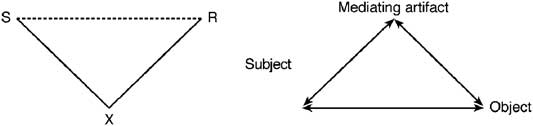
To investigate how NNE game players participated in the activity of English learning through game play, a concept of “mediation” was introduced from the first generation of activity theory (Engeström, Reference Engeström1987). In other words, participants (subject) played the game (tools) to learn English (object) in the activity of English learning through game play (Figure 1). However, tools (game) and object (to learn English) were often interchangeable during the activity (Hasu & Engeström, Reference Hasu and Engeström2000).
The activity of language learning through game play.

Participants played games to learn English or they learned English to play games. The repeated words or phrases, particularly regarding history and geography, led to the situated learning of these words and phrases during game play. Participation in the interaction with game characters also helped NNE game players to learn English from the meaningful context of game play. Participants played Civ in English, which was not their first language, while referencing dictionaries or parents for help. They said in an interview:
I have only played Civ in English, never in my mother tongue Dutch. I have learned a lot of English thanks to Civ. Especially historical terms, like ‘chivalry’ or ‘annexation’. I always use to read the civilopedia extensively.
Basically always in English, except when I translated Civ1 to Finnish (which didn't work too well because the structure is so different in Finnish and English). As I said before I learned my basic English skills playing computer games, especially Civ.
However, the influence of game play on the language learning was so limited that participants could just learn some words pertaining to history or geography. Without interaction with other players, they consciously or unconsciously focused on the words or phrases related to the game content in order to win the game. In other words, they participated in the “player-game” rather than “player-player” activities for English learning. Given the limited interactions or opportunities, game play did not help intermediate or advanced learners very much in developing their English. But beginners were assisted with their situated understanding of words and phrases (Peterson, Reference Peterson2011). Participants pointed out in an interview:
I have learned a few words by playing computer games but not a lot. The number of words in a game is not that large and they constantly repeat. There is very little interaction based on responding with words.
Because I studied history when I got older the historical English words in Civ (words like chivalry or feudalism) were very helpful to me. Those words I could later actively use at CFC.
From ecological perspectives, game play could serve as a trigger to encourage game players to participate in the activity of language learning through beyond-game culture. Participants’ interest, motivation, or frustration resulting from playing Civ brought them into CFC to develop their game play and, additionally, English. After playing games, participants gathered in the online community, interacted with those who had the same interest, discussed game strategies and skills, or collaborated for new gaming features in English. Although English learning was not a unique or main cause to move participants into beyond-game culture, NNE players participated in the activity of English learning through interactions with other players.
5.2 Language learning through beyond-game culture
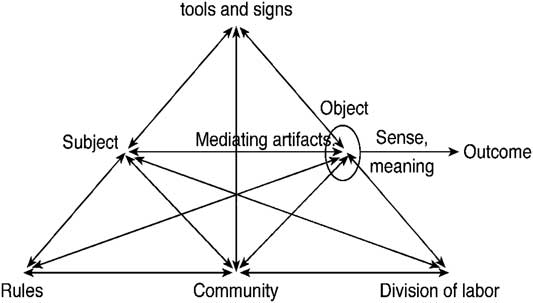
To understand language learning as a community-based activity initiated after playing games, three elements were added from the second generation of activity theory: rules, community, and division of labor (Figure 2). The expanded activity of language learning required the further developed structure of analyses to describe newly added relationships. In beyond-game culture, unlike language learning through game play, participants (subject) could have opportunities to interact with native speakers or more fluent peers through the Internet or CMC (toolsor mediating artifacts). Frequent practicing of sentences and dynamic interaction with other players enhanced the possibilities of language learning through participation in beyond-game culture. However, participants were not always aware of the object or outcome of their participation in the activity of English learning until a retrospective analysis of their own practices. They said in an interview:
I have never reflected over who CFC has changed my language until you emailed me. Since then, I have thought about it a lot. After nearly 5000 posts, which probably add up to hundreds of A4 pages, CFC stands for a large percentage of everything I have written.
At first it was to become a better player. Eventually I spent more time posting in CFC than playing civ. Learning English wasn't a reason to spend time there, it was more of a bonus on the side.
The activity of language learning through beyond-game culture.

While advancing English fluency was not a main reason to engage in beyond-game culture, participants still actively discussed, debated, or collaborated while interacting with other players. From sociocultural perspectives, participants who discussed game strategies or skills could develop language from participation in the situated contexts (Lantolf & Thorne, Reference Lantolf and Thorne2006). The features that were pointed out as pre-conditions of or requirements for language learning through game play – such as collaborative interaction (Reinders & Wattana, Reference Reinders and Wattana2011) or negotiation of meaning (Rankin et al., Reference Rankin, Morrison, McNeal, Shute and Gooch2009) – were more abundantly provided in beyond-game culture. A participant added in an interview:
Also we have to keep in mind that “practise makes the master” (it's a proverb known commonly in Poland, I suppose it's also known in English but I can't be sure) – and writing in English (letters, essays, posts in CFC – there's no difference) always help improve it.
In particular, one of the newly-added tools, the Internet, enabled participants to expand English learning experiences into beyond-game culture. In the expanded learning, participants could have various contextualized opportunities to practice and develop English as a communication tool (Ang, Zaphiris & Wilson, Reference Ang, Zaphiris and Wilson2010). The additional elements to beyond-game culture – rules, community, and division of labor – are detailed below to systemically illustrate game players’ participation in the activity of language learning through beyond-game culture.
5.2.1 Rules
When NNE game players participated in the activity of language learning in CFC, two kinds of rules impacted their learning. The first rule – English only – regulated participants’ activities in CFC while the second rule – English grammar – controlled their language use itself. To deliver their meanings in another language while following the first rule, participants often adopted a function – the spoiler. With the function, participants could use English – an official language in CFC – in the dialogue box while they put another language version of the meaning in the parallel box. That function enabled participants to use English and the other language together while following the rule of a community (English only) and achieving their objective – to learn English. The following example is a French participant's invitation to interact in English and French. Through the following and consequent interactions in the online community, participants could develop English in French or vice versa.
Français 101 : Où l'on pratique la langue de Molière
Le but de ce sujet est de permettre à ceux qui sont intéressés par la langue française de mettre leurs compétences en pratique avec leurs camarades sur le forum. Ici, les messages peuvent être écrits en français, mais afin de respecter les règles du forum, une traduction en anglais doit être fournie, entre “spoiler”.
The purpose of this thread is to allow people who are interested in the French language to practice their skills in French with fellow posters. The posts can be written in French, but to abide by the rules of the forum, a translation has to be provided, in a spoiler.
The preceding practices in CFC helped participants to develop a sense of multilingualism and multiculturalism in beyond-game culture (Ryu, Reference Ryu2011). New London Group's (1996) also pointed out “local diversity” and “global connectedness” to account for the causes of multilingual and multicultural behaviors. With increased diversity through the Internet, the rule of a community influenced the way that game players interacted with peers, which could also lead to language learning.
The second rule – English grammar – governed how to use English in beyond-game culture. Participants whose first language was not English showed a strong tendency to believe that there exists one standard version of English grammar, which is often taught in school or known to native speakers only. Thus, NNE game players tried to observe the rule as strictly as they could or more rigidly than native speakers. Although participants were all non-native speakers of English, they had no problem communicating in English. Nevertheless, most of them said their English was not “complete” or “perfect”, so little could be learned by others from English usage at their level of proficiency, nor would they learn English from any other non-native speakers. They pointed out in an interview:
I don't think that someone can learn good English from my posts, because I still make errors….. While for a people without good knowlege of English my posts may look quite well, they cannot be used for language learning.
…… but in my experience if you take two random posters, one being a native speaker and one being a non-native speaker, you'll find that the non-native speaker has better grammar and spelling.
Researchers have recently argued that there could exist multiple englishes used by different cultural, regional, economic, professional, or technological communities. English was also often used as a lingua franca to help to communicate between non-native speakers (Canagarajah, Reference Canagarajah2007; Pennycook, Reference Pennycook2007; Seidlhofer, Reference Seidlhofer2005). From sociocultural perspectives, language does not only refer to rule-governed grammar systems, but can also serve as one of the communicative resources that are formed and reformed in the very activity of interaction (Thorne & Lantolf, Reference Thorne and Lantolf2007). The difference between researchers’ and language learners’ perspectives on language or language learning should further be investigated for the appropriate understanding of informal language learning.
5.2.2 Community
CFC evolved from participants’ common interest in gaming. The online communities are called “affinity spaces” (Gee, Reference Gee2008: 87). Gee (Reference Gee2008) argued that in affinity spaces, participants could learn varieties of language and associated ways of thinking because they collaborated around a shared passion. The biggest difference between language learning through game play and beyond-game culture is the interaction with other game players; the element of an affiliated community helped NNE game players to participate in the activity of language learning. Second language acquisition researchers also agreed that collaborative interaction resulted in language development (Gass, Reference Gass2003; Ellis, Reference Ellis2005; Long, Reference Long1996). Participants could effectively communicate with peers in English because they could relate English vocabulary and syntax to their interests, knowledge, and experiences in the affinity spaces. They said in an interview:
First of all, because they all have the same interests, namely playing Civ. But also a lot of people who like history. So on both those fronts I have discussed a lot in English. What I learned from that is a lot of English slang, but also forum behavior.
You can engage in long debates to discuss the best way to model something in the game. And also, when people don't agree with you, since it's something that interest you, you won't drop the issue too soon. It “forces” you to try to express your thought better, and so to improve your way to present and explain things.
NNE players participated in the activity of English learning through beyond-game culture when their audience had the same interest and so sincerely responded to each other's opinions or questions. Their disagreements could lead to longer debates or discussions, which forced them to refine their thoughts or arguments in English. As a result, participants could develop English from the sociocultural contexts. However, collaborative interaction or negotiation of meaning as a pre-condition for language learning was essentially asynchronous in CFC; as such, it could take too long to get meaningful responses.
5.2.3 Division of labor
While participating in CFC, NNE game players often interchanged the roles of reader and writer. The different roles were not clearly divided or fixed because they did not always assume the same roles in the affinity spaces (Gee, Reference Gee2008). The roles were reciprocal and porous through the development of multiple interactions. Few participants attended to the others’ language backgrounds or fluency while focusing on the communication of the issues suggested or discussed. However, some participants intentionally revealed their first language to compensate for their lower status as non-native speakers.
first, i'm french so sorry for my medium english
 $$\[--><$>\raster="fx1"<$><!--$$
Sorry for my grammar/spelling atrocities, English isn't my first language. Ignore them, or show me your mad Swedish skills
English is not my first language so this tutorial is probably full of syntax errors. I'm sorry. It's the reason why it contains more picture than text ;)
It seemed that participants as readers took the role of students while participants as writers assumed the role of teachers. The relationship was also not fixed but always interchangeable in the specific interactions. NNE players thus constituted a temporal division of labor while participating in the activity of English learning in beyond-game culture. They commented in an interview:
Overall I think that reading English texts is a good way in learning language. Only one condition has to be met – that other people who post there are good English
So yes – I can say that I tried to learn/improve language (mostly by reading and trying to copy other users – you know, the oldest way of learning – “monkey see, monkey do” ;)).
Although participants did not overtly teach or learn English, the temporal roles of readers and writers encouraged them to develop English through copying, reading, or writing. In spite of a little concern over the quality of English, participants believed reading and writing were good ways to learn English in CFC. Thus, the activity of language learning through beyond-game culture could be understood as reading and writing in purposeful contexts for communication (Thorne & Lantolf, Reference Thorne and Lantolf2007).
5.3 The relationship between game play and beyond-game culture
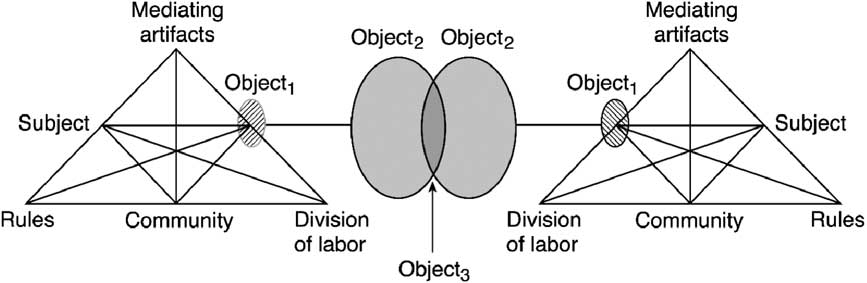
The contradiction between their present game play and desired skill levels often drove participants into beyond-game culture, in which they could develop their game skills or strategies and, additionally, language proficiency (Figure 3). As reviewed in sections 5.1 and 5.2, NNE game players participated in the activity of English learning through game play and beyond-game culture. From an ecological perspective, participants did not just learn English through either game play or beyond-game culture, but through gaming culture that integrates these two sub-cultures.While playing games, participants could learn English words or phrases regarding history or geography; while participating in beyond-game culture, participants could develop English discourse – sentences and paragraphs – through interaction with native or more capable speakers. They said in an interview:
I was already a Civ III player and a fan of Civ series, but my curiosity was unstoppable. I found CFC, its vast variety of various articles and decided it's a good place to start. …… So my primary reason why I started posting on CFC was to find answers about game. I also thought (back then) that it may be a good way to improve my English.
Learning English from CFC is better than from Civ game because in CFC you are in contact with real people, you can talk about everything, ask about everything and you will find almost unlimited variety of topics, words etc.
The activity of language learning through gaming culture.

Dissatisfaction with their game play encouraged NNE players to participate in the online community, which often led to engagement in the activity of English learning through beyond-game culture. The expanded experience in beyond-game culture also influenced English learning while playing games. Although there were individual differences, participants were able to develop English through game play and beyond-game culture at the same time. Each part of gaming culture provided different opportunities through which to learn English. Game play gave chances to learn English words or phrases in the situated context while beyond-game culture offered opportunities to participate in collaborative interaction with peers. As a result, language learning through game play was interrelated to language learning through beyond-game culture; both sides of gaming culture enabled NNE players to develop English in the situated contexts.
6 Limitations
The findings were exploratory in nature, so caution was required in the interpretation and application. The small sample size and limited duration of the study also made it difficult to generalize its findings to the whole population of NNE game players. As a main method of exploring language learning through game play, self-reporting might differ from participants’ actual experiences of language learning, although its reliability was carefully managed.
7 Conclusion
Game players can develop language through gaming culture. They can learn simple words or phrases related to the game content while playing games. After game play, they can participate in the activity of language learning from native or more fluent peers, practicing advanced forms of language such as sentences or paragraphs. To suggest a balanced understanding of language learning through gaming, thus, an ecological perspective is needed to look at both sides of gaming culture: game play and beyond-game culture. Although the findings of this study cannot present all the activities of language learning involved with gaming, they importantly suggest an expanded insight on language learning through gaming culture, particularly beyond-game culture. Future studies need to employ a longer and wider empirical research – including a direct examination of participants’ game play – to provide a balanced perspective on language learning through gaming culture.
Appendix