1. Overview
The concept of Business English has undergone some major shifts in recent years because of a number of developments: first, developments in genre theory, which has moved far beyond the surface-level textual analysis of genres to incorporate in-depth and substantial analysis of context, including professional practice; second, the gradual convergence in terms of research, theory and pedagogy of two approaches to the teaching of Business English – English for Specific Purposes (ESP) and Business Communication studies – that at one time were considered quite separate; third, the realization that there is a gap to be bridged between the academy and the professions; and finally, the overwhelming use of new forms of media in the business world. As a result of these and many other developments, there is an urgent need to revisit and review not only the concept of Business English and the context in which it is learnt and taught today, but also the framework within which it has been conceptualized, developed, taught and learnt, and, ultimately, assessed and evaluated. Drawing on recent work in a range of areas relevant to the teaching and learning of Business English, this state-of-the-art review will outline the gradual shift in the rationale for the design and implementation of programmes in this field. Moreover, the convergence of the two different approaches mentioned above – English for Specific Purposes, which in the context of business is often referred to as English for Business Purposes (EBP), and Business Communication studies – has led us to propose an integrated approach, which we call ‘English for Business Communication’ (EBC).
The article begins with an overview of EBP and the various developments that have taken place in the field, such as variation in functional language description, needs analysis, curriculum design, methods and materials development, assessment and evaluation, and disciplinary variation. It then goes on to propose the concept of EBC, showing how this is an outcome of the gradual convergence of interests and concerns seen in both EBP and Business Communication studies. Building on this, the article then looks at the critical issues and challenges faced by EBC, which are the result of a number of developments: the discourse practices of business communities, corpus-based analytical approaches, the growth of English as a lingua franca for business, concerns with sociolinguistic issues, and the need to bridge the gap between the classroom and business. Additionally, it considers the challenges posed by Business Communication studies in the light of the key role this plays in the more broadly conceived notion of EBC. Finally, suggestions are made for opportunities for replication studies.
Despite recent developments, there is still an emphasis on the analysis and description of discourse variation in academic and professional communities in all forms of disciplinary contexts; this continues to provide a rationale for the design of EBC programmes, although the methodologies and frameworks used for analysis and the depth of that analysis have undergone considerable changes, resulting in a variety of new findings. Thus the main purpose of this article is to review as much as possible of the research published in the last few years in order to offer an evidence-based account of recent and current theory and practice in EBC, and to indicate which way this field is likely to go in the coming years.
2. Overview of English for Business Purposes (EBP)
Before discussing the issues and challenges confronting EBC practitioners arising from historical developments in theoretical studies, we begin with a brief account of variation in functional language description, as this has provided, and continues to provide, the foundation for the design of EBP programmes.
2.1 Variation in functional language description
English for Business Purposes, as a relatively recent development, has its roots in ESP, which has traditionally drawn its strength from linguistics, particularly sociolinguistics, through the analysis of functional variation in language use in academic as well as occupational contexts. English for Academic and Occupational Business Purposes (EA/OBP) grew out of mainstream ESP studies, which in turn drew its inspiration from applied linguistics, in particular from the work of Halliday, McIntosh & Strevens (Reference Halliday, McIntosh and Strevens1964: 87) on functional variation in English, which put forward the notion that ‘language varies as its function varies; it differs in different situations’. They defined any variety of language distinguished according to its use as a register, differentiated as a sub-code of a particular language on the basis of statistically significant variation in lexico-grammatical features. Since then, numerous studies have identified and described the characteristic features of various academic and professional registers, such as scientific English, business English and legal English. Swales (Reference Swales2000) pointed out that the work of Halliday et al. (Reference Halliday, McIntosh and Strevens1964) on register analysis proposed a simple relationship between linguistic analysis and pedagogic materials, based on relatively ‘thin’ descriptions of the target discourses. Outsiders to a discourse or professional community are often unable to follow what specialists say and write, even if they can understand every word (Swales Reference Swales1990). Even being a native speaker in such a situation may not help if one lacks insider knowledge, including the conventions of the genre and professional practice. It is hardly surprising that in subsequent years the ESP tradition has been heavily influenced by analyses of academic and disciplinary discourses within the framework of genre analysis (Swales Reference Swales1990; Bhatia Reference Bhatia1993), which, as Widdowson (Reference Widdowson1998) pointed out, was a significant advance on register analysis. He highlighted the aspect of communicative efficiency through genre knowledge, claiming that:
It is to further such communicative efficiency that extensive work has been done in the ESP field on genre analysis by such people as Swales and Bhatia (Swales Reference Swales1990; Bhatia Reference Bhatia1993). This seeks to identify the particular conventions for language use in certain domains of professional and occupational activity. It is a development from, and an improvement on, register analysis because it deals with discourse and not just text: that is to say, it seeks not simply to reveal what linguistic forms are manifested but how they realize, make real, the conceptual and rhetorical structures, modes of thought and action, which are established as conventional for certain discourse communities. (Widdowson Reference Widdowson1998: 7)
The rationale for such developments has been that communication is not simply a matter of putting words together in a grammatically correct and rhetorically coherent textual form, but more importantly, one of having the desired impact on the members of a specifically relevant discourse community, and of recognizing the conventions for how the members of that community negotiate meaning in professional documents. In this sense, communication is more than knowing the semantics of lexico-grammar; in fact, it requires an understanding of why the members of a business or disciplinary community communicate the way they do (Bhatia Reference Bhatia1993, Reference Bhatia2004). This may require, among a number of other inputs, the discipline-specific knowledge of how professionals conceptualize issues and talk about them in order to achieve their disciplinary and professional goals.
Genre theory has thus become a favoured tool for the analysis of professional and academic discourses (Swales Reference Swales1990; Bhatia Reference Bhatia1993). In order to handle the complexities of professional genres, especially in business contexts, genre theory has also become increasingly multidimensional and multi-perspective (Bhatia Reference Bhatia2004), allowing the researcher to see ‘as much of the elephant as possible’, as the saying goes, through the integration of a number of different methodologies (Zhang Reference Zhang2007) such as textography (Swales Reference Swales1998), interpretive ethnography (Smart Reference Smart1998), corpus analysis (Santos Reference Santos2002; Nelson Reference Nelson2006; Fuertes-Olivera Reference Fuertes-Olivera2007), participant perspectives on specialist discourses (Louhiala-Salminen Reference Louhiala-Salminen1996; Locker Reference Locker1999; Rogers Reference Rogers2000; Nickerson, Gerritsen & van Meurs Reference Nickerson, Gerritsen and van Meurs2005, Gunnarsson Reference Gunnarsson2009), cross-cultural and intercultural perspectives (Bilbow Reference Bilbow1999; Gimenez Reference Gimenez2001; Vergaro Reference Vergaro2004; Planken Reference Planken2005; Vuorela Reference Vuorela2005; Palmer-Silviera, Ruiz-Garrado & Fortanet-Gomez Reference Palmer-Silveira, Ruiz-Garrado and Fortanet-Gomez2006), multimodal analysis (Nickerson Reference Nickerson, Bargiela-Chiappini and Nickerson1999; Brett Reference Brett2000; O'Halloran Reference O'Halloran2006) and observation analysis (Louhiala-Salminen Reference Louhiala-Salminen2002), to name only a few. The implication for ESP/EBP is that text-based analyses within register or genre analysis have increasingly been found inadequate for explaining and accounting for the typical discursive and professional practices (Bhatia Reference Bhatia2004, Reference Bhatia2008a, Reference Bhatia2010) of various business communities. There is thus an urgent need for study of the context of discourse in all its many forms, including how participants undertake discursive tasks and perform professional actions, and of what they achieve through these discursive and professional activities. We shall take up some of these aspects in more detail in section 4.
2.2 Needs analysis
The starting point for most Business English or EBP instructional programmes has been a careful research-based specification of the needs of a specific target group of learners, and based on such specifications, the design of a syllabus, always keeping in mind the resources available, in terms of both availability of time and teaching expertise. After designing the syllabus, one can then go on to develop pedagogic materials, decide on an appropriate language teaching methodology and, finally, choose testing and assessment procedures.
The specification of the needs of specific groups of learners has been a defining feature of ESP activity, especially in the context of EBP (Ellis & Johnson Reference Ellis and Johnson1994; West Reference West1994, Reference West, Howard and Brown1997; Jordan Reference Jordan1997; Dudley-Evans & St. John Reference Dudley-Evans and John1998; Johns & Price-Machado Reference Johns, Price-Machado and Celce-Murcia2001; Richards Reference Richards2001). The specification or analysis of the needs of a specific target group of learners for academic or occupational purposes has been approached in terms of the linguistic, communicative, discursive or strategic competence that the target group may need to acquire in order to function efficiently in their chosen area of study or workplace. We offer a very brief review of some insightful studies here, beginning with more general projects before looking at more specific individual studies.
Much has been written about the importance of devoting time to data collection before courses get under way; the benefits of periodically evaluating and revising existing ESP programmes are also widely accepted. In the last few decades, various approaches have been advocated by ESP course designers, including target situation analysis, deficiency analysis, means analysis, genre analysis and language audits (Bhatia Reference Bhatia1993; West Reference West1994, Reference West, Howard and Brown1997; Dudley-Evans & St. John Reference Dudley-Evans and John1998); West (Reference West1994) gives a detailed account. The importance of analysing the language and discourse (genres) of the target situations in which students are or will be studying or working is also increasingly being recognized (Dudley-Evans & St. John Reference Dudley-Evans and John1998; Johns & Price-Machado Reference Johns, Price-Machado and Celce-Murcia2001).
A number of large-scale attempts to specify the needs of specific groups of learners in the field of business deserve a brief mention here. An early example was completed in 1994 under the ASEAN-New Zealand English for Business and Technology Project (Khoo Reference Khoo1994), in which a team of researchers from the National University of Singapore and the Regional English Language Centre in Singapore specified some 45 company profiles from six Southeast Asian countries, namely Singapore, Malaysia, Thailand, Indonesia, Brunei and the Philippines. The profiles provided a detailed specification of the level of English used by speakers in these countries in the four skills of reading, writing, speaking and listening, as well as translation, when engaged in a range of daily business tasks and activities. The purpose of the project was to provide a basis for a further detailed specification of the needs of specific groups of learners, the design of a syllabus, and also for the development of materials.
Another significant effort in this direction was carried out in Hong Kong. A research team from six Hong Kong universities investigated the nature and range of the communicative demands that are placed on students of business studies (see Bhatia & Candlin Reference Bhatia and Candlin2001 and Jackson Reference Jackson2005 for details). The study adopted six distinct perspectives: student, teacher, curriculum, writing performance, textual and workplace. A variety of well-established methodological instruments and procedures were used, including questionnaires, focus group interviews with students and staff, classroom observation, corpus development and textual and generic analyses, including the analysis of available EBP programmes. The need for multidisciplinary expertise in the workplace – and the universities’ response to it by their introduction of multidisciplinary academic programmes in business studies – indicated that students required the ability to handle discourses related not only to their major subjects but also to other disciplines. The project findings supported the view that there were some fundamental and pedagogically important differences between disciplines that influence the teaching and learning of academic discourse within university business programmes, and that this has direct implications for the English language courses offered to students coping with such programmes. These conclusions thus supported the view that in order to plan and design effective specialist language teaching courses in the present-day context, it was essential to take into account cross-disciplinary variation (the question of disciplinary differences is revisited in greater detail in section 2.6 below). The curriculum perspective also highlighted the importance of collaboration between the host departments and ESP specialists and teachers. It showed that in most of the ESP (both EAP/EOP) programmes offered, there was a need to integrate language with the specialist content (discipline-specific), keeping in mind the requirements of cross-disciplinary expertise.
A more recent study by Zhu (Reference Zhu2004) categorized writing assignments from business courses on the basis of their characteristics and the skills needed to complete them. The data included 95 course syllabuses and handouts on writing assignments, 12 student writing samples and six interviews with business faculty. The study pointed out that writing assignments required expertise in both general academic and discipline-specific genres. Analysis of the disciplinary genres indicated that most were intended to initiate learners into the real business world, and hence required them to master a variety of problem-solving tools and information sources. Data analysis also indicated that performing in the disciplinary genres required strong analytical, problem-solving, persuasive, rhetorical and teamwork skills.
Along similar lines, another recent needs analysis by Taillefer (Reference Taillefer2007) focused on the professional needs of economics graduates in France. Derived from 251 questionnaires completed by graduates from 1998 to 2000, the analysis revealed a distinct profile of competent language users, as compared with incompetent users, based on the six-level Common European Framework of Reference for Languages: high levels of competence were seen to be necessary in all four language skills in varied types of communication with both native speakers and non-natives, and graduates expressed difficulty in meeting their target needs, particularly in oral communication. Other interesting examples of needs analysis include Alexander (Reference Alexander, Hewings and Nickerson1999), Edwards (Reference Edwards2000), Li & Mead (Reference Li2000), Johns & Price-Machado (Reference Johns, Price-Machado and Celce-Murcia2001), Crosling & Ward (Reference Crosling and Ward2002), Chew (Reference Chew2005), Cowling (Reference Cowling2007) and Goby (Reference Goby2007).
One of the issues that has not yet figured on the agenda of most of the needs-analytical frameworks we have encountered is the variety and nature of the English used in international and intranational business contexts, which is becoming increasingly relevant to global business communication. Are native-speaker-driven models of English still relevant and, hence, desirable? Or, as is suggested by much of the research on the use of English as a lingua franca, is a more neutral and shared multi-norm model of English more appropriate and desirable? We shall have more on this issue in section 4.4, when we review research on English as a Lingua Franca for Business.
2.3 Curriculum design in EBP
Curriculum design in EBP has often been based on the kinds of needs analysis discussed in the last section. Specifications for intended syllabuses have been informed by a number of principles, as well as by contextual considerations and constraints, depending – for a given group of learners – on the nature of the skills or abilities considered crucial, the activities and tasks considered relevant and the texts or genres likely to be used and frequently produced, as well as the time and resources available for the implementation of the course design exercise, and above all the experience, expertise and commitment of those involved in the teaching of such courses. It is important to realize that even the best curriculum designs can fail if the teachers are not adequately trained or have insufficient commitment.
More than twenty years ago, Schleppegrell & Royster (Reference Schleppegrell and Royster1990), drawing on an international survey of over fifty training courses in business English, reported that fewer than half were based on a sound analysis of needs to establish what was relevant to business professionals; even fewer used business-oriented instructional materials, or incorporated business-oriented activities and tasks like those used in real life. One of their main conclusions was that although there was a great need for high-quality business English courses around the world, very little was available that was based on a detailed specification of needs and the concomitant design of targeted curricula, so there was a need for theoretically informed business-oriented English courses using business-related materials, incorporating motivating work-related activities. Edwards (Reference Edwards2000) reported on the design of a multi-layered flexible course consisting of three integrated and complementary strands of functions, topics and vocabulary, using a variety of authentic material and relevant topic-based activities.
More recently, Cowling (Reference Cowling2007) reported on his experience of developing a course to give employees of Mitsubishi Heavy Industries in Japan more practical English language training, focusing on the language used in the business situations they experience in their workplace. His detailed needs analysis showed that the processes of syllabus design, especially at the planning and execution stages, were far more complex than described in the syllabus design literature. Some of the main objectives of his syllabus design task aimed to provide:
(a) Nine areas of study (one for each intensive course) that would be helpful to the students in their working lives.
(b) A communicative course on which students could adapt their current general English knowledge for use in business situations.
(c) A course that took into consideration cultural issues when communicating with foreign business people.
(d) Realistic (authentic) examples of language.
These considerations, he claims, required a content-based (Mohan Reference Mohan1986; Graves Reference Graves1996) and notional–functional syllabus (Wilkins Reference Wilkins1976) that reflected the diverse needs of the target group. The notional–functional part of the syllabus was organized around modules such as carrying out business introductions, hosting business visitors, making business-related telephone calls, placing business orders and describing business trends. The materials designed were meant to reflect realistic language, using sources such as authentic transcripts. The content-based part of the syllabus included modules such as descriptions of products and services, business presentations, business meetings and business negotiations. The teaching materials in this part of the syllabus also used authentic texts. Another feature of the programme was a set of task-based realistic activities that aimed to provide authenticity.
2.4 Methods and materials development
The demand for business English among non-native speakers has resulted in the publication of business English-focused teaching guides (e.g. Ellis & Johnson Reference Ellis and Johnson1994; Donna Reference Donna2000) and a wide range of textbooks, at almost all levels of proficiency, from pre-intermediate (e.g. Ibbotson & Stephens Reference Ibbotson and Stephens2006), through intermediate (e.g. Hollett Reference Hollett2006), to more advanced (e.g. Mackenzie Reference Mackenzie2010). These books are largely focused on language in generic business situations, and can therefore be seen as examples of English for General Business Purposes (EGBP) as explained by St. John (Reference John1996), who contrasts this with English for Specific Business Purposes (ESBP), which is concerned with learners in specific contexts with particular needs. She explains that EGBP courses, in Western Europe at least, while set in business contexts, tend to follow the kinds of course design found in EFL books, a point supported by Donna (Reference Donna2000), who sees a considerable amount of commonality between Business English and general EFL.
One of the discipline-specific approaches most widely used in EBP programmes is referred to variously as the case study, case report, case method or case history. This technique is commonly used in business education programmes, and is based on analysis, discussion and decision-making in real or realistic business contexts. Case studies present a record of a problematic business situation that an organization has actually faced. The students are required to analyse, discuss and propose solutions to the problems by suggesting specific courses of action, often highlighting the possible consequences of adopting their proposed solution. As they do this, they are required to use appropriate forms of business discourse, which allows for a unique integration of discourse and business insights, discussed and applied in real business contexts. It is interesting to note that although case studies have been successfully used for a long time in business schools, and while effective communication is one of the goals of such studies, the analysis of language patterns has not been their focus.
Esteban & Cañado (Reference Esteban and Cañado2004: 158), drawing on their experience of using case studies in their EBP courses, suggest a number of conditions for the effective use of cases in business studies. They rightly caution that this ‘largely depends on two main variables, the teacher's training and the characteristics of the teaching–learning situation’. Teachers must have some familiarity with their students’ specialism, the methodology of EBP and the theory and practice of the case study. They further suggest that training or workshops on case studies could help teachers develop and design cases and stress that, in addition, the ‘preparation involves analyzing aspects such as the match between the objectives of the syllabus and the aims of the Case Method; the balance between input and output; the authenticity of the materials and activities in which students are involved’. It is essential, they point out, that the students ‘think, read, write, discuss, analyze, and act with an authentic purpose in mind’ (p. 158).
2.5 Assessment and evaluation
Assessment in ESP in general, and in EBP in particular, has been one of the most challenging aspects of curriculum design. In early days of ESP, Widdowson (Reference Widdowson1978, unpublished talk) reminded us that the ‘purpose of evaluation’ in ESP is the ‘evaluation of purpose’, which makes this task, in principle, almost impossible to achieve. The main difficulty in assessing student performance comes from the fact that EBP programmes are, by definition, designed to achieve a specific kind of outcome which is determined in terms of the challenges that learners are likely to face in their future situations. Skehan (Reference Skehan1984), in a similar fashion, argued that:
One of the chief attractions of ESP is the prospect that it allows a more exact description of the desired terminal behaviour, which can be linked in a more satisfactory manner to the needs of individual students. This, essentially, derives from the ‘specific purpose’ aspect of this type of language teaching – it is well-defined because the target range of behaviour is restricted, and it is concerned with purposes because there is such a concern with language use. (Skehan Reference Skehan1984: 202)
More recently, Douglas (Reference Douglas2000) examined important issues in the design and implementation of assessment procedures for ESP. It is only in ESP contexts, he points out, that one can define the target language behaviour for a specific group of learners, and he proposes a comprehensive and detailed framework within which specific-purpose tests can be designed, thus identifying specific-purpose language as a field of study in its own right, stressing variation in language performance as a key feature of this field, which is driven by context and specific-purpose language. Douglas also enumerates some fundamental testing issues for ESP, such as the analysis of target-language behaviour situations, criterion- and norm-referencing, generalization and authenticity, thus underpinning the importance of two aspects of test construction: situational (how accurately the test replicates features of the real-life context) and interactional (how much the test task engages the candidate in the communication of the real-life situation). He believes that a speaker's ability to use ESP is a function of the interaction between specific-purpose background knowledge and linguistic ability; this he calls strategic competence, which for him is a psychological construct mediating between linguistic and background knowledge. Douglas also does the groundwork for mapping the characteristics of the target language behaviour to a test task, which he explains with some typical examples from ESP contexts. However, all this is primarily achieved through an essentially formalistic view of discourse, which, considering recent work on the genre analysis of ESP discourses, seems too constraining and unrealistic. Much of the work in the analysis of ESP genres to be discussed in the subsequent sections of this paper will indicate the broadening of the concept of ESP context and background knowledge embedded in academic and professional practices. It is rather unfortunate that even today there seems to be a serious lack of clear and comprehensive understanding of what is involved in a realistic, effective and reliable instrument for ESP assessment and evaluation.
Further challenges for language assessment design in business contexts are posed by the changing nature of the global workplace. Stansfield (Reference Stansfield2008), in a lecture summarizing the state of assessment in general, points to trends in worldwide migration, suggesting that the need for Language for Specific Purposes tests will be ongoing, a sentiment echoed by Hamp-Lyons & Lockwood (Reference Hamp-Lyons and Lockwood2009), who say that in the context of English as a global language of international business, ‘multinational corporations need ways of ensuring that the workplace English demands of their operations in non-English-speaking situations are being met’ (p. 150). Creating tests to meet very specific situations inevitably requires more resources than generic tests (Hamp-Lyons & Lumley Reference Hamp-Lyons and Lumley2001) such as those produced by Cambridge ESOL and Education Testing Services; this issue was much in evidence in Hamp-Lyons et al.'s (Reference Hamp-Lyons, Lumley, Hamilton and Lockwood2003) project aimed at developing a test of English for Accountancy in Hong Kong, in which it was concluded that there would be insufficient demand to warrant the creation of such a test.
Another development in the globalization of language needs – the massive growth of offshoring and outsourcing operations in countries such as the Philippines and India – has prompted further concern about the state of assessment in ESP business contexts: Hamp-Lyons & Lockwood (Reference Hamp-Lyons and Lockwood2009) say that while it is common in testing-related literature ‘to find references to the need for context and purpose sensitivity. . .little seems to have been written on how this might be achieved in such a dynamic workplace as the call center’ (p. 153). Such workplaces, they say, have multiple stakeholders, and they call for a multidimensional model for call centre language assessment that can accommodate the concerns of those stakeholders. Indeed, the challenge posed for assessment by the phenomenon of call centres is a powerful illustration of the broader challenges that lie ahead in a business world where internationalization is affecting the composition of the workforce.
However, the most interesting and urgent issue for present-day EBC testing and evaluation is the nature of the English against which the assessment should be evaluated. Should it be any of the native-speaker models, or should we consider a more flexible standard based on the use of English as a Lingua Franca, which is shared across national and other regional as well as cultural boundaries? In our view, more research in this area, especially in wider global contexts, is required, as most of the current models used for testing and evaluation are native-speaker-driven.
2.6 Disciplinary variation in EBP
Disciplinary variation in EBP has received considerable attention in the theory as well as in the practice of designing, implementing and teaching programmes in English for specific groups of learners, and this attention is reflected in many programmes. However, in recent years, particularly in the context of interdisciplinary programme offerings in many universities around the world, researchers have discovered interesting and crucial variations across sub-disciplinary divides within business education. An example is the comprehensive study of sub-disciplinary variation conducted by six universities in Hong Kong (Bhatia & Candlin Reference Bhatia and Candlin2001), referred to in section 2.2. This ethnographic study was conducted over a period of three years to determine the sub-disciplinary needs of students and establish whether there were any significant differences between business disciplines, including economics, marketing, management and finance.
The research findings provided different perspectives on disciplinary variations in business studies. The textual and academic performance perspectives clearly showed that although there were some common features that formed an academic core in business discourse, there were nonetheless distinctive generic characteristics, reflecting the requirements of the different sub-disciplines in BBA programmes. The student perspective revealed that students experienced a variety of language problems, which varied across years. Initially, students seemed to experience serious difficulty with the variations within and across the subject disciplines that they were expected to come to terms with, because they were generally unaware of the subject-specific frames that underlie disciplinary practices. However, as they progressed through the programme, they gradually became more confident in this respect, though they continued to find writing quite challenging. Most learners indicated that they needed help in handling generic realizations of professionally driven discourses, some of which have an academic orientation, others being related to workplace contexts; however, most of the genres display rhetorical preferences that are differentiated by disciplinary frames. The perceptions of business teachers, as revealed in their interviews, generally supported or complemented those of business students. Although the teachers agreed that writing at this level requires specific skills, no-one actually points out these differences to the students, and there are no explicit pedagogic practices that introduce them to these disciplinary frames and their particular norms and values. The research findings clearly supported the view that EBP needs to develop a discourse- and genre-based cross-disciplinary approach, taking into account the dynamic aspects of disciplinary tensions, to create appropriate conditions for meeting the interdisciplinary discourse-based demands placed on new students in the academy and to meet the needs of the business community for multidisciplinary communicative expertise.
Schneider & Andre (Reference Schneider and Andre2005) also underscore the importance of disciplinary differences in their study of Canadian university student interns in three disciplines. Asked to give their views on their educational preparation for workplace writing, the students’ perceptions differed markedly according to disciplinary background. The management students responded very positively about their educational preparation, as did the political science students, but the communications studies students had very negative perceptions of their preparation for the workplace. The study also shows how these responses reflected differing student expectations, in particular about the relationship between theory and practice in their respective disciplinary frames, and also in their acquisition of disciplinary and workplace genres.
The real challenge is therefore how to develop sensitivity to the dynamic complexity found in academic and professional genres in our EBP programmes that serve not just one discipline but the demands of several disciplines at the same time. In the face of such complexities, one cannot afford to continue to focus solely on descriptions and analyses of standardized examples of discourses and genres. Ignoring the complexities of the real world of discourse, whether academic, professional or institutional, in order to make life easy for applied linguists and ESP practitioners, can be misleading for both teachers and learners. Sooner or later these EBP students, when they join their intended professions, will find their classroom exposure to the world of discourse to have been simplistic, prescriptive, unreal and restricted. This mismatch between the real world of professions and that of the classroom needs to be handled more realistically. As Bhatia (Reference Bhatia2004: 25) points out,
In many of the existing analyses of genre one tends to focus on typically identifiable and largely ideal instances of genres; . . .the real world of discourse. . .is complex, dynamic, constantly developing and often not entirely predictable. There are regularities of various kinds, in the use of lexico-grammatical, discoursal, and generic resources; there are rhetorical situations, which often recur, though not exactly in the same form, or manner; there are expert and well-established users of language in specific disciplinary cultures who try to exploit, appropriate, and even bend generic expectations in order to be innovative and effective in their use of language.
At a more pedagogical level, the corresponding challenge is to handle the tension between professional practice in the real world and ESP practice in the classroom. Issues relating to how this tension is handled, and how students make the transition from the academy to the workplace, are discussed in section 4.7.
Highly relevant to multidisciplinary concerns in EBP is the issue of the appropriation and integration of disciplinary methodologies. Conventionally, EBP has derived inspiration and insights from linguistics and applied linguistics, while also turning to other disciplines for insights into the way language is used for communication. This inspiration has come from two rather different sources: one from disciplines that have a common interest in the study of language use, namely communication studies, ethnographic studies, cognitive psychology, text linguistics, the sociology of communication and so on, and the other from the disciplines that are served by the ESP community, including major disciplinary cultures such as law, business, journalism, economics, accountancy, science and engineering. A very interesting outcome of this cross-fertilization has been a more serious effort on the part of language teachers to familiarize themselves with the concerns of the disciplinary or professional communities they serve, leading to a better understanding of the background knowledge required by professional genres and practices (Candlin & Plum Reference Candlin, Plum, Candlin and Hyland1999). This has encouraged thicker (Geertz Reference Geertz1973) and more interdisciplinary descriptions of professional genres, which have brought radical changes in the way we look at EBP learning and teaching.
This kind of increasing integration of EBP with the subject disciplines or sub-disciplines that it serves is likely to encourage a more innovative appropriation of disciplinary practices and methodologies from the corresponding disciplinary cultures rather than from applied linguistics and language teaching. We already see collaboration between language specialists and members of disciplinary communities, in some cases leading to team teaching. In the area of business studies, management simulations, including case studies, business meetings, business assignments, presentations and negotiations, have delivered innovative methodological advances in the teaching and learning of specialist discourses.
3. English for Business Communication
As mentioned earlier, EBP, also known as Business English, became an independent area of study in the late eighties and early nineties, primarily due to the globalization of trade and commerce, which made it necessary for business people to move out of their home territories and operate across national, linguistic, cultural and socio-political boundaries. This new business environment achieved further incentive through the massive influx of multimedia that made significant inroads into the traditional business world, with the result that business people found themselves operating in a vibrant international marketplace, very different from their more traditional home base. As Jackson (Reference Jackson2007: 10) points out, computer-mediated communication was until recently considered a subfield of business communication, but the blending of multimedia in the traditional business environment is undermining this distinction, as mediated communication ‘is infused into nearly any business communication context, perhaps even coming to dominate certain areas such as public relations’. This also brought the predominantly US business communication research tradition into close contact with that of EBP, which was typically British and European (Dudley-Evans & St. John Reference Dudley-Evans and John1998; Bargiela-Chiappini, Nickerson & Planken Reference Bargiela-Chiappini, Nickerson and Planken2007; Belcher Reference Belcher2009). In this context, it is interesting to note that Rogers (Reference Rogers1998, Reference Rogers2001), who has a background in management studies, identified in her discussion of national agendas in Business Communication at least five key concerns. First, she felt that teaching and research in Business Communication must go hand-in-hand, which has also been one of the main concerns in EBP. Second, she found that to enhance business practice, research must centre on authentic texts, which has also been a consistent argument in EBP. The third concern she expressed was that research must be multidisciplinary, again an issue that has been given increasing attention in EBP, as discussed above. Her fourth concern was the need to take into account research in cross-cultural communications and intercultural negotiations, which, once again, has been taken up seriously in EBP research and practice. And, finally, Rogers concluded that language learning, linguistic analyses and discourse patterns are important areas for research and investigation, areas that have always been at the very core of any EBP programme design exercise.
In a subsequent study, Rogers (Reference Rogers2000) also pointed out that in text-based genre analyses there is a strong tendency to conceptualize communicative purposes in terms of the strategies of the speakers or writers; she went on to argue that such purposes cannot be fully understood without some appreciation of how they were interpreted by members of the specialist community, for which she recommended user-based analyses. Rogers thus extended the boundaries of genre analysis beyond the text to the context and audience response, looking for the relevance of user-based analytical tools for the analysis of a small corpus of CEO presentations in which company earnings were announced. It is hardly surprising, then, that in much of Rogers’ work we find a fine integration of not simply the two strands of Business Communication – EBP and Professional Communication – but also that of genre analysis. Similarly, Charles (Reference Charles1996: 20) made a necessary attempt to fill the gap between a contextual and a linguistic (text-based) business approach. Her work on business negotiations examined the particular ways in which the extra-linguistic ‘business context shapes negotiation discourse, and thus creates a mutual interdependency’. Nickerson (Reference Nickerson1998), meanwhile, adopted an interdisciplinary approach which incorporated not only EBP research but also organizational theories that account for the general patterns of communication found within multinational corporations, when she surveyed the impact of corporate culture on non-native corporate writers working in a multinational (multilingual) context.
In a similar manner, Suchan & Charles (Reference Suchan and Charles2006) point out that business communication research has helped our understanding of what actually happens during communication in the business workplace. Using a variety of research methods, including ethnography, participant observation and case analysis, other researchers such as Yates & Orlikowski (Reference Yates and Orlikowski1992), Cross (Reference Cross1994, Reference Cross2001), Orlikowski & Yates (Reference Orlikowski and Yates1994), Winsor (Reference Winsor1996, Reference Winsor2003), Louhiala-Salminen (Reference Louhiala-Salminen2002) and Gunnarsson (Reference Gunnarsson2009) have successfully explained some of the more complex organizational and situational constraints that operate on the construction, interpretation and use of business genres in real-life business contexts. They further emphasize that researchers in business and other professional communicative contexts need to take into account the everyday communication practices of managers and other members of business communities, so that their work is seen as relevant to the professional communities they serve.
The research into theories and practices of EBC that we propose here will therefore open up opportunities for managers to see their communication practices in a more informed light, providing new ways of thinking about their discursive practices. If we continue to put research and practice into separate compartments, as we have long been doing, the field will continue to be seen as only partially relevant to the discourse community we serve, especially when we see significant overlaps in the main objectives, concerns, outcomes and research procedures between the two rather different disciplinary frameworks, that is, EBP and Business Communication.
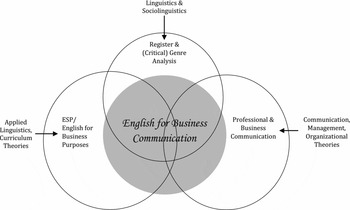
The current picture that emerges from the above discussion seems to favour a kind of integration of EBP and Business Communication displayed in Figure 1.
Dynamics of business communication: motivation and inspiration (adapted from Bhatia & Bhatia Reference Bhatia, Bhatia and Simpson2011)

Bhatia (Reference Bhatia2004, Reference Bhatia2008a, Reference Bhatia2010) argues that a comprehensive understanding of the motives and intentions of business practices is possible only if one goes beyond textual constraints to look at the multiple discourses, actions and voices that play a significant role in the formation of specific discursive practices within institutional and organizational frameworks, as well as the conventional systems of genres (Bazerman Reference Bazerman, Freedman and Medway1994) often used to meet the professional objectives of particular disciplinary or professional communities. He develops the notion of ‘interdiscursivity’ as a function of the appropriation of contextual and text-external generic resources within and across professional genres and practices. Devitt (Reference Devitt1996: 611) also points out that ‘we need to find ways to keep genre embedded and engaged within context while also keeping our focus on learning about genre and its operations’, later adding (Reference Devitt2004: 188) that ‘to teach students the rhetorical and cultural significance of one genre will require teaching the significance of its genre set and the place of that genre within that set’. Similarly, Bremner (Reference Bremner2008: 308) points out that
If we take the social constructionist view of genres and contexts as inherently dynamic, as mutually constitutive (Goodwin & Duranti Reference Goodwin and Duranti1992; Berkenkotter & Huckin Reference Berkenkotter and Huckin1993; Smart Reference Smart2006), and also recognize that genres are interconnected in wider systems of activity, then we need to look at the ways in which genres influence other genres in the system.
It should also be noted at this stage that research in areas such as the relationship between discursive activities and professional practices in most disciplinary, professional and institutional contexts (Bhatia Reference Bhatia2006, Reference Bhatia2008a, Reference Bhatia2008b, Reference Bhatia2010) is still in its early stages, and a lot more work is needed before we can find convincing answers to the question raised by Bhatia (Reference Bhatia1993): ‘why do most professionals use the language they way they do?’ For instance, we still have no comprehensive understanding of what makes a novice accounting student into a good accountant, or how we identify, train and appraise a good lawyer. What is the role of language in the development of specialist expertise in a particular professional field? What are the core competencies that are needed to make a person a competent professional? Are these competencies teachable? Is it possible to assess the acquisition of such expertise? Although we are a long way from any kind of definite or convincing answers to these questions, and much more work is needed, we seem to be moving in the right direction. We now pursue this line of thinking by considering more recent developments and research leading to the current thinking in EBC, as proposed here. We believe that in the teaching and learning of EBC we have reached the point of convergence where two equally strong traditions, English for Business Purposes and Business Communication, have started to converge; hence the appropriateness of the term English for Business Communication (EBC).
4. Critical issues and challenges for EBC
EBC is essentially a multi-disciplinary and multi-dimensional activity. Since the area it deals with is becoming increasingly complex and dynamic, an equally complex and comprehensive approach is required to deal with it. As mentioned earlier, in addition to handling the language of business, we also need to take into account the complexities of the contexts in which business genres are used and exploited to achieve the specific goals of business communities within and across the corporate world. This has raised a number of issues and challenges for theorists as well as practitioners of EBC, which we will consider now.
4.1 The explosion of multimedia discourse
One of the most powerful changes that the business world has experienced in recent years has been the ubiquitous use of multimedia in e-mails, websites, webinars and video-conferencing, as well as in the use of visuals in everyday forms of communication, such as corporate annual reports and brochures. Coupled with this is the widespread use of advertising and promotional campaigns to sell corporate products, to the extent that an increasing portion of the typical corporate budget is allocated to promotional efforts through the mass media. This has raised interesting issues, not only about the rapidly emerging changes we have been witnessing in the design, construction and dissemination of corporate genres, but also in the discursive resources and processes that give shape to such artefacts. This explosion of multimedia discourse is also evident in the way professional practices are undertaken, especially in the marketing of financial products through impressive video, audio and PowerPoint presentations, now considered normal practice in the financial sector. In this context, Du-Babcock (Reference Du-Babcock2006: 261) argues that ‘current technologies are influencing not only the way businesses communicate globally but also the way in which teaching, learning, and research can be done collaboratively’. Similarly, Jackson (Reference Jackson2007: 3), referring to the use of computer-mediated technology in business communication, adds that the ‘scope, scale, and substance of business communication are undergoing a sea change as the result of recent developments and emerging uses of communication technologies’. He sees computer-mediated communication as infused into nearly every business communication context, even coming to dominate certain areas such as public relations. The world we investigate, he argues, is, at the surface or first level, bigger in scale and scope. He concludes: ‘Typical limitations to collecting data that previously were enforced by constraints to time and space are dissipating as technologies allow us to communicate anywhere, anytime, to anyone’ (Jackson Reference Jackson2007: 10). Talking of the use of new media in the teaching and learning of business communication, Brett (Reference Brett2000: 270) points out that the conventional ‘language teaching media of video, pictures, sound, and text, can now be combined with aspects of language teaching methodology such as tasks and feedback, through computer-delivered multimedia’. He also observes that ‘(o)pportunities to provide interactive multimedia language learning materials are also expanding through CD-ROM and digital video discs (DVD), through the World Wide Web, through the use of local area networks and through interactive digital television’. He proposes the integration of multimedia with Business Communication teaching, claiming that, in his study, listening skills development was better conducted in a multimedia environment than in the teacher-led forum. These developments have raised considerable challenges for discourse and genre analysts as well as teachers and trainers in EBC.
4.2 Critical analysis of professional genres
In its earlier form, as discussed briefly in section 2.1, genre analysis was seen as an extension of linguistic analysis intended for the study of functional variation in the use of English in academic contexts. Swales’ (Reference Swales1980) work marked the beginning of genre-analytical models for a grounded description of academic research genres. Like register analysis, genre analysis was motivated by the prospect of using its findings for the teaching and learning of ESP; however, unlike registers, which were identified on the basis of a specific configuration of the three main contextual categories of field, mode and tenor of discourse, genre was identified Swales on the basis of its communicative purpose.
In more recent years, genre analysis has developed in the direction of a more comprehensive exploration of what Bhatia (Reference Bhatia2004) specifies as ‘socio-pragmatic space’ to raise a number of other issues, including some relating to the integrity of generic descriptions. He proposes a multi-perspective and multidimensional three-space model for the analysis of discourse as genre. One of the interesting aspects of this framework for genre analysis is its attempt to integrate a number of other approaches to discourse analysis into a single framework, incorporating ethnographic, critical and corpus-based and multimodal analysis of discourse. In this framework, context is assigned a more important role, thus redefining genre as a configuration of text-external and text-internal factors, highlighting at the same time two kinds of relationships involving texts and contexts (Swales Reference Swales1998; Bhatia Reference Bhatia2004, Reference Bhatia2008a, Reference Bhatia2008b). Bhatia (Reference Bhatia2010: 32–33) points out that
. . .interrelationships between and across texts focusing primarily on text-internal properties are viewed as intertextual in nature, whereas interactions across and between genres resulting primarily from text-external factors are seen as interdiscursive in nature. Intertextuality has been paid some attention in discourse and genre theory; interdiscursivity, however, has attracted relatively little attention, especially in genre theory.
Drawing evidence from a number of professional settings, in particular from corporate disclosure practices, international commercial arbitration practices and philanthropic fundraising practices, Bhatia (Reference Bhatia2010) explored the nature and function of interdiscursivity in genre theory, claiming that it is the function of an appropriation of generic resources, primarily contextual in nature, focusing on specific relationships between and across discursive and professional practices as well as professional cultures. Interdiscursivity is central to our understanding of the complexities of all kinds of professional genres, especially those of business.
Bhatia (Reference Bhatia2004), in proposing a three-space multidimensional and multi-perspective model for analysing written discourse, thus underpins the importance of context in genre theory. The three overlapping concepts of space – textual, socio-pragmatic (incorporating both genre-based discursive and professional practices) and, more generally, social – help the genre analyst to focus more appropriately on one or more of these three dimensions to analyse and interpret business and other professional discourses. However, when we focus on professional discourse, we find that most of its forms operate simultaneously within and across four somewhat different but overlapping levels in order to construct and interpret meanings in typical professional contexts. Bhatia (Reference Bhatia2004, Reference Bhatia2010) discusses the critical aspect of genre analysisFootnote 1 by taking an example of text from a corporate annual report, namely letters written by the Chairmen or CEOs of corporations to their shareholders. The texts are first analysed for lexico-grammatical features and rhetorical structures. However, it is demonstrated that this genre makes much better sense when it is also analysed in the context of the professional practice embedded in its typical corporate culture, without which the surface analysis of genre makes very limited sense. What makes this kind of analysis more insightful is the nature of the explanation and clarification that informs the reader why this genre is written the way it is (Swales & Rogers Reference Swales and Rogers1995).
The interesting thing about professional communication is that what you see as the ultimate product is the text, which is made possible by a combination of a very complex and dynamic range of resources, beyond what in linguistic and earlier discourse-analytical literature is viewed as lexico-grammatical, rhetorical and organizational. Other contributors to the construction of professional artefacts are the conventions of the genre in question, the understanding of the professional practice in which it is embedded, and the culture of the profession, discipline or institution, all of which constrain the use of textual resources for a particular discursive practice. In other words, any instance of professional communication simultaneously operates and can be analysed at these four levels: as text, as representation of genre, as realization of professional practice and as expectation of professional culture.
To take the discussion further, it seems increasingly obvious now, more than ever, that textual as well as other semiotic resources and conventions at various levels of professional engagement are often appropriated and exploited for the construction and interpretation of discursive as well as disciplinary practices, thus establishing interesting interactive patterns of intertextuality and interdiscursivity. The concept of interdiscursivity, which is sometimes subsumed under intertextuality, is not entirely new and can be traced back to the works of Kristeva (Reference Kristeva1980), Foucault (Reference Foucault1981), Fairclough (Reference Fairclough1995), Bakhtin (Reference Bakhtin1986), Candlin & Maley (Reference Candlin, Maley, Gunnarsson, Linell and Nordberg1997) and several others. However, these two concepts could be more fully developed to cast light on some of the complexities we find in discursive and professional practices within genre-analytical literature. To make an initial distinction between these two related concepts, we can safely begin by defining intertextuality as the use of prior texts transforming the past into the present, often in relatively conventionalized and somewhat standardized ways. Interdiscursivity, on the other hand, refers to more innovative attempts to create various forms of hybrid and relatively novel constructs by appropriating or exploiting established conventions or resources associated with other genres and practices. Interdiscursivity thus accounts for a variety of discursive processes and professional practices, often resulting in the ‘mixing’, ‘embedding’ and ‘bending’ of generic norms in professional contexts (Bhatia Reference Bhatia1997, Reference Bhatia2004). More importantly for our discussion here, interdiscursivity can be viewed as the appropriation of semiotic resources (which may include textual, semantic, socio-pragmatic, generic and professional) across any two or more of these different levels, especially those of genre, professional practice and professional culture. Appropriations across texts thus give rise to intertextual relations, whereas appropriations across professional genres, practices and cultures constitute interdiscursive relations.
In order to develop a comprehensive and evidence-based awareness of the motives and intentions of such disciplinary and professional practices (Swales Reference Swales1998), one needs to look closely at the many discourses, actions and voices that play significant roles in the formation of specific discursive practices within relevant institutional and organizational frameworks, in addition to the conventional systems of genres (Bazerman Reference Bazerman, Freedman and Medway1994) that are often used to meet the professional objectives of specific disciplinary or discourse communities. This is possible only within the notion of ‘interdiscursivity’, which is one of the important functions of the appropriation of text-external generic resources across professional genres and practices (Bhatia Reference Bhatia2004: 127).
As Bhatia (Reference Bhatia2010) points out, both intertextuality and interdiscursivity can be viewed as tactical appropriations of all forms of semiotic resources across texts, genres, social practices and cultures. However, he goes on to say that from the point of view of genre theory, especially in the context of professional communication, we need to distinguish them further. Appropriations across text-internal resources are intertextual in nature, as they operate within what we can refer to as ‘textual space’, but the vast majority of appropriations take place across text-external semiotic resources at other levels of professional, institutional and disciplinary discourses, such as genres, professional, institutional and disciplinary practices, and professional, institutional and disciplinary cultures, in order to meet socially shared professional, institutional, and disciplinary expectations and objectives, and sometimes also to achieve ‘private intentions’. These latter forms of appropriations, which operate in what can be viewed as ‘socio-pragmatic space’, are essentially interdiscursive in nature. It may be pointed out that these appropriations, whether text-internal or text-external, often operate discursively and simultaneously at all levels of discourse to realize the speaker's intended meaning (see Bhatia Reference Bhatia2010 for more details). Nickerson (Reference Nickerson2005: 367) also underlines the importance of such a ‘discursive turn’ that goes beyond the text, when she claims that
(T)here has been a shift from the analysis of the language used in isolated written texts or speech events, towards the analysis of contextualised communicative genres, emphasising the organisational and/or cultural factors that contribute to the realisation of the individual text/event under investigation. This discursive turn is apparent in the work of many researchers investigating English in business contexts, whatever their geographical location or the genre(s) they have chosen to study. . .
4.3 Corpus-based analyses of business and other workplace discourses
The analysis of large quantities of authentic textual data, both written and spoken, has become one of the most powerful tools for investigating aspects of business communication. It is a method that has been successfully used to study different forms of typical lexico-grammatical as well as rhetorical features of business genres, including the specific discourse strategies often exploited by business specialists to achieve their general business goals and specific objectives. Illustrations of the versatility of corpus-based work can be seen in studies as diverse as Fuertes-Olivera (Reference Fuertes-Olivera2007), who investigated lexical gender in business communication, and Bjørge (Reference Bjørge2010), who studied listening behaviour based on a number of video recordings of simulated negotiations involving international negotiators, focusing on verbal as well as non-verbal backchannelling.
A recent and detailed corpus-based study of the discourse of business meetings by Handford (Reference Handford2010) offers an excellent perspective on how business meetings are conducted in professional contexts. Drawing on the Cambridge and Nottingham Business English Corpus (CANBEC), Handford compares the specific features of business meetings with a more general corpus of spoken English, the Cambridge and Nottingham Corpus of Discourse in English (CANCODE). He identifies features of typical language use creatively exploited in business meetings, relating them to specific discursive strategies used in various contexts. The study is not restricted to the analysis of keywords and concordances, but goes much further, analysing discourse marking and interpersonal practices in business meetings, drawing interesting and significant conclusions about business meeting discourse as a genre, and highlighting the rhetorical organization of meetings and the use of strategic resources. The study is also a good illustration of how a multi-perspective framework can be used for the study of a single genre to make generalizations about a specific business practice.
Another corpus-based genre-analytical study of workplace discourse is provided by Koester (Reference Koester2010), who offers an insightful and detailed account of workplace interaction. Using a multi-perspective framework that combines genre analysis and a corpus-driven approach, he examines workplace discourse in a variety of contexts and provides a useful account of the lexico-grammatical dimension of the data in their typical organizational contexts, illustrating the use of English as a lingua franca. By integrating genre-analytical and corpus-driven approaches, Koester highlights the multidimensional aspects of workplace discourse. His previous work, notably Koester (Reference Koester2004, Reference Koester2006), also provides interesting accounts and insights into specific aspects of workplace communication.
Similarly, Handford & Koester (Reference Handford and Koester2010) take the analysis of business meetings and other workplace interactions further in their study of metaphors and idioms in two conflictual business encounters, taking data from two corpora of spoken business and workplace interactions categorized according to metaphors, formulae and anomalous collocations and functions of evaluation, intimacy, intensity and discourse.
4.4 English as a lingua franca of business
The widespread use of English in global business contexts, particularly in Europe in recent years, has generated renewed interest in the study of the functions and special status of English as a Lingua Franca (ELF) in business. Seidlhofer (Reference Seidlhofer2005) considers ELF as part of the more general phenomenon of ‘English as an international language’ (EIL) or ‘World Englishes’, along with ‘English as a global language’ (e.g. Crystal Reference Crystal2003) and ‘English as a world language’. She points out that these have been used ‘as general cover terms for uses of English spanning Inner Circle, Outer Circle, and Expanding Circle contexts (Kachru Reference Kachru1992)’, adding that ‘the traditional meaning of EIL comprises uses of English within and across Kachru's “Circles”, for intranational as well as international communication’ (p. 339). However, she also claims that ‘when English is chosen as the means of communication among people from different first language backgrounds, across linguacultural boundaries, the preferred term is “English as a lingua franca”’ (p. 339).
This trend has prompted a number of studies in recent years of various aspects of the use of English in different countries, corporations and professional contexts. A typical example can be seen in the work of Louhiala-Salminen (Reference Louhiala-Salminen2002), who studied the communication environment in a Finnish corporation by following the daily activities of a manager, showing that English enjoyed a special status as the ‘native corporate language’ in the corporation for various types of national and international activities. Jenkins, Cogo & Dewey (Reference Jenkins, Cogo and Dewey2011) have recently completed a comprehensive review of developments in research into ELF. However, we focus only on some of the literature relevant to EBC.
A valuable source for the study of ELF in international business communication is the special issue (2005) of English for Specific Purposes, which provides a comprehensive account of the use of English in business contexts. Nickerson (Reference Nickerson2005) begins her editor's introduction by referring to Seidlhofer (Reference Seidlhofer2004), who, in the light of her investigation of the use of ELF, emphasizes the potential of empirical research ‘for a better understanding of how ELF functions in international business settings’ (Reference Seidlhofer2004, cited in Nickerson Reference Nickerson2005: 367). The special issue, as she points out, illustrates ‘the use of English as a lingua franca in international business contexts as reflected in a variety of different communicative genres’ (Reference Nickerson2005: 367). Research includes work on written business genres, such as letters and business reports (Bargiela-Chiappini & Nickerson Reference Bargiela-Chiappini, Nickerson, Bargiela-Chiappini and Nickerson1999; Santos Reference Santos2002; Yeung Reference Yeung2007), and spoken genres, such as negotiations (Charles Reference Charles1996; Gimenez Reference Gimenez2006), business meetings (Bargiela-Chiappini & Harris Reference Bargiela-Chiappini and Harris1997; Rogerson-Revell Reference Rogerson-Revell, Hewings and Nickerson1999; Bennington, Shetler & Shaw Reference Bennington, Shetler and Shaw2003; Poncini Reference Poncini2003, Reference Poncini2004; Handford Reference Handford2010), advertising and other promotional artefacts (Cook Reference Cook1992; Bhatia Reference Bhatia1993, Reference Bhatia, Halmari and Virtanen2005; Halmari & Virtanen Reference Halmari and Virtanen2005), and certain electronic forms of communication (Gimenez Reference Gimenez2000, Reference Gimenez2001), focusing particularly on discursive practice, rather than just the textual surface of genre.
Specific examples of this kind of work include Louhiala-Salminen, Charles & Kankaanranta (Reference Louhiala-Salminen, Charles and Kankaanranta2005), who studied communication and language use among employees from two international corporations, focusing particularly on their communicative practices and intercultural challenges in email messages and meetings where ELF was used in internal communication. Planken (Reference Planken2005), meanwhile, investigated facework in intercultural sales negotiations. Employing Spencer-Oatey's (Reference Spencer-Oatey and Spencer-Oatey2000) framework for ‘rapport management’ in building a working relationship, she analysed two corpora of quasi-natural negotiation discourse produced by professional negotiators and students of international business communication, i.e. aspiring negotiators, using ELF for specific business purposes. The findings indicated that whereas professionals frequently initiate safe talk (talk not directly related to the main goal of the negotiation) throughout their negotiations, aspiring negotiators engage in safe talk sporadically, and only in the initial and final stages of a negotiation.
Rogerson-Revell (Reference Rogerson-Revell2007) investigated the use of ELF in international business meetings between professionals from different organizations, which brought together people from different linguistic and socio-cultural backgrounds. She found that more often than not people in these multilingual settings used ELF in these international encounters. ‘While English for International Business (EIB) has an essential function as a lingua franca in multilingual settings’, she points out, ‘it can also present challenges both linguistically and culturally, particularly as more and more interactions are between speakers whose first language is not English’ (p. 339).
In her later study (Reference Rogerson-Revell2008), Rogerson-Revell builds on her Reference Rogerson-Revell2007 survey, exploring the use of English for International Business (EIB) to analyse the discourse of business meetings in order to relate the perceptions of employees to the actual interactive characteristics of the meetings themselves. The findings suggested some support for the issues raised in the survey, particularly with regard to levels of participation. She discovered that although Native Speakers of English (NSE) did not dominate talk in terms of time, they were outnumbered in the meetings by inactive Non-Native Speakers of English (NNSE). Overall, the analysis showed that the linguistic performance of most speakers was effective. In more general terms, considering the question of linguistic competence in ELF workplaces, Gunnarsson (Reference Gunnarsson2009) raises the potential problem of ‘the consequences of the divide between those with mastery of English and those without’ (p. 247).
In addition to business meetings, there has been interest in the use of ELF in negotiations. One example is a recent study by Bjørge (Reference Bjørge2010), mentioned above in the context of corpus-based analysis, which showed that the international business community relies heavily on ELF as a shared means of communication for negotiating, although she claims that ESP Business programmes are not focused on negotiating skills.
More recently, based on an extensive survey of the perceptions of business professionals engaged in global business communication, Louhiala-Salminen & Kankaanranta (Reference Louhiala-Salminen and Kankaanranta2011) conclude that global communicative competence should be viewed as an integration of multicultural competence, competence in Business ELF (BELF) and the communicator's business know-how. They focus on features that contribute to what they regard as ‘successful’ business communication in global contexts. They also suggest that their research on ELF as the language of global interaction, which assumes a shared ‘core’ of the English language but focuses on interactional skills, rapport building, and the ability to ask for and provide clarifications, has implications for both education and training.
One of the interesting aspects of their research is that they do not address, question or even problematize the role and nature of English when it is used as a shared language by international business professionals. They suggest that English in global business contexts is not ‘owned’ by any specific native or non-native community, such as British, American or Australian, nor is it directly linked to any specific regional or cultural context or situation. It is a resource shared by the international community engaged in specific business activities across national or geographical borders.
4.5 Intercultural and cross-cultural issues in business discourse and practices
Business communication in intercultural and cross-cultural contexts has also attracted considerable attention in the last few years. Intercultural communication can be seen as a system of shared or contested values, attitudes, beliefs and ways of doing things across cultural contexts. The pioneering work in this field was done by Hofstede in Reference Hofstede1984, in his best-selling book Culture's consequences, in which he proposed four dimensions on which the differences among national cultures can be understood: Individualism, Power Distance, Uncertainty Avoidance and Masculinity. More recent works include the special issue of the Journal of Intercultural Studies (Reference Bargiela-Chiappini and Nickerson2003), in which Bargiela-Chiappini & Nickerson, in their Introduction, point out that intercultural business communication (IBC) is a complex disciplinary area, and claim that the constructs of culture and communication involve a number of well-developed fields of enquiry, each with its distinctive approach (though these sometimes overlap), theory and methodology, and suggest that the added dimension of the business context clearly increases that complexity. They also outline current debates, identifying key topics and their potential contribution to the exciting diversity that exists within IBC. Similarly, Cheng & Kong (Reference Cheng and Kong2009) outline a number of approaches to the study of intercultural communication in a range of professional communication contexts, written as well as spoken. Other interesting and insightful work in this field includes that of Varner (Reference Varner2000) and Poncini (Reference Poncini2002a, Reference Poncini2002b).
Vuorela (Reference Vuorela2005) points out that IBC deals with intercultural issues, communication and business. For her, this term refers to the communication between individuals or groups from different cultural backgrounds in a business environment. As such, it has its own identity separate from business communication, intercultural communication and international business. It is true that business communication typically deals with communication issues in business contexts, whereas international business focuses more on business practices, paying little attention to communication issues. Business communication in intercultural, cross-cultural and international contexts must deal with both communication issues and business practices. Much work in this area has focused on business negotiations in intercultural and international contexts. Charles (Reference Charles1994, Reference Charles1996, Reference Charles2007) has been one of the most significant contributors to this area, with, for example, her investigation of the organization and the rhetoric of sales negotiations, in which she draws on an analysis of both discourse and business negotiation practices in an attempt to study how the rhetoric and organization of the non-linguistic business relationship influence each other.
Some interesting research has also been carried out on written business genres in intercultural and cross-cultural contexts. Zhu (Reference Zhu2000), for example, finds notable differences in the sales genres used in Chinese and English. In a number of studies, Babcock & Du-Babcock (Reference Babcock and Du-Babcock2001) and Du-Babcock (Reference Du-Babcock2007) report on interaction in and across what they call different business communication zones. In their 2001 paper, the authors identify a number of such zones, arguing that we cannot assume that ‘all participants within an international business communication setting function as fully proficient users of all languages being spoken, with no accounting for communication difficulties based on varying levels of language proficiency’, instead proposing a comprehensive framework to represent ‘the dynamic, bi-directional, multiply influenced, and transformational translation process integral to international business communication’ (2001: 372). In her later article (Reference Du-Babcock2007), Du-Babcock distinguishes between potential zones and activated zones in order to account for language competency in more detail and construct professional, commercial and relational genres, focusing particularly on the language competencies required to communicate in different situations and perform different communication tasks.
4.6 Sociolinguistic dimensions
As interest has grown in the relationship between text and social context, increasing numbers of studies have taken sociolinguistic perspectives on business and workplace communication. Politeness has attracted much attention. As Held (Reference Held, Watts, Ide and Ehlich1992) puts it, ‘the fact that politeness represents a social norm that can be observed empirically in language and reliably analyzed by means of language has long made it an important object of study in linguistics’ (p. 133), while Eelen (Reference Eelen2001) suggests that the study of politeness helps us to understand the relationship between language and social reality. Thus alongside the large body of work on politeness in general (e.g. Brown & Levinson Reference Brown and Levinson1987; Watts Reference Watts2003; Leech Reference Leech2007), much research has also been conducted in specific workplaces, relating to both spoken (e.g. Poncini Reference Poncini2002a, Reference Poncini2002b; Holmes & Stubbe Reference Holmes and Stubbe2003) and written discourse (e.g. Bargiela-Chiappini & Harris Reference Bargiela-Chiappini and Harris1996; Pilegaard Reference Pilegaard1997; Kong Reference Kong1998; Vergaro Reference Vergaro2004; Bremner Reference Bremner2006).
Recent research into politeness has raised the possibility of a universally applicable theory, as suggested by Brown & Levinson in their Reference Brown and Levinson1987 study; this relates to the interactional nature of conversation and the fact that it is located in specific contexts. Arundale (Reference Arundale2006), for example, argues for an interactional view of face, saying that it is ‘an emergent property of relationships, and therefore a relational phenomenon, as opposed to a social psychological one’ (p. 201). This interactional view is very much in tune with the social constructionist view of genre and context as mutually constitutive; Holmes & Stubbe's extensive study of power and politeness in spoken discourse, which draws on the Wellington Language in the Workplace (LWP) project, acknowledges this interactional position: ‘the dynamic nature of any interaction entails constant negotiation of social distance or solidarity’ (Reference Holmes and Stubbe2003: 164). Bremner (Reference Bremner2006) also looks at power and politeness through this interactional prism, but using written rather than spoken data. There is a large body of research into politeness, but how it plays out and is realized linguistically in business contexts warrants continuing investigation, given how workplaces are changing in terms of their linguistic and cultural composition: a recurring theme in this paper.
A substantial amount of work on gender in spoken workplace discourse has been carried out by Holmes (Reference Holmes2004, Reference Holmes2006a, Reference Holmes2006b) and Holmes & Schnurr (Reference Holmes and Schnurr2005), focusing particularly on humour and small-talk in such contexts. The impact of gender differences on practices in written business communication has received little attention, according to Beaufort (Reference Beaufort and Bazerman2008). Exceptions are the work of Tebeaux (Reference Tebeaux1990) and Barker & Zifcak (Reference Barker and Zifcak1999), who Beaufort sees as adopting similar positions in that they argue ‘for business writers to have androgynous writing strategies to meet a variety of communication situations’ (Reference Beaufort and Bazerman2008: 224). In the conclusion to her review of research in writing in the professions, she suggests that further investigation of ‘gendered differences in workplace communications is warranted’ (p. 230).
4.7 Challenges from Business Communication studies
Traditional approaches to ESP and EBP have to a considerable degree focused on text rather than on its relationship to context, and Bhatia's (Reference Bhatia2004) multidimensional model of genre analysis – and his subsequent development of this (Reference Bhatia2008, Reference Bhatia2010) – is timely in that it calls on researchers to investigate in greater depth the factors surrounding the production of text. It is fair to say that a large body of research has emerged from business communication studies on the processes involved in the construction of texts and what it takes to become a member of a particular professional community, in a way not seen so frequently in the work of ESP and EBP researchers.
Numerous studies, grounded in the principles of the New Rhetoric approach to genre, have addressed (mainly written) communication in the workplace (e.g. Blyler & Thralls Reference Blyler and Thralls1993; Spilka Reference Spilka1993; Odell & Goswami Reference Odell and Goswami1995). This social constructionist approach to genre, often referred to as Rhetorical Genre Studies (Artemeva & Freedman Reference Artemeva and Freedman2006), sees genre as typified social action (Miller Reference Miller1984), arguing that the genres of a workplace are shaped by the recurrent social contexts that arise in that workplace, and that there is a mutually constitutive relationship between genre and context (Goodwin & Duranti Reference Goodwin and Duranti1992; Berkenkotter & Huckin Reference Berkenkotter and Huckin1995).
An additional consideration is the interrelated nature of genres in workplace contexts, giving rise to a variety of terms to describe clusters of genres that are grouped together to achieve an organization's goals such as ‘genre sets’ (Devitt Reference Devitt, Bazerman and Paradis1991), ‘systems of genres’ (Bazerman Reference Bazerman, Freedman and Medway1994) or ‘genre repertoires’ (Orlikowski & Yates Reference Orlikowski and Yates1994). Prominent research that addresses this aspect of business communication includes that of Yates & Orlikowski (Reference Yates and Orlikowski1992, Reference Yates and Orlikowski2002). Devitt's (Reference Devitt, Bazerman and Paradis1991) study of the accountancy community is much cited in this regard and also addresses issues relating to intertextuality. More recent work on the interconnected nature of genres in the workplace includes the extensive research carried out in the Bank of Canada by Smart (Reference Smart2006).
One upshot of the attention being paid to the processes involved in text creation is an interest in the ways in which members of professional communities collaborate to produce texts. Indeed, the importance and prevalence of collaboration as a feature of workplace writing is now taken as a given. Burnett (Reference Burnett2001) suggests that as much as 75% to 85% of organizational writing is carried out collaboratively. Since the mid-eighties there has been a proliferation of research in this area, largely conducted in North America, from the pioneering work of Paradis, Dobrin & Miller (Reference Paradis, Dobrin, Miller, Odell and Goswami1985), Couture & Rymer (Reference Couture, Rymer and Kogan1989) and Ede & Lunsford (Reference Ede and Lunsford1990) to large-scale studies such as those carried out by Cross (Reference Cross1994, Reference Cross2001) and Smart (Reference Smart2006).
A recent project investigating collaborative practices in the workplace (Peirson-Smith et al. Reference Peirson-Smith, Bhatia, Bremner and Jones2010) looks at how these are enacted in contexts where English functions as a ‘collaborative language’, in this case in the PR industry in Hong Kong, where PR companies typically employ a mix of native and non-native speakers. In these workplaces, the use of English is ‘a way of incorporating all of the voices on the team through an accepted business-oriented lingua franca which created common discursive ground through which team members could pursue and fulfil both corporate and individual career goals’ (Reference Peirson-Smith, Bhatia, Bremner and Jones2010: 230). The findings from this project clearly have a bearing on issues relating to ELF, and also raise the question of whether different levels of English proficiency among employees, especially native vs. non-natives, can lead to power imbalances or to more collaborative and inclusive interactions, echoing the concern voiced by Gunnarsson (Reference Gunnarsson2009), alluded to in section 4.4.
Thompson (Reference Thompson2001), in a summative article looking at research on collaborative writing carried out over the preceding ten years, concluded that most of the work was descriptive, and that it was ‘aiming to portray attitudes as they are at this moment rather than speculating about universal causation’, going on to say that the focus on description ‘also seems to indicate the assumption that collaboration will be a long-term ongoing consideration in research’ (p. 167). This has proved to be the case, as work in this area has continued to multiply, with ongoing reflections about the challenges posed by workplace collaboration (e.g. Colen & Petelin Reference Colen and Petelin2004; Forman Reference Forman2004), and occasional summative surveys of the research related to collaborative activity, such as Lowry, Curtis & Lowry's (Reference Lowry, Curtis and Lowry2004) taxonomy for collaborative writing, Hansen's (Reference Hansen2006) review of the literature on teams and teamwork and Rentz et al.'s (Reference Rentz, Arduser, Meloncon and Debs2009) checklist for designing a successful group report.
As noted above, a substantial number of studies have attempted to understand how collaborative processes are enacted in the workplace. In addition, the question of whether and how such processes can be taught in university settings has become a key issue: as Gollin (Reference Gollin, Candlin and Hyland1999) points out, workplace collaborative processes ‘are embedded, differ significantly from the writing processes modelled in traditional pedagogy’ (p. 268); she contends that collaborative writing ‘is a complex activity and needs to be actively taught’ (p. 289). However, several researchers, such as Chen et al. (Reference Chen, Donahue and Klimoski2004), Hansen (Reference Hansen2006) and Rentz et al. (Reference Rentz, Arduser, Meloncon and Debs2009), suggest that the kinds of competencies needed to be a successful collaborative writer are not generally addressed in university contexts; Hansen observes that ‘it appears that the majority of faculty who place students into teams do nothing more than that’ (Reference Hansen2006: 15).
The focus of the majority of studies of collaborative work is on process and interaction rather than text: Lowry et al. (Reference Lowry, Curtis and Lowry2004), for example, are concerned with the multiple configurations that can be seen in different workplaces. The gradual converging of text-based concerns that are associated with EBC, and the interest in processes evidenced in much business communication studies research, may result in more work in which the two aspects of collaboration are investigated in tandem.
Further work is also required on the pedagogy of collaborative writing to determine how students can best be equipped with the skills that will help them become successful collaborators in the workplace. This issue is closely related to the question of how learners can make smooth transitions from academic contexts to the workplace and become effective members of a professional community of practice. Again, this is a concern that has been investigated more thoroughly by teachers and researchers working within the social constructionist frameworks that underpin business communication studies.
Among the earliest research studies looking at transition and socialization was that of Anson & Forsberg (Reference Anson and Forsberg1990), who noted that the majority of workplace writing research had looked at the experiences of already proficient writers, rather than at the transitions made by writers entering new contexts. More recent studies have included in-depth accounts of the socialization of writers into the genres of particular workplaces e.g. Winsor (Reference Winsor1996) and Beaufort (Reference Beaufort1999). Some have addressed the difference between the academy and the workplace as contexts for learning, and how learners try to move from one to the other (Freedman, Adam & Smart Reference Freedman, Adam and Smart1994; Dias et al. Reference Dias, Freedman, Medway and Paré1999; Dias & Paré Reference Dias and Paré2000; Le Maistre & Paré Reference Le Maistre and Paré2004; Artemeva Reference Artemeva, Bazerman, Bonini and Figuieredo2009). In many cases the subjects were interns who were taking professionally-oriented writing courses in conjunction with their internship (Freedman & Adam Reference Freedman and Adam1996; Galtens Reference Galtens2000; Le Maistre & Paré Reference Le Maistre and Paré2004; Smart & Brown Reference Smart, Brown, Artemeva and Freedman2006).
All of the studies reported above involved L1 subjects; there has been less work with L2 subjects, but exceptions include the work of Parks & Maguire (Reference Parks and Maguire1999) and Parks (Reference Parks2001), who look at the experiences of francophone nurses writing in an English-medium environment in Canada, and Li's (Reference Li and Mead2000) study of a Chinese immigrant socializing into a North American workplace, although these studies did not have a strong business focus. However, a recent study by Bremner (Reference Bremner2012) details the experiences of a Cantonese-speaking intern as she socialized into a PR organization in Hong Kong.
In general there is a need for more research into language socialization (Beaufort Reference Beaufort and Bazerman2008; Roberts Reference Roberts2010), and in particular a need for more studies outside Europe and North America (Duff Reference Duff, Duff and Hornburger2008), as well as more work on the experiences of L2 learners socializing into the workplace (Vickers Reference Vickers2007). As has been pointed out, ESP and EBP have been primarily concerned with the needs of L2 learners, and it may be that the experiences of the business communication studies researchers mentioned above, and the lessons learnt from their work, could be usefully harnessed to research that takes a closer look at how L2 learners acquire the genres and discourses of professional communities in business settings.
On the issue of teaching materials aimed at teaching English for business, it was noted in section 2.4 that a wide range of textbooks for EBP exists, which were to some extent influenced in their course design by EFL. Business communication has also spawned a sizeable collection of textbooks, the bulk of which are published in North America (e.g. Locker & Kaczmarek Reference Locker and Kaczmarek2004; Ober Reference Ober2004; Bovee & Thill Reference Bovee and Thill2006; Lesikar, Flatley & Rentz Reference Lesikar, Flatley and Rentz2008). Such books are used in tertiary institutions not only in North America but also in places as diverse as Hong Kong and the United Arab Emirates. While some attempts have been made to adapt these books for specific markets outside North America (e.g. Guffey & Du-Babcock Reference Guffey and Du-Babcock2008), it is fair to say that the implicit underlying expectation in these books and the ways in which target texts are exemplified is that their audience is North American.
However, there is a growing acknowledgement of the increasing presence of ESL students in university business communication classes in English-speaking environments, which poses challenges for teachers but also ‘invites us to explore new teaching methods’ (Worley & Dyrud Reference Worley and Dyrud2007: 34). These challenges are addressed by Zhu (Reference Zhu2007): teaching intercultural business communication in Australia and New Zealand, where many students are from Asia, she describes a course designed to offer opportunities to identify cultural differences and interpret them from different cultural perspectives, thereby encouraging the participation of international students in classroom activities. Penrose (Reference Penrose2007) also identifies areas where non-native speakers of English (NNSE) have issues that need addressing, such as reticence in spoken communication, yet, like Worley & Dyrud (Reference Worley and Dyrud2007), portrays the challenges of multicultural classes as opportunities.
A different perspective on the issue of teaching NNSE is taken by Kankaanranta & Louhiala-Salminen (Reference Kankaanranta and Louhiala-Salminen2007), from the position, mentioned in section 4.4, which views Business English as a Lingua Franca (BELF). They point out that since so much English business communication is conducted in non-native English, their courses do not focus on training students to be native-like in their communication. Although the content of their courses is similar to that of courses targeted at native-speaker environments, their ‘underlying principle is that the audience always consists of international business practitioners’ (Reference Kankaanranta and Louhiala-Salminen2007: 57). They outline approaches for dealing with this kind of situation, and in the light of this underlying principle, stress the importance of audience analysis. At the same time, they raise questions about the norms and standards that can be set for such teaching, suggesting that more research in this area is needed. Finally, offering another perspective on teaching business English to non-native speakers, Kuiper (Reference Kuiper2007), in the context of teaching in Malaysia, suggests that it may be appropriate to give students business communication practice in local languages as well as English, as these were reported to be commonly used when doing business in Malaysia.
Textbooks dealing with Business English on the one hand, and business communication on the other, given their provenance and intended audience, respectively reflect to a considerable degree ESP's traditional concerns with text and social constructionism's wider concerns with community and process. However, while business communication textbooks do address to a certain extent the complexity of communicating in business contexts, on a pedagogical level issues such as intertextuality and collaboration are not fully dealt with (Bremner Reference Bremner2008, Reference Bremner2010). It remains to be seen whether the changing face of the business communication environment and an increased understanding of how communication processes actually function will be reflected in future textbooks.
4.8 Bridging the gap between the classroom and business contexts
In recent years we have seen a widening gap between classroom activities and the professional practices in which the corporate world has been engaged. Academic research has also been seen as lacking relevance and useful application to the world of work, which is particularly true given modern-day business practice and culture (Thomas Reference Thomas2007). There is a growing feeling, even amongst EBC researchers, teachers and practitioners, that if academics do not make serious efforts to understand and collaborate with professionals who are engaged in business communication, the situation may become even worse. Business and corporate practices, and the culture within which such practices are embedded, are undergoing rapid and dynamic changes. In the academic world, our frameworks, models and theories of business communication are becoming outdated and are fast losing touch with the changing world of work, which is becoming increasingly intercultural, multimodal, virtual and strategic. Consequently, EBC researchers and practitioners need to collaborate with members of professional communities in order to understand how and why they communicate the way they do. Bridging the gap between the academic and professional worlds is not simply a way of building face validity in the business world but is, more importantly, a way to develop better theories about business communication and convince our learners that we have the right kind of expertise to engage in the teaching and learning of EBC.
5. Suggestions for replication studies
In this section we suggest replication of some central areas of study that are important for research and practice in the field of EBC. One such area is the use of case methods in EBC programmes.
EBC pedagogic practice
Esteban & Cañado (Reference Esteban and Cañado2004), discussed in section 2.4 above, conducted a study to investigate how well case studies work in EBC courses for non-native speakers of English. Using a postgraduate course on foreign trade and a case study adapted for this course as a reference point in a real teaching situation, they concluded that advance preparation by the teacher, a suitable course syllabus, students’ motivation, authentic materials and activities in which the learners are involved, as well as adequate assessment measures and objectives pursued in the case, provide the key to the success of the case method. Since this is a very popular choice for many EBC practitioners, it is worth replicating the study in different disciplinary contexts, at both undergraduate and postgraduate levels, to gather more reliable evidence for the findings of this study in particular, and the use of case studies in general. Such replications will provide more informed evidence to designers of programmes, who have been using case studies for quite some time merely on the basis of the perceived relevance of the approach appropriated from business contexts.
Analysing EBC genres and practices
Another area of study crucial for the development of EBC is the replication of studies in the direction of analyses of interdiscursivity in specialized EBC discourses and practices. Devitt (Reference Devitt, Bazerman and Paradis1991) and Flowerdew & Wan (Reference Flowerdew and Wan2006), for instance, analyse tax computation letters written by tax accountants to investigate the prevalence of intertextuality in the accountants’ discourse, which the researchers studied using textual analytical procedures combined with ethnographic observations and interviews with accountants. However, this kind of study leaves a number of questions unanswered. For instance, it does not take into account interdiscursivity, in the sense of appropriation across text-external generic resources, such as the conventions and beliefs of the accounting community which are embedded in the prevalent accounting and wider corporate culture. There is a strong case for replicating this kind of study with an emphasis on critical aspects of genre theory, focusing more on accounting practices within the context of accounting cultures in particular, and corporate cultures, in general.
Needs analysis
Needs analysis of business students in various contexts has also been a prerequisite for the design and implementation of most EBC programmes, both in academic and professional contexts. A number of very comprehensive and insightful studies have been conducted in recent years, some of which we referred to earlier in the section on needs analysis (Bhatia & Candlin Reference Bhatia and Candlin2001; Chew Reference Chew2005; Jackson Reference Jackson2005; Taillefer Reference Taillefer2007). Most of these studies use the same set of procedures, such as ethnographic observations and interviews with different stakeholders. However, very few of them include an analysis of specialized EBC genres, which could lead to more reliable conclusions about student needs. There is a strong case for replication of some of these studies, in conjunction with traditional research methods.
6. Concluding remarks
In this article, we have reviewed much of the recent research in EBP and in areas such as language description, in particular genre analysis, which has been the favoured resource for the analysis of business discourse, and the development of teaching materials in EBP. We have also reviewed work in Business Communication. Our main purpose has been to see how far these two main orientations to language teaching and learning in business contexts can be usefully combined to propose a framework for the learning and teaching of EBC. Our review of research in these areas indicates that there is now much greater awareness of the work done and frameworks used in EBP and Business Communication than there was some years ago, so there is clear support for the integration of the two. Just as EBP programmes have started paying increasing attention to the business contexts in which language is used, Business Communication teachers have likewise started taking more interest in the description of language in business contexts. Both these frameworks are likely to be employed and enriched by disciplinary theories and approaches.
We have also paid some attention to the use of ELF for Business Communication. Much of the evidence for this has come from recent work in Europe, where English is being used for a wide range of business activities, not necessarily relying on native English models, whether British, American or Australian, but more generally accepted multi-norm model(s) of international English. Although the review of very recent research strongly indicates that English is the most popular language for all forms of business communication, the question of the enforcement of a specific native standard remains problematic. We therefore feel that there is a strong case for a more neutral and widely shared international standard of English as a Lingua Franca for Business in global contexts.
Vijay Bhatia has recently retired as Professor in the Department of English at the City University of Hong Kong. His research interests include applied genre analysis of professional discourse, including legal, business, newspaper and advertising genres; ESP and professional communication (theory and practice); simplification of legal and other public documents; cross-cultural and disciplinary variation in professional discourses. He has published widely in international journals. His work on genre analysis includes two books, Analysing genre: Language use in professional settings (Longman, 1993) and Worlds of written discourse: A genre-based view (Continuum, 2004).
Stephen Bremner is an Assistant Professor in the Department of English at the City University of Hong Kong, where he teaches courses relating to professional communication. His main research interests relate to workplace writing, particularly how texts are constructed, and how students make the transition from the academy to the workplace. His recent work in this area has been published in the journals English for Specific Purposes and Written Communication.