Introduction
The parasitic species of the Echinococcus granulosus sensu lato (sl) complex are the causative agents of cystic echinococcosis (CE) in humans. Although CE can remain asymptomatic for years, clinical signs appear when the growth of hydatid cysts affects organs, mainly the liver and the lungs (Craig et al., Reference Craig, McManus, Lightowlers, Chabalgoity, Garcia, Gavidia, Gilman, Gonzalez, Lorca, Naquira, Nieto and Schantz2007). The mortality rate for CE is about 2–4%, but it may increase considerably if medical treatment and care are inadequate (Brunetti et al., Reference Brunetti, Kern and Vuitton2010). CE is endemic worldwide, with very low prevalence in Western Europe to high prevalence in certain regions of central Asia and in China (Deplazes et al., Reference Deplazes, Rinaldi, Alvarez Rojas, Torgerson, Harandi, Romig, Antolova, Schurer, Lahmar, Cringoli, Magambo, Thompson and Jenkins2017). The lifecycle of these parasites is essentially domestic, and results from the consumption by dogs of hydatid cysts in viscera of livestock species (Carmena and Cardona, Reference Carmena and Cardona2013). Intermediate domestic hosts are mainly sheep, but pigs, cattle, goats and horses can also be infected after ingestion of eggs released into the environment via dog faeces (Cardona and Carmena, Reference Cardona and Carmena2013). The susceptibility of the different intermediate hosts depends on the parasitic species concerned within the E. granulosus sl complex, resulting in an absence of infection or a low to high rate of cyst fertility in infected animals. In Europe, sheep essentially maintain the lifecycle of E. granulosus sensu stricto (ss), while E. ortleppi is exclusively found in cattle (Romig et al., Reference Romig, Dinkel and Mackenstedt2006). The horse is the main intermediate domestic host of E. equinus. Concerning E. canadensis, a distinction has been made between genotypes G6/G7, mainly infecting pigs (but also camels outside Europe), and genotypes G8/G10, mainly infecting moose and reindeer (Romig et al., Reference Romig, Ebi and Wassermann2015). The status of E. canadensis still appears to be in debate, since recent molecular data from six nuclear loci argue for a distinction between G6/G7 and G8/G10 in two different species (Laurimäe et al., Reference Laurimäe, Kinkar, Moks, Romig, Omer, Casulli, Umhang, Bagrade, Irshadullah, Sharbatkhori, Mirhendi, Ponce-Gordo, Soriano, Varcasia, Rostami-Nejad, Andresiuk and Saarma2018).
During the last national survey of E. granulosus in France in 1989, the diagnosis of the parasitic infection was based solely on macroscopic observation of hydatid cysts at the slaughterhouse (Soulé et al., Reference Soulé, Fabien and Maillot1989). The national prevalence at the slaughterhouse was estimated to be 0.13% for cattle (n = 2 876 863), 0.42% for sheep and goats (n = 515 679) and 0.01% for pigs (n = 7 701 628). While the parasite was observed in animals across the country, the south was the most infected area with three main foci: (i) the Pyrenean area on the Spanish border in the southwest, (ii) the Alpine area in the southeast and (iii) Corsica island, even though only partial information was obtained for this area. Usually at the slaughterhouse in France, viscera are seized when they appear to be manifestly unfit for slaughter or processing for consumption. There is no requirement for the establishment regarding a specific diagnosis, even for the distinction between potential parasitic or bacterial infections, which results in the absence of data collection regarding the presence of E. granulosus sl. After 20 years of uncertainty about the intensity and geographic distribution of the parasitic infection in livestock in France, regional surveys were implemented at the slaughterhouse. To this end, two surveys were conducted in 2009–2010 in order to estimate the current prevalence, and to describe for the first time at a molecular level the parasitic species involved. From the Pyrenean foci to the Alpine ones in the south of France, E. granulosus ss was found in only three of the ten Departments concerned and at an overall low prevalence, with four cases per 100 000 sheep, and three cases per 100 000 cattle (Umhang et al., Reference Umhang, Richomme, Boucher, Hormaz and Boué2013). In Corsica, E. canadensis G6/7 was the only CE species described, exclusively in pigs and at a high prevalence of 5.4% (Umhang et al., Reference Umhang, Richomme, Hormaz and Boucher2014).
Given the various E. granulosus species and the prevalence levels still observed through regional surveys, the French Ministry for Agriculture supported the implementation of a national survey of E. granulosus sl at the slaughterhouse. The main objectives were to characterize at a molecular level the different E. granulosus sl species still present in France, to define their geographic distribution, and to estimate the current regional prevalence of each species.
Materials and methods
Sampling
All slaughterhouses in France were involved in the survey from January to December 2012. All livestock species were surveyed: sheep, cattle, pigs, goats and horses. All suspicious cysts located mainly but not exclusively in the lungs and liver observed during meat inspection were to be collected. A description of hydatid cysts (including pictures) was previously forwarded to each slaughterhouse in order to facilitate macroscopic identification. The samples were stored frozen at −20°C and sent to the French National Reference Laboratory for Echinococcus spp. for diagnosis.
Parasitic analysis
The fertility of the cysts was assessed by the observation of protoscoleces after incision of the cyst membrane. DNA extraction on the protoscolex or membrane tissue of the cyst was performed using an iPrep purification instrument (Invitrogen, iPrep ChargeSwitch gDNA gDNATissue Kit). The polymerase chain reaction (PCR) was carried out for all samples, targeting a part of cytochrome c oxydase subunit 1 (cox1) (Bowles et al., Reference Bowles, Blair and McManus1992). PCR products were visualized after electrophoresis using a 1% (w/v) agarose gel stained with SYBR®Safe (Invitrogen). A private company (Beckmann Coulter Genomics) sequenced the amplicons and the nucleotide sequences were aligned using the Vector NTI software programme (Invitrogen), and then compared with sequences available in GenBank using the BLASTn programme to identify the parasitic species concerned.
Data analysis
Each sample was associated with the identification number of the animal, which gave us access to the location of the farm and the geographical movements of the animals between farms, except for pigs from Corsica. Concerning sheep and pigs that were not infected by E. granulosus sl, data on the farm of origin of the animals were not available; we thus estimated a prevalence (P) at a regional scale based on the location of the slaughterhouse, as the number of infected animals per the whole number of animals slaughtered in each region. Regarding cattle, data on the farm of origin were available for all slaughtered animals, which enabled us to estimate prevalence at a regional scale, based on the place of breeding.
Results
Sampling collection and molecular diagnosis
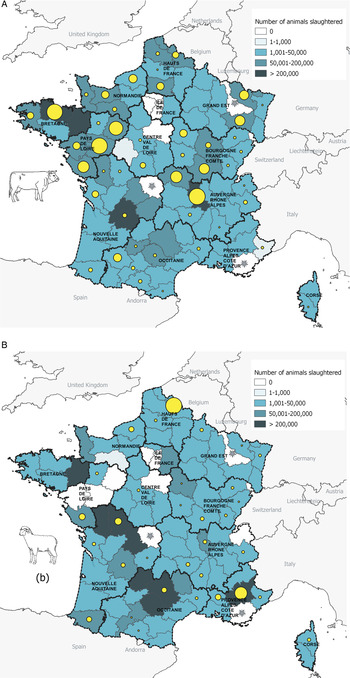
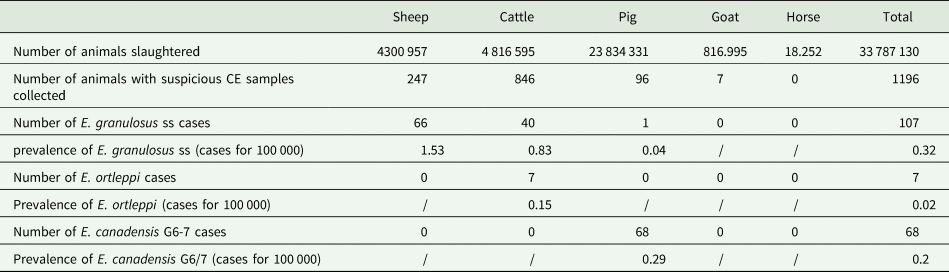
For the year 2012, 33.7 million livestock animals were slaughtered in France, mostly pigs (71%), then cattle (14%) and sheep (13%), and proportionally very few goats and horses (Table 1). In all, 1237 suspected hydatid cysts were sampled originating from 1196 animals (liver and lung samples were sometimes collected from the same animal): mostly cattle (71%) but also sheep (20%), and pigs (8%). Less than 1% came from goats and none from horses. The majority of the cysts were from the liver (92.6%), 6.9% from the lungs and 0.5% from other organs of the abdominal cavity. The samples were collected in 94 of the 267 slaughterhouses located in 57 of the 96 French Departments, with 61% of the samples coming from ten Departments, which represent 26% of the livestock sent to the slaughterhouse, all species combined. The distribution of cattle samples is similar to that of the cattle population (Fig. 1a). However, no sheep samples were received from Departments where high numbers of sheep are slaughtered (Fig. 1b). Concerning pigs, even though they are bred across the country, only six Departments provided samples including the two Corsican Departments, with 87% of the samples collected. After molecular diagnosis, 14% of the suspected cyst samples were confirmed to be due to E. granulosus sl. Three different parasitic species from this complex were identified: E. granulosus ss in sheep, cattle and pigs, E. ortleppi in cattle, and E. canadensis G6/G7 in pigs. No E. granulosus sl cases were found in goats and horses.
Number per Department of cattle (a) and sheep (b) slaughtered and sampled during the study. The number per Department of slaughtered animals is presented by groups (see legend on the figures). For sampling, the size of the circles is proportional to the number of samples collected per department. The Regions of France are indicated by black lines, and their names are given. The Departments (infra-administrative units within the regions) are indicated by grey lines.

National data concerning the official slaughter of livestock in France in 2012 and results of molecular diagnosis of E. granulosus sensu lato cases during the national surveillance at the slaughterhouse

Epidemiology of E. granulosus sensu stricto
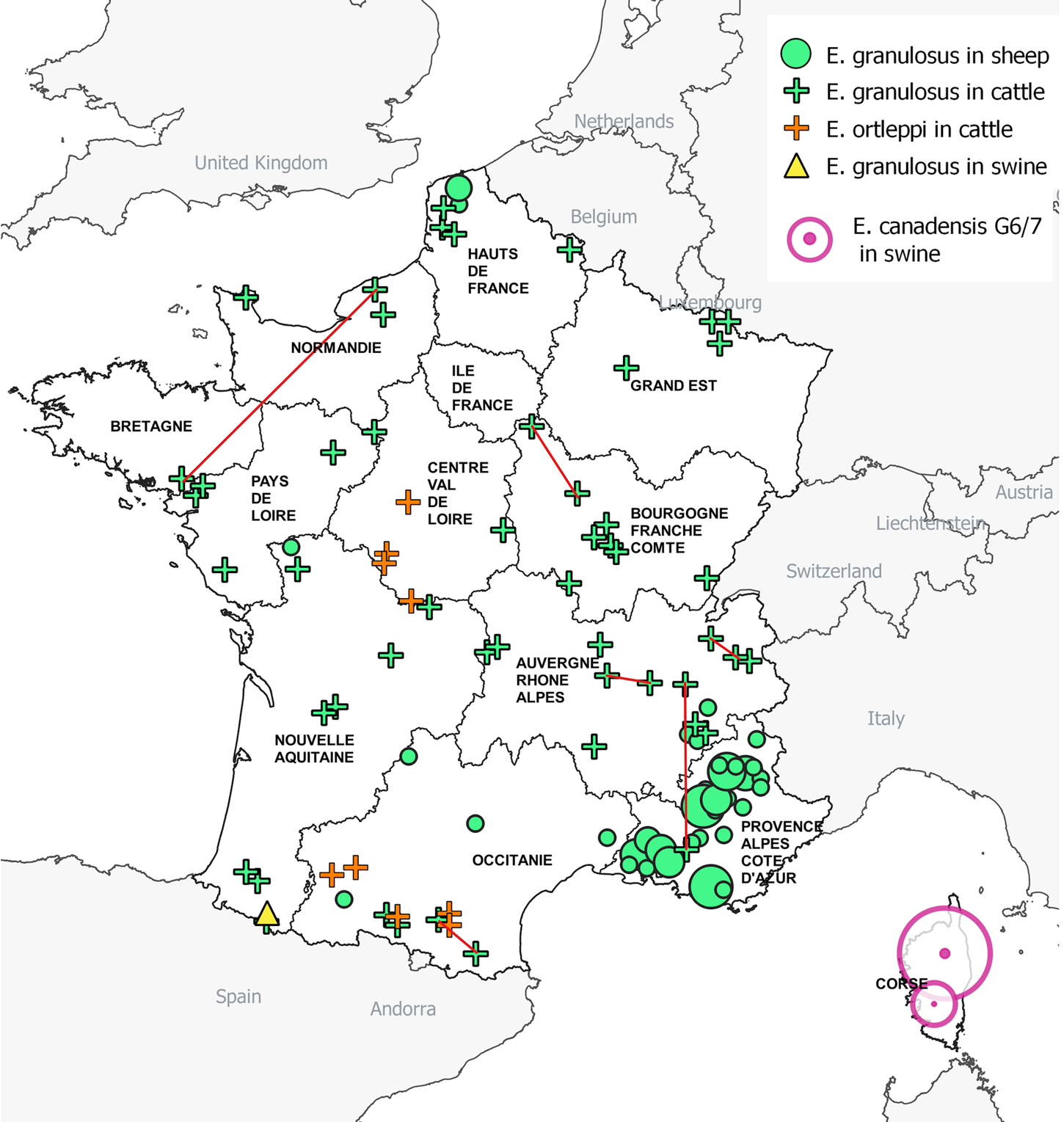
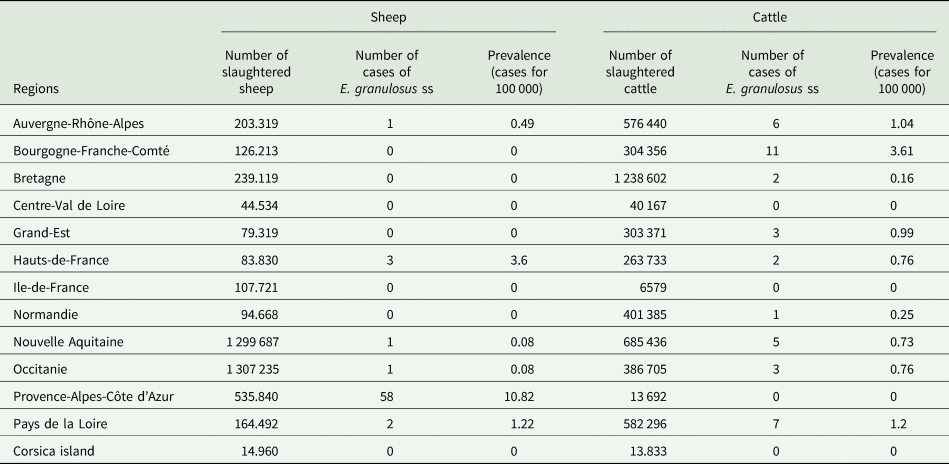
The prevalence of E. granulosus ss in sheep at the national level was 0.002% (1.53 cases per 100 000) (Table 1). Infected sheep were identified in five different regions and were slaughtered in six regions (Fig. 2). A total of 74% were slaughtered in the Provence-Alpes-Côte d'Azur region in the southeast, with a regional prevalence of 10.82 cases per 100 000 (Table 2). In the other infected regions, there were only one to three infected sheep. Ten farms had two infected sheep or more, with a maximum of seven infected animals on two farms. More than half of the infected sheep (58%) had hydatid cysts in both the liver and lungs, and three animals exhibited infection only in the lungs. A total of 42% of infected sheep exhibited fertile cysts.
Location of the farm (centroid of the commune) where sheep, cattle or swine found infected by E. granulosus sl, E. ortleppi or E. canadensis G6/7. For sheep, the size of the dots are proportional to the number of animals found infected by farm. For E. canadensis G6/7 in Corsica, the circles are located on the centroid of the Departments as we had not more details on the origin of swine. The red lines indicate a movement of a same animal between two farms.

Number of cases and slaughterhouse prevalence of E. granulosus sensu stricto in sheep and cattle at the regional level based on the location of the slaughterhouse

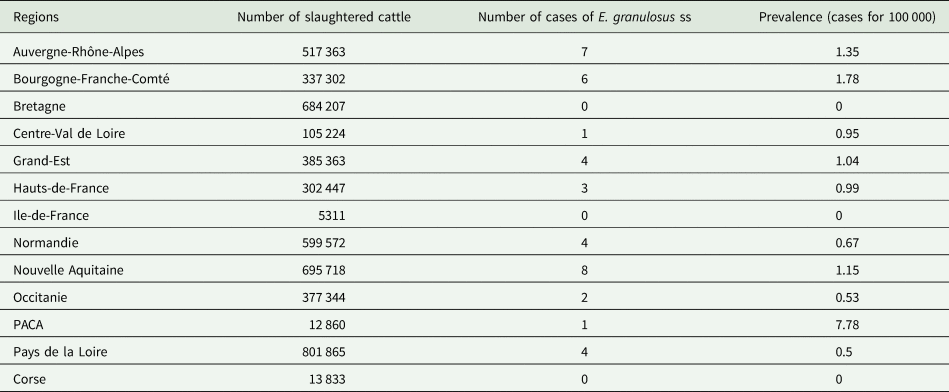
In cattle, the prevalence of E. granulosus ss at the national level was 0.001% (0.83 cases per 100 000) (Table 1). The presence of E. granulosus ss in cattle was described in ten of the 13 regions according to the data based on the place of breeding, with no difference in prevalence at the regional level (Table 3). Only very minor differences were observed using data based on the slaughterhouses or the breeding region (Tables 2 and 3). The 40 infected cattle appeared to be relatively evenly distributed across the country (Fig. 2). Hydatid cysts concerned mainly the liver (83%), with no observation of concomitant infection in both the liver and lungs. The fertility rate was extremely low (5%), with protoscoleces observed in only two individuals (one in the liver and one in the lungs). Five infected cattle were less than 2 years old, including three calves less than 6 months old.
Number of cases and slaughterhouse prevalence of E. granulosus sensu stricto in cattle at the regional level based on the breeding region

Only one pig (Table 1), bred on a farm in the Nouvelle Aquitaine region in the southwest, was found to be infected by E. granulosus ss (P = 0.04 cases per 100 000 pigs in Nouvelle-Aquitaine). Multiple CE cysts were observed in this animal in both the liver and lungs, but without protoscoleces.
The first identification of E. ortleppi
While no data on the presence of E. ortleppi were available for France, seven cases of E. ortleppi were found in cattle, indicating a national prevalence of 0.0002% (0.15 cases per 100 000 cattle) (Table 1). Four cases originated from the Centre-Val-de-Loire region (Centre of France) (P = 1 case per 100 000 cattle), and three others in the Pyrenean part of Occitanie (P = 7.5 cases per 100 000 cattle) (Fig. 2). The distance between the farms of origin of two positive animals was very small in two cases (2 and 10 km). Hydatid cysts were observed only in the lungs and with a high fertility rate (86%; protoscoleces were observed in cysts of six of the seven infected animals).
Echinococcus canadensis G6/G7 in Corsica
The E. granulosus species E. canadensis G6/G7 was found only in pigs (n = 68) from Corsica, with a regional prevalence of almost 1% (882 cases per 100 000 pigs) (Fig. 2). Hydatid cysts were reported exclusively in the liver, with a fertility rate of 47%.
Discussion
The previous national survey on E. granulosus sl in France dates back more than 20 years (Soulé et al., Reference Soulé, Fabien and Maillot1989), but the results of recent regional surveys have pointed to continued circulation of E. granulosus species (Umhang et al., Reference Umhang, Richomme, Boucher, Hormaz and Boué2013, Reference Umhang, Richomme, Hormaz and Boucher2014). It was therefore considered necessary to identify the current endemic areas, and to estimate the prevalence of the different species in the E. granulosus complex at a national level, but also at the regional level. The present study is the first in Europe to combine a national level study with systematic molecular diagnosis.
The three parasitic species of E. granulosus sl found in the present study are maintained through three different lifecycles that involve different livestock species as the main intermediate hosts (McManus, Reference McManus2013). Because of the distribution pattern of farms with infected sheep and cattle that we observed, the entire country must be considered endemic for E. granulosus ss. The prevalence observed here is similar to that obtained 2 years before in the south of the country in similar sampling conditions (Umhang et al., Reference Umhang, Richomme, Boucher, Hormaz and Boué2013). However, the prevalence is relatively low compared to that observed in 1989 (Soulé et al., Reference Soulé, Fabien and Maillot1989), probably mainly due to significant progress made in the health status of farms, and the amendment of laws concerning the slaughter of livestock. We also cannot rule out a selection bias during sampling: differences in the level of awareness of slaughterhouse workers, the training of veterinary inspectors and the rhythm of slaughter may have led to heterogeneity of sampling, resulting in an underestimation of the prevalence of E. granulosus ss in some regions, especially in sheep.
The current distribution of E. granulosus ss in sheep in the southeast of France corresponds partially to the distribution described in the Alps 20 years ago. The second historical focus in the southwest, in the Pyrenees Mountains, seems to have completely disappeared. The difference in flock management may explain the persistence of the parasite in the Alpine area, where transhumance is characterized by high levels of mixing of animals from various departments, while only transhumance within each Department occurs in the Pyrenees (Bichet and Dorchies, Reference Bichet and Dorchies1998). Even though several cases in sheep were recorded outside the southeast of France, the pattern of distribution of E. granulosus ss in sheep does not correspond with the pattern of infection in cattle, since cases in cattle are found throughout the country. The distribution of the parasite in cattle does not show any clusters of infection, while in 1989, cases were mainly located in the west and north of the country. Cattle are not considered to contribute to the lifecycle of E. granulosus ss in Europe due to the very low fertility rate generally observed (Cardona and Carmena, Reference Cardona and Carmena2013), and also reported in the present study. Cattle constitute a sentinel species of the presence of the parasite in areas where no cases were found in sheep, even though sheep are essential for the persistence of the parasite. This absence of reported cases in sheep close to the infected cattle may be explained by a sampling bias at the slaughterhouse, and/or by home slaughtering, which is allowed only for consumption by a family.
The previous national survey reported high prevalence in pigs in the centre of France and in the south. Here, we report only one case of E. granulosus ss in pigs, which appears to indicate a currently insignificant role of pigs in the transmission of this parasite species in France, probably due to the indoor intensive farming practices that are mostly used.
Unlike E. granulosus ss, the lifecycle of E. ortleppi in Europe is exclusively based on the consumption by dogs of infected lungs from cattle (Romig et al., Reference Romig, Dinkel and Mackenstedt2006). The very close proximity of certain infected farms in the two foci argues for regular access to viscera from cattle for some dogs. Home slaughtering of cattle is prohibited in France but cannot be ruled out. Another possibility for a dog to become infected is through access to bovine viscera before the rendering of cattle. To investigate the actual sources of infection in dogs, further local surveys interviewing farmers would be needed. Importantly, this report constitutes the first description of E. ortleppi in animals in France. It should be noted that two human cases were reported in the same period (Grenouillet et al., Reference Grenouillet, Umhang, Arbez-Gindre, Mantion, Delabrousse, Millon and Boué2014), but they did not originate from the same areas as infected cattle. The previous presence of E. ortleppi cases in cattle is probable, but the absence of any accurate diagnosis of the species among cases prevents us from making any robust assumptions. This species was previously considered very rare in Europe and in the process of becoming extinct, as a result of fewer opportunities for transmission between cattle and dogs (Romig et al., Reference Romig, Dinkel and Mackenstedt2006). The use of molecular diagnosis to characterize infections in humans and in cattle in France could help to determine whether some human cases are associated with the persistence of the parasite in cattle (Basmaciyan et al., Reference Basmaciyan, Burlet, Ramla, Blot, Mahy, Aubriot-Lorton, Valot, Grelat, Sautour, Grenouillet, Knapp, Millon, Piroth, Martin and Dalle2018).
No infections by E. canadensis G6/G7 were reported in mainland France; the presence of this parasite was restricted to Corsica where only pigs are found infected by this species. Free-ranging practices in Corsica and home slaughtering are certainly the most important factors to explain the current presence of this species on the island. The high prevalence reported 2 years ago in pigs and wild boars (Umhang et al., Reference Umhang, Richomme, Hormaz and Boucher2014), and in the present study in pigs, argue for a highly contaminated environment. The absence of data for pigs in Corsica in the previous national survey unfortunately prevents any retrospective evolution of the epidemiological situation. No cases of E. granulosus ss were found in pigs in Corsica in the present study, nor in dogs (Grech-Angelini et al., Reference Grech-Angelini, Richomme, Peytavin de Garam, Boucher, Maestrini, Grenouillet, Casabianca, Boué and Umhang2019), but its presence at low prevalence cannot be ruled out because of the proximity of Sardinia, where the parasite is highly endemic (Varcasia et al., Reference Varcasia, Canu, Lightowlers, Scala and Garippa2006).
The findings of this national survey concerning E. granulosus sl at the slaughterhouse are of particular interest due to the zoonotic risk associated with the presence of the parasites. Importantly, systematic control of these parasites at the slaughterhouse should enable their elimination. Human CE cases have likely been underestimated in the past because of the lack of diagnostic tools, and infection is often considered to be acquired almost exclusively abroad. The current presence of the parasites in livestock, with a wide spatial distribution but also some clusters particularly in sheep, raises the question of the proportion of autochthonous CE cases. The data found in the present study, as well as the recent extension of the National Reference Centre's mandate to reference human cases of CE (as the centre does for human cases of alveolar echinococcosis), open new perspectives in the characterization of the epidemiological links between human and animal cases, and in assessing the zoonotic impact of E. granulosus sl in France.
Acknowledgements
The authors thank all the officers in charge of slaughterhouse meat inspection for the collection of samples. We also thank Carole Sala (ANSES) for providing cattle data from the national identification database.
Financial support
The French Directorate General for Food (DGAL) funded sample collection and molecular analysis.
Conflict of interest
None.
Ethical standards
None