For the western Mediterranean region, 110 exotic species have been registered, most of them being thermophilic species originating from tropical seas (Galil, Reference Galil2008). The most recent case of an alien species in the western Mediterranean is Percnon gibbesi (H. Milne-Edwards, 1853). It is a small crab belonging to the family Plagusiidae with a subtropical distribution, ranging from California to Chile, Florida to Brazil, and Madeira to the Gulf of Guinea (Manning & Holthuis, Reference Manning and Holthuis1981). Its first Mediterranean record came from Linosa Island (Italy) in 1999 (Relini et al., Reference Relini, Orsi, Puccio and Azzurro2000), and subsequently it has been recorded in the Balearic Archipelago and the northern Spanish coast (Garcia & Reviriego, Reference Garcia and Reviriego2000; Müller, Reference Müller2001; Deuderó et al., Reference Deuderó, Frau, Cerdá and Hampel2005), Sardinia, Tyrrhenian Sea, Sicily and Malta (Pipitone et al., Reference Pipitone, Badalamenti and Sparrow2001; Mori & Vacchi, Reference Mori and Vacchi2002; Sciberras & Schembri, Reference Sciberras and Schembri2007). More recently, it has been discovered in Greek waters (Cannicci et al., Reference Cannicci, Garcia and Galil2006; Thessalou-Legaki et al., Reference Thessalou-Legaki, Zenetos, Kambouroglou, Corsini-Foka, Kouraklis, Dounas and Nicolaidou2006), Turkey (Yokes & Galil, Reference Yokes and Galil2006), Lybia (Elkrwe et al., Reference Elkrwe, Elhawaj, Galil and Ben Abdallah2008) and Taranto Gulf (Ionian Sea, Italy) (Crocetta & Colamonaco, Reference Crocetta and Colamonaco2008). The origin of P. gibbesi is attributed to Atlantic waters (Abelló et al., Reference Abelló, Visauta, Bucci and Demestre2003) and both natural dispersal through larval drift and adult movements (Pipitone et al., Reference Pipitone, Badalamenti and Sparrow2001; Abelló et al., Reference Abelló, Visauta, Bucci and Demestre2003; Elkrwe et al., Reference Elkrwe, Elhawaj, Galil and Ben Abdallah2008) and/or incidental transport through commercial and recreational vessels (Mori & Vacchi, Reference Mori and Vacchi2002; Cannicci et al., Reference Cannicci, Garcia and Galil2006) could be responsible for the rapid dispersal of P. gibbesi. According to Cannicci et al. (Reference Cannicci, Garcia and Galil2006), shipping transport appears to be an important second vector, acting on dispersal of alien species beyond the first location of introduction. Furthermore, when distribution patterns of the eurythermal P. gibbesi is compared with other alien temperate grapsoid species, it is possible that Mediterranean rising temperature values, registered over the last few years, could have given an advantage to the fast spread of P. gibbesi (Zaouali et al., Reference Zaouali, Souissi, Galil, d'Udekem d'Acoz and Ben Abdallah2007).
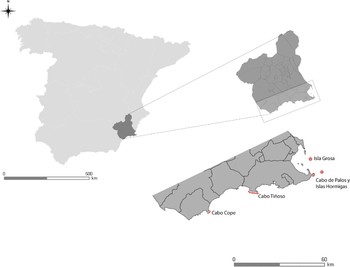
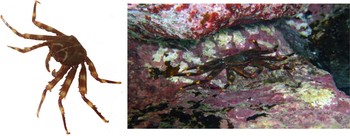
Here we enlarge the distributional range of P. gibbesi south into the Iberian Peninsula, western Mediterranean. Individuals of P. gibbesi have been observed at various sites during snorkelling and dive assessments along the coast of Murcia (Spain) (Figure 1). Observation sites comprise Cabo de Palos region and Isla Grosa, including the Cabo de Palos–Islas Hormigas Marine Reserve (37°38′N 0°42′W) which includes a no-take zone. It has been also recorded southwards at Cabo Tiñoso and Cabo Cope rocky coasts (Figure 1). All observations were done between spring and summer of 2009, around 1–3 m deep, where specimens were found mainly on rock boulders hideouts. Based on frequency classification of Humann & DeLoach (Reference Humann and DeLoach2002) the species could be categorized as common according to the frequency of encounters. In addition, photographs were taken to check species validity and are also provided here (Figure 2).
Murcia coast (Spain) and location of sites where Percnon gibbesi was found.

Percnon gibbesi photographed at Cabo de Palos coast (left) and Cabo Cope (right), Murcia, Spain.

In their review on the status of Marine Protected Areas (MPA) in the Mediterranean Sea, Abdulla et al. (Reference Abdulla, Gomei, Maison and Piante2008) outlined that, although P. gibbesi was registered by six different Mediterranean MPA managers, they agreed that its presence in a given MPA represents a negligible risk for environmental health. However, the fast expansion achieved in the past six years in Mediterranean waters, reaching densities of 1.5 ± 0.5 to 11.9 ± 7.1 ind m−2 (Sciberras & Schembri, Reference Sciberras and Schembri2007), is promoted by its ability to occupy disturbed areas (Cannicci et al., Reference Cannicci, Garcia and Galil2006) and to resist changes of temperature (Calado, Reference Calado2006). Percnon gibbesi occurs along rocky shores and in the subtidal zone, among boulders covered by algae. It is an herbivorous species feeding on both hard and soft algae and microzooplankton (Galil et al., Reference Galil, Froglia, Noël and Briand2002). Puccio et al. (Reference Puccio, Relini, Azzuro and Orsi Relini2006) suggest that the feeding behaviour of P. gibbesi could give it an advantage over other similar species, by allowing the invasive species to explore a broader feeding niche. On the other hand, the fast rate of population establishment of P. gibbesi is likely due to its high fecundity, long larval life span, and the occurrence of large megalopa larvae that produce robust juveniles (Crocetta & Colamonaco, Reference Crocetta and Colamonaco2008; Elkrwe et al., Reference Elkrwe, Elhawaj, Galil and Ben Abdallah2008). Together, these biological characteristics may enhance the competitive capacity of P. gibbesi, resulting in the most invasive decapod species in the Mediterranean Sea (Zaouali et al., Reference Zaouali, Souissi, Galil, d'Udekem d'Acoz and Ben Abdallah2007). This could cause the displacement of autochthonous species such as Pachygrapsus marmoratus Fabricius, 1787, and should be cautiously assessed in selected localities along its geographical distribution ranges.
The number of alien species registered in the Mediterranean Sea have been increasing over the last few decades, possibly caused by a number of factors—pollution, eutrophication, destruction and fragmentation of habitats, fisheries overexploitation, fast-expanding mariculture, enlargement of the Suez Canal, increase in maritime traffic, and climate change—that could be acting in a complex and synergistic form (Galil, Reference Galil2008). Continued anthropogenic impact over the ecosystem could change the Mediterranean fauna completely, replacing existing species by new exotic ones. Therefore, it is highly recommended that specific management measures should be produced in order to prevent such catastrophes.
For P. gibbesi its eurythermic capacity, cleaning function, colourful body, together with ‘reef-safe’ (not harmful to other organisms in an aquarium) characteristics, make it a widely commercialized species at Portuguese aquarium shops reaching values of 6–8 Euros ind−1 (Calado, Reference Calado2006). This may give a cue to a potential harvesting activity as a useful management tool to control the spread of this invasive species.