Neurobiological systems that regulate responses to stress have pervasive influences on physical and mental health (Heim, Entringer, & Buss, Reference Heim, Entringer and Buss2019; McEwen, Reference McEwen2012). When confronted with environmental challenges, activation of the hypothalamic–pituitary–adrenal (HPA) axis and sympathetic nervous system (SNS) mobilizes energetic resources to facilitate adaptation to changing environmental conditions, including stressors. Acute stress reactivity promotes survival and adaptation, yet there are large individual differences in stress response function that correspond to individual differences in physical and mental health outcomes (Loman & Gunnar, Reference Loman and Gunnar2010; McEwen, Reference McEwen2008). In the current study, we examine the associations of both early and later environmental experiences with stress reactivity during early adolescence, a period of significant neurobehavioral change and heightened risk of psychopathology (Dahl & Gunnar, Reference Dahl and Gunnar2009). In particular, we examine associations of caregiving quality and stressful life events (SLEs) during early adolescence (age 12 years) with physiological reactivity to social stress in a sample of children with and without exposure to early-life deprivation (i.e., institutional rearing). The primary goal is to examine the interactive effects of early and later experience on stress reactivity, thereby improving our understanding of ways in which environmental experiences get “under the skin” to impact psychobiological development.
Early Life Adversity and Stress Responsiveness
Early-life adversity has strong influences on stress response system development in children (Koss & Gunnar, Reference Koss and Gunnar2018; Reilly & Gunnar, Reference Reilly and Gunnar2019). A particularly extreme form of early adversity is deprivation of parental care associated with institutional rearing. A pattern of blunted stress responsiveness is reliably detected in studies of institutionally reared and neglected children (Bruce, Fisher, Pears, & Levine, Reference Bruce, Fisher, Pears and Levine2009; Gunnar, Frenn, Wewerka, & Van Ryzin, Reference Gunnar, Frenn, Wewerka and Van Ryzin2009; Koss, Hostinar, Donzella, & Gunnar, Reference Koss, Hostinar, Donzella and Gunnar2014; van der Vegt, van der Ende, Kirschbaum, Verhulst, & Tiemeier, Reference van der Vegt, van der Ende, Kirschbaum, Verhulst and Tiemeier2009). This hypo-responsiveness is observed across various stress indices, including lower morning cortisol levels, flatter diurnal rhythms, and lower cortisol reactivity to social stress (see Koss & Gunnar, Reference Koss and Gunnar2018 for a review). Evidence from randomized control trials indicates that the association between institutionalization and blunting of stress reactivity may reflect a causal pathway and early biological embedding (Bernard, Hostinar, & Dozier, Reference Bernard, Hostinar and Dozier2015; Cicchetti, Rogosch, Toth, & Sturge-Apple, Reference Cicchetti, Rogosch, Toth and Sturge-Apple2011; McLaughlin et al., Reference McLaughlin, Sheridan, Tibu, Fox, Zeanah and Nelson2015; Slopen, McLaughlin, & Shonkoff, Reference Slopen, McLaughlin and Shonkoff2014). However, early adolescent exposure to both positive (high-quality caregiving) and negative (SLEs) experiences may moderate the impact of institutional rearing on stress responsiveness. In the current study, we leverage data from an ongoing longitudinal randomized controlled trial of foster care for institutionally reared children to examine how these later experiences operate alongside early experience in shaping neuroendocrine and autonomic nervous systems in early adolescence.
Caregiving Quality as a Moderator of Early Life Adversity
Caregiving experiences later in childhood may modulate the impact of early adversity on stress response system development. Several studies in both animals and humans demonstrate that positive parental care serves as a potent buffer of HPA-axis reactivity over the course of development (Hostinar, Sullivan, & Gunnar, Reference Hostinar, Sullivan and Gunnar2014). For those who have experienced early psychosocial deprivation, the buffering effect of high-quality caregiving appears to result in restoration of a typical stress response. Specifically, individuals who spend their early lives in institutions exhibit a blunted response to stress, but this may be alleviated when children are subsequently exposed to high-quality caregiving, manifesting as increased HPA-axis and/or SNS reactivity (McLaughlin et al., Reference McLaughlin, Sheridan, Tibu, Fox, Zeanah and Nelson2015). Results from multicomponent interventions aimed at increasing positive caregiving have shown that foster children in the intervention arm do not show the same flattening of the diurnal cortisol response that is observed among comparison children receiving standard foster care (Fisher, Stoolmiller, Gunnar, & Burraston, Reference Fisher, Stoolmiller, Gunnar and Burraston2007). Similarly, higher caregiver sensitivity is associated with increased cortisol reactivity among post-institutionalized preschool children, suggesting the potential for recalibration of stress system functioning in response to positive caregiving following institutionalization (DePasquale, Raby, Hoye, & Dozier, Reference DePasquale, Raby, Hoye and Dozier2018).
Although high-quality care has the potential to diminish the effects of institutional deprivation, existing research has focused almost exclusively on young children. It is unclear whether caregiving experiences later in development play a similar role in mitigating the lasting effects of early deprivation on stress response system functioning. For instance, during early adolescence, caregivers’ ability to serve as effective social regulators of the HPA-axis appears to be diminished compared to earlier in childhood (Doom, Doyle, & Gunnar, Reference Doom, Doyle and Gunnar2017; Doom, Hostinar, VanZomeren-Dohm, & Gunnar, Reference Doom, Hostinar, VanZomeren-Dohm and Gunnar2015; Hostinar, Johnson, & Gunnar, Reference Hostinar, Johnson and Gunnar2015a). Moreover, social buffering of stress response systems during early adolescence may vary as a function of exposure to early life stress. For instance, Hostinar, Johnson, and Gunnar (Reference Hostinar, Johnson and Gunnar2015b) showed that mothers’ presence did not buffer HPA-axis responses to social stress among post-institutionalized children but did promote buffering in nonadopted children. Similarly, production of oxytocin – a hormone that regulates stress responses – does not increase following maternal contact among post-institutionalized children but does increase in nonadopted children (Fries, Ziegler, Kurian, Jacoris, & Pollak, Reference Fries, Ziegler, Kurian, Jacoris and Pollak2005). In the current study, we hypothesized that institutionally reared children would demonstrate a persistently blunted response to social stress regardless of the level of caregiving quality at age 12. Conversely, we expected never-institutionalized children to show a more adaptive stress response in the context of higher caregiving quality. We operationalized an adaptive response as one in which HPA-axis and SNS reactivity are elevated in response to social stress. This is consistent with the Adaptive Calibration Model of stress responsivity (Del Giudice, Ellis, & Shirtcliff, Reference Del Giudice, Ellis and Shirtcliff2011), and empirical evidence of increased cortisol reactivity as positive caregiving increase for those without a history of early adversity (e.g., Hackman et al., Reference Hackman, Betancourt, Brodsky, Kobrin, Hurt and Farah2013; Shirtcliff, Skinner, Obasi, & Haggerty, Reference Shirtcliff, Skinner, Obasi and Haggerty2017).
Stressful Life Events as a Moderator of Early Life Adversity
In addition to caregiving quality, SLEs occurring later in development have been shown to exert an effect on stress physiology and may interact with early experience to shape stress response system development. In particular, SLEs at different periods of development are linked to altered stress system functioning, with adversities occurring in the (pre)adolescent period related to the same blunted response to social stress that is observed among those who have experienced institutional care (Bosch et al., Reference Bosch, Riese, Reijneveld, Bakker, Verhulst, Ormel and Oldehinkel2012). Moreover, Mazurka, Wynne-Edwards, and Harkness (Reference Mazurka, Wynne-Edwards and Harkness2016) showed that SLEs in the three-month period preceding the onset of depression are associated with blunted cortisol reactivity in response to social stress. The combination of early and later adversity may be particularly noxious. For instance, Jaffee and colleagues (Reference Jaffee, McFarquhar, Stevens, Ouellet-Morin, Melhuish and Belsky2015) showed that the lowest levels of cortisol reactivity were observed among individuals who experienced both recent stress in addition to harsh, nonresponsive parenting early in childhood. Among those with this double-hit of early and later adversity, low cortisol reactivity was associated with higher levels of internalizing and externalizing problems. On the basis of these findings, we anticipated that early exposure to institutional deprivation in combination with later SLEs would be associated with greater blunting of the HPA-axis and SNS. This is consistent with models of stress sensitization, which posit that early adversity sensitizes individuals to subsequent proximal stress, ultimately increasing risk for psychopathology (e.g., McLaughlin et al., Reference McLaughlin, Kubzansky, Dunn, Waldinger, Vaillant and Koenen2010). Recent evidence suggests that it is the combination of early life stress and current stress, rather than current stress alone, that predicts flatter diurnal cortisol slopes in adulthood (Young et al., Reference Young, Farrell, Carlson, Englund, Miller, Gunnar and Simpson2019). On the other hand, we did not expect to observe the same degree of HPA-axis and SNS blunting when SLEs were low or when children were not exposed to institutional deprivation. In other words, it was the joint impact of early institutional rearing and later SLEs that we predicted would be associated with blunted stress reactivity in early adolescence.
The current study
In the current study, we examined how caregiving quality and recent SLEs in early adolescence interact with exposure to early life deprivation to shape patterns of stress reactivity at age 12 years. In this study, HPA-axis and SNS reactivity to social stress were measured in three groups of children: a group of children who spent their early lives in institutions but who were then randomly assigned to leave the institutions for family-based foster care (foster care group); a group of children who were randomly assigned to usual care – which in this case meant prolonged institutional care (care-as-usual group); and a comparison group of never-institutionalized children who were reared in their biological families (never-institutionalized group). With respect to the moderating role of caregiving quality, one possibility is that early placement into family-based care facilitates the beneficial effects of later high-quality caregiving on stress functioning. If this were the case, we would expect the HPA-axis and SNS response of the foster care children to be elevated at high levels of later caregiving quality compared to children who experienced prolonged institutional care. In contrast, it is possible that the profound deprivation experienced by the foster care group during early childhood may have programmed stress system functioning to an extent that is not amenable to later positive caregiving.
For SLEs, a similar development-enhancing effect may be observed such that early placement into foster care in combination with lower stress exposure later in development together fosters the development of a more normative pattern of stress reactivity compared to children with prolonged institutional care. Again, however, it is possible that the degree of early deprivation experienced by the children in foster care may engender long-term blunting that is not altered by the extent of later SLEs.
To test these possibilities, the current study examined the interaction between early and later experience on HPA-axis and SNS reactivity across two sets of analyses. In the first model, we examined the interaction between institutional deprivation and later experience (i.e., caregiving quality and SLEs). This model permits an evaluation of how later experience moderates the effect of early psychosocial deprivation on stress reactivity. The second model examined the interaction between foster care versus care-as-usual and later experience. Given that both the foster care and the care-as-usual children experienced institutional care but differed on their exposure to family-based care thereafter, this model permits an evaluation of whether, and to what extent, later experience (caregiving quality and SLEs) is associated with stress reactivity among those randomized to prolonged deprivation versus early social enrichment.
Method
Participants
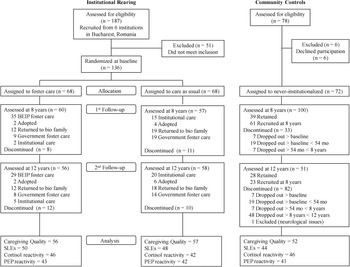
Participants were youth from the Bucharest Early Intervention Project (BEIP), a longitudinal randomized controlled trial (RCT; clinicaltrials.gov identifier: NCT00747396) of high-quality foster care for children living in institutions in Bucharest, Romania. The study commenced in April 2001. At the time the study began, 136 children aged 6–31 months who had lived in Romanian institutions for at least half their lives underwent baseline assessments. Half of these children (n = 68) were randomly assigned to receive care-as-usual, which often meant remaining in the institutions, and the other half (n = 68) were randomly assigned to be placed into high-quality foster homes with families that received training and ongoing support from local social workers, psychologists, and pediatricians in Romania. Randomization was achieved by drawing names from a hat. By design, the intervention ended at 54 months; however, these two groups were followed longitudinally, with the current study presenting data from the age 12-year assessment (see Figure 1, CONSORT flow diagram of participant enrollment/exclusion and study design). Throughout the study, a noninterference policy was adopted. Thus, while most care-as-usual children remained in institutional care through 54 months, many were removed from institutional care at some point by the 12-year assessment. A group of age- and gender-matched youth who had never experienced institutional care (n = 72) were recruited from Bucharest, Romania, to serve as a comparison group (never-institutionalized group). All data from the current study come from the 12-year follow-up.
CONSORT flow diagram showing group assignment and data available across variables included in the present analysis for the foster care group, care-as-usual group, and never-institutionalized group.

Measures
Stress reactivity task
At age 12 years, participants completed the Trier social stress test (TSST). The TSST involves three periods. First, participants were told that they would be delivering a speech in front of teachers who will judge their performance. They were then given 5 minutes to prepare their speech. Participants were also told that their speech will be videotaped and evaluated by experts at a later time. Participants were asked to talk about the qualities of a good friend and which of those characteristics they did or did not possess. Second, participants delivered a 5-minute speech in front of two evaluators. The evaluators were trained to provide neutral and mildly negative feedback during the speech (e.g., appearing bored). If participants were unable to speak for the full 5 minutes, they were first prompted to continue speaking. If they were again unable to continue, the evaluators asked a series of standardized questions (e.g., “what makes you a particularly good friend?”) until the 5 minutes was completed. Finally, participants completed a mental subtraction task aloud in front of the evaluators for 5 minutes. Participants were asked to count backwards in steps of seven from a three-digit number and were stopped and asked to start again each time they made a mistake. If participants were unable to do the mental subtraction (i.e., did not get more than two answers correct within the first minute), experimenters gave them an easier mental subtraction task involving counting backwards by three from a smaller number. After the TSST, participants completed a 5-minute recovery period.
HPA-axis reactivity
HPA-axis function was assessed by assaying cortisol from saliva samples taken at baseline (i.e., 30 minutes after arriving to the laboratory setting) and approximately 20 minutes after the part of the TSST that is associated with peak physiological and emotional reactivity (i.e., the speech portion of the task). As described in McLaughlin et al. (Reference McLaughlin, Sheridan, Tibu, Fox, Zeanah and Nelson2015), saliva samples were obtained with cryovial tubes (Immuno-Biological Laboratories [IBL]) using the drool method. Participants expectorated ~1.5 mL of saliva into a cryovial with a plastic straw. Saliva samples were stored immediately at −20 °C until they were shipped on dry ice to a laboratory in Boston. Samples were assayed for cortisol using commercially available luminescence immunoassay kits (CLIA; IBL). Intra-assay and inter-assay coefficients of variance were acceptable (5.11% and 5.37%, respectively). The standard range of cortisol values that can be detected with the cortisol immunoassay used here is 0–110 nmol/L. The range of cortisol values in our sample was 1.37–18.77 nmol/L at baseline and 2.19–39.35 nmol/L at the post-TSST assessment. HPA-axis reactivity was measured by taking the difference between the natural log of cortisol levels measured post-TSST and at baseline. Higher values reflect greater HPA-axis/cortisol reactivity.
SNS reactivity
Electrocardiogram (ECG) recordings were obtained via a Biopac ECG amplifier using a modified Lead II configuration (right clavicle, left lower torso, and right leg ground). As described in McLaughlin et al. (Reference McLaughlin, Sheridan, Tibu, Fox, Zeanah and Nelson2015), cardiac impedance recordings were obtained with a Bio-Impedance Technology model HIC-2500 impedance cardiograph. One pair of mylar tapes encircled the neck and another pair encircled the torso. A continuous 500-μA AC 95 kHz current was passed through the two outer electrodes, and basal thoracic impedance (z0) and the first derivative of basal impedance (dz/dt) was measured from the inner electrodes. A Biopac MP150 integrated the ECG and impedance cardiography (ICG) signals, sampled at 1.0 kHz, using Acqknowledge software. ECG and ICG data were scored by raters unaware of group status. Signals were averaged into 1-minute epochs using Mindware Software (Mindware Technologies). SNS activity was measured by the pre-ejection period (PEP), which represents the amount of time that elapses from the beginning of ventricular depolarization to the opening of the aortic valve (electrical systole). PEP was calculated based on the ECG and ICG signals. The Q onset in the ECG and the B onset in the ICG were placed using validated automated scoring algorithms (Berntson, Lozano, Chen, & Cacioppo, Reference Berntson, Lozano, Chen and Cacioppo2004; Lozano et al., Reference Lozano, Norman, Knox, Wood, Miller, Emery and Berntson2007). These were visually inspected to ensure accurate placement and adjusted if needed. Stroke volume (SV) was estimated from the dz/dt signal, providing an estimate of the amount of blood ejected from the heart on each cardiac cycle. SNS reactivity was measured by changes in PEP from baseline to the speech portion of the TSST, as with cortisol above. Here, lower PEP values reflect greater SNS reactivity to social stress.
Caregiving quality
Caregiving quality during early adolescence was assessed by rating the caregiving placements of youth by study staff in Romania, most of whom have worked with the children for many years and some since the beginning of the study. Ratings were based on information about whether or not the child was living in a family, how stable the family placement was, and the quality of the caregiving environment. We focus on caregiving quality at 12 years, concurrent with our assessment of stress reactivity. Two BEIP staff members who were familiar with the child's family during at the time of assessment independently rated the quality of caregiving the children received. Ratings were based on numerous hours of contact with the families including observations during and in-between procedures at lab visits. The scale was as follows: (1) Dangerous (i.e., environment that constantly fails to meet at least one basic need [e.g., adequate shelter and food, constant care from at least one preferred caregiver, etc.]. Strong suspicion of maltreatment); (2) Unacceptable (i.e., physical needs may be met, although occasional lapses occur. Caregivers fail constantly in providing emotional care for the child. Nonindividualized, instrumental and/or regimented care may be present); (3) Marginal (i.e., physical needs are generally met, although some may be at minimal levels. Emotional needs are not consistently met. A preferred caregiver is at least sometimes available for the child. Overall, the child does not lack basic protection and support, although significant deficiencies are notable); (4) Mixed (i.e., a reasonably good living environment is evident with regard to physical comfort provided to the child. Care is generally available at satisfactory levels, although the caregiver's behaviors and relationship with the child are sometimes marked by significant problems [e.g., instances of harsh parenting, lack of support, non-constructive ways of dealing with conflicts, etc.]); (5) Acceptable (i.e., physical and emotional needs are met consistently. Child feels adequately safe, secure and cared for. Good caregiver–child relationship with minimal discord and good strategies put in place by the caregiver for overcoming problems). Independent raters demonstrated excellent inter-rater reliability (ICC=0.93). The scores from the two raters were averaged to form a caregiving quality scale ranging from 1 to 5.
Stressful life events
At age 12 years, youth self-reported on the presence/absence of up to 30 life events that happened to them or members of their family over the past 12 months. As described by Wade et al. (Reference Wade, Zeanah, Fox, Tibu, Ciolan and Nelson2019), the measure is a modified version of Coddington's Child Life Events Scale that was adapted for use in this sample. Example items included: “you failed a grade in school or got bad grades”; “you and your boyfriend/girlfriend had a big fight or broke up”; “your family's house or car was broken into or robbed”; and “you had a serious accident or illness and were in the hospital.” The variable was significantly right-skewed, with only 8.5% of the sample (n = 12) reporting between 8 to 12 (the maximum) events. Thus, we re-scaled the item to reduce this skew by combining children reporting seven or more life events. The distribution on this variable was as follows: 0 = 8.5%; 1 = 19.0%; 2 = 19.7%; 3 = 19.0%; 4 = 7.0; 5 = 8.5; 6 = 7.7; 7+ = 10.6%. The full scale can be found in Wade et al. (Reference Wade, Zeanah, Fox, Tibu, Ciolan and Nelson2019).
Analysis
Two sets of analyses were carried out using Mplus version 7. The first set of analyses examined the main effects of caregiving quality and SLEs, separately, on HPA-axis (cortisol) and SNS (PEP) reactivity at 12 years, as well as the interaction between these variables with early institutional care history (i.e., ever- versus never-institutionalized). This analysis therefore tests whether caregiving quality and SLEs are associated with HPA-axis and SNS reactivity over and above the effects of institutional deprivation (Step 1), and whether the effects of caregiving quality and SLEs vary as a function of children's history of institutional care (i.e., the interaction between early and later experience; Step 2). For caregiving quality in relation to cortisol reactivity and PEP reactivity, there were 134 and 125 youth, respectively, included in the analysis. For SLEs in relation to cortisol reactivity and PEP reactivity, there were 128 and 119 youth, respectively, included in the analysis.
The second set of analyses mirrored the first but focused on children with a history of institutional care (i.e., foster care and care-as-usual children). This analysis tested whether, among those with a history of institutional care, caregiving quality and SLEs are associated with HPA-axis and SNS reactivity (Step 1), and whether such effects vary as a function of whether children experienced prolonged institutional rearing (care-as-usual group) versus early removal and placement into family care (foster care group; Step 2). For caregiving quality in relation to cortisol reactivity and PEP reactivity, there were 88 and 85 youth, respectively, included in the analysis. For SLEs in relation to cortisol reactivity and PEP reactivity, there were 86 and 83 youth, respectively, included in the analysis.
For all analyses presented below, we report unstandardized coefficients with 95% confidence intervals (CI), as well as standardized beta coefficients as a metric of effect size.
Results
Descriptive and preliminary analysis
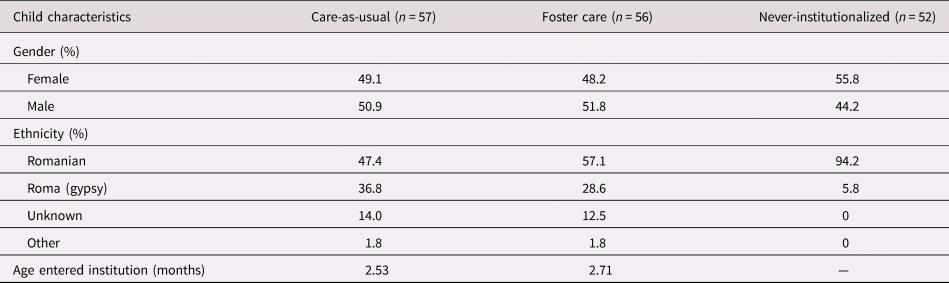
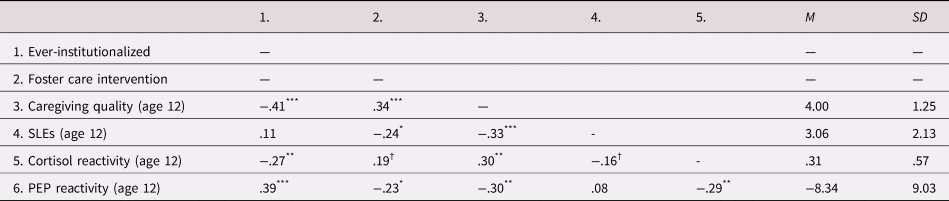
Table 1 shows descriptive statistics of the three study groups, including distributions on gender, ethnicity, and age of entrance into the institutions. Table 2 shows means and standard deviations for the primary variables of interest, as well as bivariate correlations between these variables, collapsed across all study groups.
Demographic characteristics across groups at age 12 years

Descriptive statistics and bivariate correlations between study variables

*** p < .001. **p < .01. *p < .05. †p < .10.
Note. Lower scores on PEP indicate greater reactivity
SLEs – stressful life events; PEP – pre-ejection period
Model 1: Institutional rearing, caregiving quality, and stressful life events
The main effects of institutional rearing on HPA-axis (cortisol) and SNS (PEP) reactivity at age 12 were previously reported in McLaughlin et al. (Reference McLaughlin, Sheridan, Tibu, Fox, Zeanah and Nelson2015). This study showed that children with prolonged institutional care had a blunted HPA-axis and SNS response to social stress compared to never-institutionalized children, and that the children assigned to early foster care had patterns of physiological reactivity that more closely approximated the never-institutionalized children. Here, we report on the effects of caregiving quality and SLEs at age 12 over and above the effects of institutional rearing, and the interaction between caregiving quality/SLEs and institutional rearing on HPA-axis and SNS reactivity.
Main effect of caregiving quality
We examined whether caregiving quality was associated with stress reactivity over and above the effect of institutional deprivation. Caregiving quality was associated with both cortisol and PEP reactivity after controlling for institutionalization, such that higher caregiving quality was associated with greater cortisol reactivity, B [95% CI] = .11 [.02, .19], β = .22, p = .010, and PEP reactivity, B [95% CI] = −1.37 [−2.60, −.15], β = −.18, p = .028.
Main effect of SLEs
We then examined the relation between SLEs and stress reactivity, controlling for the effects of institutional deprivation. There was no main effect of SLE over and above the effects of institutional rearing for cortisol reactivity, B [95% CI] = −.08 [−.19, .03], β = −.14, p = .15, or PEP reactivity, B [95% CI] = .64 [−.83, 2.10], β = .07, p = .40.
Interaction effects
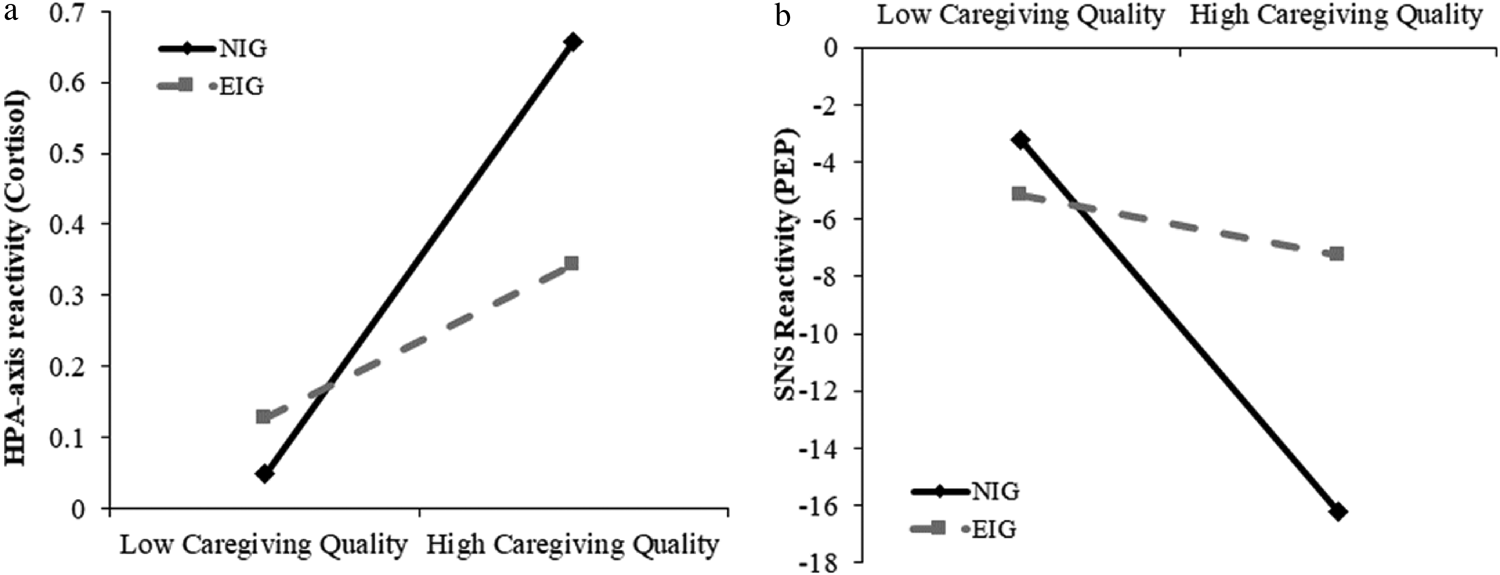
Finally, we examined interactions between institutional rearing and both caregiving quality and SLEs on stress reactivity, controlling for the main effects reported above. For cortisol reactivity, the interaction between institutional rearing and caregiving quality was not significant, B [95% CI] = −.17 [−.37, .04], β = −.30, p = .11 (Figure 2a).Footnote 1 In contrast, for PEP reactivity, there was a significant interaction between institutional rearing and caregiving quality, B [95% CI] = 4.65 [−.88, 8.43], β = .53, p = .016 (Figure 2b). Specifically, for the ever-institutionalized children, PEP reactivity remained low regardless of the level of caregiving quality. For never-institutionalized children, PEP reactivity increased as the level of caregiving quality increased. Simple slope analysis revealed that, at low levels of caregiving quality, the never- and ever-institutionalized children showed a similarly blunted response to social stress. In contrast, at high levels of caregiving quality, the never-institutionalized children showed a significantly greater PEP response to social stress than the ever-institutionalized children.
Interaction plots between caregiving quality and institutional rearing on (a) hypothalamic–pituitary–adrenal (HPA) axis reactivity (i.e., cortisol) and (b) sympathetic nervous system (SNS) reactivity (i.e., pre-ejection period, PEP). Interactions are plotted 1 SD above and below the mean for visual purposes. The interaction between institutional rearing and caregiving quality on SNS reactivity was significant, while a similar but nonsignificant interaction was observed for HPA axis reactivity. NIG = never-institutionalized children; EIG = ever-institutionalized children

There was no significant interaction between SLEs and institutional rearing for cortisol reactivity, B [95% CI] = −.11 [−.37, .15], β = −.16, p = .40 or for PEP reactivity, B [95% CI] = 2.25 [−1.18, 5.69], β = .21, p = .20.
Model 2: Foster care intervention, caregiving quality, and stressful life events
As above, the main effects of the foster care intervention versus care-as-usual on cortisol and PEP reactivity at age 12 were previously reported in McLaughlin et al. (Reference McLaughlin, Sheridan, Tibu, Fox, Zeanah and Nelson2015). Here, we focus on the main effects of caregiving quality and SLEs, and their interaction with early experience, on HPA-axis and SNS reactivity.
Main effect of caregiving quality
We examined whether caregiving quality was associated with stress reactivity over and above the effects of the foster care intervention. For cortisol reactivity, there was a marginal effect of caregiving quality, such that higher caregiving quality was associated with a greater response to social stress, B [95% CI] = .08 [−.01, .16], β = .19, p = .090. For PEP reactivity, there was no main effect of caregiving quality over and above the effects of the intervention, B [95% CI] = −.53 [−1.90, .84], β = −.09, p = .45.
Main effect of SLEs
We then examined the relation between SLEs and stress reactivity, controlling for the effects of the intervention. There was a marginal effect of SLEs on cortisol reactivity, such that more SLEs were associated with a more blunted response to social stress, B [95% CI] = −.10 [−.20, .00], β = −.19, p = .058. In contrast, there was no main effect of SLEs on PEP reactivity over and above the effect of the intervention, B [95% CI] = .87 [−.65, 2.38], β = .12, p = .26.
Interaction effects
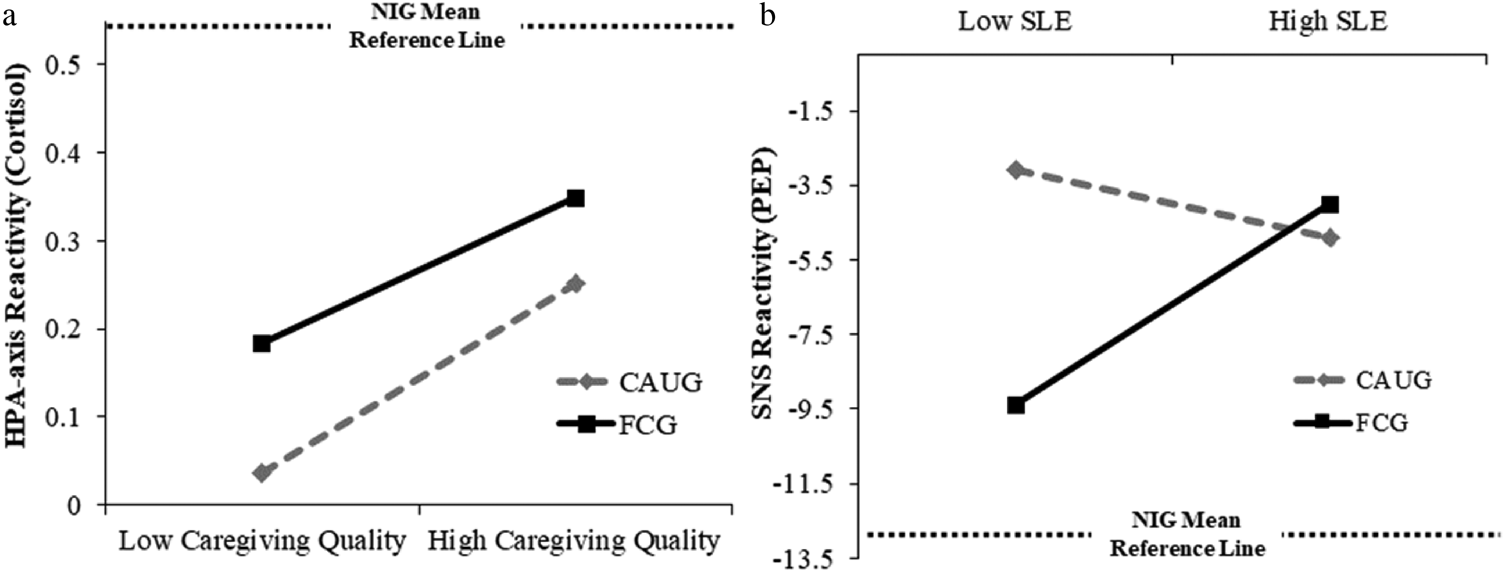
Finally, we examined interactions between the foster care intervention and both caregiving quality and SLEs on stress reactivity, controlling for the main effects reported above. The interaction between the foster care intervention and caregiving quality was not significant for either cortisol reactivity, B [95% CI] = −.02 [−.19, .15], β = −.03, p = .82 or for PEP reactivity, B [95% CI] = .21 [−2.61, 3.03], β = .02, p = .88. However, as seen in Figure 3a and consistent with the main effect reported above, the cortisol response of the foster care and care-as-usual children increased modestly as the level of caregiving quality increased, beginning to approach the mean level of the never-institutionalized children at age 12.
Interaction plots between (a) caregiving quality and intervention group on hypothalamic–pituitary–adrenal (HPA) axis reactivity (i.e., cortisol) and (b) stressful life events (SLEs) and intervention group on sympathetic nervous system (SNS) reactivity (i.e., PEP, pre-ejection period). Interactions are plotted 1 SD above and below the mean. The dotted reference line is the average reactivity level for the never-institutionalized group (NIG). The only significant interaction was between the foster care intervention and SLEs on SNS reactivity (b). For HPA-axis reactivity (a), both the foster care and care-as-usual children showed modest increases in reactivity as caregiving quality increased, and began to approach the mean level of the NIG. FCG = foster care group. CAUG = care-as-usual group.

The interaction between the intervention and SLEs was not significant for cortisol reactivity, B [95% CI] = −.01 [−.22, .20], β = −.02, p = .92. In contrast, there was a significant interaction between the intervention and SLEs for PEP reactivity, B [95% CI] = 3.60 [.93, 6.28], β = .34, p = .008. As seen in Figure 3b, PEP reactivity of the care-as-usual children remained relatively low regardless of the level of SLEs. For the foster care children, PEP reactivity increased as SLEs decreased. Simple slope analysis revealed that, at high levels of SLEs, the care-as-usual and foster care children showed a similarly blunted stress response. At low levels of SLEs, the foster care children showed a significantly greater PEP response to social stress than the care-as-usual children, and began to approach the never-institutionalized children on their stress reactivity.
Discussion
In the current study we examined the interaction between early psychosocial deprivation and later caregiving quality and SLEs on physiological reactivity to stress during early adolescence. Our findings revealed distinct patterns of association between caregiving quality and SLEs as a function of children's early exposure to institutional rearing. In particular, we showed that children who spent their early lives in institutions appear less physiologically responsive to the influence of caregivers at age 12 years, while those who do not experience early adversity demonstrate more adaptive responses to social stress when caregiving quality is high. Thus, early experience appears to modulate the degree to which children respond to the social-buffering effects of caregiving during early adolescence. Second, we showed that prolonged institutional deprivation early in life increases the risk of long-term blunting of stress reactivity, whereas the foster care intervention facilitated recovery of this response when later SLEs were low. Thus, under conditions of low exposure to stressors in early adolescence, family-based care following early deprivation may be protective against the development of a maladaptive physiological stress response.
Several specific findings emerged from the current study that extend our understanding of the ways in which experience influences stress system development. First, across the entire sample, there was a significant association between caregiving quality in early adolescence and stress reactivity, such that higher caregiving quality during early adolescence was associated with greater HPA-axis (cortisol) and SNS (PEP) response to social stress, even after controlling for participants’ history of institutional deprivation. These findings are consistent with previous studies demonstrating a heightened physiological stress response in the context of positive, supportive, and nurturing family environments (Alkon et al., Reference Alkon, Boyce, Tran, Harley, Neuhaus and Eskenazi2014; Berry et al., Reference Berry, Blair, Granger, Vernon-Feagans, Cox, Burchinal and Crnic2016; DePasquale et al., Reference DePasquale, Raby, Hoye and Dozier2018; Hackman et al., Reference Hackman, Betancourt, Brodsky, Kobrin, Hurt and Farah2013; Luecken, Kraft, & Hagan, Reference Luecken, Kraft and Hagan2009; Shirtcliff et al., Reference Shirtcliff, Skinner, Obasi and Haggerty2017). This elevation in stress reactivity as a function of higher quality caregiving may reflect an adaptive response to challenging conditions and an enhanced ability to encode, learn, and remember salient protective cues within an environment of relative safety (Shirtcliff, Peres, Dismukes, Lee, & Phan, Reference Shirtcliff, Peres, Dismukes, Lee and Phan2014). In other words, higher stress reactivity could allow youth to be more sensitive to the positive and supportive aspects of their environments, consistent with the notion of biological sensitivity to context and the Adaptive Calibration Model (Boyce & Ellis, Reference Boyce and Ellis2005; Del Giudice et al., Reference Del Giudice, Ellis and Shirtcliff2011).
Importantly, we observed a significant interaction between caregiving quality and children's history of institutional rearing on SNS reactivity, such that a higher SNS response to social stress as a function of higher caregiving quality was only observed for children who had never experienced institutional deprivation. In comparison, children who had experienced institutional deprivation demonstrated a blunted SNS response to social stress regardless of the level of later caregiving quality. This suggests that higher caregiving quality in early adolescence among those who experienced institutional care may not be sufficient to recalibrate SNS functioning during this period. Similar effects have been demonstrated in other studies of post-institutionalized children (Hostinar et al., Reference Hostinar, Johnson and Gunnar2015b). Thus, severe early neglect and deprivation may program the stress system to be under-responsive, even in the context of high-quality care later in development. From this perspective, severe early life deprivation may become biologically embedded and make children less responsive to the stress-regulating effects of enriched caregiving during early adolescence.
These findings align with theoretical models such as the Adaptive Calibration Model (Del Giudice et al., Reference Del Giudice, Ellis and Shirtcliff2011). In particular, higher levels of stress reactivity among those who experienced minimal early adversity may reflect an open and responsive stress system that facilitates social learning and environmental engagement. The never-institutionalized children in our study resemble those in this so-called “sensitive” profile. In contrast, a safe, nurturing, and supportive caregiving environment may not be adequate to overcome exposure to high levels of early life adversity (Shirtcliff et al., Reference Shirtcliff, Skinner, Obasi and Haggerty2017). Children in our study who experienced profound deprivation in the context of institutional rearing resemble those in the “unemotional” profile of the Adaptive Calibration Model. Physiologically, this profile is described as having low HPA-axis and SNS reactivity, and individuals within this profile tend to show marked insensitivity to threat, danger, and social feedback. Behaviorally, this model predicts a pattern of increased antisocial and exploitative behavior for those in the “unemotional” profile. Children who have experienced institutional rearing show heightened levels of aggression, externalizing problems, and callous-unemotional traits compared to never-institutionalized children (Humphreys et al., Reference Humphreys, Gleason, Drury, Miron, Nelson, Fox and Zeanah2015; Wade, Fox, Zeanah, & Nelson, Reference Wade, Fox, Zeanah and Nelson2018). However, early removal of children from deprived environments and placement into family-based care at least partially attenuates the effect of institutional deprivation and allows for normalization of both stress reactivity and psychopathology (Humphreys et al., Reference Humphreys, Gleason, Drury, Miron, Nelson, Fox and Zeanah2015; McLaughlin et al., Reference McLaughlin, Sheridan, Tibu, Fox, Zeanah and Nelson2015; Wade et al., Reference Wade, Fox, Zeanah and Nelson2018). For the stress response specifically, this recovery may only occur if children are removed from institutional care before age 2 years, a sensitive period for social enrichment (Hostinar et al., Reference Hostinar, Johnson and Gunnar2015b; Leneman, Donzella, Desjardins, Miller, & Gunnar, Reference Leneman, Donzella, Desjardins, Miller and Gunnar2018; McLaughlin et al., Reference McLaughlin, Sheridan, Tibu, Fox, Zeanah and Nelson2015).
The results of the current study extend these findings by suggesting that, following institutional deprivation early in life, high caregiving quality during early adolescence may not be sufficient to recalibrate physiological stress response systems. The first few years of life may therefore represent a sensitive period during which the absence of a primary attachment figure produces long-term changes in the functioning of stress response systems (see Reilly & Gunnar, Reference Reilly and Gunnar2019). Notwithstanding the apparent difficulty in remediating the effect of early deprivation via later caregiving, it is notable that institutionally-reared children who experienced high caregiving quality at age 12 began to approach the average level of cortisol reactivity of never-institutionalized children (Figure 3a). Continuing to examine these effects into later adolescence will be important to determine whether continued pubertal development facilitates recalibration during this critical stage of biobehavioral reorganization. Emerging evidence suggests that recalibration of the HPA-axis may occur after but not before puberty among those with a history of institutional care (DePasquale, Donzella, & Gunnar, Reference Depasquale, Donzella and Gunnar2019; Gunnar, DePasquale, Reid, Donzella, & Miller, Reference Gunnar, DePasquale, Reid, Donzella and Miller2019). Replication of these studies is needed, as is a better understanding of the role of caregiving quality and SLEs during (pre)adolescence in facilitating or hindering this process of recalibration.
The second set of findings centered on the role of SLEs in stress reactivity, and the role of recent stressors in moderating the effects of early institutional rearing on HPA-axis and SNS reactivity. Controlling for the effects of institutional deprivation, SLEs were unrelated to either HPA-axis or SNS reactivity. Thus, across the whole sample, there was limited evidence that later SLEs exerted a significant influence on stress reactivity independent of children's history of deprivation. However, we did observe an interaction between intervention group and SLEs on SNS reactivity specifically. Specifically, for youth in the foster care group, fewer SLEs were related to higher stress reactivity, and more SLEs were related to lower reactivity (i.e., greater blunting). In contrast, for the care-as-usual children, low levels of SNS reactivity were observed regardless of the level of SLEs, suggesting a persistently blunted response. The fact that the foster care children demonstrated a more adaptive SNS response in early adolescence when SLEs were low suggests that removal from deprived environments and placement into enriched family care early in development may safeguard against chronic physiological blunting that appears to result from prolonged institutional care. However, these children are not protected unconditionally; rather, they may still be vulnerable to physiological blunting when confronted with higher levels of later SLEs. In those with high exposure to recent SLEs, the level of physiological blunting evinced by children in the foster care group was comparable to children with prolonged institutional rearing. These results extend prior findings from our group that have shown the benefits of foster care on stress physiology (McLaughlin et al., Reference McLaughlin, Sheridan, Tibu, Fox, Zeanah and Nelson2015) by suggesting that maintenance of those effects may require that children continue to reside in environments of relative safety and low stress exposure. On the other hand, later exposure to stressful events during early adolescence may re-aggravate those underlying vulnerabilities and make it difficult for children to mount an adaptive stress response. In other words, early blunting of stress system responsiveness may be compounded by additional downregulation in response to later SLEs. Thus, while early removal of children from neglecting environments is crucial to enable recovery of stress system functioning, ongoing efforts to protect these children from exposure to stressors may be necessary to promote long-term adaptation.
The need for early removal from institutional care is underscored by the finding that the care-as-usual children demonstrated a persistently blunted SNS response irrespective of the level of SLEs they experienced in early adolescence. This suggests that prolonged early deprivation may program stress system functioning in such a way that it is less amenable to later environmental influence, consistent with the biological embedding hypothesis. This finding is generally consistent with the idea that extended deprivation may prevent later recalibration in the context of safe and low-stress environments unless a particular degree of pubertal development has also occurred (DePasquale et al., Reference DePasquale, Raby, Hoye and Dozier2018; Reilly & Gunnar, Reference Reilly and Gunnar2019). In other words, it may be that positive caregiving alone is insufficient to foster recalibration, but that puberty opens a window for recalibration, possibly thorough a mechanism of increased responsiveness to environmental input (Gunnar et al., Reference Gunnar, DePasquale, Reid, Donzella and Miller2019). Several researchers suggest that adolescence is a period of heightened neurobiological plasticity that may explain emerging individual differences in cognition, risk-taking, and psychopathology (Fuhrmann, Knoll, & Blakemore, Reference Fuhrmann, Knoll and Blakemore2015; Larsen & Luna, Reference Larsen and Luna2018). Given the age at which stress reactivity was measured in the current study (12 years), it will be important to determine whether further pubertal development enhances (or mitigates) the effects of both SLEs and caregiving quality on psychobiological development.
The current results have implications not only for psychobiological development, but for children's risk of developing psychopathology. Findings relating physiological stress reactivity to psychopathology in children have been mixed. Early meta-analytic data suggested that this relation was weak and inconsistent (Alink et al., Reference Alink, van Ijzendoorn, Bakermans-Kranenburg, Mesman, Juffer and Koot2008). More recent evidence suggests that hypo-responsiveness of the HPA axis may be more strongly linked to externalizing problems, whereas hyper-reactivity may be more strongly linked to internalizing problems (e.g. Hagan, Roubinov, Mistler, & Luecken, Reference Hagan, Roubinov, Mistler and Luecken2014; Hartman, Hermanns, de Jong, & Ormel, Reference Hartman, Hermanns, de Jong and Ormel2013; Martinez-Torteya, Bogat, Levendosky, & Von Eye, Reference Martinez-Torteya, Bogat, Levendosky and Von Eye2016; Ruttle et al., Reference Ruttle, Shirtcliff, Serbin, Ben-Dat Fisher, Stack and Schwartzman2011; Wadsworth et al., Reference Wadsworth, Broderick, Loughlin-Presnal, Bendezu, Joos, Ahlkvist and McDonald2019). This dissociation is not always observed, however, as meta-analyses of adult studies suggest that blunted stress reactivity may also be a hallmark of internalizing disorders such as depression and anxiety (Miller & Kirschbaum, Reference Miller and Kirschbaum2019; Zorn et al., Reference Zorn, Schür, Boks, Kahn, Joëls and Vinkers2017).
Moreover, stress blunting has been shown to mediate the relation between deprivation and externalizing problems in childhood and adolescence (Busso, McLaughlin, & Sheridan, Reference Busso, McLaughlin and Sheridan2017; Koss, Mliner, Donzella, & Gunnar, Reference Koss, Mliner, Donzella and Gunnar2016). This mediational effect of blunted stress reactivity is less well established for internalizing problems (Badanes, Watamura, & Hankin, Reference Badanes, Watamura and Hankin2011; Busso et al., Reference Busso, McLaughlin and Sheridan2017; Cantave et al., Reference Cantave, Langevin, Marin, Brendgen, Lupien and Ouellet-Morin2019). Taken with the current results, this suggests that blunted stress reactivity as a function of severe deprivation may increase the risk of psychopathology – especially externalizing problems – and that high-quality caregiving in early adolescence may not completely mitigate this risk. Moreover, SLEs in early adolescence may precipitate or exacerbate psychopathology among those who have experienced early adversity (Wade et al., Reference Wade, Zeanah, Fox, Tibu, Ciolan and Nelson2019). Whether physiological blunting serves as a mechanism of this stress sensitization effect requires explicit testing in future research. Moreover, given the significant overlap between internalizing and externalizing disorders, future studies should consider the potential transdiagnostic versus disorder-specific nature of physiological blunting as a biological pathway linking adversity to psychopathology.
Conclusions
Early adolescence is a period of heightened susceptibility to psychopathology and to social input from the environment. We show that high-quality caregiving at age 12 is associated with greater physiological reactivity to social stress at this age, but only among children with no history of institutional care. Thus, psychosocial deprivation in the context of institutional care may become embedded early in development and program stress system responsiveness in a manner that makes it less amenable to later input. However, continued pubertal development may help to facilitate recovery, and future studies are needed to address this possibility. Moreover, SLEs at age 12 may also moderate the effects of early experience, either compounding the effects of early psychosocial deprivation or, in the case of low SLEs, enabling a normalization of the stress response. Thus, while early adversity has clear and long-lasting effects on psychobiological development, later experience may either mitigate or exacerbate the effects of early adversity, thus offering opportunities to intervene during this period of increased vulnerability in order to protect against the development of psychopathology.
Acknowledgments
We thank the families and the children that participated in this study, as well as the research team and staff in Romania for their support and investment in this project.
Financial Statement
This study was supported by the John D. and Catherine T. MacArthur Foundation, the Binder Family Foundation, NIMH (R01MH091363 to Charles A. Nelson; R01MH103291 and R01MH106482 to Katie A. McLaughlin). The funding sources had no role in the study design; collection, management, analysis, or interpretation of data; or preparation, review, or decision to submit the manuscript.
Conflicts of Interest
NAF has received grant support from the National Institute of Mental Health (NIMH), the Eunice Kennedy Shriver National Institute of Child Health and Human Development (NICHD), the National Science Foundation (NSF), the National Institutes of Health Environmental influences on Child Health Outcomes (NIH ECHO) consortium, the Russell Sage Foundation, and the Lumos Foundation. He has received royalties from Guilford Press and Harvard University Press. He has received honoraria for lectures to professional audiences.
CHZ has received grant support from the NIMH, the Palix Foundation, the Irving Harris Foundation, the Substance Abuse and Mental Health Services Administration (SAMHSA), the Lumos Foundation, and the Inter-American Development Bank. He has received royalties from Guilford Press and Harvard University Press. He has received consulting fees from the National Society for the Prevention of Cruelty to Children. He has received honoraria for lectures to professional audiences. CAN has received grant support from the National Institutes of Health (NIH), the Jacobs Foundation, the John D. and Catherine T. MacArthur Foundation, the James S. McDonnel Foundation, the Binder Family Foundation, the Lumos Foundation, the Bill and Melinda Gates Foundation, and Harvard University. He has received royalties from the Massachusetts Institute of Technology and Harvard University Press. He has received honoraria for lectures to professional audiences and legal consulting fees. MW, MAS, and KAM report no competing or potential conflicts of interest.