In his first week in office, President Donald Trump took the unprecedented step of demanding the immediate resignations of all politically appointed US ambassadors, along with several higher-level State Department officials, with no grace period and no candidates in line to fill the vacancies.Footnote 1 A year into the administration, fifty-seven ambassadorial posts and five of eight deputy and undersecretary positions remained unfilled.Footnote 2 Critics were quick to denounce this approach, accusing the president of waging “war on the State Department”Footnote 3 or even on diplomacy itself.Footnote 4 Yet while this particular degree of understaffing was unprecedented, the general devaluation of diplomacy that it represented was not. Political leaders have long insisted on squeezing State Department budgets,Footnote 5 shuttering embassies and consulates,Footnote 6 and foregoing diplomatic tact for Pentagon-driven “mil-think” in the policy process,Footnote 7 while demanding that their diplomatic agents simply “do more with less.”Footnote 8 American diplomacy, it appears, has gone out of favor.
The public concern over Trump's diplomatic neglect, and the historical trajectory it culminated, raises a fundamental question: Does diplomacy affect the prospects of international conflict and cooperation, independent of the distribution of power and interests that underlies its conduct? Systematic empirical evidence of diplomacy's efficacy has remained elusive. At a basic level, much of the work of diplomacy is unobservable to researchers, conducted behind closed doors or through classified cables.Footnote 9 Insofar as diplomacy can be observed and quantified, its variation is largely driven by more fundamental political forces, calling into question any claims of diplomacy causing a particular outcome. States self-select into negotiations likely to bear fruit, or into those rendered necessary by impending threats. They open embassies in countries where opportunities for commercial exchange are rich, and close them when relations sour. Trump's gutting of diplomatic personnel came amid a broader foreign policy reorientation, leaving observers uncertain about whether the understaffing itself bore any real consequence.
In this paper I address the question of diplomacy's utility by analyzing diplomats’ influence in the formation and implementation of US foreign policy.Footnote 10 Specifically, I examine the variation in diplomatic influence that arises from the routine rotation of US ambassadors. The theory draws from broad literatures on bureaucratic politics, public administration, and diplomatic history, and brings their insights to bear in explaining patterns of international conflict and cooperation.
Central to the argument are the relative interests and capabilities of the various participants in the foreign policy process. Among all participants, the chief of mission (COM) to a foreign country typically holds the strongest preferences for cooperative relations with that country,Footnote 11 and wields substantial influence over the policies enacted toward it.Footnote 12 But the removal and replacement of an ambassador—with the embassy overseen by an acting official in the interregnum—causes a short-term negative shock to the weighting of diplomatic inputs in the policy process,Footnote 13 relative to the inputs of other actors who are not similarly motivated to protect the bilateral relationship. These intragovernmental dynamics have international implications because a transitory diplomat lacking internal influence will in turn be less capable of committing to and implementing the kinds of agreements that undergird bilateral cooperation. In short, during an ambassadorial turnover, the agent most interested in maintaining positive relations with a given country is rendered least effective in doing so, and diplomatic outcomes suffer as a result.
The argument yields general propositions about the efficacy of delegated diplomacy, which I test in the specific empirical context of US ambassadorial appointments, focusing on two primary outcomes. First, I consider militarized interstate disputes as escalatory actions that are rendered necessary by the inability to achieve mutually acceptable settlements through diplomatic negotiation. Second, I examine export volumes as the product of diplomats both seeking out commercial opportunities and enforcing cooperative arrangements in the face of short-term incentives to renege.Footnote 14 If ambassadorial turnovers impose constraints on diplomats’ abilities to make credible commitments to their foreign counterparts, they should in turn increase the likelihood of militarized escalation and decrease volumes of economic exchange.
Using newly collected data on US diplomatic personnel for the global sample of countries from 1960 through 2014, I find support for these predictions: the removal of an ambassador decreases US exports to the country experiencing the turnover, and heightens the risk of onset of a militarized dispute between that country and the US. Subgroup analysis suggests that the aggregate effects are driven primarily by turnovers of career ambassadors, rather than noncareer (or “political”) appointees. The quantitative analyses are complemented by a set of qualitative case studies illustrating the mechanisms underlying the empirical results.
The use of ambassadorial turnover as a measure of diplomacy—or specifically, as a measure of disruption in the conduct of diplomacy—is, at first glance, susceptible to the same methodological concerns that plague the various measures described earlier: the timing of rotation and duration of vacancy are likely endogenous to unobservable political considerations, and the direction and magnitude of the resulting bias are difficult to determine ex ante. To address this concern, my research design leverages a natural experiment arising from a distinct feature of modern US diplomatic practice: the State Department's routinized three-year ambassadorial rotation system.Footnote 15 An ambassador's entrance into office in year t − 3 is a strong predictor of turnover in year t, and is assigned (conditionally) independently of outcomes in year t. Using a t − 3 ambassadorial appointment to instrument for turnovers thus circumvents the confounding and strategic behavior that would otherwise undermine any attempt to estimate the causal effects of diplomatic representation.
A primary contribution of this study is its effort to reconcile a fundamental tension in the ways scholars and practitioners think about diplomacy.Footnote 16 Formal and quantitative international relations (IR) scholars tend to theorize diplomacy as a set of discrete and delimited interactions conducted by leaders or unitary states, typically involving threats to use force and deterrence thereof,Footnote 17 or negotiations over cooperative agreements and their subsequent enforcement.Footnote 18 In contrast, a rich body of first-hand and qualitative accounts of diplomacy gives primacy to the agency of individual diplomats carrying out the routine work of interstate relations.Footnote 19 The present study leverages insights from the agent-oriented literature to generate theoretical predictions which can be tested systematically on international outcomes. My claim is that those interactions predominantly theorized by IR scholars are occurring constantly and in all corners of the world, at varying intensities but at a volume that far outstrips a leader's capacity to manage them all,Footnote 20 so the relevant party to the exchange is often neither the country nor the leader but the agents to whom authority has been delegated. The empirical analyses show that, ceteris political paribus, international conflict and cooperation vary substantially as a function of the attributes of those agents: in the conduct of foreign relations, personnel is policy. The concluding section provides some discussion on how these findings might generalize beyond the present context of analysis and offers broader insights into the nature of delegated diplomacy.
Ambassadors and Agency in International Relations
I begin with a brief exposition of three empirical cases that will be referenced throughout the theoretical discussion.Footnote 21 These cases illustrate the roles ambassadors play in the foreign policy process, the preferences they hold, and the channels through which they can influence policy outcomes. Subsequent analysis considers how their influence is diminished during ambassadorial turnovers, and the international consequences that follow.
Agency in Practice
The bombing of the USS Cole, a US Navy destroyer docked off the port of Aden, by al-Qaida militants in October 2000 sparked an acute tension in the US–Yemeni relationship. According to a State Department investigator on the scene, US marines and FBI agents “rushed in in full force … like they were attacking Aden rather than coming to do an investigation … and they didn't know if they were going to be met by violence or an arm[ed] struggle.”Footnote 22 Another diplomat on the ground recalls that “paranoia was added to legitimate threat. Yes, the situation was teetering on the brink of being out of control.”Footnote 23
These conditions gave rise to an intense interagency dispute over the appropriate balancing of priorities in the US response, the primary antagonists of which were chief FBI investigator John O'Neill, and Barbara Bodine, the US ambassador to Yemen. Upon the FBI's arrival in the country, Bodine “pleaded with O'Neill to consider the delicate diplomatic environment he was entering. O'Neill responded that he was here to investigate a crime, not to conduct diplomacy.”Footnote 24 The ambassador insisted on keeping the FBI's presence at minimally intrusive levels, demanding that they operate in smaller numbers and with smaller weapons; ultimately tensions mounted to the point that Bodine exerted her authority as COM to block O'Neill's entry into the country.
When Ambassador John Wolf arrived in Kuala Lumpur in 1992, he “found the embassy was basically on idle … We had a big canvas on which to paint, but mostly it was blank.” The Malaysian government had for some time been in the market for military aircraft; but US–Malaysian relations were “strained,”Footnote 25 and the “sterile official dialogue meant that this issue was far off policy radars.”Footnote 26 Wolf exercised his discretion to remove what was previously a major sticking point in US–Malaysian relations—a Malaysian proposal for an exclusive East Asian Economic Caucus, which ultimately proved fruitless but had driven Secretary of State Jim Baker “apoplectic”Footnote 27—from the bilateral agenda, creating space for more productive engagement. Turning to the aircraft push, Wolf took the initiative to arrange a series of high-level meetings to promote the US-manufactured F-18 over its Russian competitor. These included visits from the McDonnell Douglas CEO and from officers in the Defense Security Assistance Agency, as well as a trip with the Malaysian defense minister to a US aircraft carrier to see the F-18s in action. He further guided McDonnell Douglas through the bidding process, advising them on ways to integrate the proposal with the Malaysian prime minister's Vision 2020 industrialization plan and pushing them to internalize the notion that they “can't just sell a piece of metal; you need to sell a relationship.”Footnote 28 The effort proved successful. Within a year of the commencement of the sales push, a deal was signed for a USD 750 million purchase of American-made aircraft.
Two persistent issues dominated US–Peruvian relations from the start of Ambassador Johnny Jones's tenure there in 1963. The first was an incompatibility between US and Peruvian views of national jurisdiction over territorial fishing waters: Peru asserted a 200-mile sovereign zone off its coastline, while the US recognized only a three-mile limit. The second was Peruvian President Belaúnde's inaugural commitment to nationalize the US-owned International Petroleum Company (IPC), coupled with the domestic political imperative to do so without compensation and in violation of US understanding of international investment law. Due to a set of foreign aid amendments restricting assistance following the confiscation of US fishing vessels or other assets, these policy disagreements came to be viewed as “time bombs threatening [Ambassador Jones's] mission,” and he worked assiduously to defuse them. On the former issue, his deputy recalls, Jones “succeeded early on in negotiating an informal modus operandi which effectively muffled the problem … The Peruvians pretty much looked the other way or if a vessel was detained, a quick visit by an Embassy rep to the affected port would result in a ‘solution’ without violence.”Footnote 29 As for the IPC matter, Jones fought within his own administration to ensure that bilateral aid was used effectively to incentivize a settlement between the company and the Peruvian government, withheld only when talks broke down but released when they resumed in good faith.Footnote 30 A major setback in bilateral relations followed the Peruvian military's ouster of Belaúnde in October 1968. Voices throughout Congress and elsewhere in the administration wanted to make an example of Peru, calling for the immediate suspension of aid and severance of diplomatic ties; but Jones insisted that recognition of the new government was “the only way the United States could expect to continue to protect and promote its interests in Peru.”Footnote 31 The ambassador's position won out, and bilateral negotiations proceeded.
These episodes illustrate the first two components of this paper's argument: the unique policy preferences held by diplomats on the ground, and the influence they wield to realize those preferences. I discuss each of these points in turn.
Preferences
Relative to other participants in the foreign policy process—including officials from other agencies, the military, the White House, and Congress—diplomats tend to hold the strongest preferences for cooperative relations with the countries in which they operate. Put differently, they exhibit the greatest willingness to pay for positive bilateral relations, whether that payment takes the form of time spent and effort exerted (their own or their subordinates’), favors called in and political capital exhausted, or other policy objectives compromised in service of the overall relationship. In their authoritative examination of the US foreign policy bureaucracy, Halperin and Clapp observe that diplomats on the ground are “strongly motivated to improve relations with” their host governments, often viewing that objective as “vital to the security of the United States, whereas priorities decided on in Washington seem out of touch.”Footnote 32 The claim is not that other participants seek uncooperative relations per se, but simply that they are less willing to make the trade-offs necessary to avoid them.
Explanations vary regarding the sources of these preferences. Perhaps the simplest account follows from Miles’ Law: “where you stand depends on where you sit.” In public administration, there is “no such thing as pure objectivity … Every person has a function to perform and that assigned responsibility markedly influences one's judgment.”Footnote 33 Diplomats are tasked with improving diplomatic relations, so the policy positions they adopt reflect the organizational position they occupy. Other rational-choice explanations point to processes of top-downFootnote 34 or bottom-upFootnote 35 selection of diplomatic “types” into the diplomatic bureaucracy; sociological theories highlight the role of the Foreign Service's organizational culture in instilling values and perspectives in the organization's members over time.Footnote 36 The reality is likely some combination of these, and each yields similar implications for the purposes of the present study.
How these preferences manifest in policy debates will depend on the particular issues at stake and alignment of vested interests. Bodine's clash with the FBI was fundamentally a disagreement over the relative importance of the holistic relationship with Yemen versus the narrow investigative goals being pursued there. Jones found his diplomatic efforts in Peru coming into conflict, on the one hand, with US business interests channeling their myopic and maximalist demands through Congress;Footnote 37 and on the other, with the broader objectives of his superiors at State, who “appreciated the ambassador's ‘local problems”’ but had to achieve “a careful and exacting coordination of US interests and timing, including some related by non-Peruvian factors.”Footnote 38
While a range of actors other than Ambassador Wolf—officials in State or Commerce at the assistant or undersecretary level, for instance—could plausibly have orchestrated the aircraft sale to Malaysia, those actors were evidently more concerned with addressing other problems or exploiting other opportunities elsewhere; only the ambassador's purview was sufficiently delimited to render the sales effort a worthwhile pursuit.
Reflecting on her handling of the Cole situation, Bodine is unapologetic. “Diplomatic relations,” she writes, “provide a context within which we are able to operate—or not … It was my job to make sure everyone involved understood that our actions must not subvert our goals.”Footnote 39 James Blanchard proudly describes his fellow ambassadors as “the only Americans who worry full-time about the complete relationship with a particular country … Nobody else does.”Footnote 40 Farrow depicts this dynamic somewhat less charitably, noting that “eyes in many a White House have rolled when the subject of ‘State's objections’ has been raised.”Footnote 41 Yet however such arguments are received by other participants in the process, the ambassador will often find herself the strongest (if not the only) advocate for the importance of relations with her host country to the broader conception of the US national interest.
Influence
Considerations of diplomats’ policy preferences are consequential only insofar as those preferences are somehow determinative of policy outcomes. Government behavior on any given international issue is inherently multifaceted—a “collage” of actions and decisions,Footnote 42 each rendered by different participants at different levels of government—and so examination of a diplomat's role in the policy process should likewise account for the various channels through which she might exert her influence over the outcome.
The channels of influence available to a COM can be grouped into two general categories: areas in which she has authority to take action independently, and areas in which she lacks that authority but can advise and advocate for decisions made by her superiors. For the first channel, US ambassadors tend to enjoy quite a broad discretionary window. The chief of a foreign mission has, for instance, “wide latitude to decide how and at what level in the host government to carry out an instruction from Washington”; as a result, ambassadors in the field “can easily come to feel that it is their responsibility … to effectively shape policy” toward their host country.Footnote 43 One ambassador recalls, as his final instruction before arriving at post, that “senior officials in Washington hoped they would not have to pay too much attention to Bolivia.”Footnote 44 Another notes that an “ambassador to a major country can actually have a wider range of authority and activity than all but the most senior cabinet members.”Footnote 45
An important source of a COM's discretionary authority is her statutory grant of “full responsibility for the direction, coordination, and supervision of all Government executive branch employees in that country,”Footnote 46 and her consequent authority to deny clearance for any such employee to enter the country in an official capacity.Footnote 47 Thus even when the broad contours of policy are determined in Washington, the COM is left with considerable leeway to determine how that policy will be implemented by personnel on the ground.
Where a diplomat lacks authority to act independently, she may still shape policy indirectly through the advice and recommendations she provides to her superiors.Footnote 48 According to Allison, “most problems are framed, alternatives specified, and proposals pushed” by a midlevel official such as an ambassador. The challenge she faces is “how to get an issue on an action-channel, how to get the government ‘to do what is right.’ The incentives push [her] to become an active advocate.”Footnote 49 Echoing this perspective, Halperin and Clapp suggest that “arguments in favor of a decision are the most important form in which information reaches the president and other senior participants”; the ability to formulate compelling arguments and proposals, to navigate them through the interagency process, and to “take account of criticisms and to get as many participants as possible on board”Footnote 50 constitutes an important means of bureaucratic influence.
Stepping back from the internal politics, of interest to a foreign government is whether the US COM wields sufficient influence—through whatever channel is available—to shape the overall policy the US puts forward in the bilateral relationship. The credibility of a diplomat's commitment to a given course of action will thus depend on her ability to enact the policy herself, or to convince her superiors to adopt her desired position, or some combination of the two.
Ambassador Bodine was able to independently set de facto bilateral policy by curtailing O'Neil's investigation and discarding the most combustible element of the policy collage. Ambassador Wolf's pursuit of the aircraft sale was undertaken at his own behest, and made possible in part by his assurances to the Malaysians that the feuding over the economic caucus would be abandoned at all levels. The relative stability of US–Peruvian relations during Jones's tenure was supported by the ambassador's day-to-day management of the low-level fisheries issues as well as his internal work of advocacy, persuasion, and negotiation regarding the aid and recognition decisions made above his jurisdiction.
In these instances, the respective COMs’ intragovernmental influence generated credibility in their intergovernmental dealings. The remainder of the analysis considers how the process of ambassadorial turnover causes an intermittent weakening of diplomatic influence in the policy process, and the international implications that follow.
Consequences of Ambassadorial Turnover
Since the early twentieth century, the US State Department has rotated ambassadors in and out of foreign missions on a regular basis. When one ambassador's tour ends, the president must nominate a successor, the Senate must confirm that successor, and the host government must accept her credentials. If there is any delay (or “vacancy”) between one ambassador's departure and her successor's arrival at post (as is almost always the case), oversight of the embassy's operations passes on to a Foreign Service Officer who serves in the acting role of chargé d'affaires ad interim.Footnote 51
I argue that the removal and replacement of a US ambassador induces a negative shock to diplomatic influence in the US foreign policy process vis-à-vis the country experiencing the turnover. In the following analysis, I first consider why acting officials, as well as appointed officials at the very beginning and end of their tenures, prove less influential compared to mid-tenure appointees. I then show how this micro-level variation in diplomatic influence can lead to macro-level variation in diplomatic outcomes.
Continuity During Turnover
Before examining the consequences of ambassadorial turnover, it is important to delimit the analysis by noting which aspects of bilateral relations are not interrupted by a turnover in the US ambassadorial post.
Considering only the letter of the law, there would be little reason to expect diplomatic influence to wane under a chargé d'affaires (and even less so under an incoming or outgoing ambassador). US statutory law is explicit in granting full COM authority to interim officials.Footnote 52 The Vienna Convention of 1961—the treaty governing diplomatic representation under international law—likewise states that, “except as concerns precedence and etiquette, there shall be no differentiation between heads of mission by reason of their class.”Footnote 53 In practice, the immediate impact of a US ambassadorial turnover may seem similarly modest, at first glance. Beyond the ambassador herself, nearly all of the embassy's personnel are assigned and rotated on schedules independent of the ambassador's.Footnote 54 Further, the US and any given country have a multitude of channels of diplomatic communication available other than the US ambassador stationed abroad—including, most notably, the foreign country's embassy in DC.Footnote 55
When assessing the impact of a US ambassadorial turnover, it is thus important to keep in mind that any such impact will be limited to those aspects of the job that can neither be effectively performed by lower-level embassy personnel, nor fully substituted by the foreign country's diplomatic representative in the US—nor clearly stipulated by legal authorities. Within these bounds, however, the potential for bilateral harm is substantial. To see why, we can draw insights from the broader literatures on bureaucratic politics and public administration, and first-hand accounts of foreign policy officials.
Rotation, Vacancy, and Influence
In embassies, and across federal offices more broadly, acting officials enjoy a narrower window of discretion than do permanent appointees. In a thorough assessment of vacancies in executive branch appointments, O'Connell identifies the primary cost of vacancy to be “agency inaction”: agencies under interim leadership tend to “make fewer policy decisions… [and] launch fewer controversial actions,”Footnote 56 even when acting officials enjoy the full legal authority of their Senate-confirmed counterparts.
These discretionary limitations are to some degree self-imposed, or imposed by professional norms and expectations: a former acting undersecretary of Homeland Security recounts that, “as the acting person … you're very much aware that you are temporary… so there's this sense of discomfort about trying to bring organizational change.”Footnote 57 In addition to avoiding change, acting officials are also less likely to push back against directives from the White House or decisions by other participants which they believe to be misguided.Footnote 58 A chargé in Bodine's position would have been legally authorized to deny the chief FBI investigator's clearance for entry into Yemen, but we can reasonably speculate that she would have opted not to exercise that authority.
Alternatively, inaction or complaisance under an acting official may be explained not by discretionary limitations, but rather by a lack of clout with important stakeholders in the US government and beyond. Acting officials, their professional competence and intra-agency esteem notwithstanding, “will not be as powerful as permanent appointees in dealing with the agency's major outside constituencies,”Footnote 59 and will lack “access to the external network to get what they need from the White House and the other agencies.”Footnote 60 We might think of external influence as a personal attribute of individual diplomats—and in fact, such influence can be a major determinant of how an ambassador gets selected in the first placeFootnote 61—but it can also emerge as a perquisite of the job. Upon commencement of the sales push for aircraft in Malaysia, Wolf quickly “discovered how useful it was to have the first name ‘Ambassador,’ 'cause I immediately picked up the phone to make several calls” to industry leaders and government officials;Footnote 62 the same access was not afforded to the lower-level embassy positions he had previously occupied.
A diplomat's influence may be further curtailed by her superiors’ unwillingness to consult her on important policy decisions. Presidents of both parties have at times expressed skepticism or distrust of careerists whom they did not personally appoint. In sensitive deliberations over normalizing relations with China, President Carter was “leery of channeling my proposals through the State Department, because I did not feel that I had full support there;”Footnote 63 Nixon “loathed the foreign service.”Footnote 64 As a consequence, according to one former ambassador, “without the appointees in place, State … [is] at a real disadvantage in policy debates.”Footnote 65
While the discussion thus far has focused on the limited influence of interim officials, the concerns carry over in substantial measure to presidentially appointed ambassadors at the very beginning or end of their tenures.
Newly appointed ambassadors may take a less active role in policy advocacy, or exercise their discretionary authority less freely, until they feel they have adequately “learned the ropes” in the new position.Footnote 66 Many diplomatic initiatives require weeks or months to develop; an incoming ambassador may be delayed in getting ambitious projects underway, and an outgoing ambassador may be unable to see them through to completion (while an interim official is cut short on both ends). Insofar as policy implementation requires collaboration across agencies or bureaus, a COM on her way out the door will find it difficult to call in favors which she will not have the opportunity to reciprocate, and a new entrant to the job will need time to build relationships and goodwill. All together, these factors render a transitional COM less influential than a long-term appointee in shaping US policy toward her host country.
Turnover and Commitment Problems
The intragovernmental dynamics described here carry implications for intergovernmental relations. From a foreign government's perspective, a US ambassadorial turnover generates a commitment problem: the diplomat assigned to the country may seek bilateral cooperation, but her commitment to manifest that preference in action depends on her ability to influence US policy. If she lacks influence internally, her commitments will lack credibility. I consider how these dynamics affect the bilateral propensity for militarized conflict and economic exchange.
Commitment and Conflict
My analysis of commitment and conflict follows from a standard bargaining framework in which the US and a foreign government find themselves in disagreement over an international policy issue. Either side has the option to escalate from quiet diplomacy to the public threat or use of force,Footnote 67 and will do so if its expected utility of escalation exceeds that of accepting a negotiated settlement (or of abiding the status quo while working toward one). Militarized escalation may prove effective at winning the issues in contention, but invariably carries some cost for the overall diplomatic relationship.
Disaggregating the state as we have in the preceding discussion, we observe that participants across the US government vary in their relative aversion to militarization as a bargaining tactic. It is the diplomats who are the most strongly motivated to find mutually agreeable settlements, and the most willing to incur the trade-offs necessary to achieve that goal. The disempowerment of diplomatic agents in the policy process thus implies that the prevailing policy will more closely reflect the interests of participants who are less averse to using force against a given country, or less inclined to accommodate that country's demands for the sake of avoiding a downturn in relations.
Broadly speaking, a US COM can mitigate the risk of conflict through the commitments she makes to her host government: she can commit to altering a US policy which, if unchanged, would push her host government toward escalation; or she can commit to providing some compensation or side payment which would induce her host government to cede the issue in contention and thus preempt the need for escalation by the US. These policy changes may require decisions that the COM has the discretion to enact independently, or decisions that she will need to convince her superiors to approve, or both. In either case, however, an acting or transitional official will lack credibility in making the necessary commitments, if it is commonly understood that she lacks the influence necessary to carry out her end of the bargain. An ambassadorial turnover thus increases the likelihood that a bilateral disagreement eludes resolution through quiet diplomacy and negotiation, and ultimately gives rise to a militarized dispute. These dynamics are examined more thoroughly in a set of case studies following the quantitative analysis.
Commitment and Trade
A second consequence of ambassadorial turnovers can be found in their impact on bilateral economic cooperation.
Here I focus specifically on US exports abroad because this is one of the responsibilities explicitly delineated in the Foreign Service Act: “Each chief of mission to a foreign country,” states section 3927(c), “shall have as a principal duty the promotion of United States goods and services for export to such country.”Footnote 68 We should note that the concept of economic diplomacy usually entails two distinct kinds of activity, the first being diplomacy in pursuit of broader institutional reforms or policy changes, and the second (alternatively referred to as “commercial diplomacy”) being diplomacy to promote specific transactions or resolve specific disputes.Footnote 69 The present focus is on the latter, which should translate more directly to short-term shocks in trade flows.
As in the preceding discussion of commitment and conflict, turnovers can undermine a COM's ability to make credible commitments to her host government in the domain of economic cooperation. The Malaysian case is instructive in this regard. Throughout his time in Kuala Lumpur, Ambassador Wolf continually worked to impress upon his host government “that Malaysia had a worthy friend in the United States, and that there could be unique advantages to a strong relationship with the US.”Footnote 70 In doing so, Wolf sought to incorporate into the aircraft deal considerations beyond the price and quality of the goods in that particular transaction: he encouraged the Malaysians to envision the full range of cooperative opportunities, and the many forms of potential reciprocity, which might follow from that exchange. The delivery of any such benefits would not be without cost for the US diplomat, and would likely require buy-in from other participants in the policy process—but those were hurdles Wolf was willing and able to overcome. These types of diffuse or implicit commitments will be less attractive coming from a more transitory and less influential chief of mission.
In other situations, interstate cooperation is facilitated by credible commitments of punishment for defection from a cooperative arrangement. A primary obstacle to reciprocal cooperation in trade is the ever-present incentive for governments to opportunistically restrict foreign imports—through means ranging from tariffs and nontariff barriers to preferential procurement practices and failure to enforce contracts—for the benefit of domestic producers.Footnote 71 Governments will generally abstain from such behavior only if they expect it to be met with retaliation, but adjudication of disputes through formal institutions is costly,Footnote 72 and cooperation must often be enforced by informal and extra-institutional means. Gertz argues that ambassadors can facilitate resolution of investment disputes by “linking specific investor complaints to the broader diplomatic relationship,”Footnote 73 and the same logic applies to trade disputes as well. Anecdotes abound about ambassadors intervening to prevent opportunistic behavior by their host governments. One ambassador recalls lobbying the Spanish government to protect the intellectual property rights of American computer and pharmaceutical companies, and to ease a dubbing license requirement that harmed American entertainment exports; another recounts pressuring the Mexican government to overturn several nontransparent bid awards for government contracts, which were ultimately granted to American firms.Footnote 74 Even in post-NAFTA Canada, Ambassador Blanchard had to intervene on a “commodity-by-commodity, case-by-case basis” to protect US exports ranging from wheat and lumber to magazines and television stations.Footnote 75 A COM unable to commit to future retaliatory measures, or to induce other bureaucratic actors to share the punitive burden, is likely to find her host government behaving less favorably toward US exporters in various small ways—none of which may rise to the level of warranting a formal proceeding, but which collectively amount to a reduction in exports during the turnover period.
Careerists and Political Appointees
The discussion thus far has elided the distinction between “career” and “political” ambassadors—that is, ambassadors who did or did not rise through the ranks of the Foreign Service—a distinction which has been the focus of some recent empirical research on US ambassadorsFootnote 76 as well as presidential appointments more broadly.Footnote 77 Throughout the period of analysis, about 26 percent of embassies at any time are overseen by noncareer ambassadors (compared to 63 percent by career ambassadors and 11 percent by acting officials). Ambassadors of either type have the same statutory authority and are appointed through the same formal processes, though the informal means of selection differ.Footnote 78
The routine appointment of noncareer ambassadors is largely unique to modern American diplomatic practice, and the empirical implications it generates are not entirely clear. With respect to policy preferences, political appointees are not the “types” who select into the Foreign Service, nor have they experienced the socialization that occurs over the course of a career there; but insofar as Miles’ Law operates in this domain, we might expect that, once they find themselves sitting in an embassy overseas, noncareer ambassadors will come to adopt similar stances as careerists do. As for bureaucratic influence, we might expect noncareer ambassadors, on average, to more closely resemble career ambassadors than acting officials, simply by virtue of their status as presidential appointees; indeed, as Halperin and Clapp note, “the single most important determinant of the influence of any senior official is his or her relationship with the president.”Footnote 79 On the other hand, research has shown noncareer ambassadors to be systematically less qualified for the position than careerists.Footnote 80 Lacking experience in operating the levers of bureaucracy, or lacking familiarity with their receiving country or region, these appointees are likely to be less effective in influencing US policy to achieve their objectives, whatever those objectives may be. Given ambiguous theoretical predictions, I leave it as an empirical matter to assess whether career and noncareer appointments (and their subsequent turnovers) have similar impacts on trade and conflict outcomes.
Research Design
We now turn to an empirical assessment of the theoretical propositions developed earlier: that ambassadorial turnovers increase the risk of onset of militarized disputes, and decrease volumes of US exports.
Sample Selection, Measurement, and OLS Specification
The first step of the research design is defining the sample to be analyzed. I begin with the sample of sovereign country-year observations, as defined by the Correlates of War, from 1960 to 2014 (Table A1 in the online appendix). From this sample I identify the subset characterized by normal diplomatic relations with the US. The decision of whether to establish diplomatic relations is a strategic one, considered in prior literature as a long-term political investment or as a marker of international status.Footnote 81 Examination of these strategic decisions is beyond the scope of this paper. Instead, I limit the analysis to conditions of already-established diplomatic relations—which characterizes the vast majority of country-years from 1960 to present—and consider the nonstrategic sources of variation in diplomatic representation under those conditions.
Specifically, I define the variable eligiblei,t, which takes a value of 0 if any of the following hold (and 1 otherwise): the US has not yet recognized the independence of a foreign country and exchanged ambassadors with that country; once-normal diplomatic relations with that country are severed or otherwise interrupted; or the US does not have an embassy operating in that country with a resident ambassador. I restrict the sample of analysis to the eligible country-year observations. The goal of this sample selection is a more credible estimation of causal effects, for a slightly more narrowly defined population. A thorough discussion of this decision, along with the precise coding of “normal” relations, is provided in the online appendix.
Outcomes
This study examines two primary outcomes.Footnote 82 First, I predict that ambassadorial turnover increases the likelihood that the US or host country resorts to militarized escalation to resolve a policy incompatibility. I operationalize this concept of escalation using the onset of militarized interstate disputes, or MIDs, defined to be “cases of conflict in which the threat, display or use of military force short of war” by one state actor is explicitly directed toward another.Footnote 83 These incidents are treated in the literature as “symbolic acts in a bargaining process,”Footnote 84 or as indicating the emergence of a “crisis” which may or may not advance further to a state of war.Footnote 85 I make no prediction relating the influence of diplomatic agents to the outcomes of these disputes. Of interest here is simply the question of whether, holding constant the political and structural conditions that determine the dyadic propensity for conflict, a militarized dispute becomes more likely to occur as a result of an ambassadorial turnover. The outcome measure employed in the analyses is mid onseti,t, an indicator for whether country i entered into an MID in year t in which the US was an opposing participant.
The second outcome of interest is the annual volume of US exports to a given host country, which I predict will decrease when US commercial diplomacy efforts are hampered by an ambassadorial turnover. Specifically, us exportsi,t is the constant USD value of all US exports in goods to country i in year t, taken from the Correlates of War Project Trade Dataset. All analyses use the common transformation of ln (us exportsi,t + 1).
Turnover
The independent variable of interest is ambassadorial turnover, which I operationalize in two ways. First, turnoveri,t is an indicator for whether the ambassadorial post in country i experienced any vacancy in year t, regardless of the length of the vacancy. It takes a value of 0 when the same presidentially appointed ambassador is in office for the entire year, and 1 otherwise. Thus it indicates that a country-year saw one or more of (1) the end of an outgoing ambassador's tenure, (2) a “vacancy” with an acting official in charge, or (3) the start of an incoming ambassador's tenure.
This operationalization follows from the preceding discussion of turnovers themselves, including the adjustment periods shortly before and after a vacancy, being causes of disruption in diplomatic relations. For robustness, additional tests consider a continuous measure, vacancyi,t, which is the portion of year t that country i goes without an ambassador. These variables were constructed by scraping the State Department's Chiefs of Mission by Country database and recording the start and end dates for all presidentially appointed ambassadors.Footnote 86 “Career” and “political” ambassadors are pooled together for the main analyses, and later disaggregated, as discussed later.
Bivariate Relationships
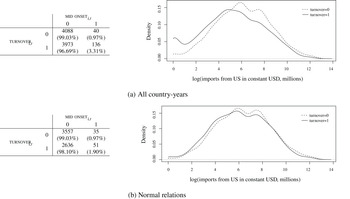
As a first pass at assessing the relationships between ambassadorial turnovers and the outcomes of interest, consider the conditional distributions depicted in Figure 1. The upper panel includes all country-years, and the lower panel is restricted to the sample of analysis (the country-years characterized by normal diplomatic relations). For both outcomes, the bivariate relations are more pronounced in the full sample than in the sample of analysis, suggesting that the sample selection process does away with one major source of confounding. For the conflict outcome, it is clear in both samples that MIDs are more likely to occur in turnover years than in nonturnover years; the main inferential challenge in testing this paper's argument is to demonstrate that the relationship is causal, with turnovers causing MIDs and not merely the reverse. For the trade outcome, the difference in conditional distributions in the sample of analysis is more subtle; in addition to causality concerns, a challenge in the trade analyses will be to gain the statistical power needed to distinguish the effect of commercial diplomacy from the geopolitical and macroeconomic factors that drive the aggregate flows.
Conditional distributions of mid onseti,t and log(imports from usi,t), by turnover status

OLS Specification
Moving beyond the descriptive patterns I presented, we can consider the following generic ordinary least squares (OLS) model of the relationship between turnovers and outcomes:
 $$Y_{it} = {\rm \smallcaps TURNOVER}_{it}\beta + X_{i, t-1}\theta + Y_{i, t-1}\phi + \alpha _i + \tau _t + \tau _t \times {\rm \smallcaps POLITICAL\ APPOINTEE}_{i, t} + \epsilon _{it}, \;$$
where α i are country fixed effects, τ t are year fixed effects which are interacted with a political appointee indicator (explained later), and X i,t−l is a vector of lagged controls specific to the outcomes of interest. Data sources and summary statistics for all variables are listed in Table A1 in the online appendix.
To fully specify the MID onset model, we will want to account for other factors that have been studied as predominant drivers of conflict.Footnote 87 These include regime type, measured by Polity2 score; democratic transitions, measured as year-to-year change in polity; economic interdependence, in the form of bilateral trade flows; an index of military capabilities; a mutual defense alliance indicator; and foreign policy alignment, measured by United Nations General Assembly (UNGA) voting affinity. Country fixed effects account for other common controls such as shared borders and geographic distance.
For the export model, a common approach to testing the effects of economic diplomacy is to incorporate the diplomatic variable of interest into a gravity model of trade.Footnote 88 In line with this literature, I control for the foreign country's population and GDP, as well as regime type (polity) and indicators for whether that country is party to a free trade agreement with the US or a member of the GATT or WTO. Geographic distance and contiguity are again subsumed by country fixed effects, and US population and GDP are subsumed by year fixed effects.
An important consideration in both models is the potential confounding influence of US election cycles on the relationship between ambassadorial appointments and foreign policy behavior. This concern is primarily addressed by inclusion of year fixed effects; but because these cyclical patterns may differentially affect countries that receive career and noncareer ambassadors, I also include the interaction of year fixed effects with an indicator of what type of appointee a given country has most recently received prior to the start of year t.Footnote 89 In addition to the covariates mentioned, I include a lagged dependent variable in each model, to account for the possibility of turnovers being strategically manipulated in anticipation of future trade or conflict outcomes; anticipated outcomes are unobservable, but recent outcomes provide a reasonable proxy.
Instrumental Variable Design
The fundamental concern with the OLS specification outlined is that it falls short of addressing any unobserved confounding in the relationship between turnovers and outcomes. To see why, consider the various reasons that the turnover and vacancy measures would take on a nonzero value. First, as mentioned, ambassadors are routinely rotated between different foreign missions and positions back in Washington. Second, incoming presidents typically dismiss the noncareer ambassadors appointed by their predecessors (and sometimes the careerists as well), in order to replace them with their own political allies. Third, an ambassador may be removed for poor performance (or conversely, due to promotion for strong performance). Fourth, ambassadors may be withdrawn as part of a larger strategy of diplomatic sanction or protest against the host country.
The confounding potential of the latter two causes of turnover should be clear, since these are situations in which the ambassador is withdrawn for reasons related, perhaps directly, to the outcomes of interest. In the former two cases, the primary concern is that the duration of the vacancy between appointments (as well as any deviation from the routine rotation schedule) may correlate with unobservable political interests and priorities. Furthermore, these confounding factors may bias OLS estimates in either direction. An ambassador may be withdrawn in anticipation of a militarized dispute, inducing a positive OLS coefficient (which certainly does not capture the causal impact of the turnover); or alternatively, an ambassador may be kept in place beyond her scheduled departure date, or a vacancy may be filled promptly, precisely because a conflict seems imminent—or because it has already begun—in which case the bias deflates OLS estimates toward zero. Similar considerations may apply to trade outcomes as well: vacancies may be left open for an extended period only when doing so is not harmful for US exports, or alternatively when opportunities for commerce are already bleak, yielding potentially countervailing biases.
The strategy I propose to address this problem gains causal leverage by effectively isolating the variation in turnovers that arises solely from the routinized rotation system. Regular rotation of Foreign Service Officers between postings at foreign missions and back home at State Department headquarters was first codified in the Rogers Act of 1924;Footnote 90 in practice, this converged to a standardized three-year appointment system (for career and noncareer ambassadors alike) by the latter half of the twentieth century.Footnote 91 Although ambassadors may occasionally hold office for a longer or shorter period, the first-stage results demonstrate that the norm of a three-year term is strongly adhered to.
I create the instrument enteri,t−3, an indicator for whether any ambassador entered office in country i in year t − 3, and use it as an exogenous predictor of turnover in year t. Using this instrument provides two distinct advantages over the OLS regression, corresponding to two potential sources of endogeneity in the turnover measure: endogenous vacancy onset, arising from strategic manipulation of ambassadorial tenure; and endogenous vacancy duration, arising from strategic manipulation of ambassadorial appointment. To the first point, the two-stage least squares estimator recovers only the local average treatment effect for the population of compliers, which here refers to the “types” of country-years for which turnovers—both observed and counterfactual—follow the standard rotation schedule. Cases in which ambassadors are dismissed early or retained beyond the three-year norm are effectively omitted from the instrumental variable (IV) estimation. The intuition behind the second point is that the appointment process is much more likely to be manipulated with respect to contemporaneous outcomes, compared to anticipated outcomes three years into the future. In other words, we would expect outcomes in year t to be more weakly related to the unobservable confounders at the time of appointment in year t − 3, compared to potential confounders in year t.
This latter consideration, in more general terms, points to the requirement of conditionally independent assignment of the instrument with respect to potential outcomes. My approach to fully satisfying this criterion involves controlling for the same lagged covariates from the OLS models detailed earlier (all lagged to t − 4 rather than t − 1 to avoid post-treatment bias), as well as lagged dependent variables,Footnote 92 and including country and year fixed effects (the latter interacted with political appointeei,t−3). In addition, to capture any remaining confounding, I control for the total vacancy the post experienced in years t − 6 through t − 4 (labeling this variable prior vacancyi,t−4:t−6), a period which represents a full ambassadorial “life cycle.” In the normal conduct of diplomatic relations, at least one vacancy will typically occur during this three-year span preceding year t − 3; how quickly that vacancy gets filled should provide a strong proxy measure for unobservable diplomatic priorities.
This IV strategy thus rests on the identifying assumption that, within the sample characterized by normal diplomatic relations and conditional on covariates, the systematic variation in enteri,t−3 arises simply from the previous history of a given ambassadorial post's rotation schedule: that is, whether this post experienced turnover in years t − 6, t − 9, and t − 12, as opposed to years t − 7, t − 10, and t − 13, and so on.
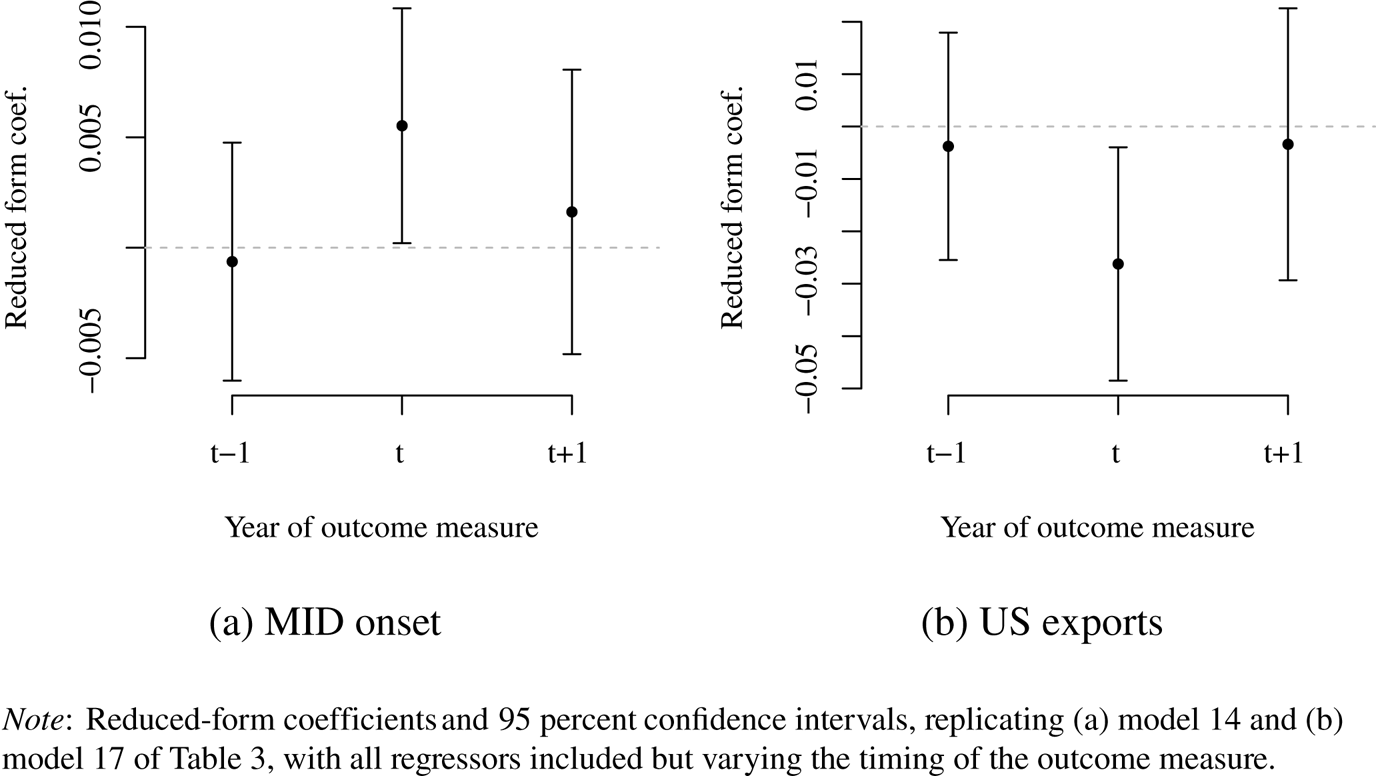
As in any observational study, the claim of independent assignment of treatment cannot be definitively proven. There are, however, two pieces of supporting evidence that should strongly mitigate against concerns of endogeneity. First, Table A12 (in the online appendix) checks for relationships between the enteri,t−3 instrument and any of the pretreatment covariates, after residualizing over country and year intercepts. The results show near-zero correlations with each variable except for prior vacancyi,t−4:t−6: the only predictor of an ambassadorial entrance in a given year is the post's recent history of vacancy. To more flexibly control for this potential confounder, I include quadratic and cubic terms of prior vacancyi,t−4:t−6 in all specifications. The second piece of evidence against endogenous assignment is the placebo test shown in Figure 2, and discussed in detail after presentation of the main results.
Reduced-form placebo tests

The two stages of the IV estimation take the following form:
 $$\displaylines{{\rm \smallcaps TURNOVER}_{it} = \gamma {\rm \smallcaps ENTER}_{i, t-3} + f( {\rm \smallcaps PRIOR\ VACANCY}_{i, t-4\colon t-6}) + Y_{i, t-4}\phi _1 + Y_{i, t-5}\phi _2 + Y_{i, t-6}\phi _3 \cr + \,X_{i, t-4}\theta _1 + \rho _i + \lambda _t + \lambda _t \times {\rm \smallcaps POLITICAL\ APPOINTEE}_{i, t-3} + \eta _{it} \cr Y_{it} = \beta \widehat{{\rm \smallcaps TURNOVER}}_{i, t} + f( {\rm \smallcaps PRIOR\ VACANCY}_{i, t-4\colon t-6}) + Y_{i, t-4}\phi _4 + Y_{i, t-5}\phi _5 + Y_{i, t-6}\phi _6 \cr + \,X_{i, t-4}\theta _2 + \alpha _i + \tau _t + \tau _t \times {\rm \smallcaps POLITICAL\ APPOINTEE}_{i, t-3} + {\rm \epsilon }_{it}, \;} $$
where f( ⋅ ) indicates a third-degree polynomial, with outcome variables and covariates as described before. As in the OLS specification, all models will be estimated separately with the binary turnoveri,t and the continuous vacancyi,t. The sample will be limited to observations of eligiblei,t−3 = 1 (rather than eligiblei,t = 1) to avoid selecting on a post-treatment variable. Summary statistics of all variables, along with characterizations of the effective sample and the IV compliers, are provided in Table A1 in the online supplement.
Empirical Results
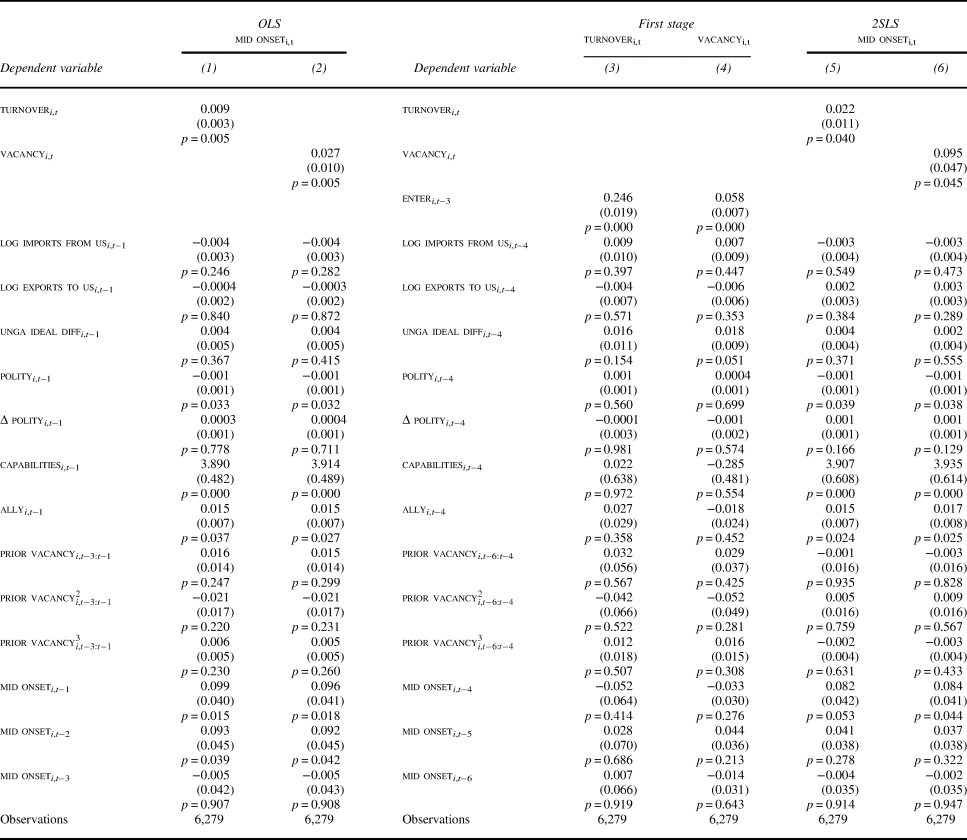
The main empirical results are reported in Tables 1 and 2. First consider the OLS results for MID onsets in Table 1. The first column reports an approximately one-percentage-point increase in the probability of MID onset associated with an ambassadorial turnover. The second column confirms this result using the continuous vacancy measure; the median vacancy duration is about 100 days, so an estimate of  $\hat{\beta }_{Pct.Vacant}$ that is three to four times as large as
 $\hat{\beta }_{Turnover}$ is intuitively reasonable.Footnote 93
MID Onset, OLS and IV

Notes: All models include country fixed effects, year fixed effects, and year fixed effects  ${\times} \ {\rm \smallcaps POLITICAL\ APPOINTEE}_{i,t-3}$. Standard errors clustered by country, with p-values from two-sided t-test. First-stage F-statistics are 161.05 for turnover (model 3) and 63.40 for vacancy (model 4).
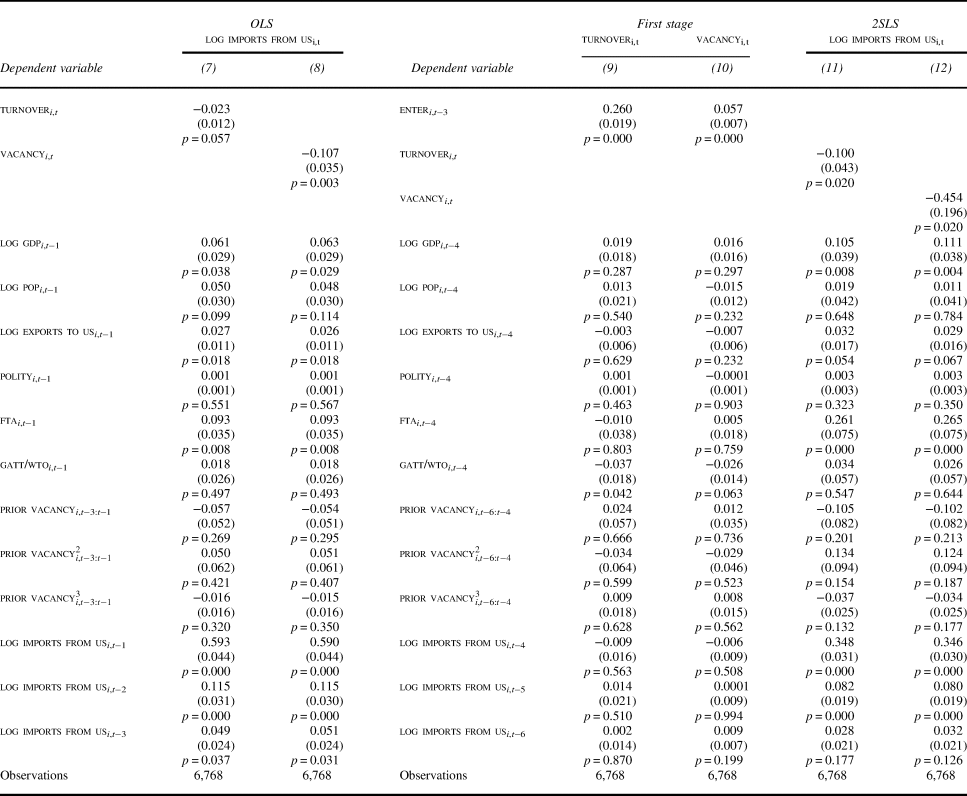
US Exports, OLS and IV

Notes: All models include country fixed effects, year fixed effects, and year fixed effects  ${\times} \ {\rm \smallcaps POLITICAL\ APPOINTEE}_{i,t-3}$. Standard errors clustered by country, with p-values from two-sided t-test. First-stage F-statistics are 178.08 for turnover (model 9) and 59.09 for vacancy (model 10).
Models 3 and 4 report the first stage of the IV estimation, regressing turnover and vacancy (respectively) on the enteri,t−3 indicator and all other covariates. Consistent with the three-year rotation schedule, the appointment of an ambassador in year t − 3 is a strong predictor of turnover and vacancy in year t. This first-stage relationship enables the second-stage IV estimation, which is reported in models 5 and 6. Coefficients are again positive and statistically significant, and in this case larger in magnitude than those estimated by OLS: an ambassadorial turnover is estimated to have a causal impact of increasing by 2.2 percentage points the probability of MID onset with the country experiencing the turnover.
Turning to Table 2, we see a similar pattern in the relationship between turnovers and US exports. Because the outcome is log-transformed, sufficiently small coefficient values can be interpreted as percentage changes: by OLS, an ambassadorial turnover is estimated to decrease exports by 2.3 percent, while two-stage least squares (2SLS) estimates an effect of 10 percent. The coefficient on the continuous vacancy variable is again about four times the magnitude of the binary coefficient (for both OLS and 2SLS), and the first-stage results are similar to those reported in Table 1. For substantive interpretation, the effect size is best understood relative to the variability in the outcome measure: by the 2SLS estimate in model 14, a turnover causes a decrease of 0.04 standard deviations of log exports; after residualizing the outcome over country and year intercepts, the effect amounts to 0.17 standard deviations.
It is notable that for both outcomes and both vacancy measures, the IV estimates are larger in magnitude than the OLS estimates. These differences are likely attributable to one (or both) of two general explanations. First is a net deflationary bias in the OLS estimates, which the IV approach corrects for: the discussion earlier outlined reasons we might expect strategic manipulation of appointments to bias OLS estimates either toward or away from zero, and it turns out that the bias toward zero dominates. Substantively, this would suggest that vacancies are avoided in situations where they would be the most harmful to bilateral relations.
A second explanation, which can hold even in the absence of bias in the OLS, would attribute the difference in the estimates to the basic differences in the estimands: the IV estimator can recover only average treatment effects local to the subpopulation of compliers, and it turns out that the compliers have larger treatment effects than does the population as a whole. In other words, the countries that most closely adhere to the three-year rotation schedule are also the countries for which bilateral relations are most heavily impacted by the status of the US COM. Comparing the covariate profiles of the compliers and the full sample,Footnote 94 we do find some differences consistent with this latter explanation. Both accounts seem intuitively plausible, and it would be difficult to rule out either one.
Heterogeneous Effects by Appointee Type
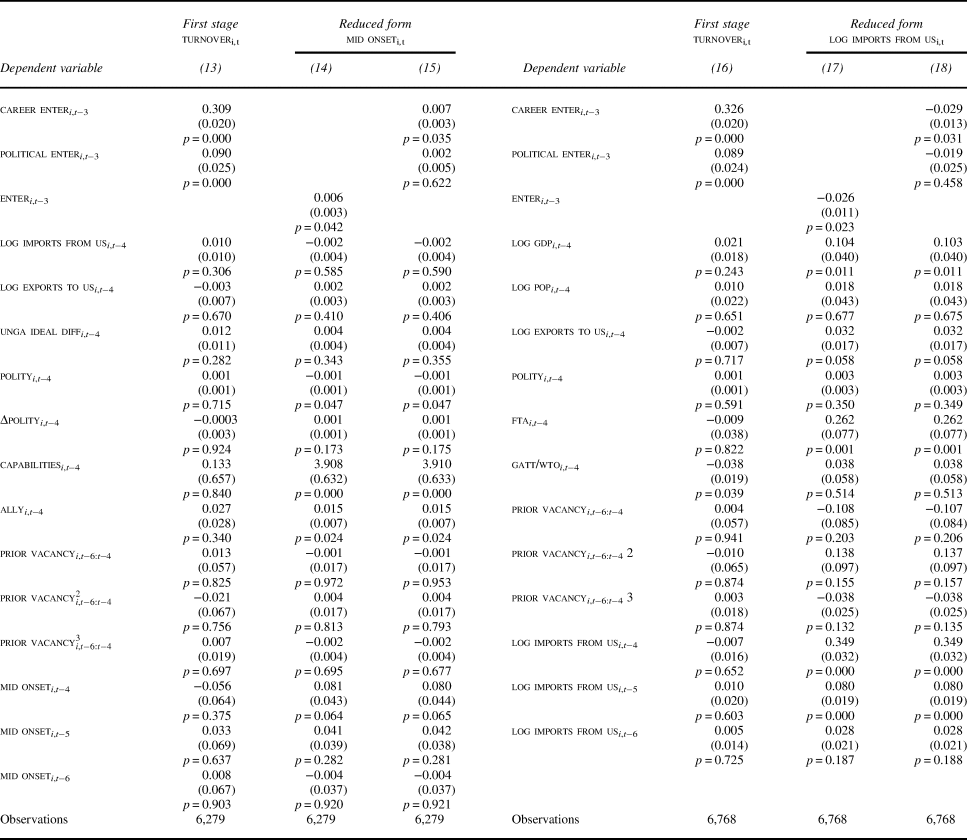
To assess whether career appointees prove more effective than noncareer appointees in promoting trade and preventing conflict, we can test for heterogeneous effects across different types of ambassadors and their respective removal. This question does not lend itself to a straightforward empirical specification; one approach is reported here, with others reported in Tables A5 and A6 in the online supplement. The approach of Table 3 involves recoding the instrument into two separate measures, which separately indicate whether a career ambassador, or a political ambassador, entered office in year t − 3.
MID onset and US exports, career vs. political appointees

Notes: All models include country fixed effects, year fixed effects, and year fixed effects  ${\times} \ {\rm \smallcaps POLITICAL\ APPOINTEE}_{i,t-3} $. Standard errors clustered by country, with p-values from a two-sided t-test.
Models 13 and 16 report the first-stage estimation, where we see that an entrance of either type is a strongly significant predictor of turnover in year t. Models 15 and 18 show the reduced-form effect of the entrance instruments on the respective outcomes, and we see the same pattern in both cases: only a career entrance has a significant effect, while the effect of a political entrance is smaller and less precisely estimated; the effect of a career entrance in both cases closely resembles the effect of the pooled entrance instrument used in the main analyses (with the reduced-form effect reported in models 14 and 17 for comparison). Alternative specifications reported in the appendix include interacting the instrument with appointee type, and splitting the sample by appointee type, and they reveal a similar pattern.
We should be cautious, however, in interpreting these results: while the general research design aims to isolate exogenous variation in the presence or absence of any presidentially appointed ambassador, it is unable to address the nonrandom assignment of different types of ambassadors to different countries. In other words, these results cannot tell us whether political ambassadors are less effective than career ambassadors in preventing disputes and promoting exports, or whether political ambassadors are simply appointed to countries where these diplomatic outcomes are less sensitive to variation in embassy-level personnel.
Robustness and Placebo Tests
The online appendix reports a series of robustness checks for alternative empirical specifications, including: omitting controls; omitting lagged dependent variables; adding other controls; accounting for a foreign country's diplomatic representation in the US; and accounting for side accreditation of US ambassadors to multiple countries. The analyses of MIDs are repeated using a range of limited dependent-variable specifications including a reduced-form logit, an IV probit, and a set of event-count and zero-inflated event-count models (with the outcome recoded accordingly); and separately, on a reduced sample of only the countries that at some point engage in an MID against the US. All results are consistent with those reported in the main text.
As a final consideration, we may be concerned that the IV design is susceptible to bias arising from endogenous assignment of the entrance instrument. Even if pretreatment covariates show no relationship with ambassadorial appointments (as reported in Table A12), actors involved in the appointment process may still be manipulating vacancies with an eye toward future outcomes. The placebo tests reported in Figure 2 should largely alleviate these concerns.
The figure presents coefficient plots for variations of models 14 and 17 from Table 3, regressing outcomes directly on enteri,t−3 (including all covariates) with the outcome measures varied from t − 1 to t + 1. For both outcomes, we see that the predicted effects of a t − 3 entrance occur only in year t—precisely when the ambassador is scheduled to leave office—and not the year before or after. Attributing the main effects reported in Tables 1 and 2 to strategic manipulation of the treatment assignment would thus require a very peculiar type of manipulation: that is, actors in the appointment process would have to be manipulating in anticipation of outcomes precisely three years, but not two or four years, into the future. This does not comport with any reasonable intuition of political actors’ behavior; the far more plausible interpretation is that the estimated relationships between turnovers and outcomes are causal.
Case Studies
The quantitative results provide systematic evidence of a relationship between ambassadorial turnovers and diplomatic outcomes. With regard to militarized disputes in particular, the mechanisms underlying this relationship warrant further elaboration. Two cases that illustrate the processes through which ambassadorial turnovers can cause underlying policy disagreements to give rise to militarized disputes. A third case of a dispute that arose between the US and Peru in 1969, at the conclusion of Ambassador Jones's tenure, is discussed in the online appendix (omitted here because of space constraints). Each case study aims to provide a “within-case” analysis, comparing diplomatic developments during a turnover against otherwise similar circumstances shortly before or after. The main principles guiding the case selection process were representativeness with respect to the broader set of militarized disputes contributing to the quantitative results, and practical concerns of data richness. A more detailed discussion of case selection is provided in the appendix.
MID 4183: Canada, 1997
Between 1979 and 1997, the United States and Canada engaged in four MIDs. Each involved a use of force by one or the other country's coast guard to assert control over contested fishing waters. In the context of US–Canadian relations, fishing disputes are no small deal: according to one diplomatic historian, “When you talk about Canadian–American relations you're essentially talking about fish.” One such disagreement in 1989 led the Canadian Coast Guard, which had previously been unarmed and civilian-manned, to arm their patrol vessels with .50-caliber machine guns and exchange fire with American fishermen—a “shooting war in the Gulf of Maine.”Footnote 95 All four disputes constituted escalatory actions as part of a bargaining process over an international policy disagreement. Three of the four coincided with a turnover in the US ambassadorial post.
Throughout the twentieth century, the two countries maintained unsettled maritime boundaries, making the allocation of fishing rights an issue that required continuous management and renegotiation.Footnote 96 The US COM in Ottawa played an integral role in overseeing this portfolio. As Ambassador Blanchard recalls, “since the United States doesn't even have a fisheries minister, and responsibility for the industry is spread across several agencies, I often had to act like one in my dealings with [Canadian Minister of Fisheries and Oceans] Brian Tobin.”Footnote 97 In one of several related episodes during Blanchard's tenure, negotiations over the joint management of Pacific salmon stocks stalled in May 1994. American fishermen in the meantime continued depleting the fisheries. In response, the Canadians threatened to obstruct passage through what were previously understood to be international waters connecting Washington and Alaska. For them the status quo was costly, and a speedy resolution was of the essence: as Tobin complained to Blanchard, “Why should we negotiate with you while you're increasing your fish catch as we speak?”Footnote 98 Blanchard moved quickly to convince the White House to impose a cap on the US salmon haul and to dissuade coastal-state senators from taking legislative action that would further inflame tensions. The Canadians were appeased, and talks continued apace.
Blanchard left post in Spring 1996, having managed the various fisheries issues on an ongoing basis but leaving no permanent resolution in place. The ambassadorial post remained vacant through Clinton's re-election and into the following year. In May the Canadian government, frustrated by the lack of progress in negotiations, directed its coast guard to conduct a series of of armed seizures of American fishing vessels; and so began the Salmon Wars of 1997.Footnote 99 Private Canadian fishermen joined the protest, blockading an Alaskan ferry route, and inadvertently devastating the tourism revenues of nearby Canadian port towns. The premier of British Columbia added fuel to the fire, suing the US government and threatening to evict the US Navy from a leased base off the coast of Vancouver. After much bad blood and economic loss, the Americans acquiesced and returned to the negotiating table.
Unlike Blanchard's account, an extensive oral history by then-chargé Thomas Weston says nothing of his own personal efforts in managing the bilateral fisheries concerns. It is perhaps telling to examine Weston's description of how US–Canadian disputes generally unfolded during his time in Ottawa: “What tends to happen is something will bring an issue to a head,” he recounts, “and it will be a crisis… and then [the] ambassador/chargé/chief of mission is deeply involved in it.”Footnote 100 Blanchard's account, in contrast, is emphatic on the ambassador's responsibility to proactively resolve issues before they reach the point of crisis—rather than getting involved after the fact.Footnote 101
According to Gibler, Canada's decision to use force in May 1997 was intended “to put out a message that they were serious about enforcing fishing regulations in [their] coastal waters.”Footnote 102 With Blanchard at post, the Canadians could be confident that their concerns were in capable diplomatic hands. In his absence, the Canadians felt the need to assert their demands by other means.
MID 2906: United Arab Republic, 1964
A dispute of quite a different nature unfolded in 1964 between the US and Egypt (known then as the United Arab Republic, or UAR), shortly after Ambassador Luke Battle's late-September arrival in Cairo.
By the time Battle's predecessor had departed in June, numerous points of tension had emerged in the US–UAR relationship. President Nasser was openly abetting anti-Western insurgencies in Yemen and the Congo. Hostilities with Israel simmered, and Nasser continually resisted US pressures to entertain disarmament talks.Footnote 103 All the while, his economy relied heavily on US assistance, including the PL-480 food aid program, which provided over half of Egypt's wheat supply—a tension not lost on congressional critics of both parties, who repeatedly sought to impose strict conditionality on bilateral aid to force Nasser in line.Footnote 104 By August, two months into the vacancy in Cairo, Nasser's ambassador in DC expressed to a group of US officials his concern that “the US hadn't done any real business with the UAR” in recent months. The ambassador himself “understood this matter but the ‘impatient young men’ who ran the government in Cairo were beginning to wonder.” The PL-480 agreement—originally conceived and negotiated over the course of several months by a previous US ambassadorFootnote 105—was set to expire, with talks for a renewal not yet begun. The prospect of a large stabilization loan had also been floated; “Cairo was taking the loan as proof of whether the US would continue its present policy” of cooperation and support writ large.Footnote 106 But that initiative now languished, with no US ambassador in place to keep it moving forward.
Pressures mounted, and Nasser felt himself politically squeezed from all sides. Increasing economic instability made him vulnerable to internal opposition. The arms race and other foreign entanglements were costly, both in direct financial terms and in the looming threat of a punitive US response; but accommodation bore political costs as well, leaving him “fearful of any action that might expose him to [the] charge [that] he was being soft.”Footnote 107 Nasser had worked to cultivate relations with the Soviets and thus establish a credible outside option for an aid patron, but then in October Khrushchev was ousted and Nasser had to “start all over again.”Footnote 108 In November, a group of students protesting US policy toward the Congo burned down the US Information Service library in Cairo; the government did not instigate the attack, but “in order to disguise the fact that the police had lost control, Nasser was prepared to accept responsibility for the attack and even be truculent about it.”Footnote 109 Finally, in December, Nasser lashed out: the Egyptian air force shot down—albeit with plausible justificationFootnote 110—an American oil-company plane near Alexandria, killing the pilot and copilot, and four days later Nasser delivered an inflammatory speech denouncing US efforts to strong-arm Egyptian policy.
What made Nasser choose to escalate, both verbally and militarily, and how did the turnover in the US ambassadorial post influence that decision? As Battle's predecessor relayed in his exit interview that June, the prior maintenance of harmonious relations between the two countries rested on “the mutual capacity to hurt each other's interests.”Footnote 111 By the fall, Nasser found himself in an acutely vulnerable position in the multidimensional bargain that characterized the bilateral relationship, facing demands from various interests across the US government for concessions which he found politically untenable. Under normal conditions, a US ambassador—the “coordinator of all our varied relationships” with her host country, in Blanchard's wordsFootnote 112—would have sought to restrain those other actors’ impulses to “fight for every small advantage [they] can get”Footnote 113 vis-á-vis the UAR, and worked to triage and temper the demands being made. But the turnover in the ambassadorial post prevented such a corrective from being applied in a timely manner.
Having never served in the region, Battle faced an unusually steep learning curve. As he later flatly acknowledged, “my appointment was the kind that all Foreign Service officers should fight. I was not prepared to go to Cairo as Ambassador.”Footnote 114 The pressing issues facing Embassy Cairo differed considerably from those Battle encountered in his previous appointment at the Bureau of Educational and Cultural Affairs, and it seems he took some time, as many appointees do, to “get up to speed” in the new position.Footnote 115 Despite the slow start, Battle did demonstrate in his internal communications an inclination to sympathize with Nasser's political difficulties from the outset,Footnote 116 and after several weeks on the job began lobbying his superiors for a PL-480 reauthorization. He warned, for instance, in a telegram on 11 November, that the US “must give early sign of continuation [of] cooperative effort or a new policy will exist here whether we intend it or not.”Footnote 117 But Nasser may not have been fully aware of Battle's efforts or intentions—the two had not yet held a substantive meeting before the downing of the planeFootnote 118—and in any case Nasser needed results faster than Battle proved capable of delivering.
The Egyptian leader thus determined that his best course of action was to force the US's hand by escalating to the point of crisis. Nasser's message was clear: “The Americans want to give us aid and dominate our policy,” he declared in his speech. “I am not prepared to sell Egyptian independence … We can tighten our belts … but we are not going to accept pressure. We are not going to accept gangsterism by cowboys.” Confirming these public statements, Nasser subsequently shared with a CIA informant his confidence that “the USA is afraid to cut off aid to Egypt because the US knows that Egypt will react by sabotaging all American efforts in the area.”Footnote 119 Indeed, the secretary of state soon afterwards wrote to Johnson arguing for the importance of “getting back onto even keel with the UAR” and outlining the multitude of US interests that would be put at risk by further deterioration of relations. “Only the Soviets,” he advised, “will benefit from a such a situation.”Footnote 120 After some initial pushback from Congress, Johnson agreed to resume aid through a series of short-term agreements—a structure proposed by Battle to ensure “almost continual negotiation with the UAR … so that the value of our cooperation is not forgotten.”Footnote 121
Relations were steadied, if not fully restored, for the next two years of Battle's tenure. Nasser took steps to resolve some of the major bilateral incompatibilities, ceasing arms shipments to the CongoFootnote 122 and entering negotiations to end the conflict in Yemen. Battle, for his part, continued advocating internally for the delivery of bilateral assistance.Footnote 123 On the ground in Cairo, he developed a personal rapport not only with Nasser but also with the country's preeminent newspaper editor (himself a powerful political figure), causing the editor to tone down his critical coverage of US policy. (The editor later described his moderation as a “derelict[ion],” but one borne out of admiration for the ambassador's hard-fought efforts to improve bilateral relations.)Footnote 124 This likely helped lighten the domestic pressures pushing Nasser toward an antagonistic posture; as a more direct approach, Battle developed a routine of preemptively seeking out the Egyptian leader to explain away the various provocations that arose from voices in Congress and the American press and to dissuade him from responding in kind: “We got into a pattern of preventative diplomacy and it worked, at least for a while.”Footnote 125
Yet the promising bilateral trajectory would not outlast Battle's appointment. Nasser had remained “very patient with all the pressure” he felt from the US while Battle was at post to keep things in order; with Battle's departure, Nasser expressed, “our patience has run out.”Footnote 126 At their farewell meeting in March 1967, Nasser withdrew his final request for US assistance, and with it any remaining possibility of a full bilateral reconciliation.Footnote 127
Conclusion
This study has sought to address the question of diplomacy's efficacy by examining the varying influence of diplomatic agents in the US foreign policy process. The findings demonstrate that two of the most widely studied phenomena in international relations—economic exchange and militarized conflict—are affected by a factor largely neglected by previous formal and quantitative research: the status of the agent charged with overseeing bilateral diplomatic relations. As a result of the removal of a US ambassador, the country in which they operate receives a lower volume of US exports and becomes more likely to engage in a militarized dispute with the US. The empirical results provide systematic support for a basic proposition long held by practitioners and proponents of diplomacy: diplomacy matters, and it matters who the individuals are who conduct it.
A natural question that arises from these findings is whether and to what extent they generalize beyond the present context of analysis. The inferential strategy employed here relied on a particular feature of US diplomatic practice: the routinized three-year rotation system with substantial spans of vacancy between appointments. Extending the analysis to other countries would require, at the very least, different research designs leveraging other context-specific sources of variation.
Theoretically, our expectations of what such an analysis would discover may be mixed. On the one hand, an implicit scope condition of the argument presented here is that the home government in question have a sufficiently broad set of international interests and engagements that its institutional response is to compartmentalize and delegate responsibilities to different agents with varying preferences and geographical purviews. The extent to which this characterization fits any given country's foreign policy apparatus is an empirical question to be considered case by case. Yet there is certainly value in the general perspective of viewing the actions and decisions of any sovereign state as the product of an internal “pulling and hauling”Footnote 128 among different actors representing organizations with competing conceptions of their nation's foreign policy interests.Footnote 129 Taking this perspective, we can ask when and why certain participants wield greater or lesser influence in the intragovernmental policy process, and how that variation can help explain the international outcomes we observe.
Data Availability Statement
Replication data for this article may be found at at <https://doi.org/10.7910/DVN/ZTWOYY>.
Supplementary Material
Supplementary material for this article is available at <https://doi.org/10.1017/S0020818321000102>.
Acknowledgments
I thank Ali Ahmed, Felipe Balcazar, Neal Beck, Jim Bisbee, Mike Gilligan, Sandy Gordon, Amanda Kennard, Gabe Koehler- Derrick, Kyuwon Lee, Melissa Lee, Peter Rosendorff, Cyrus Samii, Jay Shon, Alastair Smith, Arthur Spirling, Rob Trager, Hye Young You, the editors and reviewers at International Organization, and participants at the NYU Graduate Political Economy Seminar, the NYU International Relations Reading Group, NEWEPS-13, and APSA 2020 for feedback and advice that greatly improved the manuscript.