Tetralogy of Fallot is the most common cyanotic congenital cardiac disease with an incidence of 0.1–0.4 per 1000 live births. Life expectancy in patients with tetralogy of Fallot is reduced; without surgery, one-third of them will die during the first year of life and only one-fourth will live to the age of 10 years.Reference Bertranou, Blackstone, Hazelrig, Turner and Kirklin1 Since the inauguration of corrective surgery in patients with tetralogy of Fallot, outcomes have improved dramatically.Reference Kirklin, DuShane and Patrick2–Reference Lillehei, Varco and Cohen4 The long-term results are excellent, even though early mortality was substantial in the beginning of the surgical era. Calculated actuarial rates of survival of 97% over 14 years after corrective surgery in this early era have been reported.Reference Niwa, Hamada and Nakazawa5 Nevertheless, reoperations late after correction may be needed to improve quality of life. This study aimed to investigate the indications for reoperation late after correction of tetralogy of Fallot.
Patients and methods
We performed a retrospective data analysis of 91 patients out of 914 consecutive patients who underwent correction of tetralogy of Fallot in our department between 1960 and 2002. According to the policy of our institution, after surgery patients stay in contact with our department and the department of paediatric cardiology. To our knowledge, no patients may have undergone reoperation elsewhere. We included patients diagnosed with tetralogy of Fallot, including those with absent pulmonary valve, pulmonary atresia, or atrioventricular canal, in the study. The study excluded patients with a concomitant double outlet right ventricle and those patients who underwent reoperation in our department but underwent primary corrective surgery in another institution.
We performed primary correction, including relief of right ventricular outflow tract obstruction and closure of ventricular septal defect, using techniques that were available at that time. The ventricular septal defect was closed with a transventricular approach by use of a patch – Teflon, Dacron or polytetrafluoroethylene. More than one-third of patients, that is, 372 patients, received a transannular right ventricular outflow tract patch – pericardium, dacron or polytetrafluoroethylene – and 30 patients received valved conduits – Ionescu-Shiley, Hancock, homograft, or bovine jugular vein.
The mean age at repair was 7.1 years – 10.7 years during 1960–1969, 7.6 years during 1970–1979, 5.1 years during 1980–1989, 4.9 years during 1990–1999, and 3.3 years during 2000–2002.
We performed a palliative procedure before complete repair of tetralogy of Fallot in 434 patients out of a total of 914 patients (47.5%). During 1960–1969, 66 patients out of 201 patients (32.8%) underwent initial palliation. During 1970–1979, 269 patients out of 465 patients (57.8%) underwent initial palliation, 62 patients out of 129 patients (48.1%) during 1980–1989, 32 patients out of 92 patients (34.8%) during 1990–1999, and 5 patients out of 27 patients (18.5%) during 2000–2002.
Quantitative data were described by the mean and standard deviation. Statistical analysis was carried out using the chi-squared test or Fisher’s t-test. p-values less than 0.05 were considered significant.
Results
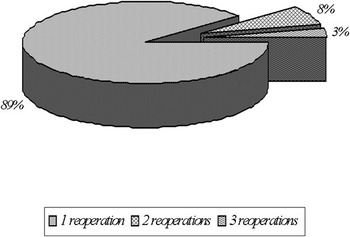
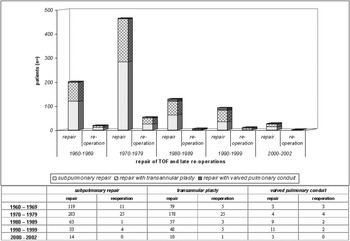
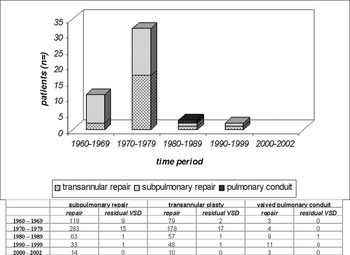
In 91 patients, we performed 102 reoperations late after correction of tetralogy of Fallot (Fig 1). The mean time interval between corrective surgery and the first reoperation was 12.8 years in the range from 1 month to 36 years. The number of patients who underwent correction of tetralogy of Fallot in our institution in each decade of the study, categorised by the type of repair, and the number of patients who subsequently required cardiac reoperation at any point in time are presented in Figure 2.
Distribution of reoperations late after correction of tetralogy of Fallot.

The number of patients who underwent correction of tetralogy of Fallot in our institution in each decade of the study period and the corresponding number of patients who subsequently required cardiac reoperation at any point in time.

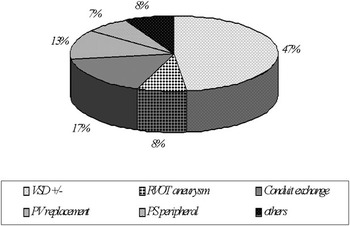
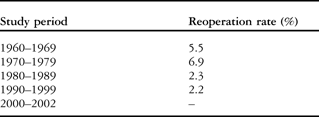
Residual ventricular septal defect was the most common primary indication for reoperation (47%), (Fig 3). In 28 cases, we performed reoperative surgery for an isolated residual ventricular septal defect, and with concomitant surgery in 20 cases with resection of aneurysm of the right ventricular outflow tract in 13 cases and surgery for pulmonary stenosis in seven cases. Two patients were reoperated on twice for persistent ventricular septal defect. The rate of reoperative surgery for residual ventricular septal defect decreased over time to 2% (Table 1 and Fig 4).
Indications for reoperation late after correction of tetralogy of Fallot. VSD+/−, ventricular septal defect with or without concomitant procedure; RVOT, right ventricular outflow tract; PV, pulmonary valve; PS, pulmonary stenosis.

The rates of patients who required reoperation for residual ventricular septal defect at any point in time broken down into each decade of primary repair (with and without concomitant procedures).

The number of reoperations for residual ventricular septal defect, with or without concomitant procedure, in each decade of the study period; VSD, ventricular septal defect.

The second main group of reoperations involved the pulmonary artery or pulmonary valve (Fig 3). The pulmonary valve was replaced in 13 cases: with a xenoprosthesis in five cases or a homograft in eight cases for severe regurgitation in seven patients, or stenosis in six patients. Deterioration or failure of implanted valved pulmonary artery conduits resulted in 17 conduit replacements, including concomitant procedures on peripheral pulmonary arteries in three cases and residual ventricular septal defect in four cases. In all, four patients underwent multiple pulmonary conduit replacements – three patients underwent three replacements and another patient underwent two replacements. The mean interval between valved conduit implantation and its replacement was 8.5 years, ranging from 1 to 16 years.
In addition to the 13 cases of aneurysm of the right ventricular outflow tract with concomitant residual ventricular septal defect, another eight cases of right ventricular outflow tract aneurysms were found. In all but one of these cases, resection of the aneurysm was combined with reconstruction of the peripheral pulmonary arteries. In 18 of the 21 cases with aneurysm formation of the right ventricular outflow tract, an untreated autologous pericardial patch was used for enlargement during the repair surgery.
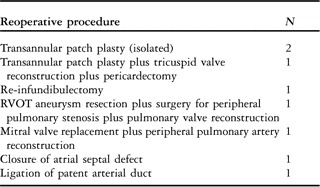
Significant peripheral pulmonary stenoses were found and operated on in eight cases. The remaining rare cases are listed in Table 2.
Breakdown of miscellaneous rare reoperations late after correction of tetralogy of Fallot.

RVOT, right ventricular outflow tract
There was no correlation between reoperation late after correction and the surgical technique regarding transannular patching and preservation of the pulmonary valve at repair. In all, 39 patients out of 372 patients (10.5%) with transannular patch underwent reoperation late after repair and 41 out of 512 patients (8.0%) with preservation of the pulmonary valve underwent reoperation late after repair (p = 0.205). Excluding closure of the isolated residual ventricular septal defect, there is a statistically significant correlation between reoperation late after repair and surgical technique regarding transannular patching or preservation of the pulmonary valve at repair; 30 out of 372 patients (8.1%) with transannular patch and 23 out of 512 patients (4.5%) with preservation of the pulmonary valve underwent reoperation, other than for isolated residual ventricular defect, late after repair (p < 0.05).
Patients who underwent implantation of valved pulmonary conduits at repair needed more frequent reoperations in 11 out of 30 patients (p < 0.05) compared to the patients with transannular patching or to the patients with preservation of the pulmonary valve at repair.
Discussion
Reoperations late after correction of tetralogy of Fallot are reported with variable incidence. Our results are comparable with the findings of Boening et alReference Boening, Scheewe and Paulsen6 and indicate that the surgical technique used in repairing tetralogy of Fallot, as for instance the use of transannular patch compared to preservation of pulmonary valve, does not influence the reoperation rate late after correction. However, when we excluded closure of isolated residual ventricular septal defect, the rate of reoperation was significantly decreased after repair with preservation of the pulmonary valve in comparison to repair with transannular patching. Furthermore, patients who underwent implantation of valved pulmonary conduits at initial repair needed more frequent reoperations than those who underwent repair with transannular patching or with preservation of the pulmonary valve at repair. Groh et alReference Groh, Meliones and Bove7 found that freedom from reoperation decreases with older age at primary repair. In contrast, Pigula et alReference Pigula, Khalil, Mayer, del Nido and Jonas8 reported that the diagnosis and morphology of tetralogy of Fallot at repair exerts a greater influence on the need for reoperation.
Most reoperations late after correction of tetralogy of Fallot in this study were for residual ventricular septal defect with or without combined procedures in about half of these patients. In the cases of isolated residual ventricular defects, a Qp:Qs ratio of 1.4 or more was the indication for reoperation. The majority of these patients were originally operated on in the early era of corrective surgery of tetralogy of Fallot with a significant decline in the incidence of residual ventricular septal defects during the last years of the study period. These data are comparable with the findings of Norgaard et al.Reference Norgaard, Lauridsen, Hevind and Pettersson9 Possible explanations could be an improvement in surgical techniques and materials for ventricular septal defect closure and especially the development of heart–lung machine technology and more sophisticated application of myocardial protection over the years resulting in improved intraoperative visualisation and more effective closure of the ventricular septal defect, even in younger individuals. In addition, the increasingly routine use of intraoperative transoesophageal echocardiography may reduce the incidence of residual ventricular septal defects.
In most patients, after correction of tetralogy of Fallot, pulmonary regurgitation is present to some extent, especially in patients who underwent transannular patch plasty during the initial repair. Pulmonary regurgitation is well tolerated by most patients for a long period of time, although some of them may develop progressive right ventricular dilatation with subsequent right ventricular failure. In the long term, d’Udekem et alReference d’Udekem, Ovaert and Grandjean10 found that transannular patching as well as incision limited to the right ventricle is responsible for a similar degree of pulmonary insufficiency and right ventricular dilatation. Nevertheless, many surgeons feel that transannular patching leads even in the long term to a greater degree of pulmonary insufficiency and right ventricular dilatation in comparison to a valve-preserving incision to the right ventricle.
Our indications for pulmonary valve replacement are severe pulmonary valve regurgitation or moderate pulmonary valve regurgitation with one of the following findings: clinical symptoms of the New York Heart Association cardiac failure class III or greater, decreased performance capacity on exercise testing, or right ventricular dysfunction. In a study by Cesnjevar et alReference Cesnjevar, Harig and Raber11, pulmonary valve replacement was found to reduce right ventricular pressures and size after repair. Comparable to pulmonary regurgitation, some residual right ventricular outflow stenosis is also well tolerated by most patients, but some of them may develop progressive right ventricular failure. Careful long-term follow-up is required, with an emphasis on right ventricular function to define the indication for reoperation. We suggest surgery in cases of right ventricular outflow stenosis with right ventricular dysfunction and/or severe right ventricular dilatation. The use of mechanical prostheses in the pulmonary position has been described,Reference Rosti, Murzi and Colli12 although we have avoided their implantation due to the increased risk for thrombosis. Nevertheless, mechanical pulmonary valve replacement may be an option in older patients.
The primary use of conduits resulted in an increasing number of reoperations for conduit exchange due to degeneration or failure. Valved conduits may serve well in the early and mid-term post-operative period, but all conduits deteriorate and are mostly obstructed in the long term, resulting in replacement at regular intervals.Reference Jonas, Freed, Mayer and Castaneda13, Reference Niwaya, Knott-Craig, Lane, Chandrasekaren, Overholt and Elkins14 In our study, the mean time interval to replacement was 8.5 years.
The use of untreated autologous pericardial patches to enlarge the infundibulum often led to aneurysm formation resulting in reoperation. Therefore, we currently follow the policy of using either a Dacron or polytetrafluoroethylene patch to enlarge the right ventricular outflow tract and only in newborns or in very young and dystrophic infants did we occasionally use the autologous pericardium. From a theoretical point of view, the use of an autologous pericardial patch treated chemically with glutaraldehyde could also be an option, although we do not have enough experience with this method in enlarging the right ventricular outflow tract.
Because of the occasionally very long-time interval between repair surgery and the need for reoperation, in our study group up to 36 years, we suggest life-long follow-up of these patients in specialised congenital cardiac centres.
In conclusion, although operative techniques and the timing of surgery are controversial, outcomes after correction of tetralogy of Fallot are excellent and the reoperation rate in the current era is low. Residual ventricular septal defects were common in the first decades of our study period, although the incidence has decreased in recent years, probably due to improvements in surgical technique and echocardiographic control during repair surgery. Enlargement of the right ventricular outflow tract by untreated autologous pericardial patch may lead to aneurysm formation and necessitate reoperation.