The contrast between an ethnic and a civic conception of the nation is a well-known discussion in the literature on nationalism (Kaufmann and Zimmer, Reference Kaufmann and Zimmer2004); it has even been qualified as “exhaustively mined” (Zubrzycki Reference Zubrzycki2001). The core idea of this dichotomy is that the civic conception of nation would define national belonging with criteria like the will to be a member of the nation or the participation in political institutions, whereas the ethnic or ethnocultural conception would make belonging to a nation a heritage of blood or customs. Despite these blurred borders (Brubaker Reference Brubaker2006), this distinction is still very much employed in qualitative and historical sociology (Breton Reference Breton1988; Kaufmann Reference Kaufmann2000; Kaufmann and Zimmer Reference Kaufmann and Zimmer2004; Smith Reference Smith1986; Zubrzycki Reference Zubrzycki2001) as being used to account for quantitative data (Hjerm Reference Hjerm1998; Jones Reference Jones2000; Jones and Smith Reference Jones and Smith2001; Kunovich Reference Kunovich2009; Reeskens and Hoogue Reference Reeskens and Hooghe2010; Shulman Reference Schulman2002, Reference Schulman2004).
In this paper I attempt to answer to two empirical questions: how do people define the conditions to be recognized as a member of their own nation? Are there theories of national belonging specific to certain countries? The ethnic-civic dichotomy provides a first answer to those questions: two opposed definitions of national belonging; some countries are often thought of as better characterized by one of these definitions than by the other. In the first part of the paper I shall examine the relations between the mode of explanation in social sciences and the use of this dichotomy. I shall argue that this dichotomy is a theory which belongs to a reason-based approach: authors who use it attempt to describe national self-understanding by depicting the logical coherence of actors’ beliefs. I will set forth this reason-based approach and spell out the reasons why the ethnic-civic dichotomy can be considered as belonging to it. Thereafter I will present some of the shortcomings of this dichotomy through an analysis of the existing literature. I contend that cognitive psychology can offer models which overcome some of these shortcomings. I follow thereby Brubaker who held that cognitive psychology can enrich our understanding of the mechanisms of categorisation which underpins ethnicity, race and nationhood (2006). Using cognitive psychology does not only amount to formulate different theories but also to adopt a causal mechanism approach. Explaining a belief would be finding mechanisms that determine it instead of depicting the actor’s reasons to adopt this belief. I will thus present the prototype model of categorisation used in cognitive psychology (Minda and Smith Reference Minda, Smith, Pothos and Wills2011; Rosch Reference Rosch1999) as a possible alternative to the ethnic-civic dichotomy. Contrary to the assumptions of this dichotomy, this model does not imply that belonging to a category depends on a logical structure of criteria but rather upon the distance from a prototype representing the central tendency of the category.
The second part of the paper will confront empirically the ethnic-civic dichotomy and the prototype model of categorisation applied to national self-understanding. Thus I will raise the following questions. How do people have a coherent theory to determine who is and is not a true member of their nation, or do they rather have an image of a typical member of their nation (a national prototype) to which many criteria contribute without constituting a logical set? To what extent do people appeal to the ethnic-civic dichotomy and to what extent do they rely upon national prototypes? Data coming from the International Social Survey Programme (issp) and of 2003 study devoted to “National identity” encompass France, Great Britain, and West-Germany. The comparison between these three cases offers a privileged example of contrasts between different national patterns (Brubaker Reference Brubaker1992; Favell Reference Favell1998). German data come only on from West-Germany for the purpose of simplification. I will proceed in two steps: I will examine answers to questions concerning the definition of “what is a true member of the country” and afterwards to questions concerning the integration of foreigners. The first step will confirm the importance of the prototype model and thus of the causal mechanism approach, whereas the second one will evidence more sharply its shortcomings and will identify in which cases a reason-based explanation is necessary.
Reason-based explanation and the ethnic-civic dichotomy
This contract between the two approaches springs from a more general methodological issue in the social sciences which has its origin in the Methodenstreit: the conflict about the methods used in the social sciences and whether they differ from those used in the natural sciences. In this regard I focus on a specific issue of this debate: the opposition between explanations by means of “reasons” and explanations by means of “causes” which has led to a large amount of philosophical discussion. The reason-based approach is generally formulated in the context of the explanation of action: it assumes that accounting for someone’s action consists in describing his “reasons” for acting and therefore that the reasons given by the actor are the causes of his action. It is a way of characterising explanation in the social sciences and of opposing it to the natural sciences which are considered as formulating laws determining the behaviour of their objects.
I do not aim to present a philosophical contribution to this question; I shall only make use of some elements of this debate insofar as it enables me to provide a better account of the question of national self-understanding. Thus I will set forth three intertwined elements I hold crucial to understanding how the reason-based approach permits an account of national self-understanding in sociology: the general conception of rationality, the holism of the mental and the principle of charity.
For a general conception of rationality in sociology, the paradigm derives from Max Weber's distinction of theoretical rationality and value rational actions (Kalberg Reference Kalberg1980; Weber Reference Weber1971 [1956]) or in the methodological propositions of Raymond Boudon (Reference Boudon2003). Boudon stated thus that in order to explain an individual’s action one has to find his reasons for behaving in that manner and hence to postulate that any action or belief, either descriptive beliefs or normative ones, is based on a system of “good reasons”. This approach amounts to revealing the inner consistency of a set of beliefs and thus leads to the definition of rationality used by Donald Davidson (Reference Davidson2004) and that the philosopher Dagfinn Føllesdal called the weakest definition of rationality: rationality as logical consistencyFootnote 1. In such an approach, one has to understand beliefs by relating them to one another, as when Weber depicts the relations between the protestant ethic and the spirit of capitalism.
This definition of rationality as logical consistency provides a way of tackling the issue of national self-understanding, for it implies the depiction of a system of beliefs that leads someone to consider himself as a member of a nation and to express positive and normative assertions coherent with this understanding. The philosophy of Donald Davidson allows us to go one step further by introducing two key elements that shed light on the underlying assumption of this mode of explanation: the holism of the mental and the principle of charity (2001a, 2001b, 2004).
The holism of the mental holds that there are no isolated beliefs; each belief is always logically related to a countless number of others (Davidson Reference Davidson2001a, Reference Davidson2004). For example, the belief that one is a member of a nation is part of a much more general knowledge: the knowledge that there are other nations; that many nations are characterized by specific cultures and languages; that, generally, a particular city is the capital of a country, etc. Isolated from all these beliefs, the belief in being a member of a nation does not make any sense. It means that far from dealing simply with a feeling of measurable intensity or an inner psychological state, dealing with the self-understanding of someone as German, for example, means dealing with a vast array of knowledge this individual holds about Germany but also about Europe and the world. It means thus that our object, national self-understanding, is not one belief, but always an entire set.
Finally (and circularly), understanding a belief as always lying in a set of beliefs requires a third element: the principle of charity. This principle requires us to consider the set of beliefs as having a logical consistency of which the researcher must make the most sense. If we understand a belief in light of its relationship with others, it means that we relate them rationally; we try to understand the coherence between them. The principle of charity is simply a logical necessity, not an empirical postulate (Davidson, Reference Davidson2001b, Reference Davidson2004). Otherwise, we assume that there is no logical or rational relation between the beliefs and, as I shall show later, we give up rationality and we reach the second approach which implies a causal explanation.
In this reason-based approach, national self-understanding is a system of beliefs about belonging to an abstract group, a nation. These three intertwined elements – the general conception of rationality, the holism of the mental and the principle of charity – describe the stance that most authors implicitly adopt when they deal with national self-understanding. They attempt to understand the relations between many beliefs. They depict them as though they form a theory or as though they are organized in a logical set. Therefore, the concept of “theory” takes place at two levels: authors formulate theories about people’s beliefs and they assume that these beliefs have the “form” of a theory. The ethnic-civic dichotomy corresponds to such an approach. It is a theory on people’s national self-understanding and it assumes that this understanding has the form of a theory: an ethnic theory or a civic theory.
Anthony Smith is one of the most often discussed authors in the literature dealing with the ethnic-civic dichotomy. He generated strong debates with his thesis that an ethnic group lies at the foundation of each nation, furnishing the nation with its myths, its symbols and its public culture (Smith Reference Smith1986; Kaufmann and Zimmer, Reference Kaufmann and Zimmer2004). Smith contends that some nations – the civic nations – are mainly characterized by ideological myths as opposed to others – the ethnic nations – mainly characterized by genealogical myths. In the civic myths, the emphasis is “on boundaries, legal institutions, rights and duties, citizenship and common culture”, whereas ethnic myths stress “genealogy, populism, customs and dialects, and nativism” (Kaufmann and Zimmer, Reference Kaufmann and Zimmer2004). He later proposed to oppose an “organic” form of nationhood to a “voluntarist” one. He thus provides a quite common formulation of the dichotomy: the ethnic conception would consider belonging to a nation a heritage (of blood or customs), whereas the civic one would make belonging to a nation a willing act of the individual. A common formulation of this civic nationalism is encapsulated in the famous quotation from Renan “la nation est un plebiscite de tous les jours”.Footnote 2 Another manner of depicting this contrast is to make it a version of the opposition between the ascribed characteristics and those which are chosen or acquired (Brubaker Reference Brubaker2006; Jones and Smith Reference Jones and Smith2001). In the first case, nationality is an objective or an essential characteristic of an individual and cannot be changed. In the second case, it is something someone can acquire and which is related to his behaviour.
This ethnic-civic dichotomy was famously used by Hans Kohn to contrast civic and “liberal” Western States with ethnic and “illiberal” Eastern ones (1944, 1982). This thesis has encountered very strong and virulent criticisms, because of its normative stance and because no nation can be considered as only ethnic or civic (Kuzio Reference Kuzio2002; Schulman Reference Schulman2002; Yack Reference Yack1996). However, most authors always stress that these definitions are ideal-types which do not reflect a strict opposition and they generally take great care to mention the limits of this distinction (see for example: Smith Reference Smith1986; Breton Reference Breton1988; Kaufmann and Zimmer Reference Kaufmann and Zimmer2004; Zubrzycki Reference Zubrzycki2001). They contend that it can be used despite the fact that obviously one cannot assign only one conception of nation to all the members of a given country.
Zubrzycki’s paper (2001) furnishes an example of such a use. She shows that this distinction lies at the centre of a political conflict in Poland about the third line of the preamble of the Polish constitution: “We, the Polish Nation – all citizens of the Republic”. According to her, this line “encapsulates the tension between the civic and the ethnic visions” (p. 636). The first formulation “We, Polish citizens” encountered a strong opposition from the Catholic Right and the official hierarchy of the Catholic church, for it did not refer to Poles as a “nation”. The controversy even led to poll being conducted in which 70 % of Poles declared to be in favour of the formulation “We, the Polish Nation” against 20 % in favour of “We, Polish citizens”. The final formula thus constitutes a compromise. In this case, the ethnic-civic dichotomy is a category mobilized by the actors in the political conflict rather than an analytical categoryFootnote 3. She also considers that the ethnic conception of the nation in Poland is a reality that can be explained:
“The nation, in Poland, is primarily understood in ethnic terms. Because Poland was deprived of a state (or of a sovereign state) for most of her modern history, ‘nation’ and ‘state’ have historically been understood as distinct if not antagonistic there” (ibid. p. 638).
An important question emerges from this thesis: can conceptions of national belonging or national self-understanding be specific to a country? That is also the assumption of the classical work of Rogers Brubaker on France and Germany (1992). Contrary to what is sometime asserted he does not use the ethnic-civic dichotomy to distinguish between France and Germany. He states that in France the conception of nationhood is state-centered, which means that the state pursues political and cultural unity and assimilation, which is quite different from the civic conception emphasising the will of the individual. He however shares a common perspective: after highlighting that one must not make a radical distinction, he asserts that there are two different national conceptions of nation: a French and a German one. The same stance can be found in Adrian Favell’s work (1998) which undertook an investigation of the different ways France and Britain deal with the integration of foreigners. According to him, these two countries are characterized by different philosophies of integration. Describing the French philosophy of integration, he even states that “this is ultimately a theory about the nature of an individual’s national identity” (p. 69). Another perspective is to use this dichotomy to characterize the evolution of national self-understanding. Breton describes the evolution of nationalism in English Canada and in Quebec as changing from an ethnic conception to a civic one (1988). We can find the same perspective in Kuzio (Reference Kuzio2002): his critics of the myth of the civic state lead him to assert that all western countries came from an ethnic conception to a civic one.
I shall view these kinds of approaches as reason-based. Authors depict numerous beliefs which, as Favell writes, “fit together” (1998). The ethnic-civic dichotomy, when applied to comparing countries, asserts that such a conception of national belonging can be specific to a country. This could be explained, as Zubrzycki wrote, by “specific cultural and historical legacies that frame the discursive field on the nation, as well as by specific political and institutional arrangements” (Zubrzycki Reference Zubrzycki2001, p. 631). In the same stance, Brubaker explained the difference between France and Germany on the basis of the specificities of the history of the state in each country (1992); Favell holds that path dependence explains the fact that France and Britain maintain a specific philosophy of integration defined during debates of the 1970s and 1980s (1998).
These examples show that the reason-based approach can be used with some relevance to describe the definitions of national belonging and the tensions to which these definitions lead. The ethnic-civic dichotomy raises however some important problems: it is very vague and the authors use it with a certain lack of consistency. Many papers have emphasised the difficulty of the distinction from an empirical and an analytical point of view. It has thus been proposed to distinguish between the ethnic and the cultural components (Kymlicka Reference Kymlicka and Ronald1999; Schulman Reference Schulman2002), so that the former refers only to the heritage of blood. However, as stressed by Brubaker, the ethnic conception becomes too narrow in this case and, empirically, most nationalists do not insist uniquely on race or blood but also on common traits like history, collective memory, culture or language. Therefore, ethnic nationalism is always an ethnocultural one. The same issue applies to the “civic conception”: “a purely acultural understanding of nationhood has never been widely held” (Brubaker, Reference Brubaker2006, p. 137). All theories of civic nationalism, notably Renan’s, also take into account phenomena like “commons values”, “historical memories”, etc. It therefore becomes difficult to empirically distinguish the ethnic conception from the civic one. This distinction is often presented as “analytical”, assuming that empirically most people combine elements of both components of national belonging. However, as Brubaker stressed, the distinction is not very strong at this analytical level either: it is not possible to state clearly that an element is ethnic or civic (2006). The language is the clearest example of the difficulty of the distinction. From one point of view, it is an element of ethnic nationalism (a heritage of a culture); from another, it belongs to civic nationalism as an instrument of communication and of the participation in political institutions.
As I already noted, authors are generally cautious before using this dichotomy. They always assert that taking too seriously leads to caricature. However, these precautions do not resolve the issue insofar as the authors do not really take this caution into account, aside from the ritual appeal to the methodology of “ideal-types”. It only makes the assertions even vaguer and therefore the criticism even more difficult. What does it means to assert that an opposition is a caricature while nonetheless using it? Who is concerned by this opposition: intellectuals? Are these conceptions only formulated in texts or are they theories that people really hold? Does it reflect the laws or the conceptions of the political class? Does it mean that an individual can share both conceptions of nation? These questions or remarks can seem pedantic. They nevertheless show the vagueness of a theory and the inescapable problems and contradictions in which a researcher can find himself when trying to implement it in an empirical study. I will spell out that point by presenting the use of this dichotomy in the quantitative literature. One of the advantages of quantitative data is that they can make even more apparent the underpinning contradictions of a theory.
This dichotomy furnishes an example to which quantitative methods can be applied without difficulty and with justification. Notably examining whether the dichotomy can describe the representations of belonging shared by most people of a country or only a small fraction. They thereby avoid the need to rely on texts or state policies which “embody the views of a very narrow segment of the state’s population: the political elite in power” (Schulman Reference Schulman2002). Therefore, the two problems I referred to in the introduction can be tackled more precisely: how do people define the conditions that are necessary for being recognized as a member of their own nation? Are there theories of national belonging specific to certain countries? A question from the International Social Survey Programme is commonly used on this topic.

Even though the answers to these questions have been extensively examined, there is still no real consensus among the authors as to their interpretations and conclusions. Jones and Smith (Reference Jones and Smith2001) or Kunovich (Reference Kunovich2009) provide an empirical corroboration of the distinction, whereas Haller and Ressler (Reference Haller and Ressler2006) or Diez Medrano (Reference Diez Medrano2005) consider that they have refuted it.Footnote 4 Reeskens and Hooghe assert that they have confirmed the validity of the dichotomy but also that the measures of the two dimensions are not equivalent cross-nationally (2010). These diverging interpretations of the same or similar data stem mainly from the conceptual vagueness of the distinction. Firstly, depending on the author, the items do not belong to the same conception. For example, Hjerm (Reference Hjerm1998) states that Born Footnote 5 and Life belong to the ethnic conception. Similarly, Jones (Reference Jones2000) assigns them to a “nativist” concept along with Religion and opposed to the “affective civic culture”. However, for Haller and Ressler these two items belong to a state-nation concept that they oppose to an ethno-cultural concept. For Schulman (Reference Schulman2002) also, these criteria belong to the civic conception opposed to a cultural national identity concept containing Religion and Language. A same review of the differences between authors could be done with Language or Feeling: sometimes they are in a civic or state nation concept and sometimes in an ethnic or ethnocultural one. Authors have thus to make very questionable choices only for characterizing those very common items: it will inevitably imply different interpretations of the results. Secondly, the respondents did not have sharp opposed conceptions of national belonging. Because of this lack of opposition, authors tend to shoehorn the data into the dichotomy. Kunovich (Reference Kunovich2009) called “Ethnic” a factor containing the items Citizenship and Life because it also contains Ancestry. Reeskens and Hooghe chose to put Citizenship out of the analysis because it was correlated with the civic and the ethnic conceptions and they also removed Life because of a strong cross loading. Despite their different methods and interpretations Haller and Ressler (Reference Haller and Ressler2006), Kunovich (Reference Kunovich2009) and Reeskens and Hooghe (Reference Reeskens and Hooghe2010) obtained very similar results. Haller and Ressler distinguished a factor mainly constructed with Born, Ancestry, Life, and Religion against a second factor with Language, Feeling and Laws. Kunovich (Reference Kunovich2009) and Reeskens and Hooghe (Reference Reeskens and Hooghe2010) obtained roughly the same opposition. Contrarily to Kunovich or Reeskens and Hooghe, Haller and Ressler interpret this result as a refutation of the dichotomy and as a confirmation of the ascribed/action-related distinction. Finally, many authors adopted Hjerm solution:
“to avoid this inconsistency, a third ideal type of national identity will be introduced: multiple national identity, or the combination of ethnic and civic national identity. There are also people with no or only a weak sense of national identity; they will be called pluralists” (Hjerm, Reference Hjerm1998).
Hjerm’s table 2 shows that multiple national identity characterized the majority and that a purely ethnic conception is very rare (between 1.2 and 6.8 % of respondents).Footnote 6 Kunovich also notes “the prevalence of multiple nationalists [...] who claim all the items are salient for national membership” (2009, p. 581) and Reeskens and Hooghe the strong correlation between the two components. The results of the comparison between countries or regions of Europe are similar. Schulman as Haller and Ressler found that most of the time, there is not a real opposition between countries or regions. Schulman asserts therefore that scholars should be more cautious when claiming that countries differ in their concept of nationhood (2002).
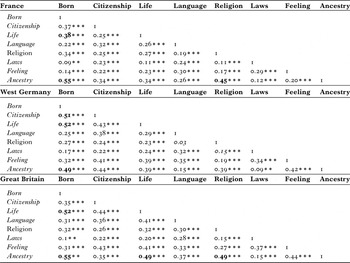
CorrelationsFootnote a between the criteria in France, West Germany and in Great Britain

Sources: issp 2003.
a Kendall’s tau-b coefficient. For each country, the three strongest correlations are in bold.
* p < 05, ** p < 01, ***p < 0001
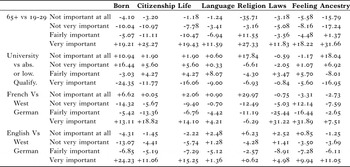
Definitions of national belonging, nationality, age, and educational degree

Differences in percentage predicted by eight multinomial logit models. Each column corresponds to one model.
Lecture: when Age and Educational degree are controlled, being French instead of being West German raises the probability of choosing “Very important” to the proposition Born of 0.1311 or of 13.11 percentage points.
Sources : issp 2003
These quantitative papers reveal the empirical difficulties associated with the conceptual ambiguities of the dichotomy: if authors do not give the same interpretation to the items which are proposed to the respondents, it is likely to be the same for the interviewees. The ethnic-civic dichotomy appears to be neither good analytically, nor empirically: authors disagree on the interpretation of the items and, empirically, these two conceptions of nation turn out to be very correlated. I shall argue that the problem does not lie in the theory but in too strong a use of the reason-based approach which leads to the scholastic fallacy described by Pierre Bourdieu (Reference Bourdieu2000). I shall turn to the causal mechanism approach to make clear its contrast with the reason-based approach. I will claim that this approach can help in providing a better understanding of the data discussed by the authors.
The causal mechanism approach and the prototype model of categorisation
Against the reason-based approach which depicts the logical consistency between beliefs and actions, a causal approach emphasises the importance of laws or mechanisms determining the beliefs and the actions of individuals. This approach often strongly contrasts the explanations by “reasons” to the explanations by “causes”: “The belief, even the belief that is the basis of the universe of science, is of the order of the automaton, the body, which, as Pascal never ceased to remind us, ‘has its reasons, of which reason knows nothing’” (Bourdieu Reference Bourdieu2000, p. 26).
The “causes” are here the “the reasons of which reason knows nothing” and which can be found in the “body” conceived of as an “automaton”. Such a deterministic stance also characterizes cognitive psychology, for it does not depict logical relations between beliefs or “good reasons”; it rather postulates the existence of mechanisms or modules determining how people think. These mechanisms are mostly unconscious: the actor does not have any control on them and they are thought of as natural phenomena. I shall argue that explaining beliefs by depicting their logical relations is often insufficient and that sociologists should take into account explanations in terms of causal mechanism. As Weber stated, sociologist have firstly to describe actions as rational, but they also have to take into account the elements that can interfere with this rationality. Contrary to a widespread opinion, authors who emphasise the importance of socialisation can be considered as close to this perspective: any explanation referring to socialisation is indeed sustained by hypotheses about cognitive mechanisms such as perception, memorisation and the learning.
Following this perspective, I shall argue that cognitive psychology has to be used to make sense of how people respond to a survey on nationalism. There is indeed in psychology a long tradition of research in categorisation and representations than can contribute to the understanding of how people use categories of ethnic groups, races or nationhood (see Brubaker Reference Brubaker2006; DiMaggio Reference DiMaggio1997). One of the most well-known models of categorisation in psychology is generally presented in contrast to what is called a “traditional view”: a category is a logical set which “has clearly defined boundaries” and whose members “have attributes in common which were the necessary and sufficient conditions for membership in the category” (Rosch,Reference Rosch1999, p. 64). As opposed to this view, Eleanor Rosch proposed the prototype model of categorisation in which belonging to a category does not depend on a logical structure of criteria but on the distance to a prototype representing the central tendency of the category. It follows that, contrary to a logical set, the boundaries of the category are not clearly defined and that some of its members are better examples of this category than others.Footnote 7 One of the most classic examples is the category of birds: “most birds fly, have wings, feathers, claws and certain body proportions. That is why a robin is a good example of what most people mean by a bird, while an emu is a poor example” (Mahmood and Armstrong Reference Mahmood and Armstrong1992, p. 5). The idea that categories are defined neither by a finite number of criteria, nor by a logical structure, appears to be very well corroborated by empirical research on various subjects (Minda and Smith, Reference Minda, Smith, Pothos and Wills2011), even in the social sciences (Boltanski and Thevenot Reference Boltanski and Thévenot1983; Mahmood and Armstrong Reference Mahmood and Armstrong1992). For example, it is applied by Mahmood and Armstrong to a particular ethnic group, the Frisians, in the Netherlands (1992). They assert, based on a previous ethnography by Mahmood, that the members of this group were unable to provide a list of necessary and sufficient criteria to be considered as one of the group, even though most of them considered that they were “primarily Frisian” and only “secondly Dutch”. Therefore, there are no specific features that one must have to be a Frisian but there are many possible features (language, living in the heart of Friesland, etc.) that can make someone more or less close to the “Frisian” concept.
Such a model does not reveal “good reasons”; nor does it depict logical relations between beliefs. It explains a categorisation by making hypotheses about a mechanism of the mind and we suppose that all categorisations are based on this mechanism. A similar mechanism would explain that we believe in the existence of French or English as in the existence of birds and trees. In such an approach national self-understanding does not involve a conception of nation similar to a theory like the ethnic conception or the civic one, it is rather a categorisation underpinned by cognitive mechanisms. Therefore, being a member of a nation would mean sharing the characteristics that a typical member has, so to be close to the average of the category. As I shall spell out in the following, such an approach enables specific empirical predictions concerning national self-understanding. It is therefore possible to confront the two theories – the ethnic-civic dichotomy and the prototype model – on an empirical ground.
The definition of national belonging: an empirical examination
In order to implement this empirical confrontation, I use the same data that was used in many of the articles I discussed above: the issp survey of 2003 devoted to the topic of “National Identity”. I proceed in two steps. Firstly I examine answers to questions concerning the definition of “what is a true member of the country” and secondly to questions dealing with the integration of foreigners. In both cases, I attempt to evaluate to what extent these two theories – the ethnic-civic dichotomy and the prototype model of categorisation – respond to the following problems: how do people define the conditions for being recognized as a member of their own nation? Are there theories of national belonging specific to certain countries? I make use of data encompassing France, West Germany, and Great Britain. In the literature I presented, these countries are often described as having a specific definition of national belonging (Brubaker Reference Brubaker1992; Favell Reference Favell1998). Hence, they do not only furnish a way of testing the ethnic-civic dichotomy but also a way of presenting results that sheds light on the difficulties of the reason-based approach or the various attempts to reveal a logical consistency in the use of criteria to define who is a member of a nation.
If people are asked what are the criteria required to be a true member of their nation, the ethnic-civic dichotomy should predict that respondents will use criteria which constitute a coherent set. They tend not to use, or use less often, characteristics of opposed conceptions of national belonging (for example, to have citizenship of the country and to have ancestry from the country). Therefore, from a statistical point of view, the ethnic-civic dichotomy predicts that the usage of criteria which belong to different conceptions of national belonging will be negatively correlated or, at least, less correlated. On the contrary, the prototype model implies that to determine who is a true member of their nation the respondents will refer to what is thought of as a typical member of their nation. Therefore, the prototype model does not predict any negative correlation among the usage of criteria which belong to different conceptions of national belonging, as long as the characteristics to which criteria refer are not negatively correlated in the reality. I start by computing the correlations between the answers to the question I presented above (p. 73), which asks respondents to rate the importance of eight criteria to be considered as a true member of their country.
First of all, there is no negative correlation to be seen. It already excludes any strong opposition between an ethnic conception and a civic one. Respondents who rated high a criterion always tended to rate high all the others and thus they did not choose between criteria. We can observe this phenomenon in the three countries under investigation, which suggest the existence of a common mechanism. Secondly, the relative strengths of the correlations cannot always be explained by the ethnic-civic dichotomy: in West Germany and in Great Britain, Feeling and Ancestry are more or as correlated as Feeling and Citizenship or Feeling and Life. The correlation between Ancestry and Life is often among the strongest as well as Ancestry and Born. Some very weak correlations, such as those between Laws and Religion or Laws and Ancestry, are more in favour of an ethnic-civic dichotomy. Hence, we can spot some variables which are more correlated with one another, but certainly not a pattern which would oppose a conception of nation to another.
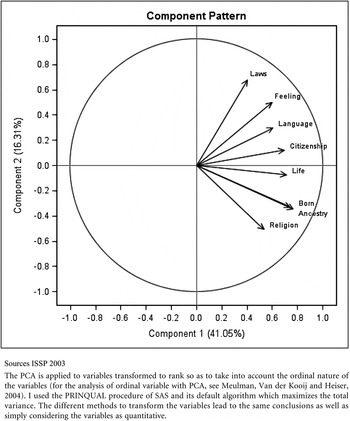
In order to summarise and represent the relationships between these variables, I used a principal component analysis (pca). The first graphic plots the first component against the second one and provides thus the best geometrical representation in a two-dimensional space of the relations between these variables. For sake of simplicity I present only the result of the analysis conducted on the three countries rather that one analysis for each country treated separately. The differences between countries are somewhat weak and do not change the results I will comment.
Principal Component Analysis on the definitions of national belonging

On the horizontal axis, which corresponds to the first component, all the vectors representing the variables have the same direction. This component synthesises the positive correlations between all these variables and it accounts for 41 % of the variance. The opposition between different forms of nationalism appears only with the second component (the vertical axis) which opposes mainly Laws, Feeling and Language to Religion, Born and Ancestry: I obtain roughly the same opposition than Haller and Ressler (Reference Haller and Ressler2006), Kunovich (Reference Kunovich2009), and Reeskens and Hooghe (Reference Reeskens and Hooghe2010). This opposition could represent the ethnic-civic dichotomy but this interpretation remains very questionable. Moreover, this component only accounts for 16% of the variance. Hence, the best representation of the data is by far the first component. It implies that the most important opposition among respondents is between those who value the importance of all criteria to those who do not and actually refuse any substantive definition of national belonging.
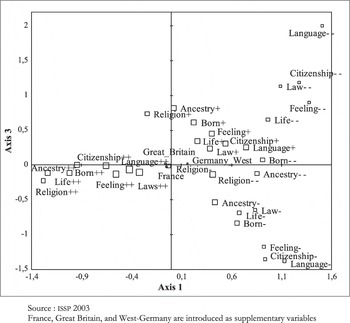
I also used a Multiple Correspondence Analysis (mca) so as to draw attention to the relations between the categories of the variablesFootnote 8 and thereby to corroborate the previous result. I categorise each possible answer to the questions listed above according to the 2 X 2 combination of the couples “radical-moderate” and “positive-negative”. For example, I call “positive radical” the answer that “Language is very important to being a true French person” and I refer to it as Language ++. I call “negative moderate” the answer “Language is not very important to being a true French person” and I refer to it as “Language -”.
Multiple Correspondence Analysis on the definitions of national belonging

The second graphic yields a geometrical representation of the first and the third factors of the mca. It enables us to analyse the proximities and distances between all of these categories. On the first axis, all the positive radical answers (“++” or “Very Important”) are on the same side and all the negative ones (“- -”) are on the other side. The second factor (not represented in the graphFootnote 9) opposes those radical answers to the moderate ones: almost all radical answers are on one side of this second axis and all the moderate ones are on the other. The third axis reproduces the same opposition between the moderates: all the positive moderate answers are on the one side and all the negative moderate answers on the other. Once again, the most important opposition is not related to different conceptions of national belonging. Such an opposition would have meant Laws ++ on the one side of the first axis and Ancestry ++ and Religion ++ on the other side. On the contrary, these variables are all on the same side of the first axis. This suggests once again that the most important opposition is between respondents who answered that a “true” English, French, or German person has all the characteristics proposed to those who disregard all these criteria. I obtain this opposition among the radical answers and among the moderate ones. It means that many respondents gave exactly the same appreciations to all propositions and this underscores even more strongly that most respondents did not choose between those criteria. We can notice that Religion +, Ancestry +, and Born + are isolated from the other moderate positive answers and that that Religion - - and Ancestry - - are on the other side of the third axis compared with the other negative radical answers. Religion ++, Ancestry ++, Life ++, and Born ++ are on the same side of the first axis (left side) with all the other radical positive answers but at the extremity of this side of the axis. As previously, it suggests that the contrast between different conceptions of national belonging exists but as a second order phenomenon.
These results show that in the three countries the most important opposition between respondents is not related to the content or to the meaning of the criteria. It corroborates the importance of the prototype model for which belonging to a category does not imply specific criteria or a logical structure of criteria but only to share most criteria a typical member has. It also draws attention on the bias of authors only or mainly interested in the ethnic-dichotomy: they focus on an opposition postulated by qualitative and theoretical literature but which is secondary in the data and gave little attention to the most important opposition (except for Diez Medrano 2005). These results could be explained by a general tendency of respondents to give always the same answer. Actually this opposition also is very useful, for it corresponds to differences between social groups and countries.
I estimated eight multinomial logit models in order to identify the effects of the educational degree, the age, and the nationality on the probability of choosing each answer.Footnote 10Table 2 sets out the average effect on the probability of choosing a category, hence the differences in percentages predicted by the models.Footnote 11
Most of the effects of the variables Age and Educational degree on the different definitions of national belonging are in the same direction: oldest people systematically have a higher probability of answering “Very important” than those aged between 19 and 29; people who hold a university degree always have a lower probability of answering “Very important” with the exception of the answer to Laws for which the difference is very weak. It is a very important result, for it means that different social groups, divided according to their age or educational degree, are not characterized by different forms of national self-understanding, but much more by their stronger or weaker reluctance to have a definition of national belonging. Once again, the results are not straightforward: these effects differ in strength. The strongest effects of the variable Age are on Ancestry and Religion. Aging people are much more likely inclined to define a true member of their nation by their ancestry or their religion. However, they are also more likely to use all the other items. A similar result appears when we compare English and French to West German. All important effects are in the same direction: the West German answer “Very important” systematically less often than the French and the English. The only exception is the response to Religion (only compared with the French). It is worth noting that West German answer “all the time” more often “Fairly important”, it means that they do not pick the most radical answer but they still agree to provide criteria. We can also notice that the effect of being French is always positive – except for Religion – but particularly strong on the variables Laws and Feeling.
To our knowledge, the only author who really tackled this aspect of the data on a theoretical ground is Diez Medrano (Reference Diez Medrano2005).Footnote 12 He reached similar conclusions. Focussing only on Spain, he made the same point: the Spanish accept all criteria and that the correlations between those criteria are all positive; therefore distinguishing between different conceptions of national belonging is not the appropriate manner in which to account for the data. Referring to Max Weber, he argues that national identity has to be understood by reference to the number of barriers that people use to close access to nationhood. He formulates the opposition as follow: “Postnationalists are indifferent to whether individuals fulfil any criterion whatsoever, whereas Credentialists demand the fulfilment of a long list of criteria in the national community” (Diez Medrano Reference Diez Medrano2005). I think however that the results show that the number of criteria (or barriers) is not really important: the opposition lies not in the use of many or few criteria but between most criteria or nothing.
These comparisons lead to the same result: the most important opposition is between those who provided a strong definition of national belonging and those who did not provide any definition at all. This opposition also corresponds to a difference between social groups defined by their age or their educational degree. The fact that many respondents and, above all, the most radical ones do not consider a strict contradiction or opposition between these criteria clearly does not speak in favour of the empirical importance of the ethnic-civic dichotomy or of any similar theory which would oppose different conceptions of national belonging to account for national self-understanding. To a certain extent, the results support the prototype model. People seem not to have a coherent theory for determining who is or who is not a true member of their nation, but more an “image” (“a prototype”) to which many criteria contribute. The “true” English, French or German is defined by numerous criteria that do not constitute a set organized by a simple rule like willing to be a member or inheriting the nationhood. To this regard, it is important to notice that Religion and Ancestry are the only criteria which are not accepted by a strong majority. This is especially interesting for Ancestry because we can assume that a large majority of the members of each of those countries in fact have ancestors in the country. It means that an empirical perspective which would define a member of a country only as someone sharing the characteristics that most people in fact have is not entirely accurate. The prototype model cannot explain these answers given to Ancestry or even to Religion. The effect of the variable Age on the variable Ancestry is beside the strongest effect of all the regressions I have used. It emphasises again the specificity of this answer and the fact that the ethnic-civic dichotomy cannot be totally discarded.
Because most authors had only a reason-based approach to national self-understanding, they have often treated this important result as “noise” and overlooked it. This outcome shows that distinctions between types of national self-understanding, such as the ethnic-civic dichotomy, cannot really explain people’s answers to such a survey, for it provides a too reason-based account for the way people categorise or answer surveys. Using only such a dichotomy amounts to a “scholastic fallacy”: putting a theory in the mind of the actors, thus explaining the actions or the beliefs as if they stem from a reflexive knowledge structured like a theory. This result is somewhat disappointing, for it is impossible to find a deep historical theory or a fine narrative to account for it. It should nevertheless not to be neglected, for it confirms a very important element of national self-understanding: while the ethnic-civic dichotomy specifies the explanation of national self-understanding, these results make it, along with ethnicity and many others related phenomena, an instance of a more general cognitive mechanism of categorisation (Brubaker Reference Brubaker2006).
Fortunately, these results do not suppress the importance of reason-based explanations. The problem arises when authors assume that people have a theory of national belonging (like the ethnic or the civic ones), it leading them to try to save the dichotomy by the means I described earlier. However, these problems of the reason-based approach and the risk of the scholastic fallacy should not imply a discording of this approach. At least, two results plead in that sense. As revealed by the numerous studies I have discussed there are also in the data oppositions that should be interpreted in a reason-based approach. There are criteria which are more correlated together than they are with others. Explaining that Religion and Ancestry are more correlated than Religion and Laws also requires understanding their relations with many other beliefs. Understanding such relations involves in fact having a reason-based approach and abandoning the causal mechanism approach of cognitive psychology. A similar point can be made about another result: the fact that the relations between criteria vary according to the countries (Kunovich Reference Kunovich2009; Reeskens and Hooghes, Reference Reeskens and Hooghe2010). People from some countries are more likely to share some specific representations of national belonging. A prototype model of categorisation could account for this result – the national variations of correlations – only by postulating that these correlations reflect the correlations between the real distributions of criteria among the population.Footnote 13 Understanding these relations also requires to situate them in more general sets of beliefs specific to a country and thereby to make use of a reason-based approach. In order to confirm these results and reinforce this last point, I shall turn to questions concerning the integration of foreigners which have the advantage of not constituting list of criteria on which one can simply agree or disagree all the time. They thus furnish a different kind of “experiment”.
The integration of foreigners
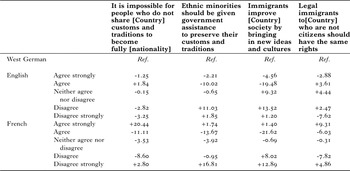
I shall now consider whether people from France, Great Britain, and West Germany have different conceptions concerning how to integrate immigrants and ethnic minorities. I estimated new statistical models on the following assertions:
Assertion 1: It is impossible for people who do not share [Country] customs and traditions to become fully [nationality]
Assertion 2: Ethnic minorities should be given government assistance to preserve their customs and traditions
Assertion 3: Immigrants improve [Country] society by bringing in new ideas and cultures
Assertion 4: Legal immigrants to [Country] who are not citizens should have the same rights
Table 3 presents differences in percentage predicted by multinomial logit models when Age and Educational degree are controlled. The French are more likely to agree strongly that it is impossible for people who do not share their customs and traditions to become a real member of their country. They also more often tend to disagree strongly with the assertion that ethnic minorities should be given government assistance to preserve their customs and traditions or with the assertion stating that immigrants improve society by bringing in new ideas and cultures. This could be explained by a more general intolerance. However, the fourth assertion “legal immigrants should have the same rights than citizens” yields results which weaken such an explanation. On this question the French do not seem to be more or less tolerant, but more divided: they are more likely to answer that they disagree strongly but also that they agree strongly. The English and the French are less likely than the German to agree with the assertion that immigrants improve society by bringing in news ideas and cultures. In this regard, both the English and French seem more reluctant about the mixing of culture.
Nationality and integration

Differences in percentage predicted by four multinomial logit models. Each column corresponds to one model.
Lecture: when Age and Educational degree are controlled, being French instead of being West German increases the probability of answering “Agree Strongly” to the first assertion of 0.2044 or 20.44 percentage points.
Sources : issp 2003
When the variables Age and Educational degree are controlled, the effect of nationality is still important. A prototype model of categorisation could hardly account for this result: different prototypes do not explain why the German or the English are less likely than the French to answer that people have to share their customs and traditions to become one of them. Moreover, another model built at the same level would hardly do a better job.Footnote 14 As already remarked by Davidson (Reference Davidson2001a, Reference Davidson2004), such a difficulty in using a causal mechanism (or a materialist) explanation is related to the holism of the mental. Understanding the reasons why the French are much more likely to disagree with the assertion that “Ethnic minorities should be given government assistance to preserve their customs and traditions” implies setting this assertion back in recent French political debate (described and analysed by Favell Reference Favell1998). It leads a description of the logical relations between many beliefs which legitimise such assertions. Speaking of these relations precisely involves giving up a causal approach in terms of mechanisms for a reason-based approach.
The first part of the empirical results, concerning the definition of national belonging, showed that most respondents can answer in a way that does not corroborate a reason-based approach in which a researcher would use analytical distinctions to describe people’s beliefs. However it does not follow from these results that people never have beliefs that would be logically related. The second part of the empirical investigation brings out the results for which a reason-based interpretation is more interesting for it throws light on how a same question, integration, can be conceived of differently because of different cultural and historical backgrounds. The reason-based explanation reveals the relations between beliefs and how the answer to a particular assertion can be understood in light of this background. The models of cognitive psychology become necessary when this mode of explanation fails, as in the first part of our empirical results, when depicting the logical relations turns out to be highly problematic or useless. Indeed at times it does not help to provide a coherent understanding of people’s beliefs or actions as when we explain someone’s behaviour by illness, madness or by common emotions such love, anger or even partisanship. Otherwise, when the system of beliefs makes sense in a reason-based approach, depicting its logical consistency is relevant and sufficient.
My first empirical result is that the prototype model of categorisation can, to some extent, account for national self-understanding. It means that, for most people, being a true member of a nation merely means exhibiting most of the criteria of a typical member. To this regard, defining what is an English, a French or a German is not very different than defining what is a bird. This result shows that we cannot properly account for a phenomenon like national self-understanding without a better comprehension of the mechanisms of categorisation. Notably, it allows us to avoid the scholastic fallacy which leads to describing common categorisations as if they were explicit and coherent theories. I argued that using the ethnic-civic dichotomy to explain empirical responses from interviewees corresponds, to a large extent, to such a scholastic fallacy. It can describe some differences between interviewees but it is clearly not a good description of the categorisations that underpin national self-understanding. Emphasising the importance of the prototype model of categorisation does not reduce sociology to psychology, for this model only contributes to an explanation of how people categorise. The prototype model explains that the majority of respondents accept very different criteria to define a member of their nation and that different generations and social groups do not have different conceptions of national belonging; it does not however explain why there is a difference, why some groups accept more easily than others to define a true member of their nation. I have not attempted to account for these generational, social and national variations, for it needs further research with more precise variables.
I confirmed that although there is certainly not a unique English, French, or German way to understand integration or nationhood, there are beliefs and relations between them which are more common in one country than in another. For it refers to sets of beliefs that are more or less coherent and that cannot be accounted for only as a categorisation imposed through causal mechanisms and socialisation processes. Stressing that there is a logical coherence is indeed already to take a reason-based approach. Overemphasizing this logical coherence would once again lead to the scholastic fallacy, whereas underestimating it would lead to discarding reason-based interpretations. Thereby, we would probably lose the concept of rationality and become trapped in vicious circles. How can a scientist claim to give reason-based arguments while at the same time stating that reason does not exist in society? I claim therefore that accounting for national self-understanding requires us to distinguish between and make use of both approaches: the reason-based approach allow us to depict the logical relations between beliefs, whereas the causal mechanism approach provides an explanation of beliefs or actions that do not constitute a set characterized by a logical consistency.
Self-understanding and national self-understanding are not only a matter of categorising the world but also of action (Eder et al. Reference Eder, Giesen, Schmidtke and Tambini2002). Categories like races or ethnic groups are part of the social reality and structure the way people behave. The same applies to the category of “nation”. Investigating the categories used to divide humanity is therefore an important issue in sociology which lies at the intersection of the sociology of ordinary knowledge and of political sociology. The material I used only enables us to deal with categories as expressed in a poll. As I previously argued, these data are no less legitimate than others (Jayet Reference Jayet2011). Faced with these questions people make a choice between propositions and by making this choice, they can reveal how they categorise. The relation between these two issues, ordinary knowledge (categories) and ordinary practice (actions), should not be considered as trivial, nor should the first one be ignored in favour of the second. Borrowing an expression from John Searle (1995), I would say that accounting for the relations between these two questions sheds light on the bricks of the construction of social reality.
Acknowledgements
The author wishes to thank Laurence Coutrot, Michel Forsé, Olivier Godechot, Caroline Guibet Lafaye, Annick Kieffer, Jacques Lautman and Marion Selz for their helpful comments and criticisms.