We are in 1940s Hollywood and the hotel band is playing from the garden on the other side of the grounds. A group of unknowing guests approaches the popular hotel. They fill the elevator to begin a tour of the extravagant building, but things quickly begin to go wrong. The band can no longer be heard; instead, eerie music coming from an unseen source begins to gain prominence. It is in a minor key and features a repeated motive produced by an electric guitar against thickening orchestral textures as the suspense mounts. Nearby, a motley crew of space explorers takes a trip through the far reaches of the galaxy to full orchestral accompaniment (although there isn't actually an orchestra present on board the spaceship). Not far from there, a family dressed in shorts and t-shirts happily takes pictures in the snow, accompanied by jaunty Christmas music. These experiences might sound like they take place in a local multiplex cursed with poor soundproofing, but the varied soundscapes are not happening in films at all. We are not watching stories about these people; we are these people: the hotel guests, the space explorers, and the happy family. We are at the Disney's Hollywood Studios theme park in Florida at the height of the Christmas season; we are surrounded by music, and there isn't a cola-stained cinema seat in sight.
A visitor at any of the Disney parks will find it impossible to avoid music. It could be argued that Walt Disney World in Florida is itself the most complex musical text in history: a forty-square-mile space in which everything has a score. The little academic work that has been done on music in the theme parks, however, has focused on its role in helping guests (Disney-speak for customers) identify with Disney products intertextually and nostalgically, rather than analyzing in detail what kind of music is heard and what role it has among the other elements of the Disney texts (whether the overarching ones like the space of Main Street U.S.A. or more discrete experiences like the ride “Twilight Zone Tower of Terror,” both of which will be analyzed below).Footnote 1 These studies usually do not take into account the elephant in the room (Dumbo, perhaps) that I alluded to above: the way music is used in the parks mirrors very closely the use of music in the cinema.Footnote 2
Disney's Imagineers (the company's term for the parks’ designers, a portmanteau of “imagination” and “engineer”) employ the musical language of film scoring to create a wide variety of narrative musical spaces in order to give guests the impression that they become protagonists as they navigate their way through these carefully staged narratives. Analyzing a number of Disney rides and spaces with a model of film-musicological narratology will show how guests in the parks are encouraged to feel that they control the respective spaces, although filtering the model through critical theory will demonstrate that the musical spaces can be seen simultaneously as controlling them. While critical theory and structuralist narratology might seem at first like strange bedfellows, analyses of both the narratives themselves and of their social effects can usefully reflect each other, together providing a more nuanced view of Disney's experiential texts than has been presented either in the academy or by Disney itself. Thus I am looking for a middle ground between this standard academic ideological view and a more hermeneutic view that shows how music functions in articulating and enhancing the experiences in which Disney's guests participate. “Anti-Disney” scholars do have valid points to make, but so do Disney-sanctioned authors who foreground the mechanical and design achievements.Footnote 3 At the end of the article Stuart Hall's communication model will be posited as a possible way to find a more constructive discourse. There are two related points to be made here: first, that the blinkered notions of Frankfurt School–inspired critical theorists who see the parks (and, by extension, their music) merely as an apparatus for forcing the dominant ideology upon the unsuspecting public should be deconstructed just as much as the parks themselves, and second, that the way in which music is used in the Disney parks warrants close analysis due to its sophisticated borrowing and intensification of film music tropes.
Before the music can be discussed, however, existing academic attitudes to Disney need to be examined more closely. Cher Krause Knight's recent study of the parks, Power and Paradise in Walt Disney's Worlds, provides a model for taking an even-handed and interdisciplinary approach to Walt Disney World, drawing on “American and cultural studies; sociology; visual, material, and popular culture; urban planning and environmental design; cultural anthropology; critical studies; and theology.”Footnote 4 Musicology should also play an important role in the analysis of these theme parks, but Knight nevertheless provides an effective example of how to analyze the parks from a constructive middle ground, between the “academics who do little to hide their disdain for Disney's parks and the mass adoration they inspire” and the Disney-sanctioned researchers and enthusiastic fans who see only their good, light, and fun sides.Footnote 5 Like Knight's in an earlier generation, and like my parents’ in one earlier still, my own upbringing was shaped by Disney and its products. My first cinematic memory is of The Little Mermaid, and I have lost count of the number of times I have visited Disney World. Although like most of my peers I set Disney aside during my teenage years, as I found my way into academia I felt myself called back to Disney via a mixture of the usual nostalgia for childhood that seems to overtake people in their twenties and the intellectual desire of a budding critical theorist to deconstruct everything that moves. In spite of all the entrenched problems, the musically creative work that goes into the Disney parks is undeniably impressive, and there seems little reason to negate their artists’ contributions in the name of critical revulsion.
Lurking behind the existing negative academic investigations of Disney is the admission that even though they may communicate undesirable messages, these texts do communicate extremely effectively. Otherwise, academics would not be so bothered by them, nor would they be among the highest grossing films, most watched television shows, and most visited theme parks in the world. According to the typical scholarly narrative, the Disney films, TV shows, and parks support a rigid heteronormativity and a whitewashed view of history, and they turn children into mindless consumers. Music plays an important role in these Disney texts, as it does in most aspects of contemporary life: much of the allegedly sexist, racist, homophobic, and mercenary information presented by the films and parks is conveyed through the medium of the popular song. For example, the remarkable success of the song “Let It Go” from Frozen (2013) stands as a major selling point for the film from which it comes. In spite of its purported feminist credentials, Frozen tells little girls that they need to get married to a big strong man, preferably a prince, but a strapping chap with a reindeer will do, and that there is something amiss if they do not desire that life plan. Princess Elsa, who chooses not to marry, is accepted within her kingdom, but the film continuously points out her difference from her more conventional, “normal” sister Anna, damning her with faint praise. The difference is foregrounded musically as well: Elsa is a belter, Anna a more conventional Broadway soprano.Footnote 6 Everyone in the film is white aside from the trolls, who are marginalized within the society of Arendelle, some of them voiced by the only African Americans in the cast and who sing R&B-inflected music that contrasts with the white pop of the rest of the score. The already problematic “Norway” pavilion at Walt Disney World's EPCOT theme park has been transformed from an advertisement for stereotypical Norwegian culture to a ride-through commercial for Frozen, and the music from the film is heard throughout this pavilion as well as in many other areas of the park.Footnote 7
The strong ideological basis underlying negative attitudes towards the parks, as well as the opposite ideology that allegedly underlays the texts themselves, often hides how Disney texts actually operate and how their audiences interact with them. When critical theorists deal with the Disney parks, they most frequently use them as case studies for presenting a dichotomy of “fake” vs. “real.” Although such a project is useful, these views tend to underestimate the volition of the audience, while also closing off analysis of textual elements that may not fit the central ideological point. Probably the best known of these theorists is Jean Baudrillard, who calls the parks a “reality transfusion,” presenting them as a primary example of the simulacrum, a copy of something that may not have existed to begin with.Footnote 8 But Baudrillard falls into a trap in which theorists of his ilk are often caught: his writings demonstrate that he has not spent much, if any, time in the parks. His descriptions are inaccurate, and his lack of firsthand knowledge of what actually goes on in the places he discusses weakens his theory. He claims, for example, that the Magic Kingdom in the Orlando park (Walt Disney World) is a replica of the one at Disneyland in California, although it is more a variation on a theme with a different layout and many different attractions. He is even taken in by the conspiracy theory that Walt Disney lies cryogenically frozen in a chamber beneath the Sleeping Beauty Castle, to be awakened when technology allows it. Another kind of criticism, exemplified by Stephen Fjellman's study Vinyl Leaves, sees the parks in black-and-white moral terms, this time as a cautionary example of capitalism run wild.Footnote 9 Fjellman, unlike Baudrillard, has at least spent a considerable amount of time in the parks. The parks’ guests know that the spaces they are visiting are not natural urban spaces, though, and according to Umberto Eco in Travels in Hyperreality (as well as park visitors’ own testimony in online forums such as allears.net), they “admire the perfection of the fake.”Footnote 10 Eco's view of the parks as hyperreal and requiring a suspension of disbelief is much more useful for interpretation than Baudrillard's pure fakery or Fjellman's anti-capitalism, where the parks become conceptual dead ends. A suspension of disbelief implies that there exists a fundamental disbelief that is being suspended, by choice. It is the job of the Disney Imagineers to create an atmosphere in which people feel comfortable with this suspension.
Music plays a major role in helping the Imagineers engender this suspension of disbelief among their audience. The parks’ use of music helps the guests to “make fictive” their experience, as if they are inside a film of their own creation, complete with background music. At Walt Disney World one can hear music at nearly every point during one's visit, but discussion of the music and its positioning in the parks has been avoided (mirroring the lack of discussion of sound and music in film scholarship, which has only recently begun to be corrected). Fjellman, in his very long and detailed book, devotes only four pages to music, his primary point being that music and sound effects “pervade the parks, adding their cacophony to the massive assault on visitors’ senses.”Footnote 11 It is certainly true that music pervades the parks, but Fjellman paints its role in such negative terms that he misses something important: rather than simply increasing the noise level, music can actually be seen as mitigating the sensory assault. Through the careful use of particular types of music in particular contexts and spaces, music in the Disney parks serves as a sensory nodal point, something recognizable to latch onto amid the other sounds, sights, and smells, both those created by Disney and by other park guests. Music is often used in this way in film (especially action films), where music can help provide continuity to scenes in which a lot is going on simultaneously or that rapidly switch from place to place.
The analytical method presented here of looking at the parks’ music through its similarities to film is supported by the history of the parks themselves: in The Mouse Machine: Disney and Technology, J. P. Telotte explains that the first designers of Disneyland came from the world of film production design and were hired specifically to approach the project “in a familiar way, as if it were a kind of film, as they not only looked for links to specific movies that might lend themselves to translation into an experiential medium, but also drew storyboards for all the proposed attractions, just as they did for their cartoons, and paid careful attention to point of view, as if they were conceiving of the rides and their details precisely in terms of camera placement.”Footnote 12 From the beginning, then, Disney's Imagineers have thought in terms of film design.
Two examples can demonstrate how this musical system works: first, a ride (or “attraction” in Disney-speak), the “Twilight Zone Tower of Terror,” and then a space, Main Street U.S.A. These examples will lead to a broader discussion of music within the general narratological strategy of the parks and then to some closer musical analysis of the rides “Pirates of the Caribbean,” “Soarin’,” and “Space Mountain.” The descriptions draw from film studies the concept of diegesis. The diegesis of a film is the world portrayed on screen, so diegetic music is music that is part of that world, music that the film's characters can hear. Non-diegetic music, then, is music that they can't hear, i.e. music that underscores a scene.Footnote 13 Recently film musicology has been problematizing these terms and seeing the distinction as not as strong, or not as useful, as it seems. For example, in his article “The Non-Diegetic Fallacy: Film, Music, and Narrative Space,” Ben Winters claims that “non-diegetic” is a misnomer because most music in film, even underscore, reflects upon the experience or mindset of the characters, who of course lie within the diegesis.Footnote 14 In applying the terms to music in the Disney parks while placing them in dialogue with the fake–real dichotomy, I hope to further problematize them by clarifying how Disney's musical/narrative system actually works.
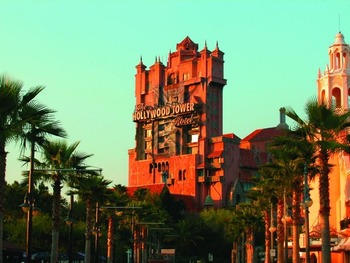
The “Twilight Zone Tower of Terror” is one of the major attractions in the Disney's Hollywood Studios (formerly MGM Studios) park (Figure 1).Footnote 15 It is in essence a tower drop ride (guests are seated in an elevator, taken to the top of the shaft, and dropped), but like most Disney attractions, the “Tower of Terror” was conceived as having an elaborate backstory. In the 1940s the Hollywood Towers Hotel was struck by lightning, transporting half of it, along with a family in one of the elevators when the lightning struck, into the “Twilight Zone.” Present-day guests are loaded into elevators and given a tour of the abandoned hotel, culminating in another lightning strike and their own trip into the “Twilight Zone,” where they are dropped multiple times from the top of the building.
Hollywood Tower Hotel/Tower of Terror, Disney's Hollywood Studios, Orlando. Photo by Aurora in March 2003. Used under the Creative Commons Attribution-Share Alike 3.0 Unported license. https://creativecommons.org/licenses/by-sa/3.0/deed.en.

As with any Disney ride, guests have to queue (for as long as two hours for a popular ride like this one) before they can get on, and Disney uses the opportunity to set the scene for the ride to follow. The “Tower of Terror” queue winds through the run-down hotel grounds, and music of a 1940s-style dance band can be heard through speakers hidden among the foliage. Through the judicious positioning of speakers and careful sound design, the music seems to come from the other side of the property, perhaps the side that vanished into the “Twilight Zone” when the lightning struck. We, the audience, are meant to forget that we are in present-day Florida and imagine ourselves transported back to California in the 1940s, and the highly marked music is an early cue in this process.
We are ourselves the protagonists of this trip, so our own experience constitutes the diegesis, and therefore the music we hear must be considered as diegetic. In these theme park attractions, unlike in film, the guests are both characters and audience. That said, however, we are not actually in control of our own narrative; what happens is being controlled by Disney's Imagineers, who have governed the narrative through the queue layout, landscaping, and music. So there is actually a double diegesis: the one we imagine ourselves to be controlling and the one controlling us. But the key to the system is that we know we are being controlled, that we are participating in Eco's “hyperreality,” and that we find enjoyment in the doubled perspective.
While waiting in the queue area, one can also hear the screams of guests already on the ride during the climactic drop, and these screams further complicate matters. At first thought they would seem to take us out of the diegesis, out of the narrative about the 1940s hotel, contrasting with, and sometimes covering, the dance band music we hear. The screams, though, are actually part of the second diegesis, the one the Imagineers have created to control us, rather than the one that makes us seem in control in the role of “hotel guests” who have chosen, of our own volition, to undergo this experience. The screams make us feel a certain apprehension, even though we know we're not really in danger, and at the same time we allow the music to lull us into a false sense of security. In the first diegesis, where we are the protagonists, we feel safe: we hear soothing dance music. But in the second, where we are controlled by Imagineers and technicians, we know that our subject position is only an illusion. The nodal point of these two diegeses is the sound: the music and the screams, and the contrast between them. It is the play between these two diegeses that make a Disney park more engaging than many other theme parks, where a drop ride would just be a drop ride, rather than a complex narrative in which we can take part. Cinema does something similar with doubled coding: the audience is simultaneously part of the film, both “sutured” into it (to use the word of an important sub-group of film psychologists) and separate from it.Footnote 16 The Disney parks present the doubling in a more literal and marked way, where the suturing is not imaginary but physically real. Because the parks’ designers use the audiovisual language of film but heighten that language by allowing their audiences to have a physical experience (exhilarating or terrifying, depending on the individual!), they offer an excellent opportunity to apply film theory to “real” life.
Many Disney rides use well-known music to tell their stories, and the “Tower of Terror” is no exception. The score of the ride proper is based on the famous Twilight Zone theme. It is a particularly strong example of Disney's careful control of music in context that the guests do not hear this theme until the actual ride. After all, in the queue we haven't yet entered the “Twilight Zone,” so using that music too early would be a wrong move in the game of the double diegesis. This is in contrast to a ride like the classic “Peter Pan's Flight”: the song “You Can Fly,” from the 1953 movie the ride is based on, plays throughout the queue area and on the ride itself. In that case, the ride is based upon a specific film, and the music from that film helps to draw in the guests. Some rides have their own theme tunes, like the “Haunted Mansion” and “Pirates of the Caribbean,” which also play in their respective queue areas. Interestingly, in Disney World's most recently opened ride, the “Seven Dwarfs Mine Train,” songs from Snow White and the Seven Dwarfs (1937) are not played in the queue area; guests hear a woodland soundscape instead, and the well-known movie songs are held off until guests approach the loading area (hearing the familiar song “Heigh-Ho” builds anticipation). Back when the parks first opened (Disneyland in 1955 and Walt Disney World in 1971), from which time “Peter Pan's Flight” dates, one had to pay separately for each ride using lettered tickets (A to E, graded based on cost), so the Imagineers had to convince their customers to pay more for an expensive “E-ticket” ride like “Peter Pan's Flight.” Playing familiar music was an effective strategy, similar to wafting the scent of fresh cookies out of the Main Street Bakery or building what Walt Disney called a “weenie” to beckon people into the park (such as the Cinderella Castle in the Magic Kingdom or the geodesic sphere at EPCOT). Now that all attractions in the parks are included on the same ticket (which can also be linked to a credit card and be used to make purchases of food and merchandise), the Imagineers can focus on setting the scene in more sophisticated musical ways, as they did in the “Seven Dwarfs Mine Train,” and even more the “Tower of Terror,” to create a true doubly diegetic space rather than simply an enjoyable ride.
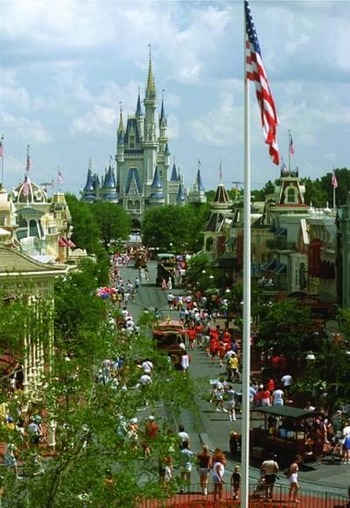
In contrast to the primarily diegetic music of attractions like the “Tower of Terror,” in Main Street U.S.A., the entrance area of the Magic Kingdom, the music would seem to be non-diegetic (Figure 2). Main Street presents an idealized small-town Midwestern Main Street from around the turn of the twentieth century, and music plays constantly over the scene. The streetscape of American cities at that time was usually quite noisy, with sounds of horses and carriages, omnibuses, tradesmen's activities, and many types of live music all competing with each other. The Disney Imagineers tidy up the sounds as much as they do the streets themselves, going so far as to turn down the volume of the acousmatic music on a particular street corner if a live performance (such as a barbershop quartet or Dixieland jazz band) is to take place there. The careful, film-like control of the soundscape and the presence of ubiquitous acousmatic music therefore at first make the music seem apart from the narrative diegesis. But we do hear the music, and again, we are the protagonists of the narrative Disney presents to us, so therefore the music can also be understood as diegetic. The music is very much a part of this particular fictive version of an American Main Street. As with the rides, audiences are presented with a doubled perspective, but this time it is more about the conditioning of a narrative space than controlling (and being controlled by) a narrative trajectory. As with the rides, the guest is simultaneously inside and outside the narrative.
Main Street, USA, Magic Kingdom, Walt Disney World Resort, Orlando. Photo by Speedway. Used under the Creative Commons Attribution-Share Alike 3.0 Unported license. https://creativecommons.org/licenses/by-sa/3.0/deed.en.

Main Street is probably also the most germane example of Eco's concept of the hyperreal. If we see Main Street as a variation on the “real” or as a Baudrillardian simulacrum, then the music must be non-diegetic: it is only present fictitiously, making the space into fiction. But if we accept it as hyperreal, the music then forms an important part of that hyperreality. Its “fictitious” presence is its very point. Main Street is clearly hyperreal and not a simulacrum: To be a simulacrum we have to be taken in on some level by the fake, believing that it is real (e.g., the “replicants” of Blade Runner, who are indistinguishable simulacra of human beings). Baudrillard thought that people were taken in by Disneyland, again demonstrating his ignorance of what the parks are actually like. No one in their right mind would think that Main Street was “real,” or even an exact replica of a real Main Street like the one in Walt Disney's hometown of Marceline, Missouri. The fact that we can always hear music is only one of the most evident tip-offs that alert us to the fiction of Main Street U.S.A. Others are the clearly forced perspective of the architecture, the extreme cleanliness, and the fact that most of the buildings are shops selling modern merchandise. In fact, the current version of Main Street U.S.A. is less hyperreal than its first version at Disneyland in 1955, where the shops did sell the types of products that could have been acquired in 1900 small-town America. Today, although the interior design of the shops hearkens back to that early time, they are a shrine to the current version of consumerism (where Disney products are consumed) rather than a historical exploration of American consumer culture (where other companies sponsored the various shops). Today one buys t-shirts and Diet Coke rather than corsets and sarsaparilla.Footnote 17 Seeing it all as hyperreal allows for a reading as fiction, as is certainly the case with Main Street U.S.A.
Most of the music piped through Main Street acousmatically is orchestral arrangements of old American favorites, pieces like the “Maple Leaf Rag” and “In the Good Old Summertime,” although there are also some turn-of-the-twentieth-century-style arrangements of more recent Disney tunes. Most guests will allow this music to pass by their ears uncritically, as nice old tunes great-grandma used to sing, but for a music historian the music is yet another example of hyperreality. For even though many of the songs date from the period invoked by the architecture, their arrangements are not at all historically informed, either in the notes or the instruments playing or the way they're played (unlike with the “Tower of Terror,” where the 1940s-style arrangements and sound design are part of the storytelling). But that's really a moot point; after all, the presence of giant mice and ducks (and the total absence of street rubbish) is not historically informed either. The important thing is that the music evokes the period just as the architecture does, thereby contributing to the fiction.
The careful overall control of the soundscape becomes especially apparent in the parks’ liminal and transitional spaces, like that between Main Street and Tomorrowland in the Magic Kingdom. As one passes from one section of the park to another the music changes, and even though the loudspeakers are positioned in the space so that the music is louder as one first enters the new section, there is always some degree of sound bleed. The seeming “mistake” can actually foreground the presence of the music, even though a guest might not notice specifically that two types of music can be heard simultaneously. It might be a variant of what Robynn Stilwell calls the “fantastical gap” between diegetic and non-diegetic film music, where the audience can't be sure if the music is meant to be heard by a film's characters or not.Footnote 18 The confusion is a pleasant one, as it gives yet another opportunity for the audience to enjoy the craft that has gone in to the parks’ design.
I claim, along with Eco, that the double diegesis of controlling and being controlled, and of enjoying that doubling, is a major component of the guests’ sense of fun in visiting the Disney parks. Guests often express amazement at the attention to detail in the attractions and at the company's expertise in crowd control: They know that in the spaces they inhabit nothing is left to chance, including their own activities. Many visitors to Disney World relinquish control even before they have arrived: they place special tags on their luggage, leaving it in Orlando's airport for collection by Disney, so that from the moment they land they can let the Disney people take care of everything. For the parks’ many repeat visitors, this relinquishing of control is almost a ritual act (as is the opposite action at the end of the trip, where people on the bus back to the airport often sing along to the Mickey Mouse Club theme, “now it's time to say goodbye”). Perhaps in our post-postmodern society we need to let someone else control our fun because we have lost the ability to do it ourselves, but we still enjoy holding the joystick. In The Disneyization of Society, Alan Bryman notes that “predominantly ludic responses among visitors to the Disney theme parks, such as those emphasizing fun, have been described as uninteresting[,] but they are in fact indicative of the kind of uncritical reception that themed environments are capable of creating.”Footnote 19 These ludic responses are uninteresting because they do not toe the line; Baudrillard and company do not allow a space for fun within their theorizations, so if anyone is having it they clearly must have been brainwashed by the powers that be. It should be remembered, though, that no one is forced to go to Disney World.Footnote 20 Although when we visit the parks we give up our own volition to a large corporation and pay a great sum for it, the experience is not much different from going to a film, an opera, a play, or a sports game. A trip to Disney world is like all of those experiences, only more so due to the hyperreal intensification of our lived experience. In all cases there is a willing suspension of disbelief, and yet it is not true that the audience accepts everything uncritically. Having fun need not be uncritical. In fact, in the many online forums revolving around Disney one finds a great deal of criticism, mostly about the rising costs of the parks and about the closure or refurbishment of much-loved rides, restaurants, or shops. Protests about a new version of the “Journey Into Imagination” attraction at EPCOT actually led to a refurbishment of the refurbishment, reinstating the popular character Figment and the ride's original theme song (in that case people clearly did notice the music).Footnote 21 Although the visitors give up some aspects of their bodily control to the corporation, they do not give up their agency as audience members.
A theorist whose work might be more effectively applied to the analysis of music in the Disney parks is Stuart Hall, whose work in cultural studies seems a natural fit for examining the effects of Disney's livable texts on their audiences, although his framework has hitherto not been applied to Disney. When critical work has been carried out on the Disney parks (as opposed to the Baudrillardian method where they are merely examples of simulacra), it has been based, tacitly or explicitly, in the Frankfurt School critical theory of the culture industry (Fjellman's work being the most obvious case). Where Hall's work gives a space to audience interpretation, the Frankfurt critics see these texts as working entirely from above. As we've seen, the reality of fan reception indicates otherwise, being particularly full of what Hall calls negotiated readings.
Hall explains that readings of a text fall into three different types: hegemonic, negotiated, and oppositional.Footnote 22 A hegemonic reading is the only one recognized in the Frankfurt system: the sender and receiver of the message conveyed by the text hold the same views, which are determined by the sender. An oppositional reading reads the text against the grain, resisting the message it is sending. A negotiated reading comes between: there are some exceptions to the rule, but for the most part the sender's message is taken at face value, perhaps with some critical thinking in the background. Many audience readings of Disney seem to fall into this negotiated category, as readers are happy to go along with the corporate text in general, but they may find elements of it to see differently. For example, the Disney parks frequently hold unofficial “gay days,” when LGBTQ guests enjoy the parks together; these guests counter–interpret the heteronormative messages that bombard visitors to the parks, although there is little notion of the visit being a protest against them. The guests know that those messages are there, while a truly oppositional reading would protest against them, and a hegemonic reading would agree with them (probably without realizing there even is an ideological message).
There are four stages in Hall's communication model. First is production or encoding, where the text is created feeding on society's beliefs as determined by the hegemonic powers. Second is circulation, how the message is sent out to its perceivers. Next is use, where the message is decoded, and finally comes reproduction, where audiences do something with the message, perhaps making other messages. I will use an additional attraction to explore how this model works within Disney's parks, focusing of course on the music's role in this process: one of the parks’ most popular rides, and one of which variations appear in all of the parks around the world, “Pirates of the Caribbean.”
The story of the ride is simple: on a boat ride, we participate in the piratical raid of a Caribbean port town. In the Disney World version, we are first taken through a series of dark and damp caves, then we ride past a ship battle going on at sea, then we witness various scenes of pillage. The recent popular movie series is based on the ride, and some aspects of the ride were changed to better reflect the films. Most notably, the films’ protagonist, Captain Jack Sparrow, was added to the ride's narrative, complete with Audio-Animatronics that look like actor Johnny Depp. The ride is also well-known for its theme song, “A Pirate's Life for Me” (or simply “Yo Ho Yo Ho”). Aside from the ship battle scene, where some music from Klaus Badelt's score for the first film (2003’s Curse of the Black Pearl) has been recently incorporated, the entire ride is scored with variations on the theme song. In Hall's model, the first step is production: the song was composed in 1967 by George Bruns and Xavier Atencio based on widespread cultural views of piracy, especially Robert Louis Stevenson's Treasure Island, which Disney had made into an iconic film in 1950. The song's origin being Disney, the circulation of the message was as wide as possible. In addition to being used throughout the ride, it has often been included in compilations of Disney music on recordings, and sheet music was sold. That allows decoding to happen: the song became popular enough for guests on the ride to sing along to it, even if they had never been on the ride before. A bit of the song was later used for a few moments in The Curse of the Black Pearl. Its inclusion in this film is a good example of reproduction, using the song as a kind of intertextual in-joke for people who are familiar with the ride. There are many other such jokes in the film, such as a scene where a dog holds the keys to a jail cell just out of reach of some locked-up pirates, a scene portrayed by Audio-Animatronics in the ride.
The modular structure of the song itself allows these uses. It is a song that can be developed indefinitely: the chorus or refrain is only four bars long, while the verse lasts eight bars, meaning that the song does not feature a symmetrical structure. The verse and chorus can alternate forever. The musical arrangers use this aspect of the song's form to propel the audience through the ride, allowing the song to float by in all of its various guises as the guests themselves float through the various scenes. The use of this song form is standard in the Disney parks, which need repeatable forms to carry guests through the rides or to carry parades through the guests. “It's a Small World” is a famously insidious case, the endless repetition of which drives some guests to distraction. This use of music propelling an audience though a physical space has analogues in film, although of course the motion is only implied by the images on the screen: early musicals such as Ernst Lubitsch's The Love Parade (1929) and Rouben Mamoulian's Love Me Tonight (1932) feature scenes where a song is passed across the city by a variety of characters, as does Meet Me in St. Louis (1944), a probable influence on Disney's creation of Main Street U.S.A.
The similarities between Disney park music and film music go beyond their narrative affordances, including also the specific musical tropes used by their composers. Music theorists Scott Murphy and Frank Lehman have argued that the prominent film-scoring technique for the family-friendly adventure movies that hold the top positions in the box office is triadic and tonal, and that it uses the harmonic techniques of late nineteenth-century composers.Footnote 23 Murphy and Lehman use neo-Riemannian transformation theory (NRT) to analyze this music, claiming that this analytical system is even better suited to film music than it is to Wagner, Brahms, and Mahler, for whose music the theory was developed.Footnote 24 The style is best exemplified by the music of John Williams, whose influence, and even whose own music, can be heard throughout the Disney parks, especially in Disney's Hollywood Studios with its “Star Tours” ride (based on the Star Wars franchise) and the “Indiana Jones Epic Stunt Spectacular” (which stages scenes from Raiders of the Lost Ark). Lehman argues that Williams's scores, and Hollywood film scores more generally, are structured in large part around what he calls chromatically modulating cadential resolutions (CMCRs), that is, a sophisticated kind of deceptive cadence that also serves as a modulation to a new tonal area.Footnote 25 We can expect such cadences in the Williams scores in the parks of course, but they also show up in other music. For example, they happen throughout the score for one of Disney World's most popular rides, “Soarin’,” which simulates a hang-gliding flight over the various sights of California.Footnote 26
The score was one of the last written by film composer Jerry Goldsmith, and it is one of the most popular scores in the parks, showing up in many of Disney's compilation albums of park music (Figure 3). It is also played throughout EPCOT as area music. CMCRs are often used at moments of wonder or surprise, and “Soarin’” is filled with such moments (Lehman coincidentally calls it Williams's “soaring wonder” style).Footnote 27 Nearly every time the scene changes or a new vista is reached, Goldsmith uses a CMCR.Footnote 28 The score also features a profusion of subtonic chords (♭VII, mixolydian inflections) and Lydian raised fourths, other common features Lehman discusses. This ride features a film, so we can expect film music techniques. Some traditional musical tropes are used to score the various sites of California, such as using guitars and claves for a horse-riding scene to evoke western movies, but the emphasis is on soaring melodies and unexpected chromatic transitions. The style is shared by “Star Tours,” where audiences are also faced with a film screen intensified by a motion simulator and 3-D glasses. But these compositional techniques also show up in a great deal of other park music, even where there is no actual film in view.
Soarin’ over California, Disney California Adventure Park. Photo by Josh Hallett from Winter Haven, FL, USA. Used under the Creative Commons Attribution-Share Alike 2.0 Generic license. https://creativecommons.org/licenses/by-sa/2.0/legalcode.

A well-known example is the popular dark roller coaster “Space Mountain,” which is scored as if it were film, even though no screen is involved (it would be too dark to see anything, anyway). In the mid-2000s, Disney hired composer Michael Giacchino to write a new score for the ride, after his success at scoring the 2004 film The Incredibles for Disney and Pixar. “Space Mountain” is a centerpiece of Tomorrowland, which, while it was created in the 1970s as a land of the future, has since been redesigned to show the future as imagined in the 1950s (park designers having found that the supposed future dates extremely quickly, and that by the 1990s the original design with geometric shapes and bucketsful of grey paint looked more like the seventies than did the rest of the park). Giacchino does the same with his music, using a prominent theremin in the style of 1950s science-fiction movies, but also adding a drum machine to give the score a contemporary twist. The Incredibles had a similar goal with its music, a mix of James Bond and Daft Punk to give a feeling of sixties style in the present, and it is likely on the basis of the Incredibles score that Giacchino was hired for the “Space Mountain” project. Listening to the “Space Mountain” score away from the ride, one is still able to discern the narrative quite easily: we take our seats in the roller coaster, departure is prepared, there is a countdown, and then we move forward. That the score is so precise demonstrates the amount of detail Disney puts into its rides; the music is very difficult to hear above the screams and the noise of the roller coaster cars, which combine with the music to form the ride's unique soundscape.Footnote 29
“Fantasmic,” a nighttime spectacular sound and light show, also uses CMCRs and, especially, lydian inflections (II7) in its score (arranged by Bruce Healey from Disney classics and an original theme). “Fantasmic” is presented as Mickey Mouse's dreamscape, as the audience is brought with him through a montage of clips from animated Disney films projected on water screens. The dream later turns into a nightmare, as Mickey battles the more popular Disney villains. At the end, we in the audience have gone through Mickey's nightmare with him, so the triumphant end to the show is our triumph as well as his. There is some cognitive work being done in film musicology about neurological responses to these kinds of musical events, and the findings of that work might well be applicable to music in the parks as well. My own experience would indicate as such: winter evenings in central Florida can get cold, especially if it's raining. We all know that music can give us goose pimples (in the case of the very kitschy “Fantasmic” possibly against our better judgment), and that this physical response is also one that warms us in cold weather, so the music actually serves as a warming mechanism. Are the Disney people even controlling our own body temperature through their use of music?
This study has demonstrated that the music in the Disney parks is just as carefully designed as any other sonic or visual elements, and that it therefore rewards our critical attention. The music helps the audience take its place within the doubled diegesis of the Disney experience. So instead of focusing on the parks' negative aspects, it is more useful to also examine the craft that goes into creating the complex layering of diegeses. The Disney parks represent an intensification of the apparatus of cinema, not just a mercenary rip-off of popular films. The parks and their music help us to see and hear that there is always a double diegesis in film—we give imaginary agency to a film's characters, but agency really always rests with the audience. The difference is only one of degree. So when Indiana Jones is crossing a chasm to find the Holy Grail, the music represents him but it simultaneously represents us, the audience, serving as an illusory bridge into Indy's world. When Ariel sings that she wants to be “part of [our] world,” the music makes us part of hers, and when we visit her at Disney World we can actually be in her physical presence. Next time you visit a Disney park, keep your ears open.