The familial aggregation of coronary arterial disease is well documented. The specific underlying mechanisms, and the relative contribution of atherosclerosis to the subsequent coronary arterial events in subjects with a positive family history, however, are not well established.Reference Zureik, Touboul, Bonithon-Kopp, Courbon, Ruelland and Ducimetière1
Many case-controlReference Nora, Lortscher and Spangler2–Reference Friedlander, Siscovick and Weinmann5 and longitudinalReference Barrett-Connor and Khaw6–Reference Colditz, Rimm, Giovannucci, Stampfer, Rosner and Willett9 studies have revealed a familial pattern for coronary arterial disease. Given that the classic risk factors could account only for some, but not all, of the clustering of such disease in families, the inherited susceptibility, and/or environmental exposures, could explain this phenomenon. Some angiographic studiesReference Anderson, Loeffler, Barboriak and Rimm10–Reference Mukerji, Holman, Artis, Alpert and Hewett12 demonstrated that patients with a positive family history had more advanced atherosclerotic occlusions and a larger number of affected coronary arteries, but other studies did not confirm this finding.Reference Hamsten and de Faire13
Still other studies have shown a greater thickening of the coronary arteries in infants and children whose grandparents originated from geographic areas with a high incidence of coronary arterial disease than in other children.Reference Vlodaver, Kahn and Neufeld14, Reference Pesonen, Norio and Hirvonen15 Autopsy studies have also shown that intimal thickening of the coronary arteries in infancy is associated with a history of coronary arterial disease in the grandparents.Reference Kaprio, Norio, Pesonen and Sarna16
The development of non-invasive methods, such as high resolution ultrasonography, now permits clinical assessment of abnormalities in vascular structure and function.Reference Zureik, Touboul, Bonithon-Kopp, Courbon, Ruelland and Ducimetière1, Reference Celermajer, Sorensen, Bull, Robinson and Deanfield17, Reference Clarkson, Celermajer, Powe, Donald, Henry and Deanfield18 In our previous studies, we found higher levels of some classic and new risk factors, as well as immunologic factors and trace elements, in children with a parental history of premature coronary arterial disease.Reference Kelishadi, Sarraf-Zadegan, Naderi, Asgary and Bashardoust19–Reference Kelishadi, Alikhassy and Amiri22 In this study, we aimed to assess the thickness of the intimal and medial layers of the carotid arteries, and the index of left ventricular mass, in children of parents suffering premature myocardial infarction. Our findings will complement some recent observations of changes in arterial function and structure in adolescents with a familial predisposition to coronary arterial disease.
Methods
We studied 112 healthy adolescents, aged from 12 to 18 years, whose parents suffered premature coronary arterial disease under the age of 55 years.Reference Kavey, Daniels and Ronald23 The cohort was recruited consecutively from offspring of patients hospitalized for premature myocardial infarction between November, 2004, and March, 2006, at hospitals affiliated to Isfahan University of Medical Sciences in Iran. We recruited 127 subjects matched for age and gender, without any family history of coronary arterial disease in the first and second relatives, to serve as controls. In order to reduce the socio-demographic differences between the two groups, the controls were selected from offspring of families living in the same neighborhood as the group of cases.
The protocol was approved by the Ethics Committee of Isfahan Cardiovascular Center, which is approved by the National Institute of Health, United States of America. Written informed consent was obtained from the parents.
All subjects were invited to the Department of Preventive Pediatric Cardiology at Isfahan Cardiovascular Center. Physical examination was conducted by a team of trained physicians and nurses under the supervision of the same paediatrician. We calculated age from birth until the date of interview. Weight and height were measured with the subjects lightly clothed and barefoot, and recorded to the nearest 0.5 centimetre and 0.1 kilogram, respectively. Based on the recommendations of Lohman et al.,Reference Lohman, Roche and Martorell24 we made 3 measurements of height and weight, using their average to compute the index of body mass as weight in kilograms divided by height in metres squared. These values were then converted to centiles using the reference data complied by the Center for Disease Control.Reference Kuczmarski, Ogden and Grummer Strawn25
Blood pressure was measured in a calm situation using mercury sphygmomanometers after at least 5 minutes of rest with the subjects sitting, the heart, cuff, and zero-indicator on the manometer all being at the level of the eye of the observer, who was a physician. All readings were taken in duplicate from the right arm. Cuffs of appropriate size were used, the width being 40% of the circumference of the upper arm, and the bladders of the cuffs covering from 80% to 100% of the circumference, and approximately two thirds of the length of the upper arm without overlapping. The procedure was explained to the students, and the cuff inflated and deflated once. The first measurement was not used in the analysis of this study. The reading at the first and the fifth Korotkoff phases were taken as systolic and diastolic blood pressures, respectively. The average of the two time measurements was recorded and included in the analysis. Elevated blood pressure was defined as the mean systolic and or diastolic blood pressure above the 90th percentile for that age and gender, after adjusting for weight and height.26 Brachial pulse pressure was calculated as the difference between systolic and diastolic blood pressures.
For blood sampling, participants were instructed to fast for 12 hours. Compliance with fasting was determined by interview on the morning of examination. Ensuring the presence of one of the parents, samples were drawn from the ante-cubital veins of the adolescents between the hours of 8:00 and 9:00 in the morning. The samples were centrifuged for 10 minutes at 3000 revolutions per minute within 30 minutes of venipuncture, and were examined in the central laboratory of Isfahan Cardiovascular Research Center, which meets the national standards, and is also under the quality control of the Center for Disease Control of the United States of America, and the Department of Epidemiology, St. Rafael University, Leuven, Belgium. Fasting levels of blood sugar, triglycerides, and total and high density lipoprotein cholesterol were measured by an enzymatic method using an auto-analyzer (Hitachi, Model 902, Japan). High density lipoprotein cholesterol was determined after precipitation with dextran sulphate and magnesium of non-high density lipoprotein cholesterol.Reference Warnick, Benderson and Albers27 Low-density lipoprotein cholesterol was calculated using samples of serum with triglycerides less than or equal to 400 mg/dL according to the Friedewald equation.Reference Friedewald, Levy and Fredrickson28
High resolution carotid ultrasonographic studies were performed with a Ving Med 750 machine, using a 7.5 MHz transducer for vascular and 3.5 MHz transducer for cardiac study. The images were recorded on videotape using a super VHS recorder and analyzed offline. An expert paediatric cardiologist, who was unaware of the family history, made all measurements. The protocol involved scanning of the posterior walls of the right and left common carotid arteries in their distal 1 centimetre. The crest at the origin of the bifurcation was used as an anatomical landmark to identify the segment to be visualized. In each examination, the cardiologist used different scanning angles to record the greatest thickness of the intimal and medial layers. On a longitudinal B-mode image, the posterior wall of the common carotid artery appears as two bright, parallel lines separated by a hypoechoic space. The inner line arises from the interface of the intimal layer with the lumen, whereas the outer line arises from the interface between the medial and adventitial layers. The distance between the interfaces represents the combined thickness of the intimal and medial layers.Reference Salonen, Seppanen, Rauramaa and Salonen29 For the purpose of measurement, the reader selected the three frames on each side that contained the thickest walls in the distal segment of the common carotid artery. The measurements were the averaged in order to give the mean mural thickness for each side.
The echo Doppler examination included a complete cross-sectional echocardiographic imaging, and an accurate Doppler interrogation, of all the cardiac chambers to exclude abnormalities of left ventricular wall motion, and any significant valvar lesions. All echocardiographic measurements, which were done by the same paediatric cardiologist, were reported as the average of at least three cardiac cycles, according to the criterions of the American Society of Echocardiography.
The index of left ventricular mass was obtained using M-mode echocardiography in the parasternal long axis view. Left ventricular measurements were made at or just below the tips of the leaflets of the mitral valve as described by Devereux et al.Reference Devereux, Alonso and Lutas30 The left ventricular mass was calculated from the measurements, in centimetres, in the Penn convention by using the thickness of the ventricular septum, the left ventricular internal dimension, and the thickness of the posterior left ventricular wall, all in diastole, by the following regression equation:
Penn-cube left ventricular mass is equal to 1.04 [(interventricular septal thickness in diastole plus left ventricular internal dimension in diastole plus posterior left ventricular wall thickness in diastole)Reference Heller and Kelson3 minus left ventricular internal dimension in diastoleReference Heller and Kelson3] – 13.6 grams. As correcting left ventricular mass for heightReference Nora, Lortscher and Spangler2, Reference Myers, Kiely, Cupples and Kannel7 minimizes the effect of gender, race, age, and obesity, the index of left ventricular mass was calculated as left ventricular mass divided by height in meters.Reference Nora, Lortscher and Spangler2, Reference Myers, Kiely, Cupples and Kannel7, Reference Daniels, Kimball, Morrison, Khoury and Meyer31
Statistical analysis
Data were analyzed by the SPSS software package (SPSS, version 13.0, Inc. Chicago, IL). The sex-adjusted differences in mean value of the quantitative variables according to parental history of premature coronary arterial diseases were determined using Student’s t test. The correlates for the combined intimal and media thickness, and the index of left ventricular mass, were studied by multiple regression analyses conducted once for the entire participants, and once for those with or without positive parental history of premature coronary arterial disease, separately. The association of having a positive parental history of premature coronary arterial disease with arterial mural thickness and index of left ventricular mass in the entire population under study was assessed after adjusting for all covariates. Pearson correlation coefficients were determined for the bivariate associations of arterial mural thickness and index of left ventricular mass with the variables assessed. The level of significance was set at a value for p of less than 0.05.
Results
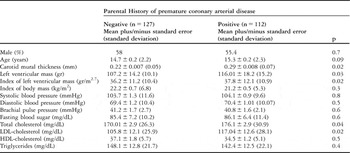
The mean age, index of body mass, fasting blood sugar, triglycerides, high density lipoprotein-cholesterol, and systolic and diastolic blood pressures were not significantly different between the cases and their controls. The combined carotid intimal and medial thickness, the left ventricular mass, the index of left ventricular mass, and the total and low density lipoprotein cholesterol were significantly higher in the cases than in their controls (Table 1).
Sex-adjusted cardiovascular risk factors according to parental history of premature coronary arterial disease.

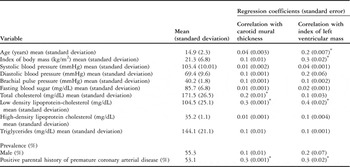
The multiple regression analysis conducted among the entire population showed that having a positive parental history of premature coronary arterial disease, as well as the levels of total and low density lipoprotein cholesterol, were significantly correlated with the combined carotid arterial intimal and medial thicknesses, whereas age, male gender, positive parental history of premature coronary arterial disease, low density lipoprotein cholesterol, and the index of body mass, all had significant correlations with the index of left ventricular mass. Systolic and diastolic blood pressures, as well as brachial pulse pressures, had no correlation either with the combined carotid arterial intimal and medial thicknesses, nor with the index of left ventricular mass (Table 2).
Characteristics of all participants, and multiple regression analysis of variables with carotid mural thickness and index of left ventricular mass.
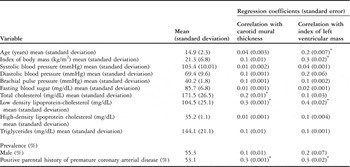
*p < 0.05 for correlations.
After adjustment for all covariates, namely age, sex, index of body mass, blood pressure, and biochemical variables, the association of having a positive parental history and the combined carotid arterial mural thickness and the index of left ventricular mass remained significant (R2 = 0.3).
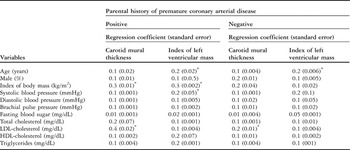
Multiple regression analysis conducted separately for those with or without a positive parental history of coronary arterial disease showed that, in the subjects, but not their controls, low density lipoprotein cholesterol and the index of body mass were the only two factors associated with the carotid arterial mural thickness, but age, index of body mass, and systolic blood pressure had significant associations with the index of left ventricular mass. In the controls, low density lipoprotein cholesterol was associated with the carotid arterial mural thickness, whereas age was associated with the index of left ventricular mass (Table 3).
Multiple regression analysis of variables associated with carotid mural thickness and index of left ventricular mass in the cases and their controls.

*p < 0.05 for correlations.
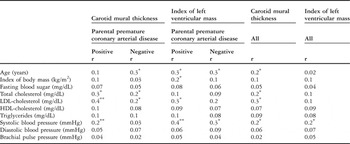
In Table 4, we show the Pearson correlations of the variables assessed with carotid arterial mural thickness and the index of left ventricular mass in the cases and their controls, as well as in the total population studied. In the cases, total and low density lipoprotein cholesterol, as well as systolic blood pressure, was significantly correlated with the carotid arterial mural thickness. In this group, age, index of body mass, low density lipoprotein cholesterol, and systolic blood pressure correlated with the index of left ventricular mass. In the controls, we found that age, as well as total and low density lipoprotein cholesterol, correlated with the arterial mural thickness, whereas age and systolic blood pressure correlated significantly with the index of left ventricular mass. In the total population studied, it emerged that age, systolic blood pressure, and total and low density lipoprotein cholesterol all correlated with the mural thickness of the carotid arteries, whilst systolic blood pressure correlated with the index of left ventricular mass.
Pearson correlation of variables with carotid mural thickness and index of left ventricular mass with or without parental history of premature coronary arterial disease.

*p < 0.05; **p < 0.0001.
Discussion
Our findings show that, compared to controls, our adolescents with a family history of premature coronary arterial disease have higher degrees of subclinical atherosclerosis and left ventricular hypertrophy. The levels of total and low density lipoprotein cholesterol in the serum were correlated with these abnormal cardiovascular findings, but after adjustment for all covariates, we found an independent association of positive parental history of premature coronary arterial disease with an increased mural thickness of the carotid arteries and the index of left ventricular mass.
There are few previous studies that have assessed the relationship between measurements of atherosclerosis in the carotid arteries and a family history of coronary arterial disease, and the few studies conducted among adults remain controversial. In the Cardiovascular Health Study, it was shown that an increased carotid arterial mural thickness in elderly subjects was associated with family history of premature myocardial infarction in first degree relatives.Reference Kuller, Borhanl and Furberg32 In a Finnish study,Reference Juonala, Viikari and Laitinen33 in contrast, the severity of carotid atherosclerosis was not proven to be associated with family history of coronary arterial disease. In the study of Zureik and colleagues,Reference Zureik, Touboul, Bonithon-Kopp, Courbon, Ruelland and Ducimetière1 also involving an elderly population, although parental history of premature death from coronary arterial disease was strongly associated with presence of plaques in the carotid arteries, it was not associated with an increased arterial mural thickness. These authors suggested that familial transmission of the risk of coronary arterial disease is not mediated specifically by arterial mural thickening when measured at sites free of plaques.Reference Zureik, Touboul, Bonithon-Kopp, Courbon, Ruelland and Ducimetière1
Some studies, nonetheless, have shown that risk factors identified in childhood are independent predictors of an increased mural thickening of the carotid arteries in adulthood,Reference Juonala, Viikari and Laitinen33–Reference Li, Chen and Srinivasan36 suggesting that exposure to risk factors in childhood may induce permanent effects on arteries that contribute to the development of future atherosclerosis.Reference Raitakari, Juonala and Kähönen34, Reference McGill and McMahan37 Cuomo et al.Reference Cuomo, Guarini and Gaeta38 showed that the thickness of the carotid arteries in healthy young subjects aged from 5 to 30 years, with a parental history of premature coronary arterial disease, was higher than in controls.
Several investigations have concluded that screening the progeny of patients suffering from early incidence of atherosclerotic events is highly productive in the identification of those at an increased risk for future coronary arterial disease.Reference Kavey, Daniels and Ronald23 Differences in the geographic and ethnic predisposition to coronary arterial disease are well documented in different populations.Reference Couch, Cross and Kida39 As far as we are aware, ours is the first study of its kind performed in a non-Western population of youths. It confirms that subjects genetically predisposed to early coronary arterial disease have higher degrees of subclinical atherosclerosis, even from adolescence.
Some previous longitudinal studies have documented the role of childhood cardiovascular risk factors, notably high levels of low density lipoprotein cholesterol, in predicting increased carotid arterial mural thickness in adulthood.Reference Raitakari, Juonala and Kähönen34–Reference Davis, Dawson, Riley and Lauer35 Although our previous national study showed that, in population-based studies, the usefulness of family history of premature cardiovascular disease is relatively low in identifying dyslipidaemic children,Reference Kelishadi, Ardalan, Gheiratmand and Ramezani40 this study is consistent with our previous studies on children of known cases of coronary arterial diseaseReference Kelishadi, Sarraf-Zadegan, Naderi, Asgary and Bashardoust19–Reference Kelishadi, Alikhassy and Amiri22 in showing that levels of total and low density lipoprotein cholesterol in the serum were higher in those adolescents with a parental history of premature coronary arterial disease. In addition, we found a significant association between the level of low density lipoprotein cholesterol in the serum and the arterial mural thickness. This correlation is well established among young adults.Reference Bhuiyan, Srinivasan, Chen, Paul and Berenson41–Reference Stein, Douglas and Srinivasan42
Increased left ventricular mass is an independent risk factor for cardiovascular morbidity and mortality.Reference Levy, Garrison, Savage, Kannel and Castelli43 Given that subjects with increased left ventricular mass might be at high risk of developing coronary arterial disease, and that a family history of premature coronary arterial disease is a well-established risk factor for subsequent coronary arterial disease in the subject, our other goal was to compare the left ventricular mass of youths with and without such family history, as well as the association between the family history of premature coronary arterial disease and the left ventricular mass. We found a higher index of left ventricular mass in the children of patients with premature myocardial infarction than in their controls, this being contrary to the study of Dekkers et al.Reference Dekkers, Treiber, Kapuku and Snieder44 We also showed that a family history of premature myocardial infarction was significantly correlated with left ventricular mass, this association remaining significant even after adjustment for blood pressure and body mass index. The strength of the study of Dekkers et al.Reference Dekkers, Treiber, Kapuku and Snieder44 is its longitudinal nature, but it has been subject to recall bias concerning the premature coronary arterial disease in the relatives. Our study, although cross-sectional, was conducted among children of known parents suffering premature myocardial infarction, and is therefore more reliable in this regard.
We found significant correlations between the indexes of body mass and left ventricular mass. Linear growth is known as the major determinant of cardiac growth in children, and it is also known that excess weight may lead to the acquisition of left ventricular mass beyond that expected from normal growth. Increased mass may also precede the development of increased blood pressure.Reference Urbina, Gidding, Bao, Pickoff, Berdusis and Berenson45 Considering that findings of longitudinal studies have shown that obesity beginning in childhood is one of the significant predictors of left ventricular hypertrophy in an otherwise healthy population of young adults,Reference Haji, Ulusoy and Patel46 the importance of implementation of preventive measures against childhood obesity should be emphasized in clinical settings, and in programmes designed to improve public health.
We should acknowledge that certain factors might have influenced the findings of the present study. Its major limitation is that the correlations should be interpreted with caution, given the cross-sectional nature of the associations. Longitudinal and genetic studies would help the understanding of the differences in susceptibility of developing early atherosclerosis.
In conclusion, our findings complement some recent observations of functional and structural changes in the systemic arteries of young and older adults with a familial predisposition to coronary arterial disease. They emphasize the importance of seeking to prevent coronary arterial disease in primary fashion, especially using the recommended high risk approach, amongst those children known to be susceptible to such future disease.
Acknowledgements
Our study was funded by Isfahan Cardiovascular Research Center, a collaborating Center of the World Health Organisation in the Eastern Mediterranean region.