Implications
We showed that maternal dietary supplementation of organic iron chelate (Ferrous N-carbamylglycinate chelate (Fe-CGly)) to the feed of late-gestation sows is effective for improving littler birth weight. As very few reports have shown that organic iron chelates could improve the reproductive performance of sows, the present results provided new insights that changing the structure of the ligand may modify the nutritive properties of feed products and improve the performance of the sows. Application of this organic iron chelates in late-gestation sows is feasible. In addition, further studies should be performed to compare the effects and the underlying mechanisms of iron chelates with different ligands in pig nutrition.
Introduction
Iron is a microelement of great importance that is essential for all kinds of animals. Iron deficiency in the pregnant mammals is closely associated with multiple adverse outcomes for both the mother and the infant, including increased risk of premature birth (Scholl et al., Reference Scholl, Hediger, Fischer and Shearer1992), maternal and perinatal mortality (Stoltzfus, Reference Stoltzfus2003), low birth weight (Berglund et al., Reference Berglund, Westrup and Domellöf2010 and Reference Berglund, Westrup and Domellöf2015) and delayed maturation of children (Choudhury et al., Reference Choudhury, Amin, Agarwal, Srivastava, Soni and Saluja2015). For sows, it results in lowered litter weight, high occurrence rates of stillbirths and neonatal infection (Moore et al., Reference Moore, Redmond and Livingston1965). Iron requirements are higher during the late-gestation period due to the faster growth of the fetal–placental unit and to expansion of the maternal erythrocyte mass (Haider et al., Reference Haider, Olofin, Wang, Spiegelman, Ezzati and Fawzi2013). Iron supplementation is critical for both maternal and neonatal health and growth performance during this period.
Recently, studies have emphasized the biological effects of organic iron chelates over iron salt, that is, ferrous sulfate (Spears et al., Reference Spears, Schoenherr, Kegley, Flowers and Alhunsen1992; Duque et al., Reference Duque, Martinez, Vilchis-Gil, Mendoza, Flores-Hernandez, Moran, Navarro, Roque-Evangelista, Serrano and Mera2014; Milman et al., Reference Milman, Jønsson, Dyre, Pedersen and Larsen2014). However, the issue remains uncertain in pregnant sows. The effects of different organic iron chelates on reproduction performance, that is, birth weight, stillbirth, and postnatal mortality, and iron status are inconsistent. For instance, glutamic acid-chelated iron (Egeli and Framstad, Reference Egeli and Framstad1997) and organic iron complex, which is composed of 35% of ferrous fumarate, 25% of iron lactate, 37% of glycine chelate iron and 3% of iron methionine chelate (Wang et al., Reference Wang, Li, Che, Lin, Fang, Xu and Wu2014) did not significantly affect the performance of both sows and their offspring. Although the glycine chelate improved the bioavailability and reduced the proportion of still-born and mummified fetuses per litter significantly, but it did not improve the litter size, birth weight, the hematocrit values and hemoglobin levels of both sows and their piglets (Tummaruk et al., Reference Tummaruk, Tantilertcharoen, Pondeenana, Buabucha and Virakul2003). Iron deficiency remains a common problem in new-born piglets due to the low body iron stores at birth (Brady et al., Reference Brady, Ku, Ullrey and Miller1978) and insufficient iron content the milk of the sows (~1.96 to 2.84 mg/l) (Klobasa et al., Reference Klobasa, Werhahn and Butler1987). Increasing iron transfer in the placenta appears to be the most appropriate approach.
In mammals, the most studied mechanisms of iron uptake are the process of transferrin (TF)/transferrin receptor 1 (TfR) receptor endocytosis (Klausner et al., Reference Klausner, Ashwell, Van Renswoude, Harford and Bridges1983) and the divalent metal transporter 1 (DMT1), a DMT in apical membrane uptake systems (Gunshin et al., Reference Gunshin, Mackenzie, Berger, Gunshin, Romero, Boron, Nussberger, Gollan and Hediger1997; Gruper et al., Reference Gruper, Bar, Bacharach and Ehrlich2005). For pregnant mice, iron binds to TF in serum, and it is taken up into the placenta via coated vesicles. The iron effluxes from endosome is transferred into the cytosol through the iron channel protein DMT1 and the TfR/TF complex, and then to the surface of the cell (McArdle et al., Reference McArdle, Andersen, Jones and Gambling2008). The DMT1 and the TF/TfR are thought to be critical for the iron transfer in placenta (Georgieff et al., Reference Georgieff, Berry, Wobken and Leibold1999). New organic iron chelates, not only to increase the absorption in intestine, but also to improve the iron transfer in placenta, are needed for pregnant mammals, especially for the sows.
N-carbamylglutamate (NCG), a metabolically stable analog of the endogenous essential cofactor N-acetylglutamate, has been shown to stimulate citrulline and arginine synthesis by providing the carbamyl from carbamylphosphate (Wu et al., Reference Wu, Knabe and Kim2004; Chacher et al., Reference Chacher, Liu, Wang and Liu2013; Wu et al., Reference Wu, Wan, Xie, Li, Huang, Shu, Ruan, Deng and Yin2015). It increases endogenous synthesis of somatotropin, and ultimately leads to improved performance of sows (Wu et al., Reference Wu, Knabe and Kim2004; Frank et al., Reference Frank, Escobar, Nguyen, Jobgen, Davis and Wu2006 and Reference Frank, Escobar, Nguyen, Jobgen, Jobgen, Davis and Wu2007). The analog of NCG, N-carbamylglycinate, was thought to provide the carbamyl through hydrolysis of carbamylglycinate to glycinate. Therefore, the organic iron chelate Fe-CGly was synthesized, aiming to improve the reproductive performance of sows by increasing iron uptake and stimulating citrulline and arginine synthesis. Previous studies indicated that it is a safe feed additive (Wan et al., Reference Wan, Zhou, Xie, Shu, Wu and Yin2015), and it could increase plasma iron and ferritin levels and improve blood iron status in iron-deficient rats, compared with ferrous sulfate (Zhang et al., Reference Zhang, Sun, Xie, Shu, Oso, Ruan, Deng, Wu and Yin2015). To exploit this new organic iron chelate, determination of its effects on reproductive performance and iron status in pregnant sows was performed in the present study.
Material and methods
All animal experiments were approved by the Animal Care and Use Committee of the Chinese Academy of Sciences (Beijing, China), and all procedures were conducted in accordance with the Chinese Guidelines for Animal Welfare.
Experimental design, animals and management
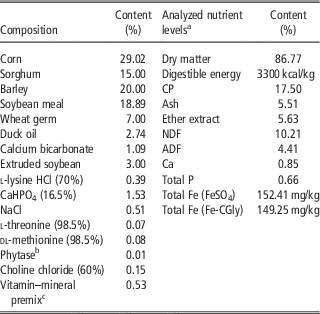
The animal experiment was conducted at a large-scale breeding farm at New Hope Liuhe Co. Ltd in Linyi, Shandong, China. Experimental diets met the National Research Council (2012) recommended nutrient requirements for sows during the late-gestation period (Table 1) including 80 mg Fe/kg as FeSO4 and Fe-CGly, respectively. The diets were prepared at an affiliated feed factory, Liuhe Feed Company in Linshu, Linyi, Shandong, China, into pellets in one batch. Multiparous sows (Landrace × Large Yorkshire, after second lactation) were bred with a Duroc boar. A total of 40 pregnant sows (back fat thickness of 18 to 20 mm) were selected at day 85 of gestation. Sows were randomly assigned to receive one of the two treatments (n=20 in each group): (1) Control (FeSO4; Henyang Tianyu Chemical Co. Ltd), and (2) Treatment (Fe-CGly; Guangzhou Tanke BIO-TECH Co. Ltd) from day 85 of gestation to parturition. All sows were housed individually in environmentally controlled slatted-floor enclosures with free access to drinking water. During farrowing, basal birth assistance was given by the farm staffs to avoid infection.
Ingredient content and composition of basal diet for late-gestating sows

Fe-CGly=ferrous N-carbamylglycinate chelate.
a These analyses of feeds were conducted according to the AOAC (2004).
b Phytase, 1000 FTU/kg, from Axtra® PHY (6-phytase from Buttiauxella sp., expressed in Trichoderma reesei), Danisco Animal Nutrition, DuPont Industrial Biosciences.
c The vitamin–mineral premix provided the following per kilogram of diets: antioxidant 100 mg, sweetening agent 200 mg, 6000 IU of vitamin A, 3000 IU of vitamin D3, 20 IU of vitamin E, 1.8 mg of vitamin K3, 2.0 mg of thiamine, 6.0 mg of riboflavin, 4.0 mg of pyridoxine, 0.02 mg of vitamin B12, 26.0 mg of niacin, 18.0 mg of pantothenic acid, 3.2 mg of folic acid, 0.4 mg of biotin, 20 mg of Cu as CuSO4·5H2O, 100 mg of Zn as ZnSO4·H2O, 50 mg of Mn as MnSO4·H2O, 1.2 mg of I as KI, 0.30 mg of Se as Na2SeO3.
Diets
Experimental diets were based on corn, sorghum, barley, wheat germ and soybean meal, and were analyzed for dry matter (DM), digestible energy, CP, fat, NDF, ash, ADF, Ca, Fe and total P (Table 1). These analyses of feeds were conducted according to the Association of Official Analytical Chemists (2004). Feed allowance was limited to 3.0 kg/day for each sow during the experimental period.
Sample collection
On day 110 of gestation, eight sows were randomly selected from each group for blood collection. Specifically, 2×5 ml blood was collected aseptically in vacuum blood collection tubes with and without heparin solution from the jugular vein 2 h after the sows had consumed the meals. The blood samples were centrifuged at 2000×g for 10 min at 4°C to obtain serum and plasma samples, and were stored at −80°C for further analysis. On the day of birth, one new-born male piglet (1.503±0.142 kg) was randomly selected from eight of the 20 litters per treatments. They were kept apart from their mother sows to avoid ingestion of colostrum. They were anaesthetized with Zoletil 100 (15 mg tiletamine/kg BW, 15 mg zolazepam/kg BW, i.m., Virbac, Carros, France) and 5 ml of blood was collected aseptically in vacuum blood collection tubes without heparin from the heart. Thereafter, they were bled by exsanguination, and kidney, liver and longissimus muscle samples were collected from these piglets. The blood samples were centrifuged at 2000×g for 10 min at 4°C to obtain serum samples, and stored at −80°C for further analysis. The tissue samples were stored at −20°C until analysis.
The litter size, litter weight at birth (alive), mean weight of live born and numbers of live born piglets, weak-born (birth weight <0.7 kg denoted by 1, and 0.7 kg<birth weight<0.8 kg denoted by 0.5) piglets, and still-born piglets and mummies from each sow were recorded. Colostrum was collected during the first 2 h after farrowing without oxytocin injection, while the placenta of the individual piglets was separated and collected immediately after delivery and frozen in liquid nitrogen before analysis.
Serum chemistry
Serum total albumin, alkaline phosphatase, globulin, glucose, total bilirubin, creatinine, immunoglobulin M, immunoglobulin G, alanine aminotransferase, aspartate aminotransferase, total cholesterol, triglyceride and total protein of late-gestation sows which was collected at day 110 gestation were determined by Roche Diagnostics kits (Division of Hoffman-la Roche Limited, Montreal, QC, Canada) using an autoanalyzer, the Hitachi 7150 (Hitachi Medical, Tokyo, Japan), according to the manufacturer’s instructions.
Iron status in serum
The serum iron and serum total iron-binding capacity (TIBC) were assayed by the colorimetric method, where the ferric iron was reduced to ferrous iron in acid, then reacted with bipyridine to a pink solution by commercial kits (A040; Nanjing Jiancheng Bioengineering Institute, Nanjing, PR China) according to the manufacturer’s instructions.
Microelement analyses in tissues and colostrum
The concentrations of iron, copper, zinc and manganese were investigated in feed, placenta and colostrum of sows and liver, kidney and muscle of new-born piglets, with an inductively coupled plasma emission spectrometer (ICP). All tissues, placenta samples and feeds were completely dried at 60°C and grinded into powder before pretreatment. Thereafter, the tissues, placenta samples and feeds (1.00±0.05 g) and colostrum (1.00±0.05 ml) were weighed in triplicate and submitted to acid-digestion using a mixture of nitric and perchloric acids following a heating procedure: 80°C, 60 min; 120°C, 30 min; and 180°C, 30 min. These samples were dried at 260°C and re-dissolved with 5 ml of 1% HNO3. Then they were transferred to a 25 mL volumetric flask, and diluted with 1% HNO3, after which, they were filtered and submitted for ICP analyses (ICP-720ES, Agilent, Palo Alto, CA, USA). All results were certified by standard references and the precision of the analytical method, calculated as the relative standard deviation of metal concentrations in the digests of the same sample, was 0.47% for feed, 5.32% for placenta, 8.13% for colostrum, 6.45% for liver, 4.28% for kidney and 7.36% for muscle. Mineral concentrations of the feed (mg/kg) and tissues (μg/g) were expressed on a DM basis, whereas colostrum mineral concentrations were reported as mg/l.
Quantitative real-time PCR
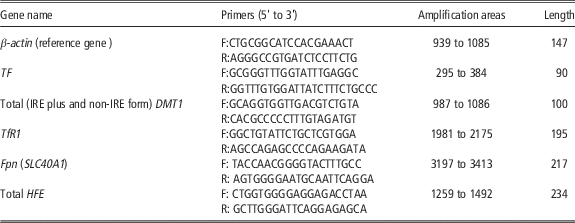
The placenta, liver and kidney tissues were homogenized under liquid nitrogen, and the messenger RNA (mRNA) was extracted as previously described by Zhang et al. (Reference Zhang, Sun, Xie, Shu, Oso, Ruan, Deng, Wu and Yin2015). The mRNA levels of β-actin (reference gene), DMT1, TF, TfR1, ferroportin (Fpn) and hemochromatosis (HFE) were determined by the Luminaris Color HiGreen High ROX (Thermo Scientific, Pittsburgh, PA, USA) on a Bio-Rad I-Cycler real-time PCR (Bio-Rad, Hercules, CA) according to the manufacturer’s instructions. The primers are shown in Table 2. The fold of changes in mRNA levels were calculated using the 2−ΔΔCt method.
Primers and annealing temperatures for quantitative real-time PCR

TF=transferrin; IRE=iron-responsive element; DMT1=divalent metal transporter 1; TfR1=transferrin receptor 1; Fpn=ferroportin; HFE=hemochromatosis.
Statistical analysis
The data were presented as mean values. All statistical analyses were performed using the SPSS 17.0 software. The differences between treatments were evaluated using a simple t-test. For the analysis of reproductive performance, the dietary treatment was considered as the fixed effect and litter was considered as a randomized factor. For the analysis of routine blood indexes, serum biochemical indexes, microelements and gene expression of iron transporters, the dietary treatment was considered as the fixed effect and animal was considered as the randomized factor. Probability values <0.05 and <0.01 were considered statistically significant and highly significant, respectively.
Results
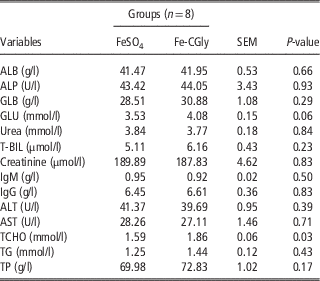
During the experimental period, no signs of undesirable effects including feed refusal, vomiting and diarrhea were observed in the 40 sows. In addition, no differences with clinical significance were found in the serum chemistry at day 110 of gestation (Table 3).
Influence of Fe supplementation (80 mg/kg) from FeSO4 or ferrous N-carbamylglycinate chelate (Fe-CGly) in the diet of sows from day 85 of gestation to parturition on serum characteristic on day 110 of gestation

ALB=total albumin; ALP=alkaline phosphatase; GLB=globulin;=GLU=glucose; T-BIL=total bilirubin; IgM=immunoglobulin M; IgG=immunoglobulin G; ALT=alanine aminotransferase; AST=aspartate aminotransferase; TCHO=total cholesterol; TG=triglyceride; TP=total protein.
Litter size and litter weights
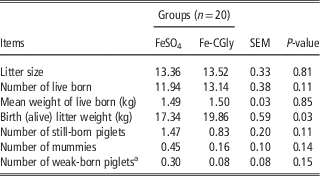
The production performance of the sows is summarized in Table 4. The mean litter size was similar for all treatments. The average number of piglets per sow was 13.36 and 13.52 for the FeSO4 and Fe-CGly supplemented groups, respectively. Similarly, the number of live born (P=0.339), still-born piglets (P=0.110), mummies (P=0.139) and weak-born piglets (P=0.154) per sow were also not significantly different. Litter weight of live born piglets was higher (P=0.030) in the Fe-CGly group (19.86 kg) than in the FeSO4 group (17.34 kg).
Influence of Fe supplementation (80 mg/kg) from FeSO4 or ferrous N-carbamylglycinate chelate (Fe-CGly) in the diet of sows from day 85 of gestation to parturition on reproduction performance

a Birth weight <0.7 kg denoted by 1, and 0.7 kg<birth weight<0.8 kg denoted by 0.5.
Effects on iron status of late-gestation sows and new-born piglets
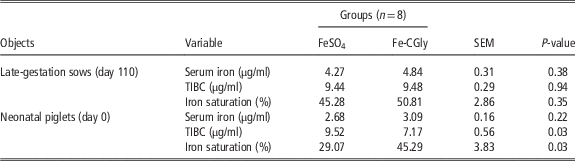
Serum iron concentration, TIBC and iron saturation were not affected in late-gestation sows (Table 5), whereas the supply of Fe-CGly in the sow diet reduced the TIBC (P=0.031), and increased iron saturation (P=0.027) in new-born piglets.
Influence of Fe supplementation (80 mg/kg) from FeSO4 or ferrous N-carbamylglycinate chelate (Fe-CGly) in the diet of sows from day 85 of gestation to parturition on serum iron concentration TIBC and iron saturation of sows on day 110 of gestation and neonatal piglets on day 0 of birth

TIBC=total iron-binding capacity; Iron saturation=Serum iron/TIBC×100%.
Mineral concentrations in placenta and colostrum of sows
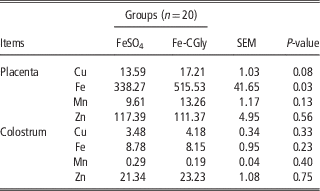
The effects of Fe-CGly on sow mineral concentrations in the placenta and colostrum are presented in Table 6. The Fe concentration was significantly higher in placentas of Fe-CGly supplemented sows than the placentas of the control group (P=0.031). Moreover, the placental Cu concentration in the Fe-CGly group also tended to be higher than that of the control group (P=0.082). The concentrations of Cu, Fe, Zn and Mn in the colostrum were not significantly affected by dietary iron sources (P>0.05).
Influence of Fe supplementation (80 mg/kg) from FeSO4 or ferrous N-carbamylglycinate chelate (Fe-CGly) in the diet of sows from day 85 of gestation to parturition on copper, iron, zinc and manganese concentrations in placenta and colostrum during farrowing (μg/g)

Mineral concentrations in tissues of new-born piglets
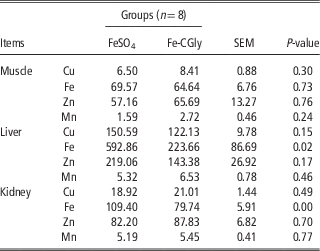
The effects of Fe-CGly on the mineral status in liver, kidney and muscle samples of off-springs are presented in Table 7. Maternal dietary supplementation with Fe-CGly significantly reduced the Fe concentration in livers (P=0.020) and kidneys (P=0.004) of the off-spring. Other investigated minerals in these two tissues and all investigated minerals in muscles did not vary significantly between the two groups (P>0.05).
Influence of Fe supplementation (80 mg/kg) from FeSO4 or ferrous N-carbamylglycinate chelate (Fe-CGly) in the diet of sows from day 85 of gestation to parturition on copper, iron, zinc and manganese concentrations in muscle, liver and kidney (μg/g) of neonatal piglets after birth (day 0)

Iron-related gene messenger RNA levels in the placenta, liver and kidney of piglets
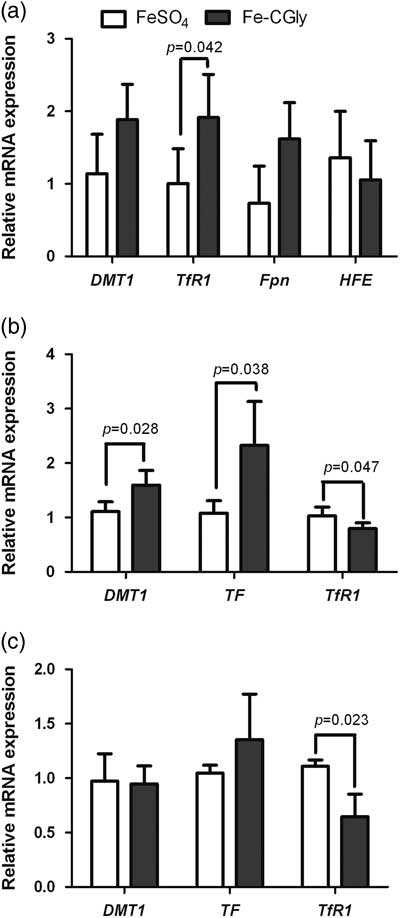
On the basis of above results, the relative expression of DMT1, TF and TfR1 were investigated. As shown in Figure 1, the mRNA levels of TF (P=0.083) and TfR1 (P=0.042) in placenta were higher in the Fe-CGly group than the FeSO4 group. Similar higher expressions of DMT1 (P=0.028) and TF (P=0.038) were also found in the liver of new-born piglets in the Fe-CGly group. However, the mRNA expression of TfR1 was significantly lower in the liver (P=0.047) and kidneys (P=0.032) of new-born piglets in the Fe-CGly group compared with the FeSO4 group. Other genes, including DMT1 in the placenta, and DMT1 and TF in kidney, were not differentially expressed (P>0.05).
Influence of Fe supplementation (80 mg/kg) from FeSO4 or ferrous N-carbamylglycinate chelate (Fe-CGly) in the diet of sows from day 85 of gestation to parturition on messenger RNA (mRNA) levels of iron homeostasis-related genes in the placenta of farrowing sows (a), and in the liver (b) and the kidney (c) of neonatal pigs. DMT1=divalent metal transporter 1; TfR1=transferrin receptor 1; Fpn=ferroportin; HFE=hemochromatosis; TF=transferrin.

Discussion
Several studies have emphasized the biological effects of organic iron chelates over iron salt (Spears et al., Reference Spears, Schoenherr, Kegley, Flowers and Alhunsen1992; Duque et al., Reference Duque, Martinez, Vilchis-Gil, Mendoza, Flores-Hernandez, Moran, Navarro, Roque-Evangelista, Serrano and Mera2014; Milman et al., Reference Milman, Jønsson, Dyre, Pedersen and Larsen2014), which suggests that maternal dietary supplementation with organic iron chelates is feasible for the improvement of reproductive performance and the prevention of iron deficiency during pregnancy. However, the effects of different organic iron chelates on sows are inconsistent in published literatures. For example, litter weight increased in sows that were given an organic iron complex (120 mg/kg, Fe) during the whole pregnancy period (Peters and Mahan, Reference Peters and Mahan2008), whereas glycine chelate (62.5 mg/kg) added to sow feed for 0 (control), 2, 4, 6 or 8 weeks before farrowing significantly improved the bioavailability of iron and the proportions of still-born and mummified fetuses per litter were significantly improved (Tummaruk et al., Reference Tummaruk, Tantilertcharoen, Pondeenana, Buabucha and Virakul2003). However, the still-born and mummified fetuses per litter were not improved when the organic iron chelate complex (80 mg/kg, Fe), composed of 35% ferrous fumarate, 25% iron lactate, 37% glycine chelate iron and 3% iron methionine chelate was fed to sows during the late-pregnancy period from day 84 to parturition (Wang et al., Reference Wang, Li, Che, Lin, Fang, Xu and Wu2014). It was not improved neither when the amino acid chelate iron complex (120 mg/kg, Fe as Availa-Fe®, Zinpro Corp., USA) was added during the whole period of pregnancy (Wei et al., Reference Wei, Xu, Luo, Zeng, Chen and Timothy2005). In the present study, the Fe-CGly (80 mg/kg, Fe) was supplemented to sows’ feed from day 85 to parturition. Although the litter size and the number of live born, still-born piglets, mummies and weak-born piglets per sow were not significantly different, they were somewhat improved under the organic iron chelate treatment, resulting in a significant improvement of litter weight. In this respect, our results suggest that Fe-CGly has a similar effect as the organic iron chelate that used by Peters and Mahan’s (Reference Peters and Mahan2008) research, but is better than the organic iron chelate complex, which was composed of 35% ferrous fumarate, 25% iron lactate, 37% glycine chelate iron and 3% iron methionine chelate (Wang et al., Reference Wang, Li, Che, Lin, Fang, Xu and Wu2014) and the Availa-Fe® (Wei et al., Reference Wei, Xu, Luo, Zeng, Chen and Timothy2005). Giving different origin/structure of the organic iron chelates or optimizing the dose and time duration of these chelates would improve the iron status in sows.
Iron is a micronutrient critical for embryonic and fetal survival and development (Hostetler et al., Reference Hostetler, Kincaid and Mirando2003). Iron deficiency results in a decline of hemoglobin, which is associated with increased probability of stillbirth and low birth weight (Zaleski and Hacker, Reference Zaleski and Hacker1993). Thus, placenta iron transport and iron availability of both sows and neonatal pigs have attracted greater attention. Compared with ferrous sulfate, organic iron chelate complex significantly increased serum iron concentration but did not affect the TIBC at day 1 of lactation (Wang et al., Reference Wang, Li, Che, Lin, Fang, Xu and Wu2014). Iron from Availa-Fe® did not statistically significantly improve the iron status of sows on day 90 and day 105 of pregnancy, but significantly improved the hemoglobin concentration in neonatal piglets (Wei et al., Reference Wei, Xu, Luo, Zeng, Chen and Timothy2005). In the present study, although improvement of serum iron status were not observed in sows on day 110 of pregnancy, the iron saturation and TIBC in the neonatal piglets at birth, as well as iron concentration in the placenta were significantly improved by Fe-CGly. The increased placenta iron transport and iron availability are probably the critical effects of Fe-CGly the context of improving litter weight.
The iron concentration in liver and kidney of neonatal piglets were significantly decreased for the Fe-CGly treatment. Although it has been described that these divalent ferrous, copper, zinc and manganese were competitively or synergistically absorbed (Rossander-Hultén et al., Reference Rossander-Hultén, Brune, Sandström, Lönnerdal and Hallberg1991; Sandström, Reference Sandström2001; Lind et al., Reference Lind, Lönnerdal, Stenlund, Ismail, Seswandhana, Ekström and Persson2003; Walker et al., Reference Walker, Kordas, Stoltzfus and Black2005), the interactions were not observed in the current study, as the concentrations of other divalent ions including copper, zinc and manganese in the liver and kidney tissues were not significantly differed under treatment. The iron stores decreased as iron needs increased in the sows because of the greater number of pigs farrowed and heavier litter weights at parturition. Similar results were found by Peters and Mahan’s (Reference Peters and Mahan2008) who showed that the concentration of hemoglobin was significantly lower in the neonates and day 2 pigs from sows fed with organic trace minerals. Although the placenta iron was significantly higher compared with the ferrous sulfate group, iron remained insufficient for the rapid growth of the fetal–placental unit. Moreover, our results revealed that the iron concentrations in colostrum were not significantly different between the two groups. Similar findings were found in cows that were fed with organic copper chelates, in which their copper levels were not improved even in colostrum (Muehlenbein et al., Reference Muehlenbein, Brink, Deutscher, Carlson and Johnson2001). Therefore, Fe-CGly supplementation in the feed of pregnant sows improved litter birth weight, probably via increased iron transportation in the placenta and iron availability in embryos, which were extremely important for the embryonic and fetal survival and development in the late-gestation sows.
To further explain the differences of in iron concentrations in liver, kidney and placenta tissues in the two treatments, the mRNA levels of DMT1, TF, TfR1, Fpn and HFE were investigated. The results revealed that in the Fe-CGly group, the mRNA level of DMT1 was significantly higher in the liver, whereas the TfR1 was significantly higher in the placenta and lower in liver and kidney tissues. The level of TfR1 transcripts, but not the DMT1, was positively correlated with the iron status in these tissues. Thus, the TfR1, but not the DMT1, may be the major pathway for Fe-CGly-related iron transportation in the placenta and in neonatal piglets. This is explicable as DMT1 is dispensable in mice placenta and liver (Gunshin et al., Reference Gunshin, Fujiwara, Custodio, DiRenzo, Robine and Andrews2005). Meanwhile, the expressions of Fpn and HFE were not significantly changed in the placenta of Fe-CGly treated sows. Thus, the circulating TF was probably the major regulatory factor involved in the Fe-CGly mediated placenta iron transfer. However, further investigations on the detailed mechanism of the Fe-CGly should be performed.
In summary, the present results showed that replacement of maternal FeSO4 supplement with Fe-CGly in the late-gestating period for sows could improve litter birth weight, probably via enhancing placenta iron transportation. As few reports have shown that organic iron chelates could improve the reproductive performance of sows, further studies need to be performed to reveal the underlying mechanisms of Fe-CGly and other organic iron chelates or complex in pig nutrition.
Acknowledgments
The authors thanked the National Key R&D Program of China (2016YFD0501201, 2016YFD0200900, 2016YFD0500504), the National Natural Science Foundation of China (31702127), the Major Project of Hunan Province (2015NK1002), the Open Foundation of Key Laboratory of Agro-ecological Processes in Subtropical Region, Institute of Subtropical Agriculture, Chinese Academy of Sciences (ISA2016303), the Natural Science Foundation of Hunan Province (2016JJ3131).