Italian ryegrass is an important forage grass that is widely distributed in Asia, Europe, and North and South America (Lopes et al. Reference Lopes, Reis, Barata and Nunes2009). Italian ryegrass was introduced in China to provide green lawns and pastures and has been extensively planted in recreational areas and used for livestock grazing (Zhang et al. Reference Zhang, Li, Gou and Zhang2009). However, in recent years, Italian ryegrass has invaded wheat fields in many provinces in China and has become an aggressive weed (Hao and Zhang Reference Hao and Zhang2015; Wang et al. Reference Wang, Song, Li, Yang, He and Lou2008). Many farmers from different provinces in China have found it difficult to control Italian ryegrass in their wheat fields using fenoxaprop-P-ethyl. However, the response of Italian ryegrass to this herbicide and corresponding resistance levels in China have not been studied to date.
Acetyl-CoA carboxylase (ACCase) is a rate-limiting enzyme that can catalyze ATP-dependent carboxylation of acetyl-CoA to form malonyl-CoA. ACCase inhibitors are important herbicides in weed management. There are three chemical families of ACCase-inhibiting herbicides: aryloxyphenoxypropionates (APPs, including fenoxaprop-P-ethyl), cyclohexanediones (CHDs), and phenylpyrazolins (DENs) (Scarabel et al. Reference Scarabel, Panozzo, Varotto and Sattin2011). APP and CHD herbicides bind the active site in diverse regions at the dimer interface in the ACCase carboxyl-transferase (hereafter, CT) domain. CHD herbicides and the DEN herbicide pinoxaden have a similar binding mode, but different chemical structures (Yu et al. Reference Yu, Kim and Tong2010).
Weeds usually evolve resistance to ACCase-inhibiting herbicides through two mechanisms: target-site (TSR) or non–target site (NTSR) resistance. Weed resistance caused by amino acid substitutions hindering the binding of ACCase-inhibiting herbicides with the CT domain of ACCase is known as the TSR mechanism. To date, researchers have identified 13 target-site mutations within the ACCase CT domain. Mutations that can result in herbicide resistance include: Asn-2078 to Gly, Cys-2088 to Arg, Gly-2096 to Ala or Ser, Ile-1781 to Leu, Ile-1781 to Val, Ile-1781 to Thr, Ile-2041 to Asn or Val, Trp-1999 to Cys, Trp-1999 to Leu, Trp-1999 to Ser, and Trp-2027 to Cys (Collavo et al. Reference Collavo, Panozzo, Lucchesi, Scarabel and Sattin2011; Cruz-Hipolito et al. Reference Cruz-Hipolito, Domínguez-Valenzuela, Osuna and De Prado2012; Délye Reference Délye, Matejicek and Gasquez2002b; Gherekhloo et al. Reference Gherekhloo, Osuna and De Prado2012; Kaundun Reference Kaundun2010; Li et al. Reference Li, Du, Liu, Yuan and Wang2014; Petit et al. Reference Petit, Bay, Pernin and Délye2010; Scarabel et al. Reference Scarabel, Panozzo, Varotto and Sattin2011; Yu et al. Reference Yu, Collavo, Zheng, Owen, Sattin and Powles2007; Zagnitko et al. Reference Zagnitko, Jelenska, Tevzadze, Haselkorn and Gornicki2001).
NTSR includes a variety of mechanisms, such as metabolic degradation of herbicide, reduced absorption/translocation, and sequestration (Cummins et al. Reference Cummins, Cole and Edwards1999; Délye Reference Délye2013). NTSR has been reported to be related to the involvement of four enzyme families: glycosyltransferase, Cyt P450, glutathione S-transferase, and ATP-binding cassette transporters (Fischer et al. Reference Fischer, Bayer, Carriere, Ateh and Yim2000; Preston et al. Reference Preston, Tardif, Christopher and Powles1996; Wang et al. Reference Wang, Li, Lv, Lou and Dong2013). The increased rates of herbicide metabolism catalyzed by Cyt P450 can enhance plant resistance to various herbicides, including diclofop-methyl, bispyribac-sodium, fluazifop-P-butyl, simazine, chlorotoluron, chlorsulfuron, ethametsulfuron-methyl, isoproturon, and mecoprop (Fischer et al. Reference Fischer, Bayer, Carriere, Ateh and Yim2000; Powles and Yu Reference Powles and Yu2010; Yun et al. Reference Yun, Yogo, Miura, Yamasue and Fischer2005; Wang et al. Reference Wang, Li, Lv, Lou and Dong2013). Liu et al. (Reference Liu, Hulting and Mallory-Smith2016) reported that the acetolactate synthase resistance in Italian ryegrass might be due to the metabolic effect of Cyt P-450. However, how Cyt P-450 function in resistance to fenoxaprop-P-ethyl in Italian ryegrass has not been reported to date.
In this study, we collected a putative resistant Italian ryegrass population from Henan province, China, where fenoxaprop-P-ethyl cannot effectively control Italian ryegrass. The objectives of this study were: (1) to determine the level of resistance to fenoxaprop-P-ethyl in the Italian ryegrass population, (2) to explore the resistance mechanism of Italian ryegrass to fenoxaprop-P-ethyl, and (3) to identify patterns of cross-resistance in the resistant population.
Materials and Methods
Materials
Seeds of the putative resistant Italian ryegrass population (HZYC-6) were collected in 2015 from wheat fields in Zhumadian, Henan province, China (32.9284°N, 113.9683°E), where fenoxaprop-P-ethyl had been used for more than 8 yr. In this region, Italian ryegrass was not being effectively controlled by fenoxaprop-P-ethyl. We collected seeds of a sensitive population (JNXW-2) from a wild (uncultivated) field in Jiangsu province and used this wild population as a susceptible control in all experiments.
Herbicides and Chemicals
Three types of ACCase-inhibiting herbicides used are presented in Table 1. Three types of Cyt P-450 inhibitors were used as follows: piperonyl butoxide (PBO; 97%, Aladdin, Shanghai, China), 1-aminobenzotriazole (ABT; 98%, Solarbio Science & Technology, Shanghai, China), and malathion (95%, Jiangsu Fengshan, Jiangsu, China).
Herbicides used in this study.

a Abbreviations: EC, emulsifiable concentrate; WP, wettable powder.
b All cities are in China.
Sensitivity to Fenoxaprop-P-ethyl
Seeds were sown in pots (25 seeds pot–1; pot dimensions were 8-cm high by 7-cm long by 7-cm wide) containing a mixture of sand and soil at a ratio of 2:1 (w/w), with a pH of 5.6 and organic matter content of approximately 14%. Plants were grown in incubators at 20/15 C (light/dark temperatures) with a 12-h light/12-h dark cycle, a light intensity of 108 µmol m−2 s−1, and a relative humidity of 85%. Plants were watered and fertilized with N–P–K regularly. They were rotated to control for differential growth or border effects. Twenty individual plants were kept in each pot after sprouting, and they were considered subsamples for each herbicide treatment. Approximately 4 wk after sowing, when the grasses had grown to the 3- to 4-leaf stage, they were sprayed with fenoxaprop-P-ethyl using a laboratory sprayer equipped with a flat-fan nozzle delivering 280 L ha−1 at 230 kPa. Then the pots were returned to the greenhouse. Fenoxaprop-P-ethyl doses of 0, 3.87, 15.5, 62 (1X field rate), 248, 992, and 1,984 g ai ha−1 were used for the JNXW-2 population. For the HZYC-6 population, fenoxaprop-P-ethyl doses of 0, 3.87, 15.5, 62, 248, 992, 1,984, and 3,968 g ha−1 were used. Four random replications were selected per dose, and the experiment was conducted twice. In the third week after treatment, all the plants were sampled, and only the fresh parts were used in later experiments.
Identification of Target-Site Mutations
Fresh leaves were collected from the plants surviving the recommended field dose of fenoxaprop-P-ethyl (n=50), and the fresh material was flash-frozen in liquid nitrogen and then transferred to a −70 C freezer. DNA was extracted using the Plant Genomic DNA kit (Yi FeiXue Bio Tech, Nanjing, China). PCR primers (Table 2) were designed based on the published ACCase genomic DNA sequence of Italian ryegrass (GenBank no. AY710293) to cover all seven mutation sites (1781, 1999, 2027, 2041, 2078, 2088, and 2096) using the software Premier v. 5.0 (Premier Biosoft International, Palo Alto, CA). The PCR analyses were conducted with 2.5 ng of DNA, 2 μl of each primer (10 μM), 25 μl of 2X PCR TaqMix (Dongsheng Biotech, Guangzhou, China), and double-distilled H2O to a final volume of 50 μl. The PCR program had 30 cycles; each cycle included 30 s at 94 C, 30 s at 61 C for the primers, and 1 min at 72 C, followed by 4 min of denaturation at 94 C. The PCR products were visualized on a 1.0% agarose gel in 1X TAE buffer. To minimize sequencing errors, each fragment was sequenced in the forward and reverse directions by a commercial sequencing company (Invitrogen Biotechnology, Shanghai, China). Sequence data were aligned and compared using BioEdit Sequence Alignment Editor Software (Pan et al. Reference Pan, Li, Zhang, Zhang and Dong2015a).
PCR primers.

a Nucleotides discriminating plastidic ACCase sequences from grasses from cytosolic ACCase sequences are in bold.
Sensitivity to Fenoxaprop-P-ethyl Following Cyt P450 Inhibition
Seeds of the HZYC-6 and JNXW-2 populations were grown as described earlier. At the 3- to 4-leaf stage, grass seedlings were treated with ABT, PBO, malathion, fenoxaprop-P-ethyl, PBO with fenoxaprop-P-ethyl, ABT with fenoxaprop-P-ethyl, and malathion with fenoxaprop-P-ethyl. Fenoxaprop-P-ethyl was used at 0, 3.87, 15.5, 62, 248, 992, and 1,984 g ha−1 to assay the susceptible population JNXW-2, and at 0, 3.87, 15.5, 62, 248, 992, 1,984, and 3,968 g ha−1 to assay the resistant population HZYC-6. PBO was used in two applications of 2,100 g ai ha−1 in 97 L ha−1 water to give a total application of 4,200 g ai ha−1 in a total volume of 194 L ha−1 water. ABT and malathion were both applied at 1,000 g ha−1. PBO, ABT, and malathion were formulated in a mixture of emulsifier (Tween-80, 1 ml L−1 in water) and acetone and were applied 1 h before herbicide application (Wang et al. Reference Wang, Li, Lv, Lou and Dong2013). Control plants were treated with mixed emulsifier and acetone. Herbicide treatments were imposed as reported in a previous study (Pan et al. Reference Pan, Li, Zhang, Zhang and Dong2015a). The treatments were replicated four times in each experiment, and the experiment was conducted two times.
Sensitivity to Other ACCase-inhibiting Herbicides
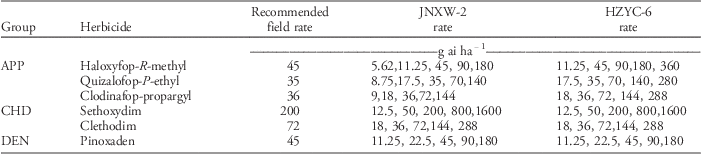
We used the method described above to detect the sensitivity of Italian ryegrass to other ACCase-inhibiting herbicides (including three APPs, two CHDs, and one DEN) at different doses (Table 3). All the herbicides were applied by the laboratory sprayer equipped with a flat-fan nozzle. The treatments were replicated four times in each experiment, and the experiment was conducted two times.
Herbicide treatments applied to the resistant and susceptible Italian ryegrass populations in cross-resistance studies.

Data Analysis
The effective herbicide dose causing a 50% reduction of fresh weight (ED50) was calculated using a three-parameter model using the ‘drc’ add-on package (Ritz and Streibig Reference Ritz and Streibig2007; Valverde et al. Reference Valverde, Boddy, Pedroso, Eckert and Fischer2014) in R v. 3.3.2 (R Development Core Team, Vienna, Austria). All dose–response data from two experiments were analyzed by ANOVA (SPSS v. 21, SPSS, IBM, Chicago, IL). There was no significant trial by treatment interaction from each experiment, so the data sets were combined and fit to a nonlinear logistic model (Chen et al. Reference Chen, Wang, Yao, Zhu and Dong2016; Yu et al. Reference Yu, Collavo, Zheng, Owen, Sattin and Powles2007). Thus, the ED50 for each herbicide tested was determined for each population.
Results and Discussion
Sensitivity to Fenoxaprop-P-ethyl
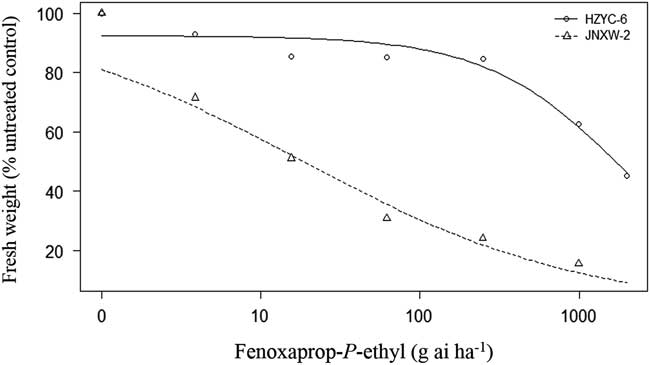
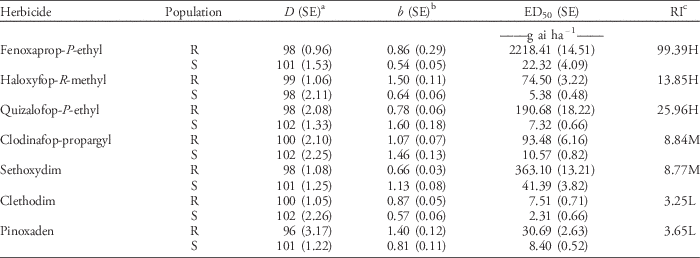
The ED50 value of population HZYC-6 (2,218.41g ha−1) was higher than the fenoxaprop-P-ethyl dose recommended for common weed control (62.0 g ha−1), and the ED50 value of population JNXW-2 was only 22.32 g ha−1. Evaluation using the resistance index (RI) indicated that population HZYC-6 showed a 99-fold resistance to fenoxaprop-P-ethyl, compared with the control population JNXW-2 (Table 4). Dose–response tests of the two populations with fenoxaprop-P-ethyl are presented in Figure 1.
Fenoxaprop-P-ethyl dose–response tests for the HZYC-6 and JNXW-2 populations.

Response of Italian ryegrass to increasing doses of graminicides.

a D represents the upper asymptote of fresh weight at dose zero (control treatment).
b b is the proportional slope of the curve around ED50.
c Resistance indices (RIs) were calculated as the ratio between the ED50 of the resistant population and the ED50 of the susceptible population: S, not resistant (<2); L, low resistance (2–5); M, moderate resistance (6–10); H, high resistance (>10) (Pan et al. Reference Pan, Li, Zhang, Zhang and Dong2015a).
Farmers in China typically prefer to use a higher dose of a single herbicide to improve weed control, rather than using additional herbicides, which can be expensive. Fenoxaprop-P-ethyl is a common herbicide in weed management, but an increasing number of studies have reported weed resistance to fenoxaprop-P-ethyl ( Pan et al. Reference Pan, Li, Zhang and Dong2015b; Yuan et al. Reference Yuan, Liu, Bi, Du, Guo and Wang2015; Xu et al. Reference Xu, Li, Zhang, Cheng, Jiang and Dong2014). In this study, an Italian ryegrass population (HZYC-6) that had been subjected to treatment with fenoxaprop-P-ethyl for 8 yr presented very high resistance to that herbicide. Italian ryegrass has evolved resistance to different types of herbicides in many countries (Kaundun Reference Kaundun2010; Liu et al. Reference Liu, Hulting and Mallory-Smith2016), but to our knowledge, this study is the first report of Italian ryegrass becoming highly resistant to fenoxaprop-P-ethyl in China.
Identification of Target-Site Mutations
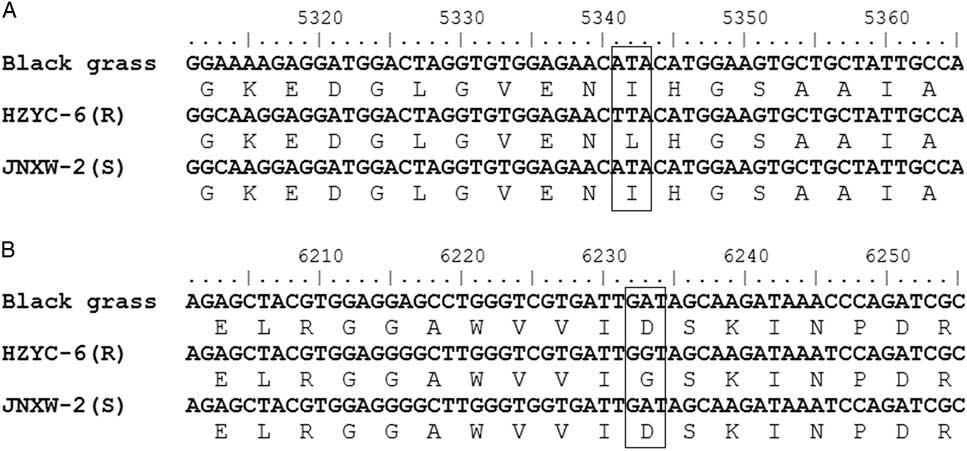
By analyzing the sequences of 50 samples from each population, we identified two known ACCase mutations in the resistant population. Substitution from A (population JNXW-2) to T (population HZYC-6) causes a substitution from isoleucine to leucine at the 1781 position (Ile-1781-Leu). Substitution from A (population JNXW-2) to G (population HZYC-6) causes a substitution from aspartate to glycine at the 2078 position (Asp-2078-Gly) (Figure 2). In the resistant population HZYC-6, 28 individuals presented mutations at position 1781 (56%), 5 individuals had mutations at position 2078 (10%), 16 individuals (32%) showed mutations at both positions 1781 and 2078, and one individual (2%) showed no mutations but was still resistant to fenoxaprop-P-ethyl.
Sequence alignment part of the acetyl-CoA carboxylase gene from the resistant (HZYC-6(R)) and susceptible (JNXW-2 (S)) Italian ryegrass populations and blackgrass (GenBank no. AJ310767). (A) The boxed codon indicates a nonsynonymous mutation at Ile-1781-Leu (nucleotide change from ATA to TTA at position 5341). (B) The boxed codon indicates a nonsynonymous mutation at Asp-2078-Gly (nucleotide change from GAT to GGT at position 6233).

Zagnitko et al. (Reference Zagnitko, Jelenska, Tevzadze, Haselkorn and Gornicki2001) reported that Ile-1781-Leu substitution in Italian ryegrass conferred herbicide resistance. Subsequently, other studies have demonstrated that this substitution could provide resistance to herbicides in other plant species, such as blackgrass (Alopecurus myosuroides Huds.) (Délye et al. Reference Délye, Calmes and Matejicek2002a) and sterile oat (Avena sterilis L.) (Liu et al. Reference Liu, Harrison, Chalupska, Gornicki, O’Donnell, Adkins, Haselkorn and Williams2007). The substitution at amino acid 1781 is the most common site known to cause ACCase-inhibitor resistance (Zhang et al. Reference Zhang, Tweel and Tong2004). In this study, we found that Ile-1781-Leu amino acid substitution was associated with fenoxaprop-P-ethyl resistance in the population we sampled from the fields in Henan province, China. This is the first report that Italian ryegrass in China has developed resistance to fenoxaprop-P-ethyl owing to an amino acid substitution at position 1781.
The Asp-2078-Gly mutation was first identified in a resistant population of blackgrass in 2005 (Délye et al. Reference Délye, Zhang, Michel, Matejicek and Powles2005) and was subsequently demonstrated to confer resistance to herbicides in rigid ryegrass (Lolium rigidum Gaudin), hood canarygrass (Phalaris paradoxa L.), sterile oat, and Italian ryegrass (Kaundun Reference Kaundun2010; Yu et al. Reference Yu, Collavo, Zheng, Owen, Sattin and Powles2007). Although position 2078 is not located within the ACCase binding site itself, examination of the three-dimensional spatial structure of ACCase revealed that loss of the aspartic acid residue at position 2078 resulted in conformational changes within the target site and, consequently, altered binding efficiencies of ACCase herbicides (Délye et al. Reference Délye, Zhang, Michel, Matejicek and Powles2005; Jang et al. Reference Jang, Marjanovic and Gornicki2013). In this study, this substitution was associated with Italian ryegrass resistance to fenoxaprop-P-ethyl; the five individuals harboring only Asp-2078-Gly were resistant to fenoxaprop-P-ethyl. To our knowledge, this is the first report that Italian ryegrass in China has developed resistance to fenoxapropP-ethyl owing to an amino acid substitution at position 2078.
Our results are consistent with the findings of a previous study on Lolium spp. that different mechanisms of herbicide resistance could coexist in a certain grass population or perhaps within a single plant (Scarabel et al. Reference Scarabel, Panozzo, Varotto and Sattin2011). Those resistance patterns may be attributed to ryegrass being a cross-pollinated species, which would facilitate the transfer of single, independently evolved mechanisms among individuals and populations (Yu et al. Reference Yu, Collavo, Zheng, Owen, Sattin and Powles2007).
Effects of Cyt P450 Inhibitors on Fenoxaprop-P-ethyl
Several Cyt P450 inhibitors, such as PBO, tetcyclacis, ABT, tridiphane, and carbon monoxide have been reported in the literature (Fischer et al. Reference Fischer, Bayer, Carriere, Ateh and Yim2000; Pan et al. Reference Pan, Li, Zhang, Zhang and Dong2015a, Reference Pan, Li, Zhang and Dong2015b; Wang et al. Reference Wang, Li, Lv, Lou and Dong2013). In this study, we found that the reagents malathion, ABT, or PBO used in mixtures with fenoxaprop-P-ethyl were more effective than fenoxaprop-P-ethyl alone against Italian ryegrass, suggesting that Cyt P450-mediated metabolism of herbicides is present in population HZYC-6, conferring resistance to additional herbicides.
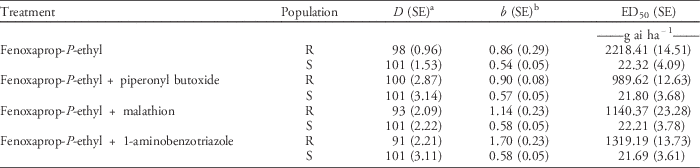
The response of the Italian ryegrass populations JNXW-2 and HZYC-6 to fenoxaprop-P-ethyl with or without PBO, malathion, and ABT, are summarized in Table 5. PBO, malathion, and ABT alone did not have a substantial impact on Italian ryegrass. There were no significant differences in the ED50 values for these herbicides in the control population JNXW-2 compared with mixtures containing fenoxaprop-P-ethyl and PBO, malathion, or ABT. Conversely, the ED50 values clearly declined when population HZYC-6 was treated with combinations of PBO and fenoxaprop-P-ethyl, malathion and fenoxaprop-P-ethyl, or ABT and fenoxaprop-P-ethyl. However, ED50 values for population HZYC-6 treated with mixtures of ACCase inhibitors and Cyt P450 inhibitors (989.62 g ha−1, 1,140.37 g ha−1, 1,319.19 g ha−1) were still higher than those of the control population (21.80 g ha−1, 22.21 g ha−1, 21.69 g ha−1) and the fenoxaprop-P-ethyl dose recommended for common weed control (62.0 g ha−1). These results indicate the presence of Cyt P450–mediated metabolism of ACCase inhibitors in population HZYC-6, and confirm our results showing that target-site resistance acts in addition to herbicide metabolism to confer resistance phenotypes. As we were unable to identify a sufficient number of plants lacking target-site modification, it remains unclear whether herbicide metabolism alone could confer resistance to typical field doses of ACCase inhibitors. This could be determined by making crosses to the control population and comparing the RI of individuals in the F2 generation having or lacking target-site modification.
Response of Italian ryegrass to fenoxaprop-P-ethyl and cytochrome P450 inhibitors.

a D represents the upper asymptote of fresh weight at dose zero (control treatment).
b b is the proportional slope of the curve around ED50.
Cross-resistance to ACCase-inhibiting Herbicides.
Population JNXW-2 was controlled by all herbicides tested, whereas HZYC-6 exhibited resistance to several of the herbicides (Table 4). The plants of the HZYC-6 population had high resistance to haloxyfop-R-methyl (RI=14) and quizalofop-P-ethyl (RI=26), moderate resistance to clodinafop-propargyl (RI=9) and sethoxydim (RI=9), and low resistance to clethodim (RI=3) and pinoxaden (RI=4).
In previous studies, both Asp-2078-Gly and Ile-1781-Leu mutations were found to confer resistance to APPs and CHDs herbicides in blackgrass, wild oat (Avena fatua L.), and Italian ryegrass (Délye et al. Reference Délye, Calmes and Matejicek2002a; Liu et al. Reference Liu, Harrison, Chalupska, Gornicki, O’Donnell, Adkins, Haselkorn and Williams2007; Zagnitko et al. Reference Zagnitko, Jelenska, Tevzadze, Haselkorn and Gornicki2001; Zhang and Powles Reference Zhang and Powles2006). Both substitutions were detected in population HZYC-6, which was found to be highly resistant to the herbicides quizalofop-P-ethyl and haloxyfop-R-methyl, moderately resistant to clodinafop-propargyl and sethoxydim, but with only low resistance to clethodim and pinoxaden.
In conclusion, the present study identified resistance to fenoxaprop-P-ethyl in the Italian ryegrass population HZYC-6 (from Henan, China). Mutations at Asp-2078-Gly and Ile-1781-Leu (target site–based resistance) were present in addition to Cyt P450–mediated metabolism (NTSR). While similar target-site mutations in other plant species have demonstrated resistant phenotypes, it is unclear at this point whether herbicide metabolism in this population is able to independently confer ACCase resistance. However, we suggest that both TSR and NTSR were present during development of herbicide resistance in population HZYC-6. Moreover, our research found that population HZYC-6 that was highly resistant to fenoxaprop-P-ethyl also exhibited resistance to several other ACCase-inhibiting herbicides. Further research may be needed to determine whether the resistance is caused by expression of different ACCases or mutation(s) in genes involved in additional metabolic processes (glycosyltransferase, glutathione S-transferase, ATP-binding cassette transporters).
Acknowledgments
This research was supported by the Special Fund for Agro-Scientific Research in the Public Interest (201303031) and a grant (No. 2013) from the Innovation Team Program for Jiangsu universities. The authors thank Haitao Gao (Nanjing Agricultural University, Nanjing, China) and Lang Pan (Nanjing Agricultural University, Nanjing, China) for technical assistance.