Introduction
Dorstenia L. holds a fascinating position within the Moraceae (mulberry family). With 105 species, Dorstenia is the second largest genus within the family, second only to Ficus L. (figs, c.750 species), and is the only Moraceae genus with herbaceous, succulent and woody species (Berg & Hijman, Reference Berg and Hijman1999; Berg, Reference Berg2001). All but one species of Dorstenia are restricted to the Neotropics or Africa, and it is the only group in the family with an almost equal distribution of species on either side of the Atlantic Ocean (Berg & Hijman, Reference Berg and Hijman1999). The Moraceae have been particularly well studied in part due to the unique pollination syndromes present in the family (Bawa et al., Reference Bawa, Perry and Beach1985; Sakai et al., Reference Sakai, Kato and Nagamasu2000; Berg, Reference Berg2001; Sakai, Reference Sakai2001; Zerega et al., Reference Zerega, Mound and Weiblen2004) and it has been hypothesised that Dorstenia may represent an intermediate form in the evolution from open inflorescence and wind pollination in Morus L. (mulberries) to the specialised syconium and obligate pollination mutualism of Ficus. In spite of Dorstenia’s unique distribution, morphology and evolutionary position within the Moraceae family, little is known about its evolutionary history, biogeography or reproductive ecology.
The Moraceae are comprised of 37 genera and c.1100 species (Berg, Reference Berg2001). The family exhibits a cosmopolitan distribution, with the majority of extant species found in the Old World tropics (Berg, Reference Berg2001). Molecular studies have shown that Moraceae is a well-supported monophyletic group, although taxon sampling for Dorstenia within the study was very poor, including only two out of 105 species (Datwyler & Weiblen, Reference Datwyler and Weiblen2004; Zerega et al., Reference Zerega, Clement, Datwyler and Weiblen2005; Clement & Weiblen, Reference Clement and Weiblen2009). The family is thought to have radiated during the mid-Cretaceous with an estimated date of 89.1 (72.6–110.0) million years ago (mya), suggesting that it probably diversified after the break-up of Africa and South America (105 mya) (Zerega et al., Reference Zerega, Clement, Datwyler and Weiblen2005).
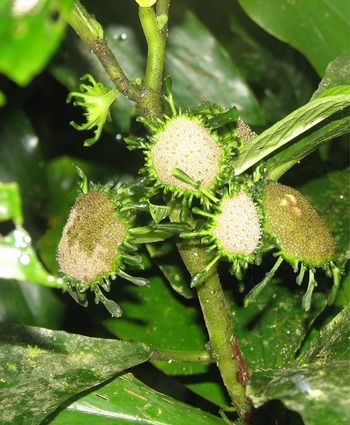
Dorstenia species are distinct from the majority of the Moraceae family in morphological characteristics as well as geographic distribution. Ninety per cent of Dorstenia species are herbaceous, as compared to the entire Moraceae family in which 90% of species exhibit a woody habit and only 10% are herbaceous. Life forms within the genus are variable, with geophytes (defined by the presence of underground storage organs), hemicryptophytes (plants with perennating buds located at the soil surface) and phanerophytes (in which the perennating buds are positioned well above the soil surface). Stems range from caulescent (well developed and above ground) to acaulescent (having only a very short below-ground stem or lacking one altogether) (Raunkiaer, Reference Raunkiaer1934). Reproductively, Dorstenia is characterised by discoid inflorescences that are primarily bisexual, with tiny reduced male and female flowers. The size and shape of the inflorescence varies among species and many are surrounded by a diversity of vegetative appendages, which differ greatly among taxa (Fig. 1). The endosperm of the seed is either microspermous (< 5 mm long or broad) or macrospermous (> 5 mm long or broad) and the fruits are drupes that dehisce explosively (Berg & Hijman, Reference Berg and Hijman1999; Berg, Reference Berg2001).
Dorstenia ciliata Engl.: close-up of inflorescence. Photo by Tracy Misiewicz.

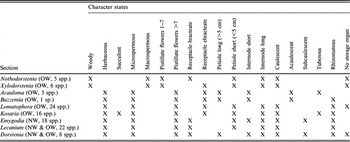
Berg & Hijman (Reference Berg and Hijman1999) and Berg (Reference Berg2001) prepared the most recent and comprehensive taxonomic treatments of Dorstenia in regional floras (Africa and the Neotropics, respectively). These treatments brought together scattered and previously unpublished taxonomic information and not only provide morphological and geographic information for Dorstenia, but also pose hypotheses regarding character evolution and dispersal mechanisms, and present a sectional classification for species in the genus (Table 1; Berg & Hijman, Reference Berg and Hijman1999).
Distribution of defining morphological characters for the sectional classification proposed by Berg & Hijman (Reference Berg and Hijman1999). Geographic distribution of species for each section is defined as Old World (OW), New World (NW) or both (NW & OW)

The genus is currently divided into nine sections based primarily on morphological characters pertaining to habit and life form (Table 1). While other sectional classifications proposed in the past included reproductive morphology, most of these divisions were proposed prior to the discovery of the majority of African species (Berg & Hijman, Reference Berg and Hijman1999). Berg & Hijman (Reference Berg and Hijman1999) were the first to propose a subdivision of the genus in its entirety.
Because Dorstenia is distinct from almost all other genera in the Moraceae with regard to habit, Berg & Hijman (Reference Berg and Hijman1999) posited that traits associated with woodiness, which is shared with most of the rest of the Moraceae, must be primitive, and characters associated with herbaceousness are derived. Based on morphological assessments Berg & Hijman (Reference Berg and Hijman1999) hypothesised that Dorstenia species have evolved from phanerophytes to hemicryptophytes to geophytes with stems evolving from caulescent to subcaulesent to acaulescent. Herbaceousness is thought to have evolved from woody habits (Berg & Hijman, Reference Berg and Hijman1999).
Since Raven & Axelrod (Reference Raven and Axelrod1974) first proposed the shifting of continental landmasses as a major driver in the shaping of spatial and temporal patterns of plant diversity there has been a debate over the importance of vicariance versus dispersal. The break-up of Gondwana in particular is a common explanation for disjunctions seen in many tropical floras (Raven & Axelrod, Reference Raven and Axelrod1974; Burnham & Graham, Reference Burnham and Graham1999; Muellner et al., Reference Muellner, Savolainen, Samuel and Chase2006; Clayton et al., Reference Clayton, Soltis and Soltis2009). As a result of Dorstenia’s southern hemisphere distribution and a lack of apparent means for long distance dispersal, the vicariance hypothesis has been specifically applied to the genus (Berg & Hijman, Reference Berg and Hijman1999). This distribution along with the equal species diversity in both the Old and the New World has led to the suggestion that Dorstenia originated at least 105 mya, the last time South America and Africa were connected (McLoughlin, Reference McLoughlin2001), and that Dorstenia species on each continent subsequently underwent separate diversifications (Berg & Hijman, Reference Berg and Hijman1999; Berg, Reference Berg2001). Alternatively, Dorstenia could have originated post-Gondwanan break-up and dispersed or migrated from one continent to the other, a more plausible hypothesis given that the Moraceae divergence is estimated to have occurred after Africa and South America split (Zerega et al., Reference Zerega, Clement, Datwyler and Weiblen2005).
Work by Zerega et al. (Reference Zerega, Clement, Datwyler and Weiblen2005) also suggested that Dorstenia is less than 20 million years old and proposed that the genus originated in the Old World and consequently migrated to the New World. However, that study included only 95 of the 1100 Moraceae taxa and only two Neotropical and no Afrotropical Dorstenia species, limiting the ability to calculate divergence dates for Dorstenia accurately or to determine whether the genus evolved in the New or the Old World.
This study reconstructs the first molecular phylogeny of the genus Dorstenia by analysing DNA sequence data from the ITS region using Bayesian and maximum likelihood approaches. This phylogeny in turn provides an evolutionary framework to test the current sectional classification of the genus, which is based solely on morphological characters, and estimate the time and place of Dorstenia’s origin. We test a post-Gondwana versus Gondwanan origin hypothesis and map the progression of distinct morphological characters, including the hypothesised evolution from woody to herbaceous habits, and test for correlations in the evolution of multiple characters.
Materials and Methods
DNA extraction, amplification and sequencing
Individuals representing 42 taxa were sequenced for the ITS region (including internal transcribed spacers 1 and 2 and the 5.8S region) of nuclear rDNA. Seven outgroup taxa were included from seven different genera and six different tribes in the Moraceae family (Antiaropsis K.Schum., Artocarpus J.R.Forst. & G.Forst., Brosimum P.Browne, Ficus, Maclura Nutt., Morus and Treculia Decne. ex Trécul) and 35 ingroup taxa, representing all but one monotypic section of Dorstenia. Material was mostly taken from herbarium specimens or, in a few cases, silica-gel-dried leaves. Vouchers and GenBank accession numbers are listed in Appendix 1 (along with taxon authorships). DNA was extracted from leaf tissue using a modified CTAB extraction method (Chaudhry et al., Reference Chaudhry, Yasmeen, Husnain and Riazuddin1999). Nine chloroplast primer pairs (pl32-trnL(UAG), trnQ(UUG)-5′rps16, 3′trnV(UAC)-ndhC, ndhF-rpl32, psbD-trnT(GGU), psbJ-petA, 3′rps16-5′trnK(UUU), atpI-atpH, and petL-psbE) described in Shaw et al. (Reference Shaw, Lickey, Schilling and Small2007) were tested but could not be included in this study due to inconsistent amplification and sequencing failure. Accordingly, all subsequent work was conducted using ITS. DNA was PCR-amplified using forward primer ITS 5 (5′-GGAAGTAAAAGTCGTAACAAGG-3′) and reverse primer ITS 4 (5′-TCCTCCGCTTATTGATATGC-3′) (White et al., Reference White, Bruns, Lee, Taylor, Innis, Gelfand, Sninsky and White1990). PCR amplifications were performed in a 25 μl reaction containing approximately 25 ng of genomic DNA, 0.55 μl 25 mM MgCl2, 2.5 μl 10× TaKaRa Ex Taq buffer (Otsu, Shiga, Japan), 2 μl 2.5 μM dNTP, 1 μl 10 mg/ml BSA, 1.25 μl 10 μM forward primer, 1.25 μl 10 μM reverse primer, and 1.25U TaKaRa Ex Taq DNA polymerase (Otsu). The PCR protocol consisted of an initial denaturation at 94°C for 5 min, followed by 30 cycles of 94°C for 30 s, 50°C for 30 s, and 72°C for 2 min, followed by a final extension period of 72°C for 10 min. While ITS has a number of potentially confounding factors associated with it (multiple copies of nrDNA, pseudogenes, and the potential for imperfect concerted evolution) most of these problems can be overcome with cloning and phylogenetic analyses of variable DNA amplicons (Alvarez & Wendel, Reference Alvarez and Wendel2003; Bailey et al., Reference Bailey, Carr, Harris and Hughes2003; Feliner & Rossello, Reference Feliner and Rossello2007). Two bands were detected and PCR products were cloned in order to isolate the gene region of interest. Transformation and ligation of PCR products were performed using the Invitrogen TOPO TA Cloning Kit for Sequencing and Invitrogen One Shot TOP10 Chemically Competent E. coli (Invitrogen Carlsbad, CA, USA). Colonies were screened using a 20 μl PCR reaction using 10 μM of primer t7, 10 μM of primer m13rev, 0.2 μM dNTP, 2 μl 10× Ex Taq buffer and 1.25U Ex Taq. Samples were cycled at 94°C for 10 min followed by 24 cycles of 94°C for 1 min, 55°C for 1 min, and 72°C for 1 min, and a final extension of 72°C for 10 min. PCR products were cleaned using a Qiagen Qia-Quick PCR Purification Kit (Valencia, CA, USA). Four amplicons per sample were selected for sequencing. Sequencing was performed in 10 μl reactions using Big Dye sequencing reagents and protocols (Applied Biosystems, Foster City, CA, USA), and data were collected on an ABI 377XL automated DNA sequencer (Applied Biosystems). The ITS region was sequenced in both directions using ITS primers. Sequences were edited using CodonCode Aligner (CodonCode Corporation, Dedham, MA, USA) and alignment was performed using MUSCLE (Edgar, Reference Edgar2004) for initial alignment, and Se-Al 2.0a11 (Rambaut, Reference Rambaut2002) was used for manual adjustments using a similarity criterion (Simmons, Reference Simmons2004).
Phylogenetic analyses
Phylogenetic reconstruction was based solely on ITS sequence data. Bayesian MCMC analyses (Yang & Rannala, Reference Yang and Rannala1997) were conducted using MrBayes v3.1.2 (Ronquist & Huelsenbeck, Reference Ronquist and Huelsenbeck2003). Gaps were treated as missing data. MrModeltest v2.3 (Nylander, Reference Nylander2004) was used to find the best-fitting model of nucleotide substitution among those examined. The GTR+I+G model was selected and applied (shape parameter = 1.0801, proportion of invariant sites = 0.1971). Three heated chains and one cold chain were run for 1,000,000 generations, with sampling every 100 generations. A 50% majority rule consensus tree was generated after 2500 burn-in trees were excluded to create the final Bayesian phylogeny. Analyses were repeated a second time to verify tree topology convergence.
Maximum likelihood (ML; Felsenstein, Reference Felsenstein1973) analyses were performed with RAxML v7.0.2 (Stamatakis, Reference Stamatakis2006). Analyses were performed on the San Diego Supercomputing Center’s computer cluster as part of the ‘Cyber Infrastructure for Phylogenetic RESearch’ (CIPRES) project. RAxML exclusively uses the GTRGAMMA model for approximating rate heterogeneity. Model parameter values were estimated in RaxML, and ML searches were performed using 500 bootstrap replicates (Felsenstein, Reference Felsenstein1985; Stamatakis et al., Reference Stamatakis, Hoover and Rougemont2008).
Phylogenetic signal
The topology based on the ML and Bayesian analyses was consistent (as described in the Results section) so the ML tree was used for all subsequent analyses. A matrix of 15 characters was compiled from the taxonomic literature (Oliver, Reference Oliver1868; Zohary, Reference Zohary1966; Berg & Hijman, Reference Berg and Hijman1999; Berg, Reference Berg2001; Conn et al., 2006+) (Appendix 2) and scored as follows: Habit (0 = woody, 1 = herbaceous), Geophyte (0 = phanerophytic, 1 = geophytic), Stem (0 = caulescent, 1 = acaulescent), Leaf margin (0 = lobate, 1 = entire), Petiole length (0 = long, 1 = short), Pistillode (0 = present, 1 = absent), Distribution (0 = Old World, 1 = New World), Leaf variegation (0 = present, 1 = absent), Endosperm size (0 = microspermous, 1 = macrospermous), Inflorescence bracts (0 = present, 1 = absent), Storage unit (0 = tuber or rhizome present, 1 = absent), Leaf apex (0 = triangular, 1 = rounded, 2 = variable), Leaf base (0 = triangular, 1 = rounded, 2 = variable), Stipule (0 = persistent, 1 = subpersistent, 2 = caducous), Staminate flower arrangement (0 = evenly dispersed, 1 = peripheral). Traits were tested for conservatism by determining whether there are significantly fewer steps in the evolution of a character on the ML phylogeny than one would expect for a random character that is not associated with the phylogeny. The number of steps in the evolution of each trait was calculated on the ML phylogeny and then compared to the number of steps from a null model generated by randomising characters across the phylogeny 1000 times. The null model was generated using randomised characters instead of randomised trees because changing the topology may reflect an effect of our phylogeny as opposed to our character. Randomising the data over the same tree eliminated this potential complication. The actual distributions were then compared to the phylogenetically random distributions; a one-tailed Monte Carlo test was performed and variances significantly lower than the null (95% of the random data sets) indicated phylogenetic signal for a trait.
Ancestral state reconstruction
Ancestral states were reconstructed using Mesquite 2.6 (Maddison & Maddison, Reference Maddison and Maddison2009). Ancestral states for all characters that showed significant phylogenetic signal were reconstructed using both parsimony and maximum likelihood methods. The likelihood analysis used the Markov k-state 1 parameter model (Mk1) that assumes some stochastic rate of change from one character state to another along a branch. This rate depends on the branch length and rate of change.
Correlated character evolution
Morphological information was obtained from the literature (Oliver, Reference Oliver1868; Zohary, Reference Zohary1966; Berg & Hijman, Reference Berg and Hijman1999; Berg, Reference Berg2001; Conn et al., 2006+). In order to test for correlated changes in discrete characters, Pagel’s (Reference Pagel1994) correlation test was performed using Mesquite 2.6 (Maddison & Maddison, Reference Maddison and Maddison2009), which uses likelihood scores. The null hypothesis for this test is that all characters evolve independently of one another. There are four rate changes: a forward and reverse rate for each character in the pair being compared. A more complex model assumes the rate of change of each character is dependent on the character state of the other character, therefore having eight different rates. The simple model, which represents the null, of independent rate change is nested within the more complex model of dependent rate change and a likelihood ratio test is used to compare the likelihood scores of these two models and ultimately test if the likelihood of the complex model is greater enough than the simple model to justify its use.
Molecular dating
A likelihood ratio test for rate constancy was performed using PAUP* 4.0 (Swofford, Reference Swofford2003) and results indicated that the gene region was not evolving in a clock-like manner. As a result molecular dating analyses were performed using BEAST v1.4 (Drummond & Rambaut, Reference Drummond and Rambaut2007). The BEAST interface BEAUti was used to create a BEAST input file. The analyses were performed with a relaxed molecular clock model assuming a lognormal distribution (Drummond et al., Reference Drummond, Ho, Phyllips and Rambaut2006). The Yule speciation process was used as a tree prior and the GTR+G+I model was applied. Eight gamma categories were used for the approximation of the gamma distribution. Antiaropsis, Artocarpus, Brosimum, Ficus, Morus and Treculia were constrained as outgroup taxa and node priors for the root; Ficus and Morus were set to a uniform distribution and calibrated with the minimum and maximum ages of Moraceae fossils as used in Zerega et al. (Reference Zerega, Clement, Datwyler and Weiblen2005). When a time period was assigned to a fossil, Zerega et al. (Reference Zerega, Clement, Datwyler and Weiblen2005) used the oldest date from that time. Fossil calibrations were placed at the crown and included Ficus achenes and Morus fruit. For Ficus achenes the upper age constraint was set to 55 mya and the lower age constraint to 40 mya. For Morus fruits the upper age constraint was set to 65 mya and the lower age constraint to 23 mya (Collinson, Reference Collinson, Crane and Blackmore1989; Zerega et al., Reference Zerega, Clement, Datwyler and Weiblen2005). The root node of the tree was calibrated with a lower age constraint of 23 mya, the lower age constraint of our youngest Moraceae fossil, and an upper age constraint of 135 mya based on the oldest known angiosperm fossil (Magallon & Sanderson, Reference Magallon and Sanderson2001). Operators were tuned using the auto-optimisation option and the final results were viewed in Tracer (Rambaut & Drummond, Reference Rambaut and Drummond2007) for all estimated parameters, and estimated sample size for all nodes was well above 200, indicating a sufficient posterior distribution quality.
Analysis of geographic range evolution
Lagrange (Likelihood analysis of geographic range evolution) (Ree et al., Reference Ree, Moore, Webb and Donoghue2005; Ree & Smith, Reference Ree and Smith2008) was used to estimate the likelihood of ancestral species ranges throughout the phylogeny using an unconstrained model. Lagrange calculates the likelihood that any particular ancestral node occupies an area given the ranges of the two daughter nodes and their branch lengths to the ancestral node. Using this calculation the algorithm calculates the likelihood for all ancestral nodes across the entire phylogeny using Monte Carlo methods. Extinction and dispersal parameters are varied throughout the calculations in order to optimise for the maximum likelihood estimates of extinction and dispersal rate.
The time-calibrated maximum likelihood phylogeny for Dorstenia and presence/absence data for Old and New World distributions were input into the Lagrange configurator, a web application that creates a python script that can be run in Lagrange.
Results
Phylogenetic analysis
The aligned sequence data obtained from 42 taxa included 985 base pairs of the ITS region. No amplicon variation was observed within any individuals. The alignment is deposited in TreeBASE (Study Accession S11222). MrModeltest identified the GTR+I+G model as the best-fitting model of sequence evolution according to the Akaike Information Criterion (Akaike, Reference Akaike1974).
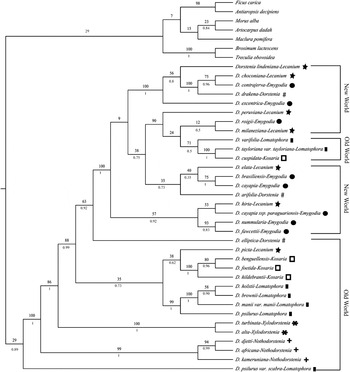
Bayesian and ML analyses of the sequence data revealed trees with similar topologies and support values. The ML tree is shown without any collapsed nodes at locations with low bootstrap values because many of our subsequent analyses could not be performed on trees with unresolved branching (Fig. 2). The data presented here support a monophyletic Dorstenia, however, with low support due to disparate confidence values calculated by the Bayesian and ML estimates for the position of D. psilurus var. scabra at the base of the clade (0.89 posterior probability [PP] and 29% bootstrap support [BS], respectively). Apart from this taxon there is strong support for the monophyly of the genus Dorstenia (1 PP, 100% BS). Also, both trees exhibit a grade of Old World Dorstenia species basal to a well-supported clade of primarily New World species (0.89 PP, 100% BS) with an Old World clade nested within it (0.5 PP, 71% BS). With the exception of two sections, the sectional classification was not supported by the phylogeny. Dorstenia sect. Xylodorstenia and Dorstenia sect. Nothodorstenia were both monophyletic with high support (100% BS, 99% BS, respectively) (Fig. 2).
Best scoring maximum likelihood tree resulting from 500 bootstrap replicates from ITS sequences. Bootstrap support values are indicated above branches and posterior probabilities from the 50% majority rule consensus Bayesian tree are indicated below branches. Posterior probabilities indicating less than 50% support are not reported. Dorstenia species are assigned shapes corresponding to their sections. Terminals have been pruned to one individual per species and labelled with their sectional classification as determined by Berg & Hijman (Reference Berg and Hijman1999).

Phylogenetic signal
Phylogenetic signal (P< 0.05) was found in nine of the 15 characters tested. Thus, for characters labelled as habit, life form, geophyte, stem, leaf margin, petiole length, endosperm size, distribution, inflorescence bracts and storage unit, there were fewer evolutionary steps along the phylogeny than would be expected if they had evolved without respect to the phylogeny.
Ancestral state reconstruction
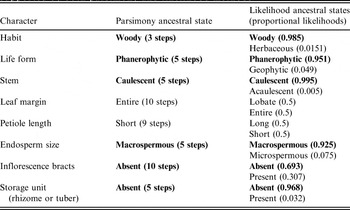
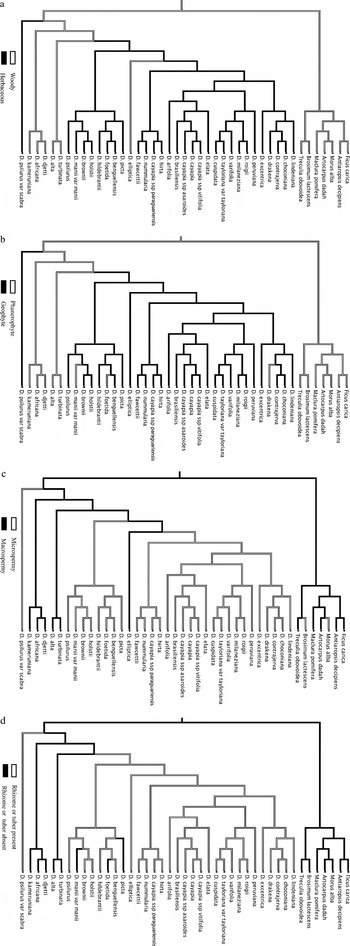
Parsimony and likelihood ancestral state reconstructions for each character are congruent to the extent that there are no instances where opposing states are unambiguously reconstructed at a node. Discrepancies in state reconstructions at a given node are infrequent for most characters and occur as instances where one of the two optimisation methods yielded an equivocal reconstruction. Results are as follows, with the most relevant results from the historical reconstructions shown in Fig. 3 and summarised in Table 2.
Ancestral state reconstruction results for characters showing phylogenetic signal. Emboldened character states are unambiguous reconstructions supported by both parsimony and likelihood methods

1. Habit: The character state reconstruction showed woody habit as the plesiomorphic state. There have been two independent instances of evolution to a herbaceous habit in the Old World grade and one instance of evolution to herbaceousness in the New World clade, the latter instance being conserved throughout the clade including the nested Old World species (Fig. 3a).
Ancestral state reconstruction for the following characters: a, habit; b, life form; c, endosperm size; d, storage organ.

2. Life form: A phanerophytic character state was shown to be plesiomorphic, with the geophytic form evolving twice independently followed by three reversals (one in the New World and two in the Old World) back to the phanerophytic life form (Fig. 3b).
3. Stem: A caulescent stem was shown to be the ancestral character state on the phylogeny with four independent instances of evolution to acaulescence for New World taxa.
4. Leaf margin: No clear ancestral state could be determined between plants with lobed and entire leaf margins. There are eight independent instances of evolution to lobate leaves in the Dorstenia clade.
5. Petiole length: No clear ancestral state could be determined between plants with short (< 5 cm) or long petioles. Short petioles are conserved throughout the Old World grade. Long petioles evolved once for the New World lineage with three reversals back to short petioles.
6. Endosperm size: Macrospermy was determined to be the ancestral character for endosperm size. Microspermy evolved independently up to three times (Fig. 3c).
7. Bracts: There was no clear distinction as to whether the presence or absence of inflorescence bracts was the ancestral state.
8. Storage unit: An absence of a storage unit such as a rhizome or tuber was shown to be the ancestral character state and it evolved independently up to five times among taxa found in the Old World (Fig. 3d).
Character correlation
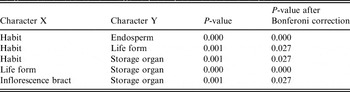
Of the 36 pairwise comparisons between the nine morphological characters with significant phylogenetic signal, five comparisons were significantly correlated (P < 0.05) after Bonferoni corrections. Habit was strongly correlated with endosperm size, life form, and the presence or absence of a storage organ. Life form and the presence or absence of bracteate inflorescences is correlated with the presence or absence of a storage organ (Table 3).
Significant results for Pagel’s (Reference Pagel1994) correlation analysis

Molecular dating
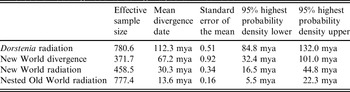
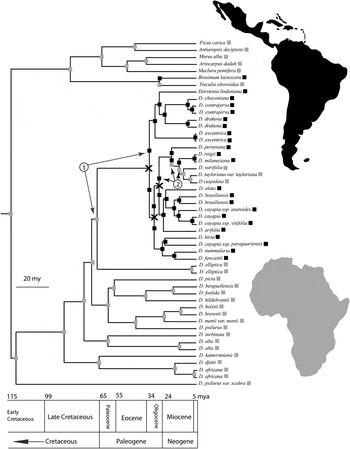
The likelihood ratio test for rate constancy rejected the null hypothesis that Dorstenia is evolving under a global molecular clock (P < 0.01). Dates for both the divergence (stem) and radiation (crown) were calculated for the New World Dorstenia clade. Unfortunately, due to poorly supported nodes, it was not possible to calculate the divergence dates accurately for the genus as a whole or the nested Old World clade. For these groups only the radiation (crown) dates were calculated. The mean estimate for the radiation of the genus Dorstenia is 112.3 mya. The mean estimate for the divergence of New World Dorstenia is 67.2 mya and the mean estimate for the radiation of New World Dorstenia is 30.3 mya. The radiation for the Old World clade nested within the New World clade is dated with a mean estimate at 13.6 mya (Table 4 and Fig. 4).
Molecular dating results using Bayesian methods

Maximum likelihood tree with ancestral range reconstructions calculated in Lagrange and divergence date estimates. Grey blocks indicate ancestral range in the Old World, black blocks represent an ancestral range in the New World, and branches with grey and black blocks indicate ancestors living in both ranges. Nodes marked with X represent places where two scenarios were presented with less than two log-likelihood units difference and the most probable ranges based on continental locations at those dates were chosen (see text). #1 indicates a migration from the Old World to the New World and #2 indicates a migration from the New World back to the Old World.

Analysis of geographic range evolution
Lagrange calculates the likelihood of range inheritance scenarios at each node. For most nodes the program only calculated one inheritance scenario. When more than one scenario is calculated, the scenario with the lowest log-likelihood is the most probable. If the second scenario is lower by at least two log-likelihood units it is considered to be outside the appropriate confidence range (Ree & Smith, Reference Ree and Smith2008). Only four nodes on our phylogeny had more than one range scenario calculated, and only one of those four nodes had one scenario with significantly higher support than the other. The three nodes (denoted with an X in Fig. 4) with two equally probable range hypotheses all shared the same two scenarios, ancestors existing in either the Old World or the New World or ancestors existing in both the New and Old World. Because the dates at which these two scenarios are calculated occur well after the break-up of South America and Africa (105 mya), the scenario with only one ancestral range per ancestor seems more intuitive and is what we present. Reconstructions reveal that an Old World origin for Dorstenia is most probable with one dispersal event to the New World and one back again to the Old World (Fig. 4).
Discussion
Dorstenia phylogeny/sectional classification
Both Bayesian and likelihood analyses of the ITS region reconstruct a monophyletic genus Dorstenia. Old World species comprise the basal grade of the phylogeny. The New World species are part of a well-supported clade with a small clade of three Old World species nested within it. Interestingly, Dorstenia psilurus var. scabra stands out in its placement on the phylogeny. It is not sister to its conspecific Dorstenia psilurus var. psilurus, from which it differs morphologically, ecologically, geographically and in chromosome number (Dorstenia psilurus var. psilurus 2n = 26, D. psilurus var. scabra 2n = 40). It is also distinguished from other closely related species because it does not display characters exhibited in basal lineages despite its position at the base of the tree. These differences along with Dorstenia psilurus var. scabra’s position on the phylogeny call for a closer investigation and possible revision of the species.
With the exception of Dorstenia sections Xylodorstenia and Nothodorstenia, which are the only two sections that exhibit woodiness, macrospermy and a phanerophytic life form, molecular data strongly suggest that the current classification does not reflect monophyletic lineages. While Dorstenia sections Xylodorstenia and Nothodorstenia are monophyletic sections as originally proposed, it is only the presence or absence of bracts on the inflorescence that distinguishes these two sections from each other. These results suggest that characters pertaining to reproductive morphology may be more useful for defining sections and that habit and life form are probably subject to convergent evolution, limiting their usefulness without support from other characters. Many of the sections and their defining characters are dispersed across the tree and complete sampling of the genus would not resolve polyphyletic sections.
Dorstenia has never been subjected to a global monograph. In the only treatment containing descriptions of all Old and New World Dorstenia species, Berg & Hijman (Reference Berg and Hijman1999) compiled and summarised ‘scattered’ unpublished data which resulted in the inconsistent inclusion of morphological data across all species. Due to this discontinuity in species descriptions, it was exceedingly difficult to code alternative characters to those proposed for determining more natural subdivisions for the genus. Incongruence between the findings presented here and the traditional classification clearly calls for a global revision of the genus incorporating both morphological and molecular data. Future directions should include reconstructing the Dorstenia phylogeny with additional markers and more complete taxon sampling. More thorough species descriptions in the form of a full monograph would also aid in proposing a more natural sectional classification for the genus.
Ancestral state reconstruction and character correlation
Ninety per cent of the Moraceae are woody. The remaining 10% of taxa with herbaceous habits are found almost exclusively in the genus Dorstenia. Based on Dorstenia’s unique position in a primarily woody family it has been suggested that the woody habit is a primitive character in the genus (Berg & Hijman, Reference Berg and Hijman1999). Observations of other morphological characters that appear to be correlated with woody and herbaceous habits have led to hypotheses that additional character states in the genus are ancestral as well and have evolved directionally (Berg & Hijman, Reference Berg and Hijman1999). For example, acaulescent stems are thought to have evolved towards caulescent stems, phanerophytic forms are considered ancestral to geophytic forms, and petiole lengths are hypothesised to have evolved from short to long (Berg & Hijman, Reference Berg and Hijman1999; Berg, Reference Berg2001). All of these hypotheses, with the exception of petiole length evolution, are well supported based on both parsimony and likelihood ancestral state reconstructions (Table 2).
Woodiness is scattered throughout the angiosperm phylogeny and considered to be a trait shared by the ancestors of extant herbaceous angiosperms (Barghoorn, Reference Barghoorn and Zimmermann1964). More recent studies on angiosperm evolution have pointed to an ancestral condition of woody growth (Field et al., Reference Field, Arens, Doyle, Dawson and Donoghue2004). However, while ancient angiosperms may have exhibited a woody habit, the evolution from woodiness to herbaceousness is not unidirectional. Studies have shown that woodiness in some species has arisen from herbaceous progenitors after a migration from a continental mainland onto islands (Böhle et al., Reference Böhle, Hilger and Martin1996; Kim et al., Reference Kim, Crawford, Francisco-Ortega and Santos-Guerra1996).
Berg & Hijman (Reference Berg and Hijman1999) hypothesised that the presence of a woody habit and macrospermy were correlated, as was the presence of the herbaceous habit and microspermy. This hypothesis was tested along with tests for correlations among woodiness, a lack of a storage organ, and a phanerophytic life form as well as herbaceousness, the presence of a storage organ, and a geophytic life form. Based on Pagel’s (Reference Pagel1994) correlation analysis, all of these traits are significantly correlated. These correlations not only corroborate Berg & Hijman’s (Reference Berg and Hijman1999) evolutionary hypotheses, but are also consistent with recent studies demonstrating very strong correlations between woodiness and macrospermy and herbaceousness and microspermy in global data (Moles et al., Reference Moles, Ackerly, Tweddle, Dickie, Smith and Leishman2007). The strong correlation between growth form and seed size has been suggested to result from coordination between life-history variables. Shifts towards a woody and macrospermous life history have been observed in tropical plant species as they move away from the equator towards less tropical areas (Moles et al., Reference Moles, Ackerly, Tweddle, Dickie, Smith and Leishman2007). Dorstenia’s adherence to this pattern in shifting correlated characters could possibly suggest that its ancestor originated in the subtropics and migrated towards more equatorial regions.
Dorstenia exhibits high levels of variation across the genus, and habitat descriptions suggest a wide range of ecological preferences. The majority of taxa sampled in this study are found in wet forests though a few have been noted to prefer drier forests, more open areas or limestone cliffs. The descriptions from herbarium specimens and taxonomic treatments used in this study were not specific enough to perform evolutionary tests, however; future studies should explicitly examine the relationship between morphology and ecology.
Molecular dating
The dating analysis places the radiation of the genus Dorstenia at 112.3 mya; the New World divergence was dated at 67.2 mya and the radiation was dated at 30.3 mya. The Old World clade nested within the New World radiated at 13.6 mya (Table 4; Fig. 4). These dates differ from estimates determined in a previous study by Zerega et al. (Reference Zerega, Clement, Datwyler and Weiblen2005), which used combined data from different gene regions (ndhF and the 26S nuclear rDNA subunit as opposed to ITS used in this study). Zerega et al. (Reference Zerega, Clement, Datwyler and Weiblen2005) estimated a radiation of 3.5–18.4 mya for the genus Dorstenia. The discrepancy in dates may also have occurred because Zerega et al. (Reference Zerega, Clement, Datwyler and Weiblen2005) included only two Dorstenia species, both of which were New World taxa that are among the more recently diverged species in the present study (D. arifolia and D. choconiana).
Analysis of geographic range evolution
The break-up of Gondwana began about 180 mya with the current continents of South America and Africa splitting about 105 mya in the mid-Cretaceous (McLoughlin, Reference McLoughlin2001). It has been previously suggested that the distribution both of the family Moraceae and the genus Dorstenia is the result of vicariance caused by the break-up of the Gondwanan landmass (Corner, Reference Corner1967; Berg & Hijman, Reference Berg and Hijman1999; Berg, Reference Berg2001). Recent studies have suggested a more recent radiation date for the family (72.6–110 mya) (Datwyler & Weiblen, Reference Datwyler and Weiblen2004; Zerega et al., Reference Zerega, Clement, Datwyler and Weiblen2005). However, our study indicates that Dorstenia radiated about 112 mya in the Old World, which suggests that the distribution of the genus could be the result of vicariance due to the separation of South America and Africa. It also suggests that a re-evaluation of Moraceae divergence dates using denser taxon sampling may yield an older age for the family.
Another possibility based on the present data is long distance dispersal or migration of Dorstenia between South America and Africa. Dispersal across the ocean seems unlikely given that Dorstenia has no obvious means for long distance dispersal, and seeds have been observed to be viable for only a limited period (Berg & Hijman, Reference Berg and Hijman1999). Nonetheless, studies suggest that long distance dispersal may be much more common than previously assumed even in flora lacking mechanisms for long distance dispersal (Pennington & Dick, Reference Pennington and Dick2004; Renner, Reference Renner2004). Long distance migration over land may also be a possible dispersal scenario. The estimated date of divergence for New World Dorstenia from Old World Dorstenia is 67.2 mya, which coincides with one of the collisions between Africa and Eurasia at about 60 mya (McLoughlin, Reference McLoughlin2001). Dorstenia could have migrated from Africa through Eurasia and into North America via the Laurasian land bridge, which existed during the Eocene (c.55–33 mya) when climates supported more tropical environments than today (Tiffney, Reference Tiffney1985). As continents continued to shift, Dorstenia would eventually go extinct in North America and Eurasia as temperatures became more temperate. This would have put the genus in South America at about the time the New World radiation was calculated to have occurred (30.3 mya) and explain why we don’t find Dorstenia in temperate areas today. Fossil evidence of Dorstenia in Eurasia or North America would support this hypothesis. Unfortunately, the authors have found no reliable record of Dorstenia fossil evidence. The explanation of a North Atlantic land bridge as a migration route into the New World, however, would not explain the apparent migration back to Africa (5.46–22.27 mya) based on our dates for the radiation of the nested Old World clade, suggesting that perhaps long distance dispersal may play an important role in determining the distribution of the genus. However, since we were unable to calculate accurately the date of divergence of the nested Old World clade from its New World ancestor, which would be older than the radiation, there is a possibility that Dorstenia could have migrated back across the North Atlantic land bridge to Africa again and subsequently diversified.
Conclusions
This study represents the first molecular reconstruction of the Dorstenia phylogeny with substantial taxon sampling. It allows for the re-evaluation in an evolutionary framework of hypotheses based on morphological characters. The evolutionary trajectory that was proposed for the majority of characters pertaining to life form, such as woodiness and herbaceousness, appears to be subject to convergent evolution and cannot, therefore, be used to define natural lineages. The vicariance hypothesis proposed by Berg & Hijman (Reference Berg and Hijman1999) to explain the diversification of the genus was tested with molecular dating and estimates of ancestral geographic ranges using likelihood methods. Based on the results it is inconclusive whether dispersal or vicariance is responsible for the distribution of the genus. Dorstenia appears to be old enough to support a Gondwanan hypothesis, although the confidence intervals around the dates fail to eliminate the possibility of a migration through Eurasia into the New World across a North Atlantic land bridge.
Acknowledgements
The authors thank the Royal Botanic Gardens, Kew, the Harvard University Herbaria, the Field Museum of Natural History Herbarium, the Cameroonian National Herbarium and the Missouri Botanical Garden for access to plant material and herbarium specimens; M. Cheek, J. M. Onana, R. Ree and S. Wagenius for guidance in different aspects of this project; and J. Fant and T. K. Misiewicz for their invaluable assistance in the laboratory and field. This research was partially funded by the Botanical Society of America Graduate Research Award, the Society of Systematic Biologists Graduate Student Award, Northwestern Plant Biology and Conservation Research Award, the Federated Garden Club of Maryland Scholarship, the Central Atlantic Region Garden Club Scholarship, and the Shaw Fellowship for Plant Conservation and Biology.
Appendix 1
Collection information
Taxon; ITS GenBank accession; Voucher specimen; Collection locale; Herbarium.
Dorstenia africana (Baill.) C.C.Berg, HQ214078, Carvalho 5308, Equatorial Guinea, NY. Dorstenia africana (Baill.) C.C.Berg, HQ214077, X.M. van der Burgt et al. 527, Cameroon, MO. Dorstenia alta Engl., HQ214081, A. Ntemi Sallu 638, Tanzania, MO. Dorstenia alta Engl., HQ214082, Ndangalasi & I. Rajabu, Tanzania, F. Dorstenia arifolia Lam., HQ214101, A.M. de Carvalho 7169, Brazil, NY. Dorstenia benguellensis Welw., HQ214102, A.S. Mkeya et al. 1109, Tanzania, MO. Dorstenia brasiliensis Lam., HQ214110, Paulo Heringer et al. 735, Brazil, NY. Dorstenia brasiliensis Lam., HQ214111, M.J. Jansen-Jacobs et al. 4436, Guyana, NY. Dorstenia brownii Rendle, HQ214094, M.A. Mwangoka et al. 3606, Tanzania, MO. Dorstenia cayapia Vell., HQ214109, G.T. Prance et al. 19219, Brazil, NY. Dorstenia cayapia Vell. ssp. asaroides (Hook.) C.C.Berg, HQ214107, M. Nee 42307, Bolivia, NY. Dorstenia cayapia Vell. ssp. paraguariensis (Hassl.) C.C.Berg, HQ214108, Shirley Ortiz 218, Bolivia, NY. Dorstenia cayapia Vell. ssp. vitifolia (Gardner) C.C.Berg, HQ214106, Roberto Fontes Vieira et al. 554, Brazil, NY. Dorstenia choconiana S.Watson, HQ214085, G. Weiblen 1417, Costa Rica, MIN. Dorstenia contrajerva L., HQ214100, E. Martinez S. et al. 28913, Mexico, NY. Dorstenia contrajerva L., HQ214099, Ulises Chavarria 809, Costa Rica, F. Dorstenia cuspidata Hochst. var. humblotiana (Baill.) Leandri, HQ214105, L. Gautier & D. Ravelonarivo LG4138, Madagascar, MO. Dorstenia djettii Guillamet, HQ214076, J. Amponsah et al. 1413, Ghana, MO. Dorstenia drakena L., HQ214097, S.D. Koch et al. 87195, Mexico, NY. Dorstenia drakena L., HQ214098, S. Salas et al. 2105, Mexico, MO. Dorstenia elata Gardner, HQ214087, R. Mello-Silva et al. 1563, Brazil, NY. Dorstenia elliptica Bureau, HQ214075, J. Nning 20, Cameroon, MO. Dorstenia elliptica Bureau, HQ214074, D.W. Thomas et al. 6990, Cameroon, NY. Dorstenia excentrica Moric., HQ214113, M. Nee 22374, Mexico, F. Dorstenia excentrica Moric., HQ214112, P.A. Fryxell et al. 3445, Mexico, NY. Dorstenia fawcettii Urb., HQ214114, M.R. Crosby et al. 770, Jamaica, F. Dorstenia foetida Schweinf., HQ214104, N. Zerega 312, cultivated, Illinois USA, CHIC. Dorstenia hildebrandtii Engl., HQ214103, N. Zerega 311, cultivated, Illinois USA, CHIC. Dorstenia hirta Desv., HQ214088, F.O. Souza et al. 21, Brazil, NY. Dorstenia holstii Engl., HQ214091, A. Ntemi Sallu 645, Tanzania, MO. Dorstenia kameruniana Engl., HQ214079, O.A. Kibure & H. Bofu 1045, Tanzania, MO. Dorstenia lindeniana Bureau, HQ214083, D. Alvarez 2721, MO. Dorstenia mannii Hook.f. var. mannii, HQ214095, R.E. Gereau 5593, Cameroon, MO. Dorstenia milaneziana Carauta et al., HQ214086, W.W. Thomas et al. 11078, Brazil, NY. Dorstenia nummularia Urb. & Ekman, HQ214115, P. Acevedo Rodriguez et al. 6439, Cuba, NY. Dorstenia peruviana C.C.Berg, HQ214084, T. Plowman 5904, Peru, F. Dorstenia picta Bureau, HQ214089, R.E. Gereau et al. 5189, Cameroon, MO. Dorstenia psilurus Welw., HQ214093, L. Festo & W. Bayona 859, Tanzania, MO. Dorstenia psilurus Welw. var. scabra Bureau, HQ214092, G. Zenker s.n., Cameroon, F. Dorstenia roigii Britton, HQ214116, E.L. Eckman 17973, Cuba, F. Dorstenia tayloriana Rendle var. tayloriana, HQ214096, M.A. Mwangoka & A. Kalage 2673, Tanzania, MO. Dorstenia turbinata Engl., HQ214080, M. Cheek 11086, Cameroon, MO. Dorstenia variifolia Engl., HQ214090, J.J. Lovett et al. 2135, Tanzania, MO. Antiaropsis decipiens K.Schum., AY289284, Weiblen 1233, New Guinea, MIN. Artocarpus dadah Miq. FJ917051, Zerega 245, Malaysia, CHIC. Brosimum lactescens (S.Moore) C.C.Berg, AY289329, Weiblen 1513, Brazil, MIN. Morus alba L., AY289274, Weiblen 1173, Michigan, USA, MIN. Treculia obovoidea N.E.Br., FJ917004, Leeuwenberg9700, Cameroon, US.
Appendix 2
Matrix of character states
Habit (0 = woody, 1 = herbaceous), Geophyte (0 = phanerophytic, 1 = geophytic), Stem (0 = caulescent, 1 = acaulescent), Leaf margin (0 = lobate, 1 = entire), Petiole length (0 = long, 1 = short), Pistillode (0 = present, 1 = absent), Distribution (0 = Old World, 1 = New World), Leaf variegation (0 = present, 1 = absent), Endosperm size (0 = microspermous, 1 = macrospermous), Inflorescence bracts (0 = present, 1 = absent), Storage unit (0 = tuber or rhizome present, 1 = absent), Leaf apex (0 = triangular, 1 = rounded, 2 = variable), Leaf base (0 = triangular, 1 = rounded, 2 = variable), Stipule (0 = persistent, 1 = subpersistent, 2 = caducous), Staminate flower arrangement (0 = evenly dispersed, 1 = peripheral).