Implications
The possibility of using reproductive traits directly measured in females as selection criteria represents an improvement in the animal category of great economic interest in breeding herds – the dams. The productive performance of a livestock breeding system depends, mainly, on the performance of cows, as their function is basically to produce good calves each year. Nowadays, the use of selection indexes considering multiple traits is increasing in selection of females. The inclusion or replacement of traits in such indexes requires prior knowledge about them, which makes the study of reproductive traits so important when the goal is to increase productivity of Nellore beef cattle.
Introduction
Reproductive traits in beef cattle measured directly in females have been little explored by researchers and animal breeding programs, which lead to a slower development of analysis methodologies and even to a lack of knowledge of such traits. According to Eler et al. (Reference Eler, Santana Júnior and Ferraz2010), the main reasons for this are as follows: (1) the ‘pre-established’ concept that reproductive traits have low heritability, which would cause a difficult and slow genetic change; (2) difficulty and inaccuracy of reproductive data collection, which decreases the reliability of genetic predictions for such traits; and (3) the categorical (threshold) nature of the most important traits, which requires more complex statistical procedures, only recently developed, compared with analyses of continuous traits.
To achieve reproductive efficiency and improve growth traits of animals, the importance of working with herds of high sexual precocity and fertility is evident. Evaluation of scrotal circumference (SC) – for example, widely used in animal breeding programs as an indicator of fertility and sexual precocity in beef cattle due to its easy measurement and, especially, high heritability estimates – should not be regarded as a breeding objective, but as a selection criterion that targets the real objective, which is to increase sexual precocity of the herd. On the other hand, traits like pregnancy in heifers, heifers rebreeding (HR) and stayability (STAY), which are measured directly in females, are still little explored, although they are of great economical relevance, as they consider the fertility and longevity of females.
Traits related to longevity have utmost importance in beef cattle evaluation; nevertheless, the main disadvantage of selecting for such traits is the increase in generation interval due to delay in phenotypic data collection (Ducrocq et al., Reference Ducrocq, Quaas, Pollak and Casella1988). Therefore, selecting for correlated traits recorded early in lifetime would allow the selection for longevity to be performed without such problems. Thus, the aims of this research were to estimate genetic parameters for reproductive and longevity traits measured in females and also SC in order to verify the possibility of using such traits as selection criteria in cattle breeding programs.
Material and methods
Data source
Data were obtained from a single database called Aliança Nelore (Gensys, 2014) with information of 1 079 974 animals born from 1984 to 2010 and kept on 246 different herds under tropical conditions. The feeding system adopted in these farms consisted basically of tropical pastures, mineral salt and water ad libitum. In general, supplementation was not performed for any category of animals. The breeding season lasted 90 days and its onset was determined by the weather and nutrition conditions of each region. Typically, first mating of heifers occurred at about 27 months of age; however, in order to identify sexually precocious females, ~10% of herds adopted the following two breeding seasons: an early season (autumn), from March to April, in which heifers were exposed at earlier ages (14 to 18 months), and the traditional season, from November to February (summer). The remaining herds adopted only the summer season.
Almost 46% of females were inseminated, and if pregnancy was not detected they were placed in groups with more than one sire (breeding groups) for natural breeding. For females that were not inseminated, natural mating was controlled – that is, a group of 30 to 50 females was placed together with a single sire. Most of the participating herds exposed primiparous cows to controlled natural mating or breeding groups, thus increasing pregnancy rate in this category. The average age at first calving was 35.75 months with a standard deviation of 5.17 months. Heifers that became pregnant early in the season were favored, as they had more time to recover and conceive at the beginning of the subsequent summer breeding season.
Evaluated traits and data editing
STAY was analyzed as a categorical trait, for which score ‘1’ was assigned to females that remained in the herd up to 76 months and conceived at least three calves until this age, whereas score ‘0’ represented failure and was assigned to those females that did not remain in the herd, in other words, were discarded for not becoming pregnant in previous breeding seasons. For this trait, number of calvings could range from 0 to 5 for those cows with first service at 18 months, and for cows with first service at 24 months calvings could range from 0 to 4.
Number of calvings at 53 months (NC53) was studied as an alternative way of measuring the ability of the females to stay in the herd. This trait was defined as the NC53 of age, considering that the cow had performance records until yearling age and also had the opportunity to reach this age. The NC53 ranged from 0 to 3. The 53 months of age was chosen to emphasize rebreeding of primiparous cows, because rebreeding is considered a bottleneck to improving productive efficiency of beef cows (Neves et al., Reference Neves, Carvalheiro and Queiroz2012). Besides, when compared with STAY, NC53 would anticipate the genetic evaluation and make possible to distinguish cows with two calves from those that did not become pregnant until the established age. Another advantage of using NC53 is the possibility to consider in the analysis all heifers that did not become pregnant up to 53 months of age.
HR was defined as success (1) or failure (0) for heifers that calved or not, respectively, since they had previously given birth. For this trait, a maximum interval of 15 months between first and second births was considered for females submitted to traditional breeding season, and for those submitted to the early breeding season the maximum interval accepted was 24 months. SC was obtained at ~18 months of age (long yearling age) by measurements made transversely in the region of largest diameter of the scrotum. Measurements were made using a specific scrotal measuring tape.
The editing of the dataset was performed using the software SAS® (SAS Institute, Inc., Cary, NC, USA). Animals with no birth and/or calving date were discarded. Age at first calving, calving interval, number of births and season of birth were calculated for the analyses of reproductive traits measured in females. The season of calving was defined by the following two classes: rainy, from October to March, and dry, from April to September. After editing, the final data file included 48403 records available for STAY, 104559 for NC53, 63130 for HR and 59576 for SC (Table 1).
Description of the dataset used in the analyses of number of calvings at 53 months (NC53), stayability (STAY), heifers rebreeding (HR) and scrotal circumference (SC) of Nellore cattle

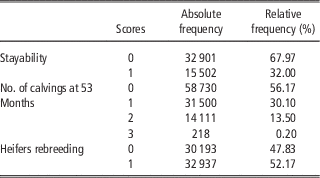
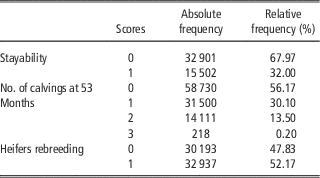
The percentages shown in Table 2 refer to the total of females that conceived or not, regardless of the age at which they were exposed in the breeding season. The percentage of females that conceived was 75.14% and 50.11% for precocious and not precocious females, respectively. Almost 68% of the studied cows failed to remain in the herd and were culled for not becoming pregnant in the previous breeding seasons. In addition, more than half (52.17%) of cows that calved as heifers stayed in the herd until their second calving (Table 2). One possible explanation for the large number of cows with no record of calving for the analysis of NC53 is the existence of many females born in a time when there was no strict management of culling of cows that did not become pregnant in the previous breeding seasons.
Frequency of observation of stayability, number of calvings at 53 months and heifers rebreeding of Nellore females
Statistical analyses
Preliminary analyses were carried out to determine the significance of contemporary groups (CGs) and covariates included in the model using the GLM procedure of SAS® software (SAS Inst., Inc., Cary, NC). Only variables that were statistically significant at 5% probability level were included in the final analyses. CGs with <5 observations and without variability – that is, those in which all animals showed the same response category – were eliminated.
For STAY and NC53, the models included fixed effects of CGs, which were formed by season and year of birth, farm of weaning to long yearling age and classification of precocity status. In addition, for STAY analysis, the effects of mating system (artificial insemination, single sire or multiple sire) to which the cow was submitted in its last calving were included as fixed effects in the model. There were only calvings up to 76 months for this trait. For HR, a CG was formed by farm from weaning to long yearling, season and year of birth and the classification of being precocious heifers or not. The age at first calving, the type of mating system the female was submitted to when it entered the breeding season and the sex of its first offspring were included as covariates in the model.
CGs for SC were defined for animals that were born in the same year and season, in the same farm and group of management at birth, weaning and yearling and also included the dates when animals were weaned and when measurements of the SC were taken. SC was previously adjusted for age (550 days) and weight (300 kg). Covariates included in the models were the linear and quadratic effects of age of dam at calving.
When working on a dataset with animals with unknown ancestry, from populations of different genetic merit of the base population, the existing genetic differences are not taken into account in genetic evaluations (Thompson, 1979). When this occurs, there is an underestimation of genetic trends and the occurrence of genetic prediction bias during the evaluation (Henderson, 1975). To minimize these problems, the inclusion of genetic groups was adopted. These groups were assigned to individuals whose ancestral information was incomplete in the pedigree file and were used to predict and correct the genetic value of each animal based on the relationship with their respective group (Westell et al., 1988). According to Phocas and Laloê (2004), the use of genetic groups must be considered, especially with a large number of animals per group, high genetic link between groups and, above all, significant genetic differences between sub-populations of base animals. In the present study, the genetic groups were created based on season of birth nested within year. It was not necessary to include parental sex, as all dams were known and only some sires had missing information. For NC53, HR, STAY and SC, 22, 21, 17 and 26 genetic groups were formed, respectively.
The (co)variance components and genetic parameters were estimated using Bayesian inference by single and bi-trait analyses (for all possible trait combinations) considering an animal model using the computer software THRGIBBS2F90 (Misztal, 2010). A threshold model was assumed for STAY, NC53 and HR. Following Gianola (1979), when a threshold model was fitted for NC53, it was assumed that an underlying continuous random variable g could represent the liability for this trait. Because NC53 was defined by records falling into four mutually exclusive ordered categories, a set of three thresholds (t1, t2 and t3) corresponded to the discontinuities in the observed scale (y), under the assumption that t0=–∞ and t4=+∞, such that: if g <t1, y=0; if t1< g <t2, y=1; if t2< g <t3, y=2; and if t3< g , y=3. For HR and STAY, only one threshold was used, as these traits had only two phenotypic classes. In this way, the liability g was modeled as:
 $$g= X_{1} b{\plus}Z_{1} a{\plus}Z_{2} Q_{1} c{\plus}e$$
where
g
is the vector with underlying liabilities for studied traits, and
b
,
a
and
c
the vectors of fixed effects of CG, genetic additive random effects of animal and the vector of effects of genetic groups, respectively. The
X
1,
Z
1 and
Z
2 the incidence matrixes relating elements in
b
,
a
and
c
to
g
, respectively.
Q
1 the incidence matrix that relates animals to the fixed effect of genetic groups. It was assumed that
E[g]=X
1
b, u~N (
0
, Aσ
²
u) and e~N (
0
, Iσ
²
e), where
A
is the additive genetic relationship matrix and
I
is an identity matrix of order equal to the number of observations. As
 $$\sigma _{e}^{2} $$
is not estimable in the case of STAY and HR (Gianola and Foulley, Reference Gianola and Foulley1983), this parameter was attributed the arbitrary value 1. Flat priors were used for fixed and random effects.
For SC, a linear model that considered CG as the fixed effect and additive genetic effect of the animal as random was assumed and can be represented in matrix notation as follows:
 $$Y=Xb{\plus}Z_{1} a{\plus}Z_{2} Q_{1} c{\plus}e $$
where
Y
is the vector of observations and
X
is the incidence matrix associating observations to the fixed effects of CG,
b
is the vector of fixed effects,
Z
1 and
Z
2 are the incidence matrixes associating observations to additive genetic effects (
a
) and genetic groups (
Q
1
c
) and
e
is the vectors of residuals. Assumptions were that
 $${\bi a}\,\sim\,N( {\bf 0}, {\bi A}\sigma _{\bi a}^{2} )$$
,
 $${\bi e}\,\sim\,N({\bf 0}, {\bi I}_{e} \sigma _{e}^{2} )$$
and
 $${\bi c}\,\sim\,N\left( {{\bf 0}, {\bi I}_{g} \sigma _{g}^{2} } \right),$$
where A is the additive genetic relationship matrix,
I
is an identity matrix of order equal to the number of observations and
 $$\sigma _{a}^{2} $$
,
 $$\sigma _{e}^{2} $$
,
 $$\sigma _{g}^{2} $$
are the additive genetic, residual and between genetic group variances, respectively. For analysis purposes, residual correlations between SC and female reproduction traits were fixed at zero, as these traits are measured on different animals.
In single and bi-trait analyses, chains with length of 1 000 000 cycles were generated, in which the first 100 000 cycles were discarded (burn-in). In single-trait analyses, samples were stored every 100 cycles, and for bi-trait analyses samples were stored every 50 cycles. The convergence of Gibb’s Sampling algorithm was verified by visual inspection using the BOA package (Smith, Reference Smith2005) available for software R (R Development Core Team, 2013), as well as using Heidelberg and Welch (Reference Heidelberg and Welch1983) and Geweke (Reference Geweke1992) tests. Visual inspections of the trace plots from the outputs of the Gibb’s sampler were also used to assess the convergence for the genetic parameters in the analysis among studied traits. All traits reached the stationary phase of the Gibb’s chain, indicating that the sampling processes were appropriate. Estimates of heritabilities and genetic correlations were based on the mean of the marginal posterior (co)variances estimated from single and bi-traits analyses.
Direct and indirect responses to selection and the indirect selection efficiency were calculated according to Falconer and Mackay (1996). In order to know the effect of selection on SC on the other studied traits, the intensity of selection was assumed to be 2.67 (selection of 1% of the animals), while direct selection was assumed for SC. On the other hand, to know the effect of direct selection on NC53 on longevity traits (STAY and HR) in females, selection intensity of 1.16 (selection of 30% of the animals) was assumed. These values were established based on what is normally used in traditional herds. Table 1 shows the numbers of records, of CGs, of animals in the relationship matrixes and the period of calving per trait. The frequencies of STAY, NC53 and HR according to their phenotypic classes can be seen in Table 2.
Results and discussion
For brevity, only results obtained in bi-trait analyses are presented, as the parameters obtained in both single and bi-trait analyses, for all studied traits, were similar.
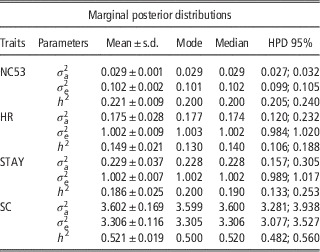
Results for variance components and genetic parameters, obtained in bi-trait analyses, showed little difference in mean, mode and median values, indicating that convergence of the Gibb’s chain was achieved and the marginal posterior distribution tended to follow a normal and symmetric distribution (Table 3). In general, estimates of heritability ranged from low to moderate. The estimate of heritability for NC53 (0.22±0.009, Table 3) was slightly higher than that reported in other studies for longevity traits. Neves et al. (Reference Neves, Carvalheiro and Queiroz2012) estimated 0.17 for heritability using the same definition of NC53. Van Melis et al. (Reference Van Melis, Oliveira, Eler, Ferraz, Casellas and Varona2010) presented estimates of heritability ranging from 0.17 to 0.20 in multivariate analysis for survival (number of calvings until cow death), using a sequential threshold model.
Estimates of marginal posterior distributions of variance components and heritabilities, obtained in bi-trait analyses, for number of calvings at 53 months (NC53), heifers rebreeding (HR), stayability (STAY) and scrotal circumference (SC) of Nellore Cattle

 $$\sigma _{a}^{2} $$
;
 $$ \sigma _{e}^{2} $$
; h
2=direct additive genetic variance, residual variance and heritability, respectively; HPD 95%=limits 95% for the highest density posterior interval.
Generally, most of the studies related to the evaluation of traits that measure longevity or length of productive life in cows, do it by adopting STAY in the following definition: probability of a cow to remain in herd until a specific age, when the opportunity to reach that age is given (Hudson and Van Vleck, Reference Hudson and Van Vleck1981). In the present research, STAY was evaluated at 76 months of age. For this trait, estimates of heritability range from low to moderate, and in this research heritability obtained in the bi-trait analyses was moderate and equal to 0.19±0.025 (Table 3).
In agreement with the findings obtained in this research, Martinez et al. (Reference Martinez, Koch, Cundiff, Gregory, Kachman and Van Vleck2005); Rasali et al. (Reference Rasali, Crow, Shrestha, Kennedy and Brûlé-Babel2005) and Van Melis et al. (Reference Van Melis, Eler, Oliveira, Rosa, Silva, Ferraz and Pereira2007) also reported values of moderate magnitude – 0.25, 0.23 and 0.22, respectively, for STAY using a threshold model. Jamrozik et al. (Reference Jamrozik, McGrath, Kemp and Miller2013) presented heritabilities for STAY to consecutive calvings in Canadian Simmental cows ranging from 0.12 to 0.36. These authors found a clear trend of reduction in heritability estimates proportional to the increase in the number of consecutive calvings.
One of the major problems found in herds of tropical countries is related to HR. Studies show that this trait is strongly influenced by environmental factors (Pereira, Reference Pereira2008; Boligon and Albuquerque, Reference Boligon and Albuquerque2012), as heifers have to conciliate pregnancy and subsequent lactation concomitant to their own growth. The heritability estimated in the present study for this trait was low (0.15±0.021, Table 3) and similar to the value of 0.14 reported by Boligon and Albuquerque (Reference Boligon and Albuquerque2012), confirming the large influence of environmental effects on this trait.
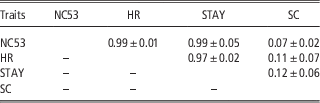
Estimates of genetic correlations among the studied traits were positive, ranging from weak to strong values (Table 4). Genetic correlations among the reproductive traits STAY, NC53 and HR were similar and superior compared with those estimated between SC and these traits. Genetic correlation between STAY and SC (0.12±0.058) was similar to that reported by Santana et al. (Reference Santana, Eler, Ferraz and Mattos2012), 0.17. These authors suggested that there is no antagonism between SC and STAY; in other words, selection on one trait would produce little or no effect on other.
Estimates of genetic correlations between the studied traits of Nellore cattle
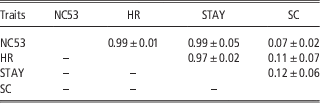
NC53=number of calvings at 53 months; HR=heifers rebreeding; STAY=stayability; SC=scrotal circumference.
In general, genetic correlations between SC and female reproductive traits found in this study (ranging from 0.07 to 0.12) were not strong, indicating that response to selection for female reproductive traits based on SC would be much slower than the response to selection based directly on genetic merit for female reproductive traits.
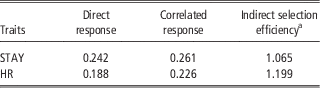
Jamrozik et al. (Reference Jamrozik, McGrath, Kemp and Miller2013) concluded that STAY to second calving can be considered as a good indicator of STAY to later calvings, as indicated by the genetic correlation estimated between these traits (0.61). The efficiency of indirect selection values obtained in the present study, between NC53 and STAY (1.065), indicated that selection applied on NC53 will be more efficient to improve longevity compared with selection applied directly on STAY. These results confirm an advantage of selecting for STAY at younger ages or for NC53, due to its strong correlation and greater heritability when compared with STAY and also due to higher accuracy and reduction in generation interval for being a trait evaluated earlier in lifetime. The genetic progress for STAY implies reducing costs related to replacement of animals because of culling. Furthermore, with a decrease in replacement rate, there is an opportunity to increase selection intensity for other traits, resulting in increased response to selection. However, due to the long time required for evaluation of this trait, this practice could lead to an increase in the generation interval. This problem can be minimized by adopting NC53 as an indirect selection criterion to improve female longevity.
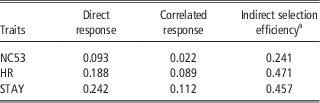
With the purpose of achieving more informative conclusions about the behavior and association between studied traits when indirect selection was applied, not only the correlations estimated in this study were considered but also the correlated responses for each trait. Correlated and direct responses and indirect selection efficiency (considering selection on SC) were, respectively, 0.022, 0.093 and 0.241 for NC53; 0.089, 0.188 and 0.471 for HR; and 0.112, 0.242 and 0.457 for STAY (Table 5). Correlated and direct responses and efficiency of indirect selection for evaluation of longevity in females were, respectively, 0.261, 0.242 and 1.065 for STAY and 0.226, 0.188 and 1.199 for HR (Table 6).
Direct response to selection applied (i=1.16) to the traits number of calvings at 53 months (NC53), heifers rebreeding (HR) and stayability (STAY) of Nellore females, correlated response and indirect selection efficiency to the same traits considering direct selection (i=2.67) applied on scrotal circumference
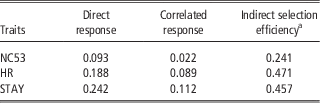
a Indirect selection efficiency was calculated as the ratio of the correlated response to the direct response.
Direct response to selection applied (i=1.16) to the traits heifer rebreeding (HR) and stayability (STAY) of Nellore females, correlated response and indirect selection efficiency to the same traits considering direct selection (i=1.167) applied on number of calvings at 53 months (NC53)
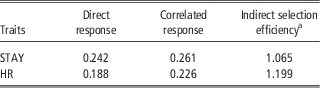
a Indirect selection efficiency was calculated as the ratio of the correlated response to the direct response.
The high genetic correlations estimated between HR and STAY (0.97±0.021, Table 4) and between HR and NC53 (0.99±0.007, Table 4), combined with heritabilities of these traits (0.22±0.009 and 0.19±0.025 for NC53 and STAY, respectively), suggest an improvement on HR rates, if selection were applied for traits related to longevity. This result can be confirmed by analyzing the value obtained for efficiency of indirect selection between NC53 and HR (1.199, Table 6). This result indicates that, if selection on NC53 was applied in order to achieve improvements in HR, results would be more favorable than if directly selection on HR was performed. The positive and strong correlations found in the present study among STAY and HR corroborates the findings of Caetano et al. (Reference Caetano, Rosa, Savegnago, Ramos, Bezerra, Lôbo, De Paz and Munari2013). Using age at the last calving (ALC) to evaluate cows’ longevity, these authors found that females with greater numbers of calvings were more precocious than those with fewer calvings.
The values estimated for genetic variance (3.602, Table 3) and heritability (0.52±0.019, Table 3) for SC, as usually described in literature (e.g. Barrozo et al., Reference Barrozo, Buzanskas, Oliveira, Munari, Neves and Queiroz2012), indicate the possibility of good responses when selection is applied to this trait. Weak genetic correlations were estimated between female reproductive traits and SC; therefore, no effective genetic response in those traits through SC selection is expected.
SC is more heritable than the traits measured in females, denoting existence of sufficient additive genetic variability for obtaining genetic progress with the selection of young sires for this trait. The NC53, as a way of measuring the ability of the cow to stay productive in the herd, was more efficient than the usual definition of STAY at 76 months. The positive and strong estimates for genetic correlations between these traits (NC53 and STAY), when combined with results obtained for correlated responses and indirect selection, confirm that selection performed earlier in life could be more advantageous for evaluation of longevity and animal breeding purposes.
The estimated heritability for NC53 shows that a considerable important part of the variation is determined by additive genes action. Considering the correlations between STAY and NC53, correlated responses and indirect selection efficiency, the NC53 could be indicated as an alternative criterion to evaluate the STAY of the cow. Thus, it would provide an anticipation on the genetic evaluation of bulls based on the performance of their daughters to 53 months, instead of 76 months, as it has been practiced by breeding programs.
Considering the positive and strong genetic correlations between NC53 and HR, selection for the trait measured early in lifetime would be recommended. However, the heritability estimate for NC53 was higher than that for HR, indicating more advantages in selecting for NC53, mainly due to greater genetic gain by its selection. Another advantage in selecting for NC53, instead of using binary traits such as STAY or HR, is that a trait with greater number of categories allows the threshold model to resemble the linear model. The inclusion of reproductive traits measured directly in females as selection criteria in animal breeding programs can be an alternative to gradually improve sexual precocity and the length of productive life of cows in the herds studied.
Acknowledgments
To Gensys Associated Consultants Ltda. for providing the data and information used in this study. To Fundação de Amparo à Pesquisa do Estado de São Paulo – FAPESP (Process no.: 2011/16066-5) and CNPq (Process no. 303606/2009-6) for financial support.