Introduction
The efficiency of a treatment plan in radiotherapy relies on the precise amount of monitor units (MUs) delivered to the patient, or more precisely to the target volume. Many limitations exist in terms of dose delivery: the surrounding normal tissues and the gross tumour volume margin. In radiotherapy, the dose range used is very high; therefore, any small change in the dose received by the tumour can lead to changes in the clinical response to the treatment.
To ensure safe and accurate use of radiotherapy, there has been an obligation to create worldwide organisations and associations involved in producing guidance on the safe use of radiation. Both the American Association of Physicists in Medicine (AAPM) and the International Commission on Radiation Units and Measurements (ICRU) have published many reports on dosimetry and quality assurance, as well as reports describing the risks in detail and all the limitations concerning the acceptable error of dose deviation. ICRU has recommended that the deviation should be <3% for each step involved in dose delivery.1, 2 In contrast, the AAPM is interested in defining the responsibility of each working person in a radiotherapy department.Reference Rustgi3 The oncologist prescribes the dose to be delivered and the physicist uses the treatment planning system (TPS) to produce and calculate the treatment plan. Our interest focussed on the precision of the TPS dose calculation, which should be highly accurate with very small deviations. Error in treatment planning could have several adverse effects on the dose delivery and therefore on the whole treatment efficiency.
The treatment time or beam-on time for a linear accelerator is measured in MU and a specified amount of MU delivers a specific dose at the reference conditions of 10 × 10 cm2 field size, under 10 cm of depth and source to the surface distance (SSD) equal to 100 cm. 100 MU is equal to 1 Gy and therefore MU should be calculated precisely and carefully, to prevent dose errors that could lead to deadly accidents.Reference Malicki, Bly and Bulot4 The purpose of developing an independent program is to evaluate the accuracy of the TPS dose calculation.5 It is desirable to have an independent check for each treatment plan as an additional quality assurance procedure of the TPS, and therefore for the whole treatment sequence. Double check of MUs should be performed on a treatment plan at a point that would be either at the isocentre or near to the centre of the tumour, as recommended by the AAPM. If the deviations found are >5%, a correction should be performed before beginning the treatment, or continuing to deliver it.Reference Kutcher, Coia and Gillin6
Recently manufactured 3D TPS now incorporate improved computing techniques. These TPS provide an accurate dose calculation with an excellent modelling of the radiation transport and dose deposition. As a consequence, they have become more common in radiotherapy departments. In our department, during the commissioning phase, the TPS’s algorithms were tested and validated within 1–2% accuracy in a large water phantom. Even so, an independent MU calculation was needed to complete the TPS overall check, and therefore the whole sequence of quality assurance. The MU double check is normally included in the TPS taking the standard beam data, also called the manual calculation.Reference Van Dyk, Barnett, Cygler and Schragge7, Reference Ayyangar, Saw, Gearheart, Shen and Thompson8 For better verification, the tests should be performed using an independent software, allowing the user to calculate the MUs for any clinical case.
The efficiency and precision of double check calculation have been investigated by several authors. An early publication by Jackson Chan et al. described the comparison between the ‘Pinnacle TPS’ and hand calculation without considering the tissues’ heterogeneity.Reference Chan, Russell, Peters and Farrell9 Results of the tests have shown a 1% deviation. A similar paper, published by Starkschall et al., reported that the systematic difference was of 0·5–1% for the MU calculation.Reference Starkschall, Steadham, Wells, O’Neill, Miller and Rosen10 A Microsoft Excel spreadsheet was also created by Leszczynski et al. for independent MU calculation and they concluded that this method is sufficient to identify errors and estimate the magnitude of uncertainties in clinical dosimetry.Reference Leszczynski and Dunscombe11 All these works quoted above were described by Sellakumar et al.Reference Sellakumar, Arun, Sanjay and Ramesh12 In their publication, they compared the MU calculated by the TPS and an independent MU verification software and show that the more detailed the database used for double calculation, the better the agreement will be. A satisfactory agreement was found in most of the tested regions of treatment plan, and the deviations were within the required standards.Reference Sellakumar, Arun, Sanjay and Ramesh12
Recent TPSs are very accurate in dose calculation and an independent double-check program is expected to give a less accurate calculation, due to the lack of many factors included in the TPS calculation such as beam obliquity, beam incidence and heterogeneity. For that reason, the TPS calculation is always considered as a reference calculation. In advanced treatment techniques such as intensity-modulated radiation therapy (IMRT) or volumetric modulated arc therapy (VMAT), the difficulty in calculation increases because of other complex factors introduced in the case of beam intensity modulation. Also, the equations giving the MU in terms of the field size, the dose rates, the accelerator’s head rotation speed and the multi-leaf collimator (MLC) speed become very complex.Reference Chen, Xing and Nath13, Reference Ramos, Monge, Aristu and Moreno14 There are many full packages of software on the market specialising in the MU double calculation for all treatment techniques. These software packages verify IMRT and VMAT plans and claim to be accurate and efficient in dose calculations.Reference Iftimia, Cirino, Xiong and Mower15, Reference Tuazon, Narayanasamy, Papanikolaou, Kirby, Mavroidis and Stathakis16
All linear accelerators are produced with asymmetric jaws that can move independently of the facing jaw, in addition to a collimating system of automatically moving small leaves, MLCs, and each one is independent of another. The number and shape of these leaves also depends on the accelerator geometry. The 3D conformal radiation therapy (3DCRT) is based on the computer-controlled systems of MLCs, the use of which can undoubtedly save critical organs from unnecessary exposure. The coupling of asymmetric and irregular MLC-shaped fields is used in the planning of and delivery to complicated target volume shapes.
The use of an asymmetric and/or MLC field changes the basic measured quantities; this consequently changes the machine characterisation parameters. Published protocols examine and describe only the symmetric fields dosimetry and the absorbed dose measurements performed along the beam axis.17, 18 For that reason, the dosimetric characterisation of asymmetric fields has been investigated in many research studies to determine their equivalent field, as well as for the irregular fields.
The equivalent field is used to determine the standard field shape (square or circular) for a non-standard field shape of the photon beam (asymmetric and irregular); to deduct dependent dosimetric parameters of that field such as the output factors, the scatter factors and the depth dose quantities. Among the first attempts, Day determined a simple method to calculate the equivalent field for rectangular fields,Reference Day19 rectified later on by Kwa et al. by introducing a scatter correction factorReference Kwa, Kornelson, Harrison and El-Khatib20 and extended afterward by Araki et al., to be implemented for asymmetric and irregular field equivalence determination.Reference Araki, Ikeda and Moribe21 All the above-cited works were dosimetry-based methods that needed bulk measurements. More recently, a simple physical-based method for the field equivalency calculation was established.Reference Birgani, Chegeni, Zabihzadeh and Hamzian22 The presence of the convolution and superposition algorithms in the TPS has narrowed the use of equivalent field methods for treatment planning process. However, they are highly in demand for independent dose calculations and for manual MU double-checks to verify the TPS calculations in case of complex treatment planning setups, within an optimum time.
Verification of the treatment plan and checking the machine dose distribution measurements for each patient undergoing radiotherapy is a time-consuming process and is often not practicable. Therefore, double verification with a reliable third-party program (or manual calculation with a new methodology in our case) is very easy to use and the least time consuming, in order to check the dose calculation precision of all cases in an optimised time.
In this work, we have adopted the latter cited methodReference Birgani, Chegeni, Zabihzadeh and Hamzian22 for the field equivalence calculation as an upgrade of our in-house developed monitor unit calculation program (MUCP). The MUCP is based on analytic equations from the ESTRO BookletReference Dutreix, Bjarngard, Bridier, Mijnheer, Shaw and Svensson23 and the TG 71 and 114.24, 25 This uses Root CERN’s toolkit26 for interpolation of routinely available measured data of symmetric fields.
The aim of this study is to test the MUCP—using this method—in simple and complicated 3DCRT treatments by verifying the MU calculation for symmetric, asymmetric and irregular fields without heterogeneity considerations or surface’s incidence corrections. Other factors will be introduced to the MUCP to complete and improve this study. The dose calculations were performed and evaluated between our MUCP and Xio treatment planning system, Elekta AB, Stockholm, Sweden.27 Our aim is to establish a simple, less time-consuming program for MUs verification, parametrised with input measured beam data, clinically valid for 3DCRT.
Methods
The MUCP
The homemade MUCP was written in Cplusplus (C++). An object-oriented programming language, C++, is based on more structured information (objects, classes, functions, inheritance, polymorphism, data abstraction and encapsulation). It is used in this study because of its large benefits in terms of high portability, multi-device, multi-platform application development, efficiency and rapidity. Commissioning data such as percentage depth dose (PDD), tissue maximum ratio (TMR) text files, in addition to a head-scatter and phantom-scatter factors text files (TSCF: total-scatter correction factor, Sp: phantom-scatter factor) are used as a database for this program. The PDD and TMR were collected for the following field sizes: 3 × 3, 4 × 4, 5 × 5, 7 × 7, 10 × 10, 12 × 12 and 15 × 15 cm2. TMR data were derived from PDDs by applying the conversion formula using the IBA software.28 All these text files were placed together in a folder named ‘data’. Polynomial interpolation used to build an unlimited database has been performed with the Root CERN’s toolkit.26 The MUCP was installed on a separate computer, with Scientific Linux as the operating system, after choosing the appropriate interpolations (details presented in the interpolation manner section).
After validating our interpolations, we introduced a recently developed method of the field equivalence calculations for symmetric, asymmetric and both symmetrical and asymmetrical irregular fields. This physically based method is founded on analytical equations taking into account the scatter and primary radiation reaching the calculation point separately.Reference Birgani, Chegeni, Zabihzadeh and Hamzian22 It is known that integral computations could be time-consuming, especially for complicated mathematical functions. Thus, in this case numerical approximations provide acceptable solutions within a short execution time.Reference Jiang, Xie, Yu, Yu, Wang, He and Teo29
We used MATLAB software (MathWorks, Inc., Natick, MA, USA) to compute the integrals. The MATLAB/C++ platform was established by linking required MATLAB libraries to our program. The dual linking of MATLAB and Root26 to our MUCP was established using the Cmakelist.Reference Martin and Hoffman30 Consequently, the MUCP’s execution takes several minutes, including the period the user needs to select the desired treatment parameters.
In this study, different symmetrical square and rectangular field sizes (user must specify the field equivalency calculation method using either sterling or the analytical method) in addition to several asymmetric, irregular symmetric and asymmetric fields were chosen to do the calculations for both isocentric and fixed SSD techniques. Four points on beam axes were selected at depth: 1·5, 5, 10 and 20 cm, in order to evaluate the program’s response in high and low gradient dose regions. Each point is characterised by the field size defined either by two sides width (W) and length (L) for symmetrical fields, or the jaw positions X1, X2, Y1 and Y2 for asymmetric fields, or the preselected MLC positions files, prescription dose, calculation depth, the treatment technique used (fixed SSD or isocentric) and the distance of treatment (SSD or SAD distance). All these parameters are inserted by the user while interacting with the program’s interface. The validation method that was followed focusses more on testing the MUCP’s precision for asymmetric fields and MLC blocked fields, where the existing double checks are showing limited performances. Thus, there was no need for repeating the calculation for the symmetrical fieldsReference Birgani, Chegeni, Zabihzadeh and Hamzian22–25 as well as for the adopted analytical method for the symmetrical and asymmetrical irregular fields,Reference Birgani, Chegeni, Zabihzadeh and Hamzian22 because it gives the same number of MU according to simple analytical equations.
At first the MUs of the program were calculated for different sets, and the dose calculation1 of TPS was established in a large digital water–phantom created within the TPS. All calculations are kept in the beam central axis. At the end, a global validation with experimental measurements of energy deposited in a water phantom of an Elekta Synergy (Elekta AB, Stockholm, Sweden)31 photon beam was performed to evaluate first the correctness of the MU, and then the accuracy of the dose delivery.
The interpolation manner
The polynomial interpolation was used to build a mathematical model representing the set of experimental points in our ‘data’ folder. This was done by the compute and the fit functions chosen to be implemented in the MUCP.
A limited database was used for the MUCP, namely, a few square-field PDD and TMR text files representing the variation of dose with depth, as well as a head–scatter and phantom–scatter (TSCF and Sp) text files containing square fields and their corresponding scatter values. In consequence, such a limited database does not cover a large number of field sizes, which presents a serious disadvantage. For that reason, the mathematical fit functions were established and were used in our model as data generators to overcome the common limited database problem.
First, we had to analyse the variations in PDD and TMR separately as a function of field size and depth, and second, the head-scatter (TSCF) and phantom-scatter (Sp) variation with field size only. The appropriate interpolation functions can predict a correct value of number of no-measured PDD, TMR, TSCF and Sp corresponding first for unavailable square and rectangular fields characterised by their equivalent square fields (ESFs) according to the Sterling formula (1),Reference Sterling, Perry and Katx32 and later to the asymmetric and irregular fields and their equivalent by the analytic method.Reference Birgani, Chegeni, Zabihzadeh and Hamzian22
 $$ESF{\equals}2{\times}X{\times}Y\,/\,(X{\plus}Y)$$
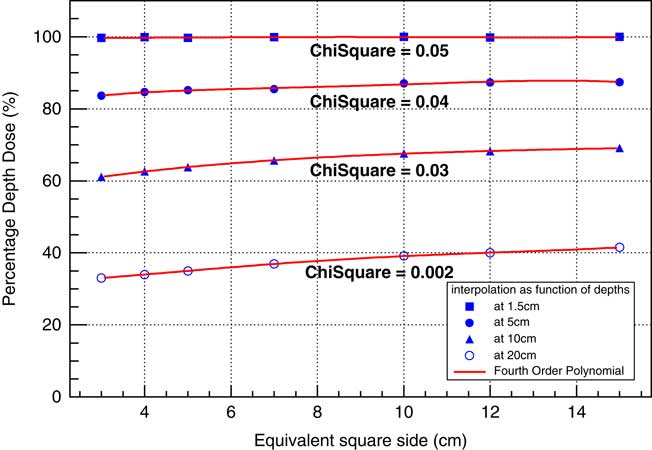
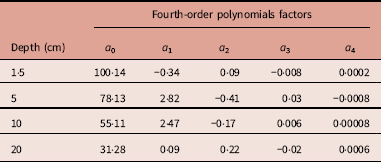
First, the appropriate interpolation function should relate the variation of PDD/TMR values with field size in terms of depth. Four different depths (1·5, 5, 10 and 20 cm of depth) were selected. We collected PDD/TMR values from the database for the different square field sizes, at each selected depth, and we plotted the experimental points. The corresponding fit functions were established accordingly. Based on the outcome, fourth-order polynomials represent the better agreement with experimental values of the constituted database with minimum χ2 values (Figure 1). The polynomial factors a 0, a 1, a 2, a 3 and a 4 represented in Table 1 were calculated for each series of points (seven for each depth) depending on the calculation depth. The process of interpolation is performed while the program is executing and depends on the calculation depth entered by the user.
Percentage depth dose (PDD) as a function of the equivalent square side, interpolation with fourth-order polynomials at depth of 1·5, 5, 10 and 20 cm.

Polynomial factors for the fourth-order polynomials at four depths: 1·5, 5, 10 and 20 cm, for PDD interpolation functions

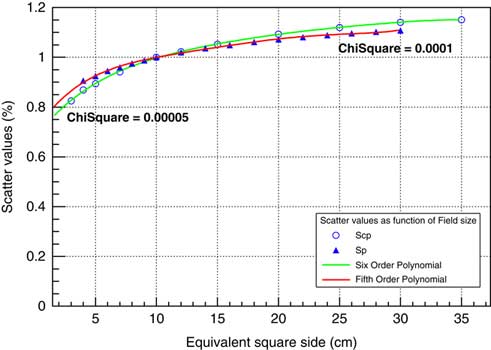
Second, experimental data points of the head–scatter (TSCF) and phantom–scatter (Sp) were plotted and fitted with different functions: exponential, logarithmic and different–order polynomial functions. The choice was limited to the fifth- and sixth-order polynomials, giving the best χ2 values. The fit functions established, shown in Figure 2, are used to define both, TSCF and the Sp. Therefore, additional time-consuming interpolation operations are avoided.
Total-scatter factor (Scp or TSCF) and phantom-scatter factor (Sp) as a function of the equivalent square side: interpolation with sixth and fifth-order polynomial, respectively.

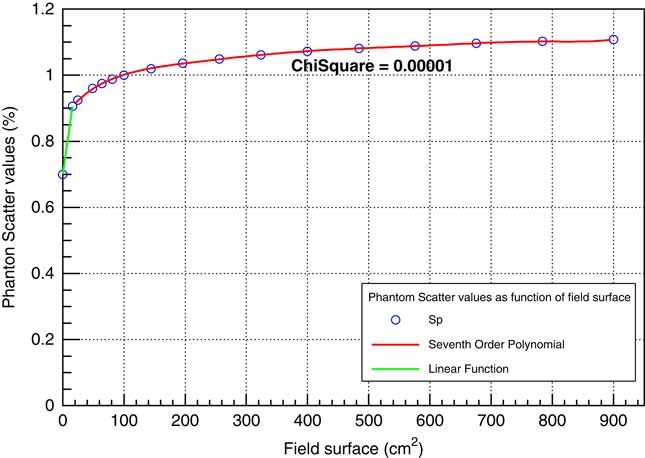
The interpolation of phantom scatter factor (Sp) as a function of the field surface was implemented to evaluate the MLC-shaped field equivalence by a seventh-order polynomial. A linear interpolation approximation for the small fields was performed to extend the model use cases, as shown in Figure 3.
Phantom-scatter factor (Sp) as a function of field surface (cm2): interpolation with a linear function and seventh-order polynomial.

The ROOT data analysis library26 has been used to perform interpolations and to calculate fit function parameters. Including Root’s Fitting Library in our C++ MUCP allows us to benefit from existing fitting functions, including polynomial functions. The error on the measurements of PDD is ±1% and the error on the size of the fields is ±1 mm on each side. The error rectangles remain constant at each measurement point, and are not discernible because of the scale chosen. Figures 1–3 show the interpolation performed. The same process of PDD interpolation was followed for TMR (Figure 1). Figures 2 and 3 show the interpolation for head- and phantom-scatter factors with a fifth, sixth and seventh-order polynomial functions. The polynomial interpolation used allows us to generate data needed for calculation and might not exist in our database.
The MU calculation by the TPS
To validate our MUCP and the accuracy of its calculations, a large water-phantom of 40 × 40 × 40 cm3 was created and digitised into Xio TPS,27 in which the calculation points previously entered into the MUCP took place. These calculation points were checked manually for each beam by manipulating beam characteristics, and were fixed with ICRU reference points or the isocenter, as recommended.1, 2 Simple and complex treatment setups were considered in the tests to evaluate the MUCP’s response. The MU required to deliver the prescribed dose to each calculation point were calculated by TPS Xio27 using a pencil-beam algorithm without any heterogeneity consideration in our digital phantom. The treatment’s parameters were entered manually by the user in the TPS and in the MUCP; the double check of the entered value was secured by screen displays of all user inputs. The TPS calculation is considered as the reference. The relative error (MUdiff) between MU calculated by Xio TPS27 and by our program divided by TPS’s MU value is given by the following expression (2).
 $${\rm MU}_{{{\rm diff}}} {\rm {\equals}(MU_{{{MUCP}}}}{\minus}{\rm MU_{{TPS}})\,/\,MU_{{TPS}}}$$
The experimental measurement under the Elekta Synergy linear accelerator
The verification by independent calculation software requires validation by the direct measurement. The MU dose correspondence was later checked by experimental measurement of dose deposit of an Elekta Synergy31 photon beam, in a 3D water phantom system, Model Blue Phantom (IBA Dosimetry, Schwarzenbruck, Germany) (with a size of 48 × 48 × 41 cm3)28 using a PTW Farmer type ionisation chamber of 0·65 cc effective volume. The ionisation chamber is related to an electrometer to measure the collected charges. Pressure and temperature correction factors were introduced to the electrometer before starting the measurement. The distance of treatment was fixed at 100 cm for both treatment techniques. Measurement points were fixed with the intelligent scanning of the IBA phantom. These measurements were repeated two or three times to improve the accuracy and were performed for all tested field sizes entered manually through the user interface.
Results
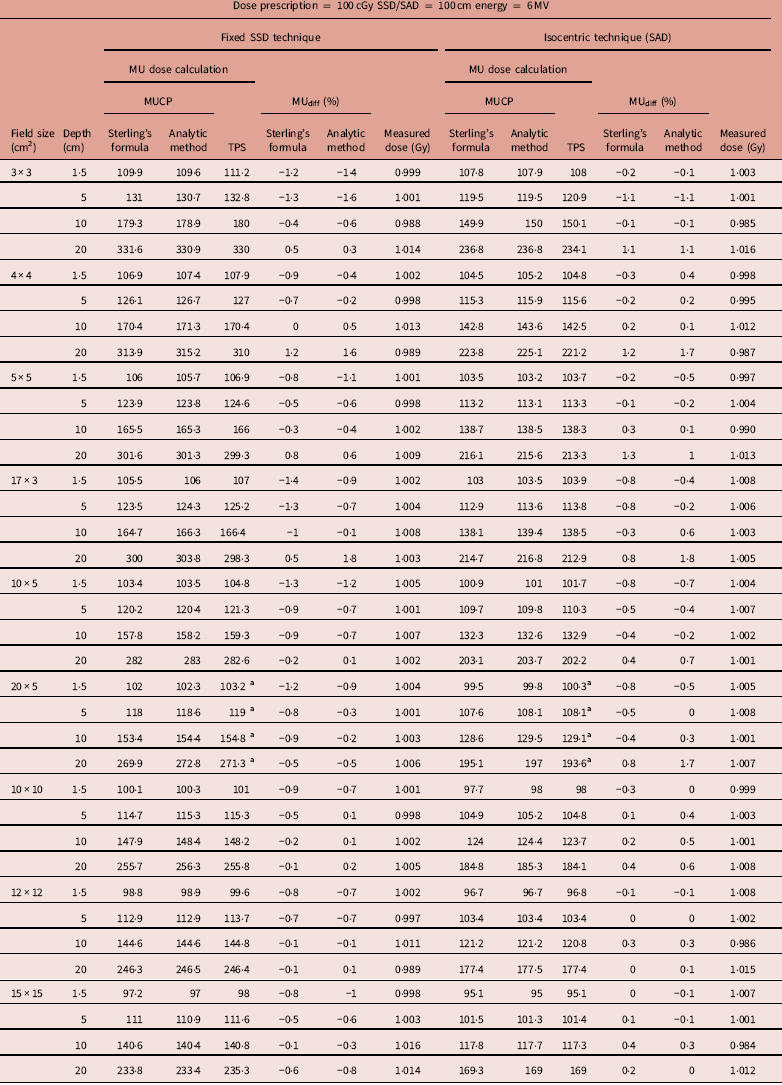
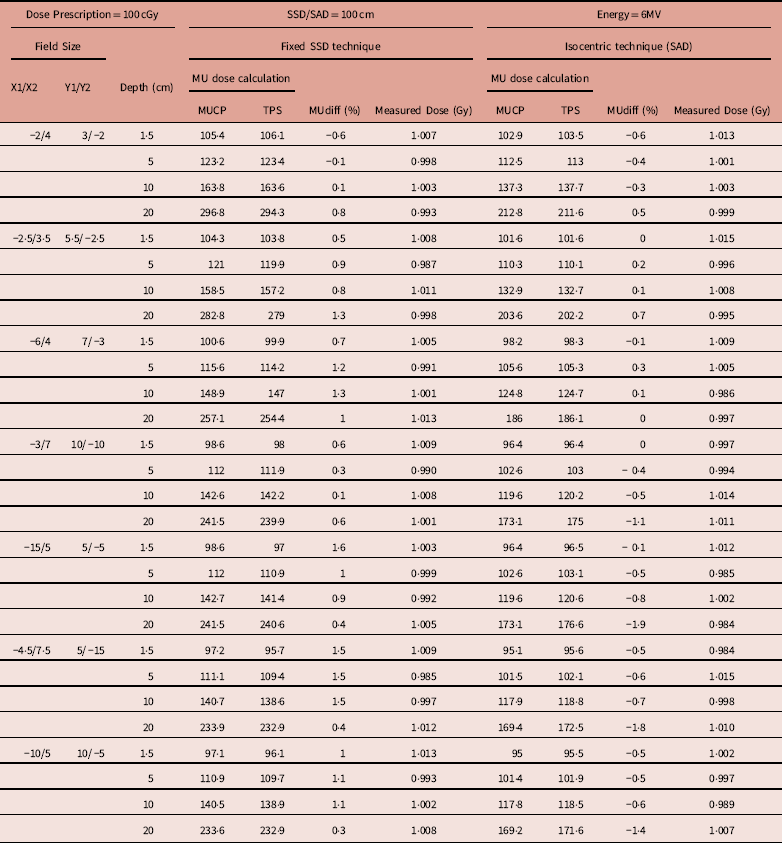
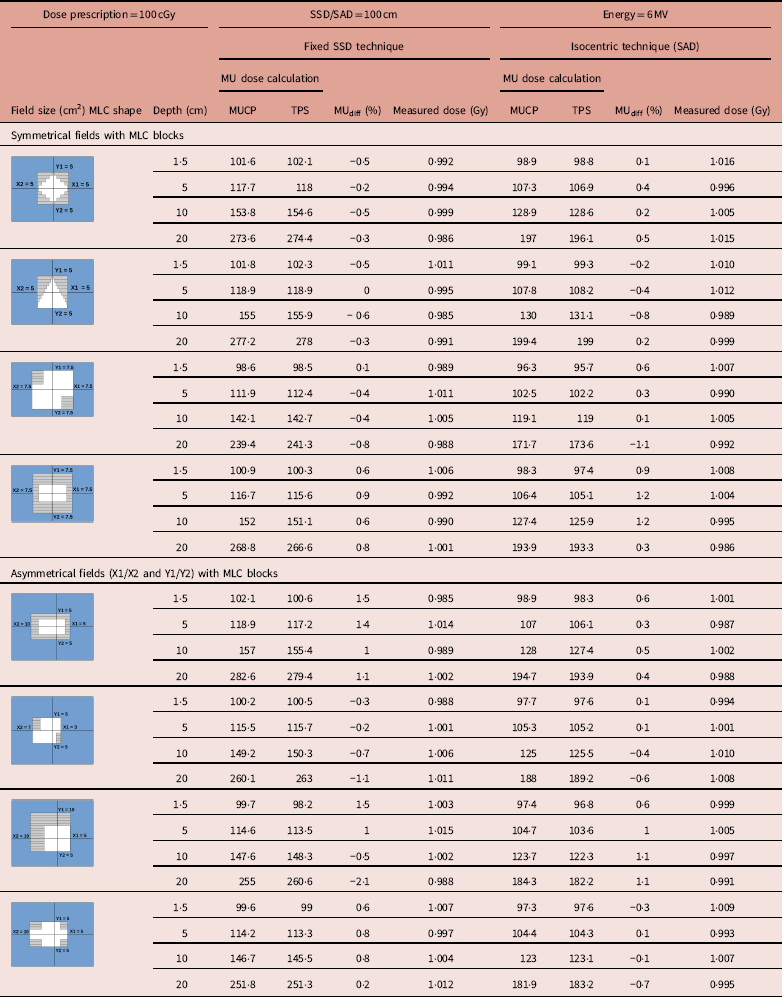
All the calculations and measurements were performed for a 6 MV energy photon beam and one gantry angle equal to 0°. The TPS and MUCP’s calculations as well as the corresponding measured doses are gathered in Tables 2–4. These tables display the comparison of MU numbers calculated by TPS and MUCP and show the accuracy of the program’s calculations for all tested field sizes at four different depths with both treatment techniques. All results show a good agreement, and are within the recommended deviation of 3% for both treatment techniques (fixed SSD or isocentric).
Comparison between calculated dose values obtained by the TPS and the homemade MUCP for both fixed and isocentric techniques, at different depths, and different symmetrical square and rectangular field sizes for a 6 MV photon beam

(a) MU values are the average of two measurements with two complementary rectangular fields X x Y cm2 and Y x X cm2.
Comparison between calculated dose values obtained by the TPS and the homemade MUCP for the fixed SSD andisocentric techniques, at different depths, different asymmetric rectangular field sizes for a 6 MV photon beam

Comparison between calculated dose values obtained by the TPS and the homemade MUCP for the fixed SSD and isocentric technique at different depths and different symmetrical and asymmetrical MLC blocked fields for a 6 MV photon beam

Discussion
Comparison of MU calculated by ‘Xio’ TPS and MUCP
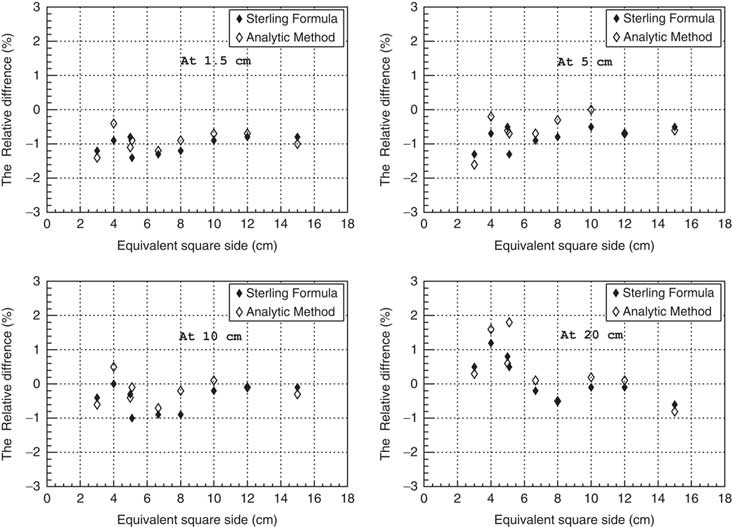
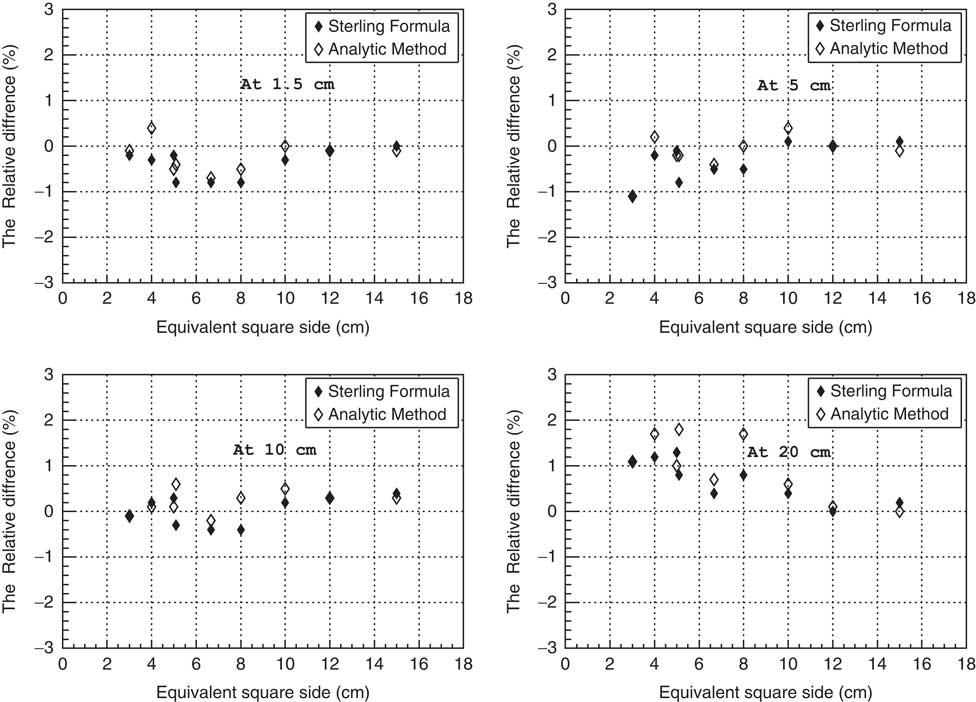
The MUCP accurately calculated the MU needed to deliver the prescribed dose of 1 Gy to all on-beam central-axis calculation points for all field sizes. Regarding the symmetrical square and rectangular fields, the MUCP dose values are less than the TPS in most cases with the fixed SSD technique by both field equivalence methods (sterling or analytical); the few exceptions were obtained for the sterling method at 20 cm for fields ≤17 × 3 cm2, and start to appear for the analytical method at 10 cm to cover almost all the points at 20 cm of depth (Table 2 and Figure 4). On the other hand, the MUCP dose values with the isocentric technique have demonstrated neither a dominant overestimation nor an underestimation.
The relative difference between the TPS and the MUCP dose calculation (MU) for fixed SSD technique as a function of field sizes, at 1·5, 5, 10 and 20 cm depth, respectively, calculated using sterling and the analytic method.

Overall, the MUCP calculated less MU numbers than the TPS in slightly half cases by the sterling method (Table 2; Figure 5). The MUdiff is <0 at near surface depths; as the depth increases MUdiff convert to positive values and the gap between MUdiff of the two methods tend to lightly enlarge. It is clear that turning point is the 10 cm depth, beyond which approximately all values become >0. This observation is valid for both treatment techniques and field equivalence methods (Figures 4 and 5). This could be related to the depth of normalisation, beam energy or the TPS calculation algorithm.
The relative difference between the TPS and the MUCP dose calculation (MU) for isocentric technique as a function of field sizes, at 1·5, 5, 10 and 20 cm depth, respectively, calculated using sterling and the analytic method.

The MU calculation with the analytical method shows small deviations compared to calculations performed using the sterling formula. Indeed, the larger deviation between these two calculations were 1·3 and 1%, seen at 20 cm of depth in case of the 17 × 3 cm2 field for both techniques.
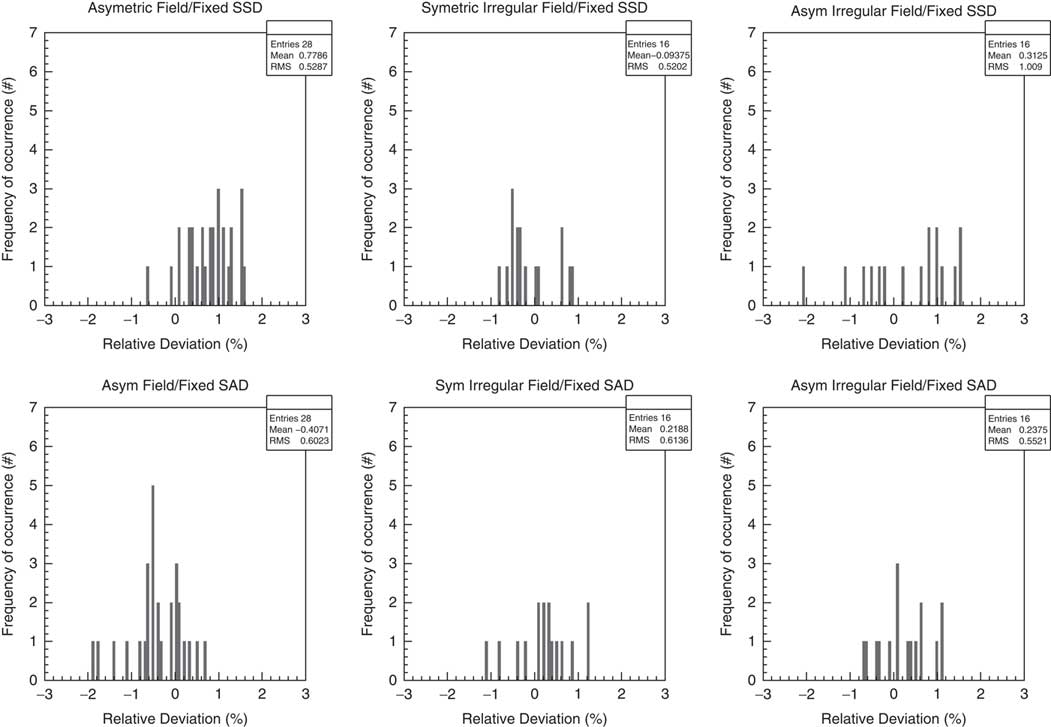
Concerning the asymmetric and irregular fields examination, the MUCP has mainly overestimated the MU calculation for asymmetric fields with the fixed SSD technique, symmetric irregular fields with the isocentric technique and asymmetric irregular fields with both techniques. On the other hand, the underestimation was principally seen for asymmetric fields with the isocentric technique, and symmetric irregular fields with the fixed SSD technique. The maximum relative differences between MUCP and the TPS calculation were 1·9, 1·2 and 2·1% for the asymmetric, symmetric and asymmetric irregular fields, respectively, for both treatment techniques (Tables 3 and 4, Figure 6). The MUdiff values are >0 in most cases, regardless of the calculation depth in the fixed SSD technique, and evenly distributed in the isocentric technique.
The distribution of the relative difference (%) between the TPS and the MUCP dose calculation (MU) for asymmetric and irregular fields for fixed SSD and isocentric techniques.

It appears that the MUCP calculates doses slightly lower than the TPS in deeper depth regions. Indeed, the largest negative MUdiff (2·1%) is calculated at 20 cm depth. These values are observed in some asymmetrical fields with the isocentric setup, and one asymmetrical irregular field with the fixed SSD technique. This could be related to the beam modeling process by the dose calculation algorithms in the TPS, that takes into account the field’s complex geometry rather than a simple ESF.
In Figure 1, the interpolation was performed using a large-scale PDD values for the four selected depths in this study. Consistent with the literature, the depth of calculation influences significantly the equation curve. At near surface depths, the PDD/TMR values are nearly constant for all field sizes. It means that only primary radiation reaches the depth of calculation/measurement. For deeper regions, the PDD/TMR value increases as function of field size to a certain value and stabilises. Owing to the PDD/TMR field size and depth dependence, interpolation should be performed for any random depth entered by the user while executing the program.
The testing results of the ICRU reference point in diverse depths along beam central axis have shown good agreements with standards, therefore confirming the conclusion of Takahashi et al.,Reference Takahashi, Kamima and Itano33 which underlines the major interest of the ICRU reference point’s placement as a confirmation procedure for dose independent check (MUs) from the TPS calculation.
The overall results shown in Tables 2–4 confirm the validity of the interpolation approach in Figures 1–3, as well as the field equivalence calculation method used for a symmetric, asymmetric and irregular fields. The polynomial functions predict a correct value for both PDD/TMR, head-scatter factor (TSCF) and phantom scatter (Sp) factors values for any field size. The MUCPs validation is based on these results of both the techniques (Figures 4–6). According to the recommendations, the deviation is always <±3% within the standard for both MU calculation and experimental measurement. In this way, the MUCP can be used for any symmetrical square or rectangular field, asymmetric and symmetric/asymmetric irregular fields under any depth on-beam central axis for both treatment techniques. However, it should be noted that the implemented field equivalency method is limited in case of fields in which one side is ≤2 cm. The authors of the original work recommended further investigation to take into account this aspect.Reference Birgani, Chegeni, Zabihzadeh and Hamzian22
The MU dose correspondence verification by measurements
Using a well-calibrated machine, we tested our program for field sizes ranging from 3 × 3 to 15 × 15 cm2, as well as several asymmetric and symmetric/asymmetric irregular fields at depths of 1·5, 5, 10 and 20 cm with dose measurements. The results at each point show no wide deviation from the prescribed dose of 1 Gy (Tables 2–4). The minimum and maximum deviations for a 1 Gy were about 0·1 and 1·6% for both techniques. As expected, the measurements confirm a good MU dose correspondence between the MUCP calculation and the linear accelerator.
Conclusions
Our aim was to establish a simple and non-time-consuming program for MUs verification, parametrized with input measured beam data, clinically valid for 3DCRT. An interpolation approach was adopted and a set of mathematical fit functions describing the variation of PDD/TMR, phantom scatter and the total scatter were performed in order to extend the limits of our program’s utilisation, by offering the user the freedom to set different field’s shapes of 6 MV photon beam starting from a limited measured database. This tool is very useful because a large database increases the calculation’s time. The present work is applicable to other photon beam energies. In addition to that, we adopted a straightforward, less time-consuming field equivalence calculation method.
In this paper, the MUCP was tested in simple and complex 3DCRT treatment cases for both techniques, based on a simple analytic equation from ESTRO Booklet no 3 and Task Group (TG) No.71 and 114 formalism for manual MU calculations. By adding the asymmetric and MLC-shaped field cases providing a stringent test of the programs accuracy, the MUCP is a very valuable tool to the clinical physicist; for fundamental TPS quality insurance, with more realistic testing options. The MATLAB/C++ platform was established by linking all needed MATLAB libraries to our program. Moreover, its execution takes several minutes including the time a user takes to enter the treatment parameters.
The differences between TPSs calculations and MUCPs for all tested cases were within accepted standards. Regarding the symmetric square and rectangular fields, the maximum difference was 1·8% for both the fixed SSD and isocentric techniques. As for the asymmetric and symmetric/asymmetric irregular MLC fields, the maximum relative deviation was 2·1% for both techniques in all tested field cases. An additional measurement test showed that the minimum and maximum deviations for a delivered dose of 1 Gy were about 0·1 and 1·6% for both techniques. The deviations were within the accepted range for all field sizes at all depths. The MUCP can be used for any 3DCRT field shape verification under any depth on-beam central axis for both treatment techniques, which will surely guarantee dose calculation accuracy as well as therapeutic goal.
Further study will be undertaken to add other factors such as heterogeneity and off-axis calculation. An extension of the presented model makes it possible to use this for advanced treatment techniques such as VMAT. Work is ongoing to upgrade the MUCP with the aim to use this in IMRT. Accordingly, this will help the physicist to effectively analyse the TPS response, relying on the MUCP as a quality assurance method.
Acknowledgements
The authors would like to thank AL AZHAR Oncology Center in Rabat for providing the database needed in our software package and the materials to carry out this study.
Financial Support
This research received no specific grant from any funding agency, commercial, or not-for-profit sectors.
Conflicts of Interest
None.