


I. INTRODUCTION
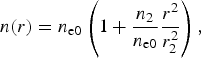
Propagation of high-intensity optical pulses in plasma channels (Ehrlich et al., Reference Ehrlich, Cohen, Zigler, Krall, Sprangle and Esarey1996; Nikitin et al., Reference Nikitin, Antonsen, Clark, Yuelin and Milchberg1997) is relevant to a wide range of applications, such as ultra-broadband optical generators (Corkum et al., Reference Corkum, Rolland and Srinivasan-Rao1986), optical harmonic generators (Zhou et al., Reference Zhou, Peatross, Murnane, Kapteyn and Christov1996), X-ray sources (Lemoff et al., Reference Lemoff, Yin, Gordon III, Barty and Harris1995), and laser-driven accelerators (Arefiev et al., Reference Arefiev, Khudik and Schollmeier2014). This has been experimentally demonstrated in plasma channels generated by hydrodynamic expansion (Durfee & Milchberg, Reference Durfee and Milchberg1993, Durfee et al., Reference Durfee, Lynch and Milchberg1995; Nikitin et al., Reference Nikitin, Antonsen, Clark, Yuelin and Milchberg1997) or capillary discharges (Ehrlich et al., Reference Ehrlich, Cohen, Zigler, Krall, Sprangle and Esarey1996; Spence et al., Reference Spence, Butler and Hooker2001). Geddes et al. (Reference Geddes, Toth, Van Tilborg, Esarey, Schroeder, Cary and Leemans2005) created the channel with twin pulse scheme utilizing a combined effect of femtosecond pulse ignition and longer pulse assisted heating. Furthermore, plasma channels have been used to guide intense (>1018W/cm2) laser pulses in laser–plasma accelerator experiments (Geddes et al., Reference Geddes, Toth, Van Tilborg, Esarey, Schroeder, Bruhwiler, Nieter, Cary and Leemans2004; Leemans et al., Reference Leemans, Nieter, Gonsalves, Toth, Nakamura, Geddes, Esarey, Schroeder and Hooker2006). Verma and Sharma (Reference Verma and Sharma2009) studied the prolongation of a gaseous plasma channel formed by a two-pulse technique for laser intensities below the tunnel ionization threshold. Kumar et al. (Reference Kumar, Dahiya and Sharma2011) developed a formalism for the formation of a parabolic radial density profile,  $n(r) = {n_{{\rm e0}}}(1 + ({n_2}/{n_{{\rm e0}}}){r^2}/r_2^2 )$ by using a sequence of two pulses and examined the focusing of the third intense pulse in the low-laser intensity limit, where n e0 is electron density on channel axis, n 2/n e0 and r 2 are related to pre-pulses. Zhang et al. (Reference Zhang, Xie, Hong, Wu and Zhao2011) investigated the Gaussian laser pulse in a preformed plasma channel including the effects of relativistic self-focusing, ponderomotive self-channeling, and channel focusing. The existence of electromagnetic solitary waves can enhance charged particle acceleration involving the laser–plasma channel interaction.
Liu and Tripathi (Reference Liu and Tripathi1996) studied the stimulated Raman forward scattering (SRFS) of a non-relativistic laser pump in a preformed cold plasma channel. The plasma channel introduces significant non-local effects on the stimulated Raman scattering. The Raman forward scattering in shallow plasma channels is investigated by Shvets and Li (Reference Shvets and Li2001). Instability arises due to the radial shear of the plasma frequency and the existence of the weakly damped hybrid (electrostatic/electromagnetic) modes of the radially inhomogeneous plasma. An interplay between these two effects produces double-peaked spectra for the direct forward scattering in a channel. Sajal et al. (Reference Sajal, Panwar and Tripathi2006) examined the SRFS of a relativistic laser pump in a self-created plasma channel including the non-local effects. The ponderomotive force of laser pulse front pushes the electrons radially outward, on the time scale of a plasma period  ${\rm \omega} _{\rm p}^{ - 1} $, where ωp is the electron plasma frequency, which creates a radial space charge, and modifies the electron density. The growth rate of the Raman forward scattering increases with the normalized pump amplitude at a lower value of pump amplitude, whereas at a higher value of the pump amplitude the growth rate decreases with the increase in normalized pump amplitude. With the increasing laser spot size the growth rate becomes maximum at the highest values of the pump amplitude. Panwar et al. (Reference Panwar, Kumar and Ryu2012) investigated the SRFS of an intense short-pulse laser in a plasma channel formed by two pre-laser pulses. The normalized growth rate of the SRFS increases with density non-uniformities of plasma channels. Verma and Sharma (Reference Verma and Sharma2011) examined the non-linear laser Eigen mode in a self-created plasma channel in the presence of an axial magnetic field. The non-linearity in electron response is induced by the relativistic mass effect and ponderomotive force.
Esarey et al. (Reference Esarey, Krall and Sprangle1994) investigated an envelope equation which describes the laser pulse self-focusing and optical guiding in plasmas. Watts et al. (Reference Watts, Zepf, Clark, Tatarakis, Krushelnick, Dangor, Allott, Clarke, Neely and Norreys2002) observed relativistic self-phase modulation in the interaction of a high-intensity laser pulse (1 ps, 1.053 µm, 80 J) with a plasma. Pajouh et al. (Reference Pajouh, Abbasi and Shukla2004) developed a theory of relativistic modulational instability of a circularly polarized intense Gaussian laser beam in a plasma. Andreev et al. (Reference Andreev, Kirsanov and Sakharov2000) studied the structure of the wakefield excited in the linear stage of the self-modulation of a high-power laser pulse in a homogeneous underdense plasma. Chen et al. (Reference Chen, Liu and Li2011) investigated the modulation instability of an intense right-hand elliptically polarized laser beam propagating through a magnetized pair plasma considering the relativistic and ponderomotive non-linearities. Etemadpour and Javan (Reference Etemadpour and Javan2015) examined the effect of superthermal ions and electrons on the modulation instability of a circularly polarized laser pulse in a magnetized plasma.
In this paper, we study the role of plasma channel non-uniformity on the modulational instability of a guided Gaussian laser pulse. A laser is guided by a preformed plasma channel, which has non-uniformity, relativistic mass, and ponderomotive non-linearities. A plasma wave propagating together with the laser with its group velocity causes defocusing/focusing at different parts of Gaussian laser and induces an axial intensity gradient. Further, the laser pulse exerts a longitudinal ponderomotive force on electrons to derive a plasma wave, which leads to the growth of the modulational instability. We study the modification in a self-guided equilibrium of a laser pulse and the growth rate of modulational instability in the presence of plasma channel non-uniformity. In Section II, we study the laser plasma channel equilibrium for different plasma channel non-uniformity and in Section III we carry out the modulational instability analysis. Results and discussions are given in Section IV.
II. PROPAGATION OF LASER THROUGH A NON-UNIFORM PLASMA CHANNEL
Consider a linearly polarized laser beam propagating along the  $\hat z$-direction through a non-uniform plasma channel. Density non-uniformity of plasma channel,
 $$n(r) = {n_{{\rm e0}}}\left( {1 + \displaystyle{{{n_2}} \over {{n_{{\rm e0}}}}}\displaystyle{{{r^2}} \over {r_2^2}}} \right),$$
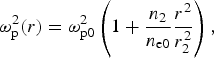
can be developed by two laser pulses [Kumar et al. (Reference Kumar, Dahiya and Sharma2011)], where n e0 is electron density on channel axis. The plasma channel non-uniformity n 2/n e0 and spot size r 2 are related to the properties of the channel. Then the plasma frequency profile becomes,
 $${\rm \omega} _{\rm p}^2 (r) = {\rm \omega} _{{\rm p}0}^2 \left( {1 + \displaystyle{{{n_2}} \over {{n_{{\rm e0}}}}}\displaystyle{{{r^2}} \over {r_2^2}}} \right),$$
where 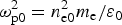 ${\rm \omega} _{{\rm p}0}^2 = n_{{\rm e0}}^{\rm 2} {m_{\rm e}}/{{\rm \varepsilon} _0}$ is the electron plasma frequency, m e and ε0 are the electron mass and electric permittivity, respectively. The electric field of a laser pulse is given by,
 $${\vec E_0} = \hat x{A_0}(r,z,t){e^{ - i({{\rm \omega} _0}t - {k_0}z)}},$$
where k 0 = (ω0/c)η0, η0 is the refractive index of the plasma, and A 0(r, z, t) is a slowly varying complex amplitude of the laser. The intensity distribution of this mode at “z = 0” is given by,
 $${A_0} \vert _{z = 0}^2 = E_{00}^2 {e^{ - {r^2}/r_0^2}} {g_0}(t),$$
where g 0(t) is the temporal shape of the main pulse. And at z > 0, the intensity distribution is modified by the beam width parameter “f”,
 $$ \vert {A_0}{ \vert ^2} = \displaystyle{{E_{00}^2} \over {{\,f^2}}}{e^{ - {r^2}/r_0^2 {\,f^2}}}{g_0}(t - z/c).$$
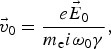
The main laser pulse imparts oscillatory velocity to electrons,
 $${\vec v_0} = \displaystyle{{e{{\vec E}_0}} \over {{m_{\rm e}}i{{\rm \omega} _0}{\rm \gamma}}}, $$
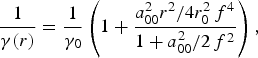
where –e is the electron charge. Here we have neglected  $({\vec v_0} \times {\vec B_0})$, because of its twice high frequency. In the paraxial approximation, relativistic gamma factor can be expanded by using Taylor's expansion,
 $${\displaystyle{1 \over {{\rm \gamma} (r)}} = \displaystyle{1 \over {{{\rm \gamma} _0}}}\left( {1 + \displaystyle{{a_{00}^2 {r^2}/4r_0^2 {\,f^4}} \over {1 + a_{00}^2 /2{\,f^2}}}} \right),} $$
where  $a_{00}^2 = e{A_{00}}/{m_{\rm e}}{{\rm \omega} _0}c\vert{^2}$ is the normalized laser amplitude and
 ${\rm \gamma}_0 = (1 + a_{00}^2 {/2)^{1/2}}$ is the value of γ on the axis. The wave equation governing the electric field of the pump laser beam in a plasma can be written as,
 $${\nabla ^2}{\vec E_0} - \nabla (\nabla \cdot {\vec E_0}) + \displaystyle{{{\rm \omega} _0^2} \over {{c^2}}}{{\rm \varepsilon} _{{\rm eff}}}{\vec E_0} = 0,$$
where the effective dielectric permittivity becomes in terms of z and r as,
 $${{\rm \varepsilon} _{{\rm eff}}}(r,z) = {{\rm \varepsilon} _{{\rm eff}0}} + {{\rm \varepsilon} _2}{r^2},$$
where
 $${{\rm \varepsilon} _{{\rm eff}0}} \equiv 1 - \displaystyle{{{\rm \omega} _{{\rm p}0}^2} \over {{\rm \omega} _0^2 {{\rm \gamma} _0}}},\quad {{\rm \varepsilon} _2} \equiv - \displaystyle{{{\rm \omega} _{{\rm p}0}^2 \Phi} \over {{\rm \omega} _0^2 {{\rm \gamma} _0}r_0^2 {\,f^2}}},$$
 $${\rm and}\quad \Phi \equiv \displaystyle{{{n_2}} \over {{n_{{\rm eo}}}}}\displaystyle{{r_0^2 {\,f^2}} \over {r_2^2}} + \displaystyle{{a_{00}^2} \over {4{\,f^2}(1 + a_{00}^2 /2{\,f^2})}}.$$
Electromagnetic wave satisfies the condition,  $\nabla \cdot {\vec E_0} = 0$. In terms of a slowly varying laser amplitude, one can neglect (∂2A 0/∂z 2) by using the WKB approximation,
 $$2i{k_0}\displaystyle{{\partial {A_0}} \over {\partial z^{\prime}}} + \nabla _ \bot ^2 {A_0} - k_0^2 {A_0} + \displaystyle{{{\rm \omega} _0^2} \over {{c^2}}}\left( {{{\rm \varepsilon} _{{\rm eff}0}} + {{\rm \varepsilon} _2}{r^2}} \right){A_0} = 0,$$
where the old variables z and t are transformed to z′ = z and t′ = (t − z/v g), respectively. Now, following Akhmanov et al. (Reference Akhmanov, Sukhorukov and Khokhlov1966) and Sodha et al. (Reference Sodha, Ghatak and Tripathi1974) to evaluate the pulse evolution we introduce an eikonal approximation,
 $${\vec A_0} = {\vec A_{00}}(r){e^{i{k_0}S(r,z^{\prime})}},$$
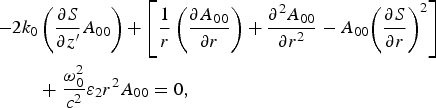
and separate the real and imaginary parts. This results in the following equations,
 $$\eqalign{ - 2{k_0}&\left( {\displaystyle{{\partial S} \over {\partial z^{\prime}}}{A_{00}}} \right) + \left[ {\displaystyle{1 \over r}\left( {\displaystyle{{\partial {A_{00}}} \over {\partial r}}} \right) + \displaystyle{{{\partial ^2}{A_{00}}} \over {\partial {r^2}}} - {A_{00}}{{\left( {\displaystyle{{\partial S} \over {\partial r}}} \right)}^2}} \right] \cr &+ \displaystyle{{{\rm \omega} _0^2} \over {{c^2}}}{{\rm \varepsilon} _2}{r^2}{A_{00}} = 0,} $$
and
 $${k_0}\displaystyle{{\partial A_{00}^2} \over {\partial z^{\prime}}} + \left( {\displaystyle{{{\partial ^2}S} \over {\partial {r^2}}} + \displaystyle{1 \over r}\displaystyle{{\partial S} \over {\partial r}}} \right)A_{00}^2 + \displaystyle{{\partial A_{00}^2} \over {\partial r}}\displaystyle{{\partial S} \over {\partial r}} = 0.$$
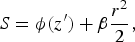
The coupled set of equations for  $A_{00}^2 $ and S are solved in the paraxial approximation by expanding S as,
 $$S = {\rm \phi} (z^{\prime}) + {\rm \beta} \displaystyle{{{r^2}} \over 2},$$
where
 $${\rm \beta} = \displaystyle{1 \over f}\displaystyle{{df} \over {dz^{\prime}}},$$
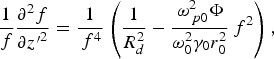
and ϕ(z′) is the axial phase. After solving the Eqs. (14) and (15), we get the single equation for laser beam width parameter,
 $$\displaystyle{1 \over f}\displaystyle{{{\partial ^2}f} \over {\partial {{z^{\prime}}^2}}} = \displaystyle{1 \over {{\,f^4}}}\left( {\displaystyle{1 \over {R_d^2}} - \displaystyle{{{\rm \omega} _{\,p0}^2 \Phi} \over {{\rm \omega} _0^2 {{\rm \gamma} _0}r_0^2}} {\,f^2}} \right),$$
where  ${R_{\rm d}} = {k_0}r_0^2 $ is the diffraction length. The second term on the right hand side of the above Eq. (18) contributes to non-linear self-focusing length. The laser beam width parameter governs the equation through the dimensionless distance ξ = z/R d,
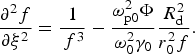 $$\displaystyle{{{\partial ^2}f} \over {\partial {{\rm \xi} ^2}}} = \displaystyle{1 \over {{\,f^3}}} - \displaystyle{{{\rm \omega} _{{\rm p}0}^2 \Phi} \over {{\rm \omega} _0^2 {{\rm \gamma} _0}}}\displaystyle{{R_{\rm d}^2} \over {r_0^2 f}}.$$
The boundary conditions at ξ = 0 for an initially plane wavefront are f = 1, ∂f/∂ξ = 0, and S 0 = 0. We observed the variation of a normalized pump intensity distribution  $I = (a_{00}^2 /{\,f^2})exp( - {r^2}/r_0^2 {\,f^2})$ with respect to the propagation distance ξ for different values of plasma channel non-uniformities n 2/n e0 are plotted in Figure 1. Larger values of plasma channel non-uniformity induce more focusing of laser pulse, which further increase the normalized laser pulse intensity. Normalized pump intensity distribution through the deep plasma channel n 2/n e0 = 0.3 for different normalized laser amplitude a 00 are given in Figure 2. In a deep plasma channel, the self-focusing is only due to the relativistic mass correction. When both the terms on the right hand side of Eq. (18) are equal, then the beam width parameter (f = 1) becomes unity for all the values of z. Thus, the Gaussian intensity profile given in Eq. (4) of the laser would remain the same for z > 0. We obtain the equation for the laser spot size,
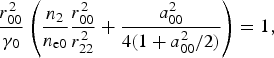 $$\displaystyle{{r_{00}^2} \over {{{\rm \gamma} _0}}}\left( {\displaystyle{{{n_2}} \over {{n_{{\rm e0}}}}}\displaystyle{{r_{00}^2} \over {r_{22}^2}} + \displaystyle{{a_{00}^2} \over {4(1 + a_{00}^2 /2)}}} \right) = 1,$$
where r 00 = r 0ωp0/c and r 22 = r 2ωp0/c. In Figure 3, we plotted the variation of the normalized pump intensity a 00 with the plasma channel non-uniformity for the fixed normalized spot size r 22. The normalized pump amplitude a 00 must decrease with the increase in plasma channel non-uniformity to maintain the constant shape of the pulse.
Variation of a normalized pump intensity distribution  $I = (a_{00}^2 /{\,f^2})exp( - {r^2}/r_0^2 {\,f^2})$ with respect to the normalized distance of propagation ξ and pulse with r/r 0 for plasma channels with non-uniformities, n 2/n e0 = 0.0 (1a), n 2/n e0 = 0.1 (1b), n 2/n e0 = 0.2 (1c), and n 2/n e0 = 0.3 (1d) and normalized laser intensities is a 00 = 0.57.

Variation of normalized pump intensity distribution  $I = (a_{00}^2 /{\,f^2})exp( - {r^2}/r_0^2 {\,f^2})$ with respect to the normalized distance of propagation ξ and pulse with r/r 0 through a deep plasma channel with non-uniformity n 2/n e0 = 0.3 for normalized laser intensities a 00 = 0.65 (2a), a 00 = 0.75 (2b), a 00 = 0.85 (2c), and a 00 = 0.95 (2e).
Variation of a normalized pump amplitude a 00 of main laser pulse with respect to plasma channel non-uniformities n 2/n e0 for r 00 = 3 (red-dashed line) and r 00 = 5 (blue-line).
III. MODULATIONAL INSTABILITY
A laser pulse can exerts a ponderomotive force on the electrons,  ${\vec F_{\rm p}} = e\nabla {{\rm \phi} _{\rm p}}$, where
 $${{\rm \phi} _{\rm p}} \approx ({m_{\rm e}}{c^2}/e)a_{00}^2 \big[(1/2{\,f^2})(1 + {r^2}/r_0^2 {\,f^2})\big].$$
We perturb the equilibrium by a plasma wave of potential ϕ with the density perturbation n p and the velocity perturbation  $\vec v$. The plasma wave modifies the beam width parameter to f = 1 + Δf, and the ponderomotive potential to ϕ′p,
 $${\phi ^{\prime}_{\rm p}} \approx \displaystyle{1 \over 2}\displaystyle{{{m_{\rm e}}{c^2}} \over e}a_{00}^2 \left[ {\displaystyle{1 \over 2}(1 - 2\Delta f)\left( {1 + (1 - 2\Delta f)\displaystyle{{{r^2}} \over {r_0^2}}} \right)} \right],$$
where Δf ≪ 1. The equations governing  $\vec v$ and n p are,
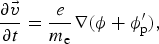 $$\displaystyle{{\partial \vec v} \over {\partial t}} = \displaystyle{e \over {{m_{\rm e}}}}\nabla ({\rm \phi} + {{\rm \phi} ^{\prime}_{\rm p}}),$$
and
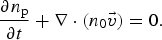 $$\displaystyle{{\partial {n_{\rm p}}} \over {\partial t}} + \nabla \cdot ({n_0}\vec v) = 0.$$
Taking ∂n p/∂t of Eq. (24) and using Eq. (23) and Poisson's equation 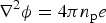 ${\nabla ^2}{\rm \phi} = 4{\rm \pi} {n_{\rm p}}e$, we obtain
 $$\displaystyle{{{\partial ^2}{n_{\rm p}}} \over {\partial {t^2}}} + {\rm \omega} _{{\rm p0}}^2 {n_{\rm p}} = - \displaystyle{{{n_{{\rm e0}}}e} \over {{m_{\rm e}}}}\displaystyle{{{\partial ^2}{{{\rm \phi} ^{\prime}}_{\rm p}}} \over {\partial {z^2}}},$$
writing,
 $${n_{\rm p}} = {n_{{\rm p0}}} + {n_{{\rm p2}}}{r^2}/r_0^2, $$
Eq. (25) can split into,
 $$\displaystyle{{{\partial ^2}{n_{{\rm p0}}}} \over {\partial {{t^{\prime}}^2}}} + {\rm \omega} _{{\rm p0}}^2 {n_{{\rm p0}}} = {n_{{\rm e0}}}{c^2}a_{00}^2 \displaystyle{{{\partial ^2}\Delta f} \over {\partial {z^2}}},$$
and
 $$\displaystyle{{{\partial ^2}{n_{{\rm p2}}}} \over {\partial {{t^{\prime}}^2}}} + {\rm \omega} _{{\rm p0}}^2 {n_{{\rm p2}}} = 2{n_{{\rm e0}}}{c^2}a_{00}^2 \displaystyle{{{\partial ^2}\Delta f} \over {\partial {z^2}}},$$
where ∂/∂z = ∂/∂z − (1/c)∂/∂t′. The relevant combination of the permittivity becomes,
 $${{\rm \varepsilon} _{{\rm eff}}}(r,z) = {{\rm \varepsilon} _{{\rm eff0}}} + {{\rm \varepsilon} ^{\prime}_2}{r^2},$$
where
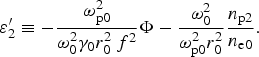 $${{\rm \varepsilon} ^{\prime}_2} \equiv - \displaystyle{{{\rm \omega} _{{\rm p0}}^2} \over {{\rm \omega} _0^2 {{\rm \gamma} _0}r_0^2 {\,f^2}}}\Phi - \displaystyle{{{\rm \omega} _0^2} \over {{\rm \omega} _{{\rm p0}}^2 r_0^2}} \displaystyle{{{n_{{\rm p2}}}} \over {{n_{{\rm e0}}}}}.$$
Thus, one can obtain the following perturbation equation in terms of the beam width parameter,
 $$\displaystyle{{{\partial ^2}\Delta f} \over {\partial z^{\prime}}} + \left( {\displaystyle{3 \over {R_{\rm d}^2}} - \displaystyle{{{\rm \omega} _{{\rm p0}}^2} \over {{\rm \omega} _0^2 {{\rm \gamma} _0}}}\displaystyle{{{n_2}} \over {{n_{{\rm e0}}}}}\displaystyle{3 \over {r_2^2}}} \right)\Delta f = - \displaystyle{{{\rm \omega} _{{\rm p0}}^2} \over {{\rm \omega} _0^2}} \displaystyle{{{n_{{\rm p2}}}} \over {{n_{{\rm e0}}}r_0^2}}, $$
and ignoring the product of perturbed quantities Δf and n p2/n e0. Letting,
 $$\Delta f = {a_{\rm f}}exp[ - i({\rm \omega} t - qz^{\prime})],$$
and
 $$\displaystyle{{{n_{{\rm p2}}}} \over {{n_{{\rm e0}}}}} = {a_{\rm n}}exp[ - i({\rm \omega} t - qz^{\prime})],$$
and looking for the solutions for which q is complex, we obtain,
 $$\left( {{q^2} - \left( {\displaystyle{3 \over {R_{\rm d}^2}} - 3\displaystyle{{{\rm \omega} _{\,p0}^2} \over {{\rm \omega} _0^2 {{\rm \gamma}_0}r_0^2}} \displaystyle{{{n_2}} \over {{n_{{\rm e0}}}}}\displaystyle{{r_0^2} \over {r_2^2}}} \right)} \right){a_f} = \displaystyle{{{\rm \omega} _{{\rm p0}}^2} \over {r_0^2 \omega _0^2}} {a_{\rm n}},$$
 $$\left( {{{\rm \omega} ^2} - {\rm \omega} _{{\rm p0}}^2} \right){a_{\rm n}} = - 2a_0^2 {\left( {{\rm \omega} + qc} \right)^2}{a_{\rm f}},$$
which yields the following dispersion relation for the modulational instability of the laser,
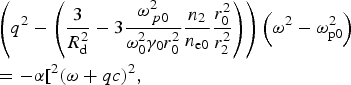 $$\eqalign{& \left( {{q^2} - \left( {\displaystyle{3 \over {R_{\rm d}^2}} - 3\displaystyle{{{\rm \omega} _{\,p0}^2} \over {{\rm \omega} _0^2 {{\rm \gamma} _0}r_0^2}} \displaystyle{{{n_2}} \over {{n_{{\rm e0}}}}}\displaystyle{{r_0^2} \over {r_2^2}}} \right)} \right)\left( {{{\rm \omega} ^2} - {\rm \omega} _{{\rm p0}}^2} \right) \cr & = - {{\rm \alpha}[ ^2}{\left( {{\rm \omega} + qc} \right)^2},} $$
where,
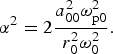 $${{\rm \alpha} ^2} = 2\displaystyle{{a_{00}^2 {\rm \omega} _{{\rm p0}}^2} \over {r_0^2 {\rm \omega} _0^2}}. $$
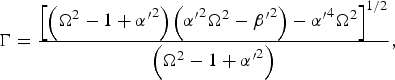
An instability occurs when the quantity within the square root is negative. The spatial growth rate becomes,
 $$\Gamma = \displaystyle{{{{\left[ {\left( {{\Omega ^2} - 1 + {{{\rm \alpha} ^{\prime}}^2}} \right)\left( {{{{\rm \alpha} ^{\prime}}^2}{\Omega ^2} - {{{\rm \beta} ^{\prime}}^2}} \right) - {{{\rm \alpha} ^{\prime}}^4}{\Omega ^2}} \right]}^{1/2}}} \over {\left( {{\Omega ^2} - 1 + {{{\rm \alpha} ^{\prime}}^2}} \right)}},$$
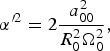
where
 $${{\rm \alpha} ^{\prime 2} = 2\displaystyle{{a_{00}^2} \over {R_0^2 \Omega _0^2}},} $$
and
 $${{\rm \beta} ^{\prime ^2} = \left( {\displaystyle{3 \over {R_{\rm d}^2}} - \displaystyle{3 \over {{{\rm \gamma} _0}\Omega _0^2}} \displaystyle{{{n_2}} \over {{n_{{\rm e0}}}}}\displaystyle{1 \over {R_2^2}}} \right)\left( {{\Omega ^2} - 1} \right).}$$
Here, we non-dimensionalized the above equations with Γ = γc/ωp0, Ω = ω/ωp0, Ω0 = ω0/ωp0, and R 0 = r 0ωp0/c, R 2 = r 2ωp0/c. The normalized growth rates of the modulational instability of a main pulse are plotted for shallow (Figs 4a and 4b) and deep plasma channels (Figs 5a and 5b). In both the cases, the growth rate increases very sharply at Ω = 1 and sharply drops to zero on further increase in Ω. For a small laser pump amplitude the growth rate increases with the increase in plasma channel non-uniformity (Fig. 4b). In a deep plasma channel with non-uniformity 0.3, the growth rate of the modulational instability also increases with the normalized laser amplitude (Fig. 5b).
The normalized growth rate Γ = γ 0ωp0/c of modulational instability as a function of a normalized frequency of the plasma wave Ω = ω/ωp0 for normalized laser intensity a 00 = 0.3 through different channel non-uniformities n 2/n e0 = 0.0 (red-line), n 2/n e0 = 0.2 (blue-dashed line), and n 2/n e0 = 0.3 (green-long-dashed line). And Figure 4b is the zoom in portion of Figure 4a near the maximum growth rate.
The normalized growth rate Γ = γ 0ωp0/c of modulational instability as a function of normalized frequency of the plasma wave Ω = ω/ωp0 through a deep channel with non-uniformity 0.3 for normalized laser intensity a 00 = 0.5 (red-line), a 00 = 0.65 (blue-dashed line), and a 00 = 0.75 (green-line). And Figure 5b is the zoom in portion of Figure 5a near the maximum growth rate.
IV. RESULTS AND DISCUSSSION
We have carried out an analysis of the plasma channel non-uniformity effect on the modulational instability, and found that self-focusing is induced by the relativistic mass non-linearity and the plasma channel non-uniformity. The normalized laser pulse intensity increases with the increase in non-uniformity of the plasma channel such as n 2/n e0 = 0.1, 0.2, and 0.3 in Figure 1. However, in deep plasma channels with non-uniformity n 2/n e0 = 0.3, the laser pulse intensity increases due to the relativistic mass non-linearity as shown in Figure 2. To maintain the constant shape of the laser pulse, the plasma channel non-uniformity must decrease with the increase of the laser pulse amplitude (Fig. 3). A co-propagating plasma wave perturbation with the laser group velocity produces the axial intensity gradient. Further, the laser pulse derives a plasma wave by exerting a ponderomotive force on the electrons, and develops the modulational instability. The normalized growth rate of the modulation for the main pulse is modified by the plasma channel non-uniformity as well as by the laser intensity. In Figures 4a and 4b, it is shown that in the presence of a plasma channel the growth rate increases with non-uniformity n 2/n e0 = 0.0, 0.2, and 0.3. In the presence of deep cavitation n 2/n e0 = 0.3, the normalized growth rate also increases with the intensity of the main laser pulse as shown in Figures 5a and 5b. However, the growth rate peak shifts towards the larger value of normalized plasma wave frequency.
ACKNOWLEDGMENTS
This work was supported by the IBS and the NFRI of Korea. This research was also supported by National R&D Program through the National Research Foundation of Korea (NRF) funded by the Ministry of Science, ICT & Future Planning (2015M1A7A1A02050238).



