Surgical site infection (SSI) is a serious complication of surgical procedures that occurs after approximately 2% of inpatient surgeries performed at hospitals in the United States.Reference Mu, Edwards, Horan, Berrios-Torres and Fridkin 1 An estimated 157,000 SSIs occurred in US acute care hospitals in 2011, 2 and 3% of patients with SSIs die as a result of the infection.Reference Umscheid, Mitchell, Doshi, Agarwal, Williams and Brennan 3 – Reference Mangram, Horan, Pearson, Silver and Jarvis 5 The hospital-related cost of a single SSI has been estimated at $12,000–$35,000,Reference Anderson, Pyatt, Weber and Rutala 6 and estimates of annual nationwide hospital costs of SSI have ranged from $3 billion to $10 billion.Reference Scott 7 Methicillin-resistant Staphylococcus aureus (MRSA) is a common cause of SSI and is associated with long and expensive hospitalizations as well as high mortality rates.Reference Engemann, Carmeli and Cosgrove 8 , Reference Anderson, Kaye and Chen 9
SSI is the most common type of healthcare-associated infection (HAI) in our network of community hospitals.Reference Lewis, Moehring, Chen, Sexton and Anderson 10 We previously studied trends in the rates of SSI in our network and found that the overall prevalence rate of SSI increased from 2000 to 2005, as did the rate of SSI due to MRSA, which was the most common pathogen responsible for SSI.Reference Anderson, Sexton, Kanafani, Auten and Kaye 11 More recent data from the Centers for Disease Control and Prevention’s (CDC) National Healthcare Safety Network (NHSN) showed a decrease in overall SSI rates for many common procedures between 2008 and 2012. 12 These findings are concordant with results of other recent studies that reported similar declines in the rate of hospital-onset invasive MRSA infections.Reference Dantes, Mu and Belflower 13 – Reference Landrum, Neumann and Cook 15
Only sparse recent data are available regarding the epidemiology of SSI in community hospitals. Most studies describing the epidemiology of SSI have been undertaken at university-affiliated hospitals and other tertiary-care teaching facilities. Published studies of SSI in community hospitals are hampered by single-hospital retrospective designs, small numbers of infections, or analysis of data on rates of SSI for a limited number of procedure types.Reference Boston, Baraniuk, O’Heron and Murray 16 – Reference Chattopadhyay, Zaroukian and Potvin 19 The objectives of this analysis were (1) to describe the epidemiology of SSI for commonly performed procedures in a large network of community hospitals and (2) to characterize the trends of SSI prevalence rates over time for MRSA and other pathogens frequently responsible for SSI.
METHODS
Setting
The Duke Infection Control Outreach Network (DICON) is a network of 42 community hospitals in 5 states in the southeastern United States.Reference Anderson, Miller and Chen 20 Community hospitals within our network have access to expert infection control consultation, educational services, benchmark data, and detailed data analysis.Reference Kaye, Engemann, Fulmer, Clark, Noga and Sexton 21 Trained and experienced infection preventionists prospectively enter data collected from patients undergoing 37 types of operative procedures 22 into a database. The database contains the following information: type of surgical procedure; hospital; primary surgeon; patient age; procedure date and duration; NHSN risk index (which is calculated from the patient’s American Society of Anesthesiologists [ASA] classification system score, wound class, and operative duration)Reference Culver, Horan and Gaynes 23 ; and the presence or absence of postoperative SSI, including causative organism, if a postoperative culture was obtained and was positive.
DICON SSI surveillance methods have previously been described in detail.Reference Anderson, Miller and Chen 20 , Reference Kaye, Sloane, Sexton and Schmader 24 Potential SSIs were identified through review of microbiology culture results, hospital readmissions following surgery, clinical rounds, and questionnaires sent to surgeons regarding postoperative patients. Infection preventionists used NHSN criteria to categorize SSIs into superficial (superficial incisional) and complex (deep incisional or organ-space) SSIs. 22
Analysis Plan
We analyzed 532,694 consecutive NHSN operative procedures performed at the 29 DICON hospitals that were members of our network from January 2008 through December 2012. In 2013, the NHSN substantially decreased the time period of SSI surveillance following many procedures. Because this change in surveillance methods resulted in the exclusion of approximately 10% of our SSIs captured by traditional NHSN definitions,Reference Dicks, Lewis and Durkin 25 we excluded procedures performed after 2012 from our analysis.
We focused our analysis on complex SSIs because superficial SSIs are less clinically relevant and costly than complex SSIs.Reference Ming, Chen, Miller and Anderson 26 Furthermore, surveillance of superficial SSIs is difficult to standardize. However, for the procedure-specific analysis, we included total (complex and superficial) SSI rates to allow comparison to NHSN benchmark rates, which are not stratified by depth of infection.
First, we determined the overall prevalence rate of SSI during the 5-year study period and then stratified all collected data by procedure type, NHSN risk index, and pathogen responsible for infection. Then, for each year of the study from 2008 through 2012, we determined the prevalence rate of SSI, stratified by causative organism. We used unadjusted log-binomial regression to calculate annual crude prevalence rates and prevalence rate ratios (PRRs) for all SSIs independent of pathogen, as well as for MRSA SSI.
Next, we constructed 2 multivariate log-binomial regression models to further analyze SSI prevalence trends over time: one model analyzed all SSI, and the second model analyzed MRSA SSI only. We considered potential effect measure modifiers and confounders of the relationship between calendar year and SSI prevalence rate. Patient age,Reference Mangram, Horan, Pearson, Silver and Jarvis 5 , Reference Kaye, Sloane, Sexton and Schmader 24 NHSN risk index,Reference Culver, Horan and Gaynes 23 , Reference Edwards, Peterson and Mu 27 and procedure typeReference Edwards, Peterson and Mu 27 are well-established risk factors for SSI. Some data suggest that SSI prevalence also increases for surgeons with less experience performing certain proceduresReference Wurtz, Wittrock, Lavin and Zawacki 28 , Reference Kaafarani, Kaufman, Reda and Itani 29 ; thus, we also created a variable reflecting surgeon experience.
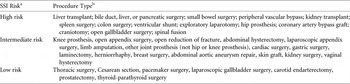
We defined patient age as a continuous variable. The NHSN risk index variable was defined as an ordinal variable; scores from 0 to 3 represented increasing levels of SSI risk. We defined a procedure-associated risk variable with 3 categories based upon procedure-specific SSI prevalence rates in the DICON network. High-risk procedures were in the highest quartile of SSI; low-risk procedures were in the lowest quartile of SSI; and intermediate-risk procedures composed the middle 2 quartiles of SSI prevalence (Table 1). Surgeon experience was defined as a binary variable: procedures were deemed to have been performed by an “experienced” surgeon if the primary surgeon performed the particular NHSN procedure type >1 standard deviation more times per year than the average surgeon in the network who performed the procedure.
Surgical Procedures Stratified by Risk of Complex Surgical Site Infection (SSI) at Network of 29 Community Hospitals from 2008 through 2012

NOTE. Complex SSIs included deep-incisional and organ-space infections.
a High-risk procedures were in the highest quartile of SSI prevalence in the Duke Infection Control Outreach Network; low-risk procedures were in the lowest quartile of SSI prevalence; and intermediate-risk procedures composed the middle 2 quartiles of SSI prevalence.
b Procedure types in each risk category are listed in descending order of complex SSI prevalence rate.
We evaluated effect measure modification of the PRRs for each of the 4 covariates by comparing log-binomial regression models with interaction terms to the respective reduced models, using likelihood ratio tests to determine significance (P<.10). A directed acyclic graphReference Greenland, Pearl and Robins 30 based upon findings of prior studies indicated that all 4 covariates were potential confounders; therefore, all covariates were initially included in both multivariate models. Multivariate generalized estimating equation models were fit to estimate the association between calendar year and SSI, adjusted for clustering of SSI at individual hospitals. We used likelihood ratio tests (P<.05) to determine which covariates were independent predictors of SSI. A backwards elimination strategy established which covariates exhibited meaningful confounding, changing PRR estimates by ≥10%.Reference Weng, Hsueh, Messam and Hertz-Picciotto 31
Patient and surgeon data were de-identified prior to entry into the DICON Surgical Database. The Duke University and University of North Carolina at Chapel Hill Institutional Review Boards approved this research. We maintained the data in a Microsoft Access database (Microsoft Corporation, Redmond, WA) and analyzed all data using SAS, version 9.4 (SAS Institute, Cary, NC).
RESULTS
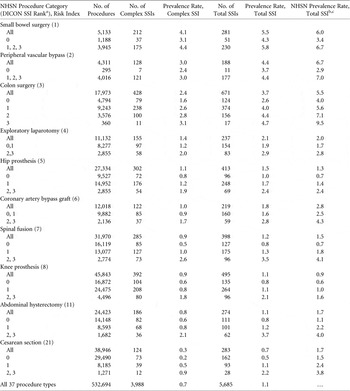
A total of 3,988 complex SSIs occurred following 532,694 consecutive procedures performed over the 5-year study period, giving an overall prevalence rate of 0.7 infections per 100 procedures (Table 2). Among the 26 procedures that were performed more than 4,000 times during the study period, small bowel surgery had the highest prevalence rate of SSI (4.1 infections per 100 procedures), followed by peripheral vascular bypass surgery (3.0 infections per 100 procedures), colon surgery (2.4 infections per 100 procedures), and exploratory laparotomy (1.4 infections per 100 procedures). In general, the prevalence rates of total (complex and superficial) SSI, stratified by risk index, were similar to prevalence rates reported by the National Healthcare Safety Network (NHSN).
Prevalence Rates of Surgical Site Infection (SSI) following Common Surgical Procedures at Network of 29 Community Hospitals from 2008 through 2012

NOTE. Rates were calculated per 100 procedures. Complex SSIs included deep-incisional and organ-space infections. Total SSIs also included superficial-incisional infections. NHSN, National Healthcare Safety Network; DICON, Duke Infection Control Outreach Network.
a The 26 procedure types performed at least 4,000 times over the study period were ranked in descending order of complex SSI prevalence rate.
b The 2009 NHSN reportReference Edwards, Peterson and Mu 27 summarized data from participating hospitals from 2006 through 2008 and did not distinguish complex from superficial SSIs.
c NHSN prevalence rates for risk index category “all” were standardized to the DICON distribution of NHSN risk index scores for each procedure.
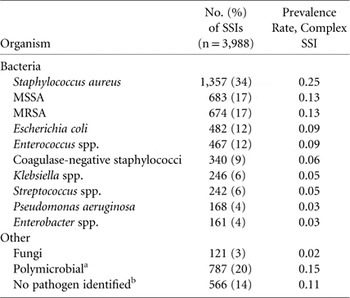
S. aureus was the most common organism causing SSI (0.25 infections per 100 procedures) and was responsible for 1,357 (34%) SSIs (Table 3). MRSA and methicillin-susceptible S. aureus (MSSA) SSIs occurred with equal frequency: each was responsible for 17% of the SSIs. Escherichia coli (12%) was the most common cause of Gram-negative SSI. Overall, 20% of SSIs were polymicrobial, and cultures were either negative or not obtained for 14% of SSIs.
Most Common Organisms Causing Complex Surgical Site Infections (SSI) at Network of 29 Community Hospitals from 2008 through 2012

NOTE. Rates were calculated per 100 procedures. Complex SSIs included deep-incisional and organ-space infections. MSSA, methicillin-susceptible Staphylococcus aureus; MRSA, methicillin-resistant Staphylococcus aureus; spp, species.
a Polymicrobial infections were also included in individual SSI counts for each organism isolated.
b Negative cultures or no cultures taken.
The unadjusted prevalence rate of SSI decreased from 0.76 infections per 100 procedures in 2008 to 0.69 infections per 100 procedures in 2012 (prevalence rate ratio [PRR], 0.90; 95% confidence interval [CI], 0.82–1.00) (Table 4). A decline in S. aureus SSI prevalence was largely responsible for the overall decrease in SSIs, and this decline in S. aureus SSI occurred because the rate of MRSA SSI decreased from 0.14 infections per 100 procedures in 2008 to 0.10 infections per 100 procedures in 2012 (PRR, 0.69; 95% CI, 0.54–0.89). In comparison, the prevalence rates of SSI from other pathogens remained relatively constant over this 5-year period (Figure 1).
Prevalence rates of complex surgical site infection (SSI), by causative pathogen, at our network of 29 community hospitals from 2008 through 2012. Rates were calculated per 100 procedures. Complex SSIs included deep-incisional and organ-space infections. S. aureus, Staphylococcus aureus; spp, species.

Prevalence Rates of Complex Surgical Site Infection (SSI) at Network of 29 Community Hospitals from 2008 through 2012

NOTE. Rates were calculated per 100 procedures. Prevalence rates (PRs), prevalence rate ratios (PRRs), and confidence intervals (CIs) were calculated with log-binomial regression models. Complex SSIs included deep-incisional and organ-space infections. MRSA, methicillin-resistant Staphylococcus aureus.
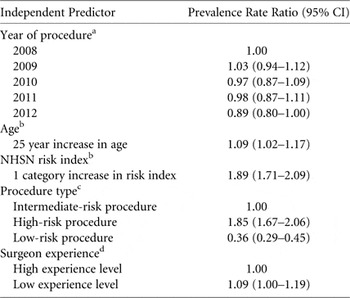
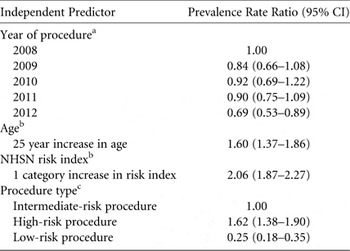
Patient age, NHSN risk index, procedure type, and surgeon experience did not exhibit meaningful effect measure modification of the relationship between year of surgery and SSI prevalence in the regression model analyzing all SSI or in the model analyzing MRSA SSI. All 4 covariates were independent predictors of SSI from all pathogens combined (Table 5). All covariates except surgeon experience were also independent predictors of MRSA SSI (Table 6). The adjusted PRRs of SSI for each calendar year for both models were nearly identical to the crude PRRs of the unadjusted models. In fact, backward elimination demonstrated that none of the potential confounders changed any of the point estimates in either model by more than 10%, and adjusting for potential clustering of SSI at particular hospitals had minimal effect on the estimates. The precision of the estimates from the crude and adjusted models were also comparable.
Results of Multivariate Analyses Determining Independent Predictors of Complex Surgical Site Infection (SSI) (All Pathogens) at Network of 29 Community Hospitals from 2008 through 2012

NOTE. Complex SSIs included deep-incisional and organ-space infections. Generalized estimating equation models were fit to adjust for clustering of SSI at individual hospitals. Prevalence rate ratios were individually adjusted for potential confounders based upon directed acyclic graphs.Reference Greenland, Pearl and Robins 30 CI, confidence interval; NHSN, National Healthcare Safety Network.
a Adjusted for age, NHSN risk index, procedure type, and surgeon experience.
b Adjusted for calendar year, procedure type, and surgeon experience.
c Adjusted for age, calendar year, NHSN risk index, and surgeon experience. High-risk procedures were in the highest quartile of SSI prevalence in the Duke Infection Control Outreach Network; low-risk procedures were in the lowest quartile of SSI prevalence; and intermediate-risk procedures composed the middle 2 quartiles of SSI prevalence.
d Adjusted for age, calendar year, NHSN risk index, and procedure type. A procedure performed by a surgeon with a high level of experience was performed by a surgeon who performed the particular NHSN procedure >1 SD more times than the average surgeon in the network who performed the procedure. Otherwise, the procedure was considered to have been performed by a surgeon with a low level of experience.
Results of Multivariate Analyses Determining Independent Predictors of Complex MRSA Surgical Site Infection (SSI) at Network of 29 Community Hospitals from 2008 through 2012

NOTE. Complex SSIs included deep-incisional and organ-space infections. Generalized estimating equation models were fit to adjust for clustering of SSI at individual hospitals. Prevalence rate ratios were individually adjusted for potential confounders based upon directed acyclic graphs.Reference Greenland, Pearl and Robins 30
CI, confidence interval; NHSN, National Healthcare Safety Network.
a Adjusted for age, NHSN risk index, and procedure type.
b Adjusted for calendar year and procedure type.
c Adjusted for age, calendar year, and NHSN risk index. High-risk procedures were in the highest quartile of SSI prevalence in the Duke Infection Control Outreach Network; low-risk procedures were in the lowest quartile of SSI prevalence; and intermediate-risk procedures comprised the middle 2 quartiles of SSI prevalence.
DISCUSSION
Our study describes a large series of consecutive surgical procedures performed over a 5-year period at 29 community hospitals. The analysis revealed a statistically significant but modest decrease in the prevalence rate of SSI from all pathogens during the 5-year study period. This decline in rates was primarily due to a more impressive decline in the prevalence rate of SSI due to MRSA. Our regression analyses confirmed that neither influential clusters of SSI at certain hospitals nor confounding by changes in characteristics of surgical patients over time were responsible for the reduced rates of SSI.
Prevalence rates of SSI in our network were similar to rates of SSI previously reported by the NHSN for most procedures, but rates for certain common procedures and risk indices differed notably from NHSN benchmarks. For example, prevalence rates of SSI following colon surgery in our network were at least 35% lower than respective NHSN rates for each category of risk index.
Several factors may explain differences between SSI rates reported by our network and the NHSN. First, nearly 40% of hospitals in the NHSN are academic hospitals.Reference Edwards, Peterson and Mu 27 As a result, the benchmark SSI rates reported by NHSN may not be applicable to smaller community hospitals.Reference Anderson, Hartwig and Pappas 32 Also, the NHSN’s most recent comprehensive procedure-associated module utilized SSI data collected from 2006 through 2008; thus, rates derived from these data may not be consistent with current SSI rates. Our data showed recent significant declines in the rates of SSI due to MRSA. These findings illustrate that rates of SSI currently utilized by the NHSN, based on data collected 8–10 years ago, are not appropriate benchmarks for hospitals in 2016. Finally, NHSN surveillance reports combine data from complex and superficial SSIs. We think that rates of complex SSI are much more meaningful than aggregate rates of SSI due to complex and superficial SSI because complex SSIs are of greater clinical significance and are easier to consistently detect and measure.Reference Ming, Chen, Miller and Anderson 26
Hospitals in our network experienced larger reductions in prevalence rate of SSI from all organisms combined and specifically from MRSA when we included superficial SSI in our analysis (data not shown), but the validity and implications of surveillance data including superficial SSIs are not clear. Thus, we believe that it is more reliable and more clinically relevant to evaluate and time-trend data on rates of complex SSI than to evaluate data that do not distinguish complex from superficial SSIs.
Our findings are consistent with the reported results in several other recently published national studies. These studies also reported that the prevalence of invasive MRSA infections has recently declined, especially among healthcare-associated infections.Reference Dantes, Mu and Belflower 13 – Reference Landrum, Neumann and Cook 15 However, the downward trend of the rate of SSI due to MRSA in our community hospital network was opposite to the trend noted in our prior study, which showed an increase in rates of MRSA SSI from 2000 to 2005.
Data from our study do not explain why rates of SSI caused by MRSA decreased in our network. We hypothesize that improved infection control practices, including specific interventions designed to reduce invasive MRSA infections, and national shifts in the genetics of S. aureus are 2 of several factors that contributed to the decreased prevalence of MRSA SSI.
DICON recommended 3 primary infection control practices to our member hospitals that may have contributed in particular to the reduction in prevalence of MRSA SSI over the study period. First, we recommended chlorhexidine-alcohol solutions for preoperative skin preparation.Reference Darouiche, Wall and Itani 33 – Reference Noorani, Rabey, Walsh and Davies 35 Second, we recommended that surgeons include intravenous vancomycin in the perioperative antibiotic prophylaxis regimen for selected high-risk patients, such as those with history of MRSA infection or colonization, recent healthcare-facility exposure, or planned high-risk cardiac, vascular, or implant-associated surgeries.Reference Bratzler, Dellinger and Olsen 36 Third, we recommended daily chlorhexidine bathing for all ICU patients.Reference Huang, Septimus and Kleinman 37 , Reference Viray, Morley, Coopersmith, Kollef, Fraser and Warren 38 DICON did not recommend the routine use of MRSA preoperative screening protocols or the use of decolonization strategies prior to surgery. We cannot quantify the impact that these infection control measures had upon SSI prevalence because DICON hospitals and surgeons did not uniformly adopt each of our infection control recommendations. Even hospitals that made similar changes in infection control practices during the study period may have changed protocols at different times or used different methods to implement new practices.
Clonal shifts in MRSA strain types may also have contributed to the decrease in MRSA SSI prevalence that we observed in our network. For example, USA300 MRSA strains have become important causes of healthcare-associated invasive MRSA infections.Reference David, Daum and Bayer 14 , Reference Moore, Hingwe and Donabedian 39 , Reference Jenkins, McCollister and Sharma 40 A recent large study showed a significant overall decrease in hospital-onset MRSA bloodstream infections at US hospitals over the same time period as our study;Reference David, Daum and Bayer 14 however, rates of MRSA infection and prevalence of USA300 strains showed substantial variation across different geographical areas. Thus, genetic shifts associated with decreased prevalence of USA300 or other MRSA strain types in our region may at least partially explain why rates of MRSA SSI decreased in our network.
Our study has several limitations. SSIs that occur in the outpatient setting are difficult to detect, and our surveillance may not capture all of these infections. However, our methods are highly sensitive in detecting postoperative infections that require repeat surgery or readmission to the hospital, and inpatient management is usually required for complex SSIs. Also, 14% of SSIs in our study that met NHSN SSI definitions had negative cultures or cultures were not performed. Complex SSIs from MRSA are typically severe infections, and we doubt many MRSA infections were culture-negative or not cultured; however, more complete data on causative pathogen might change the microbiologic epidemiology of SSI from less virulent or fastidious organisms described in this study. Finally, the generalizability of our findings to community hospitals outside of the southeastern United States is uncertain. Our data for MRSA SSIs correlate well with national data for invasive MRSA infections; however, it is possible that other trends of SSI prevalence found in our network were not consistent with trends experienced at hospitals in other regions.
Our data, collected from a large cohort of community hospitals, demonstrated a decrease in SSI prevalence, particularly in SSI due to MRSA, from 2008 to 2012. The results are concordant with other recent studies performed in tertiary care hospitals that have reported declines in invasive infections caused by MRSA. Reasons for declines in SSI prevalence are likely multifactorial but are still largely unknown or unproven. Further time-trended studies are needed to determine whether these declines will continue or reverse. Such trends are important because they inform perioperative prevention measures, such as screening protocols, antibiotic prophylaxis, and skin antisepsis practices. In the meantime, our data are useful benchmarks that can be used for inter-hospital comparison and to monitor trends of SSI prevalence at community hospitals over time.
ACKNOWLEDGMENTS
Financial support: A.W.B. is supported by a training grant from National Institutes of Health (grant no. 5T32AI100851-02). D.J.A. is supported by a career development grant from National Institutes of Health (grant no. K23AI095357).
Potential conflicts of interest: All authors report no conflicts of interest relevant to this article.