

Fossil plants from the late Eocene–early Oligocene of southern England provide important evidence for understanding changes in vegetation and climate during this period of differentiation of the British flora and global cooling. This study focuses on the fossil flora of the latest Eocene Insect Limestone exposed on the Isle of Wight. The Insect Limestone is famous for the insect fauna (see papers in both Insect Limestone volumes) but the diverse flora, with many species unique to this bed, is also of great significance. In addition, insects and plants are preserved in association, allowing the consideration of plant–insect interaction and the use of both sources of information in palaeoenvironmental reconstruction.
The Insect Limestone flora is one of a series of Paleogene floras in the southeastern UK which form a global benchmark for studies of Paleogene vegetation (Mai Reference Mai1995; Collinson & Hooker Reference Collinson and Hooker2003) and it is a European benchmark for the Bembridge–Spechbach floral assemblage (Kvaček Reference Kvaček2010). The UK floras were reviewed and summarised by Collinson & Cleal (Reference Collinson, Cleal, Cleal, Thomas, Batten and Collinson2001a, Reference Collinson, Cleal, Cleal, Thomas, Batten and Collinsonb, Reference Collinson, Cleal, Cleal, Thomas, Batten and Collinsonc). A detailed comparison of the Bembridge Marls and underlying Bembridge Limestone floras was presented in Collinson et al. (Reference Collinson, Singer, Hooker, Planderová, Konzálová, Kvaček, Sitár, Snopková and Suballyová1993). Apart from making a significant contribution to this floristic series, the Insect Limestone flora is important because it lies close to the Eocene–Oligocene transition, a time of major global change associated with the build up of the first major ice sheet on Antarctica (Hooker et al. Reference Hooker, Collinson and Sille2004, Reference Hooker, Collinson, Grimes, Sille and Mattey2007, Reference Hooker, Grimes, Mattey, Collinson and Sheldon2009; Grimes et al. Reference Grimes, Hooker, Collinson and Mattey2005; Sheldon et al. Reference Sheldon, Mitchell, Collinson and Hooker2009). In addition, the Insect Limestone flora contains wetland elements typical of the Solent Group floras; along with fruits, seeds and leaves representing non-wetland elements including trees, shrubs, one climber and putative herbs (Collinson & Cleal Reference Collinson, Cleal, Cleal, Thomas, Batten and Collinson2001b). In combination, these provide a unique window on vegetation of this time interval. Exceptional preservational conditions have also led to the survival of delicate structures such as wings and plumes on fruits and seeds.
The aim of this paper is to provide a revised list of the Insect Limestone flora which can be used to interpret the vegetational context of the insects. Within this remit, we have paid special attention to taxa of significance for understanding plant–insect interactions.
1. Geological context
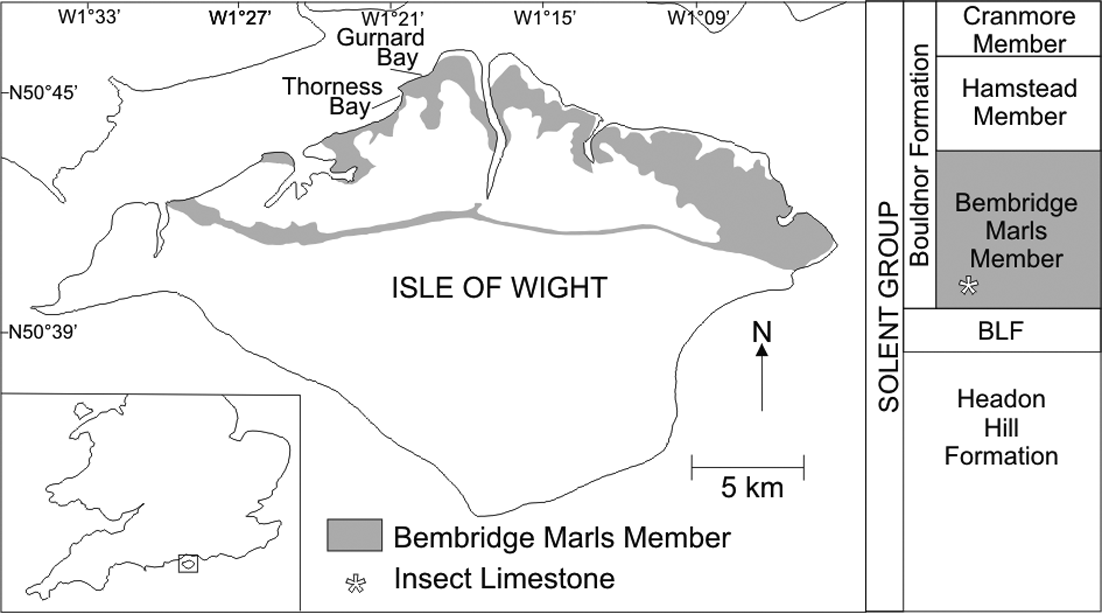
The plants are preserved in tabular to lenticular bands of very fine-grained micrite known as Insect Limestone. This unit lies close to the base of the Bembridge Marls Member (e.g., within the basal 1.5 m at Gurnard) of the Bouldnor Formation in the Solent Group (Fig. 1). On the basis of labels in the collections of the Natural History Museum, London, the Dinosaur Isle Museum, Isle of Wight, and published information in Reid and Chandler (Reference Reid and Chandler1926) most, if not all, of the plant specimens come from exposures in Gurnard and Thorness Bays (Fig. 1).
Extent of the outcrop of the Bembridge Marls Member which contains the Insect Limestone at the stratigraphic position shown by the asterisk. BLF=Bembridge Limestone Formation.

Hooker et al. (Reference Hooker, Collinson, Grimes, Sille and Mattey2007) re-identify the Eocene–Oligocene transitional interval magnetochrons in Gale et al. (Reference Gale, Huggett, Pälike, Laurie, Hailwood and Hardenbol2006) such that at least the lowest 4.5 m of the Bembridge Marls Member are latest Eocene in age, belonging in subchron 1 of Chron C13r and not in Chron C13n. The biostratigraphy indicates that the position of Chron C13n should lie higher in the sequence in the hiatus below the Nematura bed of the overlying Hamstead Member (Hooker et al. Reference Hooker, Collinson and Sille2004, Reference Hooker, Collinson, Grimes, Sille and Mattey2007). Further refined correlation of the UK succession to the global timescale was presented in Hooker et al. (Reference Hooker, Grimes, Mattey, Collinson and Sheldon2009). The Insect Limestone is therefore latest Eocene in age.
2. Previous work on the flora
Much of our knowledge of this flora is based on the collections of Joseph Edwin Ely A'Court Smith (1813–1900), a retired chief officer with the Merchant Service and a keen amateur geologist. Early reports on the plant fossils were made by Gardner in the 1880s (Gardner Reference Gardner1883, Reference Gardner1884, Reference Gardner1885, Reference Gardner1886, Reference Gardner1888). Most of A'Court Smith's collection was eventually deposited in the Natural History Museum, London. This collection was the focus of the first comprehensive publication on the Insect Limestone flora, comprising over 100 taxa, by Reid & Chandler (Reference Reid and Chandler1926). Collinson & Cleal (Reference Collinson, Cleal, Cleal, Thomas, Batten and Collinson2001b) reviewed and summarised the flora, but their work did not involve any new collecting and did not attempt to apply new techniques to gain additional information from the existing fossils.
3. Revision of the floral list
3.1. Identifying specimens from the Insect Limestone lithology
The Insect Limestone is a micrite which is light olive grey/light greenish grey/light bluish grey in colour when fresh and weathers at extremes to a very pale orange/greyish orange (according to the Geological Society of America (1984) Rock-Color Chart). It fractures conchoidally and is well-cemented.
The collections in the Natural History Museum, London, were found to contain specimens preserved in light-dark moderate brown (5 YR 4/4 to 5 YR 3/4) to dark reddish brown ironstone concretions quite distinct from the Insect Limestone lithology (although they were labelled as Insect Limestone). Ironstone concretions and bands do occur within the Bembridge Marls Member, including one in the cliffs in Gurnard Bay at a slightly higher level than the Insect Limestone. All plant fossils preserved only in the ironstone lithology have here been excluded from the Insect Limestone floral list. Where this has resulted in removal of a taxon from the floral list, the specific examples are stated in the text. This has resulted in the exclusion of all Charophyta, all Arecaceae (palms), the genus Aldrovanda (Droseraceae) and the fern genus Anemia. For further details see later sections of text.
3.2. Field collecting
During the course of this project, three week-long collecting trips were undertaken by one of us (Hayes). Insect Limestone was examined at sites ranging from Gurnard Point to Burnt Wood, including Sticelet Ledge, Saltmead Ledge and Gurnard Bay. Collinson has periodically studied Insect Limestone at Gurnard Point over many years of field excavations in the Solent Group. In addition, we have had access to material collected by Dr E.A. Jarzembowski on Geologists' Association field trips. Some of the most important specimens have been found by dedicated enthusiastic amateur collectors, especially Andy Yule. Information from all of these collections is incorporated into our understanding of the relative frequency of different elements in the Insect Limestone flora.
3.3. Taxonomic revision and new techniques
The descriptions provided by Reid & Chandler (Reference Reid and Chandler1926) have proven to be comprehensive and accurate. Some taxonomic revisions have already been undertaken by other authors (reviewed in Collinson & Cleal Reference Collinson, Cleal, Cleal, Thomas, Batten and Collinson2001b), and these are incorporated in the revised floral list. Our aim has been to apply new non-destructive techniques involving minimal risk, to try to gain additional information that might help to confirm or refute taxonomic assignments.
Many of the specimens have deteriorated since originally described. A number of important taxa, including fruits, seeds and leaves, are represented by single specimens. For fruits and seeds, many of the key specimens now consist of fragmentary organic material more or less loose within a limestone external mould. We have attempted to produce improved images of selected specimens using the Alicona infinite focusing microscope and low-vacuum scanning electron microscopy (VP SEM) (Leo 1455VP SEM with Oxford Instruments INCA analysis system, 19Pa, 15–20 kV). The former has proved unsuccessful so far, due to lack of experience with this new technology, but does have potential for application to this material. The VP SEM has proven useful in some cases (see plumed seeds).
Most of the leaf specimens have been covered in varnish at some point in the past. Cross-polarised light has been used to reduce glare and increase contrast to enable venation detail to be studied and illustrated. The use of this technique for plant fossils was developed by Cedric Shute (Crabb Reference Crabb2001).
4. Discussion of the revised floral list
4.1. Wetland floral elements
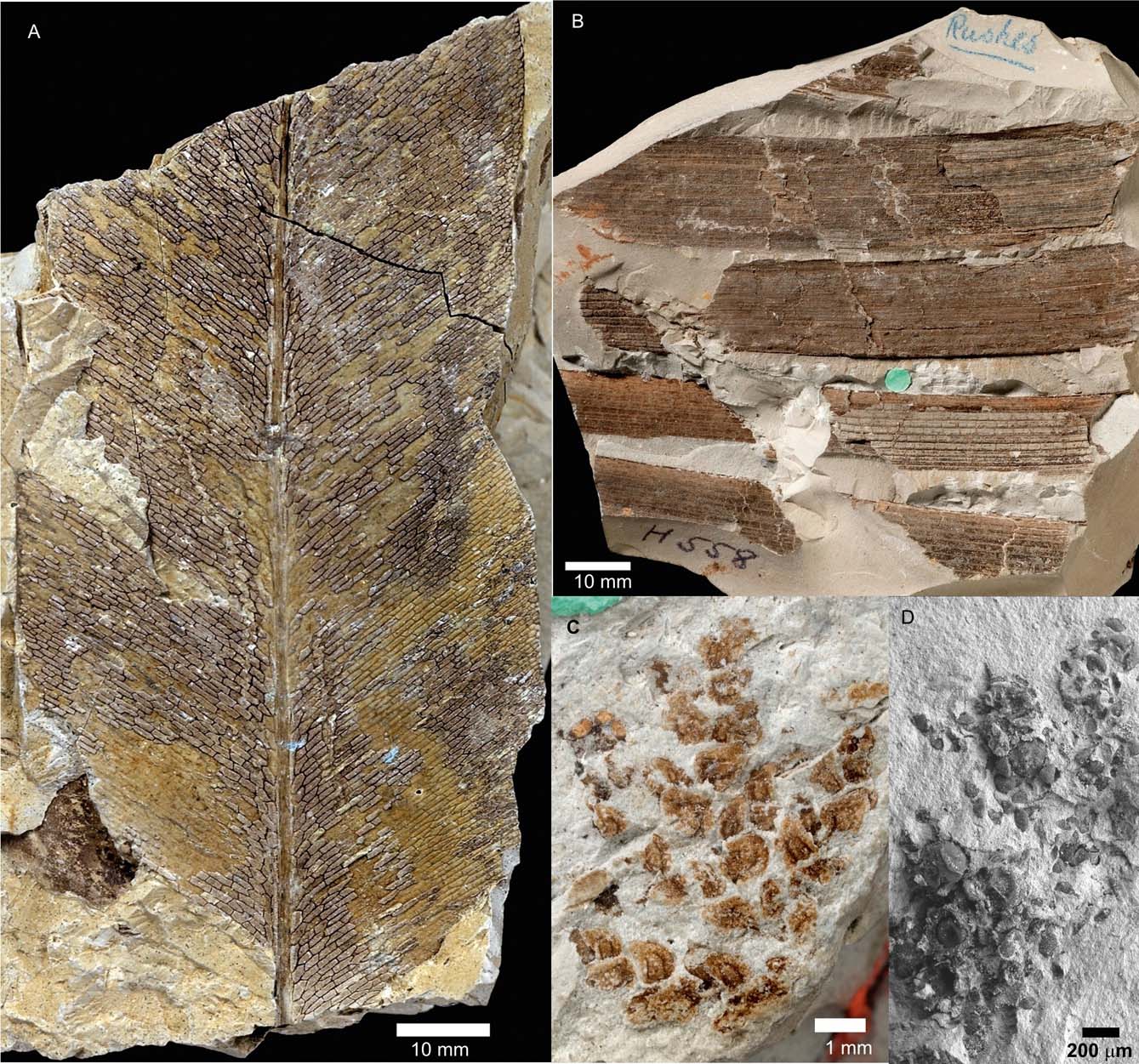
The nearest living relatives of many of the Insect Limestone plant fossils are wetland herbaceous plants (Fig. 2A–D). There are free-floating plants, such as Azolla (a small fern) and Stratiotes (a monocot) and one submerged plant, Ottelia (another monocot), which is a rare element in the middle and late Eocene of Europe (Mai & Walther Reference Mai and Walther1978). Rooted plants with floating leaves are represented by Potamogeton (monocot) and Sabrenia (dicot). The monocots Typha and Sparganium and the fern Acrostichum are marginal emergent plants, and the Cyperaceae may also have been marginal emergents. Modern leaves of Typha and Sparganium are similar. However, details of the leaf venation and the net-like diaphragms in the internal aerenchymatous chambers confirm that the Insect Limestone leaves are Typha (Smith et al. Reference Smith, Collinson, Rudall, Simpson, Seberg, Petersen, Barfod and Davis2010). Fossil Typha is represented not only by leaves but also by fruits and seeds in the Insect Limestone. Najas (known only from two specimens) may be a member of this community, but the identification has not been confirmed as the specimens have not been located. There are no charophytes in the Insect Limestone, although charophytes occur elsewhere in the Bembridge Marls Member (Collinson Reference Collinson1983) in association with the other wetland plants listed above. Aldrovanda intermedia Reid & Chandler is not preserved in Insect Limestone and has been removed from the floral list.
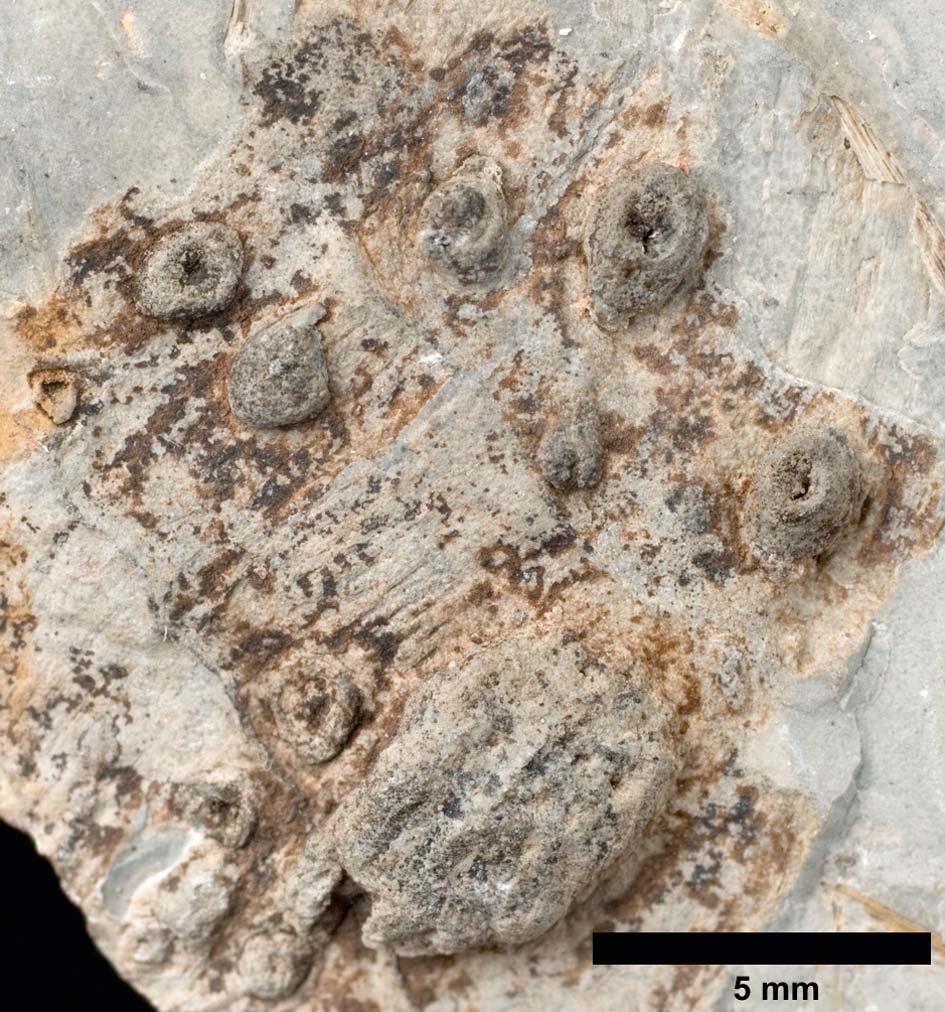
Typical wetland elements from the Insect Limestone: (A) Acrostichum, NHMUK V 68469; (B) Typha leaves, NHMUK V 17521; (C–D) Azolla: (C) a partial plant with megaspore apparatuses near top left, NHMUK V 17002, same specimen as line figure by Reid & Chandler (Reference Reid and Chandler1926, fig. 2); (D) a clump of dispersed megaspore apparatuses with entwined microspore massulae, VP SEM, Collinson, personal collection.

Acrostichum is one of few ferns able to tolerate mangrove habitats today. However, specimens from the Eocene and Oligocene of the USA, Germany, the Czech Republic and elsewhere in the UK are all preserved in freshwater deposits (Collinson Reference Collinson2002). Therefore, the presence of Acrostichum need not imply a brackish palaeoenvironment.
The presence of Limnocarpus as a fairly common element is similar to other occurrences in the lower part of the Bembridge Marls Member (Collinson Reference Collinson1983). There, this genus is associated with other freshwater wetland elements, but also with brackish elements such as organic walled linings of foraminiferans. The Insect Limestone wetland plant habitat may therefore range from fully freshwater to slightly brackish conditions at times (at maximum <3.5 ppt). Halite crystal cavities may suggest occasions of hypersalinity (A. Ross pers. comm., 2012), although these cavities have not been noted on the plant-bearing surfaces that we have studied.
The wetland elements are the most abundant plant fossils in the Insect Limestone. During recent collecting trips, specimens of Typha foliage were the most frequent plant fossil encountered. Typha seeds, Potamogeton and Sparganium fruits, Acrostichum foliage and clusters of Azolla megaspores and massulae have also been collected recently. In contrast, non-wetland elements are rarely encountered. Only two specimens of Juglandaceae fruit and a couple of fragmentary dicotyledonous leaves have been found on recent trips.
4.2. Non-wetland floral elements
4.2.1. Juglandaceae trees
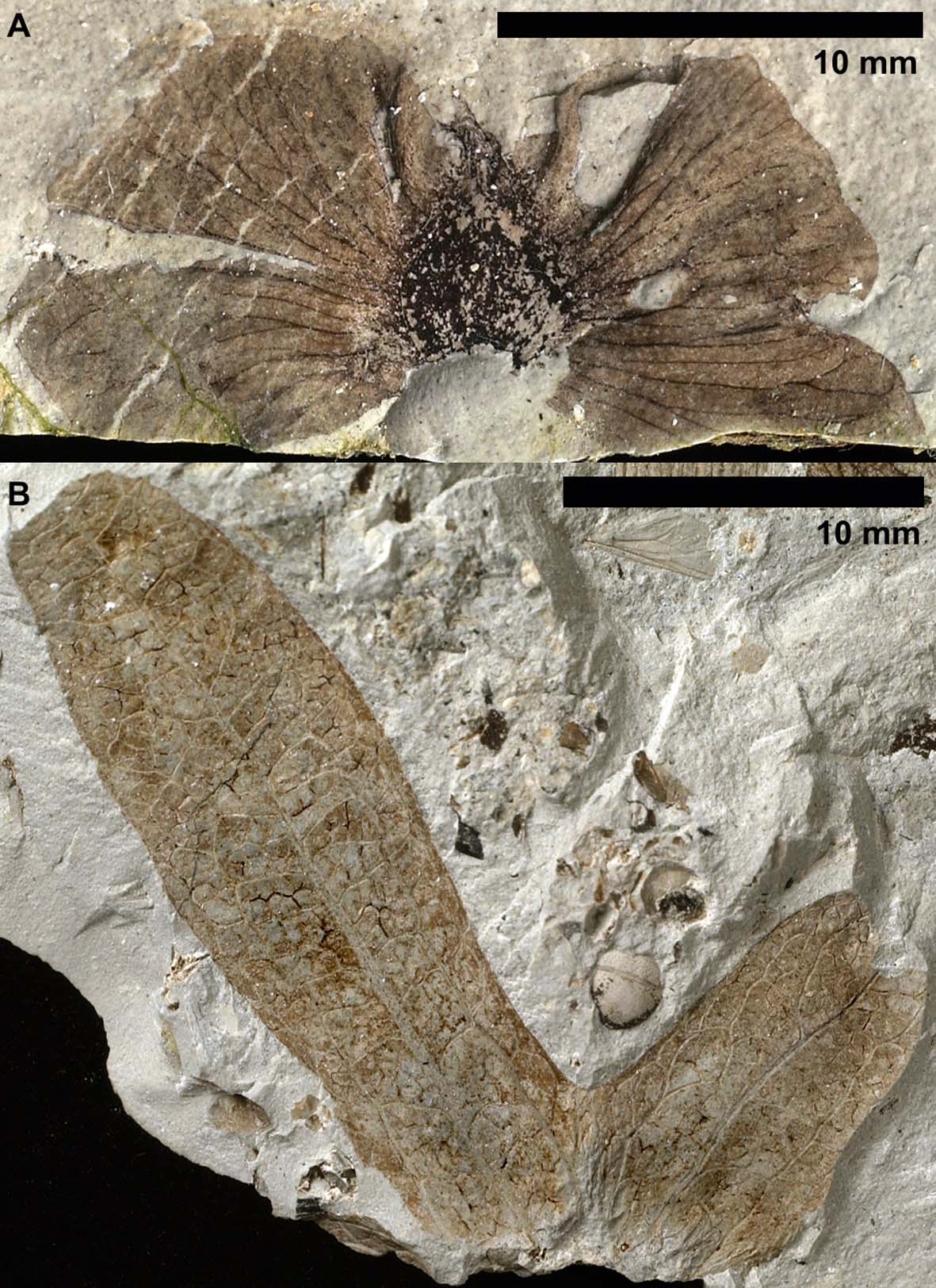
Juglandaceae (walnut, hickory and wingnut family) are represented in the Insect Limestone flora by two species, Palaeocarya macroptera (Brongniart) Jähnichen, Friedrich & Takáč (Reference Jähnichen, Friederick and Takáč1984) (Fig. 3B) and Hooleya hermis (Heer) Reid & Chandler (Reference Reid and Chandler1926) (Fig. 3A). Both of these are well understood fossil members of the family, the former being represented by co-occurring fruits and leaves at various sites (Manchester Reference Manchester1987). One new specimen of each of these species has been collected recently, indicating that they were regular components of the source vegetation of the Insect Limestone flora. Collinson and Cleal (Reference Collinson, Cleal, Cleal, Thomas, Batten and Collinson2001b) erroneously listed Engelhardtia sp., from the Insect Limestone but this specimen (E. sp. 2 in Reid & Chandler Reference Reid and Chandler1926) had been included in P. macroptera by Manchester (Reference Manchester1987).
Recently collected Juglandaceae winged fruits: (A) Hooleya, NHMUK V 68470; (B) Palaeocarya, NHMUK V 68471. Note in (B): insect wing top centre and other plant debris on same slab.

4.2.2. Putative Ficus leaf: rejected
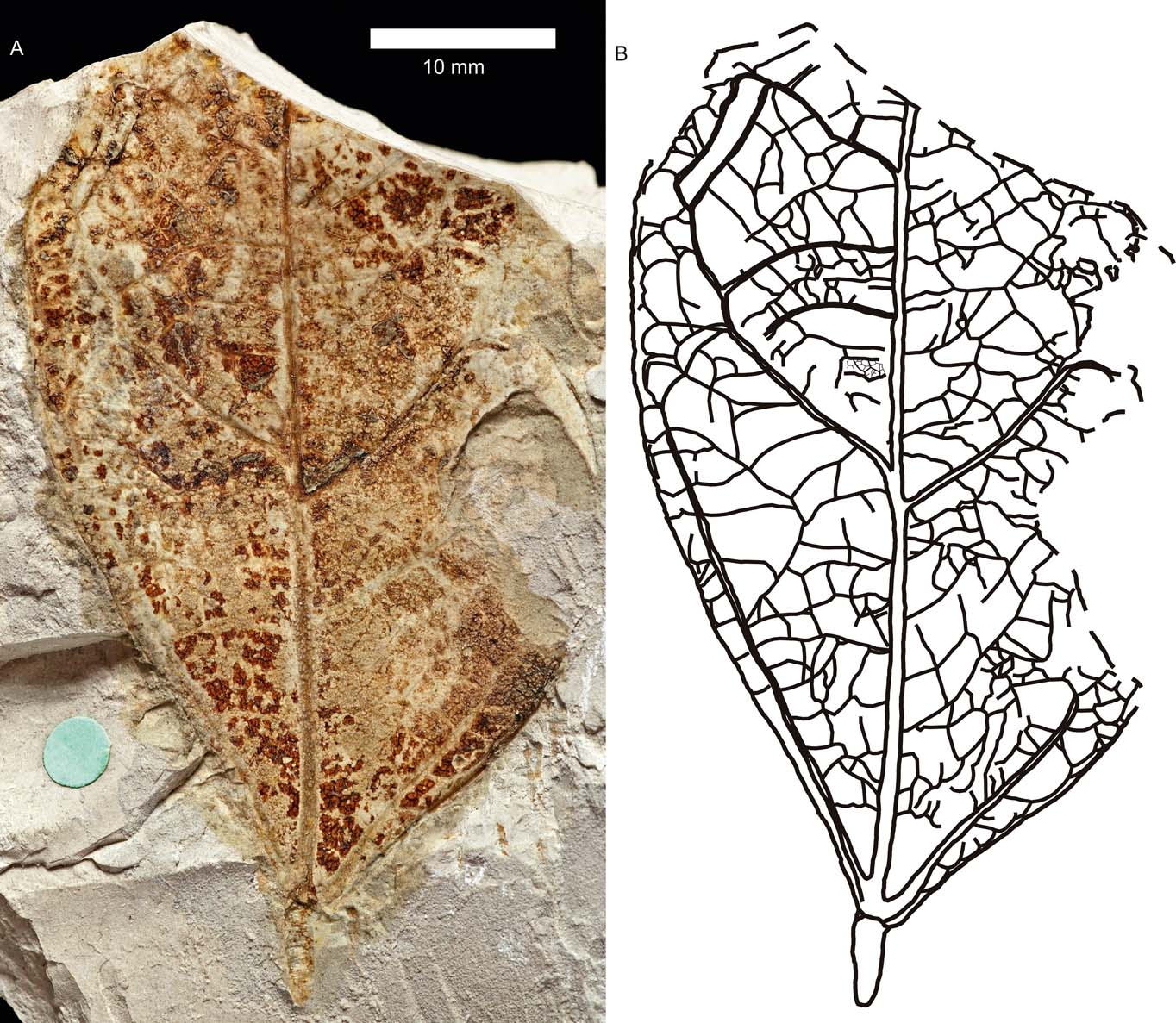
(Fig. 4A, B) There is a very specialised relationship between members of the genus Ficus (figs) and fig wasps. Fig wasp larvae can only develop within fig sarconia, unique enclosed inflorescences, and fig wasps are the only pollen vectors for figs. Rønsted et al. (Reference Rønsted, Weiblen, Cook, Salamin, Machado and Savolainen2005) have provided molecular phylogenies calibrated using fossil records, and suggest that there is evidence for long-term codivergence of this association going back 60 million years. Three fig wasp specimens have been found in the Insect Limestone and, in combination with their in situ pollen, these prove that the fig wasp–fig tree mutualism has existed for at least 34 million years (Compton et al. Reference Compton, Ball, Collinson, Hayes, Rasnitsyn and Ross2010).
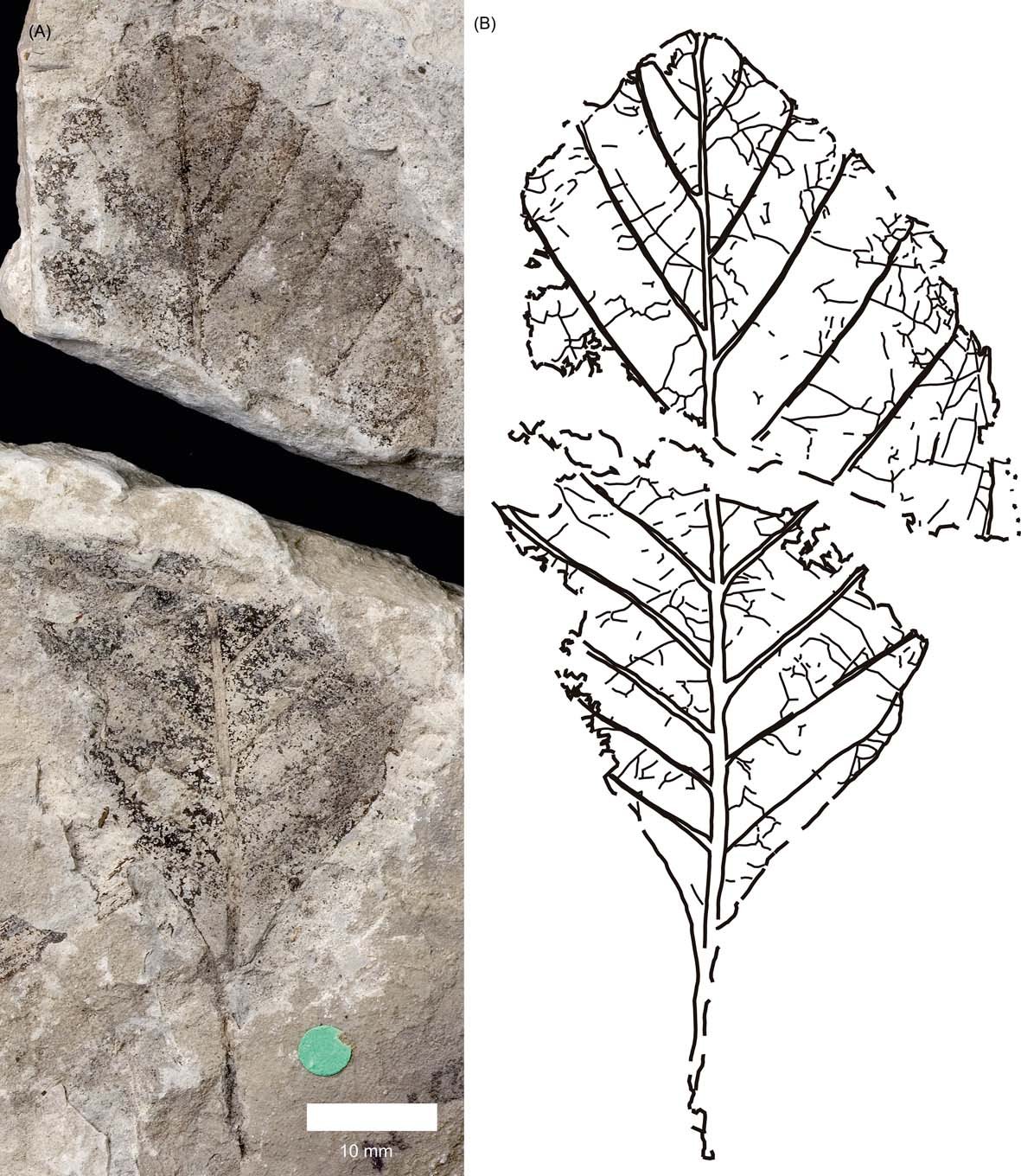
(A) Photograph of incertae sedis dicotyledonous leaf (formerly Ficus sp. sensu Reid & Chandler (Reference Reid and Chandler1926)), NHMUK V 17576. (B) Line interpretation of venation pattern which reveals more information than Reid & Chandler (Reference Reid and Chandler1926, fig. 6) through use of cross-polarised light, and demonstrates that the specimen cannot be included in the genus Ficus.

A single leaf specimen had been marked “Ficus” by Gardner in the late nineteenth century. Reid & Chandler (Reference Reid and Chandler1926) agreed that it showed the general characteristics of Ficus (fig) and drew comparisons with herbarium material at Kew. The identification of this leaf specimen is important because of the fig wasps newly discovered in the Insect Limestone (Compton et al. Reference Compton, Ball, Collinson, Hayes, Rasnitsyn and Ross2010). However, there is just one incomplete specimen, with detail obscured by a coating of varnish applied in the past. Using cross-polarised light to increase contrast and reduce glare, it has been possible to study, draw and describe the fine detail of the leaf architecture (Fig. 4B).
Many of the features are consistent with those seen in some fig species: asymmetrical lamina; obovate leaf form; acute cuneate base; entire margin; presence of a petiole; pinnate brochidodromous venation, with abruptly curved loop-forming branches enclosed by secondary, tertiary and quaternary arches; moderate acute angle of divergence of secondary veins from midvein, with lowest pair of secondary veins more acute than those above; reticulate pattern of tertiary veins; distinct higher order venation; and looped marginal ultimate venation.
However, further comparative study is required because there are some inconsistencies, particularly in the angle of divergence of the tertiary and higher order veins. It is, therefore, not possible to confirm the identification of this specimen as Ficus.
4.2.3. Other trees and shrubs
Reid & Chandler (Reference Reid and Chandler1926) assigned two specimens to the Fagaceae (the oak and beech family). Collinson & Cleal (Reference Collinson, Cleal, Cleal, Thomas, Batten and Collinson2001b) considered the nut tentatively assigned to Quercus sp.? as indeterminate. The leaf tentatively assigned to Fagus sp.? (Fig. 5A, B) is broken, abraded and poorly preserved. Attempts to study the detail of this leaf have not revealed diagnostic characters. Although much of the primary and secondary vein pattern can be illustrated (Fig. 5B), the higher order venation and the leaf margin are not clear. The pinnate simple craspedodromous venation and possibly toothed margin are typical of the Fagaceae, but these features are also characteristic of many other Fagalean forms and other groups, such as the Urticales and Betulales (Hamamelidae) and families within the Dilleniidae and Rosidae. It is therefore concluded that this specimen should not be assigned to Fagus.
(A) Photograph of incertae sedis dicotyledonous leaf (formerly Fagus sp. ? sensu Reid & Chandler (Reference Reid and Chandler1926)), NHMUK V 17574. (B) Line interpretation of venation pattern showing features of a variety of fagalean groups.

Reid & Chandler (Reference Reid and Chandler1926) assigned one specimen to Carpinus sp. in the Betulaceae (the birch family). Manchester & Donoghue (Reference Manchester and Donoghue1995, p.721) assigned this specimen and a single specimen of Abelia sp. 4 to the genus Asterocarpinus, an extinct genus of Betulaceae. The other species of “Abelia” described by Reid & Chandler (Reference Reid and Chandler1926) (see Appendix) were all regarded as incertae sedis by Manchester & Donoghue (Reference Manchester and Donoghue1995), though one was revised and placed in the genus Raskya (of unknown affinity) by Manchester & Hably (Reference Manchester and Hably1997). The remaining record of Caprifoliaceae, Dipelta, a deciduous tree, was critically reappraised and accepted by Manchester & Donoghue (Reference Manchester and Donoghue1995).
Three genera of Bignoniaceae (the trumpet creeper family), two of which could be trees, were described from the Insect Limestone by Reid & Chandler (Reference Reid and Chandler1926), each based on a single specimen. The winged seed attributed to Catalpa is similar to a fossil assigned to this genus from the Oligocene of Oregon (Meyer & Manchester Reference Meyer and Manchester1997). Reid & Chandler (Reference Reid and Chandler1926) had “no doubt” about the affinity of the winged seed of Radermachera. There seems to be no reason to doubt these taxonomic assignments. The Rutaceae are represented by Zanthoxylae, Zanthoxylum, a single specimen of a characteristic seed.
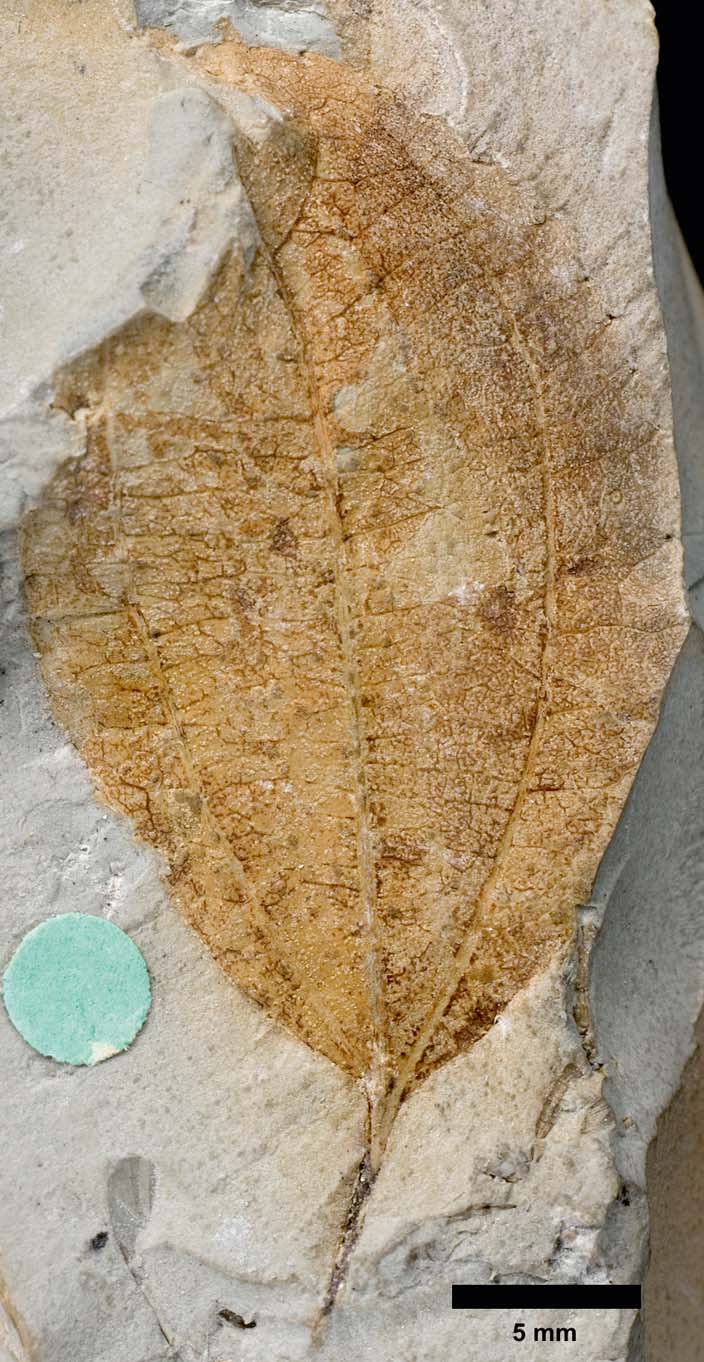
One single leaf specimen (Fig. 6) was assigned to Zizyphus (Rhamnaceae) by Reid & Chandler (Reference Reid and Chandler1926). Zizyphus, a genus of shrubs to small trees, has been recognised as a sclerophyllous element in European late Eocene and early Oligocene floras (see Collinson & Hooker Reference Collinson and Hooker2003 and references therein). The winged fruit of Raskya (affinity unknown, formerly Abelia) is an associated but rarer element. A few additional dicotyledon leaf morphotypes are not identifiable to family and some of these specimens are small, relatively coriaceous leaves which, like Zizyphus, may be considered to be sclerophyllous elements. Dicotylophyllum pinnatifidum Reid & Chandler (which is Palibinia-like, Collinson & Hooker Reference Collinson and Hooker2003) is another sclerophyllous element. Conifers are represented by several genera with scale-like or needle leaves, although only one (Araucarites gurnardi Florin leafy shoots) is represented by more than one or two specimens. These leafy shoots may have been produced by the same plant that produced the Doliostrobus Marion cone scales and may belong in the Taxodiaceae, Araucariaceae or the extinct family Doliostrobaceae (see discussion and references in Collinson Reference Collinson1996; Kunzmann Reference Kunzmann1999; Kvaček Reference Kvaček2002; Kvaček & Teodoridis Reference Kvaček and Teodoridis2011; Collinson et al. Reference Collinson, Manchester and Wilde2012a). Other conifers include rare Pinaceae (Pinus is represented by one seed and one group of needles and there is one seed assigned to Pityospermum) and Cupressaceae (Quasisequoia, one twig assigned to ?Libocedrus sp. and one cone to Cupressus sp.).
Zizyphus paradisiacus (Unger) Heer, NHMUK V 17018, representing the rare sclerophyllous elements.

Reid & Chandler (Reference Reid and Chandler1926) identified three palm taxa: the fan-palm Sabal major (Unger) Heer; an unnamed species of Palmophyllum Conwentz; and Palaeothrinax mantelli Reid & Chandler, later reidentified as Palmacites Brongniart (Read & Hickey Reference Read and Hickey1972). None of these palms are preserved within the Insect Limestone and they have therefore been removed from the floral list.
The Lauraceae are represented by three species: Daphnogene lanceolatum Unger; Daphnogene cinnamomifolia (Brongniart) Unger; and an unnamed species of Neolitsea Bentham. Daphnogene lanceolatum is a widespread species in the European Paleogene (e.g. Mai & Walther Reference Mai and Walther1978, Reference Mai and Walther1985; Kvaček & Teodoridis Reference Kvaček and Teodoridis2011).
In summary, trees and shrubs are represented by members of the flowering plant families Juglandaceae (Palaeocarya and Hooleya); Betulacaeae (Asterocarpinus); Caprifoliaceae (Dipelta); Bignoniaceae (Catalpa, Radermachera); Rhamnaceae (Zizyphus); Rutaceae (Zanthoxylum); and Lauraceae (Daphnogene and Neolitsea); and by several conifers. This list includes both mesophytic and sclerophyllous elements and deciduous and evergreen taxa. With the exception of the Juglandaceae, all of these named taxa are represented by very few specimens (many by only a single specimen) and they have not been encountered in any recent collecting efforts. Therefore, they are unlikely to have been common elements in the local vegetation.
4.3. Habitats uncertain
4.3.1. Putative herbs
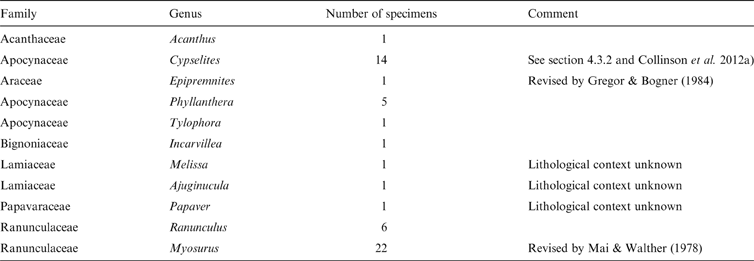
A number of flowering plant genera recognised in the Insect Limestone include herbaceous plants amongst their nearest living relatives (Table 1). The majority of these are represented by very few specimens, in several cases only a single specimen. Apart from their potential herbaceous affinity, these records are also important because they represent very early examples of the taxa in the fossil record. Unfortunately, no new specimens of any of these taxa have been discovered during recent collecting and the specimens in the collections are represented by fragmentary organic material within limestone moulds which have deteriorated since they were originally studied. Therefore, it has not been possible to confirm or refute these identifications; see Table 1. In addition there are six specimens of undeterminable sterile fern pinnules and one specimen of an Equisetum (horsetail) node with nodal plate.
Possible herbaceous (likely non-aquatic) flowering plants listed in the Insect Limestone flora. Those where the lithology is unknown may not be from the Insect Limestone. Generic and family affinities are not confirmed unless revisions are cited. Families are from APG (2003).

4.3.2. Taxa with plumed propagules
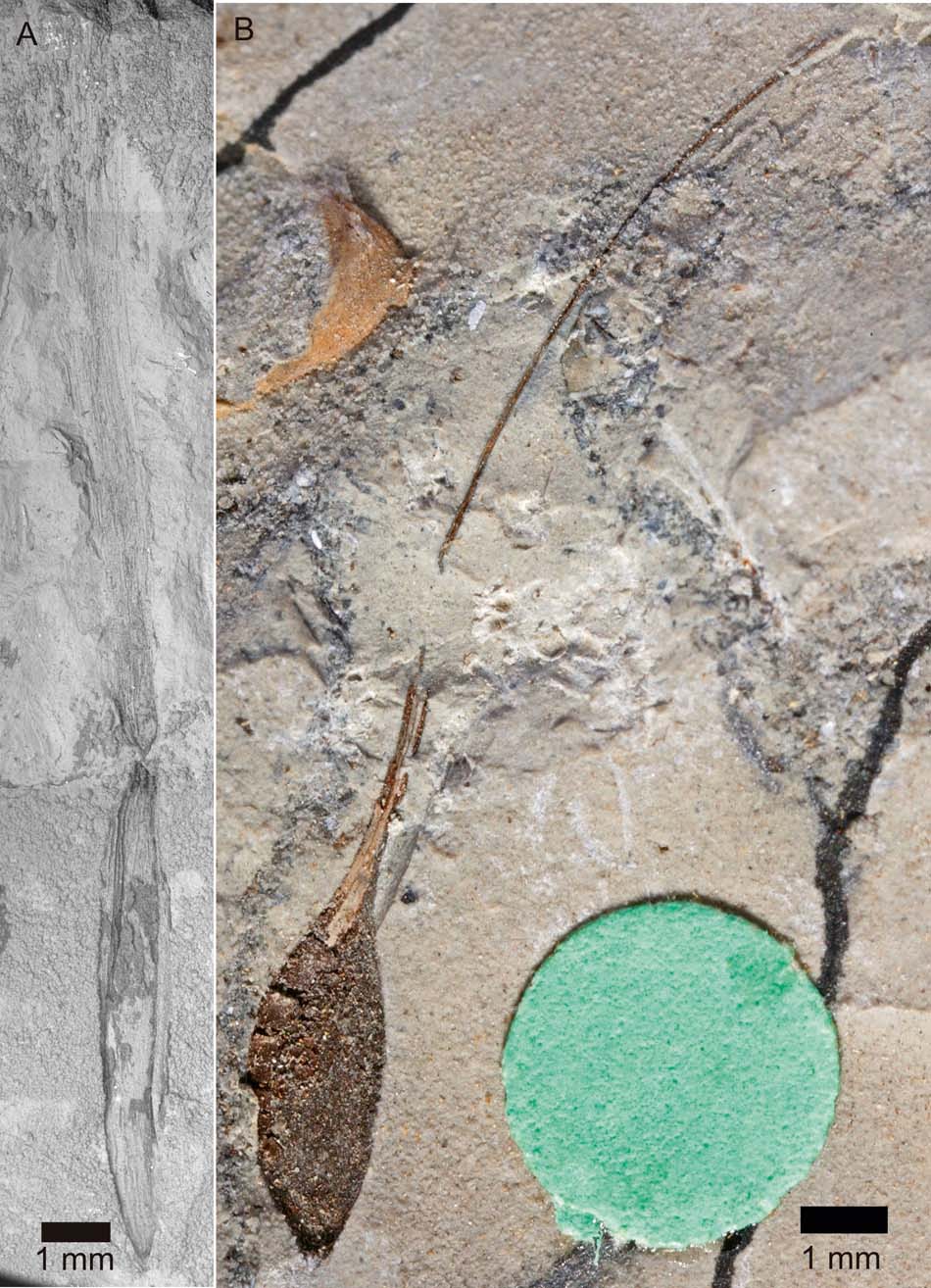
Plumed propagules are rare in the Paleogene fossil record, with the modern diversity being a relatively recent evolutionary innovation (Collinson & van Bergen Reference Collinson, van Bergen, Hemsley and Poole2004). The Insect Limestone contains two genera of plumed seed. Phyllanthera (Apocynaceae) is represented by six specimens, but it has not been possible to confirm the identification. The generic name Cypselites (Apocynaceae) has nomenclatural priority (Collinson et al. Reference Collinson, Manchester and Wilde2012a) over Apocynospermum (used by Reid & Chandler Reference Reid and Chandler1926). The genus is represented by four species (total 14 specimens) in the Insect Limestone (Fig. 7A) and is rare but widespread in the Eocene and Oligocene (Wilde & Frankenhäuser Reference Wilde and Frankenhäuser1998; Manchester Reference Manchester1999; Collinson et al. Reference Collinson, Manchester and Wilde2012a). The mode of attachment of the hair tuft, confirmed here by VP SEM, is consistent with some modern representatives of Apocynaceae, but consideration of generic affinity would require an extensive survey of all modern seeds in the family.
(A) Apocynospermum striatum Reid & Chandler (Reference Reid and Chandler1926), NHMUK V 17598 (generic name Cypselites has nomenclatural priority see text). (B) Clematis vectensis Reid & Chandler (Reference Reid and Chandler1926), NHMUK V 17584, plumed and awned propagules.

4.3.3. Possible climbers, including Clematis-like awned fruits
There are 34 specimens of awned fruit (Fig. 7B) assigned to the species Clematis vectensis Reid & Chandler (Reference Reid and Chandler1926) (Ranunculaceae). The modern genus Clematis includes both lianas and herbs. Re-examination of several of the Insect Limestone specimens by VP SEM has not yielded any new information, nor has SRXTM (synchrotron radiation x-ray tomographic microscopy) on very similar fruits (Carpolithus sp. 2) from the Eocene Messel oil shales (Collinson et al. Reference Collinson, Smith, Manchester, Wilde, Howard, Robson, Ford, Marone, Fife and Stampanoni2012b). Carpolithus sp. 2 from Messel (Collinson et al. Reference Collinson, Manchester and Wilde2012a) has a similar morphology to the Insect Limestone specimens attributed to Clematis; however, key features of the latter are not evident on the former. Fruits with a long persistent style (awn) are very rare in Paleogene floras and both these occurrences are linked to exceptional preservation conditions. The Insect Limestone and Messel oil shale specimens may be early records of the genus Clematis, but they both lack the long hairs which typically occur on the fruit body and style of modern members of the genus (Collinson et al. Reference Collinson, Manchester and Wilde2012a). Therefore, this generic determination remains unconfirmed. Becker (Reference Becker1969) included a leaflet identified as Clematis ellensburgensis as a component of the Beaverhead Basins fossil flora of SW Montana, USA, now considered early Oligocene (or less likely latest Eocene) (Leilke et al. Reference Leilke, Manchester and Meyer2012). However, Leilke et al. (Reference Leilke, Manchester and Meyer2012) also assert that the taxonomic assignments provided by Becker (Reference Becker1969) are in need of a thorough taxonomic revision. Recent molecular phylogeny suggests that Clematis was an ancient genus with an origin in the Oligocene (Xie et al. Reference Xie, Wen and Li2011), a result which would be consistent with presence of Clematis-like fossils in the middle and late Eocene. However, Xie et al. (Reference Xie, Wen and Li2011, p. 917) stated “the stem age is consistent with the earliest reliable fossilized fruits in western Europe” and they cited the Insect Limestone fossils as an example. We are not aware of any verified pre-Quaternary records of Clematis and this may call into question the divergence times estimated by Xie et al. (Reference Xie, Wen and Li2011).
Three seeds have been tentatively assigned to ?Actinidia sp. (Chandler Reference Chandler1963, p. 329), a genus which includes climbers such as the kiwi fruit today, but also includes shrubs and trees. As there is doubt about the generic determinations and a range of habits within the modern genera, neither of these taxa can be taken as evidence for climbers or lianas in the Insect Limestone flora.
4.4. Comparison with other mid-latitude northern hemisphere fossil floras
There are a number of fossil floras of late Eocene and early Oligocene age that can be compared with the flora from the Insect Limestone. These include North American floras (reviewed in Devore & Pigg Reference DeVore and Pigg2010), the late Eocene Zeitz floristic complex from the Weisselster Basin in Germany (Mai & Walther Reference Mai and Walther1985), the Haselbach flora (probably early Oligocene) from the same Basin in Germany (Mai and Walther Reference Mai and Walther1978; Kunzmann & Walther Reference Kunzmann and Walther2012) and other late Eocene to early Oligocene floras from far east Russia and central Europe discussed in Akhmetiev et al. (Reference Akhmetiev, Walther and Kvaček2009).
The only one of these floras showing a noteworthy similarity with the Insect Limestone flora is the Kučlín flora from North Bohemia, Czech Republic, (Akhmetiev et al. Reference Akhmetiev, Walther and Kvaček2009; Kvaček & Teodoridis Reference Kvaček and Teodoridis2011) that is probably slightly older than the Insect Limestone (Kvaček & Teodoridis Reference Kvaček and Teodoridis2011). In the Insect Limestone flora, the aquatic elements dominate and the surrounding vegetation is poorly represented, in terms of both specimen number and diversity. Nevertheless, elements in common between the two floras include Cypselites, Daphnogene, Doliostrobus, Hooleya, Palaeocarya, Quasisequoia, Raskya and Zizyphus. Taking account of the wider floristic diversity at Kučlín, Kvaček (Reference Kvaček2010) interpreted the zonal vegetation as mid-latitude notophyllous broad-leaved evergreen forest, whilst Kvaček & Teodoridis (Reference Kvaček and Teodoridis2011), after fully revising the Kučlín flora, recognised that notophyllous elements were not so significant and interpreted the vegetation as broad-leaved evergreen forest.
Despite the above similarities, the Kučlín flora differs from the Insect Limestone flora in having far greater diversity, including some thermophilic elements (e.g. Icacinaceae) that last appear in the UK sequence earlier in the late Eocene (Collinson & Cleal Reference Collinson, Cleal, Cleal, Thomas, Batten and Collinson2001b; Collinson & Hooker Reference Collinson and Hooker2003). The rare winged bignoniaceous seeds, the possible herbs of the Acanthaceae, Lamiaceae and Apocynaceae (except Cypselites) and the distinctive, abundant Clematis-like awned fruit from the Insect Limestone are all missing from the Kučlín flora. The small seeds of the possible herbs (Table 1) might not have been recognised in the leaf-dominated Kučlín fossil assemblage, but the winged seeds and awned fruit would most likely have been collected had they been present.
5. Insect–plant interactions
In spite of the highly diverse and abundant insect fauna, we have found very little evidence of insect–plant interaction. One indeterminable leaf fragment shows evidence of insect damage in the form of several small galls (Fig. 8). Gall wasps are recorded in the insect fauna (Antropov et al. Reference Antropov, Belokobylskij, Compton, Dlussky, Khalaim, Kolyada, Kozlov, Perfilieva and Rasnitsyn2014, this volume). Jarzembowski (Reference Jarzembowski1980) figured an insect larva in a plant stem. None of the seeds show any evidence of borings such as those made by weevils, but this is not unexpected in view of the relatively recent earliest occurrences and rarity of evidence of this interaction in the Paleogene record (Collinson & van Bergen Reference Collinson, van Bergen, Hemsley and Poole2004). Weevils are, however, a diverse and abundant group of beetles from the Insect Limestone. Although three fig wasps, with fig pollen, are recorded amongst the insects (Compton et al. Reference Compton, Ball, Collinson, Hayes, Rasnitsyn and Ross2010) the putative Ficus leaf must be considered as incertae sedis.
Galls on an indeterminable non-dicotyledonous leaf or stem fragment (Sedgwick Museum, CAMSMX.50195).

Adults and larvae of stratiomyid flies occur in the Insect Limestone. Two important specimens recently collected by Andy Yule show these larvae together with plant debris, including fragments of Typha leaves and with lymnaeid gastropods. Adults and larvae of some modern stratiomyid flies are commonly associated with plant debris and with vegetation, including Cyperaceae and Typha (James Reference James, McAlpine, Peterson, Shewell, Teskey, Vockeroth and Wood1981; Stubbs & Drake Reference Stubbs and Drake2001). Unfortunately, we cannot undertake a wider survey to test this association evidence, as the museum collections of stratiomyids are mostly on small pieces of Insect Limestone that have been trimmed after collection and do not show the original facies context of the specimens.
6. Taphonomy
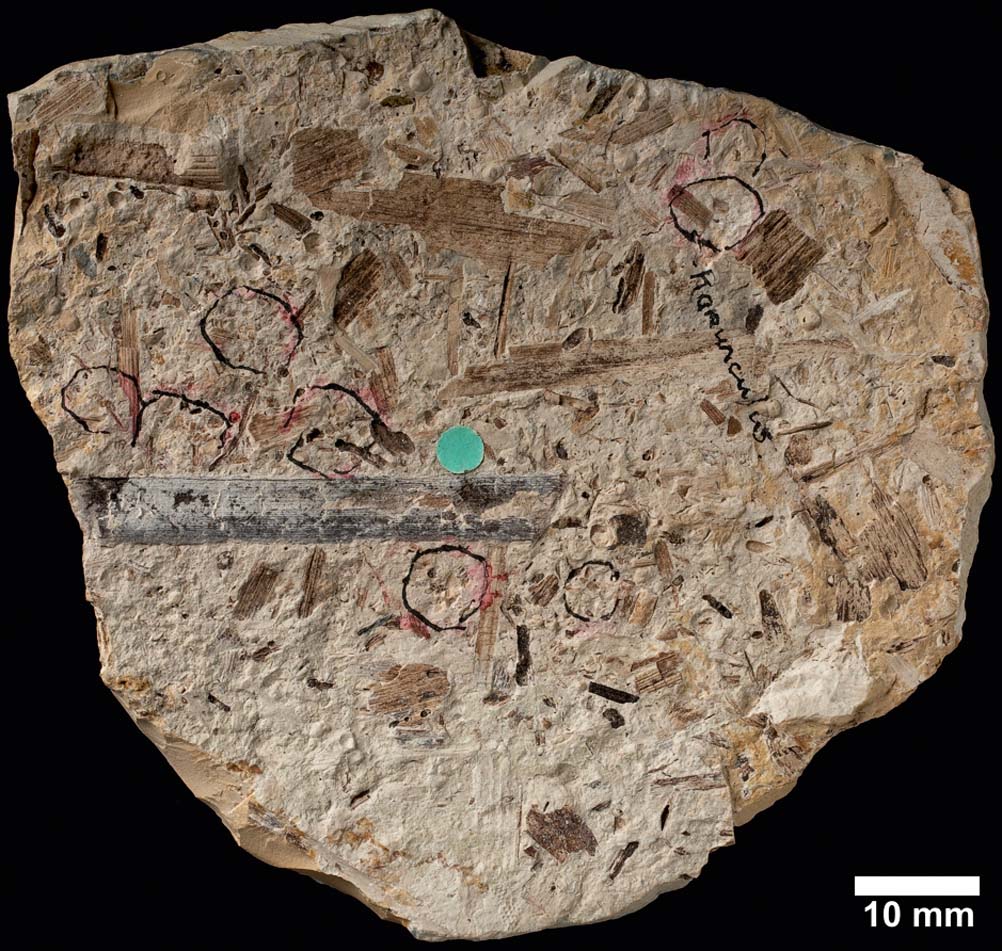
Large portions of the Insect Limestone are totally barren of any fossils. Plant fossils typically occur in concentrations of mixed plant debris along laminations (Fig. 9) and more rarely as larger separate fossils (Fig. 2A). The plant debris concentrates are poorly sorted. Elongate leaf fragments in random orientation co-occur with round seeds, whilst thin cuticular fossils (leaves, Typha seeds) co-occur with thick sclerotic seed coats. This suggests a lack of current winnowing or sorting, such as might occur during flow or in varying depositional energy regimes. The plant fossils often occur in concentrates and sometimes these also contain rare planorbid and lymnaeid freshwater gastropods, with rare thin and smooth ostracods and also insect wings. The plant debris sometimes includes fine rootlets and rooted rhizome fragments, but these are not common and are unlikely to indicate rip-up of living rooted vegetation.
A block of Insect Limestone, NHMUK V 17503, showing a typical plant debris accumulation which includes a Myosurus fruit, fragments of monocotyledonous leaves (Typha) and fragments of Azolla. In addition there are insect wings and wing-cases.

Elsewhere in the Bembridge Marls Member, laminated mudrocks contain similar plant debris with a wide variety of wetland floral elements in association with freshwater faunas, including ostracods and gastropods (Collinson Reference Collinson1983). However, the plant occurrences in these horizons are mostly laterally (100 m–several km) and vertically (up to 20 cm) extensive and continuous, not patchy (Collinson Reference Collinson1983), in strong contrast to the Insect Limestone occurrences. Some other mudrock horizons in the Bembridge Marls Member, and elsewhere in the Solent Group, contain large almost monotypic concentrates of one particular wetland fruit or seed type, such as Stratiotes or Sabrenia or Potamogeton or Limnocarpus, which may have resulted from current sorting or winnowing. These are absent in the Insect Limestone.
The most plausible scenario for the accumulation of the Insect Limestone plant fossils seems to be that they represent plant debris concentrated by minor wind movements and water turbulence at the surface or margins of a water body. Subsequent deposition could have resulted from waterlogging, or from short term stranding during minor water level fluctuations. We see no evidence that the plant remains dried out (such as might occur during a long interval of shoreline stranding) prior to deposition. The more common plant remains were probably derived from plants living in, or close to, the water body, whilst rarer elements were probably blown in from a greater distance, especially in the case of the winged and plumed seeds and also possibly most of the dicotyledonous leaves.
The association of a variety of freshwater wetland plants as the most frequent plant fossils occasionally associated with freshwater gastropods and ostracods suggests that freshwater conditions existed locally, at least in some places or at certain intervals, during deposition of the Insect Limestone. However, the laterally and vertically discontinuous occurrence of plant debris rules out the existence of an extensive, persistent freshwater marsh and wetland comparable to that which has been reconstructed for other parts of the Bembridge Marls Member (Collinson Reference Collinson1983), the lower Hamstead Member (Hooker et al. Reference Hooker, Collinson and Sille2004) and other parts of the Solent Group (Collinson Reference Collinson, Knobloch and Kvaček1990; Collinson et al. Reference Collinson, Singer, Hooker, Planderová, Konzálová, Kvaček, Sitár, Snopková and Suballyová1993). The presence of Limnocarpus probably indicates slight brackish water influence at times, as has been suggested elsewhere in the lower part of the Bembridge Marls Member (Collinson Reference Collinson1983).
7. Conclusions
This revision provides new information on the composition of the Insect Limestone flora. Study of the collections upon which previous work was based has shown that the three palm genera (Sabal, Palmophyllum, Palmacites), the one taxon representing the Droseraceae (Aldrovanda), two species of fern (Anemia sp. ?A. colwellensis Chandler and one indeterminable species), one species of conifer (indeterminable) and the charophytes are not preserved within the Insect Limestone and have been excluded from the floral list. Detailed analysis of the architecture of fragmentary dicotyledonous angiosperm leaf specimens under cross-polarised light has shown that there is insufficient evidence to include Ficus and Fagus within the macroflora. These results, along with the conclusion that the nut assigned to Quercus sp. ? is indeterminate (Collinson & Cleal Reference Collinson, Cleal, Cleal, Thomas, Batten and Collinson2001b), have removed the Moraceae and Fagaceae from the flora. The revised floral list is presented in Appendix 1. A small number of the taxa are represented by specimens with no surrounding matrix and therefore may not be from the Insect Limestone. In addition, many of the taxa are represented by only one or very few specimens, and some of this material is not well preserved, so it has not been possible to confirm or refute all of the existing identifications.
Low-vacuum scanning electron microscopy (VP SEM) has confirmed some important taxonomic features, e.g. hair tuft attachment in Cypselites, but has not yielded any new diagnostic characters. The mode of attachment of the hair tuft in Cypselites is consistent with some modern representatives of Apocynaceae. Unfortunately, synchrotron radiation X-ray tomographic microscopy (SRXTM) of specimens from the Messel oil shales did not reveal any new diagnostic characters (Collinson et al. Reference Collinson, Smith, Manchester, Wilde, Howard, Robson, Ford, Marone, Fife and Stampanoni2012b). Placing Cypselites within a phylogenetic context would require an extensive survey of all modern seeds in the family. It is disappointing that some possible herbaceous flowering plants (Acanthaceae, Apocynaceae, Lamiaceae), the two winged seeds (attributed to Catalpa and Incarvillea of the Bignoniaceae) and the awned fruit (attributed to Clematis) cannot be firmly identified to those taxa and that no close living relative has been recognised for the extinct plumed seed Cypselites (Apocynaceae). The putative Bignoniaceae and herbs are poorly preserved, with very few specimens. The plumed seeds and awned fruit failed to reveal new diagnostic characters, even when studied from two floras using two different new approaches (VP SEM and SRXTM) known to be capable of delivering important new data from fossils.
Recent collecting has provided new insights on the relative frequencies of the different types of plant fossils and it has been possible to build up a picture of the local vegetation. Fragments of Typha foliage are the most abundant fossils and, along with other wetland elements, dominate the flora. The abundance and varying sizes of leaves, together with fruits and seeds, strongly suggests that Typha plants were a very important element in the marginal emergent vegetation. The non-wetland plants most frequently represented are trees of the Juglandaceae. Remains of other flowering plant trees and shrubs and conifers are very rare. There are also specimens of possible herbaceous plants and plants bearing plumed and awned propagules, but the closest modern genus for many of the taxa is unconfirmed and the nearest living relatives of the families listed show a variety of habits. Comparison with other fossil occurrences and nearest living relatives suggests that the local wetland vegetation grew in, or close to, a freshwater body which may sometimes have experienced a slight brackish influence. Since the plant debris is only preserved in concentrations, it is unlikely that there was an extensive, persistent marsh. Trees, shrubs and herbs probably grew in patches a greater distance from the water. There is little evidence of plant–insect interaction, but galls and a possible association between stratiomyid flies and Typha have been observed. The patchy and sporadic nature of the plant occurrences means that further collecting is particularly important to improve our understanding of this flora.
8. Acknowledgements
We would like to acknowledge INTAS, the Natural History Museum, London and the Royal Society for financial support for fieldwork and travel. We would like to thank Martin Munt and the Dinosaur Isle Museum for access to collections; Andy Yule for the material he has so keenly collected and generously donated to the Natural History Museum, London; Ed Jarzembowski and Jill Ward for access to material they have collected; Andrew Ross for support for this project; Phil Crabb, Phil Hurst, Pat Hart and the rest of the staff of NHM Image Resources; and Alex Ball (NHM Imaging and Analysis Centre). Johanna Eder, Lilla Hably, Zlatko Kvaček and Scott Wing are thanked for helpful discussion. This paper contributes to INTAS Project No. 03-51-4367.
9. Appendix 1. Revised floral list from the Insect Limestone
Current classification follows Smith et al. Reference Smith, Pryer, Schuettpelz, Korall, Schneider and Wolf2006 for pteridophytes, Farjon Reference Farjon2001 for gymnosperms and (based on APG2) Judd et al. Reference Judd, Campbell, Kellogg, Stevens and Donoghue2002 and Bremer et al. Reference Bremer, Bremer and Thulin2003 for angiosperms. Refer to text for comments on specific taxa, especially the reliability of determinations to modern genera.
In all these cases, confirmation of the generic attribution would require extensive comparative surveys of the fruits/seeds of all modern genera in the respective families and close sister taxa. This has not been possible during the current project and, in some cases, the preservation of the fossil will no longer permit such detailed comparisons.