Introduction
Tourism, especially seaborne, represents an increasingly important aspect of the Antarctic economy. Hence, White (Reference White1994: 248) defined the Antarctic economy as being in ‘the tourism period’. Rapid expansion and diversification of tourism (Lück and others Reference Lück, Maher and Stewart2010; Haase and others Reference Haase, Lamers and Amelung2009; Bastmeijer and others Reference Bastmeijer, Lamers and Harcha2008; Stewart and others Reference Stewart, Draper and Johnston2005; Molenaar Reference Molenaar2005; Murray and Jabour Reference Murray and Jabour2004; Bastmeijer Reference Bastmeijer2003), as well as an increase in the number of landing sites (Naveen Reference Naveen2003) have been observed in the last two decades. Furthermore, some easily accessible research stations are being turned into tourist destinations and a visit to one of them has become a usual feature of most tours to Antarctica.
According to the results of a survey conducted by the Council of Managers of National Antarctic Programs (COMNAP) that covered five Antarctic seasons from 1998 to 2003, 76% of the operating stations that participated in the survey, allowed tourist visits to their stations, and 27% of respondents provided accommodation at stations (COMNAP 2004). There are now several types of land-based facilities with primary or partial tourism purposes, even if their primary purpose is not commercial (Bastmeijer and others Reference Bastmeijer, Lamers and Harcha2008). 43% of respondents benefited from travel to/from or within Antarctica on tourist-chartered aircraft, ships or other vehicles (COMNAP 2004). In particular, the International Association of Antarctica Tour Operators (IAATO) aims at supporting scientific research by means of logistical support specifically offering transport for scientists (IAATO 2012).
Despite the fact that the relationship between science and tourism has been recognised as one of the prime polar tourism research needs (Stewart and others Reference Stewart, Draper and Johnston2005), little data is available through academic sources on tourist activities at Antarctic research stations. Only three studies have reported on the interactions between tourists and scientific bases, two of them devoted to the Polish Arctowski station on King George Island. Donachie (Reference Donachie1994) described why Arctowski station has become popular with tour operators. He raised early concerns over high levels of visitation to Arctowski and suggested specific proposals for better visitor management at the station. For that reason a more detailed method of collecting visitor data has been started, and a special trail for visitors was designed. As Ciaputa and Salwicka (Reference Ciaputa and Salwicka1997) noted the trail heads tourists away from the station buildings, which minimises the disturbance of the station life.
In a case study of tourism at the Faraday station, Enzebacher (Reference Enzenbacher1994) identified issues that challenge station management and policymakers. In her paper she focused on the evolution in British Antarctic Survey (BAS) tourism policy and the success of Faraday's strict tourism policy in reducing potential threats to the both Antarctic environment and the station's science programme. The findings obtained by Enzebacher (Reference Enzenbacher1994) will be detailed in the following section of this paper.
The three cited sources are dated in the 1990s. Since then there have been no special publications on the development of tourism and effectiveness of its regulation at certain Antarctic stations. Hence, this study is to fill, at least partly, the existing gap in this academic field and aims to contribute to the wider issues on Antarctic tourism development and regulation at research stations by examining some of the approaches for Vernadsky station, one of the most visited stations.
For study purposes, tourists are defined as non-governmental travelers who voyage to and from Antarctica by the commercial transport for the purpose of pleasure and who are not affiliated in any capacity with an established National Antarctic Programme (Enzenbacher Reference Enzenbacher1992; Bauer Reference Bauer2001).
Vernadsky station: change in governance and recent tourism regulation
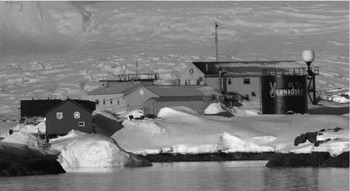
Enzenbacher (Reference Enzenbacher1994) asserts that the research station on Galindez Island, Argentine Islands Archipelago, is the oldest operational station in the Antarctic Peninsula region (Fig. 1). The station was transferred to Ukraine according to a bilateral agreement between the UK and Ukraine in 1995. Ukraine took over the full possession of the station on 6 February 1996, and the station was renamed after academician Volodymyr Vernadsky, the first president of Ukraine Academy of Sciences (1918), who developed the concept of biosphere and noosphere of the Earth. At present, Vernadsky Station is operated by the National Antarctic Scientific Centre (NASC). Although Ukraine still does not have any national operators that offer tourism options for the Antarctic region, Vernadsky Station increasingly receives tourist visits by other nationals.
General view of Vernadsky station (photo by A. Matveew, 13th UAE, 2008–2009, from the NASC's archive).

Lynch and others (Reference Lynch, Crosbie, Fagan and Naveen2010) found that tourist landings and marine traffic are highly concentrated at a few specific locations and that growth in tourism activity occurred disproportionally rapidly at these sites relative to growth in visitation of the peninsula as a whole. One of these specific locations is the Vernadsky station area. Popular destinations in this area can be categorised in terms of their recreational attractiveness as the following: (1) site of exceptional wilderness and aesthetic value (scenic landscape); (2) coastal site with wildlife diversity; (3) historic site of the ‘heroic age’; and (4) a working research station.
The most popular type of sea based Antarctic tourism is by cruise vessel. The following activities are common during such cruises: a small boat cruise (zodiacs) near the larger cruise vessels, kayaking, and scuba diving. The deep Penola Strait allows for cruise ship navigation in this area. Many small pebbled bays are indented in the island's coastline, with rocky outcrops along the shore. They are convenient for yacht anchorage. The dominant type of tourist activity on Argentine Islands is visiting Vernadsky Station and the neighbouring historic site Wordie House. It has historic importance as an example of an early British scientific research station.
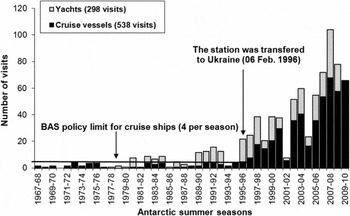
In the period when Faraday Station was operated by BAS, tour ship visits were strictly limited to four per season (Enzenbacher Reference Enzenbacher1994). The limitations were imposed to reduce potential threats to the Antarctic environment, threats to the station's science programmes (such as disruption of planned research activity and/or station work schedules); and to improve safety of those involved in supporting tourism activities.
Faraday station provided attractions to tourists since the 1967–1968 season and is one of the most visited sites by tourists annually (Enzenbacher Reference Enzenbacher1994). All Antarctic tours are seaborne, involving cruise ships carrying 30 to 300 passengers, depending on the ship and the tourist operator. There was remarkably little variation in the statistics of visits while the station was operated by the British. On the contrary, since 1995 a considerable increase in the number of both cruise ships and yacht visits has been observed. Fig. 2 represents the longest time series data on non-governmental activity at any scientific station in Antarctica from 1968 up to 2010.
Summary of cruise vessels and yacht visits to Faraday/Vernadsky Station (1967–2010). Sources: Enzenbacher (Reference Enzenbacher1994); IAATO tourism statistics; Vernadsky station commanders’ reports (1996–2010). The data from 1993–1994, 1994–1995, and 2009–2010 doe not include commercial yachts activity.

As the figure shows, visits to the station have not been restricted and limited since the station was transferred to Ukraine in 1996. Consequently, the new NASC tourism policy is favourable for non-government activity and promotes firsthand experience of the Ukrainian Antarctic programme and its progress. Moreover, the State Antarctic Research Programme for 2002–2010 contained a special objective to develop national tour routes along Antarctic Peninsula and around Vernadsky station with the purpose of popularisation. But, as practice proves, such proposal has not been developed by Ukrainian tour operators nor the wider public as yet. Hence, the current Antarctic Research Programme for 2011–2020 does not include such an objective. Instead, the Ukrainian Antarctic programme aims to work in partnership with the worldwide tourism industry to support scientific research activities. As NASC does not currently have its own research vessel, it seeks the support of IAATO companies to transport Ukrainian staff (a few persons per season) to and from Vernadsky station. Reduced rates or other forms of support are possible. This collaboration can be of mutual benefit, because while NASC partly solves its problems with transportation to the station and some supply operations, it also gives IAATO an opportunity to have an experienced lecturer on board tour vessels.
When time permits station visitors are offered a guided tour around the station, including visits to offices and science laboratories. Furthermore, tourists visit the Faraday bar, the southernmost public bar in the world, as well as having use of the post office facilities. From station commanders’ reports the largest number of stamps (7485) were sold in 2006–2007, when the total revenue was about U$ 2600.
For a long time there were no written guidelines managing interaction between Vernadsky station personnel and tourist operations. Consequently, the majority of tourist visits to the station were not subject to formal regulation, leaving the manner in which visits took place to be agreed between station personnel and expedition leaders from cruise vessels. In spite of the above mentioned positive effects of tourism in Antarctica, some restrictions for non-governmental visiting parties are inevitable. The winter personnel of each annual Ukrainian Antarctic Expedition (UAE) varies from 11 to 15 persons. So the non-restricted number of tourist visits to the station each season is currently high enough, and seasonal attendance of more then 5000 visitors is near the critical level. Any further increases in visitor numbers may cause considerable problems for station staff such as disturbance in work schedules, research and various logistical operations (Members of the 9th UAE, personal communication, 2003–2004).
Progress in tourism policy and recommendations for better visitor management
At the XXXIII Antarctic Treaty Consultative Meeting (Punta del Este, Uruguay, 2010) it was agreed to encourage parties to prepare policies relating to visitors at its stations, if they had not yet developed them. Such policies should have clearly stated the level of availability of infrastructure and personnel to cater for tourism activities. To this effect the NASC has developed procedures for visits to Vernadsky station. The NASC makes clear that for its part it does not consider the provision of facilities for tourism beyond humanitarian assistance and basic hospitality to be the proper purpose of a national Antarctic programme. Scientific research should be accorded priority in relation to all tourism activities in Antarctica in compliance with the Resolution 7 on the General Principles of Antarctic Tourism adopted by the XXXII Antarctic Treaty Consultative Meeting in Baltimore in 2009. Expedition leaders or the captain of the ship have to arrange with the station commander the date and time of the visit to the station, objectives and conditions of the visit, and the approximate number of visitors. The final decision is at the discretion of the base commander who is free to decline the request on the basis of unfavourable weather conditions or possible disruption of station activities.
As Galindez Island has a small surface area and is covered with the ice cap, it is impractical to establish a special tourist route to divert visitors away from the station buildings toward alternative attractions (as it was installed at Arctowski station). Therefore, there is no choice but to introduce the following limitations on tourist visits directly at the station:
only one ship is allowed to visit the station per day;
if granted access to the station, visitors are divided into small groups of up to 30 people;
station tours are approximately 30–45 minutes long for each group;
the total time limit spent for visit is 3 hours per day
During January-February, in the peak of tourist season, any visits at the station should be supervised by a NASC representative, whose responsibilities could include:
coordination of visits to the station to limit the impact on scientific research and station operations (for example) escorting tourists through the station ensuring codes of conduct are adhered to);
inspection, observation and environmental monitoring of tourist activities;
education of tourists about research conducted by the Ukrainian Antarctic programme;
improving visitation records (completion of a visit-form detailing each visit).
It is clear that the effective management and monitoring of tourist activities in Antarctica can only be achieved by comparing systematically collected data. Noting the convenience of obtaining consistent information that will facilitate analysis of the scope, frequency and intensity of tourist activities, the author proposes to establish more detailed methods of collecting visitor data. Besides the baseline data of tourist activity (the number of visitors, the name of the ship/yacht, the date of the visit, the arrival and departure time) it would be useful to collect demographic characteristics, description of tours operators and cruise ships, and more detailed explanation of tourist activity.
Currently, for those sites that are most heavily visited sufficient information has been obtained from different sources to characterise the sites and to identify their particular sensitivities. Such information has been used by the Antarctic Treaty parties for the development of a series of site specific guidelines to manage visitation. These site guidelines include a brief description of the site and the standard set of management measures such as zoning, a map with landing requirements as well as visitor code of conduct relevant to the local characteristics.
There are four sites in the Vernadsky area for which specific guidelines were already designated. For example, visitor guidelines for Wordie House prepared in 2008 in the framework of effective co-operation between NASC and BAS. The main quantitative restrictions are the following: landing is allowed for ships carrying 500 or fewer passengers; maximum 2 ships per day, of which no more than one can carry over 200 passengers; no more than 36 visitors ashore at any time, and no more than 12 visitors are allowed inside the base at one time.
Another three similar visitor site guidelines were developed for Petermann Island, Pleneau Island, and Booth Island in recent years. It is strictly important that these sites most routinely visited by tourists are close to Vernadsky research stations, which might be a good body of local permanent environmental monitoring. Another suitable place for such analyses is the Arctowski station on King George Island. The concentration of tourist activity in the vicinity of these stations, would suggest that any impact on the environment along the Antarctic Peninsula, would be more likely to be observed in these areas. Hence, the development of a long-term monitoring programme facilitated at these two stations would support future management decisions and provide opportunities for assessing a broader range of management options on a more regional rather than site-specific scale.
For example, geographic location, configuration and accessibility of nearby islands allowed the commencement of extensive research activities at representative sites that play a key role in regional ecosystem processes in the Antarctic Peninsula region. This necessitates the creation of a broad-scale and more comprehensive management system with regards not only to separate islands, regulated by site-specific guidelines, but the whole area being under the influence of Vernadsky station (Fedchuk Reference Fedchuk2009). For this reason a multiple-use management system within an Antarctic Specially Managed Area, ASMA, could supplement the areas with a special regime of protection and management. A possible ASMA might cover the Lemaire and Penola Straits including the most visited sites located on the neighbouring islands, which hold important seabird and mammal concentrations and fragile plant communities. The basic measures for environmental protection and minimizing cumulative impacts should be on-site visitor management (in view of the observed spatial trends in ship-borne tourism) as well as coordinated research activities at representative sites that play a key role in regional ecosystem processes.
Conclusions
Due to differences in tourism policies and regulations, operating Antarctic stations differ in terms of number and nature of tourist visits (Enzenbacher Reference Enzenbacher1994). Regulation of tourist visits at the stations is a combination of restrictions or limitations, as well as the establishment of a specific tourist trail to divert visitors from stations toward alternative attractions (a spatial approach). Acceptance of the on-site presence management authority by both tourists and tour operators provides the control required to ensure that such non-governmental activity can obtain the benefits of station visits without seriously compromising station operations and scientific research (Cessford Reference Cessford1997).
Faraday/Vernadsky station is the oldest operational station in the Antarctic Peninsula region and, in tourist terms, may be considered representative of other stations in the vicinity in that it has been regularly visited by seaborne tourists since 1968 (Enzenbacher Reference Enzenbacher1994). The increase in the number of visitors is due to the fact that the station has changed its government since 1996. In the period when Faraday station was operated by the BAS, the tour ship visits were strictly limited in order to reduce potential threats to the station's science programme and the Antarctic environment as well. However, visits to the station have not been restricted since the station was transferred to Ukraine in 1996. Such change in tourist policy, currently provided by the Ukrainian Antarctic programme, is dictated by both political and economical purposes. The first one concerns popularisation of Ukraine as a ‘new Antarctic state’ among the wider public. The second purpose is intended for transportation of staff to and from Vernadsky station on cruise ships. As a result, in the period 1995–2011, when the station was managed by Ukraine, both visits of cruise ships and yachts have increased considerably. In future the Ukrainian Antarctic programme will provide revised site-specific guidelines which may include more restrictions on access, numbers of visitors and time ashore in view of the observed high numbers of visitors and spatial trends in ship-borne tourism.
Further research using a comparative approach should analyse more case studies to identify the national policies and operational procedures at different stations in Antarctica applied by the both groups of Antarctic Treaty Consultative Parties (those that do support Antarctic tourism at its stations and those that do not) to examine regulation patterns and indicates policies for better visitor management at Vernadsky station. It is suggested that further consideration should include analysing the trends in visitor activity at Vernadsky station as one of the key visitor sites along Antarctic Peninsula, as well as sufficient on-site environmental monitoring and assessment to ensure the guidelines remain effective and relevant.
Since the study area is one of the most heavily visited in the Antarctic Peninsula region (Lynch and others Reference Lück, Maher and Stewart2010), further research should also provide data useful for detailed monitoring programmes and science-based grounds for designation of the whole Vernadsky area as a possible broad-scale ASMA. The basic measures are to regulate sea-borne tourism with specifying spatial and seasonal restrictions on tourist visits. This approach may lend itself for use as strategic tools to manage relatively large areas, on a more regional rather than site-specific scale, where National Antarctic programmes and commercial tourism activities coexist.