Decolonising education often departs from the problematic that (neo-)colonial practices are ‘endemic to society’ (Brayboy, Reference Brayboy2005, p. 429) and that Eurocentrism is the ‘consciousness in which all of us have been marinated’ (Battiste, Reference Battiste, Tripp and Muzzin2005, p. 124, emphasis added). However, it is only in recent years that there has also been work that acknowledges the way in which Western modern society is also occularcentric (i.e., privileging vision). For example, working at the intersection of the visual culture of schools and decolonising methodologies, Battiste, Bell, Findlay, Findlay, and Henderson (Reference Battiste, Bell, Findlay, Findlay and Henderson2005) state that a ‘Eurocentric curriculum is hidden in plain view’ as educational institutions are often ‘founded on a vision and visualization of education and culture that look to Europe as the center of all knowledge and civilization’ (p. 8). The importance of shifting the gaze from vision (i.e., goals) to visualisation (i.e., ways-of-seeing) cannot be understated, not only because visual literacy is increasingly becoming the dominant and most developed form of literacy (note: for those for whom sight is an ability and privilege), but also because of the ways in which who and what is seen, as well as how and where sight is regulated, reinforce dominant ways-of-knowing and ways-of-being while diminishing and denying the validity of others.
There are many ways in which Eurocentrism and visuality intersect to produce and make operational curriculums that are hidden in plain sight. Prevalent and deeply problematic examples of such are the often-deployed stereotypical representations of Indigenous peoples. Even a cursory reading of Indigenous education literature rapidly reveals the many ways in which Indigenous peoples face misrepresentations, missed representations, and over-representations (e.g., ‘the media have often been guilty of over-representing Indigenous perpetrators of crime while under-representing them as victims’ [Battiste et al., Reference Battiste, Bell, Findlay, Findlay and Henderson2005, p. 10]). By circulating societally in many different ways, these problematic representations (re)produced through the (ongoing) projection of white settler hopes and fears onto imaginaries respectively lead to the romanticising and pathologising of Indigenous peoples (see Francis, Reference Francis1992; Higgins, Madden, & Korteweg, Reference Higgins, Madden and Korteweg2013). Furthermore, such images have often been used, and continue to be used to ‘justify’ (neo-)colonial practices such as the appropriation and commodification of Indigenous knowledge (Battiste et al., Reference Battiste, Bell, Findlay, Findlay and Henderson2005; Castellano, Reference Castellano2004; Davis, Reference Davis2008; Smith, Reference Smith1999, Reference Smith, Denzin and Licoln2005).
In response to mis-, missed, and over-representations, ‘there is a growing commitment among [Indigenous] communities to constructively engage with issues by generating solutions that are local, Indigenous and self-determined’ (Jordan, Stocek, Mark, & Matches, Reference Jordan, Stocek, Mark and Matches2009, p. 74). One of the ways that Indigenous communities are ‘researching back’ (Smith, Reference Smith1999) is through self-representation via the production of countervisuals by adopting and adapting visual research methodologies such as photovoice, ‘a fairly simple technique that involves participants in taking photos of objects and people that represent particular elements of their everyday life’ (Allen & Hutchinson, Reference Allen and Hutchinson2009, p. 121). Given that ‘the visual is central to the cultural construction of social life in contemporary Western societies’ (Rose, Reference Rose and Rose2007, p. 2), and that photovoice is the most frequently used participatory visual research method (Prosser, Reference Prosser, Denzin and Lincoln2011), photovoice accordingly offers a significant and productive methodological location to work within and against occularcentric Eurocentrism.
While photovoice work is beginning to emerge in and with Indigenous communities, there are nonetheless an increasing amount of examples of work within a growing number of disciplinary spaces. Within health education, Jennings and Lowe (Reference Jennings and Lowe2013) worked with American Indian youth to photo-document healthy and unhealthy spaces within their community to address Indigenous/non-Indigenous health disparities as well as the cross-cultural disconnect in conceptions of health. Within social work, Krieg and Roberts (Reference Krieg, Roberts, Kindon, Pain and Kesby2007) amplified the voice of multiply marginalised First Nations women in the Canadian prairies who faced systemic and personal violence on a daily basis. Within anthropology, Truchon (Reference Truchon2007) employed photovoice with the youth from the Innu (First Nations) community of Uashat mak Mani-Utenam (in Northern Canada) to resist the all-too-frequent perception of Indigenous peoples as passive victims of colonial suffering by visually framing stories of strength, solidarity, and resilience.
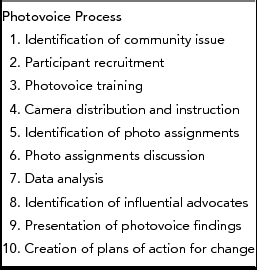
However, while photovoice can be an appropriate and productive methodology, Castleden and Garvin in their work with the Huu-ay-aht First Nation (Reference Castleden and Garvin2008) caution that adaptation is necessary as ‘the “classic” photovoice [is] similar to the academic trend of doing “parachute” research in Indigenous communities’ (p. 1401). This has to do with the notion that many ‘classic’ photovoice projects (see Table 1) are primarily by and for the researchers. In their large-scale study of community-based participatory projects that employ photovoice to enhance community change (n = 31 studies), Hergenrather, Rhodes, Cowen, Bardhosi, and Pula (Reference Hergenrather, Rhodes, Cowan, Bardhoshi and Pula2009) identified that the majority of projects they assessed had community concerns defined by the research team, data analysis performed by researchers (with occasional collaboration through member checking), as well as an absence of reporting upon policy changes. The defining of community concerns by researchers is especially significant as photovoice projects often centre deficit narratives rather than, or in addition to, much needed stories of survival and resilience (Truchon, Reference Truchon2007). Despite these possible pitfalls and problematics, there is nonetheless consensus from a growing group of scholars who see and put to work the potential of the visual for research with/in Indigenous communities who work within and against the using and abusing of participatory visual methodologies, and who recognise that such methodologies require the inflection of decolonial goals and other inter-connected objectives (e.g., working against neo-liberalism, anti-racism, addressing patriarchy; Battiste et al., Reference Battiste, Bell, Findlay, Findlay and Henderson2005; Castleden et al., Reference Castleden and Garvin2008; Higgins, Reference Higgins2014; Jordan et al., Reference Jordan, Stocek, Mark and Matches2009).
Photovoice Process
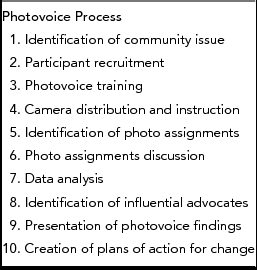
Note: Sourced from Hergenrather et al. (Reference Hergenrather, Rhodes, Cowan, Bardhoshi and Pula2009, p. 695). Reproduced with permission from PNG Publications.
However, theories, methods and ethics are never hermetically sealed from one another. Rather, they are always already reciprocally shaping one another within the in-between space we call methodology. This particular in-between space is all the more problematic and possibly productive when considering that it is located within the complicated and contested space that is the ‘cultural interface’ (Nakata, Reference Nakata2007a, Reference Nakata2007b) between Indigenous and Western knowledge systems, where hybridity is not always synonymous with balance. In order to reconfigure photovoice as a methodology for research with/in Indigenous contexts, this article is centered around the question: What does it mean to reconceptualise photovoice with, in, and for the cultural interface? More specifically, what would it mean to rebraid photovoice using corresponding bodies of theoretical literature that have been reconceived at the cultural interface? As such, this article will first discuss complexities and complications of this methodological rebraiding at the cultural interface, as well as the possibilities that it offers. As photovoice rests upon both praxis and standpoint theory, this will be followed by turning to the work of Indigenous scholars who consider the following theories within this contested space, with a particular focus on Torres Strait Islander scholar Martin Nakata's Indigenous standpoint (Reference Nakata2007a, Reference Nakata2007b) and Quechua scholar Sandy Grande's Red pedagogy (Reference Grande2004, Reference Grande, Denzin, Lincoln and Smith2008). Lastly, these insights will then be put into conversation with a key concept upon which photovoice rests (i.e., voice) in order to provide insight into how photovoice might be done differently with/in Indigenous contexts.
Methodological Métissage at the Cultural Interface: A Framework for Rebraiding
Problematics and Possibilities of Methodologies For and At the Cultural Interface
The relationship between Indigenous and Western knowledge systems is often one of ‘Jagged Worldviews Colliding’ (Little Bear, Reference Little Bear and Battiste2000), as it is a relationship that has often been, at its best, tenuous. The prevalent and problematic approach within many spaces is to attribute this troubling and troubled relationship to a decontextualised and ahistorical account of difference, and to conceive of these differences as dichotomous. However, as Dei (Reference Dei2000) reminds us: ‘Indigenous knowledges do not “sit in pristine fashion” outside of the effects of other knowledges’ (p. 111). Furthermore, Western knowledges are also not immune to the influence of Indigenous and other knowledge systems (Harding, Reference Harding2008; Little Bear, Reference Little Bear and Battiste2000). Even if it were a dichotomy, it is a dichotomy that is always already deconstructing and is in an ongoing cross-cultural becoming. Accordingly, for spaces that are always already at the cultural interface (e.g., Indigenous knowledge systems and knowledge practices within the academy), there is a need for a ‘different conceptualisation of the cross-cultural space, not as a clash of opposites and differences, but as a layered and very complex entanglement of concepts, theories and sets of meanings of a knowledge system’ (Nakata, Reference Nakata2006, p. 272). While there are increasingly points of resonance within this in-between space (Davis, Reference Davis2008), one should not be overly or only romantic about the possibilities. Furthermore, just as one should not blind to the ways in which these potentially productive hybrid spaces remain contested and complicated, it is also problematic to too easily write them off altogether. In other words, there continues to be a need to remain critical and complicit towards these possibilities as ‘not opening up theoretical positions for more complicated discussion means that the cultural interface is sutured over in favour of the Western order of things and its constitution of what an Indigenous opposition should be’ (Nakata, Reference Nakata2007b, pp. 10–11).
The cultural interface, as Nakata (Reference Nakata2007a, Reference Nakata2007b) defines it, comprises the particular nodes within discourse where competing and contesting knowledge systems are positioned with and against each other in ways that are shaped by various different discursive practices (e.g., theories, epistemic regulation, social imaginaries) that dynamically intersect with the materiality of place, space, and time. As Nakata (Reference Nakata2007a) explains, these always already shifting nodes:
inform, constrain or enable what can be seen or not seen, what can be brought to the surface or sutured over, what can be said or not said, heard or not heard, understood or misunderstood, what knowledge can be accepted, rejected, legitimized or marginalized, or what actions can be taken or not taken on both individual and collective levels. (p. 199)
Elsewhere, I have argued with respect to decolonising pedagogies (Higgins, Reference Higgins2014) that every attempt to work against colonisation is also within colonisation and inevitably reifies (neo)colonial constructs, concepts, or structures through the process. In the same way that it may be productive to consider decolonising pedagogies as de/colonising to explore the (neo)colonial complexities and complications that emerge through the practice of decolonising pedagogies (Higgins, Reference Higgins2014; see also Brayboy & Maughan, Reference Brayboy and Maughan2009; Madden & McGregor, Reference Madden and McGregor2013), it is also a productive site from which to consider research methodology. It has been argued that the cultural interface is an incredibly productive and apt concept for situating Indigenous learners within teaching methodologies (Nakata, Reference Nakata2007a, Reference Nakata2007b), as well as non-Indigenous learners engaging with Indigeneity (McGloin, Reference McGloin2009). Furthermore, I will argue that it is also a useful metaphor for considering similarly situated research methodologies because the suturing over at the cultural interface does not occur only on any particular (human) body, but also occurs upon many bodies of knowledge. As these include bodies of methodological knowledge, the complex and complicating ways in which this over-writing occurs need to be worked within and against.
Indigenous Métissage: An Example of Methodology at and for the Cultural Interface
A strong exemplar of methodological braiding at the cultural interface would be Papaschase Cree scholar Dwayne Donald's (Reference Donald2011) Indigenous Métissage. In short, Indigenous Métissage is a research methodology that works to complicate Indigenous–non-Indigenous relationships by braiding together complex and contradictory de/colonial narratives around place. While literary métissage works through the relational braiding of differing narratives without subsuming difference (e.g., Hasebe-Ludt, Chambers, Oberg, & Leggo, Reference Hasebe-Ludt, Chambers, Oberg, Leggo, Springgay, Irwin, Leggo and Gouzouasis2008), Indigenous Métissage is methodologically significant because it (re)situates literary métissage by inflecting upon it an acknowledgment of the diverse, complex, and contradictory ways in which diverse Indigenous (e.g., Aboriginal, diasporic) and non-Indigenous bodies (e.g., racialised and white settlers) are (self-) positioned within a white settler society around, with, and in an Indigenous conception of place. This centring of an Indigenous conception of place is not to be understated. Where literary métissage aims to account for and be accountable to cultural difference by situating narratives politically, constitutionally, geographically, and historically, Indigenous Métissage extends this by situating narratives within a natural-cultural ecology of relationships. As such, Indigenous Métissage works against the partial (post-) colonial placelessness that often surfaces when notions of complex and hybrid cultural identities are discussed (see also Grande, Reference Grande, Denzin, Lincoln and Smith2008), by acknowledging Indigenous ways-of-knowing-in-being as intrinsically connected to a natural-cultural ecology of relationships, as well as the importance and need for decolonial political claims to and for land. Overall, it is a narrative braiding that brings a decolonising sensibility to the ways in which such a braiding may problematically become a suturing over within and at the cultural interface.
Photovoice: A Brief Primer on a Methodology to be Rebraided
Photovoice (Wang & Burris, Reference Wang and Burris1994, Reference Wang and Burris1997) is a participatory, collaborative, and critical action research methodology through which ‘people can identify, represent, and enhance their community through specific photographic technique’ (Wang & Burris, Reference Wang and Burris1997, p. 369). Photovoice aims to enhance the agency that participants already exhibit by visually amplifying participants’ voices around personal and community concerns, experiences, and other matters important to them in order to promote critical dialogue, as well as reach policymakers (Wang, Reference Wang2006). As a methodology, it is often lauded for its potential to empower participants by paving paths for policy change, resisting stereotypical representations that currently frame them in society, and widening the space for other sorts of counter-narratives through ‘giving voice’ (Lutrell, Reference Lutrell2010; Wang, Reference Wang2000, Reference Wang2006; Wang & Burris, Reference Wang and Burris1994, Reference Wang and Burris1997). In a meta-analysis of a large body of literature on photovoice, Hergenrather et al. (Reference Hergenrather, Rhodes, Cowan, Bardhoshi and Pula2009), demonstrate that the process of photovoice (see Table 1) lends itself to the pursuit and realisation of a wide variety of community-determined goals (e.g., physical, mental, and emotional health, as well as community development). Furthermore, the research relationship that is framed by photovoice is potentially one that is reciprocally beneficial (i.e., to both participants and researchers; see Wang, Reference Wang2006), as well as one that can hold deep educational and pedagogical value for all parties involved (Cook & Buck, Reference Cook and Buck2010; Meyer & Kroger, Reference Meyer and Kroeger2005).
Theoretically, photovoice draws from bodies of work that strive towards democracy, empowerment, autonomy, and equity: praxis and feminist theory (Wang & Burris, Reference Wang and Burris1994). Furthermore, it also draws from the body of work on documentary photography, which recognises that a photographer's perspective may fail to recognise and represent the perspective of the photographed subject; hence, the participant-employed photography methods (Wang & Burris, Reference Wang and Burris1994, Reference Wang and Burris1997). However, there are multiple ethical considerations that must generally be attended to within photovoice-based research (e.g., ethics of visual representation, relations of power within collaboration and negotiation) (Allen & Hutchinson, Reference Allen and Hutchinson2009; Lutrell, Reference Lutrell2010; Papademas, Reference Papademas2004; Pauwels, Reference Pauwels2008). Furthermore, these ethical considerations are always further inflected by the contextual, ethical, and relational elements that frame each and every research project. As such, in considering contextualisation, it is important to remember that the goals themselves are not neutral but rather have their own situatedness (i.e., their theoretical underpinnings are praxis and feminist standpoint). The ways in which these goals are framed need to be (re)shaped with/in the situatedness of the research context in order to minimise the rate at which that which is being worked against is reproduced.
While there are multiple ways in which photovoice could be reconfigured for and at the cultural interface, the approach taken within this article is to use a differential conception of the critical theories from which photovoice stems. While photovoice has been reworked for work with/in Indigenous communities (Castleden et al., Reference Castleden and Garvin2008), this reworking is largely at the level of methods without a displacement of the problematic theoretical and ethical values that operate implicitly through traditional photovoice practices. As such, this article builds upon this earlier repurposing by drawing from different conceptions of the theories informing photovoice that account for the complexities that occur at the cultural interface (i.e., Grande's [Reference Grande2004, Reference Grande, Denzin, Lincoln and Smith2008] Red pedagogy and Nakata's [Reference Nakata2007a, Reference Nakata2007b] Indigenous standpoint) and to use these as new theoretical strands with which to rebraid photovoice as a methodology.
First Thread: Considerations for Feminist Standpoint Theory for and at the Cultural Interface
Within photovoice, feminist standpoint theory is utilised to frame participants’ perspectives as well as perspectivities. In short, ‘standpoint theories claim to represent the world from a particular socially situated perspective that can lay a claim to epistemic privilege or authority’ (Anderson, Reference Anderson2011, 2¶1). In other words, it is methodology built around the notion that those who are best situated to understand a community of knowers’ issues are those who experience them: the members of that community (Harding Reference Harding and Harding2004, Reference Harding2009; Pohlhaus, Reference Pohlhaus2002). While feminist standpoint theory has traditionally been conceived as a stance that works within and against patriarchy, it is a body of ongoing and ever-expanding work to productively draw upon when considering various forms of systemic and lived daily oppression.
Nakata's Indigenous Standpoint Theory
Drawing from and building upon feminist scholars’ work on standpoint theory, Torres Strait Islander scholar Martin Nakata developed a model of inquiry more specific to the local, historical, and current experiences in sites of (neo)colonisation that Indigenous people face on a day-to-day basis: an Indigenous standpoint theory (Nakata, Reference Nakata2007a, Nakata, Reference Nakata2007b). Nakata (Reference Nakata2007a) defines Indigenous standpoint theory as:
a method of inquiry, a process for making more intelligible ‘the corpus of objectified knowledge about us’ as it emerges and organises understanding of our lived realities. [It is] theorising knowledge from a particular and interested position — not to produce the ‘truth’ of the Indigenous position but to better reveal the workings of knowledge and how understanding of Indigenous people is caught up and implicated in its work. (p. 215)
Here, ‘people's lived experience at the cultural interface is the point of entry for investigation, not the case under investigation’ (Nakata, Reference Nakata2007b, p. 12). This model begins its investigation from how Indigenous students, scholars and researchers negotiate the everyday and ongoing complexities at the cultural interface: the intricate and contradictory space where Western and Indigenous thought intersect and overlap. However, as a form of inquiry into the nature of Indigenous knowledges and experiences at the interface, Indigenous standpoint theory does not simply take experience as ready-made knowledge, but rather engages with the questions that can be asked from these experiences. Nakata suggests that an Indigenous standpoint is not a position that one already has, but rather something that must be produced through critical reflexivity on both the self (via experience) and the self-in-relation (via structural and social relations). It is through the labour of critically reflecting upon and within day-to-day experiences at the cultural interface through both personal and structural lenses that an Indigenous standpoint is forged. In order to guide the endeavour that is the production of an Indigenous standpoint, Nakata (Reference Nakata2007a, Reference Nakata2007b) offers three principles he considers useful for understanding, investigating and developing this position.
Considerations for Cultivating an Indigenous Standpoint at the Cultural Interface
The first principle is that the cultural interface is a contested knowledge space. As the social and epistemological positions of Indigenous peoples are shaped by and within a contested and intersectional knowledge space, we can ask which knowledges are permitted and which are prohibited. Furthermore, we can also ask what can be known from the ways in which this space is (self-)disciplined.
The second principle offered is that agency is framed by the cultural interface. Indigenous peoples are ‘constantly being asked to be both continuous with one position at the same time as being discontinuous with another’ (Nakata, Reference Nakata2007a, p. 216), to align with either an Indigenous or non-Indigenous position or identity. While this position may limit agency, it also provides a platform to investigate the self-in-relation to others and structures with regards to how knowledge is constructed. Through gaining insight into how relationships are framed, how one might be positioned as a result of such framing, what positions can be taken, and how those positions could be defended, agency can be cultivated.
The third principle offered is that the tensions at the cultural interface are embodied experiences. In addition to the social and structural relationships that shape the cultural interface, the everyday tensions and ambiguities generated at the cultural interface are lived and embodied experiences that result from the strain between positions that are often dichotomised. From this, we can ask how the everyday experiences at the cultural interface shape and limit the range and diversity of perspectives of Indigenous peoples.
Second Thread: Considerations for Praxis at and for the Cultural Interface
Within photovoice, Freire's praxis frames notions that people need to be active agents in both the processes of understanding and changing their communities, and that mutual experiences, collective reflection, and action are effective means of doing so. In short, praxis can be defined as the act of linking critical theory and practice. Expanding upon this definition, Freire (1970/Reference Freire2000) initially defined praxis as critical theory linked to political action in the real world. He elaborates upon this by stating that ‘world and action are intimately interdependent. But action is human only when it is not merely an occupation but also a preoccupation, that is, when it is not dichotomized from reflection’ (Freire, 1970/Reference Freire2000, p. 53). While understandings of praxis have since differentially proliferated, here it is useful to consider the critical action that is linked to the interfaced space between Western critical theory and Indigenous philosophy (i.e., an Indigenous praxis).
Grande's Red Pedagogy: An Indigenous Praxis
Of particular note is Grande's (Reference Grande2004, Reference Grande, Denzin, Lincoln and Smith2008) Red Pedagogy, which begins with recognition of the many ways that (Western) critical theories do not always overlap with Indigenous philosophies. Rather than framing the former (i.e., Western critical theory) as strictly deficient, Grande sets out to productively explore the tensions between the two bodies of knowledge, as no one iteration of praxis can account for all contexts (see also Lee, Reference Lee2006). These generative tensions provide a ‘space of engagement’. They are the ‘liminal and intellectual borderlands where [I]ndigenous and non-[I]ndigneous scholars encounter one another, working to remember, redefine, and reverse the devastation of the original colonialist “encounter”’ (Grande, Reference Grande, Denzin, Lincoln and Smith2008, p. 234). By placing the core assumptions and constructs of praxis under a critical Indigenous gaze, Grande comes to the conclusion that if the traditional (neo-)Marxist project of addressing Empire does not also include a co-occurring analysis of colonialism, research risks reproducing and upholding power structures that negatively impact Indigenous peoples through the (re)production of colonial structures (see also Evans, Hole, Berg, Hutchinson, & Sookraj, Reference Evans, Hole, Berg, Hutchinson and Sookraj2009; Smith, Reference Smith, Denzin and Licoln2005; Jordan, Reference Jordan2003). As the expansive body of praxis literature has not undergone the necessary recontextualisation required to make it readily appropriate for, and transferable to Indigenous contexts, Grande (Reference Grande, Denzin, Lincoln and Smith2008) asks the following three thought-provoking questions in order to reconfigure praxis: (1) ‘[Does praxis] articulate constructions of subjectivity that can theorize the multiple and intersecting layers of [I]ndigenous identity as well as root them in the historical material realities of indigenous life?’ (p. 238); (2) ‘[Does praxis] articulate a geopolitical landscape any more receptive to the notion of [I]ndigenous sovereignty than other critical pedagogies rooted in liberal conceptions of democracy?’ (p. 242); and (3) ‘[Does praxis] articulate a view of land and natural resources that is less anthropocentric than other Western discourses?’ (p. 245). As the first question is discussed earlier, the latter two will be quickly developed below.
Critical Questions for Practising Indigenous Praxis at the Cultural Interface
While praxis aims to empower those involved, if the way in which empowerment is framed within the research differs greatly from participants’ personal and communal conceptions of what becoming agents could or should entail, the research runs the risk of disempowering more than empowering (Jordan et al., Reference Jordan, Stocek, Mark and Matches2009). The notions found within praxis of (neo)liberal and egalitarian democracy often undermine Indigenous claims to sovereignty by failing to critically problematise both its own discourses around freedom and autonomy, as well as those centred around land and place when applied into Indigenous contexts. With respect to freedom and autonomy, there is divergence between a Western notion of the free and autonomous individual that undergirds praxis and ecology of relationships that is central to Indigeneity (Cajete, Reference Cajete1994). In response, conceptions of Indigenous praxis depart from more standard individualistic approaches to praxis by ‘inspiring [participants] to commit to their communities, rather than promote the democratic goals of individual freedom and liberation’ (Lee, Reference Lee2006, p. 8), while simultaneously working towards communal autonomy. Indigenous praxis is defined as an act that builds, enhances and fosters healthy relationships whether they are within the community or beyond (Evans et al., Reference Evans, Hole, Berg, Hutchinson and Sookraj2009; Grande, Reference Grande2004, Reference Grande, Denzin, Lincoln and Smith2008; Lee, Reference Lee2006). However, these complex and contradictory claims between Indigenous and Western accounts make praxis a difficult practice at the cultural interface:
It is axiomatic that [praxis] done well should lead to the empowerment of individuals and communities.. . . At the same time . . . community empowerment often involves complex and contradictory processes . . . [which] may empower certain individuals and disempower others. Community empowerment may also come at the expense of some individual empowerment. (Evans et al., Reference Evans, Hole, Berg, Hutchinson and Sookraj2009, p. 903)
With respect to land and place, Western constructions of democracy are tied to issues of property while Indigenous sovereignty is tied to issues of land and place. Within these latter constructions, theories of democracy are often practised through the ‘equal’ distribution of (still) colonised and occupied lands. This does not equate with justice for Indigenous communities (Grande, Reference Grande, Denzin, Lincoln and Smith2008; Smith, Reference Smith, Denzin and Licoln2005). Furthermore, there is need to shift from an anthropocentric view of land (e.g., nature exists for humans to exploit) towards one in which humans are responsible for, nurtured by, and thus intimately connected to land (Cajete, Reference Cajete1994). Thus, an Indigenous praxis that considers the cultural interface works towards a conception of land rather as a place of belonging with which Indigenous peoples have had a longstanding and reciprocal relationship, by working within and against colonial conceptions of land as proprietary and non-agentic.
Discussion: Rebraiding Photovoice For and At the Cultural Interface
In order to productively employ the threads of Indigenous standpoint and praxis, the discussion below will focus on braiding them around a concept that is central to photovoice: voice. As such, it is worth noting that the following process of rebraiding might create entirely different strands depending on which concepts (e.g., empowerment, agency, transformation) and which conceptual practices might be reconceptualised through such a rebraiding. What is offered within this article is but one possibility.
It is worth noting that the purpose here is not to offer a critique of the theoretical tenets upon which photovoice rests and the practices that (re)produce them through practice (i.e., individualistic and anthropocentric empowerment and agency, as articulated by theories of praxis and feminist standpoint theory). These tenets already fail to respond to critiques from current Western canonical conceptions of standpoint and praxis. Rather, the goal is to explore what it might mean to keep methodology fluid and on the move to be better positioned to respond to the complexities that occur with/in and at the cultural interface, rather than engaging with the process of replacing one method with another.
Rethinking (Photo)voice With Indigenous Praxis
As photovoice's primary conceptual practice through which it attempts to operationalise the (self-)empowerement of research participants is that of ‘giving voice’, it is a rich conceptual location to engage in thinking with Indigenous praxis. As stated earlier, conventional concepts of praxis rely on autonomous, stable, unified, and rational individuals, and a similarly positioned and postulated voice that emerges from such individuals. However, an Indigenous praxis that considers complications at the cultural interface might work towards articulating a conception of voice that is both individualistic as well as communal or collective in its nature. Furthermore, in centring issues and possibilities of land and place, it is important to include other-than-humans (e.g., plants, rivers, mountains) within the conception and consideration of which bodies are included within the collective.
One of the ways in which this can be worked towards is through the inclusion of more voices. For example, Castleden and Garvin in their work with the Huu-ay-aht First Nation (Reference Castleden and Garvin2008) to address past, present, and future community ‘needs for cedar, a sacred resource’ (p. 1396), adapted photovoice methods by including ‘a feedback loop, seeking input from the entire community at regular intervals throughout the project’ (Castleden et al., Reference Castleden and Garvin2008, p. 1401). While a step in the right direction, I would argue that in some ways this continues to rely upon singular, anthropocentric, and individualistic conceptions of voice and fails or makes it impossible to include other-than-human bodies within those who are heard. Within such a theoretical, other-than-human bodies are not considered agents from whom a voice emerges, and certainly not a voice that could be considered stable, coherent, or rational. Thus, rather than considering multiple singular voices through a metaphysics of individualism, I am suggesting considering the multiplicity within the singularity of a voice that is considered through a relational framework, so that it is both that of an individual and of a collective that includes more than only humans (e.g., what would it have meant for this photovoice project to have been framed as one that is speaking with rather than about cedar?).
Here, it is useful to consider McCall's (Reference McCall2011) First Person Plural, in which she develops a conception of voice as relational. Developed largely around early Indigenous story-based literature, where non-Indigenous researchers would collect stories from Elders, translate them and collect them within volumes, McCall makes the argument that even if these researchers left little trace of themselves or the research process, the voice within these texts nonetheless emerged from within that particular relationship. This style of writing inevitably rendered, and continues to render, Indigenous storytellers as decontextualised, ahistorical, and transpersonal (i.e., pan-Indigenous) for potential readers. If we utilise a bidirectional communication metaphor (i.e., interchangeable transmitter and a receiver; e.g., a walkie-talkie) to think about the way in which the stories were collected (i.e., rather than treat the story as a faithful and reliable transmission), the story that is produced is not only in what is told to the researcher, but also in what is said back, what is unsaid, as well as how the researcher understands and retells it, failures in translation, understanding, and so on. McCall here refers to this type of voice as a potential and unorthodox form of collaboration:
Collaboration cannot be thought of as a process in which interlocutors successfully overcome or transcend the impediments to their ‘free’ speech. In every communicative act there is a gap between teller and listener, between writer and reader, between signifier and signified. However, this gap can be a creative space in which new forms of agency and voice may arise. (p. 212)
If voice can be thought of as always already emerging with/in and through relationships, such that locution considered in this way stems from a first person plural, what might this mean for photovoice with Indigenous praxis in mind? While there is little room for sentient landscapes and the other-than-human beings that live there within conventional conceptions of photovoice, when voice is considered relational, there is space to consider these other bodies within the voice that emerges. However, while relational accounts of voice are always already placed, if the goal of such a photovoice project is to reach policymakers around issues of land and sovereignty, it is worth intensifying such a relationship to make the link more tangible and apparent. One particular strategy that can be employed is to tell stories with/in and at important but contested place-sites that have complicated and contested histories (Donald, Reference Donald2011). Framing the photographic documentation process are questions and cues such as ‘if this place-site could tell a story, what would it be?’, not to speak for the place-site but rather to speak with it. Furthermore, the telling of stories with rather than about place and the other-than-human bodies within it is an important facet of Indigenous ways-of-knowing that could and should be utilised to frame the voices that arise through such projects.
Rethinking (Photo)voice With Indigenous Standpoint Theory
Given that voice is always articulated from a particular standpoint, and that those who are situated within particular systems of oppression have an epistemic privilege in the articulation of these experiences, voice is an ideal location to methodologically inflect Indigenous standpoint upon photovoice. When considering the conceptual practice of ‘giving voice,’ it is worth recalling that a voice stemming from a standpoint is not a readymade stance but rather a position that is forged within a community of knowers. Furthermore, how and if this voice is heard is also a labour as ‘the movement from silence to speaking is a complex process that does not guarantee a “hearing”’ (McCall Reference McCall2011, p. 28) nor a desirable ‘hearing’. If we continue to work from a consideration that voice is a communicative act in which there is transmitter and a receiver, it becomes important and productive to understand general trends in which texts or images of Indigeneity are read and consumed, even if it is an impossibility to control or constrain meaning-making practices. If we consider the ways in which Indigenous peoples are often prohibited from occupying the in-between space that is the cultural interface by being asked to align with either an Indigenous or a Western position while falling out of line with the other, it is fair to state that Indigenous peoples are also read in such a hermetically sealed manner. Thus, if photovoice is a representational strategy in and of itself, how might these representations be done differently to disrupt and displace the polarising positioning that Indigenous peoples face when read while still utilising participant-generated photographs?
Photovoice-based projects often utilise an analytical framework and dissemination model in which individual or singular photographs are read and presented for the singular ‘voice’ that is articulated. Even if meaning is not readymade, such a singularised approach to (photo)voice runs the risk of the meaning-making process subsuming possible complexities into simpler, polarised, and hermetic categories of Indigenous or Western (Nakata, Reference Nakata2007a, Reference Nakata2007b). Such a polarisation is further complicated by the ways in which dominant understandings of Indigeneity are reflected within an imaginary conception of Indigenous peoples as pan-Indigenous, occupying a temporality that is already past, and of peoples to be either romanticised or pathologised (Francis, Reference Francis1992; Higgins et al., Reference Higgins, Madden and Korteweg2013). While it is deeply productive to disrupt and displace the dominant understanding of Indigenous peoples by replacing one image with one that troubles it (e.g., Truchon, Reference Truchon2007), singular or singularising representations still run the risk of perpetuating epistemic violence through the ongoing (re)positioning of Indigenous peoples within these three distinct poles to create positions that could not and would not be inhabited (e.g., Higgins et al., Reference Higgins, Madden and Korteweg2013).
In order to resist the problematic ways in which the contradictions and complexities of the cultural interface get subsumed and silenced (e.g., Indigenous/non-Indigenous categorisation), it becomes productive to think about modes of analysis and dissemination that employ photographic juxtaposition. Similar to textual practices that require readers to make meaning in-between textual images as a strategy to work against problematic closures of meaning in Indigenous education (e.g., Indigenous Métissage [Donald, Reference Donald2011], poetic transcription [Madden, Higgins, & Korteweg, Reference Madden, Higgins and Korteweg2013]), photographic juxtaposition can work to keep meaning on the move (i.e., not sedimenting within problematic poles). This representational strategy in which at least two distinctly different visual texts are meaningfully juxtaposed and presented as one complex (photo)voice ‘creates space for multiple meanings, the different and embodied ways-of-knowing that readers might bring with them, and a reflective/reflexive stage upon which the voices are placed’ (Madden et al., Reference Madden, Higgins and Korteweg2013, p. 222). While such juxtaposition does not guarantee that meaning will not be foreclosed, as well as always already sutured over by problematic colonial concepts, the necessity of an active reader produces the possibility of reflective/reflexive engagement. This non-negligible engagement within the meaning making can help viewers become more cognisant of the ways in which they are always already implicated within the production of epistemic violence through polarisation.
Conclusion
Within a Eurocentric society that privileges visuality, there is a need to disperse and displace problematic visions and visualisations of education that continue to (re)centre the West as a knowledge and knowledge-able singularity. Resistance here need not take the form of refusal of visuality as this would be akin to turning a blind eye. Rather, it is productive to work within and against methodologies that centre ways-of-seeing the world in order to disrupt occularcentric Eurocentrism. Within this article, this dislocation is done with the most propagated and popular participatory visual research method: photovoice.
The argument herein is that methodology is (re)produced with/in the interconnected space in-between methods, theories, and ethics. As such, a simple repurposing of methods is not sufficient for such a desired dispersal, because the whole (e.g., theory, ethics) is in the part (i.e., methods). Building upon earlier work that repurposes the methods of photovoice, this article reconsiders photovoice with/in Indigenous contexts as a methodology situated at the cultural interface. At this particular interface, photovoice's Western theoretical roots (i.e., praxis and feminist standpoint theory) enter a complex dialogical relationship with Indigenous ways-of-knowing that requires critical and complicit engagement. In this article, this is achieved by considering the work of Indigenous theorists whose work differentially conceives of the two theories that inform photovoice (i.e., praxis and feminist standpoint theory -> Indigenous praxis and Indigenous standpoint theory). By inflecting these differential considerations onto a key concept operationalised through photovoice (i.e., voice), two reconfigured methodological practices were produced.
Through the first pairing, a reconfigured notion of (photo)voice via Indigenous conceptions of praxis invites us to consider voice not only as individualistic and only possible through human agency, but also stemming from a place-based community that includes humans, other-than-humans, and more-than-humans. Furthermore, it is an invitation to consider (photo)voice not as a singular (photo)voice speaking about an ecology of relationships, but rather one speaking with it that enfolds it within: the part (i.e., the photovoice) is a first person plural that is a differential production of the whole (i.e., the human, other-than-human, and more-than human relations with/in which this voice emerged).
The second pairing, which employed Indigenous standpoint theory, asks us to continue considering the ways in which Indigenous (photo)voices are read at the cultural interface by also critically and complicity including readers within the community of knowers from which voice emerges. At this particular cultural interface there is always the risk of (re)producing the colonial suturing over of meaning in problematic and polarising manners (e.g., when reading an image that is already overwritten by and with the double(d) problematic stereotype of Indigenous peoples as bodies to romanticise and/or demonise). To resist this foreclosure of meaning, it is suggested herein to utilise representational juxtaposition as both an analytical and a dissemination practice. This juxtaposition works against the epistemic violence that occurs and is made possible by reading practices that do not interrupt, and potentially make readers cognisant of the ways in which too simple readings are already sutured over by colonial imaginaries.
Together, these practices can be thought of as an incitement to work towards photovoice projects that work towards relational Indigenous ways-of-knowing-in-being while simultaneously working against Eurocentric segmentation and categorisation. However, these considerations for photovoice emerge through but one particular configuration of this methodology at the cultural interface. It is worth noting that there are many other possible possibilities that can productively disrupt, displace, and disperse the occularcentrism of Eurocentrism by working within and against it. As such, this is not an injunction to engage in these particular participatory photography methods, but rather an invitation to partake in the differential production of methodology at the cultural interface, as this work is never fully over.
About the Author
Marc Higgins is a doctoral candidate within the Centre for Cross-Faculty Inquiry at the University of British Columbia who works the methodological space within and between Indigenous, post-structural, and post-humanist theories in order to think and practise education and educational research differently around and with contested ways-of-knowing (i.e., epistemology) and ways-of-being (i.e., ontology).