Introduction
Investigating the antecedents of adult socioeconomic position (SEP) is the core of status attainment research. The best known examples are based on British or US populations (Deary et al., Reference Deary, Taylor, Hart, Wilson, Davey Smith, Blane and Starr2005); studies from other countries have been reviewed by Breen & Jonsson (Reference Breen and Jonsson2005).
Mostly, the measure of status attainment has been occupational class (Bond & Saunders, Reference Bond and Saunders1999; Judge et al., Reference Judge, Higgins, Thoresen and Barrick1999; Wang et al., Reference Wang, Kick, Fraser and Burns1999; Breen & Goldthorpe, Reference Breen and Goldthorpe1999, Reference Breen and Goldthorpe2001, Reference Breen and Goldthorpe2002; Saunders, Reference Saunders2002; Thienpont & Verleye, Reference Thienpont and Verleye2003; Nettle, Reference Nettle2003; Breen & Jonsson, Reference Breen and Jonsson2005; Deary et al., Reference Deary, Taylor, Hart, Wilson, Davey Smith, Blane and Starr2005) or educational attainment (Heath et al., Reference Heath, Berg, Eaves, Solaas, Corey, Sundet, Magnus and Nance1985; Tambs et al., Reference Tambs, Sundet, Magnus and Berg1989; Hernstein & Murray, Reference Hernstein and Murray1994; Lindbekk, Reference Lindbekk1998; Wang et al., Reference Wang, Kick, Fraser and Burns1999; Marks & McMillan, Reference Marks and McMillan2003; Thienpont & Verleye, Reference Thienpont and Verleye2003; Breen & Jonsson, Reference Breen and Jonsson2005; Deary et al., Reference Deary, Taylor, Hart, Wilson, Davey Smith, Blane and Starr2005; Nielsen, Reference Nielsen2006). Income level has also been applied (Judge et al., Reference Judge, Higgins, Thoresen and Barrick1999; Bowles & Gintis, Reference Bowles and Gintis2002).
The research questions have been somewhat different. Several studies have focused on intergenerational social mobility (Mascie-Taylor & Gibson, Reference Mascie-Taylor and Gibson1978; Lindbekk, Reference Lindbekk1998; Breen & Goldthorp, Reference Breen and Goldthorpe1999, Reference Breen and Goldthorpe2001; Bowles & Gintis, Reference Bowles and Gintis2002; Nettle, Reference Nettle2003; Thienpont & Verleye, Reference Thienpont and Verleye2003; Aakvik et al., Reference Aakvik, Salvanes and Vaage2005; Black et al., Reference Black, Devereux and Salvanes2005; Breen & Jonsson, Reference Breen and Jonsson2005; Deary et al., Reference Deary, Taylor, Hart, Wilson, Davey Smith, Blane and Starr2005). Contributions of parental and individual factors to status attainment have been covered in several British studies (Bond & Saunders, Reference Bond and Saunders1999; Breen & Goldthorpe, Reference Breen and Goldthorpe1999, Reference Breen and Goldthorpe2001, Reference Breen and Goldthorpe2002; Saunders, Reference Saunders2002; Nettle, Reference Nettle2003; Richards & Sacker, Reference Richards and Sacker2003; Deary et al., Reference Deary, Taylor, Hart, Wilson, Davey Smith, Blane and Starr2005). Relations between intelligence and personality factors and subsequent adult status have been investigated in some US studies (Hernstein & Murray, 1999; Judge et al., Reference Judge, Higgins, Thoresen and Barrick1999; Wang et al., Reference Wang, Kick, Fraser and Burns1999). Also the role of heritability in status attainment processes has been studied (Heath et al., Reference Heath, Berg, Eaves, Solaas, Corey, Sundet, Magnus and Nance1985; Tambs et al., Reference Tambs, Sundet, Magnus and Berg1989; Nielsen, Reference Nielsen2006). The relative importance of ascription (class of origin) and personal merits (ability, effort) was intensely debated some years ago (Bond & Saunders, Reference Bond and Saunders1999; Breen & Goldthorpe, Reference Breen and Goldthorpe1999, Reference Breen and Goldthorpe2001, Reference Breen and Goldthorpe2002; Saunders, Reference Saunders2002). However, the distinction between ‘ascription’ and ‘merit’ is not straightforward because SEP of origin and personal ability share some genetic and other causes (Deary et al., Reference Deary, Taylor, Hart, Wilson, Davey Smith, Blane and Starr2005; Nielsen, Reference Nielsen2006).
Status attainment has been an issue in research on social inequalities in health, mainly by considering the impact of social mobility on health inequalities (West, Reference West1991; Blane et al., Reference Blane, Davey Smith and Bartley1993; Bond & Saunders, Reference Bond and Saunders1999; Deary et al., Reference Deary, Taylor, Hart, Wilson, Davey Smith, Blane and Starr2005). One major advancement in social inequality research since the Black Report (Townsend & Davidson, Reference Ben-Shlomo and Kuh1982) is the concept of life course influences – how biological and social factors operating at different stages of life contribute to inequalities in adult health (Ben-Shlomo & Kuh, Reference Ben-Shlomo and Kuh2002; Kuh et al., Reference Kuh, Ben-Shlomo, Lynch, Hallqvist and Power2003; Kuh & Ben-Shlomo, Reference Kuh and Ben-Shlomo2004; Power & Kuh, Reference Power, Kuh, Siegrist and Marmot2006). The life course concept has led to renewed interest in status attainment processes (Mackenbach, Reference Mackenbach2005; Bosma, Reference Bosma, Siegrist and Marmot2006). There has been a specific focus on indirect selection, which is a mechanism involving early factors that have a potential to affect social inequalities in health because they are simultaneously involved in status attainment processes and in disease involvement (West, Reference West1991; Blane et al., Reference Blane, Davey Smith and Bartley1993).
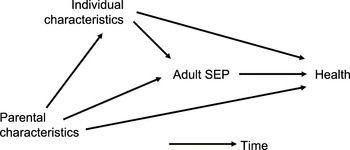
Several causal models that elucidate the effects of life course exposures on adult health have been developed by Kuh et al. (Reference Kuh, Ben-Shlomo, Lynch, Hallqvist and Power2003). Figure 1 illustrates some of the possible pathways between early factors, adult SEP and subsequent health outcomes. The arrows in the diagram indicate asymmetry between the elements: parental characteristics (e.g. social class of origin) could influence health by mediation via early individual characteristics (e.g. cognitive ability) or adult SEP, or via other paths. Early individual characteristics could in a similar way act upon health through adult SEP or other paths.
A causal model showing potential relations between parental and early individual characteristics, adult socioeconomic position (SEP) and subsequent health.

The trajectories in Fig. 1 could be used to estimate status attainment processes, and thereby provide information of value in investigating the impact of early factors on social gradients in health. Given such early factors have adverse effects on both SEP and health, the contribution of adult SEP in explaining disease risk, i.e. social causation, could be overestimated (Bosma, Reference Bosma, Siegrist and Marmot2006). Mackenbach (Reference Mackenbach2005) has requested a research agenda that would include ‘studies of the determinants of intergenerational social mobility that try to disentangle the influence of individual characteristics and that of the family and wider social environment’.
In a register-based cohort comprising all live-born subjects in Norway 1967–1976, data include repeated measures of social and biological circumstances recorded prospectively throughout life (Kristensen et al., Reference Kristensen, Bjerkedal and Irgens2007). This provides an opportunity to study the influence of early factors on status attainment by following up men born in 1967–1971. The study was restricted to men because conscript data that were not available for women were included. The main objective was to estimate the relative importance of parental and individual characteristics on status attainment, where educational attainment at age 28 years served as an indicator of adult status. The particular aim of the study was to assess the relative contribution of SEP of origin and general ability. Status attainment studies have mostly emphasized parental SEP and own ability, and the aim here was to investigate the impact of other parental and early individual characteristics.
Methods
Participants
The study population included all 170,678 male live births registered in the Medical Birth Registry of Norway, 1967–1971. The national identification numbers of child and parents allowed linkage with national registers: the Central Population Register; the Education Register of Statistics Norway; the Armed Forces Personnel Data Base; and the benefit and income registers of the National Insurance Administration. Men included in the analyses (index persons) numbered 160,914 residents with education data and who were alive at the end of the calendar year of their 28th birthday. A total of 5.7% (3.5% deaths, 1.7% emigrations, 0.5% with missing education data) were excluded.
All mothers were identified in the birth records, but the identity of the father was missing in the birth record for 7261 (4.5%) of the index persons.
Ethical approval of the study was given by the Regional Committee for Medical Research Ethics (Ref. No. S-06028).
Variables
Linkages provided data for the index persons and their parents. Some data were longitudinal and updated annually, e.g. death, emigration, education, pension and income.
The study outcome was educational level at age 28 years, which was used as an indicator of status attainment. Outcome data were derived from the National Education Registry in Statistics Norway, which is based upon annual educational codes from records of individual educational institutions. The first digit of the six-digit code has nine categories, providing the education level. Educational attainment was defined as total years of education in the calendar year of the 28th birthday. Years of education (between 0 and 20) were allocated to education level categories, according to the Norwegian standard NUS2000 (Statistics Norway, 2003).
Three background factors, eleven parental characteristics and eight early individual characteristics were considered. The background factors considered were year of birth (five categories), birth order (five categories) and type of municipality at index age 16 years (seven categories).
Register data for parents were based on mother's and father's identity as indicated in the birth record. An exception to this was parental education level data, which were retrieved from the index person's record in the Education Register. Accordingly, index persons with missing data on paternal education level were considerably fewer (2717; 1.7%) than those missing father's identity in the birth record. Maternal and paternal education levels at index person age 16 years were collapsed into five ordered categories. Parental education level, defined as the sum of educational years, was used as a continuous variable in some analyses. Maternal and paternal income levels at index age 16 years were divided into four ordered categories or as continuous variables. Maternal marital status was categorized according to her status at index person birth and age 18 years: married or unmarried on both occasions, divorced on either occasion, or other. Maternal age at index birth was included in five ordered categories. Mother's total number of children through 1998 was recorded. Mother and father were classified as disabled or dead if occurring before the index person was aged 18 years.
Individual characteristics included birth weight, chronic childhood disease and Armed Forces variables. Birth weight in singletons was separated into four categories based on z-scores, and multiple births were allocated a separate category. Childhood disease was defined as receiving basic or attendance insurance benefit from chronic disease before age 17 years. The Armed Forces Personnel Data Base provided conscript and military duty data. Men drafted for compulsory military service, usually at age 18 years, are obliged to complete several conscript examinations, including a test of general ability. This test is highly correlated with the Wechsler Adult Intelligence Scale and is recorded as stanine scores, i.e. single digits from 1 (low) to 9 (high). Scores are normally distributed with mean 5 and SD 2 in the general population (Sundet et al., Reference Sundet, Barlaug and Torjussen2004). Mental and physical functions were assessed by the conscription board physician and classified into ordered categories. Body mass index (BMI) and body height were also included in ordered categories. Military duty was classified as completed, drafted but not completed, and not drafted.
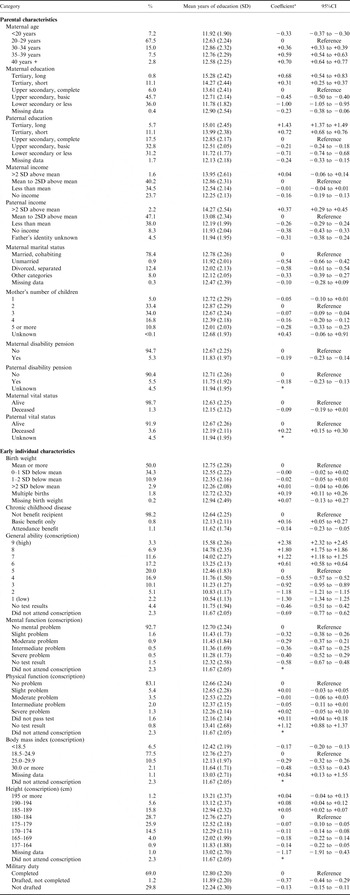
Details on categorizations of independent variables are provided in Table 1.
Status attainment among 160,914 men born in Norway in 1967–1971: mean years of education at age 28 in association with parental and early individual characteristics in OLS regression

a Effect estimates for parental characteristics adjusted for background factors (year of birth, birth order, municipal category) and other parental characteristics; estimates for individual characteristics adjusted for background factors, parental characteristics and other individual characteristics.
* Estimate dropped due to collinearity.
Statistical analysis
STATA/SE 10.1 software was used for analysis. Mean years of education were computed, and associations with independent variables estimated in OLS regression models. According to the causal diagram in Fig. 1, parental characteristics were not adjusted for individual characteristics whereas individual characteristics were adjusted for parental characteristics. Both parental and individual characteristics were adjusted for background factors. The regression models provided explained variances and adjusted effects (coefficients) for the study factors.
Variance estimates of the regression coefficients were corrected for dependencies between brothers by using the cluster option in STATA with the mother's identity as cluster variable. Ninety-five per cent confidence intervals (CI) were computed for all associations. Throughout, missing values were included in the regression models as separate categories.
Educational attainment was also analysed in path models (http://www.ats.ucla.edu/stat/Stata/faq/pathreg.htm), where relationships between the most influential variables were assessed. To obtain fully adjusted effect estimates, the path analysis included all variables considered in the linear regression models.
Results
The grand mean years of education was 12.62 (SD 2.24). Table 1 shows means and adjusted differences in educational years in association with categories of parental and individual characteristics. The strongest association was found for general ability where the adjusted difference between the highest and lowest scorers ranged 3.68 years. Differences between the highest and lowest categories were also strong for paternal and maternal education (2.14, respectively 1.68 years). Maternal age was also quite strongly associated with educational years with an adjusted mean difference of 1.03 years between teenage mothers and mothers aged 40 years or more. More moderate associations (coefficient differences ranging between 0.50 and 0.75) were found for paternal income, maternal marital status and BMI at conscription. Other variables were only weakly associated with education in the adjusted models. Associations for the ordered variables showed a dose-dependent relationship, with some exceptions. The highest educational attainment was found for normal weight (BMI 18.5–24.9). Small positive educational attainment effects were found for groups with deceased fathers, multiple births and men who had received basic benefit in childhood. Men classified as having mental problems at conscription had less education than men with no such problem, but no dose-dependent relationship was evident.
The explained variance of the full model was 0.387. Explained variance was reduced to 0.248 after removing general ability from the model, and to 0.146 after additional removal of parental education. Removing parental income in addition to general ability and parental education yielded an explained variance of 0.109. The other characteristics had only marginal influence on explained variance.
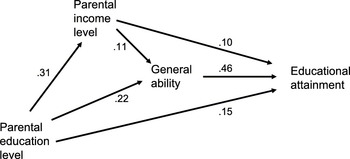
Path analysis was restricted to 142,229 men with complete information on general ability, parental education and parental income (Fig. 2). The combined direct and indirect effect of parental education was 0.30 (0.15+0.22×0.46+0.31×0.11×0.46+ 0.31×0.10), that of parental income was 0.15 (0.10+0.11×0.46) whereas the total effect of general ability was 0.46. Thus, the relative impact of general ability was 50.4% whereas parental education and income contributed 33.2% and 16.4%, respectively.
Path model for educational attainment dependent on parental education level, parental income level and general ability, among 142,229 men born in Norway in 1967–1971.

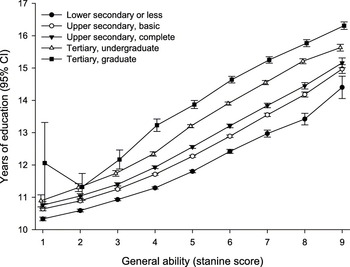
The combined effects of parental education level and general ability are shown in Fig. 3 for 147,103 men with data on both predictors. Both factors had a strong influence on own educational attainment. Except for the extreme low scores of general ability, educational increments in associations with general ability increases seemed to be independent of parental education level. One SD increase in general ability score (1.83 units) was associated with a 1.25 year increase (95%CI 1.24–1.26) in educational attainment, whereas a 1 SD (3.95 years) increase in parental education was associated with an estimated education increment of 0.97 years (95%CI 0.96–0.98). However, the effect size of parental education was dependent on general ability score: a 1 SD increase was associated with an increment in own education of 0.45 years (95%CI 0.42–0.48) for persons with a general ability score <4; the corresponding increase was 0.86 years (95%CI 0.85–0.87) for those with ability scores >3.
Mean years of education at age 28 years across levels of parental education level and own general ability score among 147,103 men born in Norway in 1967–1971.

Discussion
In this large population, comprising all male Norwegian residents born in 1967–1971, explained variances in the regression models and the path model results suggest that status attainment in the study population was dominated by general ability, parental education level and parental income level, in that order. Other parental or individual characteristics had only marginal influence.
One issue in status attainment studies that has a special relevance for research on social inequalities in health has been to disentangle the relative importance of SEP of origin and intellectual performance. Several publications based on the National Child Development Study (NCDS; the British 1958 birth cohort) are particularly interesting (Bond & Saunders, Reference Bond and Saunders1999; Breen & Goldthorpe, Reference Breen and Goldthorpe1999, Reference Breen and Goldthorpe2001, Reference Breen and Goldthorpe2002; Saunders, Reference Saunders2002; Nettle, Reference Nettle2003; Thienpont & Verleye, Reference Thienpont and Verleye2003). Based on the same data, Saunders (Reference Saunders2002) claimed that Britain is a meritocratic society governed by personal merits whereas Breen & Goldthorpe (Reference Breen and Goldthorpe1999, Reference Breen and Goldthorpe2001, Reference Breen and Goldthorpe2002) insisted that adult status was determined by class of origin. Other NCDS investigators found a more balanced contribution from ability (childhood IQ) and parental SEP (Nettle, Reference Nettle2003; Thienpont & Verleye, Reference Thienpont and Verleye2003).
Educational attainment was strongly associated with both general ability and parental education level in the present study. This result is not in agreement with the conclusions of Saunders (Reference Saunders2002) or Breen & Goldthorpe (Reference Breen and Goldthorpe1999). However, it is not far from Thienpont & Verleye's (Reference Thienpont and Verleye2003) conclusions: the structural path model (Fig. 3) in their study shows coefficients of 0.70 and 0.49 for IQ at age 11 and parental education level, respectively. In the British 1946 birth cohort (Richards & Sacker, Reference Richards and Sacker2003) the path diagram (Fig. 1a) shows approximately equal influence from childhood cognition (0.45) and father's occupation (0.42) on own educational attainment.
Saunders (Reference Saunders2002) found a comparative status attainment advantage for less talented persons with well educated parents in the NCDS. This is not in agreement with other analyses of NCDS data, which indicate that class mobility in adulthood associated with intelligence test scores in childhood was uniform across all social classes (Nettle, Reference Nettle2003). Results of the present study suggest that the low general ability scorers had less benefit than higher scorers from having educated parents, which is opposite to Saunders' findings.
Several determinants other than general ability, parental education and parental income were included in the analyses. Adjusted regression results showed modest negative effects of teenage motherhood, maternal divorce, unmarried mothers, mental problems and obesity at conscription, and disrupted military duty. Other adjusted effects of parental and early individual characteristics on status attainment were marginal.
Validity issues
The study was based on linkage between national registers, containing data gathered prospectively from birth onwards. Linkage is considered to be complete with nationwide coverage. These strengths make selection bias an unlikely problem, and lack of power is considered to be a minor problem.
Education level at young adult age was used as an indicator of status attainment. The preferred measure of status attainment has been occupational class (Bond & Saunders, Reference Bond and Saunders1999; Judge et al., Reference Judge, Higgins, Thoresen and Barrick1999; Wang et al., Reference Wang, Kick, Fraser and Burns1999; Breen & Goldthorpe, Reference Breen and Goldthorpe1999, Reference Breen and Goldthorpe2001, Reference Breen and Goldthorpe2002; Saunders, Reference Saunders2002; Nettle, Reference Nettle2003; Thienpont & Verleye, Reference Thienpont and Verleye2003; Breen & Jonsson, Reference Breen and Jonsson2005; Deary et al., Reference Deary, Taylor, Hart, Wilson, Davey Smith, Blane and Starr2005). However, educational attainment has also been applied in several studies (Heath et al., Reference Heath, Berg, Eaves, Solaas, Corey, Sundet, Magnus and Nance1985; Tambs et al., Reference Tambs, Sundet, Magnus and Berg1989; Hernstein & Murray, Reference Hernstein and Murray1994; Lindbekk, Reference Lindbekk1998; Wang et al., Reference Wang, Kick, Fraser and Burns1999; Thienpont & Verleye, Reference Thienpont and Verleye2003; Breen & Jonsson, Reference Breen and Jonsson2005; Deary et al., Reference Deary, Taylor, Hart, Wilson, Davey Smith, Blane and Starr2005; Nielsen, Reference Nielsen2006). Educational attainment has some advantages over occupational class in having a naturally ordered scaling and a value that is often fixed at early adult age (Kaufman, Reference Kaufman, Rothman, Greenland and Lash2008). A problem in using education level is that there have been strong population trends over time, making comparisons in populations of mixed ages difficult. The mean annual increase in education was only 0.06 years in the study population, so it is less likely that such time trends would have much influence on the results. Another element that should be considered when applying education as an indicator of status attainment is that education in Norway is often adapted for children with special needs. Table 1 and Fig. 3 show clearly that the relationship between general ability and educational attainment is not linear; the curve has a slight J pattern. This is likely to be due to the use of specially adapted courses classified as basic upper secondary (11 years) for mentally retarded children in Norway (Bjerkedal & Kristensen, Reference Bjerkedal and Kristensen2007).
There are limitations with a potential for information bias or confounding that may be more apparent. These limitations are related to specifications of the analytical model, lack of quality in study variables, and lack of information on important variables.
Status attainment processes and social inequalities in health are influenced by complex social and biological processes over time (Mackenbach, Reference Mackenbach2005; Nielsen, Reference Nielsen2006). Model specifications and causal models are complex, but evidently much cruder than the truth (Baron & Kenny, Reference Baron and Kenny1986; De Stavola et al., Reference De Stavola, Nitsch, dos Santos Silva, McCormack, Hardy, Mann, Cole, Morton and Leon2006; Nielsen, Reference Nielsen2006). It is not always self-evident which way the arrow points in causal modelling. In this study, it was assumed that SEP of origin was an antecedent of general ability in status attainment processes (Fig. 1). This was also the assumption of Richards & Sacker (Reference Richards and Sacker2003). Contrary to this, Deary et al. (Reference Deary, Taylor, Hart, Wilson, Davey Smith, Blane and Starr2005) assumed no asymmetry between class of origin and IQ.
Data in national registers are crude and often collected for purposes other than research. Data quality problems with proxy variables can influence inferences. Data were recorded prospectively in different independent registers in the present study, and the resulting errors would in general be non-differential and produce biases towards the null.
Data error is a problem that has been much discussed in status attainment research (Deary et al., Reference Deary, Taylor, Hart, Wilson, Davey Smith, Blane and Starr2005; Nielsen, Reference Nielsen2006). The assumption that class of origin and intellectual performance can be interpreted as measures of ascription and merit, respectively, are apparently not correct: ability does not necessarily express merit only, but could reflect social privilege, and social class of origin could partly reflect merit, and inferences could be misleading (Deary et al., Reference Deary, Taylor, Hart, Wilson, Davey Smith, Blane and Starr2005; Nielsen, Reference Nielsen2006).
An obvious shortcoming in this study is lack of important variables. Lack of data on individual or family function in childhood is important. One variable likely to be important in this setting is parental intellectual level (Mascie-Taylor & Gibson, Reference Mascie-Taylor and Gibson1978). Other examples are data on school qualifications and behaviour, or indicators of own effort or parental aspiration and interest, all being used in status attainment studies (Saunders, Reference Saunders2002). Other personality characteristics have also proved valuable in status attainment and social inequality studies, e.g. conscientiousness, neuroticism, coping ability and sense of control (Hernstein & Murray, Reference Hernstein and Murray1994; Judge et al., Reference Judge, Higgins, Thoresen and Barrick1999; Bosma, Reference Bosma, Siegrist and Marmot2006).
Inferences
Education level was mainly associated with general ability and parental education, suggesting that contemporary status attainment among Norwegian men is a process involving both elements of origin and the individual. This balance could be the result of relative priorities in national education and social policies. Several educational reforms intending to increase the education level as well as increase the equality of opportunity have been implemented during the last decades in Norway (Aakvik et al., Reference Aakvik, Salvanes and Vaage2005). Policy differences between European countries have been found, classifying regimes according to Esping-Andersen's model as liberal, conservative or social-democratic (Hega & Hokenmaier, Reference Hega and Hokenmaier2002; Xu, Reference Xu2008). Liberal regimes, e.g. Britain, offer priority to education policies that support the individual, conservative regimes support social rather than educational policies whereas social democratic regimes, e.g. Norway, are placed in between (Hega & Hokenmaier, Reference Hega and Hokenmaier2002). Socioeconomic differences in educational attainment between Western industrialized countries in the PISA (Programme for International Student Assessment) study also support the interpretation that strong national education policies are associated with more equal opportunities, rendering family structure less important (Xu, Reference Xu2008).
Acknowledgments
Assistance from Ola Thune at the National Insurance Administration and Geir Skjeret at the Norwegian Armed Forces Medical Services in file preparations is appreciated. This study was funded by the Research Council of Norway (Grant No. 161321/V50). Conflicts of interest: none declared.